The Vermont legislature has voted to create the state's first renewable energy standards for electric utilities. The bill, H.40, changes the way Vermont encourages the generation and use of renewably derived electricity.
Like most states, Vermont law has encouraged renewable energy development for over a decade. In 2005 the state legislature created the Sustainably Priced Energy Enterprise Development, or SPEED, program to promote
renewable energy development. Under SPEED, the state encouraged its 18 utilities to enter into
long-term contracts for power from renewable energy sources, with a goal that utilities source 20% of their supply from qualifying SPEED resources
by 2017. The SPEED program's goal has been to promote the development of in-state
energy sources which use renewable fuels to ensure
that to the greatest extent possible the economic benefits of these new
energy sources flow to the Vermont economy in general and to the rate
paying citizens of the state in particular.
But between recent controversy over possible "double counting" of renewable energy attributes produced and sold by Vermont utilities, and perennial interest in refining state energy policy, this year the Vermont legislature pursued H.40 as an attempt to fix Vermont's renewable energy programs. H.40 will replace the SPEED goals with a Renewable Energy Standard and Energy
Transformation, or RESET, program. The RESET program includes a renewable portfolio standard requiring that 55 percent
of a utility’s electricity come from renewables, including large-scale
hydro power, by 2017, increasing 4 percentage points every three years until reaching 75% by 2032.
The bill also gives utilities an entrance into financing thermal
efficiency for heating and cooling. It will require utilities to offer incentives and on-bill financing for
projects like weatherization and heat pumps. To monitor and protect against impacts to customer rates, H.40 requires annual reports starting in 2018 on the RESET program's impact on electric rates, including 10-year forward projections.
It also allows utilities to seek waivers if they can show that compliance would
increase electric rates.
Previous efforts to institute a mandatory renewable energy standard in Vermont were not successful, but this year versions of H.40 have now been approved by both chambers of the state legislature. The Vermont House of Representatives passed H.40 on March 10, and the Senate approved an amended version on May 15.

Energy powers society; society's choices shape energy policy. A blog about our energy resources and the choices they present for society.
Showing posts with label renewable portfolio standard. Show all posts
Showing posts with label renewable portfolio standard. Show all posts

Report on Maine renewable portfolio standard in 2013
Wednesday, May 6, 2015
The Maine Public Utilities Commission has issued a report on Maine's use of renewable electricity in 2013. The report shows the impact of Maine's renewable portfolio standard, a state law requiring electricity suppliers to source specified percentages of their electricity from “new” renewable resources.
Since 2000, Maine law has required electricity suppliers to include renewable energy in their portfolio of supply sources. Maine’s original electric industry restructuring legislation included a 30% eligible resource portfolio requirement. The eligible resource portfolio requirement, now referred to as Class II, mandated that each retail competitive electricity supplier meet at least 30% of its retail load in Maine from “eligible resources.” Eligible resources are defined in statute as either renewable resources or efficient resources. Renewable resources are defined in statute as fuel cells, tidal power, solar arrays, wind power, geothermal installations, hydroelectric generators, biomass generators, and municipal solid waste facilities. Renewable resources may not exceed a production capacity of 100 megawatts. “Efficient” resources are cogeneration facilities that were constructed prior to 1997, meet a statutory efficient standard and may be fueled by fossil fuels.
During its 2007 session, the Maine Legislature enacted an Act to Stimulate Demand for Renewable Energy. This Act established a new "Class I" standard, requiring Maine electricity suppliers to source specified percentages of their electricity from “new” renewable resources. Generally, new renewable resources are renewable facilities that have an in-service date, resumed operation or were refurbished after September 1, 2005. The Act set the initial renewable percentage requirement at 1% in 2008, increasing in annual one percentage point increments to 10% in 2017. Pursuant to the Act, the renewable requirement will remain at 10% thereafter, unless the Commission suspends the requirement.
The Commission's March 31, 2015 report, Annual Report on New Renewable Resource Portfolio Requirement, reports on renewable portfolio standard compliance activity in calendar year 2013. This lag between the study period and the report's issuance is driven by the timing of the most recently filed Competitive Electricity Provider (CEP) annual compliance reports, which were filed in July 2014 for calendar year 2013. In 2013, the Act required suppliers to source 5% of their power from new renewable resources. Suppliers can comply either by acquiring sufficient renewable energy certificates or RECs to cover their compliance obligation, or by paying an "alternative compliance payment".
According to the report, in 2013 suppliers purchased 727,291 Class I RECs from 21 certified generating facilities to meet the portfolio requirement. Nearly 97% of these RECs came from biomass facilities located in Maine. According to the report, 17 of the 21 facilities are biomass, three are hydro, and one is a wind facility. 18 of the 21 facilities are located in Maine, one is located in Connecticut, one is located in Massachusetts and one is located in Vermont.
The Commission's report also documents the cost of compliance in 2013. During 2013, the cost of RECs used for compliance with the Class I requirement ranged from approximately $1.50 per MWh to $60 per MWh, with an average cost of $19. 8 7 per MWh and a total cost of $14, 292,438. As noted in the report, the cost of Maine Class I RECs has dropped substantially since 2013, with the report citing a current trading range of $3.00 to $5.00. With minor use of the alternative compliance mechanism by two suppliers, the total cost to ratepayers during 2013 was $14,296,249, which the Commission's report translates into an average rate impact of about 0.12 cents per kWh (about 60 to 65 cents monthly for a typical residential bill, or a residential customer bill impact of about 1%).
The report also documents the 2013 costs of RECs used to satisfy the "Class II" eligible resource portfolio requirement as ranging from $0.00 per MWh (some RECs were included as part of an energy transaction at no specified extra cost) to $1.00 per MWh, with an average cost of $0.16 per MWh and a total cost of $589,386. This translates into less than three cents per month on a typical residential bill.
Since 2000, Maine law has required electricity suppliers to include renewable energy in their portfolio of supply sources. Maine’s original electric industry restructuring legislation included a 30% eligible resource portfolio requirement. The eligible resource portfolio requirement, now referred to as Class II, mandated that each retail competitive electricity supplier meet at least 30% of its retail load in Maine from “eligible resources.” Eligible resources are defined in statute as either renewable resources or efficient resources. Renewable resources are defined in statute as fuel cells, tidal power, solar arrays, wind power, geothermal installations, hydroelectric generators, biomass generators, and municipal solid waste facilities. Renewable resources may not exceed a production capacity of 100 megawatts. “Efficient” resources are cogeneration facilities that were constructed prior to 1997, meet a statutory efficient standard and may be fueled by fossil fuels.
During its 2007 session, the Maine Legislature enacted an Act to Stimulate Demand for Renewable Energy. This Act established a new "Class I" standard, requiring Maine electricity suppliers to source specified percentages of their electricity from “new” renewable resources. Generally, new renewable resources are renewable facilities that have an in-service date, resumed operation or were refurbished after September 1, 2005. The Act set the initial renewable percentage requirement at 1% in 2008, increasing in annual one percentage point increments to 10% in 2017. Pursuant to the Act, the renewable requirement will remain at 10% thereafter, unless the Commission suspends the requirement.
The Commission's March 31, 2015 report, Annual Report on New Renewable Resource Portfolio Requirement, reports on renewable portfolio standard compliance activity in calendar year 2013. This lag between the study period and the report's issuance is driven by the timing of the most recently filed Competitive Electricity Provider (CEP) annual compliance reports, which were filed in July 2014 for calendar year 2013. In 2013, the Act required suppliers to source 5% of their power from new renewable resources. Suppliers can comply either by acquiring sufficient renewable energy certificates or RECs to cover their compliance obligation, or by paying an "alternative compliance payment".
According to the report, in 2013 suppliers purchased 727,291 Class I RECs from 21 certified generating facilities to meet the portfolio requirement. Nearly 97% of these RECs came from biomass facilities located in Maine. According to the report, 17 of the 21 facilities are biomass, three are hydro, and one is a wind facility. 18 of the 21 facilities are located in Maine, one is located in Connecticut, one is located in Massachusetts and one is located in Vermont.
The Commission's report also documents the cost of compliance in 2013. During 2013, the cost of RECs used for compliance with the Class I requirement ranged from approximately $1.50 per MWh to $60 per MWh, with an average cost of $19. 8 7 per MWh and a total cost of $14, 292,438. As noted in the report, the cost of Maine Class I RECs has dropped substantially since 2013, with the report citing a current trading range of $3.00 to $5.00. With minor use of the alternative compliance mechanism by two suppliers, the total cost to ratepayers during 2013 was $14,296,249, which the Commission's report translates into an average rate impact of about 0.12 cents per kWh (about 60 to 65 cents monthly for a typical residential bill, or a residential customer bill impact of about 1%).
The report also documents the 2013 costs of RECs used to satisfy the "Class II" eligible resource portfolio requirement as ranging from $0.00 per MWh (some RECs were included as part of an energy transaction at no specified extra cost) to $1.00 per MWh, with an average cost of $0.16 per MWh and a total cost of $589,386. This translates into less than three cents per month on a typical residential bill.
Controversy over renewable energy claims
Thursday, March 5, 2015
If an electric utility generates power from renewable resources and sells renewable energy certificates representing the renewable attributes of that energy, can it still call the underlying power "renewable"? No, according to the U.S. Federal Trade Commission.
While this question may seem metaphysical, it arises from the structure of most U.S. renewable energy markets. Most states have adopted renewable portfolio standards, which require utilities and competitive electricity suppliers to source some of their power from renewable resources. In most cases, utilities and suppliers can satisfy this requirement by using renewable energy certificates or credits known as RECs. While each state's program differs, these RECs typically represent the renewable attributes of electric energy -- the right to claim that energy is renewable -- but are distinct from that underlying energy. As a result, a renewable generator can sell RECs to one buyer and the underlying energy to another.
Vermont utility Green Mountain Power Corporation recently found itself at the center of controversy over its claims regarding renewable energy. The utility owns and is involved with a variety of renewable energy generation projects in Vermont, including wind and solar projects. It sells energy produced from these projects to Vermont customers, while simultaneously selling some of the RECs generated by these sources to out of state utilities.
In 2014, concerns over "double counting" of renewable energy attributes led Connecticut to ban the use of RECs from renewable generation that also is counted toward another state’s renewable goals for meeting Connecticut's requirements, and REC marketer NextEra Energy to notify New England market participants that it would no longer buy Vermont RECs.
On September 15, 2014, a group of petitioners asked the Federal Trade Commission to investigate Vermont utility Green Mountain Power Corporation's claims that it is providing its customers with electricity from renewable sources such as commercial wind and solar projects, given its separate sale of the RECs to out of state utilities. The Federal Trade Commission regulates claims about the environmental impacts of commerce under Section 5 of the Federal Trade Commission Act, including claims regarding the production, sale, and use of renewable energy. In their complaint, the petitioners claimed that "Vermont customers are being misled into thinking that they are buying 'renewable energy,' when in fact what they are getting is 'null' electricity consisting of a mix of fossil fuel, nuclear, gas and other 'brown' sources of electricity from the regional grid."
The FTC responded to this petition in February 2015 by issuing a letter to Green Mountain Power's counsel expressing concern that the utility might have created confusion for its customers about the renewable attributes of the power they purchased by not “clearly and consistently communicating” that it sells RECs for most of its renewable energy-generating facilities to entities outside Vermont. In the letter, the FTC said that it had not found that any Green Mountain Power statements violated the Federal Trade Commission Act. However, the Commission urged Green Mountain Power in the future to prevent any confusion by clearly communicating the implications of its REC sales for Vermont customers and REC purchasers.
The FTC letter represents the latest salvo in efforts to regulate claims regarding the production, sale, and use of renewable energy. To help marketers avoid making deceptive environmental claims, for over 20 years the FTC has issued "Green Guides" providing its administrative interpretation of the law. The Green Guides outline general principles that apply to all environmental marketing claims and provide guidance regarding many specific environmental benefit claims, including renewable energy claims. The Green Guides, as well as the recent FTC letter, illustrate the importance of caution in making claims about renewable energy in business activities.
 |
| Solar panels in the Utah desert. |
While this question may seem metaphysical, it arises from the structure of most U.S. renewable energy markets. Most states have adopted renewable portfolio standards, which require utilities and competitive electricity suppliers to source some of their power from renewable resources. In most cases, utilities and suppliers can satisfy this requirement by using renewable energy certificates or credits known as RECs. While each state's program differs, these RECs typically represent the renewable attributes of electric energy -- the right to claim that energy is renewable -- but are distinct from that underlying energy. As a result, a renewable generator can sell RECs to one buyer and the underlying energy to another.
Vermont utility Green Mountain Power Corporation recently found itself at the center of controversy over its claims regarding renewable energy. The utility owns and is involved with a variety of renewable energy generation projects in Vermont, including wind and solar projects. It sells energy produced from these projects to Vermont customers, while simultaneously selling some of the RECs generated by these sources to out of state utilities.
In 2014, concerns over "double counting" of renewable energy attributes led Connecticut to ban the use of RECs from renewable generation that also is counted toward another state’s renewable goals for meeting Connecticut's requirements, and REC marketer NextEra Energy to notify New England market participants that it would no longer buy Vermont RECs.
On September 15, 2014, a group of petitioners asked the Federal Trade Commission to investigate Vermont utility Green Mountain Power Corporation's claims that it is providing its customers with electricity from renewable sources such as commercial wind and solar projects, given its separate sale of the RECs to out of state utilities. The Federal Trade Commission regulates claims about the environmental impacts of commerce under Section 5 of the Federal Trade Commission Act, including claims regarding the production, sale, and use of renewable energy. In their complaint, the petitioners claimed that "Vermont customers are being misled into thinking that they are buying 'renewable energy,' when in fact what they are getting is 'null' electricity consisting of a mix of fossil fuel, nuclear, gas and other 'brown' sources of electricity from the regional grid."
The FTC responded to this petition in February 2015 by issuing a letter to Green Mountain Power's counsel expressing concern that the utility might have created confusion for its customers about the renewable attributes of the power they purchased by not “clearly and consistently communicating” that it sells RECs for most of its renewable energy-generating facilities to entities outside Vermont. In the letter, the FTC said that it had not found that any Green Mountain Power statements violated the Federal Trade Commission Act. However, the Commission urged Green Mountain Power in the future to prevent any confusion by clearly communicating the implications of its REC sales for Vermont customers and REC purchasers.
The FTC letter represents the latest salvo in efforts to regulate claims regarding the production, sale, and use of renewable energy. To help marketers avoid making deceptive environmental claims, for over 20 years the FTC has issued "Green Guides" providing its administrative interpretation of the law. The Green Guides outline general principles that apply to all environmental marketing claims and provide guidance regarding many specific environmental benefit claims, including renewable energy claims. The Green Guides, as well as the recent FTC letter, illustrate the importance of caution in making claims about renewable energy in business activities.
Value of distributed solar energy
Thursday, October 30, 2014
What is the value of distributed solar photovoltaic electric generation? An investigation by the Maine Public Utilities Commission into this question is ongoing, and will culminate in a report to the state legislature this winter. At stake are policies and incentives to foster the growth of solar energy in Maine.
Distributed solar generation -- such as solar panels on rooftops and ground-mounted solar arrays -- is a small but rapidly growing sector of the U.S. energy mix. Solar panels can produce renewable electricity, with no direct fuel use, emissions, or reliance on foreign energy sources. Customer-sited and other distributed generation resources can also enhance the reliability of the local electric grid, and reduce the need for more expensive transmission and distribution upgrades. The growing shift to solar energy is also seen as a driver of jobs and economic development.
In recognition of these benefits, states and the federal government have enacted a variety of policies and incentives for solar power development and use. These policies include renewable portfolio standards which mandate that utilities source certain amounts of their power from renewable resources, as well as net metering policies which allow a customer to offset its power bill with energy produced from on-site solar panels.
But what is the true value of distributed solar energy resources? In an effort to find out, in 2014 the Maine Legislature enacted An Act To Support Solar Energy Development in Maine. This law is also known as the Maine Solar Energy Act, P.L 2013 Chapter 562 (codified at 34-B M.R.S. §§ 3471-3473). The law expresses the legislative finding that Maine's solar energy resources "constitute a valuable indigenous and renewable energy resource." Moreover, the law is predicated on the findings that solar energy development is unique in its benefits to and impacts on the climate and the natural environment, and that it can help Maine because it can displace fossil fuel combustion and associated air pollution and greenhouse gas emissions. The Act set a state policy "to encourage the attraction of appropriately sited development related to solar energy generation, including any additional transmission, distribution and other energy infrastructure needed to transport additional solar energy to market, consistent with all state environmental standards; the permitting and financing of solar energy projects; appropriate utility rate structures; and the siting, permitting, financing and construction of solar energy research and manufacturing facilities for the benefit of all ratepayers."
With these findings noted, the Act directed the Maine Public Utilities Commission to construct a report by February 15, 2015 on the value of distributed solar energy generation in Maine. In so doing, the Act requires the Commission to develop a method for valuing distributed solar energy generation. By statute, this method must, at a minimum, account for:
The Commission's investigation is ongoing. On October 23, 2014, the Commission released a draft of its consultants' initial report, "Maine Distributed Solar Valuation Methodology." That document is designed as a draft of the methodology to be used in the valuation phase, offered for public review and comment.
The Commission will accept written comments on the draft report until November 12, 2014. In addition, the Commission and its consultant, Clean Power Research, will hold a work session on the Draft Methodology on October 30, 2014.
Following the first phase to establish the valuation methodology, the Commission and its consultants will conduct a second phase in which the methodology will be applied to Maine to calculate the value of distributed solar generation. The Commission's work will be summarized in its report to the legislative energy committee, a draft of which the Commission plans to release in January 2015.
Distributed solar generation -- such as solar panels on rooftops and ground-mounted solar arrays -- is a small but rapidly growing sector of the U.S. energy mix. Solar panels can produce renewable electricity, with no direct fuel use, emissions, or reliance on foreign energy sources. Customer-sited and other distributed generation resources can also enhance the reliability of the local electric grid, and reduce the need for more expensive transmission and distribution upgrades. The growing shift to solar energy is also seen as a driver of jobs and economic development.
 |
| Rooftop solar photovoltaic panels on a business in Patten, Maine. |
But what is the true value of distributed solar energy resources? In an effort to find out, in 2014 the Maine Legislature enacted An Act To Support Solar Energy Development in Maine. This law is also known as the Maine Solar Energy Act, P.L 2013 Chapter 562 (codified at 34-B M.R.S. §§ 3471-3473). The law expresses the legislative finding that Maine's solar energy resources "constitute a valuable indigenous and renewable energy resource." Moreover, the law is predicated on the findings that solar energy development is unique in its benefits to and impacts on the climate and the natural environment, and that it can help Maine because it can displace fossil fuel combustion and associated air pollution and greenhouse gas emissions. The Act set a state policy "to encourage the attraction of appropriately sited development related to solar energy generation, including any additional transmission, distribution and other energy infrastructure needed to transport additional solar energy to market, consistent with all state environmental standards; the permitting and financing of solar energy projects; appropriate utility rate structures; and the siting, permitting, financing and construction of solar energy research and manufacturing facilities for the benefit of all ratepayers."
With these findings noted, the Act directed the Maine Public Utilities Commission to construct a report by February 15, 2015 on the value of distributed solar energy generation in Maine. In so doing, the Act requires the Commission to develop a method for valuing distributed solar energy generation. By statute, this method must, at a minimum, account for:
- the value of the energy;
- market price effects for energy production;
- the value of its delivery, generation capacity, transmission capacity and transmission and distribution line losses; and
- the societal value of the reduced environmental impacts of the energy.
The Commission's investigation is ongoing. On October 23, 2014, the Commission released a draft of its consultants' initial report, "Maine Distributed Solar Valuation Methodology." That document is designed as a draft of the methodology to be used in the valuation phase, offered for public review and comment.
The Commission will accept written comments on the draft report until November 12, 2014. In addition, the Commission and its consultant, Clean Power Research, will hold a work session on the Draft Methodology on October 30, 2014.
Following the first phase to establish the valuation methodology, the Commission and its consultants will conduct a second phase in which the methodology will be applied to Maine to calculate the value of distributed solar generation. The Commission's work will be summarized in its report to the legislative energy committee, a draft of which the Commission plans to release in January 2015.
Massachusetts increases renewable energy incentives
Monday, August 13, 2012
Energy legislation signed by Massachusetts Governor Deval Patrick earlier this month creates new opportunities for renewable energy projects in New England.
Finally enacted as Senate Bill 2395, the bill titled "An Act relative to competitively priced electricity in the Commonwealth" (37-page PDF) represents a combination of legislative proposals offered during the 2012 session. The Act expands opportunities for renewable energy and energy efficiency, while seeking to manage increases in the cost of energy to consumers.
A number of the Act's provisions improve opportunities for renewable electricity production in Massachusetts and other New England states. Building on the Green Communities Act of 2008, the new law increases the amount of electricity that electric distribution companies may purchase from renewable generating facilities under long-term contracts. Previous law had required utilities to procure up to 3% of their electricity through long-term power purchase agreements with independent renewable energy developers.
The 2012 act amends the Green Communities Act by requiring distribution companies to solicit 10 to 20-year power purchase agreements from renewable developers for up to an additional 4% of the utilities' annual load. By the end of 2016, the Commonwealth's distribution companies will conduct two rounds of joint solicitations for the new contracts. Unlike previous renewable PPA negotiations such as led utility National Grid to select offshore wind developer Cape Wind as a renewable energy supplier, the new contracts must be negotiated through a competitive bid process.
The new law also provides a boon for distributed generation, requiring 10% of the newly-mandated supply to come from newly developed, small, emerging or diverse renewable energy distributed generation facilities located in its service territory. Standards for these distributed generation projects require a maximum project capacity no greater than 6 megawatts. Eligible distributed generation projcts cannot be net metering facilities, and must rely on a technology with no more than 30 megawatts of installed capacity in Massachusetts as of April 2012.
Under the Massachusetts renewable portfolio standard, projects eligible for this incentive may be built in any New England state, New York, or eastern Canada.
Finally enacted as Senate Bill 2395, the bill titled "An Act relative to competitively priced electricity in the Commonwealth" (37-page PDF) represents a combination of legislative proposals offered during the 2012 session. The Act expands opportunities for renewable energy and energy efficiency, while seeking to manage increases in the cost of energy to consumers.
A number of the Act's provisions improve opportunities for renewable electricity production in Massachusetts and other New England states. Building on the Green Communities Act of 2008, the new law increases the amount of electricity that electric distribution companies may purchase from renewable generating facilities under long-term contracts. Previous law had required utilities to procure up to 3% of their electricity through long-term power purchase agreements with independent renewable energy developers.
The 2012 act amends the Green Communities Act by requiring distribution companies to solicit 10 to 20-year power purchase agreements from renewable developers for up to an additional 4% of the utilities' annual load. By the end of 2016, the Commonwealth's distribution companies will conduct two rounds of joint solicitations for the new contracts. Unlike previous renewable PPA negotiations such as led utility National Grid to select offshore wind developer Cape Wind as a renewable energy supplier, the new contracts must be negotiated through a competitive bid process.
The new law also provides a boon for distributed generation, requiring 10% of the newly-mandated supply to come from newly developed, small, emerging or diverse renewable energy distributed generation facilities located in its service territory. Standards for these distributed generation projects require a maximum project capacity no greater than 6 megawatts. Eligible distributed generation projcts cannot be net metering facilities, and must rely on a technology with no more than 30 megawatts of installed capacity in Massachusetts as of April 2012.
Under the Massachusetts renewable portfolio standard, projects eligible for this incentive may be built in any New England state, New York, or eastern Canada.
NJ tweaks solar energy law
Wednesday, July 25, 2012
New Jersey Governor Chris Christie has signed into law a bill designed to support the Garden State's solar energy industry. The bill, which amends New Jersey's electric renewable portfolio standard, is hoped to remedy a perceived oversupply in the state market for solar renewable energy certificates, or SRECs.
Under New Jersey law, electric public utilities are required to source a specified portion of their power from solar electric generating facilities. This solar-produced power is represented by SRECs, a tradable commodity issued by the New Jersey Board of Public Utilities to generators for each megawatt hour of solar energy they generate from grid-connected facilities.
New Jersey's renewable portfolio standard requires utilities need to procure a specified amount of SRECs. When the law first took effect, New Jersey had a shortage of eligible installed solar generation compared to this legislative demand, so SREC prices were high -- over $600 per MWh. These prices were a significant incentive to develop solar capacity. New Jersey installed more solar capacity in the first quarter of 2012 than any other state, and led the nation in solar installations on commercial and industrial properties in 2011. Today there are over 16,000 solar installations throughout the state, totaling over 800 MW in installed solar capacity. Another 600 MW of solar capacity is in various stages of installation.
As New Jersey experienced significant growth in solar capacity, SREC supplies grew to the point where they exceeded the level of utility demand required by the renewable portfolio standard. SREC prices fell below $200 on spot markets. These low prices hurt solar developers and other stakeholders whose financing is reliant on REC sales and assumed higher prices.
The bill signed into law this week, "An Act concerning certain electric customer metering and solar renewable portfolio standards requirements and amending P.L.1999, c.23" (available as Senate Bill 1925 and Assembly Bill 2966), is designed to fix this problem. It increases the amount of solar energy utilities must buy in the near-term. As of June 1, 2013, the state’s solar energy mix will change from a fixed megawatt-hour requirement to a percentage-based requirement. In proximate years, the change will represent an increase over the current solar carve-out; over time, it will return to the currently-planned arc of solar requirements.
The exact effect of the new law on SREC markets remains to be seen. With a short-term increase in SREC demand, prices may rise, leading more projects to come online. Will the short-term accelerated increase in demand lead to long-term price support, more development, both - or neither?
Under New Jersey law, electric public utilities are required to source a specified portion of their power from solar electric generating facilities. This solar-produced power is represented by SRECs, a tradable commodity issued by the New Jersey Board of Public Utilities to generators for each megawatt hour of solar energy they generate from grid-connected facilities.
|
| Solar photovoltaic panels on the roof of Gallagher's Auto Parts, in Patten, Maine. |
New Jersey's renewable portfolio standard requires utilities need to procure a specified amount of SRECs. When the law first took effect, New Jersey had a shortage of eligible installed solar generation compared to this legislative demand, so SREC prices were high -- over $600 per MWh. These prices were a significant incentive to develop solar capacity. New Jersey installed more solar capacity in the first quarter of 2012 than any other state, and led the nation in solar installations on commercial and industrial properties in 2011. Today there are over 16,000 solar installations throughout the state, totaling over 800 MW in installed solar capacity. Another 600 MW of solar capacity is in various stages of installation.
As New Jersey experienced significant growth in solar capacity, SREC supplies grew to the point where they exceeded the level of utility demand required by the renewable portfolio standard. SREC prices fell below $200 on spot markets. These low prices hurt solar developers and other stakeholders whose financing is reliant on REC sales and assumed higher prices.
The bill signed into law this week, "An Act concerning certain electric customer metering and solar renewable portfolio standards requirements and amending P.L.1999, c.23" (available as Senate Bill 1925 and Assembly Bill 2966), is designed to fix this problem. It increases the amount of solar energy utilities must buy in the near-term. As of June 1, 2013, the state’s solar energy mix will change from a fixed megawatt-hour requirement to a percentage-based requirement. In proximate years, the change will represent an increase over the current solar carve-out; over time, it will return to the currently-planned arc of solar requirements.
The exact effect of the new law on SREC markets remains to be seen. With a short-term increase in SREC demand, prices may rise, leading more projects to come online. Will the short-term accelerated increase in demand lead to long-term price support, more development, both - or neither?
Vermont considers renewable energy law
Thursday, January 12, 2012
The Vermont Legislature is considering a proposal to enact a renewable portfolio standard, a law requiring utilities to source a specified percentage of their electricity from eligible renewable resources. If enacted, Bill S-170 (72-page PDF) could change Vermont's energy landscape.
Today, Vermont is the only New England state not to have a statutory renewable portfolio standard, or RPS. Instead, Vermont's approach to renewable energy has focused on SPEED, or the Sustainably Priced Energy Enterprise Development Program. SPEED's goal is that by 2012, at least 10% of the state's 2005-era electric load be served by new sources of renewable energy, or 20% of total load by 2017. To further that goal, SPEED created incentives such as a feed-in tariff designed to encourage new renewable development. Unlike true RPS programs in other states, the Vermont program's targets are not strictly binding.
Bill S-170 would take Vermont away from the goal-based model and toward a firm renewable energy mandate. The bill would create a two-tiered RPS, with a "tier one" for projects coming into service during 2005-2012 and a "tier two" for projects coming online in 2013 and later. The bill would require utilities to source power from new renewable resources in each of these categories, plus additional power from existing renewable facilities. In 2013, utilities would have to source 40% of their power from existing renewable resources, plus 10% more from "tier one" new resources. Over time, the requirement would grow; by 2025, utilities would have to add in 40% from "tier two" resources, adding up to environmental attributes representing 90% of total annual retail sales.
The bill also proposes to keep a revised version of SPEED alive, as well as a requirement that Vermont energy consumption be net-zero of carbon emissions by 2025, and provisiosn for a climate change education campaign. S-170 bill has been assigned to a legislative committee for review.
 |
| Power lines run through a field near Colchester Pond, Vermont. |
Today, Vermont is the only New England state not to have a statutory renewable portfolio standard, or RPS. Instead, Vermont's approach to renewable energy has focused on SPEED, or the Sustainably Priced Energy Enterprise Development Program. SPEED's goal is that by 2012, at least 10% of the state's 2005-era electric load be served by new sources of renewable energy, or 20% of total load by 2017. To further that goal, SPEED created incentives such as a feed-in tariff designed to encourage new renewable development. Unlike true RPS programs in other states, the Vermont program's targets are not strictly binding.
Bill S-170 would take Vermont away from the goal-based model and toward a firm renewable energy mandate. The bill would create a two-tiered RPS, with a "tier one" for projects coming into service during 2005-2012 and a "tier two" for projects coming online in 2013 and later. The bill would require utilities to source power from new renewable resources in each of these categories, plus additional power from existing renewable facilities. In 2013, utilities would have to source 40% of their power from existing renewable resources, plus 10% more from "tier one" new resources. Over time, the requirement would grow; by 2025, utilities would have to add in 40% from "tier two" resources, adding up to environmental attributes representing 90% of total annual retail sales.
The bill also proposes to keep a revised version of SPEED alive, as well as a requirement that Vermont energy consumption be net-zero of carbon emissions by 2025, and provisiosn for a climate change education campaign. S-170 bill has been assigned to a legislative committee for review.
Alaska's Susitna hydro project revived
Wednesday, December 14, 2011
A large hydroelectric project proposed by Alaska's public power authority is moving closer to reality. With over 600 megawatts of electric generating capacity, the Susitna-Watana Hydroelectric Project would be the largest dam built in the U.S. since 1966, when the Glen Canyon Dam was built on the Colorado River in Arizona. If built, the Susitna project would represent a return to both mega-scale hydro and state-backed hydroelectric development in the United States.
The Susitna River project has been under consideration for nearly 50 years, although environmental concerns and the relatively low cost of oil dampened interest in the project for much of that time. Increasing fossil fuel costs, renewable energy targets, and interest in exploiting the state's sovereign resources have now led to a revival of the project. In 2011, Alaska state legislators unanimously approved funding for the Alaska Energy Authority to pursue the project.
The Alaska Energy Authority (AEA) was created by the Alaska Legislature as a public corporation of the state, albeit with a separate and independent legal existence. AEA's missions include reducing the cost of electricity in Alaska, and constructing, acquiring, financing, and operating projects that utilize Alaska's natural resources to produce electricity and heat.
Renewed interest in the Susitna project comes partly in response to Alaska's renewable portfolio standard law. In 2010, the Alaska Legislature enacted House Bill 306, creating a goal that the state receive 50% of its electric generation from renewable and alternative energy sources by 2025. The project could also produce low-cost electricity, with generation costs projected to be lower than natural gas over the life of the project, possibly significantly lower once the project's financing is paid off.
AEA now plans to follow the traditional process for licensing hydroelectric projects through the Federal Energy Regulatory Commission. AEA is expected to file its pre-application document with FERC on December 29, 2011, with the license review process expected to take up to six years.
If the Susitna project is built, it will be a departure from the recent trend of dam removal. Some observers have argued that the era of building large-scale hydroelectric facilities in the United States ended decades ago, but the Susitna project could reverse that trend. Moreover, the Susitna project would be built by a sovereign state government, echoing historic federal efforts like the Tennessee Valley Authority and Bonneville Power Authority.
The Susitna River project has been under consideration for nearly 50 years, although environmental concerns and the relatively low cost of oil dampened interest in the project for much of that time. Increasing fossil fuel costs, renewable energy targets, and interest in exploiting the state's sovereign resources have now led to a revival of the project. In 2011, Alaska state legislators unanimously approved funding for the Alaska Energy Authority to pursue the project.
The Alaska Energy Authority (AEA) was created by the Alaska Legislature as a public corporation of the state, albeit with a separate and independent legal existence. AEA's missions include reducing the cost of electricity in Alaska, and constructing, acquiring, financing, and operating projects that utilize Alaska's natural resources to produce electricity and heat.
Renewed interest in the Susitna project comes partly in response to Alaska's renewable portfolio standard law. In 2010, the Alaska Legislature enacted House Bill 306, creating a goal that the state receive 50% of its electric generation from renewable and alternative energy sources by 2025. The project could also produce low-cost electricity, with generation costs projected to be lower than natural gas over the life of the project, possibly significantly lower once the project's financing is paid off.
AEA now plans to follow the traditional process for licensing hydroelectric projects through the Federal Energy Regulatory Commission. AEA is expected to file its pre-application document with FERC on December 29, 2011, with the license review process expected to take up to six years.
If the Susitna project is built, it will be a departure from the recent trend of dam removal. Some observers have argued that the era of building large-scale hydroelectric facilities in the United States ended decades ago, but the Susitna project could reverse that trend. Moreover, the Susitna project would be built by a sovereign state government, echoing historic federal efforts like the Tennessee Valley Authority and Bonneville Power Authority.
August 4, 2011 - Northern Pass transmission project delayed
Thursday, August 4, 2011
For the past year, several large New England utilities have been collaborating on a major new transmission project to connect Canadian generators with New England markets. Northeast Utilities and NSTARhave proposed a high-voltage DC transmission line they call the "Northern Pass". If built as proposed, this $1.1 billion transmission line will be capable of sending about 1200 MW of power from Hydro-Quebec's generation network into New England. Canada, and Quebec in particular, possess many gigawatts of generation capacity, much of which comes from hydroelectricity.
In the meantime, some project opponents have expressed concerns about local siting issues related to the route the line will take through the White Mountain National Forest, other wild lands, and a number of communities. Between Groveton, NH, and the Canadian border, no transmission rights of way exist today, meaning about 40 miles of new transmission corridor are needed. Where this line should run has been a contentious issue. As a result, the developers have expressed a willingness to consider alternative routes.
At the same time, other opponents have observed that if gigawatts of Canadian renewable power are imported into New England to satisfy domestic renewable power mandates, the region will not see the more localized environmental and economic development benefits from the development of renewable power projects in New England. Many consider these local benefits key to the value of state renewable portfolio standards.
Now, the Northern Pass developers have announced that a rollback of the project's anticipated startup date to allow for a new route north of Groveton. On the project's journal website, Northern Pass now states that its "expected in-service date has been modified to 2016, with construction expected in the 2014 – 2016 time frame, compared to the initial range of 2013 – 2015".
In the meantime, some project opponents have expressed concerns about local siting issues related to the route the line will take through the White Mountain National Forest, other wild lands, and a number of communities. Between Groveton, NH, and the Canadian border, no transmission rights of way exist today, meaning about 40 miles of new transmission corridor are needed. Where this line should run has been a contentious issue. As a result, the developers have expressed a willingness to consider alternative routes.
At the same time, other opponents have observed that if gigawatts of Canadian renewable power are imported into New England to satisfy domestic renewable power mandates, the region will not see the more localized environmental and economic development benefits from the development of renewable power projects in New England. Many consider these local benefits key to the value of state renewable portfolio standards.
Now, the Northern Pass developers have announced that a rollback of the project's anticipated startup date to allow for a new route north of Groveton. On the project's journal website, Northern Pass now states that its "expected in-service date has been modified to 2016, with construction expected in the 2014 – 2016 time frame, compared to the initial range of 2013 – 2015".
August 2, 2011 - green pricing programs grow
Tuesday, August 2, 2011
"Green pricing" energy programs are one way electricity consumers can choose the mix of resources making up their energy supply. Under these programs, consumers can voluntarily pay for electricity sourced from renewable resources. Green pricing programs, which often but not always come at a premium over default service, represent a free market solution to the question of who should pay for renewable power, and give customers control over their energy mix.
This is a different approach from renewable portfolio standards, which require utilities to source specified portions of their power from renewables. These two strategies can work together, as the majority of states now use both RPS and green pricing programs.
The U.S. Energy Information Administration defines green pricing:
The number of customers participating in green pricing programs also increased for a third consecutive year to 1,123,778 customers. This represents a 12% increase in customer participation -- and yet green pricing has been chosen by less than 0.08% of the nation's total 143,497,0601 electricity customers.
What does the future hold for green pricing?
This is a different approach from renewable portfolio standards, which require utilities to source specified portions of their power from renewables. These two strategies can work together, as the majority of states now use both RPS and green pricing programs.
The U.S. Energy Information Administration defines green pricing:
Green pricing: In the case of renewable electricity, green pricing represents a market solution to the various problems associated with regulatory valuation of the nonmarket benefits of renewables. Green pricing programs allow electricity customers to express their willingness to pay for renewable energy development through direct payments on their monthly utility bills.The EIA's July 2011 report on green pricing and net metering (9 page PDF) shows a record number of customers participating in green pricing programs. Green pricing programs now exist in every state except Alaska, Hawaii, and New Hampshire, so it is no surprise that EIA's recent report documents an increase in green pricing participation. EIA's most recent data, which covers 2009, shows a 6% increase in the number of electric industry participants (utilities, competitive suppliers) with customers in green pricing programs.
The number of customers participating in green pricing programs also increased for a third consecutive year to 1,123,778 customers. This represents a 12% increase in customer participation -- and yet green pricing has been chosen by less than 0.08% of the nation's total 143,497,0601 electricity customers.
What does the future hold for green pricing?
May 25, 2011 - Maine declines to change renewables standard
Wednesday, May 25, 2011
The Maine Legislature's energy committee has just declined to change the state's ten year commitment to renewable power.
On Monday, I noted that Governor LePage's energy bill, LD 1570, proposed to freeze Maine's renewable portfolio standard. His stated intent was to lower the cost of energy to consumers.
Further analysis suggested that the cost of the renewables law was far smaller than its economic benefits, and that deviating from the stable increase in renewable power would send a market signal to developers that they cannot count on revenue from Maine renewable energy credits. Project developers, energy consumers, and environmentalists decried the proposal as "stepping over dollars to get to nickels".
This afternoon, the Joint Standing Committee on Energy, Utilities and Technology voted unanimously to pass a significantly pruned version of that bill. If enacted, the revised LD 1570 would not deviate from Maine's annual 1% increase in the sourcing of renewable energy. Rather, the bill calls for a study of the costs and benefits of Maine's renewable portfolio standard.
On Monday, I noted that Governor LePage's energy bill, LD 1570, proposed to freeze Maine's renewable portfolio standard. His stated intent was to lower the cost of energy to consumers.
Further analysis suggested that the cost of the renewables law was far smaller than its economic benefits, and that deviating from the stable increase in renewable power would send a market signal to developers that they cannot count on revenue from Maine renewable energy credits. Project developers, energy consumers, and environmentalists decried the proposal as "stepping over dollars to get to nickels".
This afternoon, the Joint Standing Committee on Energy, Utilities and Technology voted unanimously to pass a significantly pruned version of that bill. If enacted, the revised LD 1570 would not deviate from Maine's annual 1% increase in the sourcing of renewable energy. Rather, the bill calls for a study of the costs and benefits of Maine's renewable portfolio standard.
May 23, 2011 - Maine considers RPS changes
Monday, May 23, 2011
The Maine Legislature is considering changes to Maine's renewable portfolio standard. Since 2007, Maine law has required electricity suppliers to source an increasing portion of their energy from qualified new renewable resources. This portion of new renewable power is scheduled to increase 1% annually, reaching 10% by 2017. Proponents point to this long-term state commitment to renewable power as essential to securing financing for new renewable projects in Maine.
The Portland Press Herald has published an editorial arguing that the Governor has not made the case for freezing the renewable portfolio standard. The Bangor Daily News ran a similar editorial, noting that the Governor's bill would not make a dent in electricity costs, but would stifle economic growth.
The bill is scheduled for further committee work on Wednesday.
 |
| The rotunda in the Maine State House. |
LD 1570, developed by Governor LePage, proposes to freeze this commitment at the current year's 4%.
You can find the original text of LD 1570 here. This proposal is generating significant debate over the cost of energy, whether or how much Maine's renewables law increases consumer costs, and the economic development value of siting renewable projects in Maine.The Portland Press Herald has published an editorial arguing that the Governor has not made the case for freezing the renewable portfolio standard. The Bangor Daily News ran a similar editorial, noting that the Governor's bill would not make a dent in electricity costs, but would stifle economic growth.
The bill is scheduled for further committee work on Wednesday.
April 14, 2011 - Canadian hydro imports as renewable
Thursday, April 14, 2011
What energy sources are renewable? What does renewable mean? Any state developing a renewable energy standard would be wise to consider these questions. There is broad consensus on a core group of technologies, while the degree to which some other energy sources may be renewable remains a subject of debate. When it comes to renewable portfolio standards - laws mandating that a certain portion of electricity sold be sourced from qualified renewable resources - it can take an act of the legislature to deem a particular resource type "renewable".
The Nova Scotia Legislature is currently considering this very question. The provincial minister of energy and natural resources proposed a bill to declare hydroelectricity "renewable electricity" by legislative mandate. That bill, Bill No. 15 classifies hydroelectricity as renewable electricity, for the purpose of meeting Nova Scotia's 40% renewable electricity by 2020 goal. Bill No. 15 would apply to hydroelectricity generated in Nova Scotia - there are about 40 small hydro plants in Nova Scotia, collectively supplying about 11% of provincial capacity - as well as to hydroelectricity produced elsewhere and imported into the province.
Many states and provinces are wrestling with the question of whether hydroelectricity imported from Canadian large-scale hydro projects should count towards their own renewable portfolio standards. For many states in the northeastern US, importing hydroelectricity from Hydro-Quebec is one option; New Hampshire's review of the proposed Northern Pass transmission line raises these issues. In Nova Scotia's case, the province is a partner in the Muskrat Falls portion of the Lower Churchill hydro resource in Labrador. A 180-kilometer underwater cable called the Maritime Link will connect Labrador and Newfoundland with Nova Scotia. Nova Scotia will put up 20% of the project capital, in exchange for which it will receive 170 megawatts of hydroelectricity for 35 years, with an option for an additional 330 megawatts. The province expects this one project to account for a quarter of the province's 40% renewable mandate.
In this context, what does Bill No. 15 do? By proposing to clarify that imported hydroelectricity counts toward the province's renewable energy standard, does the bill imply that it is not currently clear that hydro is renewable? Or is Bill No. 15 simply part of the overall package of Nova Scotia's 40% renewable electricity mandate, helping clarify that Nova Scotia can rely on cost-effective regional resources in its pursuit of environmental goals?
 |
| Wood pellets: biomass for homes, on display at a gas station. |
The Nova Scotia Legislature is currently considering this very question. The provincial minister of energy and natural resources proposed a bill to declare hydroelectricity "renewable electricity" by legislative mandate. That bill, Bill No. 15 classifies hydroelectricity as renewable electricity, for the purpose of meeting Nova Scotia's 40% renewable electricity by 2020 goal. Bill No. 15 would apply to hydroelectricity generated in Nova Scotia - there are about 40 small hydro plants in Nova Scotia, collectively supplying about 11% of provincial capacity - as well as to hydroelectricity produced elsewhere and imported into the province.
Many states and provinces are wrestling with the question of whether hydroelectricity imported from Canadian large-scale hydro projects should count towards their own renewable portfolio standards. For many states in the northeastern US, importing hydroelectricity from Hydro-Quebec is one option; New Hampshire's review of the proposed Northern Pass transmission line raises these issues. In Nova Scotia's case, the province is a partner in the Muskrat Falls portion of the Lower Churchill hydro resource in Labrador. A 180-kilometer underwater cable called the Maritime Link will connect Labrador and Newfoundland with Nova Scotia. Nova Scotia will put up 20% of the project capital, in exchange for which it will receive 170 megawatts of hydroelectricity for 35 years, with an option for an additional 330 megawatts. The province expects this one project to account for a quarter of the province's 40% renewable mandate.
In this context, what does Bill No. 15 do? By proposing to clarify that imported hydroelectricity counts toward the province's renewable energy standard, does the bill imply that it is not currently clear that hydro is renewable? Or is Bill No. 15 simply part of the overall package of Nova Scotia's 40% renewable electricity mandate, helping clarify that Nova Scotia can rely on cost-effective regional resources in its pursuit of environmental goals?
April 14, 2011 - California establishes 33% renewable energy standard
Wednesday, April 13, 2011
California established a 33% renewable energy standard this week when Governor Jerry Brown signed Senate Bill 2X. That bill creates a legislative mandate that California utilities and other electric service providers must source 33% of the electricity they sell to retail consumers from renewable resources. The Governor's signing ceremony followed the bill's passage by each chamber of California's legislature with a majority vote - 26-11 in the Senate and 55-19 in the Assembly.
California's new 33% RPS law is not its first renewable electricity standard. The California Legislature had previously enacted an RPS that required utilities to source 20% of their electricity from renewables. In fact, California has already had a 33% RPS. After legislation increasing the renewable mandate failed to pass at the end of the last decade, in September 2009 Governor Schwarzenegger raised the RPS to 33% by executive order.
SB 2X also relieves some jurisdictional uncertainty over the RPS. California's original legislative 20% RPS was administered by the California Public Utilities Commission, but Governor Schwarzenegger's Executive Order gave the California Air Resources Board authority over the additional RPS mandate beyond 20%. SB 2X restores the CPUC's authority over the RPS, giving it a mandate to develop rules implementing the shift.
 |
| Electric vehicle charging station, Burlington, Vermont. |
California's new 33% RPS law is not its first renewable electricity standard. The California Legislature had previously enacted an RPS that required utilities to source 20% of their electricity from renewables. In fact, California has already had a 33% RPS. After legislation increasing the renewable mandate failed to pass at the end of the last decade, in September 2009 Governor Schwarzenegger raised the RPS to 33% by executive order.
SB 2X also relieves some jurisdictional uncertainty over the RPS. California's original legislative 20% RPS was administered by the California Public Utilities Commission, but Governor Schwarzenegger's Executive Order gave the California Air Resources Board authority over the additional RPS mandate beyond 20%. SB 2X restores the CPUC's authority over the RPS, giving it a mandate to develop rules implementing the shift.
March 8, 2011 - Maryland's long-term contracting for offshore wind
Tuesday, March 8, 2011
Offshore wind development in the mid-Atlantic states is moving forward - what will it cost? The Maryland legislature is considering a plan by Governor Martin O'Malley to kickstart offshore wind development. The Governor has said that offshore wind projects are a critical part of how Maryland can meet the state's renewable energy goal of sourcing 20 percent of its electricity from renewable sources by 2022, but without long-term contracts, it is unclear whether enough (or any) projects would be built. To get over this hurdle, Governor O'Malley's plan would require Maryland utilities to sign long-term contracts to buy offshore wind power at prices above the current market rate. Project developers view the contracts, lasting up to 25 years, as essential to getting the projects financed and built.
 So how much will this cost? Figures diverge by a factor of more than sixfold. Governor O'Malley's estimates are that the plan will cost the average ratepayer $1.44 per month, but that figure has been called into question by other more recent analyses. The Maryland legislature's budget analyst's has concluded that the monthly cost to average ratepayers will be $3.61, while Maryland's Public Service Commission has predicted a range of monthly costs between $2.16 and $8.70.

November 4, 2010 - what kinds of generation make up Maine's standard offer mix?
Thursday, November 4, 2010
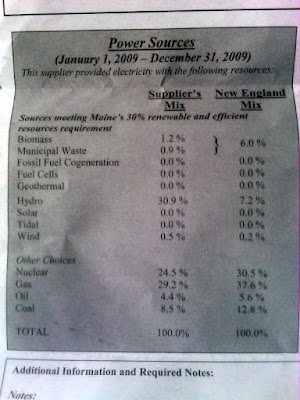
The photo above shows a recent mailing I received at my house detailing the power source mix for the current standard offer provider for customers of Central Maine Power's T&D network: NextEra Energy Power Marketing, LLC.
You can see that the largest share of power sourced by NextEra in 2009 was hydro (30.9%), with gas a close second (29.2%) and nuclear power (basically, Seabrook) at 24.5%. In total, 33.5% of NextEra's energy supply came from sources meeting Maine's renewable portfolio standard requirements. By contrast, the average New England mix is more heavily weighted in gas, nuclear, and coal, with renewable sources playing a much smaller role.
The generation mix is not simply an academic question; it has implications for other policy choices. For example, we've seen in past entries how the generation mix can affect other environmental claims, like what kind of emissions are associated with electric vehicles.
Interestingly, the supply mix is slightly different from the last time I got a notice.
October 22, 2010 - renewable energy credits
Friday, October 22, 2010
Continuing to look at RECs (renewable energy certificates or credits): today, an overview of how RECs are tracked and traded, and the kinds of markets in which RECs have value.
Because RECs are not tangible commodities, RECs are typically held and traded electronically. In New England, the New England Power Pool Generation Information System (NEPOOL GIS) tracks the creation of RECs in each of the six states. In much of the Western United States, RECs are tracked by the Western Renewable Energy Generation Information System (WREGIS). Other accounting systems cover various voluntary markets. These systems track the production and characteristics of renewable power. In general, for each MWh of eligible renewable power produced, the systems credit the owner’s GIS account with one REC. Where stronger state incentives exist, some resource types are compensated more highly, earning more than one REC per megawatt-hour. This “REC multiplier” concept can make some project types (e.g. solar power) more lucrative. Account holders may then engage in bilateral transactions with other REC market participants, generally buying and selling RECs without restriction. However, because RECs are traded on an over the counter basis, there is no standardized exchange where REC prices or sales volumes are regularly posted.
Because RECs are not tangible commodities, RECs are typically held and traded electronically. In New England, the New England Power Pool Generation Information System (NEPOOL GIS) tracks the creation of RECs in each of the six states. In much of the Western United States, RECs are tracked by the Western Renewable Energy Generation Information System (WREGIS). Other accounting systems cover various voluntary markets. These systems track the production and characteristics of renewable power. In general, for each MWh of eligible renewable power produced, the systems credit the owner’s GIS account with one REC. Where stronger state incentives exist, some resource types are compensated more highly, earning more than one REC per megawatt-hour. This “REC multiplier” concept can make some project types (e.g. solar power) more lucrative. Account holders may then engage in bilateral transactions with other REC market participants, generally buying and selling RECs without restriction. However, because RECs are traded on an over the counter basis, there is no standardized exchange where REC prices or sales volumes are regularly posted.
Across the various states, the potential market into which generators may sell RECs is significant. Voluntary markets allow a buyer to purchase RECs in order to support claims that the power the buyer consumes came from renewable resources. This can provide a variety of “goodwill” benefits ranging from enhanced green marketing opportunities (e.g. “our product is environmentally friendly”) to allowing the buyer to publicly and financially support a particular renewable project (e.g. “we support the city’s community-scale wind project”).
The larger opportunity to sell RECs may lie in compliance markets. In the majority of U.S. states as well as the District of Columbia, RPS programs requires electric companies to supply a minimum amount of power from qualified resources. Each state’s program varies in its implementation. In general, utilities must source an increasing percentage of power from renewable resources over the next several decades.
October 21, 2010 - renewable energy credits
Thursday, October 21, 2010
Yesterday, we began a look at RECS: renewable energy credits, or renewable energy certificates. A REC represents the renewable attributes associated with a particular megawatt-hour of generation. This approach to placing a higher value on renewable generation as opposed to other technologies works well because electrons are generally fungible, and indeed because power transactions are often “virtual” as opposed to physical deliveries of electrons from a specific generator to a specific consumer. RECs may thus be sold to any purchaser, even if no power actually changes hands. In some jurisdictions, RECs may be traded and used for compliance even if the underlying power would not physically be deliverable to the REC buyer. It is thus important to view RECs as a separate commodity offering renewable generators a new revenue stream.
Because many U.S. states have enacted legislative standards (called Renewable Portfolio Standards, or RPS) requiring certain amounts of utility load served to be sourced from renewable power, RECs also include information on their eligibility for certification for compliance with these state requirements.
October 20, 2010 - renewable energy certificates
Wednesday, October 20, 2010
 |
| Busy harbor in Norfolk, VA, with ships old and new. |

In the United States, federal and state policies favor renewable energy production by providing incentives for the development of renewable power resources. One primary state-level mechanism for rewarding renewable generators is the Renewable Energy Certificate (REC) market. In many states, laws and regulations require utilities to source a specified portion of their power from qualified renewable resources. Utilities satisfy this compliance obligation by purchasing or otherwise obtaining RECs to cover this load. In addition, a variety of voluntary markets exist for RECs.
Pulp and paper mills are well-positioned to participate in the REC market as sellers. As shaped by the forces of history and economics, today's mills often operate renewable generation such as a hydroelectric generation station or a biomass-fired steam turbine generator. For each megawatt-hour of qualified renewable power generated at a mill, a certified resource's owner will receive one REC. Owners can then sell these RECs in voluntary or compliance markets. The opportunity to sell RECs can enhance the economics of a mill and its renewable generation.
August 16, 2010 - renewable energy standards and goals
Monday, August 16, 2010
NPR has an interesting set of graphics today illustrating the diversity of U.S. states' policies on renewable energy. As we saw last month, the U.S. does not have a federal-level renewable energy standard, or even a specific goal for renewable development defined in terms of capacity (megawatts, or more realistically gigawatts).
The first factory built-to-order solar-powered integrated electric-vehicle charging station has been unveiled in Korea: the SunPods SP-300. The unit, also known as the "EV Plug-N-Go", was first displayed at International Green Energy Expo Korea 2010 in Deagu, South Korea.
The first factory built-to-order solar-powered integrated electric-vehicle charging station has been unveiled in Korea: the SunPods SP-300. The unit, also known as the "EV Plug-N-Go", was first displayed at International Green Energy Expo Korea 2010 in Deagu, South Korea.
Subscribe to:
Posts (Atom)
