This summer Vermont energy regulators issued an order implementing a Renewable Energy Standard. This standard, or RES, requires
Vermont
electric
utilities to
procure
an
increasing
share
of electricity from
renewable
sources.
Under a 2015 law called Act 56 (formerly called bill H.40), the Vermont Legislature directed the Public Service Board
to
issue
an
order
implementing
the
RES
to
take
effect
on
January 1, 2017. Act 56 set certain rules for the RES, but left other issues to the Board. Following working group meetings, workshops, and opportunities for written comment, the Board adopted the RES by order dated June 28, 2016.
The RES sets targets for utility procurement of renewable energy, starting at 55%
of
the
electricity
sold
to
customers
from
renewable
sources
in 2017,
increasing
gradually
to
75% in 2032.
Of
these
amounts,
at least 1%
must
come
from
new,
distributed
renewable
generators,
such
as
net-metering
systems,
rising
to
l0% by
2032.
The
RES
also
establishes
a category of
"energy
transformation
projects," to encourage
utility investment in
projects
that
directly
reduce
customers' fossil-fuel
consumption. Energy transformation projects might include measures
like
weatherization, biomass heating, cold-climate
heat
pumps, demand management,
or
clean
vehicle
technologies. To satisfy this requirement, utilities
must
demonstrate
fossil-fuel
savings
equivalent
to
2% of
their
annual
retail
sales
(increasing to 12% by
2032) or
procure
an
equal
amount
of
additional
renewable
generation. The Board has described the energy transformation project program as the first of its kind in the U.S.
Most states have adopted binding renewable portfolio standards for electricity supply. Before the enactment of Act 56 and the Board's adoption of the RES, Vermont had renewable goals under its Sustainably Priced Energy Enterprise Development or SPEED program, but no mandatory renewable portfolio standard.
Under the act, the Vermont Public Service Board order adopting the RES will take effect on January 1, 2017.

Energy powers society; society's choices shape energy policy. A blog about our energy resources and the choices they present for society.
Showing posts with label supply mix. Show all posts
Showing posts with label supply mix. Show all posts

NRC approves Georgia nuclear reactors
Friday, February 10, 2012
Federal regulators have approved the construction of two nuclear reactors in Georgia. The Nuclear Regulatory Commission approved the addition of two Toshiba/Westinghouse AP1000to Southern Co.'s existing Vogtle nuclear power plant, despite a dissenting vote by NRC Chairman Gregory Jaczko. (Here is the NRC order.) This represents the first NRC approval for construction of a new reactor since 1978.
31 states are already home to commercial nuclear reactors. The U.S. power industry's nuclear fleet includes 104 reactors at 65 power plants. (EIA provides a nice map with generalized locations of nuclear power plants.) Most are located near water sources, in the eastern half of the country. Illinois alone is home to 11 reactors.
Over the last two decades, nuclear energy has provided about 20% of our electricity supply. For example, in 2010, U.S. nuclear plants generated 807 billion kilowatt-hours out of nearly 3,884 billion kWh total supply. This amounts to about 8% of the total energy consumed in the U.S. from all sources.
The Vogtle project's projected cost is $14 billion, with a targeted operational date as early as 2016. The reactors approved for Georgia each have a nameplate capacity of 1,154 megawatts, making them significant sources of power. The reactors chosen for the project are designed to have simple fail-safe mechanisms to protect against the kind of catastrophe that occurred at Fukushima.
The NRC approved the project by a 4-1 vote. Chairman Jaczko cast the dissenting vote, noting in his written dissent, "I simply cannot authorize issuance of these licenses without any binding obligation that these plants will have implemented the lessons learned from the Fukushima accident before they operate."
By majority vote, the NRC authorized its Director of the Office of New Reactors to issue the work authorizations and licenses needed to allow the construction and operation of Vogtle Units 3 and 4.
31 states are already home to commercial nuclear reactors. The U.S. power industry's nuclear fleet includes 104 reactors at 65 power plants. (EIA provides a nice map with generalized locations of nuclear power plants.) Most are located near water sources, in the eastern half of the country. Illinois alone is home to 11 reactors.

Over the last two decades, nuclear energy has provided about 20% of our electricity supply. For example, in 2010, U.S. nuclear plants generated 807 billion kilowatt-hours out of nearly 3,884 billion kWh total supply. This amounts to about 8% of the total energy consumed in the U.S. from all sources.
The Vogtle project's projected cost is $14 billion, with a targeted operational date as early as 2016. The reactors approved for Georgia each have a nameplate capacity of 1,154 megawatts, making them significant sources of power. The reactors chosen for the project are designed to have simple fail-safe mechanisms to protect against the kind of catastrophe that occurred at Fukushima.
The NRC approved the project by a 4-1 vote. Chairman Jaczko cast the dissenting vote, noting in his written dissent, "I simply cannot authorize issuance of these licenses without any binding obligation that these plants will have implemented the lessons learned from the Fukushima accident before they operate."
By majority vote, the NRC authorized its Director of the Office of New Reactors to issue the work authorizations and licenses needed to allow the construction and operation of Vogtle Units 3 and 4.
August 8, 2011 - what's in your electricity supply mix?
Monday, August 8, 2011
What kinds of generation resources make up your electricity supply mix? While the answers differ across suppliers and over time, the question of what's in your generation basket can affect not only the price you pay for power but also the environmental attributes of the power used to satisfy your demand.
Customers have an interest in understanding which generation resources are in their energy mix. In states like Maine, electricity suppliers and utilities have been required to provide customers mailings containing information on the resource mix. By looking at this data over time (like this August 2010 mailing, this November 2010 mailing, and this July 2011 mailing), customers can understand not only what they've been buying but how it is changing over time.
Now, in a notice of proposed rulemaking (26 page PDF), the Maine Public Utilities Commission proposes to repeal its rule requiring competitive electricity providers and transmission and distribution utilities to provide quarterly mailings with supply mix information. This follows on the heels of a 2011 law change by the Maine State Legislature which opened up more flexibility in how these suppliers must make supply mix information available.
The Maine PUC is entertaining comments on its proposal until September 9, 2011. Will the new rule require (or allow) suppliers to make supply mix information available in electronic or online formats in lieu of paper mailings?
Customers have an interest in understanding which generation resources are in their energy mix. In states like Maine, electricity suppliers and utilities have been required to provide customers mailings containing information on the resource mix. By looking at this data over time (like this August 2010 mailing, this November 2010 mailing, and this July 2011 mailing), customers can understand not only what they've been buying but how it is changing over time.
Now, in a notice of proposed rulemaking (26 page PDF), the Maine Public Utilities Commission proposes to repeal its rule requiring competitive electricity providers and transmission and distribution utilities to provide quarterly mailings with supply mix information. This follows on the heels of a 2011 law change by the Maine State Legislature which opened up more flexibility in how these suppliers must make supply mix information available.
The Maine PUC is entertaining comments on its proposal until September 9, 2011. Will the new rule require (or allow) suppliers to make supply mix information available in electronic or online formats in lieu of paper mailings?
August 2, 2011 - green pricing programs grow
Tuesday, August 2, 2011
"Green pricing" energy programs are one way electricity consumers can choose the mix of resources making up their energy supply. Under these programs, consumers can voluntarily pay for electricity sourced from renewable resources. Green pricing programs, which often but not always come at a premium over default service, represent a free market solution to the question of who should pay for renewable power, and give customers control over their energy mix.
This is a different approach from renewable portfolio standards, which require utilities to source specified portions of their power from renewables. These two strategies can work together, as the majority of states now use both RPS and green pricing programs.
The U.S. Energy Information Administration defines green pricing:
The number of customers participating in green pricing programs also increased for a third consecutive year to 1,123,778 customers. This represents a 12% increase in customer participation -- and yet green pricing has been chosen by less than 0.08% of the nation's total 143,497,0601 electricity customers.
What does the future hold for green pricing?
This is a different approach from renewable portfolio standards, which require utilities to source specified portions of their power from renewables. These two strategies can work together, as the majority of states now use both RPS and green pricing programs.
The U.S. Energy Information Administration defines green pricing:
Green pricing: In the case of renewable electricity, green pricing represents a market solution to the various problems associated with regulatory valuation of the nonmarket benefits of renewables. Green pricing programs allow electricity customers to express their willingness to pay for renewable energy development through direct payments on their monthly utility bills.The EIA's July 2011 report on green pricing and net metering (9 page PDF) shows a record number of customers participating in green pricing programs. Green pricing programs now exist in every state except Alaska, Hawaii, and New Hampshire, so it is no surprise that EIA's recent report documents an increase in green pricing participation. EIA's most recent data, which covers 2009, shows a 6% increase in the number of electric industry participants (utilities, competitive suppliers) with customers in green pricing programs.
The number of customers participating in green pricing programs also increased for a third consecutive year to 1,123,778 customers. This represents a 12% increase in customer participation -- and yet green pricing has been chosen by less than 0.08% of the nation's total 143,497,0601 electricity customers.
What does the future hold for green pricing?
July 21, 2011 - how the electricity supply mix affects air emissions
Thursday, July 21, 2011
The types of generators making up your electricity supply mix vary from region to region and time to time. How that mix is composed affects the air emissions associated with the electric power sector.
Yesterday, I looked at a mailing I recently received about the resources making up my electricity supply. Also included in that fact sheet was this chart showing the average air emissions of carbon dioxide (CO2), nitrogen oxide (NOx), and sulfur dioxide (SO2) in pounds of emissions per megawatt-hour of power sold to customers:

The power sold through this standard offer period averaged 605.86 pounds of CO2 per MWh generated -- 34.5% less than the New England system average over the same time. NOx and SO2 emissions were 0.52 and 0.94 lbs per MWh respectively -- each about half the emissions rate per MWh of the regional average.
Yesterday, I looked at a mailing I recently received about the resources making up my electricity supply. Also included in that fact sheet was this chart showing the average air emissions of carbon dioxide (CO2), nitrogen oxide (NOx), and sulfur dioxide (SO2) in pounds of emissions per megawatt-hour of power sold to customers:

The power sold through this standard offer period averaged 605.86 pounds of CO2 per MWh generated -- 34.5% less than the New England system average over the same time. NOx and SO2 emissions were 0.52 and 0.94 lbs per MWh respectively -- each about half the emissions rate per MWh of the regional average.
November 4, 2010 - what kinds of generation make up Maine's standard offer mix?
Thursday, November 4, 2010
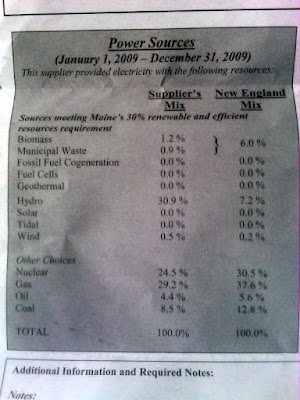
The photo above shows a recent mailing I received at my house detailing the power source mix for the current standard offer provider for customers of Central Maine Power's T&D network: NextEra Energy Power Marketing, LLC.
You can see that the largest share of power sourced by NextEra in 2009 was hydro (30.9%), with gas a close second (29.2%) and nuclear power (basically, Seabrook) at 24.5%. In total, 33.5% of NextEra's energy supply came from sources meeting Maine's renewable portfolio standard requirements. By contrast, the average New England mix is more heavily weighted in gas, nuclear, and coal, with renewable sources playing a much smaller role.
The generation mix is not simply an academic question; it has implications for other policy choices. For example, we've seen in past entries how the generation mix can affect other environmental claims, like what kind of emissions are associated with electric vehicles.
Interestingly, the supply mix is slightly different from the last time I got a notice.
Subscribe to:
Posts (Atom)
