A Maine electric utility has launched a program to offer residential consumers rates that vary depending on whether the consumption occurs during times of peak demand on the electric grid. Central Maine Power Company's residential time-of-use rates are designed to encourage consumers to shift their use of electricity-intensive equipment to off-peak hours, generally between 8:00 p.m. and 7:00 a.m. and on weekends. How many customers will choose this option? What effects will it have, both for the consumers opting in and for society as a whole?
Traditionally, electric ratepayers pay the same price for every kilowatt-hour of energy they consume, without regard to the time of consumption or to conditions on the grid. But the cost of producing a given kilowatt-hour of electricity depends on factors including the portfolio of generators operating at the time, as well as on the instantaneous demand for electricity in the overall regional market. Because they are not directly exposed to the real-time price of power, consumers individually and collectively may not make efficiency choices about how much power they consume, and when they consume it. For example, energy prices are typically lower at night, when demand is reduced, but consumers have not traditionally had any incentive to shift their consumption to lower-priced nighttime hours. Some utilities have offered industrial and commercial businesses time-of-use rates to encourage efficiency, but most residential ratepayers have not had this option in recent years.
Central Maine Power now offers residential consumers the option to choose time-of-use rates. Prices during peak hours will be about 15 percent higher than under the default rate schedule, with off-peak prices about 20 percent below the default rates. The structure offers the opportunity for consumers to choose to shift heavy-consuming applications like air conditioning and heating to off-peak hours. This could save these consumers money - but it would require them to modify their behavior, invest in new "smart" technology, or both. Will consumers find the opportunity for savings to be worth these changes?
The current enrollment window is open through January 31, 2013.

Energy powers society; society's choices shape energy policy. A blog about our energy resources and the choices they present for society.
Showing posts with label Central Maine Power. Show all posts
Showing posts with label Central Maine Power. Show all posts

Electric vehicle pilot program proposed in Maine
Monday, July 23, 2012
A pilot program proposed by a Maine utility could lead to more electric vehicles on the road. Central Maine Power Co. has asked the Maine Public Utilities Commission to approve its Electric Vehicle Pilot Project No. 2, which includes a limited number of grants to help customers purchase or lease an electric vehicle.
As described in CMP's June 21 filing with the Commission, the electric vehicle pilot project consists of grant funding, CMP promotion of electric vehicles, and the collection of data on vehicle usage. CMP envisions issuing cash grants of up to $15,000 each to ten selected organizations located in CMP’s service territory. These organizations, selected through a public solicitation process, could use these grants to help them purchase or lease ten electric vehicles. Each organization can also apply a portion of the grant toward the purchase and installation of a Level 2 (208V or 240V) rapid charging station, if it so chooses.
The project arises out of a requirement approved by the Commission as part of the settlement of a 2008 case over CMP's Maine Power Reliability Program, or MPRP. As part of a deal allowing CMP to invest $1.4 billion in transmission infrastructure in its territory, the Commission required CMP to develop a process for pilot projects to facilitate the increased use of hybrid and electric cars in Maine, and to promote the storage of renewable and other energy generated off-peak to replace fuels with greater climate impacts. Using off-peak electricity to power transportation could both save money for consumers and allow the utility to make more full use of its transmission and distribution grid.
Specifically, the stipulation required CMP to bring forward at least three pilot projects to facilitate the increased use of hybrid and electric cars by the end of 2012. CMP's first pilot project entails integrating a limited number of electric vehicles into CMP's fleet. This project, which is currently being implemented, is designed to give the utility first-hand experience with EVs, in a manner that minimizes costs and risks.
If approved, CMP's second project would introduce ten vehicles into the broader community. The utility has said that its objective is to build awareness and lessen consumers' concerns by getting more of the new EV models into the public's hands. Its ultimate stated goal is to create interest and "buzz" about EVs, particularly among innovative early adopters who would be most likely to purchase an EV.
A third phase is still under development, but CMP has said it will propose reducing barriers to EV use through education, participate in the development of public charging infrastructure, and assess a lower off-peak rate for EV charging.
The Maine Public Utilities Commission is reviewing CMP's proposal and is expected to issue its decision later this year.
As described in CMP's June 21 filing with the Commission, the electric vehicle pilot project consists of grant funding, CMP promotion of electric vehicles, and the collection of data on vehicle usage. CMP envisions issuing cash grants of up to $15,000 each to ten selected organizations located in CMP’s service territory. These organizations, selected through a public solicitation process, could use these grants to help them purchase or lease ten electric vehicles. Each organization can also apply a portion of the grant toward the purchase and installation of a Level 2 (208V or 240V) rapid charging station, if it so chooses.
The project arises out of a requirement approved by the Commission as part of the settlement of a 2008 case over CMP's Maine Power Reliability Program, or MPRP. As part of a deal allowing CMP to invest $1.4 billion in transmission infrastructure in its territory, the Commission required CMP to develop a process for pilot projects to facilitate the increased use of hybrid and electric cars in Maine, and to promote the storage of renewable and other energy generated off-peak to replace fuels with greater climate impacts. Using off-peak electricity to power transportation could both save money for consumers and allow the utility to make more full use of its transmission and distribution grid.
Specifically, the stipulation required CMP to bring forward at least three pilot projects to facilitate the increased use of hybrid and electric cars by the end of 2012. CMP's first pilot project entails integrating a limited number of electric vehicles into CMP's fleet. This project, which is currently being implemented, is designed to give the utility first-hand experience with EVs, in a manner that minimizes costs and risks.
If approved, CMP's second project would introduce ten vehicles into the broader community. The utility has said that its objective is to build awareness and lessen consumers' concerns by getting more of the new EV models into the public's hands. Its ultimate stated goal is to create interest and "buzz" about EVs, particularly among innovative early adopters who would be most likely to purchase an EV.
A third phase is still under development, but CMP has said it will propose reducing barriers to EV use through education, participate in the development of public charging infrastructure, and assess a lower off-peak rate for EV charging.
The Maine Public Utilities Commission is reviewing CMP's proposal and is expected to issue its decision later this year.
Maine court sustains challenge to smart meter project, partially
Wednesday, July 18, 2012
The Maine Supreme Judicial Court has issued an opinion that calls into question the Maine Public Utilities Commission's dismissal of a complaint against a utility regarding its use of smart-meter technology. With over 600,000 smart meters already installed, what the court ruling means is unclear.
In 2010, the Commission approved a proposal by Central Maine Power Company (CMP) to install smart meters on its customers' sites. The project, which CMP called Advanced Metering Infrastructure, entailed replacing existing customer meters with "smart meters" capable of transmitting customer usage data back to the utility using radio frequency signals.
The project triggered a series of customer complaints raising concerns about the health and safety of smart-meter technology associated with the AMI project, focusing on the health effects of RF radiation emitted by the wireless smart meters and the technology’s potential to violate individuals’ privacy. Customers also complained about the lack of an opt-out provision allowing customers to choose to retain their existing meters.
In 2011, the Commission ordered CMP to provide two alternatives for customers who choose not to have the standard wireless smart meter installed on their premises: either a standard meter, or a smart meter set to receive-only mode. Under the Commission's order, customers opting out would pay an extra fee.
In response, nineteen CMP customers filed a complaint against both CMP and the Commission, challenging the opt-out fee. The Commission dismissed that complaint, finding that it had considered and resolved the issues raised in the complaint by ordering CMP to allow customers to opt out. This dismissal triggered an appeal by the customers to the Maine Supreme Judicial Court.
In the court's opinion issued last week, Friedman v. Public Utilities Commission, the court agreed with the customer complainants that the Commission should not have dismissed the portion of the complaint against CMP addressing health and safety issues.
In reaching this conclusion, the court noted that one of the Commission’s core regulatory responsibilities is to ensure that public utilities provide “safe, reasonable and adequate service” to customers. The court found that the Commission had explicitly declined to decide "that smart meter technology is not a credible threat to the health and safety of CMP’s customers". On that sole ground, the court vacated the portion of the Commission’s dismissal of the customer complaint that was directed at CMP and addressed health and safety concerns.
So what does the court's ruling mean in practical terms? CMP has already installed about 600,000 smart meters across its service territory, and has only about 2,000 smart meters left to install. The Commission is undoubtedly reviewing the court's order and has scheduled a deliberative session for next Tuesday, July 24, at 10:00 a.m.
In 2010, the Commission approved a proposal by Central Maine Power Company (CMP) to install smart meters on its customers' sites. The project, which CMP called Advanced Metering Infrastructure, entailed replacing existing customer meters with "smart meters" capable of transmitting customer usage data back to the utility using radio frequency signals.
The project triggered a series of customer complaints raising concerns about the health and safety of smart-meter technology associated with the AMI project, focusing on the health effects of RF radiation emitted by the wireless smart meters and the technology’s potential to violate individuals’ privacy. Customers also complained about the lack of an opt-out provision allowing customers to choose to retain their existing meters.
In 2011, the Commission ordered CMP to provide two alternatives for customers who choose not to have the standard wireless smart meter installed on their premises: either a standard meter, or a smart meter set to receive-only mode. Under the Commission's order, customers opting out would pay an extra fee.
In response, nineteen CMP customers filed a complaint against both CMP and the Commission, challenging the opt-out fee. The Commission dismissed that complaint, finding that it had considered and resolved the issues raised in the complaint by ordering CMP to allow customers to opt out. This dismissal triggered an appeal by the customers to the Maine Supreme Judicial Court.
In the court's opinion issued last week, Friedman v. Public Utilities Commission, the court agreed with the customer complainants that the Commission should not have dismissed the portion of the complaint against CMP addressing health and safety issues.
In reaching this conclusion, the court noted that one of the Commission’s core regulatory responsibilities is to ensure that public utilities provide “safe, reasonable and adequate service” to customers. The court found that the Commission had explicitly declined to decide "that smart meter technology is not a credible threat to the health and safety of CMP’s customers". On that sole ground, the court vacated the portion of the Commission’s dismissal of the customer complaint that was directed at CMP and addressed health and safety concerns.
So what does the court's ruling mean in practical terms? CMP has already installed about 600,000 smart meters across its service territory, and has only about 2,000 smart meters left to install. The Commission is undoubtedly reviewing the court's order and has scheduled a deliberative session for next Tuesday, July 24, at 10:00 a.m.
August 16, 2011 - DOE loan guarantee to Maine wind project
Tuesday, August 16, 2011
A wind energy developer has just received a $102 million loan guarantee to support its project in Maine. Yesterday the U.S. Department of Energy lent its financial support to Record Hill Wind LLC for its 50.6 megawatt project near Roxbury, Maine. The project's design includes 22 Siemens turbines and an 8 mile transmission line to interconnect with Central Maine Power's system. Born out of a partnership between Independence Wind LLC and Wagner Forest Management, the project also scored major financial support from the Yale University endowment fund.
Record Hill Wind's federal loan guarantee through the DOE further solidifies the project's financial footing. Department of Energy operates several loan guarantee programs; Record Hill's backstop comes courtesy of DOE's Section 1705 program, which is now ramping down. While the Section 1705 program may be a casualty of the federal budget, DOE's three loan programs have to date offered over $40 billion in support for 42 clean energy projects across the country.
Record Hill Wind's federal loan guarantee through the DOE further solidifies the project's financial footing. Department of Energy operates several loan guarantee programs; Record Hill's backstop comes courtesy of DOE's Section 1705 program, which is now ramping down. While the Section 1705 program may be a casualty of the federal budget, DOE's three loan programs have to date offered over $40 billion in support for 42 clean energy projects across the country.
November 4, 2010 - what kinds of generation make up Maine's standard offer mix?
Thursday, November 4, 2010
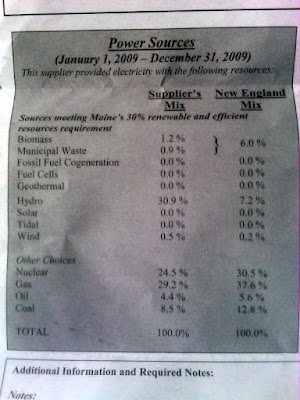
The photo above shows a recent mailing I received at my house detailing the power source mix for the current standard offer provider for customers of Central Maine Power's T&D network: NextEra Energy Power Marketing, LLC.
You can see that the largest share of power sourced by NextEra in 2009 was hydro (30.9%), with gas a close second (29.2%) and nuclear power (basically, Seabrook) at 24.5%. In total, 33.5% of NextEra's energy supply came from sources meeting Maine's renewable portfolio standard requirements. By contrast, the average New England mix is more heavily weighted in gas, nuclear, and coal, with renewable sources playing a much smaller role.
The generation mix is not simply an academic question; it has implications for other policy choices. For example, we've seen in past entries how the generation mix can affect other environmental claims, like what kind of emissions are associated with electric vehicles.
Interestingly, the supply mix is slightly different from the last time I got a notice.
July 28, 2010 - Alta Wind Energy Center breaks ground; PACE financing
Wednesday, July 28, 2010
Today's picture: Central Maine Power transmission lines off Route 201 in Topsham, Maine.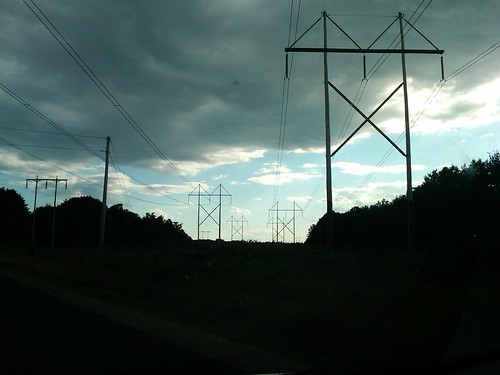
In California, the Alta Wind Energy Center — with plans for thousands of acres of turbines to generate electricity for 600,000 Southern California homes — officially broke ground yesterday. Here's the official project website, which is running a bit slowly today (likely due to all the interest in the project). Terra-Gen Power, LLC does have a slick website that is worth checking out. Some highlights include:
In enacting the smart grid bill, the Maine Legislature found that:
With this policy in place, the ball is now in the court of smart grid infrastructure developers. We now have a law that will support roll-out of smart grid projects in Maine. Who will be the first to propose one?
A bit of personal news, related to energy: an article I co-authored with a colleague and a client has been published in Paper360 Magazine. Click through to read about how a pulp and paper mill navigates the waters of compliance with the Regional Greenhouse Gas Initiative (RGGI) and other climate change regulation.
How about PACE financing? PACE-promoting provisions got stripped out of the current Senate energy bill. These tweaks are viewed as necessary to let PACE programs flourish, as government-backed lenders Fannie Mae and Freddie Mac have suggested that they won't play with PACE.
In California, the Alta Wind Energy Center — with plans for thousands of acres of turbines to generate electricity for 600,000 Southern California homes — officially broke ground yesterday. Here's the official project website, which is running a bit slowly today (likely due to all the interest in the project). Terra-Gen Power, LLC does have a slick website that is worth checking out. Some highlights include:
- The Alta Wind Energy Center (AWEC), under developed by Terra-Gen Power, is composed of multiple projects. The first AWEC development is the Alta-Oak Creek Mojave Project.
- The Alta-Oak Creek Mojave Project will be composed of up to 320 wind turbine generators and supporting infrastructure.
- The Project will be developed primarily on privately-owned land adjacent to existing wind energy developments in the Tehachapi area of California.
- The Project is projected to add 50 full-time jobs to the Kern County economy.
In enacting the smart grid bill, the Maine Legislature found that:
- The cost of electricity to consumers in this State is high in comparison to costs in similar markets and impedes economic development;
- The State has recognized the consequences of climate change and has committed to policies to reduce emissions of greenhouse gases;
- The State's electric grid and long-term infrastructure investment are vital to continued security and economic development, and smart grid functions will deliver electricity from suppliers to consumers using modern technology to increase reliability and reduce costs in a way that saves energy and to enable greater consumer choice;
- The State currently lacks a comprehensive smart grid policy but faces critical decisions regarding the implementation of smart grid functions and associated infrastructure, technology and applications, and the commission and the Legislature will play central roles in making those decisions; and
- It is vital that a smart grid policy be developed in order to ensure that all ratepayers and the State as a whole are afforded the benefits of smart grid functions and associated infrastructure, technology and applications.
With this policy in place, the ball is now in the court of smart grid infrastructure developers. We now have a law that will support roll-out of smart grid projects in Maine. Who will be the first to propose one?
A bit of personal news, related to energy: an article I co-authored with a colleague and a client has been published in Paper360 Magazine. Click through to read about how a pulp and paper mill navigates the waters of compliance with the Regional Greenhouse Gas Initiative (RGGI) and other climate change regulation.
How about PACE financing? PACE-promoting provisions got stripped out of the current Senate energy bill. These tweaks are viewed as necessary to let PACE programs flourish, as government-backed lenders Fannie Mae and Freddie Mac have suggested that they won't play with PACE.
June 9, 2010 - tidal power in Maine: the Passamquoddy Power Project
Wednesday, June 9, 2010
Maine's historic wood and stone tide mills were just going dark in the 1930s. At the same time, larger tidal power projects were in the works. Chief of these was the Passamaquoddy Power Project, a large project designed to generate 300 to 500 MW of capacity.
In 1919, having returned from dam siting and building in South America, Dexter P. Cooper took some rest and relaxation on Campobello Island, just over the New Brunswick border from (and only accessible by road from) Lubec, Maine. As the August 1935 article in Popular Science put it:
What Cooper envisioned was the construction of five huge dams connecting various points and islands near the junction of Passamaquoddy Bay and Cobscook Bay. Cobscook Bay would be effectively walled off from Passamaquoddy Bay. As the Bay of Fundy's tide rose in Passamaquoddy Bay, the topography would make Passamaquoddy fill much faster than Cobscook. Once a five-foot head was built up, the penstocks would be opened and Passamaquoddy would fall down into Cobscook, spinning turbine generators along the way. Under expected conditions, the head could build up to as much as 18 to 23 feet. At low tide, gates would open and equalize the water levels.
Tidal projects have always had to deal with the effects of lunar time changes. Each night, the moon passes its zenith about 50 minutes later than the night before. In older times, this meant that the milling could only take place for part of the day, and not necessarily at convenient times. The Passamaquoddy project included an early pumped storage reservoir. A 180,000 horsepower pumping station at Haycock Harbor was to pump seawater into a 13,000 acre reservoir at 130' above sea level.
If you've ever been to Lubec, or if you follow tidal power projects, you probably know that the Passamaquoddy Power Project was never completed. I'm looking at the "why", to see what we can learn from history.
In 1919, having returned from dam siting and building in South America, Dexter P. Cooper took some rest and relaxation on Campobello Island, just over the New Brunswick border from (and only accessible by road from) Lubec, Maine. As the August 1935 article in Popular Science put it:
With nothing to do, Cooper spent whole days watching the tides swirl past the island. He calculated the billions of horsepower going to waste. As a sort of hobby, he began imagining ways of putting the rising and falling water to work. In the end, he became convinced of the entire practicability of harnessing the Fundy tides.
What Cooper envisioned was the construction of five huge dams connecting various points and islands near the junction of Passamaquoddy Bay and Cobscook Bay. Cobscook Bay would be effectively walled off from Passamaquoddy Bay. As the Bay of Fundy's tide rose in Passamaquoddy Bay, the topography would make Passamaquoddy fill much faster than Cobscook. Once a five-foot head was built up, the penstocks would be opened and Passamaquoddy would fall down into Cobscook, spinning turbine generators along the way. Under expected conditions, the head could build up to as much as 18 to 23 feet. At low tide, gates would open and equalize the water levels.
Tidal projects have always had to deal with the effects of lunar time changes. Each night, the moon passes its zenith about 50 minutes later than the night before. In older times, this meant that the milling could only take place for part of the day, and not necessarily at convenient times. The Passamaquoddy project included an early pumped storage reservoir. A 180,000 horsepower pumping station at Haycock Harbor was to pump seawater into a 13,000 acre reservoir at 130' above sea level.
If you've ever been to Lubec, or if you follow tidal power projects, you probably know that the Passamaquoddy Power Project was never completed. I'm looking at the "why", to see what we can learn from history.
June 8, 2010 - tidal power in history: Winnegance to Passamaquoddy
Tuesday, June 8, 2010
I was fortunate to use wind power yesterday afternoon: I went sailing with a colleague on his Hunter 41. While on my way to the dock in Falmouth, I stopped by the site of a historic tide mill:
This isn't the best photo, but beyond the picnic table, you can see a stone pier extending across the mouth of Mill Creek. It seems information on the history of this mill site is limited, but it is suggested that it milled grain, and then lumber. The Town of Falmouth maintains a short but nice trail here, although parking is very limited.
In 1935, President Franklin Delano Roosevelt created the Federal Writers' Project, a program under the WPA designed to put writers to work while promoting economic development through tourism and industry. The project published 48 state guides to America (plus Alaska, Puerto Rico and Washington, D.C.) known as the American Guide Series. Each state in this series compiled its own detailed histories and descriptions of every city and town, along with narratives of interesting automobile tours.
Yesterday, I looked at the history of tidal power development at Winnegance, near Bath and Phippsburg, Maine. The 1937 Maine Writers' Project Guide describes the one remaining tide mill at Winnegance:
So we can see that by 1937, policymakers including the federal government were reconsidering Maine's tidal power resources. Winnegance's tide mills were just on their way out, but the Passamaquoddy Power Project was just on the eastern horizon. Tomorrow I'll look at the 500 MW PPP in more depth.

 |
| From Energy Policy Update |
In 1935, President Franklin Delano Roosevelt created the Federal Writers' Project, a program under the WPA designed to put writers to work while promoting economic development through tourism and industry. The project published 48 state guides to America (plus Alaska, Puerto Rico and Washington, D.C.) known as the American Guide Series. Each state in this series compiled its own detailed histories and descriptions of every city and town, along with narratives of interesting automobile tours.
Yesterday, I looked at the history of tidal power development at Winnegance, near Bath and Phippsburg, Maine. The 1937 Maine Writers' Project Guide describes the one remaining tide mill at Winnegance:
At 3 m. is the junction with a dirt road. Left on this road to a Tide Mill, 0.4 m., which until 1935 was used for cutting lumber. This old structure is a primitive forerunner of the mills and factories planned as part of the Passamquoddy Power Project.
So we can see that by 1937, policymakers including the federal government were reconsidering Maine's tidal power resources. Winnegance's tide mills were just on their way out, but the Passamaquoddy Power Project was just on the eastern horizon. Tomorrow I'll look at the 500 MW PPP in more depth.
May 25, 2010 - New Mills dam in context
Tuesday, May 25, 2010
Yesterday, I wrote about the Reed & Reed-affiliated company Osprey 1 LLC that has asked FERC for preliminary approval to study powering up the New Mills dam on the Cobbosseecontee in Gardiner, Maine. I'm going to use this space to post some of my notes as I dig into this story.
First, some FERC basics. We're talking about docket number P-13709-000, Notice of Preliminary Permit Application Accepted for Filing and Soliciting Comments, Motions to Intervene, and Competing Applications re Osprey I, LLC under P-13709. Here's the original application for preliminary permit and a link to the FERC notice (3 page PDF).
The existing New Mills Dam is currently not in use for hydropower production and has no FERC license. The last FERC license for New Mills Dam was surrendered 5/16/1996.
The New Mills Dam was originally constructed in the 1840s to provide water to an adjacent mill. The dam impounds water including Pleasant Pond, part of the impoundment area of the Dam, which abuts the City of Gardiner and the Towns of West Gardiner, Richmond, and Litchfield. Pleasant Pond was the primary water source for the Gardiner Water District until the 1950s, when the construction of the Maine Turnpike degraded the water quality. The District switched ultimately switched to two groundwater wells.
In 1974 the District obtained the New Mills Dam from the City of Gardiner, which had operated the Dam for nearly a century. The District constructed a hydro-electric facility at the dam in 1982, and sold its power through a contract with Central Maine Power Company from 1983 to 1994.
1994 brought change to the river. That year, CMP bought out the contract and the project's FERC license was surrendered. In 1997, the District initiated an action under the Maine Dam Abandonment Act to abandon the dam.
The dam was the subject of litigation in the late 1990s.
Is this a good site for the restoration of historic hydropower capacity? What forces and factors led to the dam's abandonment in the 1990s? In the ensuing years, have those forces gone away?
First, some FERC basics. We're talking about docket number P-13709-000, Notice of Preliminary Permit Application Accepted for Filing and Soliciting Comments, Motions to Intervene, and Competing Applications re Osprey I, LLC under P-13709. Here's the original application for preliminary permit and a link to the FERC notice (3 page PDF).
The existing New Mills Dam is currently not in use for hydropower production and has no FERC license. The last FERC license for New Mills Dam was surrendered 5/16/1996.
The New Mills Dam was originally constructed in the 1840s to provide water to an adjacent mill. The dam impounds water including Pleasant Pond, part of the impoundment area of the Dam, which abuts the City of Gardiner and the Towns of West Gardiner, Richmond, and Litchfield. Pleasant Pond was the primary water source for the Gardiner Water District until the 1950s, when the construction of the Maine Turnpike degraded the water quality. The District switched ultimately switched to two groundwater wells.
In 1974 the District obtained the New Mills Dam from the City of Gardiner, which had operated the Dam for nearly a century. The District constructed a hydro-electric facility at the dam in 1982, and sold its power through a contract with Central Maine Power Company from 1983 to 1994.
1994 brought change to the river. That year, CMP bought out the contract and the project's FERC license was surrendered. In 1997, the District initiated an action under the Maine Dam Abandonment Act to abandon the dam.
The dam was the subject of litigation in the late 1990s.
Is this a good site for the restoration of historic hydropower capacity? What forces and factors led to the dam's abandonment in the 1990s? In the ensuing years, have those forces gone away?
3/25/10
Thursday, March 25, 2010
The big news in this corner of the continent is that Hydro-Quebec and New Brunswick Power have canceled their proposed deal. Details are still coming out, but key factors include the radical unpopularity of the deal in NB -- with some reports of as low as 8% of New Brunswickers supporting the deal -- and "increased costs and risk" for HQ. More to follow for sure.
In Maine legislative news:
The Utilities and Energy Committee has voted out an amended version of LD 1810, the Ocean Energy Task Force bill. This bill, proposed by Governor Baldacci's Ocean Energy Task Force, underwent a significant scaling back during the committee process, largely due to concerns over impacts to electric ratepayers. The Task Force, whose members included former Central Maine Power utility chief David Flanagan, was told to propose legislation that would remove obstacles to building 5000 MW of offshore and coastal wind and tidal energy in Maine. The result was a bill that included mandates to overbuild transmission, loosen the standards for the PUC's approval of transmission lines, have ratepayers finance generator lead lines, and expose all ratepayers to rates of up to 25 cents per kWh in order to pay for long-term contracts for ocean energy. Through extensive questioning by legislators and stakeholder involvement, the result is a dramatically scaled-back bill voted out of the Committee unanimously this evening. As voted out, the amended bill eliminates much of the the pro-transmission prejudices embodied in the original bill, and the provisions that would have had ratepayers backstop generator lead lines. The Committee also transformed an ocean energy RFP process that would have exposed ratepayers to potentially significant cost increases into a voluntary "ocean energy standard offer". This is a good result that will empower Maine's renewable energy industry and economy, without inappropriately exposing ratepayers to costs and risk.
When dam owner FPL Energy got approval to remove its Fort Halifax dam and hydroelectric station on the Sebasticook River in Winslow, Maine, many people voiced concerns ranging from bad energy policy (why remove clean hydro when we're doing all we can to install more renewable capacity?) to bankside erosion causing damage to houses. The naysayers were right about the erosion; yesterday, the town completed its $725,000 buyout and demolition project of the six houses on Dallaire Street that were in peril of falling into the river.
Central Maine Power's $1.6 billion MPRP transmission project runs into new trouble: the Sierra Club says the MPRP will harm wetlands.
In Maine legislative news:
The Utilities and Energy Committee has voted out an amended version of LD 1810, the Ocean Energy Task Force bill. This bill, proposed by Governor Baldacci's Ocean Energy Task Force, underwent a significant scaling back during the committee process, largely due to concerns over impacts to electric ratepayers. The Task Force, whose members included former Central Maine Power utility chief David Flanagan, was told to propose legislation that would remove obstacles to building 5000 MW of offshore and coastal wind and tidal energy in Maine. The result was a bill that included mandates to overbuild transmission, loosen the standards for the PUC's approval of transmission lines, have ratepayers finance generator lead lines, and expose all ratepayers to rates of up to 25 cents per kWh in order to pay for long-term contracts for ocean energy. Through extensive questioning by legislators and stakeholder involvement, the result is a dramatically scaled-back bill voted out of the Committee unanimously this evening. As voted out, the amended bill eliminates much of the the pro-transmission prejudices embodied in the original bill, and the provisions that would have had ratepayers backstop generator lead lines. The Committee also transformed an ocean energy RFP process that would have exposed ratepayers to potentially significant cost increases into a voluntary "ocean energy standard offer". This is a good result that will empower Maine's renewable energy industry and economy, without inappropriately exposing ratepayers to costs and risk.
When dam owner FPL Energy got approval to remove its Fort Halifax dam and hydroelectric station on the Sebasticook River in Winslow, Maine, many people voiced concerns ranging from bad energy policy (why remove clean hydro when we're doing all we can to install more renewable capacity?) to bankside erosion causing damage to houses. The naysayers were right about the erosion; yesterday, the town completed its $725,000 buyout and demolition project of the six houses on Dallaire Street that were in peril of falling into the river.
Central Maine Power's $1.6 billion MPRP transmission project runs into new trouble: the Sierra Club says the MPRP will harm wetlands.
Subscribe to:
Posts (Atom)
