Showing posts with label Phippsburg. Show all posts

October 28, 2010 - Maine dam removal?

Thursday, October 28, 2010

Fiery fall foliage in Phippsburg, Maine.
Yesterday, I mentioned a list of recently-removed Maine dams.  That list describes 20 dams as having been removed as of January 1, 2010, with another ten dams described as "currently proposed or under study for removal":


* Boston Felt Dam Lebanon, ME & Rochester, NH Salmon Falls River

* Coopers Mills Dam Whitefield Sheepscot River

* Gardiner Paperboard Dam Gardiner Cobbosseecontee Stream

* Great Works Dam Old Town & Bradley Penobscot River

* Montsweag Dam Wiscasset & Woolwich Montsweag Brook

* Veazie Dam Veazie & Eddington Penobscot River

* West Winterport Dam Winterport & Frankfort Marsh Stream

* Juliet Mill Dam Lisbon Sabattus River

* Farwell Mill Dam Lisbon Sabattus River

* Martin Brook Upper Dam Madawaska Martin Brook

Of these, several more have been removed.  For example, the Montsweag dam is gone.  The West Winterport dam is also gone.

Let's take a deeper look at one of the dams on this list.  The Boston Felt dam (Project No. 4542–013), which formerly produced 150 kW, was granted an exemption from licensing on August 29, 1983 (24 FERC ¶ 62,240). The project stopped operations in May 2006, due to a breach of the project dam by high river flows.  Project owner Bacon Felt Company, Inc., stated that a 20-foot long, 6-foot wide section of the wooden frame dam was carried away by the flooding.

After the water level dropped, the Federal Energy Regulator Commission ordered the owner to repair the dam.  US Fish and Wildlife Service also gave a directive regarding the installation of fish passage.  The owner allegedly explained why the project was inoperable (damage to the dam) and told FERC that resumption of generation at the project may be beyond its available resources, and said it would file a compliance plan and progress reports.  By September 2009, FERC issued a notice of revocation of exemption by surrender, based on allegations that exemptee had not taken responsive action.

In an October 2009 response, Bacon Felt filed a protest, stating that it had in fact replied to the Commission's information request and had requested a 120-day review period.  By February 2010, the project owner filed a formal motion requesting withdrawal of the notice of revocation of its exemption to maintain the project.  Bacon pointed to a host of changes, including a change in ownership of the company, changes to their manufacturing strategy, and an overall increase in the price of purchased power.  Bacon then argued that it had not surrendered its exemption, nor had it abandoned the project triggering an implied surrender.  Bacon pointed to examples of what implied surrender usually looks like, including:
  • James Lichoulas Jr., 124 F.E.R.C. ¶ 61,255, P 23 (implied surrender found where “the building over the substructure generating facilities [had] been demolished, the generating equipment [was] covered with collapsed building materials, and the wicket gate operators of the turbines appear[ed] to be inoperable.”), on reh’g, 125 F.E.R.C. ¶ 61,195 (2008)
  • New England Fish Co., 38 F.E.R.C. ¶ 61,106, at 61,285 (1987) (finding surrender where the licensee “abandoned good-faith operation of the project in 1964” and “never filed an application for new license when the term of the original license expired in 1977.”)
  • Pinedale Power & Light Co., 38 F.E.R.C. ¶ 61,036 (1987) (finding surrender where the licensee abandoned the project 15 years prior to the surrender decision and sold the property 12 years prior to it).
Bacon then argued that current energy policy still favors the development of suitable waterways, and that it could continue (or resume) producing low-cost renewable power from the project.

The case remains pending before the Commission.


October 27, 2010 - removing Maine dams, or not

Wednesday, October 27, 2010

Fall foliage over Center Pond, in Phippsburg, Maine.  Center Pond was a tidal marsh that was dammed years ago to facilitate the commercial production of ice.  It's a fine place to paddle.

Dam removal is a hot topic.  On the Olympic Peninsula of Washington, two large dams are currently slated for removal.  In Maine, a number of dams have been removed in the past twenty-five years.  The Maine DEP maintains a list of Maine dams that either have been removed (PDF) or are "currently proposed or under study for removal".  This list presents their status as of January 1, 2010.

Twenty dams are cited as having been removed by that date:


DAM NAME LOCATION AFFECTED WATERS YEAR REMOVED
1. Milton Leatherboard Lower Dam Lebanon, ME & Milton, NH Salmon Falls River 1986
2. Bolster’s Mill Dam Harrison & Otisfield Crooked River 1987-88
3. Columbia Falls Dam Columbia Falls Pleasant River 1988
4. Bangor Dam Bangor & Brewer Penobscot River 1995
5. Mast Point Dam Berwick, ME & Somersworth, NH Salmon Falls River 1997
6. Grist Mill Dam Hampden Souadabscook Stream 1998
7. Temple Mill Dam Hampden Souadabscook Stream 1999
8. Brownville Dam Brownville Pleasant River 1999
9. Edwards Dam Augusta Kennebec River 1999
10. East Machias Dam East Machias East Machias River 2000
11. Mill Dam Corinna East Branch Sebasticook River 2000-01
12. Sennebec Dam Union St. George River 2002
13. Main Street Dam Newport Sebasticook River 2002
14. Smelt Hill Dam Falmouth Presumpscot River 2002
15. Sandy River Dam Norridgewock & Starks Sandy River 2006
16. Fort Halifax Dam Winslow Sebasticook River 2008
17. Fields Pond Dam Orrington Sedunkedunk Stream 2008
18. Sherman Lake Dam Newcastle Marsh River 2009
19. Mill Pond Dam Brewer Sedgunkedunk Stream 2009
20. Little River Dam Lisbon & Topsham Little River 2009

To these, 2010 has brought at least two additions: the Montsweag Dam, on Montsweag Brook in Wiscasset and Woolwich.  You can watch 19 days worth of demolition work on that dam in a 3-minute time-lapse Youtube video.  Also gone in 2010 is the West Winterport dam on Marsh Stream in Winterport and Frankfort.

July 1, 2010 - tidal power in the Basin

Thursday, July 1, 2010

Reporting from Boston today: this morning I attended a forum held at the British Consulate on energy and cleantech R&D opportunities, and had several good meetings to catch up with friends in the city. I'm always impressed by how much Boston has going on. Here's a peek out my office window here in Boston:

Boston skyline

Now, back to Maine, for a look at the tidal power history of the Basin, past and present.

Basin

The Basin is a nearly-completely enclosed bay in the town of Phippsburg, Maine. On a satellite photo map, you can see how the tide would ascend the New Meadows River (here, effectively a bay in the ocean) and then enter the narrow gates of the Basin between Brightwater and the Denny Reed Point area.

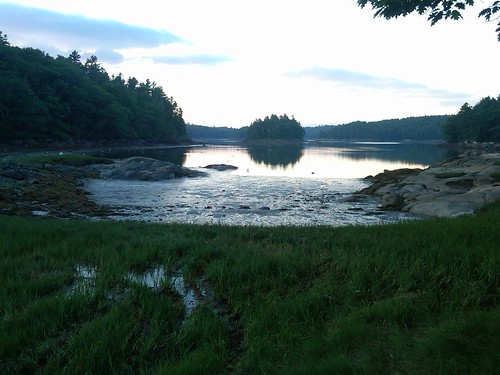
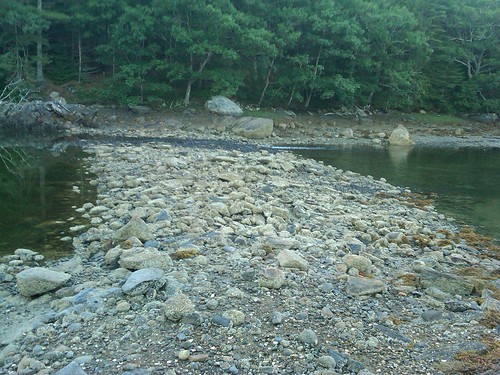
Last night I checked out the remains of a tide mill site at the upper end of the southeastern arm of the Basin. You can see where a stone structure was built across the mouth of the tidal flat. Last night, on a dropping tide, the water was flowing down over the stone structure, keeping a bed of mussels very happy.

Basin

I have found one source that says there were once two tide mills at this location. Other than the stone structure and evidence of old roads in the area, I didn't see much else in the way of obvious archeological clues. The mill pond is still relatively deep on the west side, and I did see small fish swimming around above the rock ramp. Black-backed and herring gulls were dropping shellfish onto the ledges to crack their shells, and several osprey passed overhead carrying their cleaned catches back to their nests.

Today, the Basin is protected by The Nature Conservancy. An anonymous donor left nearly 2,000 acres to TNC. Clam diggers still bring in a substantial harvest from the upper Basin (including the tide flats above the rock structure in the picture above), and it is a popular site for hiking, biking, and hunting.

June 21, 2010 - adventure and news

Monday, June 21, 2010

From the energy/adventure department: yesterday I went kayaking on Center Pond in Phippsburg, Maine. (Thanks to the Phippsburg Land Trust for helping conserve the lands and access!) Center Pond, like Winnegance, was originally a tidal salt marsh. It was dammed in 1883 to make an ice pond. Ice was big business along the lower Kennebec, as it was the principal source of refrigeration for the world, and the combination of clean fresh water and proximity to shipping made the Kennebec a busy place for shipping ice.

I had a great paddle, although I did get chased off by a powerful lightning storm that ended up knocking out power for a few hours.
From Energy Policy Update

Quick energy policy news: an editorial in today's Morning Sentinel about biomass energy. This article comes in the wake of recent studies suggesting that despite other analyses, biomass combustion does have carbon and climate impacts. Indeed, several recent studies have suggested that not only does biomass combustion emit long-term atmospheric carbon, but that increased harvesting will exacerbate the carbon imbalance. The editorial notes that in Maine, biomass for combustion has typically come from wood waste and thinnings, not wood suitable for use for pulp, fiber or lumber, and suggests a compromise that may include restrictions that require the use of wood waste and thinning, not higher value material.

This is consistent with a conversation I had this morning with a client. We were discussing biomass markets and the federal BCAP program. He told me that BCAP was responsible for a number of processors setting up chippers in the woods in order to participate in the incentive program, and that some of this BCAP-induced activity involved chipping wood that could have been used for fiber or lumber. I've heard similar accounts several times in the months since BCAP went live.

June 8, 2010 - tidal power in history: Winnegance to Passamaquoddy

Tuesday, June 8, 2010

I was fortunate to use wind power yesterday afternoon: I went sailing with a colleague on his Hunter 41. While on my way to the dock in Falmouth, I stopped by the site of a historic tide mill:
From Energy Policy Update
This isn't the best photo, but beyond the picnic table, you can see a stone pier extending across the mouth of Mill Creek. It seems information on the history of this mill site is limited, but it is suggested that it milled grain, and then lumber. The Town of Falmouth maintains a short but nice trail here, although parking is very limited.

In 1935, President Franklin Delano Roosevelt created the Federal Writers' Project, a program under the WPA designed to put writers to work while promoting economic development through tourism and industry. The project published 48 state guides to America (plus Alaska, Puerto Rico and Washington, D.C.) known as the American Guide Series. Each state in this series compiled its own detailed histories and descriptions of every city and town, along with narratives of interesting automobile tours.

Yesterday, I looked at the history of tidal power development at Winnegance, near Bath and Phippsburg, Maine. The 1937 Maine Writers' Project Guide describes the one remaining tide mill at Winnegance:

At 3 m. is the junction with a dirt road. Left on this road to a Tide Mill, 0.4 m., which until 1935 was used for cutting lumber. This old structure is a primitive forerunner of the mills and factories planned as part of the Passamquoddy Power Project.

So we can see that by 1937, policymakers including the federal government were reconsidering Maine's tidal power resources. Winnegance's tide mills were just on their way out, but the Passamaquoddy Power Project was just on the eastern horizon. Tomorrow I'll look at the 500 MW PPP in more depth.

June 7, 2010 - historic tidal energy: tide mills and

Monday, June 7, 2010

I've been looking into the history of tidal power and coastal use policy. The Winnegance story is illustrative of the kind of resources and opportunities that exist along the coast of Maine and many other states, as well as the kinds of conflicts that arise through development of these resources.

One classic conflict is between energy development and environmental protection. For dam proposals, whether tidal or in rivers, one of the common considerations is the impact on fish. Recently, this came up in the Fort Halifax dam case, where a lack of agreement over fish passage resulted in 2008 in the depowering and removal of the 1908 dam.

Fish protection came up with the dams and mills at Winnegance as early as 1892. In that year, the Supreme Judicial Court of Maine considered the case Oliver v. Bailey. On February 24, 1892, game wardens on patrol came across a bass net that had been strung across Winnegance Creek by John Oliver, whose property abutted the stream. This was prohibited by a special act passed in 1885, which regulated the level of water behind the dam as well as the catching of bass in Winnegance Creek.

The Court's opinion notes the the local history and alterations to land use based on commercial needs:

prior to 1837 Winnegance creek was an Inlet of the Kennebec river; that in that year, under the charter granted in 1835, the dam was erected across said creek, and northeast of the public highway, extending from the Bath to the Phippsburg shore; that sawmills on the dam were erected, and gates constructed, for the purpose of sawing lumber; and that the dam so erected, and the mills so constructed, thereon, had for their purpose the utilization of water to be held In the creek above said dam by the operation of said gates.

The Court's opinion provides an interesting look into how the tide mills played a major role in shaping the local landscape:
It was also agreed that since said date, at different times, as business might warrant, the several mills upon said dam have been in operation; that the owners of said mills each have above the same, and between the dam and the highway, booming privileges. In which to place their logs, and that the same were set off and allotted to the several owners of the mills on said dam, wherein each might place and hold his logs for use; that the flood gates in said dam are 18 feet wide, would admit scows, lighters, and rowboats, and that such had at times passed through said gates, and under said highway; that, at a certain time of tide, mastless scows, skiffs, and boats can pass under said highway, provided the owners of the booming privileges leave an opening so to do; and that there has been place left by the owners of said booming privileges for craft, of the kind and type designated, to pass up said creek.

The court again addressed the impacts of the tide mill development on navigation and commerce:
It was also agreed that the bridge connecting the city of Bath and the town of Phippsburg has been maintained by both for many years; that said bridge is built, legally, of cobwork spiling, and across the channel are stringers, affording a space under said bridge from 30 to 40 feet long, that gundolos may pass through up and down; that some 40 years ago a schooner was built and launched In the creek, and taken out to the Kennebec river, by removing a portion of the dam sufficient to give passage to said schooner from the creek Into the river; that the lighters mentioned, carrying boards and wood of some kind, have occasionally passed through the gates, and under the bridge; and that the millowners, when the tide had reached its flood, have all the gates so constructed that, at the beginning of slack water, they close, and the water is held for the purpose of running the mills constructed on said dam.

Oliver argued that the regulations were "intended only for the protection of salt-water fish, or fish that migrate between salt and fresh water". Oliver argued that the 1835 legislative dam authorization and 1837 dam construction, use of the upstream pond for booming logs, and limited navigation through the dam, "separated Wlnnegance creek above the dam from the general body of the tidal waters of the state, and taken it out of the above-cited statutes for the protection of migratory fish."

The Supreme Judicial Court disagreed, stating, "The statutory protection of these fish is as important now as before the erection of the dam." Oliver lost his case, and presumably his net.

In Oliver's case, the court wrestled with the question of whether the tidal power development had so fundamentally changed the landscape as to take Winnegance Creek from tidal to non-tidal status. The court concluded that, in light of environmental considerations, it had not. There may have been other more subtle issues in play in the 1892 case, but it provides an interesting window into the past history of tidal energy development in Maine.

I'm curious how this issue would be addressed today. What are the inshore effects of tidal barrage and related power technologies? Today these issues might not come up in the context of game wardens, but the descriptions of the tide mills' impacts of navigation, commerce, and fisheries all have relevance to modern tidal power development.

Soon to come: more Winnegance history, and a look at how things were for the much larger Passamaquoddy Power Project in the 1930s.