Showing posts with label Boston. Show all posts

Tide Mill Institute 2018 symposium

Friday, September 28, 2018

Tide Mill Institute holds its 14th annual conference on November 10, 2018, in Beverly, Massachusetts. The symposium -- "Creating Tide Mills -- Then and Now", features educators, historians, environmentalists, archeologists and others interested in tidal power and its history.

Tide Mill Institute exists to advance the appreciation of tide mill history and technology by encouraging research, by promoting appropriate re-uses of former tide mill sites, and by fostering communication among tide mill enthusiasts. Since 2005, the Institute has held an annual symposium on the past, present, and future uses of tidal energy.

This year's conference topics focus on how humans historically extracted power from the tides, as well as on efforts to use this power again in the current era. Speakers and discussions will address topics including:
  • Medieval vertical and horizontal millwheels and their diffusion from mainland Europe.
  • Fresh-water tidal rice mills in South Carolina.
  • An in-stream tidal device in New York’s East River supplying power to the grid.
  • Proposed perpetual tidal power system for Salem Massachusetts.
  • A tide mill at the heart of the 1775 Battle of Brooklyn.
  • Winter storm surges damage historic tide mills in Massachusetts and New York.
  • Recreating gearing features of two early North Shore tide mills.
  • A new tidal energy canal for Boston?
  • The structure of tide mill dams.
Tide Mill Institute's 2018 symposium will be held on Saturday, November 10, 2018, from 8:30 am to 4:00 pm, at the Cummings Center in Beverly, Massachusetts. Registration materials are available on Tide Mill Institute's website. Lunch is included; attendees are encouraged to register by November 1.

FERC Summer 2016 energy market and reliability report

Friday, May 20, 2016

Federal energy regulatory staff have presented their 2016 Summer Seasonal Assessment to the Federal Energy Regulatory Commission.  The "Summer 2016 Energy Market and Reliability Assessment" presents an summer outlook by FERC's Office of Electric Reliability and Office of Enforcement on electricity and natural gas markets and reliability issues.

Highlights include:
  • "low natural gas prices that have resulted from robust production and near record levels of natural gas in storage"
  • electric system reserve margins are expected to be adequate this summer, though tighter in Texas
  • total U.S. load forecast, when weather-adjusted, is essentially unchanged in recent years, largely due to little to no load growth in commercial and residential sectors
  • the total generating capacity in the U.S. has decreased by approximately 2 percent since last summer, primarily due to coal retirements. According to the report, "The factors that prompted these closures include increased competition from natural gas, environmental regulations and an average fleet age that exceeded 50 years old."
  • Over 18 gigawatts of new generating capacity will be installed nationwide through the summer, with a majority of these capacity additions coming from renewables such as wind and solar, plus the first new U.S. nuclear unit in over 20 years.
  • Organized markets are attempting to manage the growing impacts of renewable generation.
  • FERC staff expects natural gas fired generation to remain robust; natural gas fired generation has surpassed coal plant output since July 2015. Meanwhile coal stockpiles are growing due to a decrease in coal generation.
  • Natural gas future prices have fallen since last year, though the Boston region's price drop is not significant.  Basis swaps -- financial instruments that represent the natural gas price differential between a specific point and the Henry Hub -- for Boston are priced higher than last summer, "suggesting expectations for greater congestion due to above-normal temperatures and a reduction in capacity along the Algonquin pipeline because of planned maintenance to tie in the Algonquin Incremental Market (AIM) expansion project this summer."

New England offshore wind advances

Friday, February 24, 2012

Plans to generate electricity from offshore winds off the southern New England coast appear to be gathering some momentum, as a series of events unrolling this month favor offshore wind development.

On February 3, the U.S. Bureau of Ocean Energy Management took the initial steps in its process to lease sites for offshore wind projects in federal waters off Massachusetts.  BOEM requested information about uses of an area of sea about about 12 nautical miles south of the islands of Martha’s Vineyard and Nantucket, as well as expressions of interest by developers identifying particular sites.  Responses to the call for information and nominations, as the key document is known, are due in mid-March.

Last week, Massachusetts officials announced a proposed settlement that would allow utilities NSTAR and Northeast Utilities to merge, but only on the condition that the resulting utility sign a long-term contract to buy power from the proposed Cape Wind project.  Cape Wind already has a power purchase agreement with utility National Grid for half the project's output; if the NSTAR deal is approved, Cape Wind would have power purchase agreements in place for 77.5% of its expected output.  Proponents hope that this increased certainty around the project's revenues could enable the project to be financed and built.

This week, Boston hosted a major offshore wind industry conference.  Today, the U.S. Bureau of Ocean Energy Management plans to make an announcement "latest milestone in commercial wind energy planning and leasing in the area of mutual interest offshore of Rhode Island and Massachusetts."

None of these steps alone may be sufficient to spur offshore wind development in New England waters, but collectively these steps illustrate how multiple levels of government are promoting offshore wind.  Will their collective result produce power in the near term?

Massachusetts offshore wind meetings held

Wednesday, February 15, 2012

Federal ocean managers plan to lease ocean waters south of Massachusetts to developers of offshore wind energy projects.  This month the Bureau of Ocean Energy Management opened its leasing process for 826,241 acres of water about 12 nautical miles south of Martha's Vineyard and Nantucket.

The newly opened leasing area is relatively large -- about 6% larger than the state of Rhode Island, or about 50 times larger than the 25 square mile footprint proposed for the Cape Wind project.  Nevertheless it is less than half of the size of the area originally proposed for offshore wind leasing off Massachusetts.

BOEM's "Smart from the Start" leasing process includes holding public meetings to allow stakeholders to weigh in.  This week BOEM held meetings in Vineyard Haven, New Bedford, and Boston.

BOEM's Call for Information and Nominations for the waters off Massachusetts asks developers to indicate interest by March 22, 2012.

July 1, 2010 - tidal power in the Basin

Thursday, July 1, 2010

Reporting from Boston today: this morning I attended a forum held at the British Consulate on energy and cleantech R&D opportunities, and had several good meetings to catch up with friends in the city. I'm always impressed by how much Boston has going on. Here's a peek out my office window here in Boston:

Boston skyline

Now, back to Maine, for a look at the tidal power history of the Basin, past and present.

Basin

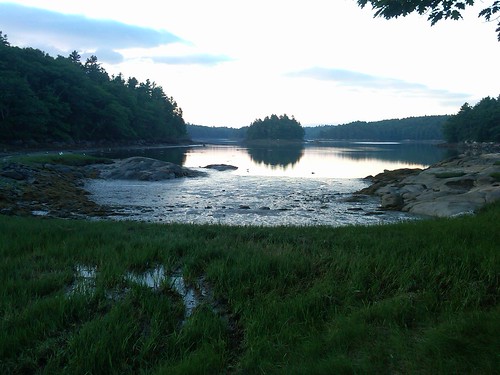
The Basin is a nearly-completely enclosed bay in the town of Phippsburg, Maine. On a satellite photo map, you can see how the tide would ascend the New Meadows River (here, effectively a bay in the ocean) and then enter the narrow gates of the Basin between Brightwater and the Denny Reed Point area.

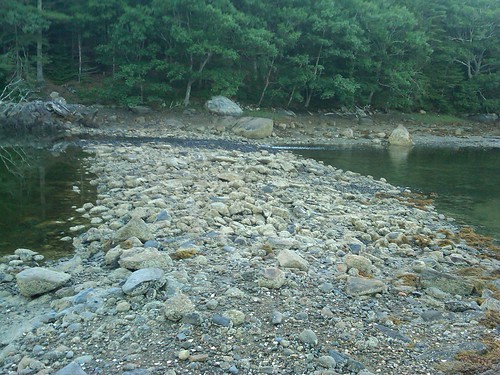
Last night I checked out the remains of a tide mill site at the upper end of the southeastern arm of the Basin. You can see where a stone structure was built across the mouth of the tidal flat. Last night, on a dropping tide, the water was flowing down over the stone structure, keeping a bed of mussels very happy.

Basin

I have found one source that says there were once two tide mills at this location. Other than the stone structure and evidence of old roads in the area, I didn't see much else in the way of obvious archeological clues. The mill pond is still relatively deep on the west side, and I did see small fish swimming around above the rock ramp. Black-backed and herring gulls were dropping shellfish onto the ledges to crack their shells, and several osprey passed overhead carrying their cleaned catches back to their nests.

Today, the Basin is protected by The Nature Conservancy. An anonymous donor left nearly 2,000 acres to TNC. Clam diggers still bring in a substantial harvest from the upper Basin (including the tide flats above the rock structure in the picture above), and it is a popular site for hiking, biking, and hunting.