Showing posts with label mill. Show all posts

Tide Mill Institute 2018 symposium

Friday, September 28, 2018

Tide Mill Institute holds its 14th annual conference on November 10, 2018, in Beverly, Massachusetts. The symposium -- "Creating Tide Mills -- Then and Now", features educators, historians, environmentalists, archeologists and others interested in tidal power and its history.

Tide Mill Institute exists to advance the appreciation of tide mill history and technology by encouraging research, by promoting appropriate re-uses of former tide mill sites, and by fostering communication among tide mill enthusiasts. Since 2005, the Institute has held an annual symposium on the past, present, and future uses of tidal energy.

This year's conference topics focus on how humans historically extracted power from the tides, as well as on efforts to use this power again in the current era. Speakers and discussions will address topics including:
  • Medieval vertical and horizontal millwheels and their diffusion from mainland Europe.
  • Fresh-water tidal rice mills in South Carolina.
  • An in-stream tidal device in New York’s East River supplying power to the grid.
  • Proposed perpetual tidal power system for Salem Massachusetts.
  • A tide mill at the heart of the 1775 Battle of Brooklyn.
  • Winter storm surges damage historic tide mills in Massachusetts and New York.
  • Recreating gearing features of two early North Shore tide mills.
  • A new tidal energy canal for Boston?
  • The structure of tide mill dams.
Tide Mill Institute's 2018 symposium will be held on Saturday, November 10, 2018, from 8:30 am to 4:00 pm, at the Cummings Center in Beverly, Massachusetts. Registration materials are available on Tide Mill Institute's website. Lunch is included; attendees are encouraged to register by November 1.

Restoring old mill hydro sites and FERC licensure

Friday, February 5, 2016

Suppose you own an existing water powered mill complex whose hydromechanical facilities have not been operational for decades.  You would like to develop a hydropower project at the site, using the existing dam, headrace, and headgates, plus new equipment including two small generators, penstocks, and appurtenant facilities, to provide electricity to your home and workshop.  Do you need a license from the Federal Energy Regulatory Commission?

In the case of the Egnaczak Net Zero Hydro Project proposed for the outlet of the Hoosic River in Cheshire, Massachusetts, the FERC concluded that section 23(b)(1) of the Federal Power Act requires that project's owners to obtain a license for the project's construction, maintenance, and operation.  Proposed by Kenneth and Susan Egnaczak, the Egnaczak Net Zero Hydro Project would have a total generating capacity of 10.7 kilowatts.

Pursuant to section 23(b)(1) of the Federal Power Act, a non-federal hydroelectric project must be licensed (unless it has a still-valid pre-1920 federal permit) if it:
(a) is located on a navigable water of the United States;
(b) occupies lands or reservations of the United States;
(c) utilizes surplus water or waterpower from a government dam; or
(d) is located on a stream over which Congress has Commerce Clause jurisdiction, is constructed or modified on or after August 26, 1935, and affects the interests of interstate or foreign commerce.
The fourth prong itself has three main elements: project located on a Commerce Clause stream, post-1935 construction or modification, affecting interstate commerce.  In this case, FERC concluded that the Egnaczak project satisfied the fourth prong.

First, FERC found that the Egnaczak project is located on a Commerce Clause stream.  Under a 1965 Supreme Court ruling, for purposes of Federal Power Act section 23(b)(1), Commerce Clause streams are the headwaters and tributaries of navigable waters of the United States.  While FERC declined to determine whether the Hoosic River is navigable at the site of the project, it concluded that downstream segments of the Hoosic are navigable, as is the Hudson River into which the Hoosic flows.

Second, FERC next found that installing new hydroelectric generating capacity constitutes post-1935 construction within the meaning of Federal Power Act section 23(b)(1). 

Third, FERC found that the project would offset both electrical and heating needs that would have been otherwise supplied by the interstate grid -- and thus that the project would affect the interests of interstate commerce.  A footnote notes, "It is well settled that small hydroelectric projects that are connected to the interstate grid affect interstate commerce by displacing power from the grid, and the cumulative effect of the national class of these small projects is significant for purposes of FPA section 23(b)(1)."

FERC concluded that because the project would be located on a Commerce Clause stream, would be constructed after 1935, and would affect interstate commerce through its connection to the interstate grid, Section 23(b)(1) of the Federal Power Act requires Kenneth and Susan Egnaczak to obtain a license for the project's construction, maintenance, and operation.  The FERC order also suggests the project may be eligible to obtain an exemption from licensing as a small hydroelectric power project of 10 megawatts or less, and encourages the applicants to investigate the requirements for securing an exemption from licensure.

Pittsfield NH dam repowering project

Thursday, May 24, 2012

As governments and businesses consider the hydroelectric potential of existing non-powered dams, competition is heating up to claim and evaluate the best sites.  Federal regulators yesterday resolved a conflict between two developers by awarding a preliminary permit to a developer interested in studying the feasibility of repowering or rebuilding hydroelectric energy production at an existing mill dam on the Suncook River in Pittsfield, New Hampshire.

Another former mill dam in the heart of a New England village: the Doughty Dam in North Berwick, Maine.

Yesterday's order by the Federal Energy Regulatory Commission (9-page PDF) granted a preliminary permit to KC Hydro LLC of New Hampshire to study the feasibility of the Pittsfield Mill Dam Hydropower Project.  Originally built for industrial purposes, the Pittsfield Mill Dam is currently owned by the New Hampshire Department of Environmental Services.

As described in KC Hydro's original permit application (11-page PDF), the project concept involved either restoring an existing but mothballed 415 kW turbine which previously operated under an exemption from licensing, or installing entirely new facilities (potentially with a 530 kW capacity) to capture the hydroelectric potential of the water already impounded behind the dam.

After KC Hydro submitted its preliminary permit, another developer - AMENICO Green Solutions, LLC - applied for a competing preliminary permit for the same site.  AMENICO proposed a similar project, which focused on restoring the existing 415 kW turbine.  AMENICO noted that it had property rights to the site, which it claimed KC Hydro did not.

Noting that the applications were comparable, FERC recited its standard for resolving the competing claims:
Staff has reviewed the applications and found no basis for concluding that either applicant’s plan is superior to the other. Neither applicant has presented a plan based on detailed studies or the results of agency consultation. Where the plans of the applicants are equally well adapted to develop, conserve, and utilize in the public interest the water resources of the region, the Commission will favor the applicant with the earliest application acceptance date.
Because KC Hydro had applied first, FERC awarded the preliminary permit to KC Hydro.  In doing so, FERC noted that a permit applicant is not required to have obtained all access rights to a project site as a condition of receiving a preliminary permit.  However, FERC did note that a preliminary permit does not grant a right of entry onto any lands, so a permittee must obtain any necessary authorizations and comply with any applicable laws and regulations to conduct any field studies.

With its preliminary permit in hand, KC Hydro now has 3 years to investigate the site and apply for a full project license.  Will the Pittsfield dam ultimately be repowered?

Sunken history behind Penobscot dams

Monday, April 30, 2012

As two dams come out of Maine's Penobscot River, the conservation organization leading the dam removal effort has discovered what historians might view as sunken treasure: submerged mill dam structures from centuries past.  At the same time, these sunken dam remnants may continue to impede fish passage once the modern dams are removed, potentially frustrating the dam owner's intent in removing them.

The Penobscot River Restoration Trust is undertaking the removal of the Veazie and Great Works Dams on the Penobscot River.  Following a 2004 settlement agreement among previous dam owners, environmental and conservation groups, and governmental agencies, the Federal Energy Regulatory Commission approved their removal, along with the installation of fish passage equipment at the upstream Howland dam on the Piscataquis River.

Dam removal is expected to help fish and other aquatic wildlife, but FERC required the Trust to develop a plan to mitigate any adverse impacts of dam removal on infrastructure and archaeologic resources.  For example, the Trust knew that the historic remnants of previous dams and lumber mills lay submerged in the impoundment behind the Veazie Dam.  The remnants are associated with a series of lumber mills successively known as the Penobscot Mill Dam Company Mills, the City Mills, the Corporation Mills, and the Veazie Lumber Company Mill, which consisted of two sets of saw mills connected along water-control structures that ran parallel to the Penobscot River, and which were constructed in the mid-nineteenth century. Moreover, the site was purchased in 1889 for use as one of Maine’s first
hydroelectric facilities.

The Trust, along with the state historical preservation office, entered into a memorandum of agreement requiring the Trust to document the Veazie remnant structures after the modern dam is removed.  Because the historic mill dam is expected to impair natural river flow after the modern dam is gone, the Trust also plans to remove the historic structure after it is documented.

As it turns out, the historic Veazie dam is not the only historic or archaeological resource submerged beneath the Penobscot River's waters. While finalizing plans for removal of the Great Works dam, the Trust discovered that a similar, inundated, remnant structures exist in the Great Works impoundment.  The structural remains within the impoundment of the Great Works Dam were constructed as two structures in the early 19th century to provide water for two early sawmill complexes on the Penobscot River at Great Works: for the mills of Rufus Dwinel on the west bank, and for the mills of the Great Works Milling and Manufacturing Company on the east bank. These original dams, on each side of the river, were built as wing dams that extended upriver and out from the river bank, and likely were built independently of each other. The two dams were then consolidated under a single ownership in the early 1880s by the Penobscot Chemical Fibre Company, who built an early mill for producing wood pulp for paper on the Penobscot River.

Both of these sites may be eligible for nomination to the National Register of Historic Places as historic archaeological sites.

As a result of the re-discovery of these additional historic remnants, the Trust sought and obtained FERC's approval to document and remove part of the historic Great Works structures.  The Trust anticipates removing the modern Great Works dam as early as this summer.

October 20, 2010 - renewable energy certificates

Wednesday, October 20, 2010

Busy harbor in Norfolk, VA, with ships old and new.
I'm back from the TAPPI PEERS conference in Norfolk, Virginia.  TAPPI put on a great show, and the participants were very enthusiastic about the technical aspects of the pulp and paper industry.  I offered a presentation about renewable energy certificates (also known as renewable energy credits in some states - either way, RECs). A REC is a non-tangible trad\able commodity representing a set of the environmental, social and other non-power attributes of renewable electricity generation.
In the United States, federal and state policies favor renewable energy production by providing incentives for the development of renewable power resources. One primary state-level mechanism for rewarding renewable generators is the Renewable Energy Certificate (REC) market. In many states, laws and regulations require utilities to source a specified portion of their power from qualified renewable resources. Utilities satisfy this compliance obligation by purchasing or otherwise obtaining RECs to cover this load. In addition, a variety of voluntary markets exist for RECs.

Pulp and paper mills are well-positioned to participate in the REC market as sellers. As shaped by the forces of history and economics, today's mills often operate renewable generation such as a hydroelectric generation station or a biomass-fired steam turbine generator. For each megawatt-hour of qualified renewable power generated at a mill, a certified resource's owner will receive one REC. Owners can then sell these RECs in voluntary or compliance markets. The opportunity to sell RECs can enhance the economics of a mill and its renewable generation.

August 5, 2010 - Patriot Place gets solar power; integrating wind into the grid

Thursday, August 5, 2010

 
 Solar power in action: making wind, pushing sails past Ram Island Light, Boothbay Harbor, Maine.

Several large utilities including Duke Energy Corp. have reported significantly increased power sales for the second quarter of 2010, particularly from industrial customers.  Duke now projects that 2010 power sales will rise 2%.  At its midwestern operating companies, Duke noted 20% growth in industrial power sales.

Here's a short letter to the editor of the Lewiston Sun Journal about old swimming holes now gone, including the impoundments behind older mill dams like the Barker Mill Dam on the Little Androscoggin River.

Add another high-profile place to the list of large businesses adding solar power: Patriot Place, the shopping mall adjoining the New England Patriots' Gillette Stadium, has installed a 525 kW solar array.  They turned to Constellation Energy for the installation, but the solar photovoltaic panels themselves were manufactured by Evergreen Solar of Massachusetts.

Wind turbine prices are flat, averaging about $1.37 million per megawatt of capacity according to a survey by Bloomberg New Energy Finance.  (Note that this is just the turbine price; towers, transmission and installation are all in addition to the turbine price.)  Turbine pricing is down about 15% from its peak in 2008, likely due to a mix of factors including new technology and increased production capacity, but also some decreased demand compared to the initial fervor.

Meanwhile, people continue to solve the problem of how to integrate wind into the grid.  Energy storage is one major approach.  Xcel Energy has issued a report on its experiments with massive 1 megawatt batteries to smooth out voltage and current from wind farms.  Xcel's project in Minnesota is promoted as America's first direct wind-energy-storage project.

July 8, 2010 - a look at the Half Moon Tidal Energy project; news roundup

Thursday, July 8, 2010

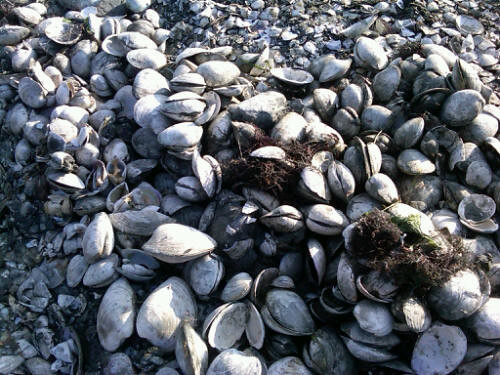
Quahog shells at New Meadows:
New Meadows harvest

Today, following on my recent posting about FERC marine hydrokinetic projects in Maine, I'm looking at some more specific information about one of the projects: P-12704, the Half Moon Tidal Energy project proposed by Tidewalker Associates for Cobscook Bay.

The brainchild of Dr. Normand Laberge, Tidewalker Associates is exploring several marine energy resources. In April 2007, Tidewalker received a Preliminary Permit for its Half-Moon Cove Tidal Power Project (P-12704). By March 2009, Tidewalker had done enough studies to move forward with a Pre-Application Document (PAD) and Notification of Intent (NOI) seeking authorization from FERC to construct its tidal power project in Half-Moon Cove.

On April 12, 2010, Tidewalker Associates filed a successive preliminary permit application, pursuant to section 4(f) of the Federal Power Act (FPA), proposing to study the feasibility of the Half-Moon Cove Tidal Power Project. The FERC Notice describes the current proposal:
The proposed project would consist of: (1) a new 1,200-foot-long rock-filled barrage with a crest elevation of approximately 27 feet above mean sea level (msl); (2) a new 30-foot-wide, 15-foot-high filling and empting gated section; (3) the 850-acre Half-Moon Cove with a surface elevation of 13.0 feet above msl; (4) a new powerhouse with four turbine generating units with a total capacity of 9.0 megawatts; and (5) a new 34.5 kilovolt, 7.1-mile-long transmission line. The project would produce an estimated average annual generation of about 45,000 megawatt-hours.

Comments, motions to intervene, competing applications, and notices of intent to file competing applications are all due by mid-July.

Resources:
2007 project presentation on cobscook.org


Other energy news:
Maine's Land Use Regulation Commission took a straw vote on TransCanada Corp.'s request to add 631 acres in Franklin County to the list of locations where industrial wind energy projects benefit from a streamlined permitting process. Result: if they voted today, LURC would deny the request.

New Meadows is in the news, as quahog harvesting continues like wildfire. Unlike most Maine shellfish beds, the New Meadows quahog flats are regulated by the state (instead of towns) because even at low tide, the flats remain covered by water. Combine this lighter (and cheaper) regulation with the reopening of the flats after 5 years of pollution closure, and you get a whole lot of harvesting.

New Meadows' namesake


Steve LaFreniere, owner of Eastbrook Timber Corp. of West Enfield, bought the Saunders Brothers mill in Greenwood at auction yesterday for $450,000. The wooden dowel mill closed in May, leaving 55 people out of work. LaFreniere is reported as saying he intends to resume dowel production. The auction was the result of a mortgage foreclosure. There has been a mill at the site since 1819, when Samuel Locke founded the industry at what became known as Locke Mills village.

June 7, 2010 - historic tidal energy: tide mills and

Monday, June 7, 2010

I've been looking into the history of tidal power and coastal use policy. The Winnegance story is illustrative of the kind of resources and opportunities that exist along the coast of Maine and many other states, as well as the kinds of conflicts that arise through development of these resources.

One classic conflict is between energy development and environmental protection. For dam proposals, whether tidal or in rivers, one of the common considerations is the impact on fish. Recently, this came up in the Fort Halifax dam case, where a lack of agreement over fish passage resulted in 2008 in the depowering and removal of the 1908 dam.

Fish protection came up with the dams and mills at Winnegance as early as 1892. In that year, the Supreme Judicial Court of Maine considered the case Oliver v. Bailey. On February 24, 1892, game wardens on patrol came across a bass net that had been strung across Winnegance Creek by John Oliver, whose property abutted the stream. This was prohibited by a special act passed in 1885, which regulated the level of water behind the dam as well as the catching of bass in Winnegance Creek.

The Court's opinion notes the the local history and alterations to land use based on commercial needs:

prior to 1837 Winnegance creek was an Inlet of the Kennebec river; that in that year, under the charter granted in 1835, the dam was erected across said creek, and northeast of the public highway, extending from the Bath to the Phippsburg shore; that sawmills on the dam were erected, and gates constructed, for the purpose of sawing lumber; and that the dam so erected, and the mills so constructed, thereon, had for their purpose the utilization of water to be held In the creek above said dam by the operation of said gates.

The Court's opinion provides an interesting look into how the tide mills played a major role in shaping the local landscape:
It was also agreed that since said date, at different times, as business might warrant, the several mills upon said dam have been in operation; that the owners of said mills each have above the same, and between the dam and the highway, booming privileges. In which to place their logs, and that the same were set off and allotted to the several owners of the mills on said dam, wherein each might place and hold his logs for use; that the flood gates in said dam are 18 feet wide, would admit scows, lighters, and rowboats, and that such had at times passed through said gates, and under said highway; that, at a certain time of tide, mastless scows, skiffs, and boats can pass under said highway, provided the owners of the booming privileges leave an opening so to do; and that there has been place left by the owners of said booming privileges for craft, of the kind and type designated, to pass up said creek.

The court again addressed the impacts of the tide mill development on navigation and commerce:
It was also agreed that the bridge connecting the city of Bath and the town of Phippsburg has been maintained by both for many years; that said bridge is built, legally, of cobwork spiling, and across the channel are stringers, affording a space under said bridge from 30 to 40 feet long, that gundolos may pass through up and down; that some 40 years ago a schooner was built and launched In the creek, and taken out to the Kennebec river, by removing a portion of the dam sufficient to give passage to said schooner from the creek Into the river; that the lighters mentioned, carrying boards and wood of some kind, have occasionally passed through the gates, and under the bridge; and that the millowners, when the tide had reached its flood, have all the gates so constructed that, at the beginning of slack water, they close, and the water is held for the purpose of running the mills constructed on said dam.

Oliver argued that the regulations were "intended only for the protection of salt-water fish, or fish that migrate between salt and fresh water". Oliver argued that the 1835 legislative dam authorization and 1837 dam construction, use of the upstream pond for booming logs, and limited navigation through the dam, "separated Wlnnegance creek above the dam from the general body of the tidal waters of the state, and taken it out of the above-cited statutes for the protection of migratory fish."

The Supreme Judicial Court disagreed, stating, "The statutory protection of these fish is as important now as before the erection of the dam." Oliver lost his case, and presumably his net.

In Oliver's case, the court wrestled with the question of whether the tidal power development had so fundamentally changed the landscape as to take Winnegance Creek from tidal to non-tidal status. The court concluded that, in light of environmental considerations, it had not. There may have been other more subtle issues in play in the 1892 case, but it provides an interesting window into the past history of tidal energy development in Maine.

I'm curious how this issue would be addressed today. What are the inshore effects of tidal barrage and related power technologies? Today these issues might not come up in the context of game wardens, but the descriptions of the tide mills' impacts of navigation, commerce, and fisheries all have relevance to modern tidal power development.

Soon to come: more Winnegance history, and a look at how things were for the much larger Passamaquoddy Power Project in the 1930s.