
Energy powers society; society's choices shape energy policy. A blog about our energy resources and the choices they present for society.
Showing posts with label FERC. Show all posts
Showing posts with label FERC. Show all posts
FERC Order 2222 opens wholesale markets to distributed energy resource aggregators
Friday, September 18, 2020
U.S. electric utility regulators have issued an order requiring the nation's regional organized wholesale electric markets to allow participation by portfolios of solar projects and other distributed energy resources. The Federal Energy Regulatory Commission's Order 2222 finds that existing regional electricity market rules are unjust and unreasonable in light of barriers that they present to the participation of DER aggregations in these markets, and requires regional grid operators to revise their tariffs to accomodate distributed energy resource aggregators. While further process and uncertainty remain ahead, FERC Order 2222 should facilitate the development of distributed energy resources by removing barriers to electricity market participation.
As defined by the FERC, distributed energy resources (DER) encompass a variety of types of technology when installed on the distribution system, a distribution subsystem or behind a customer meter. Typically less than 10,000 kilowatts in capacity for each installation, DER technologies include solar photovoltaic systems and other distributed generation or intermittent generation, electric storage, electric vehicles and their charging equipment, thermal storage, and other consumer-side measures like demand response and energy efficiency. The U.S. is experiencing significant growth in the number and size of DERs installed on the system, due to factors including federal tax incentives and state incentives, as well as considerations of reliability and utility rate design.
Through Order 2222, issued on September 17, 2020, FERC has now found "that existing RTO/ISO market rules are unjust and unreasonable in light of barriers that they present to the participation of distributed energy resource aggregations in the RTO/ISO markets, which reduce competition and fail to ensure just and reasonable rates." As a result, the Commission adopted a final rule requiring regional transmission organizations and other organized wholesale market operators to establish DER aggregators as a type of market participant, to allow them to register their DERs under one or more participation models that accommodate the physical and operational characteristics of those resources and to participate in the regional organized wholesale capacity, energy and ancillary services markets. Order 2222 allows DERs to aggregate together to satisfy minimum size and performance requirements that they might not meet individually.
The boundaries between federal and state jurisdiction over DERs arise as a matter of federal law, and have occasionally been tested -- most recently in connection with FERC Order 841, governing storage. As noted by the Commission, its Order 2222 final rule "builds off the DC Circuit Court’s recent ruling on Order No. 841, in which the court affirmed the Commission’s exclusive jurisdiction over the regional wholesale power markets and the criteria for participation in those markets."
Order 2222 prohibits state regulators from broadly excluding DERs from participating in regional markets, but gives state retail regulatory authorities some power by creating a "small utility opt-in", as well as respecting states regulators’ current ability to prohibit aggregators from bidding retail customers’ demand response into regional markets. Regarding interconnection, Order 222 explains that "state and local authorities remain responsible for the interconnection of individual DERs for the purpose of participating in wholesale markets through a DER aggregation."
The final rule largely tracks a 2016 proposed rule developed by FERC staff, with some changes. The regulator appears excited to take this step. According to a fact sheet issued by the Commission under the title, "FERC Order No. 2222: A New Day for Distributed Energy Resources", Order 2222 "will help usher in the electric grid of the future and promote competition in electric markets by removing the barriers preventing distributed energy resources (DERs) from competing on a level playing field in the organized capacity, energy and ancillary services markets run by regional grid operators."
Order 2222's final rule will take effect 90 days after its publication in the Federal Register. Grid operators will then have 270 days within which they must submit to FERC a compliance filing and a plan for timely implementation of the final rule. While Order 2222 and federal laws place some constraints on what the grid operators may propose, each regional transmission organization or independent system operator has some leeway to develop and propose solutions it views as tailored to its own markets and needs. This feature of federalism will likely result in some diversity in terms of regional designs, to be considered through regional stakeholder discussion and the Commission's regulatory processes.

FERC sets carbon pricing and offshore wind tech conferences
Thursday, June 18, 2020
U.S. federal electricity regulators have scheduled technical conferences for this autumn to discuss issues related to two major policy initiatives: carbon pricing in organized wholesale electricity markets, and offshore wind integration in regional transmission organizations and independent system operators (RTOs/ISOs). The Federal Energy Regulatory Commission's scheduling of two technical conferences on these topics signals its interest in exploring the interplay between state energy and environmental policies and federally jurisdictional markets.
One technical conference regarding Carbon Pricing in Organized Wholesale Electricity Markets (Docket No. AD20-14-000) will be held on September 30, 2020, "to discuss considerations related to state adoption of mechanisms to price carbon dioxide emissions, commonly referred to as carbon pricing, in regions with Commission-jurisdictional organized wholesale electricity markets." The case has its genesis in a request for such an event, filed on April 13, 2020, by a broad coalition including Advanced Energy Economy, the American Council on Renewable Energy, the American Wind Energy Association, Brookfield Renewable, Calpine Corporation, Competitive Power Ventures, Inc., the Electric Power Supply Association, the Independent Power Producers of New York, Inc., LS Power Associates, L.P., the Natural Gas Supply Association, NextEra Energy, Inc., PJM Power Providers Group, R Street Institute, and Vistra Energy Corp. A number of other utilities, RTOs, and state interests also expressed support, prior to the Commission's issuance of a public notice on June 17 scheduling the event.
Another technical conference regarding Offshore Wind Integration in RTOs/ISOs (Docket No. AD20-18-000), to be held October 27, 2020, will be convened "to discuss whether existing Commission transmission, interconnection, and merchant transmission facility frameworks in RTOs/ISOs can accommodate anticipated growth in offshore wind generation in an efficient and effective manner that safeguards open access transmission principles and to consider possible changes or improvements to the current framework should they be needed to accommodate such growth."
Beyond the fact that the Commission issued notices of both technical conferences on June 17, 2020, the proceedings also share a common focus on the effects of state energy and environmental policies on federally-jurisdictional activities. For now, the prevailing carbon pricing mechanisms -- such as the Regional Greenhouse Gas Initiative adopted by many northeastern states -- and the strongest policies favoring or requiring offshore wind development are arising as a matter of state law and policy, as opposed to federal law.
The boundaries between federal and state jurisdiction are viewed by many as long-settled, although a series of federal court and agency decisions have found specific state electricity procurement and subsidy laws to be preempted by federal regulation, and a case pending before the Commission asks it to find that most state net metering programs are preempted by federal law. Whether the Commission grants or denies the pending request, the June 17 notices of technical conferences on carbon pricing and offshore wind integration suggest continued federal interest in exploring the implications of state policies on FERC-jurisdictional markets.
One technical conference regarding Carbon Pricing in Organized Wholesale Electricity Markets (Docket No. AD20-14-000) will be held on September 30, 2020, "to discuss considerations related to state adoption of mechanisms to price carbon dioxide emissions, commonly referred to as carbon pricing, in regions with Commission-jurisdictional organized wholesale electricity markets." The case has its genesis in a request for such an event, filed on April 13, 2020, by a broad coalition including Advanced Energy Economy, the American Council on Renewable Energy, the American Wind Energy Association, Brookfield Renewable, Calpine Corporation, Competitive Power Ventures, Inc., the Electric Power Supply Association, the Independent Power Producers of New York, Inc., LS Power Associates, L.P., the Natural Gas Supply Association, NextEra Energy, Inc., PJM Power Providers Group, R Street Institute, and Vistra Energy Corp. A number of other utilities, RTOs, and state interests also expressed support, prior to the Commission's issuance of a public notice on June 17 scheduling the event.
Another technical conference regarding Offshore Wind Integration in RTOs/ISOs (Docket No. AD20-18-000), to be held October 27, 2020, will be convened "to discuss whether existing Commission transmission, interconnection, and merchant transmission facility frameworks in RTOs/ISOs can accommodate anticipated growth in offshore wind generation in an efficient and effective manner that safeguards open access transmission principles and to consider possible changes or improvements to the current framework should they be needed to accommodate such growth."
Beyond the fact that the Commission issued notices of both technical conferences on June 17, 2020, the proceedings also share a common focus on the effects of state energy and environmental policies on federally-jurisdictional activities. For now, the prevailing carbon pricing mechanisms -- such as the Regional Greenhouse Gas Initiative adopted by many northeastern states -- and the strongest policies favoring or requiring offshore wind development are arising as a matter of state law and policy, as opposed to federal law.
The boundaries between federal and state jurisdiction are viewed by many as long-settled, although a series of federal court and agency decisions have found specific state electricity procurement and subsidy laws to be preempted by federal regulation, and a case pending before the Commission asks it to find that most state net metering programs are preempted by federal law. Whether the Commission grants or denies the pending request, the June 17 notices of technical conferences on carbon pricing and offshore wind integration suggest continued federal interest in exploring the implications of state policies on FERC-jurisdictional markets.
FERC responds to COVID-19 pandemic
Monday, April 6, 2020
In response to the COVID-19 pandemic, U.S. energy regulators have adopted a variety of measures, including designating a single point point
of contact for all industry inquiries related to impacts of the Novel
Coronavirus on their activities jurisdictional to the Federal Energy Regulatory Commission, issuing a Policy Statement providing regulatory guidance on energy infrastructure, market, reliability and security matters, and providing other regulatory relief.
On March 19, 2020, the Federal Energy Regulatory Commission named Caroline Wozniak to lead a team of 14 technical staff from the Commission’s 12 program offices, as the Commission’s point of contact for all industry inquiries related to impacts of their COVID-19 preparations and responses on their FERC-jurisdictional activities.
On April 2, 2020, the Commission issued a Policy Statement providing regulatory guidance on energy infrastructure, market, reliability and security matters. Through the Policy Statement, the Commission noted that Commission-regulated entities have taken actions in response to the national emergency conditions that may disrupt, complicate, or otherwise change their normal course of business operations, which "may create questions about entities’ ability to meet regulatory requirements and/or recover the costs necessary to take steps to safeguard the business continuity of their systems." The Policy Statement emphasizes that the Commission will prioritize its processing of filings made for the purpose of assuring the reliable operation of energy infrastructure during this emergency, including requests for relief such as "cost recovery necessary to assure business continuity of the regulated entities’ energy infrastructure in response to the national emergency."
Separately, Commission Chair Neil Chatterjee issued a statement describing the Commission's efforts to help regulated entities manage their potential enforcement and compliance-related burdens during the COVID-19 pandemic. Announcing "that the Commission will exercise appropriate prosecutorial discretion in addressing events that arise during the emergency period", he noted that enforcement staff will take the current emergency into account when evaluating compliance programs, as part of an audit for operations taking place during the emergency, and in assessing the timeliness of self-reports.
On March 19, 2020, the Federal Energy Regulatory Commission named Caroline Wozniak to lead a team of 14 technical staff from the Commission’s 12 program offices, as the Commission’s point of contact for all industry inquiries related to impacts of their COVID-19 preparations and responses on their FERC-jurisdictional activities.
On April 2, 2020, the Commission issued a Policy Statement providing regulatory guidance on energy infrastructure, market, reliability and security matters. Through the Policy Statement, the Commission noted that Commission-regulated entities have taken actions in response to the national emergency conditions that may disrupt, complicate, or otherwise change their normal course of business operations, which "may create questions about entities’ ability to meet regulatory requirements and/or recover the costs necessary to take steps to safeguard the business continuity of their systems." The Policy Statement emphasizes that the Commission will prioritize its processing of filings made for the purpose of assuring the reliable operation of energy infrastructure during this emergency, including requests for relief such as "cost recovery necessary to assure business continuity of the regulated entities’ energy infrastructure in response to the national emergency."
Separately, Commission Chair Neil Chatterjee issued a statement describing the Commission's efforts to help regulated entities manage their potential enforcement and compliance-related burdens during the COVID-19 pandemic. Announcing "that the Commission will exercise appropriate prosecutorial discretion in addressing events that arise during the emergency period", he noted that enforcement staff will take the current emergency into account when evaluating compliance programs, as part of an audit for operations taking place during the emergency, and in assessing the timeliness of self-reports.
NJ considers PJM capacity market alternatives
Monday, March 30, 2020
The New Jersey Board of Public Utilities has opened an investigation into "how the State can best achieve its reliability, clean energy, and environmental objectives, while keeping costs to consumers as low as possible." Like many states, New Jersey’s utilities participate in a
federally regulated regional transmission organization’s capacity
market, but are also subject to state clean energy laws -- a tension
that has caused the state's energy regulators to consider whether to
leave the PJM regional capacity market.
At issue is whether New Jersey can "achieve its long-term clean energy and environmental objectives under the current resource adequacy procurement paradigm" -- the regional electric capacity market operated by PJM Interconnection -- or whether it should adopt an alternative mechanism to "meet New Jersey’s resource adequacy needs in a manner consistent with the State’s clean energy and environmental objectives, while considering costs to utility customers."
New Jersey electric utilities currently participate in the PJM regional markets, including a capacity market. The state has adopted a 2019 Energy Master Plan: Pathway to 2050, establishing a series of state-focused clean energy goals such as 7,500 MW of offshore wind by 2035 and 100% clean energy by 2050. Other states in the PJM region have adopted different clean energy goals.
At the same time, PJM's regional market is federally regulated. In December 2019, the Federal Energy Regulatory Commission directed PJM to modify its "Minimum Offer Price Rule" or MOPR, governing the capacity market. Designed to counteract excessive market power, the federal ruling directed PJM to modify its MOPR to also counteract the pricing effects of state clean energy policies. In its state Energy Master Plan, New Jersey described FERC's action as "actively attempting to support fossil fuel interests in the [PJM] region under the guise of promoting ‘fair’ competition."
In response to the FERC's MOPR order, on March 27, the New Jersey Board of Public Utilities issued an Order Initiating Proceeding in Docket No. EO20030203. Citing the federal order, the Board characterized it as "a direct attack on the State’s clean energy programs" and expressed concern that continued participation in the federally-regulated PJM market could frustrate New Jersey's ability to achieve its clean energy goals. The Board thus initiated a proceeding to consider whether to retain the current PJM market paradigm, or whether an alternative could achieve the state's climate and environmental goals at a lower cost to consumers.
Withdrawing from a regional transmission organization can be done under certain circumstances, but federally regulated tariffs and territories spanning multiple states with their own laws can complicate the path toward a clean break. As envisioned by the Board, possible alternatives for New Jersey might include using a "fixed resource requirement" or FRR approach under the PJM tariff to effectively withdraw one or more service areas from the broader PJM capacity market, or adopting a statewide clean energy standard that would require load-serving entities to source increased percentages of renewable or other clean energy.
Board staff subsequently issued a Request for Written Comments in the proceeding, soliciting written comments on four sets of topics by April 29. Issues raised in the request for comment include whether New Jersey could utilize the Fixed Resource Requirement alternative to satisfy its resource adequacy needs and accelerate its clean energy goals, whether modifications to the Board's Basic General Service construct could facilitate resource adequacy procurements aligned with the state's Energy Master Plan, and whether other mechanisms such as a clean energy standard or clean energy market could facilitate achievement of the state's clean energy goals.
Staff have suggested the Board's investigation will be completed later this year.
At issue is whether New Jersey can "achieve its long-term clean energy and environmental objectives under the current resource adequacy procurement paradigm" -- the regional electric capacity market operated by PJM Interconnection -- or whether it should adopt an alternative mechanism to "meet New Jersey’s resource adequacy needs in a manner consistent with the State’s clean energy and environmental objectives, while considering costs to utility customers."
New Jersey electric utilities currently participate in the PJM regional markets, including a capacity market. The state has adopted a 2019 Energy Master Plan: Pathway to 2050, establishing a series of state-focused clean energy goals such as 7,500 MW of offshore wind by 2035 and 100% clean energy by 2050. Other states in the PJM region have adopted different clean energy goals.
At the same time, PJM's regional market is federally regulated. In December 2019, the Federal Energy Regulatory Commission directed PJM to modify its "Minimum Offer Price Rule" or MOPR, governing the capacity market. Designed to counteract excessive market power, the federal ruling directed PJM to modify its MOPR to also counteract the pricing effects of state clean energy policies. In its state Energy Master Plan, New Jersey described FERC's action as "actively attempting to support fossil fuel interests in the [PJM] region under the guise of promoting ‘fair’ competition."
In response to the FERC's MOPR order, on March 27, the New Jersey Board of Public Utilities issued an Order Initiating Proceeding in Docket No. EO20030203. Citing the federal order, the Board characterized it as "a direct attack on the State’s clean energy programs" and expressed concern that continued participation in the federally-regulated PJM market could frustrate New Jersey's ability to achieve its clean energy goals. The Board thus initiated a proceeding to consider whether to retain the current PJM market paradigm, or whether an alternative could achieve the state's climate and environmental goals at a lower cost to consumers.
Withdrawing from a regional transmission organization can be done under certain circumstances, but federally regulated tariffs and territories spanning multiple states with their own laws can complicate the path toward a clean break. As envisioned by the Board, possible alternatives for New Jersey might include using a "fixed resource requirement" or FRR approach under the PJM tariff to effectively withdraw one or more service areas from the broader PJM capacity market, or adopting a statewide clean energy standard that would require load-serving entities to source increased percentages of renewable or other clean energy.
Board staff subsequently issued a Request for Written Comments in the proceeding, soliciting written comments on four sets of topics by April 29. Issues raised in the request for comment include whether New Jersey could utilize the Fixed Resource Requirement alternative to satisfy its resource adequacy needs and accelerate its clean energy goals, whether modifications to the Board's Basic General Service construct could facilitate resource adequacy procurements aligned with the state's Energy Master Plan, and whether other mechanisms such as a clean energy standard or clean energy market could facilitate achievement of the state's clean energy goals.
Staff have suggested the Board's investigation will be completed later this year.
2019 in review
Tuesday, December 31, 2019
Here's a roundup of some of the items published on this blog in 2019 that have drawn significant interest:
- The enactment of a portfolio of Maine energy legislation that significant reformed the state's electricity renewable portfolio standard, long-term contracting programs, net energy billing program, and climate policy.
- Increasing public recognition that most of Maine's greenhouse gas emissions arise from the direct combustion of fossil fuels in the transportation and heating sectors, and the need to reduce transportation- and heating-related efforts through "beneficial electrification" or other means.
- Action by the United States to withdraw from the United Nations' Paris Climate Agreement.
- A federal proposal to "reform PURPA" or amend regulations adopted in implementation of a federal law designed to encourage cogeneration and renewable power production.
- Offshore wind procurement processes in Massachusetts and elsewhere.
- Growth in deployment of electric energy storage, following federal regulators' adoption of rules and state legislatures' enactment of incentive programs.
- Federal regulation and enforcement of market manipulation and mandatory reliability standards for the bulk electric system.
- A federal appellate court ruling, Hoopa Valley Tribe v. Federal Energy Regulatory Commission, reshaping a common practice in hydropower licensing by holding that the states and applicants for water quality certifications cannot indefinitely stall federal time limits for state action by repeatedly withdrawing and resubmitting their applications.
FERC approves energy storage tariffs
Wednesday, October 23, 2019
U.S. utility regulators have approved the first two regional implementations of a landmark 2018 order designed to remove barriers to the participation of electricity storage in wholesale markets.
In 2018, the Federal Energy Regulatory Commission issued its Order No. 841, requiring each organized power market to revise its tariff to establish a "participation model" for electric storage resources in the capacity, energy and ancillary service markets. The rule requires each market's participation model to include market rules that recognize the physical and operational characteristics of electric storage resources and facilitate their participation in those markets. The Commission later affirmed the rule, through its Order No. 841-A.
Last week, the Commission issued two orders approving Order No. 841 compliance filings by Southwest Power Pool, Inc. and by PJM Interconnection. The Commission generally found that the SPP and PJM tariff revisions complied with the new rule, and largely accepted their filings. For example, the Commission found that both proposals "generally enable electric storage resources to provide all services they are capable of providing; allow electric storage resources to be compensated for those services in the same manner as other resources; and appropriately recognize the unique physical and operational characteristics of electric storage resources."
However, the Commission also provided directives for further compliance filings by SPP and PJM to be made within 60 days. The Commission found that while both filed tariffs generally satisfy Order No. 841’s directive allowing electric storage resources to de-rate their capacity to meet minimum run-time requirements, neither tariff included minimum run-time requirements for resource adequacy and capacity, respectively. Because "such requirements affect rates, terms and conditions of service," the Commission initiated proceedings under section 206 of the Federal Power Act to address the specific issue of minimum run-time requirements.
In a pair of separate statements (on SPP and on PJM), Commissioner McNamee concurred with the orders insofar as they found compliance with the Commission's orders and regulations. But Commissioner McNamee said, "I write separately, however, to express my continuing concern that the Commission exceeded its statutory authority under the Federal Power Act, and should have, at the very least, provided states the opportunity to opt-out of the participation model created by the Storage Orders." Commissioner McNamee also reiterated jurisdictional concerns he had previously raised in a partial concurrence to and partial dissent from Order No. 841-A, "to the extent the Commission’s Storage Orders exercised authority over the distribution system and behind-the-meter."
Other organized wholesale market operators, such as ISO New England, Inc., are also adopting tariff revisions to comply with Order No. 841, to enhance the ability of electric storage facilities to participate in regional wholesale electricity markets.
In 2018, the Federal Energy Regulatory Commission issued its Order No. 841, requiring each organized power market to revise its tariff to establish a "participation model" for electric storage resources in the capacity, energy and ancillary service markets. The rule requires each market's participation model to include market rules that recognize the physical and operational characteristics of electric storage resources and facilitate their participation in those markets. The Commission later affirmed the rule, through its Order No. 841-A.
Last week, the Commission issued two orders approving Order No. 841 compliance filings by Southwest Power Pool, Inc. and by PJM Interconnection. The Commission generally found that the SPP and PJM tariff revisions complied with the new rule, and largely accepted their filings. For example, the Commission found that both proposals "generally enable electric storage resources to provide all services they are capable of providing; allow electric storage resources to be compensated for those services in the same manner as other resources; and appropriately recognize the unique physical and operational characteristics of electric storage resources."
However, the Commission also provided directives for further compliance filings by SPP and PJM to be made within 60 days. The Commission found that while both filed tariffs generally satisfy Order No. 841’s directive allowing electric storage resources to de-rate their capacity to meet minimum run-time requirements, neither tariff included minimum run-time requirements for resource adequacy and capacity, respectively. Because "such requirements affect rates, terms and conditions of service," the Commission initiated proceedings under section 206 of the Federal Power Act to address the specific issue of minimum run-time requirements.
In a pair of separate statements (on SPP and on PJM), Commissioner McNamee concurred with the orders insofar as they found compliance with the Commission's orders and regulations. But Commissioner McNamee said, "I write separately, however, to express my continuing concern that the Commission exceeded its statutory authority under the Federal Power Act, and should have, at the very least, provided states the opportunity to opt-out of the participation model created by the Storage Orders." Commissioner McNamee also reiterated jurisdictional concerns he had previously raised in a partial concurrence to and partial dissent from Order No. 841-A, "to the extent the Commission’s Storage Orders exercised authority over the distribution system and behind-the-meter."
Other organized wholesale market operators, such as ISO New England, Inc., are also adopting tariff revisions to comply with Order No. 841, to enhance the ability of electric storage facilities to participate in regional wholesale electricity markets.
Electric utility rate cases on the rise
Monday, July 22, 2019
Federal data shows an increase in the number of U.S. electric utility rate cases filed in 2018, to the largest number since 1983. Of the 89 utilities filing rate cases in 2018, 10 proposed to decrease rates, one proposed a rate freeze until next year, and the remaining 78 utilities proposed to increase their rates.
Under typical state law, public electric utility companies must obtain regulatory approvals before changing the rates they charge their customers. According to the U.S. Energy Information Administration, 89 electric utilities sought to change their rates by filing rate cases with state regulatory commissions in 2018. This represents a significant increase relative to two decades ago.
According to EIA, the frequency or number of electric utility rate cases "typically reflects changes in the costs of generating and delivering electricity." For 2018, EIA pointed to increases in spending for electric transmission and delivery (as opposed to generation) as driving most of the rate increases that were ultimately approved.
EIA notes that the last time electric utility rate case filings were this active was the early 1980s, an era of significant rate increases: electricity rates increased at an average annual rate of 12% in the decade following the 1973 oil embargo. To explain that historic period of numerous rate cases, EIA points to factors including investments in coal and nuclear plants following the oil crisis; the enactment of the federal Public Utility Regulatory Policies Act of 1978 (PURPA), which required utilities to purchase electricity from generation from small, independently-owned renewable facilities, and the 1979 Three Mile Island nuclear plant accident which placed increased focus (and expense) on the safety of nuclear plants. By contrast, during a period of time when the Federal Energy Regulatory Commission was restructuring most electric markets (between 1995 and 2000), fewer than 20 rate cases were filed in most years.
Utilities typically ask for approval of significantly higher rate increases than are ultimately approved by regulators. According to EIA, in 2018, utilities asked for an aggregate rate increase $6.8 billion, but regulators approved a total increase of just $2.8 billion.
Under typical state law, public electric utility companies must obtain regulatory approvals before changing the rates they charge their customers. According to the U.S. Energy Information Administration, 89 electric utilities sought to change their rates by filing rate cases with state regulatory commissions in 2018. This represents a significant increase relative to two decades ago.
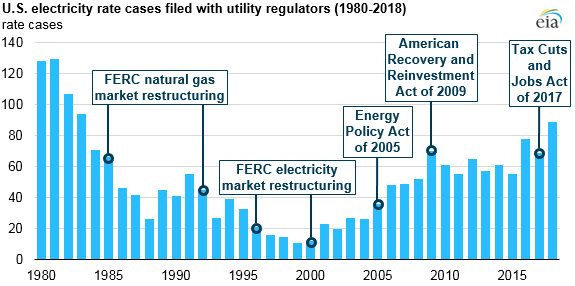 |
| Source: U.S. Energy Information Administration |
According to EIA, the frequency or number of electric utility rate cases "typically reflects changes in the costs of generating and delivering electricity." For 2018, EIA pointed to increases in spending for electric transmission and delivery (as opposed to generation) as driving most of the rate increases that were ultimately approved.
EIA notes that the last time electric utility rate case filings were this active was the early 1980s, an era of significant rate increases: electricity rates increased at an average annual rate of 12% in the decade following the 1973 oil embargo. To explain that historic period of numerous rate cases, EIA points to factors including investments in coal and nuclear plants following the oil crisis; the enactment of the federal Public Utility Regulatory Policies Act of 1978 (PURPA), which required utilities to purchase electricity from generation from small, independently-owned renewable facilities, and the 1979 Three Mile Island nuclear plant accident which placed increased focus (and expense) on the safety of nuclear plants. By contrast, during a period of time when the Federal Energy Regulatory Commission was restructuring most electric markets (between 1995 and 2000), fewer than 20 rate cases were filed in most years.
Utilities typically ask for approval of significantly higher rate increases than are ultimately approved by regulators. According to EIA, in 2018, utilities asked for an aggregate rate increase $6.8 billion, but regulators approved a total increase of just $2.8 billion.
FERC Order 841-A affirms electric storage market participation
Monday, May 20, 2019
On May 16, 2019, the Federal Energy Regulatory Commission issued an order generally affirming an earlier order which established reforms to remove barriers to the participation of electric storage resources in certain organized wholesale markets. The Commission's Order No. 841-A denied various requests for rehearing of last year's Order No. 841.
In 2018's Order No. 841, the Commission found that existing rules for electricity markets operated by regional transmission organizations and independent system operators were unjust and unreasonable in light of barriers that they present to the participation of electric storage. Based on this finding, the Commission ordered wholesale market makers to revise their tariffs to "establish a participation model consisting of market rules that, recognizing the physical and operational characteristics of electric storage resources, facilitates their participation in the RTO/ISO markets." Order No. 841 required each regional organization's participation model to (1) ensure that a resource using the participation model for electric storage resources is eligible to provide all capacity, energy, and ancillary services that it is technically capable of providing in the RTO/ISO markets; (2) ensure that a resource using the participation model for electric storage resources can be dispatched and can set the wholesale market clearing price as both a wholesale seller and wholesale buyer consistent with existing market rules that govern when a resource can set the wholesale price; (3) account for the physical and operational characteristics of electric storage resources through bidding parameters or other means; and (4) establish a minimum size requirement for participation in the RTO/ISO markets that does not exceed 100 kW. Order No. 841 also required that the sale of electric energy from the RTO/ISO markets to an electric storage resource that the resource then resells back to those markets must be at the wholesale locational marginal price.
In Order No. 841-A, the Commission generally affirmed these findings, while clarifying a handful of relatively limited points. The ruling ends for now some of the uncertainty over the scope and applicability of Order No. 841.
As regional wholesale markets develop tariff revisions to integrate electric storage resources, there could be significant opportunities to develop and benefit from electric storage. Reports have suggested significant potential for electric storage deployment -- with one 2018 study suggesting the U.S. could be home to between 7 and 50 gigawatts of storage, if costs continue to decline and sufficient policy support is available.
In 2018's Order No. 841, the Commission found that existing rules for electricity markets operated by regional transmission organizations and independent system operators were unjust and unreasonable in light of barriers that they present to the participation of electric storage. Based on this finding, the Commission ordered wholesale market makers to revise their tariffs to "establish a participation model consisting of market rules that, recognizing the physical and operational characteristics of electric storage resources, facilitates their participation in the RTO/ISO markets." Order No. 841 required each regional organization's participation model to (1) ensure that a resource using the participation model for electric storage resources is eligible to provide all capacity, energy, and ancillary services that it is technically capable of providing in the RTO/ISO markets; (2) ensure that a resource using the participation model for electric storage resources can be dispatched and can set the wholesale market clearing price as both a wholesale seller and wholesale buyer consistent with existing market rules that govern when a resource can set the wholesale price; (3) account for the physical and operational characteristics of electric storage resources through bidding parameters or other means; and (4) establish a minimum size requirement for participation in the RTO/ISO markets that does not exceed 100 kW. Order No. 841 also required that the sale of electric energy from the RTO/ISO markets to an electric storage resource that the resource then resells back to those markets must be at the wholesale locational marginal price.
In Order No. 841-A, the Commission generally affirmed these findings, while clarifying a handful of relatively limited points. The ruling ends for now some of the uncertainty over the scope and applicability of Order No. 841.
As regional wholesale markets develop tariff revisions to integrate electric storage resources, there could be significant opportunities to develop and benefit from electric storage. Reports have suggested significant potential for electric storage deployment -- with one 2018 study suggesting the U.S. could be home to between 7 and 50 gigawatts of storage, if costs continue to decline and sufficient policy support is available.
FERC upholds Block Island offshore wind PPA
Tuesday, April 30, 2019
Federal energy regulators have denied a complaint by a Newport, Rhode Island city councilor against state regulators' approval of a power purchase agreement for an offshore wind project off Block Island.
At issue is Deepwater Wind Block Island, LLC's small-scale 30-megawatt offshore wind project located near Rhode Island's Block Island. The project sells its output to utility Narragansett Electric Company, Inc. d/b/a National Grid (National Grid), pursuant to a power purchase agreement approved by the Rhode Island Public Utilities Commission on August 16, 2010.
On June 7, 2018, Ms. Kathryn E. Leonard filed a complaint to the Federal Energy Regulatory Commission, alleging that the implementation of the power purchase agreement violated various federal laws, including the Federal Power Act, Public Utility Regulatory Policies Act of 1978 (PURPA), and the Supremacy and Interstate Commerce Clauses of the U.S. Constitution.
On April 24, 2019, the Commission issued its order denying Ms. Leonard's complaint. In the seventeen-page order, the Commission noted that the complainant provided no evidence in support of her assertion that the power purchase agreement was entered into pursuant to Rhode Island's implementation of PURPA. Instead, the Commission found that the Rhode Island Public Utilities Commission's approval of the contract was pursuant to state law, not pursuant to its PURPA regulations -- but that even if it were pursuant to PURPA, federal regulations governing sales by qualifying facilities to electric utilities explicitly permit negotiated rates.
The Commission similarly found that the complainant failed to show that the contract or its pricing was unjust and unreasonable under the Federal Power Act, and to provide sufficient support for its constitutional claims. The Commission also distinguished the Block Island PPA from contracts it previously invalidated in another case, Hughes v. Talen, which involved contracts for differences and an explicit requirement of participation in the capacity market. For these reasons, the Commission denied the complaint.
The Block Island project is the first commercially-operating offshore wind project in the United States. A number of other projects are currently under development, and several states in the Northeast have enacted laws requiring utility procurement of offshore wind energy. According to a 2016 analysis by the U.S. Department of Energy, U.S. offshore wind has a technical resource potential of more than 2,000 gigawatts of capacity, or 7,200 terawatt-hours of generation per year -- nearly twice the nation’s current electricity use.
At issue is Deepwater Wind Block Island, LLC's small-scale 30-megawatt offshore wind project located near Rhode Island's Block Island. The project sells its output to utility Narragansett Electric Company, Inc. d/b/a National Grid (National Grid), pursuant to a power purchase agreement approved by the Rhode Island Public Utilities Commission on August 16, 2010.
On June 7, 2018, Ms. Kathryn E. Leonard filed a complaint to the Federal Energy Regulatory Commission, alleging that the implementation of the power purchase agreement violated various federal laws, including the Federal Power Act, Public Utility Regulatory Policies Act of 1978 (PURPA), and the Supremacy and Interstate Commerce Clauses of the U.S. Constitution.
On April 24, 2019, the Commission issued its order denying Ms. Leonard's complaint. In the seventeen-page order, the Commission noted that the complainant provided no evidence in support of her assertion that the power purchase agreement was entered into pursuant to Rhode Island's implementation of PURPA. Instead, the Commission found that the Rhode Island Public Utilities Commission's approval of the contract was pursuant to state law, not pursuant to its PURPA regulations -- but that even if it were pursuant to PURPA, federal regulations governing sales by qualifying facilities to electric utilities explicitly permit negotiated rates.
The Commission similarly found that the complainant failed to show that the contract or its pricing was unjust and unreasonable under the Federal Power Act, and to provide sufficient support for its constitutional claims. The Commission also distinguished the Block Island PPA from contracts it previously invalidated in another case, Hughes v. Talen, which involved contracts for differences and an explicit requirement of participation in the capacity market. For these reasons, the Commission denied the complaint.
The Block Island project is the first commercially-operating offshore wind project in the United States. A number of other projects are currently under development, and several states in the Northeast have enacted laws requiring utility procurement of offshore wind energy. According to a 2016 analysis by the U.S. Department of Energy, U.S. offshore wind has a technical resource potential of more than 2,000 gigawatts of capacity, or 7,200 terawatt-hours of generation per year -- nearly twice the nation’s current electricity use.
FERC licensing post-Hoopa Valley Tribe ruling
Wednesday, March 20, 2019
In the wake of a January 2019 court ruling holding that the states and applicants for water quality certifications cannot indefinitely stall federal time limits for state action by repeatedly withdrawing and resubmitting their applications, federal energy regulators are being asked to rule that states have waived their rights to issue water quality certifications.
On January 25, 2019, the United States Court of Appeals for the District of Columbia Circuit issued an opinion in Hoopa Valley Tribe v. Federal Energy Regulatory Commission. The court’s basic holding addresses language in Section 401 of the Clean Water Act providing that a state’s water quality certification requirements shall be waived with respect to a federally jurisdictional application if the state “fails or refuses to act on a request for certification, within a reasonable period of time (which shall not exceed one year) after receipt of such request.” In its recent ruling, the court strictly construed the one year limit for state action, saying it couldn’t be gamed by repeatedly withdrawing and refiling the application, because that would usurp the federal regulatory scheme.
At issue in Hoopa Valley Tribe are PacifiCorp’s Klamath River hydropower facilities in California and Oregon. PacifiCorp applied for relicensing in 2004, and met all milestones except state water quality certification. A 2010 settlement agreement with a consortium of stakeholders included an agreement between the states and the licensee “to defer the one-year statutory limit for Section 401 approval by annually withdrawing-and-resubmitting the water quality certification requests that serve as a pre-requisite to FERC’s overarching review.” A Native American tribe (which was not a signatory to the settlement agreement) petitioned FERC for a declaratory order that California and Oregon had waived their Section 401 authority and that PacifiCorp had correspondingly failed to diligently prosecute its licensing application for the Project. FERC rejected the tribe’s petition.
On appeal, the DC Circuit said the issue was whether a state waives its Section 401 authority when, pursuant to an agreement between the state and applicant, an applicant repeatedly withdraws-and-resubmits its request for water quality certification over a period of time greater than one year. The court then said determining the effectiveness of this scheme was “an undemanding inquiry” given the statutory language which sets a maximum of one year for states to consider the certification request. The court says that each resubmitted request wasn’t really a “new” request, so FERC acted arbitrarily and capriciously in finding that the states hadn’t failed to act. The opinion offers strong language saying states’ “deliberate and contractual idleness” cannot be used to “usurp FERC’s control over whether and when a federal license will issue.” The court remanded the case to FERC with a directive to proceed with its review of, and licensing determination for, the project.
Now, parties are invoking the Hoopa Valley Tribe ruling in requests to the Commission for orders finding that states have waived their certification rights through the withdrawal-and-resubmission process. On February 28, 2019, Exelon Generation Company, LLC requested a declaratory order that Maryland has waived its authority to issue a water quality certification for Exelon's Conowingo Hydroelectric Project, by failing to timely act on Exelon's request for certification.
Similarly, in February, Dan Dinges, president and CEO of Cabot Oil & Gas Corporation, filed a letter with the Commission, urging prompt approval of the Constitution natural gas pipeline. Dinges described dhe Constitution Pipeline, of which Cabot is one of the developers, as having been blocked by the state of New York, and noted that the DC Circuit had held in abeyance a case relating to the Constitution pipeline’s certification pending action on the Hoopa Valley Tribe case because they raised “common questions of law.” In his letter, Dinges cites the Commission’s failure to act on the Vineyard Wind capacity auction waiver request, points to New England’s constrained pipelines and fuel security concerns, and argues that “the gamesmanship of the State of New York has never been more suspect” in the wake of the Hoopa Valley Tribe ruling. He urged the Commission to act on the Constitution Pipeline. Subsequently, the Commission posted notice allowing parties to the Constitution Pipeline case an opportunity to comment on the impact of the ruling on that case.
On January 25, 2019, the United States Court of Appeals for the District of Columbia Circuit issued an opinion in Hoopa Valley Tribe v. Federal Energy Regulatory Commission. The court’s basic holding addresses language in Section 401 of the Clean Water Act providing that a state’s water quality certification requirements shall be waived with respect to a federally jurisdictional application if the state “fails or refuses to act on a request for certification, within a reasonable period of time (which shall not exceed one year) after receipt of such request.” In its recent ruling, the court strictly construed the one year limit for state action, saying it couldn’t be gamed by repeatedly withdrawing and refiling the application, because that would usurp the federal regulatory scheme.
At issue in Hoopa Valley Tribe are PacifiCorp’s Klamath River hydropower facilities in California and Oregon. PacifiCorp applied for relicensing in 2004, and met all milestones except state water quality certification. A 2010 settlement agreement with a consortium of stakeholders included an agreement between the states and the licensee “to defer the one-year statutory limit for Section 401 approval by annually withdrawing-and-resubmitting the water quality certification requests that serve as a pre-requisite to FERC’s overarching review.” A Native American tribe (which was not a signatory to the settlement agreement) petitioned FERC for a declaratory order that California and Oregon had waived their Section 401 authority and that PacifiCorp had correspondingly failed to diligently prosecute its licensing application for the Project. FERC rejected the tribe’s petition.
On appeal, the DC Circuit said the issue was whether a state waives its Section 401 authority when, pursuant to an agreement between the state and applicant, an applicant repeatedly withdraws-and-resubmits its request for water quality certification over a period of time greater than one year. The court then said determining the effectiveness of this scheme was “an undemanding inquiry” given the statutory language which sets a maximum of one year for states to consider the certification request. The court says that each resubmitted request wasn’t really a “new” request, so FERC acted arbitrarily and capriciously in finding that the states hadn’t failed to act. The opinion offers strong language saying states’ “deliberate and contractual idleness” cannot be used to “usurp FERC’s control over whether and when a federal license will issue.” The court remanded the case to FERC with a directive to proceed with its review of, and licensing determination for, the project.
Now, parties are invoking the Hoopa Valley Tribe ruling in requests to the Commission for orders finding that states have waived their certification rights through the withdrawal-and-resubmission process. On February 28, 2019, Exelon Generation Company, LLC requested a declaratory order that Maryland has waived its authority to issue a water quality certification for Exelon's Conowingo Hydroelectric Project, by failing to timely act on Exelon's request for certification.
Similarly, in February, Dan Dinges, president and CEO of Cabot Oil & Gas Corporation, filed a letter with the Commission, urging prompt approval of the Constitution natural gas pipeline. Dinges described dhe Constitution Pipeline, of which Cabot is one of the developers, as having been blocked by the state of New York, and noted that the DC Circuit had held in abeyance a case relating to the Constitution pipeline’s certification pending action on the Hoopa Valley Tribe case because they raised “common questions of law.” In his letter, Dinges cites the Commission’s failure to act on the Vineyard Wind capacity auction waiver request, points to New England’s constrained pipelines and fuel security concerns, and argues that “the gamesmanship of the State of New York has never been more suspect” in the wake of the Hoopa Valley Tribe ruling. He urged the Commission to act on the Constitution Pipeline. Subsequently, the Commission posted notice allowing parties to the Constitution Pipeline case an opportunity to comment on the impact of the ruling on that case.
FERC workshop on abandoned mine pumped storage
Monday, March 11, 2019
Federal hydropower regulators have scheduled a workshop to explore potential opportunities for development of closed-loop pumped storage projects at abandoned mine sites, as required by the America's Water Infrastructure Act of 2018.
Enacted by Congress and signed by President Trump in October 2018, the Act amends several portions of the Federal Power Act which govern how the Federal Energy Regulatory Commission issues preliminary permits, hydropower licenses, and approvals for qualifying conduit hydropower facilities. Among other requirements, the Act directed the Commission to issue a rule establishing an expedited process for issuing and amending licenses for closed-loop pumped storage projects under this section.
The Act also includes provisions designed to facilitate exploration of the use of abandoned mine sites for pumped storage projects. Section 3004 of the Act requires the Commission to hold a workshop within 6 months to explore potential opportunities for development of closed-loop pumped storage projects at abandoned mine sites, and issue guidance within one year to assist applicants for licenses or preliminary permits for closed-loop pumped storage projects at abandoned mine sites. In November 2018, the Commission docketed its action on Closed-loop Pumped Storage Projects at Abandoned Mines Guidance as Docket No. AD19-8-000 and established a schedule for rulemaking, public comment, and issuance of guidance.
The Commission has now issued a Notice of Workshop in the abandoned mine pumped storage docket, scheduled for April 4, 2019. The notice states that the workshop will involve roundtable discussions by panelists, moderated by Commission staff. The agenda for the workshop includes discussion of how to identify sites for development of closed-loop pumped storage projects at abandoned mines, as well as the benefits and challenges associated with the use of abandoned mines for pumped storage. The agenda also includes time for soliciting feedback from the workshop panel and other participants on what types of information would be most helpful to include in the guidance mandated by the Act.
Enacted by Congress and signed by President Trump in October 2018, the Act amends several portions of the Federal Power Act which govern how the Federal Energy Regulatory Commission issues preliminary permits, hydropower licenses, and approvals for qualifying conduit hydropower facilities. Among other requirements, the Act directed the Commission to issue a rule establishing an expedited process for issuing and amending licenses for closed-loop pumped storage projects under this section.
The Act also includes provisions designed to facilitate exploration of the use of abandoned mine sites for pumped storage projects. Section 3004 of the Act requires the Commission to hold a workshop within 6 months to explore potential opportunities for development of closed-loop pumped storage projects at abandoned mine sites, and issue guidance within one year to assist applicants for licenses or preliminary permits for closed-loop pumped storage projects at abandoned mine sites. In November 2018, the Commission docketed its action on Closed-loop Pumped Storage Projects at Abandoned Mines Guidance as Docket No. AD19-8-000 and established a schedule for rulemaking, public comment, and issuance of guidance.
The Commission has now issued a Notice of Workshop in the abandoned mine pumped storage docket, scheduled for April 4, 2019. The notice states that the workshop will involve roundtable discussions by panelists, moderated by Commission staff. The agenda for the workshop includes discussion of how to identify sites for development of closed-loop pumped storage projects at abandoned mines, as well as the benefits and challenges associated with the use of abandoned mines for pumped storage. The agenda also includes time for soliciting feedback from the workshop panel and other participants on what types of information would be most helpful to include in the guidance mandated by the Act.
FERC official testifies on electromagnetic pulses and geomagnetic disturbances
Friday, March 8, 2019
Electromagnetic pulse and geomagnetic disturbance events "pose a serious threat to the electric grid and its supporting infrastructures that serve our Nation," according to testimony delivered by a federal official to the U.S. Senate Committee on Homeland Security and Governmental Affairs.
Electromagnetic pulse (EMP) and geomagnetic disturbance (GMD) events are two types of events that could affect the nation's electric grid. Generally speaking, GMD events are naturally occurring solar magnetic disturbances which periodically disrupt the earth’s magnetic field. These disruptions can induce currents on the electric grid that may simultaneously damage or destroy key transformers over a large geographic area.
On February 27, 2019, Joseph McClellan, director of the Federal Energy Regulatory Commission's Office of Energy Infrastructure Security, testified before the Senate committee. As described in his testimony, EMP events can be generated by "devices that range from small, portable, easily concealed battery-powered units all the way through missiles equipped with nuclear warheads." High-altitude nuclear detonations can generate three distinct EMP effects: "a short high energy radio-frequency-type burst called E1 that can destroy electronics; a slightly longer burst that is similar to lightning termed E2; and a final effect termed E3 that is similar in character and effect to GMD, with the potential to damage transformers and other electrical equipment."
According to Director McClellan's testimony, any of these effects could lead to "wide-area blackouts." In his testimony, he cited reports by the federal EMP Commission as finding that "a single EMP attack could seriously degrade or shut down a large part of the electric power grid," with the potential that significant parts of electric infrastructure could be “out of service for periods measured in months to a year or more."
He also cited a 2010 study by Oak Ridge National Laboratory as finding that "EMP and GMD events pose substantial risk to equipment and operation of the Nation’s electric grid and under extreme conditions could result in major long-term electrical outages," that "GMD disturbances are inevitable with only the timing and magnitude subject to variability," and that a solar storm such as occurred in 1921 "could damage or destroy over 300 bulk power system transformers interrupting service to 130 million people with some outages lasting for a period of years." Director McClellan clarified that subsequent analysis suggested that in case of such an event, "the power grid may collapse before significant damage was done to transformers; resulting in a potentially wide-spread, but relatively short, power outage."
Director McClellan also spoke to the Federal Energy Regulatory Commission's "dual-fold approach" to address these threats: employing mandatory standards to establish foundational practices while also working collaboratively with industry, the states and federal agencies to identify and promote best practices to mitigate advanced threats. According to a report released in 2018 by the U.S. Government Accountability Office, U.S. and Canadian electricity suppliers have taken steps to prepare for potential electromagnetic disruptions, but more research is needed on both geomagnetic disturbances and high-altitude electromagnetic pulses.
Electromagnetic pulse (EMP) and geomagnetic disturbance (GMD) events are two types of events that could affect the nation's electric grid. Generally speaking, GMD events are naturally occurring solar magnetic disturbances which periodically disrupt the earth’s magnetic field. These disruptions can induce currents on the electric grid that may simultaneously damage or destroy key transformers over a large geographic area.
On February 27, 2019, Joseph McClellan, director of the Federal Energy Regulatory Commission's Office of Energy Infrastructure Security, testified before the Senate committee. As described in his testimony, EMP events can be generated by "devices that range from small, portable, easily concealed battery-powered units all the way through missiles equipped with nuclear warheads." High-altitude nuclear detonations can generate three distinct EMP effects: "a short high energy radio-frequency-type burst called E1 that can destroy electronics; a slightly longer burst that is similar to lightning termed E2; and a final effect termed E3 that is similar in character and effect to GMD, with the potential to damage transformers and other electrical equipment."
According to Director McClellan's testimony, any of these effects could lead to "wide-area blackouts." In his testimony, he cited reports by the federal EMP Commission as finding that "a single EMP attack could seriously degrade or shut down a large part of the electric power grid," with the potential that significant parts of electric infrastructure could be “out of service for periods measured in months to a year or more."
He also cited a 2010 study by Oak Ridge National Laboratory as finding that "EMP and GMD events pose substantial risk to equipment and operation of the Nation’s electric grid and under extreme conditions could result in major long-term electrical outages," that "GMD disturbances are inevitable with only the timing and magnitude subject to variability," and that a solar storm such as occurred in 1921 "could damage or destroy over 300 bulk power system transformers interrupting service to 130 million people with some outages lasting for a period of years." Director McClellan clarified that subsequent analysis suggested that in case of such an event, "the power grid may collapse before significant damage was done to transformers; resulting in a potentially wide-spread, but relatively short, power outage."
Director McClellan also spoke to the Federal Energy Regulatory Commission's "dual-fold approach" to address these threats: employing mandatory standards to establish foundational practices while also working collaboratively with industry, the states and federal agencies to identify and promote best practices to mitigate advanced threats. According to a report released in 2018 by the U.S. Government Accountability Office, U.S. and Canadian electricity suppliers have taken steps to prepare for potential electromagnetic disruptions, but more research is needed on both geomagnetic disturbances and high-altitude electromagnetic pulses.
PG&E withdraws Potter Valley hydro relicensing, FERC opens orphan project solicitation
Wednesday, March 6, 2019
California electric utility Pacific Gas and Electric Company has withdrawn its expression of intent to seek a new license for the Potter Valley Hydroelectric Project, saying its relicensing would be contrary to the interests of its electric ratepayers. The withdrawal has prompted federal hydropower regulators to institute an "orphan project" process to find interest from other entities in seeking a license for the project. If no other entity seeks and obtains a new license for the project, PG&E would be responsible for surrendering the existing project license.
The Potter Valley Project is located on the Eel and East Fork Russian Rivers in northern California, about 15 miles northeast of the city of Ukiah. Originally licensed by the Federal Power Commission in 1922, and owned by PG&E since 1930, the project includes Lake Pillsbury, impounded by Scott Dam; the Van Arsdale Reservoir, impounded by the Cape Horn Diversion Dam; and a tunnel, penstock and powerhouse located in the headwaters of the Russian River Basin. PG&E estimates the average annual generation of the project to be 19,900 megawatt-hours, with an installed capacity of 9.4 megawatts. The current license issued by the Federal Energy Regulatory Commission expires on April 14, 2022, requiring PG&E to submit a new license application by April 14, 2020.
On April 6, 2017, PG&E filed a pre-application document (PAD) and notice of its intent (NOI) to file an application for a new license. But on January 25, 2019, PG&E filed notice of the withdrawal of its NOI and PAD, indicating it is no longer seeking a new license for the project and is terminating its efforts to transfer and sell the project.
In that notice, PG&E said it has "determined that it would be contrary to the interests of its electric ratepayers to continue relicensing the Potter Valley project." PG&E said it had long recognized hte project as "uneconomic for PG&E's ratepayers (i.e. the cost of production exceeding the cost of alternative sources of renewable power on the open market)." PG&E cited "continued declining energy markets, potential increased costs associated with anticipated new license conditions, and challenging financial circumstances" as leading the company to conclude it cannot justify to its ratepayers further expenditures associated with the project.
PG&E noted its anticipation that the Commission would institute its "orphan project" process under the Commission's rules to solicit license applications for Potter Valley from other entities, and expressed its understanding that PG&E would be responsible for surrendering the existing license if no other entity seeks and obtains a new license for the project. PG&E closed by saying it "recognizes the value of Potter Valley to local communities because it provides for the protection of important environmental resources, consumptive water uses, public recreation, and other economic values" which the utility said should be appropriately considered if it is required to file a surrender application.
In response, on March 1, 2019, the Commission issued a Notice Soliciting Applications for a new license for the Potter Valley project within 120 days. The Commission noted that if no other applicant files an application for a license by April 14, 2020, PG&E would be provided with written notice that no timely application for the project has been filed, and would then have 90 days within which to file a schedule for the filing of a surrender application for the project.
The Potter Valley Project is located on the Eel and East Fork Russian Rivers in northern California, about 15 miles northeast of the city of Ukiah. Originally licensed by the Federal Power Commission in 1922, and owned by PG&E since 1930, the project includes Lake Pillsbury, impounded by Scott Dam; the Van Arsdale Reservoir, impounded by the Cape Horn Diversion Dam; and a tunnel, penstock and powerhouse located in the headwaters of the Russian River Basin. PG&E estimates the average annual generation of the project to be 19,900 megawatt-hours, with an installed capacity of 9.4 megawatts. The current license issued by the Federal Energy Regulatory Commission expires on April 14, 2022, requiring PG&E to submit a new license application by April 14, 2020.
On April 6, 2017, PG&E filed a pre-application document (PAD) and notice of its intent (NOI) to file an application for a new license. But on January 25, 2019, PG&E filed notice of the withdrawal of its NOI and PAD, indicating it is no longer seeking a new license for the project and is terminating its efforts to transfer and sell the project.
In that notice, PG&E said it has "determined that it would be contrary to the interests of its electric ratepayers to continue relicensing the Potter Valley project." PG&E said it had long recognized hte project as "uneconomic for PG&E's ratepayers (i.e. the cost of production exceeding the cost of alternative sources of renewable power on the open market)." PG&E cited "continued declining energy markets, potential increased costs associated with anticipated new license conditions, and challenging financial circumstances" as leading the company to conclude it cannot justify to its ratepayers further expenditures associated with the project.
PG&E noted its anticipation that the Commission would institute its "orphan project" process under the Commission's rules to solicit license applications for Potter Valley from other entities, and expressed its understanding that PG&E would be responsible for surrendering the existing license if no other entity seeks and obtains a new license for the project. PG&E closed by saying it "recognizes the value of Potter Valley to local communities because it provides for the protection of important environmental resources, consumptive water uses, public recreation, and other economic values" which the utility said should be appropriately considered if it is required to file a surrender application.
In response, on March 1, 2019, the Commission issued a Notice Soliciting Applications for a new license for the Potter Valley project within 120 days. The Commission noted that if no other applicant files an application for a license by April 14, 2020, PG&E would be provided with written notice that no timely application for the project has been filed, and would then have 90 days within which to file a schedule for the filing of a surrender application for the project.
FERC, DOE to hold Security Investments for Energy Infrastructure Technical Conference
Tuesday, March 5, 2019
The Federal Energy Regulatory Commission and the United States Department of Energy have scheduled a joint technical conference to discuss current cyber and physical security practices used to protect energy infrastructure and possible federal and state incentives for related security investments.
According to a notice issued on February 4, the Security Investments for Energy Infrastructure Technical Conference will be led by one or more FERC Commissioners and DOE senior officials. Its agenda addresses two high-level topics: types of current and emerging cyber and physical security threats, and how federal and state authorities can facilitate investments to improve the cyber and physical security of energy infrastructure.
In a supplemental notice issued on March 1, the agencies noted that the Commission has adopted a "well-developed set of mandatory and enforceable reliability standards that set baseline protections for both cyber and physical security of the bulk electric system" as well as "policies that allow for the recovery of prudently incurred costs to comply with those mandatory reliability standards." The supplemental notice describes the technical conference as aimed at better understanding:
The federal agencies' Security Investments for Energy Infrastructure Technical Conference has been scheduled for on March 28, 2019.
According to a notice issued on February 4, the Security Investments for Energy Infrastructure Technical Conference will be led by one or more FERC Commissioners and DOE senior officials. Its agenda addresses two high-level topics: types of current and emerging cyber and physical security threats, and how federal and state authorities can facilitate investments to improve the cyber and physical security of energy infrastructure.
In a supplemental notice issued on March 1, the agencies noted that the Commission has adopted a "well-developed set of mandatory and enforceable reliability standards that set baseline protections for both cyber and physical security of the bulk electric system" as well as "policies that allow for the recovery of prudently incurred costs to comply with those mandatory reliability standards." The supplemental notice describes the technical conference as aimed at better understanding:
- the need for security investments that go beyond those measures already required by mandatory reliability standards, including in infrastructure not subject to those standards (e.g., natural gas pipelines);
- how the costs of such investments are or could be recovered; and
- whether additional incentives for making such investments are needed, and if so, how those incentives should be designed.
The federal agencies' Security Investments for Energy Infrastructure Technical Conference has been scheduled for on March 28, 2019.
PNGTS applies for Westbrook XPress Phase I pipeline project
Monday, January 21, 2019
An interstate natural gas pipeline system bringing gas from eastern Canada into Maine has asked U.S. regulators for approvals necessary for a project that would marginally increase the system's capacity to bring gas to Maine and the New England market.
At issue is Portland Natural Gas Transmission System (PNGTS), a pipeline that spans New England from the Canadian border to pipeline connections in New Hampshire, Maine, and Massachusetts. Its facilities include 142 miles of wholly-owned mainline from an interconnection with Trans-Québec & Maritimes Pipeline Inc. at the U.S./Canada border to Westbrook, Maine plus two laterals, as well as 101 miles of mainline from Westbrook to Dracut, Massachusets, which PNGTS owns jointly with another interstate pipeline, Maritimes & Northeast Pipeline, L.L.C. PNGTS operates pursuant to a number of federal approvals, including a certificate issued by the Federal Energy Regulatory Commission and a Presidential Permit authorizing its facilities for importing gas from (or exporting gas to) Canada.
On December 21, PNGTS applied to the Commission for authorization for Phase I its "Westbrook Xpress Project," which would increase the certificated capacity on the northern portion of its system from Pittsburg, New Hampshire, to Westbrook, Maine, by 42.482 million cubic feet per day (MMcf/d), effective November 1, 2019. The pipeline's application includes both public materials and materials that are protected against public disclosure as "controlled unclassified information", including privileged information and "critical energy infrastructure information."
In the public materials, PNGTS describes continued increased demand for natural gas: "Growing demand for natural gas for space heating, industrial processes and electric generation is driving a commensurate demand for incremental pipeline deliverability from abundant North American supply basins." PNGTS says its Westbrook XPress project "will provide access to, and allow for the transportation of, natural gas supplies from key North American supply basins such as Marcellus, Utica, and others" via Canadian pipelines. The company describes its Westbrook Xpress project is "a solution to meet this growing demand in areas of North America that have some of the highest residential gas prices in the winter." It envisions two distinct phases of the project: Phase I with an incremental 42.482 million cubic feet per day of certificated capacity, with an anticipated Phase II to bring an incremental 62.989 million cubic feet per day of capacity.
The Commission has docketed PNGTS's application for Phase I of the Westbrook XPress project as Docket No. CP19-32, and has issued public notice of the opportunity to intervene or comment through 5:00 pm Eastern Time on January 29, 2019.
At issue is Portland Natural Gas Transmission System (PNGTS), a pipeline that spans New England from the Canadian border to pipeline connections in New Hampshire, Maine, and Massachusetts. Its facilities include 142 miles of wholly-owned mainline from an interconnection with Trans-Québec & Maritimes Pipeline Inc. at the U.S./Canada border to Westbrook, Maine plus two laterals, as well as 101 miles of mainline from Westbrook to Dracut, Massachusets, which PNGTS owns jointly with another interstate pipeline, Maritimes & Northeast Pipeline, L.L.C. PNGTS operates pursuant to a number of federal approvals, including a certificate issued by the Federal Energy Regulatory Commission and a Presidential Permit authorizing its facilities for importing gas from (or exporting gas to) Canada.
On December 21, PNGTS applied to the Commission for authorization for Phase I its "Westbrook Xpress Project," which would increase the certificated capacity on the northern portion of its system from Pittsburg, New Hampshire, to Westbrook, Maine, by 42.482 million cubic feet per day (MMcf/d), effective November 1, 2019. The pipeline's application includes both public materials and materials that are protected against public disclosure as "controlled unclassified information", including privileged information and "critical energy infrastructure information."
In the public materials, PNGTS describes continued increased demand for natural gas: "Growing demand for natural gas for space heating, industrial processes and electric generation is driving a commensurate demand for incremental pipeline deliverability from abundant North American supply basins." PNGTS says its Westbrook XPress project "will provide access to, and allow for the transportation of, natural gas supplies from key North American supply basins such as Marcellus, Utica, and others" via Canadian pipelines. The company describes its Westbrook Xpress project is "a solution to meet this growing demand in areas of North America that have some of the highest residential gas prices in the winter." It envisions two distinct phases of the project: Phase I with an incremental 42.482 million cubic feet per day of certificated capacity, with an anticipated Phase II to bring an incremental 62.989 million cubic feet per day of capacity.
The Commission has docketed PNGTS's application for Phase I of the Westbrook XPress project as Docket No. CP19-32, and has issued public notice of the opportunity to intervene or comment through 5:00 pm Eastern Time on January 29, 2019.
FERC relicenses Poe hydro project
Monday, December 17, 2018
The Federal Energy Regulatory Commission has issued an order issuing a new hydropower license to utility Pacific Gas & Electric Company for its Poe Hydroelectric Project.
The 143-megawatt project is located on the North Fork Feather River in northern California, and includes land within the Plumas National Forest. Originally licensed in 1953, the project includes two dams impounding reservoirs, a 33,000-foot-long pressure tunnel bypassing about 7.6 miles of the river, and a powerhouse with two turbines.
The Commission issued a new 40-year license for the Poe project to PG&E on December 17, 2018. In relicensing proceedings, the Commission considers a number of public interest factors, including the economic benefits of project power. In general, the Commission evaluates the economics of a hydropower project by comparing the current costs of the project to likely alternative power, without considering forecasts concerning potential future inflation, escalation, or deflation beyond the license issuance date. The Commission says the basic purpose of its economic analysis is to provide a general estimate of the potential power benefits and the costs of a project, and of reasonable alternatives to project power.
In the Poe project's case, the Commission noted that after considering mandatory conditions and other measures suggested by Commission staff, PG&E's annual cost of operating the project would be about $9,590,000. Assuming that the project would generate an average of 498,113 megawatt-hours of energy annually, this works out to $19.3 per megawatt-hour. By comparison, the Commission found that the project's the corresponding alternative energy cost plus the value of its dependable capacity gave this power a value of $50,800,000, or $102 per megawatt-hour in the first year of operation, the project would cost $41,210,000 or $82.7 per megawatt-hour less than the likely alternative cost of power.
The 143-megawatt project is located on the North Fork Feather River in northern California, and includes land within the Plumas National Forest. Originally licensed in 1953, the project includes two dams impounding reservoirs, a 33,000-foot-long pressure tunnel bypassing about 7.6 miles of the river, and a powerhouse with two turbines.
The Commission issued a new 40-year license for the Poe project to PG&E on December 17, 2018. In relicensing proceedings, the Commission considers a number of public interest factors, including the economic benefits of project power. In general, the Commission evaluates the economics of a hydropower project by comparing the current costs of the project to likely alternative power, without considering forecasts concerning potential future inflation, escalation, or deflation beyond the license issuance date. The Commission says the basic purpose of its economic analysis is to provide a general estimate of the potential power benefits and the costs of a project, and of reasonable alternatives to project power.
In the Poe project's case, the Commission noted that after considering mandatory conditions and other measures suggested by Commission staff, PG&E's annual cost of operating the project would be about $9,590,000. Assuming that the project would generate an average of 498,113 megawatt-hours of energy annually, this works out to $19.3 per megawatt-hour. By comparison, the Commission found that the project's the corresponding alternative energy cost plus the value of its dependable capacity gave this power a value of $50,800,000, or $102 per megawatt-hour in the first year of operation, the project would cost $41,210,000 or $82.7 per megawatt-hour less than the likely alternative cost of power.
FERC issues notices for America's Water Infrastructure Act of 2018 implementation
Wednesday, November 14, 2018
Federal hydropower regulators have issued a pair of notices framing the implementation of recently enacted legislation designed to streamline the processes for licensing some hydroelectric projects.
On October 23, 2018, President Trump signed the America's Water Infrastructure Act of 2018. The new law amends several portions of the Federal Power Act which govern how the Federal Energy Regulatory Commission issues preliminary permits, hydropower licenses, and approvals for qualifying conduit hydropower facilities. It also directs the Commission to:
As part of the provisions calling for new expedited processes for issuing and amending licenses for qualifying facilities at existing nonpowered dams and closed-loop pumped storage projects, the new law also requires the Commission to convene an interagency task force, including appropriate federal and state agencies and Indian tribes, to coordinate the regulatory processes required to construct and operate these projects. Also on November 13, the Commission published a notice inviting these groups to request participation in the interagency task force. Federal and state agencies and Indian tribes who wish to participate on the interagency task force must file a statement of interest with the Commission by November 29, 2018.
On October 23, 2018, President Trump signed the America's Water Infrastructure Act of 2018. The new law amends several portions of the Federal Power Act which govern how the Federal Energy Regulatory Commission issues preliminary permits, hydropower licenses, and approvals for qualifying conduit hydropower facilities. It also directs the Commission to:
- Issue a rule within 180 days establishing an expedited process for issuing and amending licenses for qualifying facilities at existing nonpowered dams that will seek to ensure a final decision by the Commission on an application for a license no later than two years after receipt of a completed application;
- Issue a rule within 180 days establishing an expedited process for issuing and amending licenses for closed-loop pumped storage projects that will seek to ensure a final decision by the Commission on an application for a license no later than two years after receipt of a completed application;
- Along with the Secretaries of the Army, Interior, and Agriculture, jointly develop a list of existing nonpowered federal dams that the Commission and the Secretaries agree have the greatest potential for non-federal hydropower development, to be published within 12 months; and
- Hold a workshop within 6 months to explore potential opportunities for development of closed-loop pumped storage projects at abandoned mine sites, and issue guidance within one year to assist applicants for licenses or preliminary permits for closed-loop pumped storage projects at abandoned mine sites.
As part of the provisions calling for new expedited processes for issuing and amending licenses for qualifying facilities at existing nonpowered dams and closed-loop pumped storage projects, the new law also requires the Commission to convene an interagency task force, including appropriate federal and state agencies and Indian tribes, to coordinate the regulatory processes required to construct and operate these projects. Also on November 13, the Commission published a notice inviting these groups to request participation in the interagency task force. Federal and state agencies and Indian tribes who wish to participate on the interagency task force must file a statement of interest with the Commission by November 29, 2018.
New law eases some hydro licensing processes
Thursday, November 1, 2018
A recently-enacted federal law will make it easier for hydroelectric project developers to secure a license for new hydroelectric facilities at existing non-powered dams.
U.S. rivers are home to thousands of dams, most of which impound water but don't generate electricity. A 2013 report suggested only 3% of the nation's 80,000 dams were used to produce hydroelectric power. In an effort to facilitate the development of hydroelectric facilities at some of these non-powered dams, Congress recently enacted the America's Water Infrastructure Act of 2018.
Title III of the Act relates to energy matters. One section of the Act extends the default term of preliminary permits for hydropower development from three to four years. The Act authorizes the Federal Energy Regulatory Commission to extend the period of a preliminary permit for up to four additional years, and to issue an additional permit under "extraordinary circumstances."
Another section of the Act speeds up the process through which the Commission evaluates proposals to develop "qualifying conduit hydropower facilities" and increases such a project's maximum installed capacity from 5 megawatts to 40 megawatts.
A third section of the Act requires the Commission to, within 180 days, issue a rule establishing an expedited process for issuing and amending licenses for hydroelectric facilities meeting defined criteria. These criteria require the "qualifying facilities" to be associated with an existing dam or other barrier operated for the control, release, or distribution of water for agricultural, municipal, navigational, industrial, commercial, environmental, recreational, aesthetic, drinking water, or flood control purposes, which as of the date of the Act's enactment was not generating electricity with Commission-licensed or exempted hydropower generating works. The Act also requires that the operation of these facilities must not result in any material change to the storage, release, or flow operations of the associated qualifying nonpowered dam.
The Act also includes provisions creating an establishing an expedited process for issuing and amending licenses for closed-loop pumped storage projects, and prescribing the considerations for setting the terms of new licenses for existing projects through the relicensing process.
The Act, which was introduced in the Senate as S.3021, was signed by President Trump on October 23, 2018, and became law the same day. The Commission has until April 2019 to issue the rules required by the Act.
U.S. rivers are home to thousands of dams, most of which impound water but don't generate electricity. A 2013 report suggested only 3% of the nation's 80,000 dams were used to produce hydroelectric power. In an effort to facilitate the development of hydroelectric facilities at some of these non-powered dams, Congress recently enacted the America's Water Infrastructure Act of 2018.
Title III of the Act relates to energy matters. One section of the Act extends the default term of preliminary permits for hydropower development from three to four years. The Act authorizes the Federal Energy Regulatory Commission to extend the period of a preliminary permit for up to four additional years, and to issue an additional permit under "extraordinary circumstances."
Another section of the Act speeds up the process through which the Commission evaluates proposals to develop "qualifying conduit hydropower facilities" and increases such a project's maximum installed capacity from 5 megawatts to 40 megawatts.
A third section of the Act requires the Commission to, within 180 days, issue a rule establishing an expedited process for issuing and amending licenses for hydroelectric facilities meeting defined criteria. These criteria require the "qualifying facilities" to be associated with an existing dam or other barrier operated for the control, release, or distribution of water for agricultural, municipal, navigational, industrial, commercial, environmental, recreational, aesthetic, drinking water, or flood control purposes, which as of the date of the Act's enactment was not generating electricity with Commission-licensed or exempted hydropower generating works. The Act also requires that the operation of these facilities must not result in any material change to the storage, release, or flow operations of the associated qualifying nonpowered dam.
The Act also includes provisions creating an establishing an expedited process for issuing and amending licenses for closed-loop pumped storage projects, and prescribing the considerations for setting the terms of new licenses for existing projects through the relicensing process.
The Act, which was introduced in the Senate as S.3021, was signed by President Trump on October 23, 2018, and became law the same day. The Commission has until April 2019 to issue the rules required by the Act.
FERC solicits panel members to resolve hydropower licensing study disputes
Monday, October 29, 2018
U.S. hydropower regulators have asked for volunteers interested in serving as panel members to assist in resolving disputes related to the scope of studies required for hydropower licensing.
Under federal law, the Federal Energy Regulatory Commission is tasked with processing applications for licenses for most hydropower projects located in the U.S. To process any given application, the Commission typically uses one of three different licensing processes. Since 2005, the Commission's "Integrated Licensing Process" or ILP has been the default choice.
Under the ILP, the applicant seeking a license files a proposed study plan describing the studies it intends to conduct to inform the Commission's review of its application. Studies might cover the project's impact on a variety of types of resources and issues, such as aquatic, terrestrial, cultural, recreational, geological, land management, engineering and socioeconomic topics. After a 90-day period of consultation with stakeholders and Commission staff, the applicant may file a revised study plan for Commission approval. Ultimately, the director of the Commission's Office of Energy Projects will issue a study determination approving the study plan with any modifications based on the record. Whatever studies are required by the Commission-approved study plan must be conducted by the applicant or its consultants.
The nature and extent of the studies required can be controversial. Stakeholders have opportunities to comment on the applicant's original study plan, to participate in consultation, and to comment to the Commission on the revised study plan.
Under the ILP, certain federal or state agencies or tribes also have the ability to request that a study dispute be referred to a dispute resolution panel. The three-member panel would consist of FERC staff, the agency or tribal representative referring the dispute, and an independent third person selected by the other two panelists from a list of subject-matter experts. The panel members make a finding with respect to each disputed study request, on the extent to which each study criteria set forth in the regulations is or is not met, and why. The panel then makes a recommendation to the Director of the Office of Energy Projects based on its findings.
On October 22, 2018, the Commission issued a notice requesting applications from those interested in being listed as potential panel members. The Commission previously compiled lists in 2004, 2010, and 2015. For the latest round, the Commission has requested applications by January 31, 2019.
Under federal law, the Federal Energy Regulatory Commission is tasked with processing applications for licenses for most hydropower projects located in the U.S. To process any given application, the Commission typically uses one of three different licensing processes. Since 2005, the Commission's "Integrated Licensing Process" or ILP has been the default choice.
Under the ILP, the applicant seeking a license files a proposed study plan describing the studies it intends to conduct to inform the Commission's review of its application. Studies might cover the project's impact on a variety of types of resources and issues, such as aquatic, terrestrial, cultural, recreational, geological, land management, engineering and socioeconomic topics. After a 90-day period of consultation with stakeholders and Commission staff, the applicant may file a revised study plan for Commission approval. Ultimately, the director of the Commission's Office of Energy Projects will issue a study determination approving the study plan with any modifications based on the record. Whatever studies are required by the Commission-approved study plan must be conducted by the applicant or its consultants.
The nature and extent of the studies required can be controversial. Stakeholders have opportunities to comment on the applicant's original study plan, to participate in consultation, and to comment to the Commission on the revised study plan.
Under the ILP, certain federal or state agencies or tribes also have the ability to request that a study dispute be referred to a dispute resolution panel. The three-member panel would consist of FERC staff, the agency or tribal representative referring the dispute, and an independent third person selected by the other two panelists from a list of subject-matter experts. The panel members make a finding with respect to each disputed study request, on the extent to which each study criteria set forth in the regulations is or is not met, and why. The panel then makes a recommendation to the Director of the Office of Energy Projects based on its findings.
On October 22, 2018, the Commission issued a notice requesting applications from those interested in being listed as potential panel members. The Commission previously compiled lists in 2004, 2010, and 2015. For the latest round, the Commission has requested applications by January 31, 2019.
Laos dam construction and collapse
Thursday, July 26, 2018
A dam under construction in Laos as part of a hydropower scheme has collapsed, causing flooding and damage.
At issue is the Xe-Pian Xe-Namnoy project, a 410-megawatt hydroelectric power project under development for Xe-Pian Xe-Namnoy Power Company (PNPC). PNPC is a joint venture among the government of Laos and construction and power companies from South Korea and Thailand. The project, whose construction costs are estimated at about $1 billion, involves the construction of three primary dams to form reservoirs. Construction of the system was reportedly 90% complete, with commercial operation projected for 2019, and an agreement in place agreement to export 90% of project power to Thailand. The project has been touted for the degree of international investment involved, although some have criticized the project for insufficient local benefits.
From an engineering perspective, the project's primary dams impound water in a large reservoir. The project also includes three auxiliary "saddle dams" near several heads of the reservoir, essentially to prevent the reservoir from spilling down the impoundment's back side as it fills.
Project maps posted online by PNPC show saddle dams on three of the main reservoir's western branches.
One of these smaller saddle dams reportedly failed on July 23, 2018, allegedly due to severe rains. Saddle Dam D -- a facility 8 meters wide, 770 meters long and 16 meters high -- was built to support water diversion around the project's reservoir. But the structure reportedly fractured, causing water to spill downstream to the Xe Pian river outside of the project's intended path of water flow. According to the prime minister of Laos, at least 26 people have died and 131 are missing from the resulting flooding, and several villages .
Response and recovery actions are ongoing. The dam collapse highlights the importance of safety in dam construction and reservoir operations, as did the February 2017 failure of the Oroville Dam's spillway in California.
At issue is the Xe-Pian Xe-Namnoy project, a 410-megawatt hydroelectric power project under development for Xe-Pian Xe-Namnoy Power Company (PNPC). PNPC is a joint venture among the government of Laos and construction and power companies from South Korea and Thailand. The project, whose construction costs are estimated at about $1 billion, involves the construction of three primary dams to form reservoirs. Construction of the system was reportedly 90% complete, with commercial operation projected for 2019, and an agreement in place agreement to export 90% of project power to Thailand. The project has been touted for the degree of international investment involved, although some have criticized the project for insufficient local benefits.
From an engineering perspective, the project's primary dams impound water in a large reservoir. The project also includes three auxiliary "saddle dams" near several heads of the reservoir, essentially to prevent the reservoir from spilling down the impoundment's back side as it fills.
 |
| A map of the project, found at http://www.pnpclaos.com/index.php/en/project/maps |
 |
| Another project map found at http://www.pnpclaos.com/index.php/en/project/maps |
One of these smaller saddle dams reportedly failed on July 23, 2018, allegedly due to severe rains. Saddle Dam D -- a facility 8 meters wide, 770 meters long and 16 meters high -- was built to support water diversion around the project's reservoir. But the structure reportedly fractured, causing water to spill downstream to the Xe Pian river outside of the project's intended path of water flow. According to the prime minister of Laos, at least 26 people have died and 131 are missing from the resulting flooding, and several villages .
Response and recovery actions are ongoing. The dam collapse highlights the importance of safety in dam construction and reservoir operations, as did the February 2017 failure of the Oroville Dam's spillway in California.
Subscribe to:
Posts (Atom)
