Federal electricity regulators have given New England's regional grid operator more time to develop proposed new mechanisms to enhance long-term fuel security, after states and market participants asked for an extension to allow continued stakeholder discussions. At stake are what could be significant reforms to the region's electricity markets, including new opportunities for generators to earn revenue for providing fuel security, as well as the prospect of significant new costs for consumers.
ISO New England Inc. is the regional transmission organization and independent system operator for the electric grid serving nearly all of New England. In this role, it develops and administers markets for electric energy, capacity, and other products. ISO-NE also engages in regional system planning, and manages proposals to retire or close power plants that provide capacity to the region.
In 2018, the owner of the Mystic Generating Station, the largest power station in Massachusetts by nameplate capacity, proposed to retire its units in 2022. But after a study of the remaining electric system, ISO-NE determined that the retirement of Mystic's units 8 and 9 would present "unacceptable fuel security risks" that could lead to rolling blackouts as soon as the winters of 2022 through 2024. In response, ISO-NE asked the Federal Energy Regulatory Commission for waivers to allow the grid operator to retain the Mystic units to meet fuel security needs.
Some stakeholders disagreed that the Mystic units' retirement posed a reliability risk; others argued the costs of retaining them would outweigh any benefits. While the Commission denied ISO-NE's waiver request, it ultimately approved a short-term cost-of-service agreement under which regional ratepayers will pay to keep the Mystic units online. But the Commission also made a preliminary finding that ISO-NE's tariff may be unjust and unreasonable, and directed ISO-NE to file proposed tariff revisions creating a long-term fuel security mechanism by July 1, 2019. At the grid operator's request, the Commission later extended that deadline to November 15, 2019, to allow more time for proposal development and stakeholder discussion.
In the meantime, this spring ISO-NE filed a proposed short-term "inventoried energy program" from December 1
through the end of February during winters 2023/2024 and 2024/2025 as "a
bridge to a long-term, market-based solution that more comprehensively
addresses the region’s energy security risks" -- but Commission staff identified that filing as "deficient" and requested additional information, which prompted ISO-NE to provide additional information. In the absence of a Commission quorum willing to vote, those revisions became effective by operation of law on August 6, 2019, although parties have sought rehearing regarding the Commission's failure to act.
But even more time may be necessary. On July 31, 2019, the New England States Committee on Electricity (NESCOE) filed a motion requesting an additional six-month extension of time to allow ISO-NE and the region to work through issues related to ISO-NE’s proposed long-term fuel security mechanism. Representing the governors of the six New England states, NESCOE said granting its request would "enable a more complete
and holistic filing in response to the directives in the July 2018
Order, allow ISO-NE to address core consumer protection elements that
are fundamental to state support, and remove barriers to achieving a
greater degree of regional coalescence around a proposal." Several commenters supported the motion.
Ultimately, the Commission granted an extension of time up to and including April 15, 2020 for ISO-NE to file its long-term fuel security mechanism. While New England will soon be forced to address the issue of fuel security for its electric generating portfolio, these short-term and long-term market changes proposed by the grid operator are on hold for now.

Energy powers society; society's choices shape energy policy. A blog about our energy resources and the choices they present for society.
Showing posts with label risk. Show all posts
Showing posts with label risk. Show all posts

FERC official testifies on electromagnetic pulses and geomagnetic disturbances
Friday, March 8, 2019
Electromagnetic pulse and geomagnetic disturbance events "pose a serious threat to the electric grid and its supporting infrastructures that serve our Nation," according to testimony delivered by a federal official to the U.S. Senate Committee on Homeland Security and Governmental Affairs.
Electromagnetic pulse (EMP) and geomagnetic disturbance (GMD) events are two types of events that could affect the nation's electric grid. Generally speaking, GMD events are naturally occurring solar magnetic disturbances which periodically disrupt the earth’s magnetic field. These disruptions can induce currents on the electric grid that may simultaneously damage or destroy key transformers over a large geographic area.
On February 27, 2019, Joseph McClellan, director of the Federal Energy Regulatory Commission's Office of Energy Infrastructure Security, testified before the Senate committee. As described in his testimony, EMP events can be generated by "devices that range from small, portable, easily concealed battery-powered units all the way through missiles equipped with nuclear warheads." High-altitude nuclear detonations can generate three distinct EMP effects: "a short high energy radio-frequency-type burst called E1 that can destroy electronics; a slightly longer burst that is similar to lightning termed E2; and a final effect termed E3 that is similar in character and effect to GMD, with the potential to damage transformers and other electrical equipment."
According to Director McClellan's testimony, any of these effects could lead to "wide-area blackouts." In his testimony, he cited reports by the federal EMP Commission as finding that "a single EMP attack could seriously degrade or shut down a large part of the electric power grid," with the potential that significant parts of electric infrastructure could be “out of service for periods measured in months to a year or more."
He also cited a 2010 study by Oak Ridge National Laboratory as finding that "EMP and GMD events pose substantial risk to equipment and operation of the Nation’s electric grid and under extreme conditions could result in major long-term electrical outages," that "GMD disturbances are inevitable with only the timing and magnitude subject to variability," and that a solar storm such as occurred in 1921 "could damage or destroy over 300 bulk power system transformers interrupting service to 130 million people with some outages lasting for a period of years." Director McClellan clarified that subsequent analysis suggested that in case of such an event, "the power grid may collapse before significant damage was done to transformers; resulting in a potentially wide-spread, but relatively short, power outage."
Director McClellan also spoke to the Federal Energy Regulatory Commission's "dual-fold approach" to address these threats: employing mandatory standards to establish foundational practices while also working collaboratively with industry, the states and federal agencies to identify and promote best practices to mitigate advanced threats. According to a report released in 2018 by the U.S. Government Accountability Office, U.S. and Canadian electricity suppliers have taken steps to prepare for potential electromagnetic disruptions, but more research is needed on both geomagnetic disturbances and high-altitude electromagnetic pulses.
Electromagnetic pulse (EMP) and geomagnetic disturbance (GMD) events are two types of events that could affect the nation's electric grid. Generally speaking, GMD events are naturally occurring solar magnetic disturbances which periodically disrupt the earth’s magnetic field. These disruptions can induce currents on the electric grid that may simultaneously damage or destroy key transformers over a large geographic area.
On February 27, 2019, Joseph McClellan, director of the Federal Energy Regulatory Commission's Office of Energy Infrastructure Security, testified before the Senate committee. As described in his testimony, EMP events can be generated by "devices that range from small, portable, easily concealed battery-powered units all the way through missiles equipped with nuclear warheads." High-altitude nuclear detonations can generate three distinct EMP effects: "a short high energy radio-frequency-type burst called E1 that can destroy electronics; a slightly longer burst that is similar to lightning termed E2; and a final effect termed E3 that is similar in character and effect to GMD, with the potential to damage transformers and other electrical equipment."
According to Director McClellan's testimony, any of these effects could lead to "wide-area blackouts." In his testimony, he cited reports by the federal EMP Commission as finding that "a single EMP attack could seriously degrade or shut down a large part of the electric power grid," with the potential that significant parts of electric infrastructure could be “out of service for periods measured in months to a year or more."
He also cited a 2010 study by Oak Ridge National Laboratory as finding that "EMP and GMD events pose substantial risk to equipment and operation of the Nation’s electric grid and under extreme conditions could result in major long-term electrical outages," that "GMD disturbances are inevitable with only the timing and magnitude subject to variability," and that a solar storm such as occurred in 1921 "could damage or destroy over 300 bulk power system transformers interrupting service to 130 million people with some outages lasting for a period of years." Director McClellan clarified that subsequent analysis suggested that in case of such an event, "the power grid may collapse before significant damage was done to transformers; resulting in a potentially wide-spread, but relatively short, power outage."
Director McClellan also spoke to the Federal Energy Regulatory Commission's "dual-fold approach" to address these threats: employing mandatory standards to establish foundational practices while also working collaboratively with industry, the states and federal agencies to identify and promote best practices to mitigate advanced threats. According to a report released in 2018 by the U.S. Government Accountability Office, U.S. and Canadian electricity suppliers have taken steps to prepare for potential electromagnetic disruptions, but more research is needed on both geomagnetic disturbances and high-altitude electromagnetic pulses.
Kilauea lava approaches geothermal power plant
Tuesday, May 22, 2018
Lava erupting from the Kilauea volcano on Hawaii has caused a nearby geothermal power plant to shut down.
Puna Geothermal Venture is a geothermal energy conversion plant on the island of Hawaii. It brings steam and hot liquid from underground wells to the surface, where the steam is directed to a turbine generator to produce electricity. A second turbine uses the first turbine's exhaust steam to generate additional electricity. Under a contract, up to 38 megawatts of power produced by the project is sold to Hawaii Electric Light Company and distributed to customers, reportedly representing about a quarter of the big island's electricity supply.
But as Kilauea erupts, lava flows are reportedly threatening the Puna plant. The majority upstream owner of project operator Puna Geothermal Venture GP, Ormat Technologies Inc., issued a press release on May 15 describing steps taken to secure the Puna facilities in accordance with its emergency response plan, including taking electricity generation offline, shutting down and protecting the geothermal wells, removing flammable materials, and cooperating with state emergency agencies. The Honolulu Civil Beat reported on May 21 that most of the plant's wells have been capped, and that lava flows have reached the plant property but so far have been held back by a natural berm.
According to Ormat's May 15 press release, its property and business interruption insurance policies include insurance coverage in the event of volcanic eruptions and earthquake in an amount of up to $100 million (combined). But the company noted that any significant physical damage to, or extended shut-down of, the Puna facilities could have an adverse impact on the power plant's electricity generation and availability, which in turn could have a material adverse impact on the company's business and results of operations.
Puna Geothermal Venture is a geothermal energy conversion plant on the island of Hawaii. It brings steam and hot liquid from underground wells to the surface, where the steam is directed to a turbine generator to produce electricity. A second turbine uses the first turbine's exhaust steam to generate additional electricity. Under a contract, up to 38 megawatts of power produced by the project is sold to Hawaii Electric Light Company and distributed to customers, reportedly representing about a quarter of the big island's electricity supply.
But as Kilauea erupts, lava flows are reportedly threatening the Puna plant. The majority upstream owner of project operator Puna Geothermal Venture GP, Ormat Technologies Inc., issued a press release on May 15 describing steps taken to secure the Puna facilities in accordance with its emergency response plan, including taking electricity generation offline, shutting down and protecting the geothermal wells, removing flammable materials, and cooperating with state emergency agencies. The Honolulu Civil Beat reported on May 21 that most of the plant's wells have been capped, and that lava flows have reached the plant property but so far have been held back by a natural berm.
According to Ormat's May 15 press release, its property and business interruption insurance policies include insurance coverage in the event of volcanic eruptions and earthquake in an amount of up to $100 million (combined). But the company noted that any significant physical damage to, or extended shut-down of, the Puna facilities could have an adverse impact on the power plant's electricity generation and availability, which in turn could have a material adverse impact on the company's business and results of operations.
NECPUC 2018 energy symposium
Monday, May 21, 2018
New England utility regulators have gathered in Maine for the 71st annual symposium of the New England Conference of Public Utilities Commissioners.
NECPUC is a non-profit corporation which provides regional regulatory assistance on matters of common concern to public utilities commissions of the six New England states. Its board of directors is composed of public utilities commissioners from the six New England states. NECPUC meets regularly throughout the year and sponsors an annual symposium on regulatory issues.
NECPUC holds its 71st annual symposium in Cape Neddick, Maine, from May 20-23, 2018. The agenda for the 2018 NECPUC event includes programs focused on topics affecting the New England utility landscape. For the energy sector, these include a plenary session on wholesale markets and how consumers are impacted by "reliability-centric market challenges," as well as a panel on advancing electric vehicle infrastructure in New England. Another set of panels focuses on how to analyze, regulate, and manage risks of high-impact, low-frequency events like cybersecurity attacks or extreme weather. Other panels cover water, telecommunications, and natural gas topics.
Speakers scheduled to appear include Maine Governor Paul LePage and Federal Energy Regulatory Commission Commissioner Robert Powelson, as well as commissioners from numerous state public utilities commissions.
NECPUC is a non-profit corporation which provides regional regulatory assistance on matters of common concern to public utilities commissions of the six New England states. Its board of directors is composed of public utilities commissioners from the six New England states. NECPUC meets regularly throughout the year and sponsors an annual symposium on regulatory issues.
NECPUC holds its 71st annual symposium in Cape Neddick, Maine, from May 20-23, 2018. The agenda for the 2018 NECPUC event includes programs focused on topics affecting the New England utility landscape. For the energy sector, these include a plenary session on wholesale markets and how consumers are impacted by "reliability-centric market challenges," as well as a panel on advancing electric vehicle infrastructure in New England. Another set of panels focuses on how to analyze, regulate, and manage risks of high-impact, low-frequency events like cybersecurity attacks or extreme weather. Other panels cover water, telecommunications, and natural gas topics.
Speakers scheduled to appear include Maine Governor Paul LePage and Federal Energy Regulatory Commission Commissioner Robert Powelson, as well as commissioners from numerous state public utilities commissions.
US intelligence threat assessment on cyber, energy, infrastructure risks
Friday, February 16, 2018
The U.S. intelligence community has released an unclassified report presenting its assessment of the global context and how threats could affect U.S. actions. The latest Worldwide Threat Assessment finds increasing risk of cyber attacks and threats to U.S. infrastructure, as well as impacts from climate change.
The 28-page report released February 13, 2018, Statement for the Record: Worldwide Threat Assessment of the US Intelligence Community, describes a variety of global and regional threats.
While a disclaimer notes that the order of topics addressed does not necessarily imply the relative importance or magnitude of threats covered in the report, the first category of global threat addressed is cyber threats. According to the assessment, "The potential for surprise in the cyber realm will increase in the next year and beyond as billions more digital devices are connected — with relatively little built-in security — and both nation states and malign actors become more emboldened and better equipped in the use of increasingly widespread cyber toolkits. The risk is growing that some adversaries will conduct cyber attacks — such as data deletion or localized and temporary disruptions of critical infrastructure — against the United States in a crisis short of war. "
Illustrating this threat, the report notes that state-sponsored cyber attacks against Ukraine and Saudi Arabia in 2016 and 2017 targeted multiple sectors across critical infrastructure, government, and commercial networks, including disruption of Ukrainian energy-distribution networks. The report projects that in the next year, "Russian intelligence and security services will continue to probe US and allied critical infrastructures."
The report also notes the complex global foreign intelligence threat environment facing the U.S. in 2018. While it identifies penetrating the US national decisionmaking apparatus and intelligence community as primary objectives for numerous foreign intelligence entities, the report notes that "the targeting of national security information and proprietary information from US companies and research institutions involved with defense, energy, finance, dual-use technology, and other areas will remain a persistent threat to US interests."
The report cites U.S. Energy Information Administration forecasts that 2018 West Texas Intermediate and Brent prices will average $58 and $62 per barrel, respectively, compared to $98 and $109 in 2013. Noting that oil prices have remained low since 2013, the report observes that oil-exporting countries continue to suffer from low prices, and that "their economic woes are likely to continue, with broader negative implications. Subdued economic growth, combined with sharp increases in North American oil and gas production, probably will continue putting downward pressure on global energy prices, harming oil-exporting economies." The report describes impacts of low oil prices on countries including Venezuela, Saudi Arabia and other Persian Gulf oil exporters, Angola, Nigeria, Russia.
The report also notes the existence and impacts of climate change. It observes, "Challenges from urbanization and migration will persist, while the effects of air pollution, inadequate water, and climate change on human health and livelihood will become more noticeable. Domestic policy responses to such issues will become more difficult — especially for democracies — as publics become less trusting of authoritative information sources."
According to the assessment, "The impacts of the long-term trends toward a warming climate, more air pollution, biodiversity loss, and water scarcity are likely to fuel economic and social discontent — and possibly upheaval — through 2018." It notes that the "past 115 years have been the warmest period in the history of modern civilization , and the past few years have been the warmest years on record." It cites extreme weather events in a warmer world as having the potential for greater impacts in the future, as well as increased challenges to government prompted by environmental concerns or water scarcity. The report also notes that nearly half the world's international river basins are exposed to gaps in the agreements governing water supply and dam development, exacerbating this concern.
The 28-page report released February 13, 2018, Statement for the Record: Worldwide Threat Assessment of the US Intelligence Community, describes a variety of global and regional threats.
While a disclaimer notes that the order of topics addressed does not necessarily imply the relative importance or magnitude of threats covered in the report, the first category of global threat addressed is cyber threats. According to the assessment, "The potential for surprise in the cyber realm will increase in the next year and beyond as billions more digital devices are connected — with relatively little built-in security — and both nation states and malign actors become more emboldened and better equipped in the use of increasingly widespread cyber toolkits. The risk is growing that some adversaries will conduct cyber attacks — such as data deletion or localized and temporary disruptions of critical infrastructure — against the United States in a crisis short of war. "
Illustrating this threat, the report notes that state-sponsored cyber attacks against Ukraine and Saudi Arabia in 2016 and 2017 targeted multiple sectors across critical infrastructure, government, and commercial networks, including disruption of Ukrainian energy-distribution networks. The report projects that in the next year, "Russian intelligence and security services will continue to probe US and allied critical infrastructures."
The report also notes the complex global foreign intelligence threat environment facing the U.S. in 2018. While it identifies penetrating the US national decisionmaking apparatus and intelligence community as primary objectives for numerous foreign intelligence entities, the report notes that "the targeting of national security information and proprietary information from US companies and research institutions involved with defense, energy, finance, dual-use technology, and other areas will remain a persistent threat to US interests."
The report cites U.S. Energy Information Administration forecasts that 2018 West Texas Intermediate and Brent prices will average $58 and $62 per barrel, respectively, compared to $98 and $109 in 2013. Noting that oil prices have remained low since 2013, the report observes that oil-exporting countries continue to suffer from low prices, and that "their economic woes are likely to continue, with broader negative implications. Subdued economic growth, combined with sharp increases in North American oil and gas production, probably will continue putting downward pressure on global energy prices, harming oil-exporting economies." The report describes impacts of low oil prices on countries including Venezuela, Saudi Arabia and other Persian Gulf oil exporters, Angola, Nigeria, Russia.
The report also notes the existence and impacts of climate change. It observes, "Challenges from urbanization and migration will persist, while the effects of air pollution, inadequate water, and climate change on human health and livelihood will become more noticeable. Domestic policy responses to such issues will become more difficult — especially for democracies — as publics become less trusting of authoritative information sources."
According to the assessment, "The impacts of the long-term trends toward a warming climate, more air pollution, biodiversity loss, and water scarcity are likely to fuel economic and social discontent — and possibly upheaval — through 2018." It notes that the "past 115 years have been the warmest period in the history of modern civilization , and the past few years have been the warmest years on record." It cites extreme weather events in a warmer world as having the potential for greater impacts in the future, as well as increased challenges to government prompted by environmental concerns or water scarcity. The report also notes that nearly half the world's international river basins are exposed to gaps in the agreements governing water supply and dam development, exacerbating this concern.
New England Operational Fuel-Security Analysis released
Tuesday, January 23, 2018
The risk that power plants will run out of fuel is the foremost challenge to a reliable power grid in New England, according to the region's grid operator, and the region is vulnerable to the season-long outage of any of several major energy facilities.
While the ability to count on a portfolio of power plants to generate power is considered the cornerstone of reliable electricity supply, ISO New England has noted several factors that make fuel security a growing concern for the region. These factors include the inadequacy of the region’s natural gas infrastructure to meet winter needs for both heating and power, and the retirement of many of the region’s coal, oil, and nuclear power plants due to economic and environmental pressures.
On January 17, 2018, ISO New England released its Operational Fuel-Security Analysis, a 56-page report studying the possible fuel security risks facing region's power plants under a wide range of hypothetical future scenarios. Prepared following about two years of study, the report found that maintaining the electric grid's reliability "is likely to become more challenging, especially if current power system trends continue."
The report considered a 23 possible range of possible future power resource combinations that could materialize for the winter period from December 1, 2024 through February 28, 2025, to examine whether enough fuel would be available to meet demand and to quantify the operational risks. Each scenario assumed no new natural gas pipeline capacity would be added to serve generators, but considered variation in five other key factors for power system reliability: resource retirements, LNG availability, oil tank inventories, imported electricity, and renewable resources.
The study identified six major conclusions:
While the ability to count on a portfolio of power plants to generate power is considered the cornerstone of reliable electricity supply, ISO New England has noted several factors that make fuel security a growing concern for the region. These factors include the inadequacy of the region’s natural gas infrastructure to meet winter needs for both heating and power, and the retirement of many of the region’s coal, oil, and nuclear power plants due to economic and environmental pressures.
On January 17, 2018, ISO New England released its Operational Fuel-Security Analysis, a 56-page report studying the possible fuel security risks facing region's power plants under a wide range of hypothetical future scenarios. Prepared following about two years of study, the report found that maintaining the electric grid's reliability "is likely to become more challenging, especially if current power system trends continue."
The report considered a 23 possible range of possible future power resource combinations that could materialize for the winter period from December 1, 2024 through February 28, 2025, to examine whether enough fuel would be available to meet demand and to quantify the operational risks. Each scenario assumed no new natural gas pipeline capacity would be added to serve generators, but considered variation in five other key factors for power system reliability: resource retirements, LNG availability, oil tank inventories, imported electricity, and renewable resources.
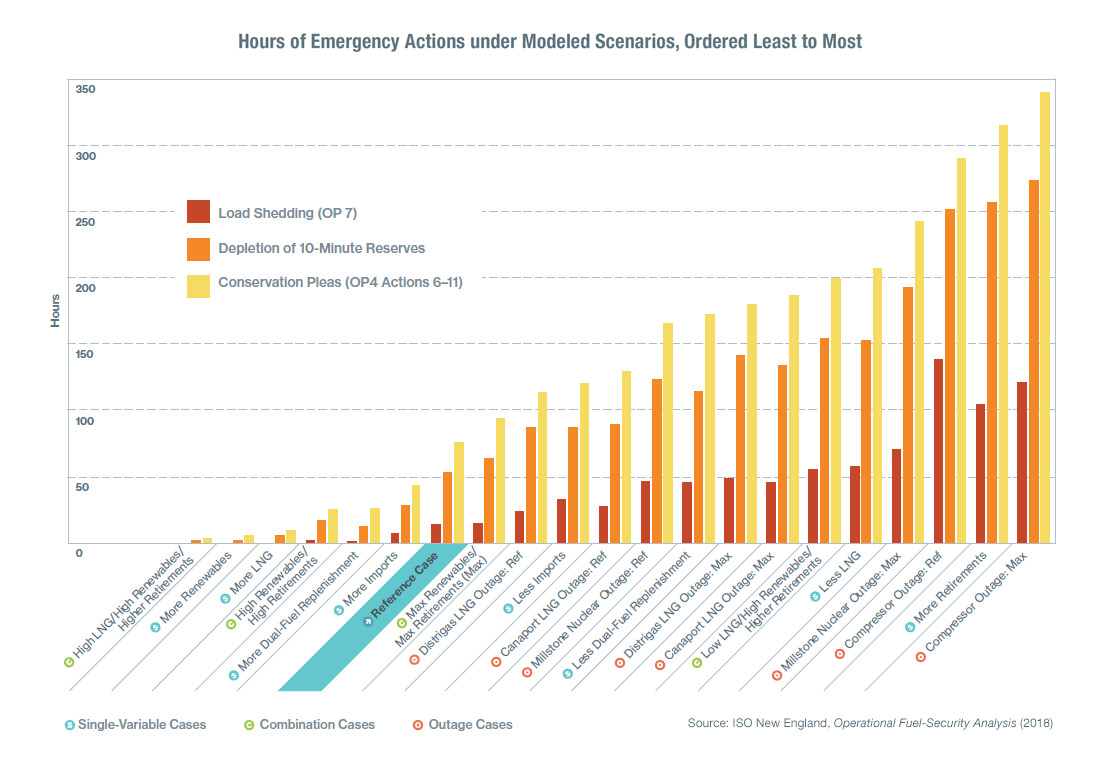 |
| ISO-NE chart of Hours of Emergency Actions under Modeled Scenarios, Ordered Least to Most, Operational Fuel-Security Analysis (2018) |
The study identified six major conclusions:
Outages: The region is vulnerable to the season-long outage of any of several major energy facilities.
Stored fuels: Power system reliability is heavily dependent on LNG and electricity imports; more dual-fuel capability is also a key reliability factor, but permitting for construction and emissions is difficult.
Logistics: The timely availability of fuel is critical, highlighting the importance of fuel-delivery logistics.
Risk trends: All but four scenarios result in fuel shortages requiring load shedding, indicating the trends affecting New England’s power system may intensify the region’s fuel-security risk.
Renewables: More renewable resources can help lessen the region’s fuel-security risk but are likely to drive coal- and oil-fired generation retirements, requiring high LNG imports to counteract the loss of stored fuels.
Positive outcomes: Higher levels of LNG, imports, and renewables can minimize system stress and maintain reliability; to attain these higher levels, delivery assurances for LNG and electricity imports, as well as transmission expansion, will be needed.
House subcommittee holds hearing on FERC oversight
Tuesday, December 1, 2015
Members of the Federal Energy Regulatory Commission testify today before the House Energy & Commerce Committee, Subcommittee on Energy and Power, as that committee considers its oversight of the FERC.

The FERC is an independent administrative agency within the Department of Energy. Its mandate includes regulating the transmission, reliability, and wholesale sale of electricity in interstate commerce pursuant to the Federal Power Act; the transmission and sale of natural gas for resale in interstate commerce pursuant to the Natural Gas Act; the transportation of oil by pipeline in interstate commerce pursuant to the Interstate Commerce Act; and evaluating proposals to build liquefied natural gas (LNG) terminals and interstate natural gas pipelines, as well as the licensing of non - federal hydropower projects.
As described in a committee background memorandum for today's hearing, the Subcommittee on Energy and Power is exploring whether FERC’s statutory authorities require modernization to reflect current energy realities. Chief among those statutory authorities are the Federal Power Act and the Natural Gas Act. The committee memorandum also notes an interest in evaluating "whether FERC is overstepping its existing statutory boundaries to pursue policy goals not intended by Congress."
Specific issues expected to be examined at the hearing include:
Based on prefiled documents, today's hearing features:

The FERC is an independent administrative agency within the Department of Energy. Its mandate includes regulating the transmission, reliability, and wholesale sale of electricity in interstate commerce pursuant to the Federal Power Act; the transmission and sale of natural gas for resale in interstate commerce pursuant to the Natural Gas Act; the transportation of oil by pipeline in interstate commerce pursuant to the Interstate Commerce Act; and evaluating proposals to build liquefied natural gas (LNG) terminals and interstate natural gas pipelines, as well as the licensing of non - federal hydropower projects.
As described in a committee background memorandum for today's hearing, the Subcommittee on Energy and Power is exploring whether FERC’s statutory authorities require modernization to reflect current energy realities. Chief among those statutory authorities are the Federal Power Act and the Natural Gas Act. The committee memorandum also notes an interest in evaluating "whether FERC is overstepping its existing statutory boundaries to pursue policy goals not intended by Congress."
Specific issues expected to be examined at the hearing include:
- Potential impacts of the U.S. EPA's Clean Power Plan rule on electricity markets, fuel diversity, and electric reliability;
- Commission oversight of organized wholesale electricity markets and their operation
- Risks to the security of the electric grid, including physical and cyber security, geomagnetic disturbances, electromagnetic pulse, and severe weather;
- How to integrate renewable, intermittent resources and distributed generation;
- The role of demand response and other demand-side management technologies in wholesale markets, at issue in the EPSA v. FERC case pending before the U.S. Supreme Court;
- Electric transmission operations and planning, including implementation of Order No. 1000;
- Natural gas pipeline permitting, LNG siting, and hydropower licensing;
- FERC market manipulation authorities and enforcement practices; and
- FERC’s implementation of the mandatory purchase obligation from qualifying facilities (QFs) under section 210 of the Public Utility Regulatory Policies Act of 1978.
Based on prefiled documents, today's hearing features:
- testimony by FERC Chairman Norman Bay
- testimony by Commissioner Cheryl LaFleur
- testimony by Commissioner Tony Clark
- testimony by Commissioner Colette Honorable
Solar bonds: SolarCity launches first US public debt offering
Wednesday, October 15, 2014
Could publicly offered solar bonds play a significant role in financing solar photovoltaic projects?
Solar energy company SolarCity Corporation appears to think so, as this morning it filed a registration statement with the U.S. Securities and Exchange Commission to issue up to $200 million in solar bonds. SolarCity describes the move as "the nation’s first registered public offering of solar bonds." What does SolarCity's solar bond offering mean for solar energy?
By some metrics, SolarCity is the largest developer of residential solar photovoltaic projects in the U.S. The company says it is currently providing more than one out of every three new solar power systems in the U.S., and notes that it "installed more residential solar in the second quarter of 2014 than its next 50 competitors combined." While SolarCity develops projects under several financial models, its typically installs rooftop solar panels at its customers' sites with no upfront costs to the customer, who then pays the company every month for leasing the facilities or for the electricity it uses. These long-term contracts create more stable ongoing revenues for SolarCity compared to those experienced by developers of turnkey projects who may end their relationship after the project is commissioned.
SolarCity's model has proved attractive to capital, as it has been involved with financing the installation of approximately $5 billion in renewable energy assets. Much of the capital SolarCity needs to develop these projects has come from investments from major banks and corporations including US Bancorp and Google Inc., as well as individuals owning shares of the company's stock (traded as SCTY).
SolarCity has also turned to debt offerings, making three private placements of solar bonds in the last year. Generally speaking, SolarCity will pay returns on the bonds using income generated from customers' monthly payments. Because this income stream is both relatively stable and predictable, it should enable repayment of the bonds plus a steady yield.
But no company has previously publicly offered solar bonds of this type in the U.S. SolarCity thus views its publicly offered solar bonding model as unique, in that it gives individual investors access to new investment opportunities -- and in turn, it may give SolarCity access to a whole lot more money -- up to $200 million in this round, with the prospect of more to come.
Under SolarCity's new offering, investors will be able to purchase solar bonds for as little as $1,000, with maturities ranging from one year to seven years and interest rates of up to 4 percent. The relatively short maturity of these bonds, compared to those previously offered to institutional investors, helps reduce the risk that during the bonds' lives utility rates will change in a way that hurts their economics.
The company notes that solar bonds will be available to all U.S. investors who are at least 18 years old and meet SolarCity’s eligibility requirements, with no fees for purchase. Indeed, the relatively low $1,000 minimum investment for this solar bond offering highlights SolarCity's strategy of targeting the millions of small or "retail" investors. To facilitate these individual investors' access to the bonds, the company launched a new online investment site (solarbonds.solarcity.com).
How will the new solar bond offering affect SolarCity and the pace of solar development in the US? With a market capitalization of $4.2 billion, SolarCity is relatively large compared to the $200 million that it may raise pursuant to the current public bond offering. Nevertheless, individual investors' appetite for opportunities to participate in solar and other renewable energy projects may be significant enough that more bond offerings will follow on the heels of this one. As the Brookings-Rockefeller Project on State and Metropolitan Innovation found in an April 2014 report, Clean Energy FinanceThrough the Bond Market:A New Option for Progress, "Bond finance holds tremendous potential for clean energy investment, at levels in the tens of billions of dollars in the next several years." If SolarCity is indeed successful in attractive individual bond investors, other solar developers like First Solar, Inc. and Sunrun may soon follow suit with solar bond offerings of their own.
Solar energy company SolarCity Corporation appears to think so, as this morning it filed a registration statement with the U.S. Securities and Exchange Commission to issue up to $200 million in solar bonds. SolarCity describes the move as "the nation’s first registered public offering of solar bonds." What does SolarCity's solar bond offering mean for solar energy?
 |
| Solar panels on a residential rooftop in Massachusetts. |
By some metrics, SolarCity is the largest developer of residential solar photovoltaic projects in the U.S. The company says it is currently providing more than one out of every three new solar power systems in the U.S., and notes that it "installed more residential solar in the second quarter of 2014 than its next 50 competitors combined." While SolarCity develops projects under several financial models, its typically installs rooftop solar panels at its customers' sites with no upfront costs to the customer, who then pays the company every month for leasing the facilities or for the electricity it uses. These long-term contracts create more stable ongoing revenues for SolarCity compared to those experienced by developers of turnkey projects who may end their relationship after the project is commissioned.
SolarCity's model has proved attractive to capital, as it has been involved with financing the installation of approximately $5 billion in renewable energy assets. Much of the capital SolarCity needs to develop these projects has come from investments from major banks and corporations including US Bancorp and Google Inc., as well as individuals owning shares of the company's stock (traded as SCTY).
SolarCity has also turned to debt offerings, making three private placements of solar bonds in the last year. Generally speaking, SolarCity will pay returns on the bonds using income generated from customers' monthly payments. Because this income stream is both relatively stable and predictable, it should enable repayment of the bonds plus a steady yield.
But no company has previously publicly offered solar bonds of this type in the U.S. SolarCity thus views its publicly offered solar bonding model as unique, in that it gives individual investors access to new investment opportunities -- and in turn, it may give SolarCity access to a whole lot more money -- up to $200 million in this round, with the prospect of more to come.
Under SolarCity's new offering, investors will be able to purchase solar bonds for as little as $1,000, with maturities ranging from one year to seven years and interest rates of up to 4 percent. The relatively short maturity of these bonds, compared to those previously offered to institutional investors, helps reduce the risk that during the bonds' lives utility rates will change in a way that hurts their economics.
The company notes that solar bonds will be available to all U.S. investors who are at least 18 years old and meet SolarCity’s eligibility requirements, with no fees for purchase. Indeed, the relatively low $1,000 minimum investment for this solar bond offering highlights SolarCity's strategy of targeting the millions of small or "retail" investors. To facilitate these individual investors' access to the bonds, the company launched a new online investment site (solarbonds.solarcity.com).
How will the new solar bond offering affect SolarCity and the pace of solar development in the US? With a market capitalization of $4.2 billion, SolarCity is relatively large compared to the $200 million that it may raise pursuant to the current public bond offering. Nevertheless, individual investors' appetite for opportunities to participate in solar and other renewable energy projects may be significant enough that more bond offerings will follow on the heels of this one. As the Brookings-Rockefeller Project on State and Metropolitan Innovation found in an April 2014 report, Clean Energy FinanceThrough the Bond Market:A New Option for Progress, "Bond finance holds tremendous potential for clean energy investment, at levels in the tens of billions of dollars in the next several years." If SolarCity is indeed successful in attractive individual bond investors, other solar developers like First Solar, Inc. and Sunrun may soon follow suit with solar bond offerings of their own.
NJ regulators reject offshore wind project
Thursday, March 20, 2014
The New Jersey Board of Public Utilities has voted against extending ratepayer subsidies to an offshore wind project proposed by developer Fishermen's Energy, challenging the project's financial viability.
Back in 2011, Fishermen's Energy proposed a 25-megawatt offshore wind pilot project to be located off Atlantic City. The developer applied to the Board of Public Utilities for ratepayer support under New Jersey's Offshore Wind Economic Development Act of 2010. That law directed the Board of Public Utilities to develop a program to require utilities to source a percentage of the electricity they sell in New Jersey from one or more qualified offshore wind projects. To track energy from offshore wind, the law envisioned the creation of offshore renewable energy certificates, or ORECs, that could be sold by qualified offshore wind projects to the load-serving utilities. The concept was that given the relatively high costs and uncertainty of offshore wind, no project could be financed or built without a steady revenue stream from OREC sales.
But the New Jersey project appeared to stall before the Board. Charged with creating the OREC program and evaluating whether the Fishermen's Energy project could qualify to produce ORECs, the Board was faced with serious technical tasks. As the regulatory process for the Fishermen's Energy project lengthened -- ultimately stretching to over 1,000 days -- Board staff raised concerns over the financial viability of the project, as well as over the impact of the requested subsidy to ratepayer costs. Despite trimming the project's estimated costs to $188 million, these concerns remained, leading Board staff to recommend denial of Fishermen's Energy's request for OREC certification.
Yesterday, the Board of Public Utilities rejected Fishermen’s Energy’s proposal by a unanimous 4-0 decision. While the Board's formal written order has not yet been released, expect it to explain the Board's reasoning in more detail when it surfaces next week. In the meantime, Fishermen’s Energy is undoubtedly considering its options, which may include dropping the project, appealing the Board's rejection, or finding alternative ways to de-risk and finance the project.
 |
| The New Jersey coast near Atlantic City, seen from above. |
Back in 2011, Fishermen's Energy proposed a 25-megawatt offshore wind pilot project to be located off Atlantic City. The developer applied to the Board of Public Utilities for ratepayer support under New Jersey's Offshore Wind Economic Development Act of 2010. That law directed the Board of Public Utilities to develop a program to require utilities to source a percentage of the electricity they sell in New Jersey from one or more qualified offshore wind projects. To track energy from offshore wind, the law envisioned the creation of offshore renewable energy certificates, or ORECs, that could be sold by qualified offshore wind projects to the load-serving utilities. The concept was that given the relatively high costs and uncertainty of offshore wind, no project could be financed or built without a steady revenue stream from OREC sales.
But the New Jersey project appeared to stall before the Board. Charged with creating the OREC program and evaluating whether the Fishermen's Energy project could qualify to produce ORECs, the Board was faced with serious technical tasks. As the regulatory process for the Fishermen's Energy project lengthened -- ultimately stretching to over 1,000 days -- Board staff raised concerns over the financial viability of the project, as well as over the impact of the requested subsidy to ratepayer costs. Despite trimming the project's estimated costs to $188 million, these concerns remained, leading Board staff to recommend denial of Fishermen's Energy's request for OREC certification.
Yesterday, the Board of Public Utilities rejected Fishermen’s Energy’s proposal by a unanimous 4-0 decision. While the Board's formal written order has not yet been released, expect it to explain the Board's reasoning in more detail when it surfaces next week. In the meantime, Fishermen’s Energy is undoubtedly considering its options, which may include dropping the project, appealing the Board's rejection, or finding alternative ways to de-risk and finance the project.
Subscribe to:
Posts (Atom)
