Federal electricity regulators have given New England's regional grid operator more time to develop proposed new mechanisms to enhance long-term fuel security, after states and market participants asked for an extension to allow continued stakeholder discussions. At stake are what could be significant reforms to the region's electricity markets, including new opportunities for generators to earn revenue for providing fuel security, as well as the prospect of significant new costs for consumers.
ISO New England Inc. is the regional transmission organization and independent system operator for the electric grid serving nearly all of New England. In this role, it develops and administers markets for electric energy, capacity, and other products. ISO-NE also engages in regional system planning, and manages proposals to retire or close power plants that provide capacity to the region.
In 2018, the owner of the Mystic Generating Station, the largest power station in Massachusetts by nameplate capacity, proposed to retire its units in 2022. But after a study of the remaining electric system, ISO-NE determined that the retirement of Mystic's units 8 and 9 would present "unacceptable fuel security risks" that could lead to rolling blackouts as soon as the winters of 2022 through 2024. In response, ISO-NE asked the Federal Energy Regulatory Commission for waivers to allow the grid operator to retain the Mystic units to meet fuel security needs.
Some stakeholders disagreed that the Mystic units' retirement posed a reliability risk; others argued the costs of retaining them would outweigh any benefits. While the Commission denied ISO-NE's waiver request, it ultimately approved a short-term cost-of-service agreement under which regional ratepayers will pay to keep the Mystic units online. But the Commission also made a preliminary finding that ISO-NE's tariff may be unjust and unreasonable, and directed ISO-NE to file proposed tariff revisions creating a long-term fuel security mechanism by July 1, 2019. At the grid operator's request, the Commission later extended that deadline to November 15, 2019, to allow more time for proposal development and stakeholder discussion.
In the meantime, this spring ISO-NE filed a proposed short-term "inventoried energy program" from December 1
through the end of February during winters 2023/2024 and 2024/2025 as "a
bridge to a long-term, market-based solution that more comprehensively
addresses the region’s energy security risks" -- but Commission staff identified that filing as "deficient" and requested additional information, which prompted ISO-NE to provide additional information. In the absence of a Commission quorum willing to vote, those revisions became effective by operation of law on August 6, 2019, although parties have sought rehearing regarding the Commission's failure to act.
But even more time may be necessary. On July 31, 2019, the New England States Committee on Electricity (NESCOE) filed a motion requesting an additional six-month extension of time to allow ISO-NE and the region to work through issues related to ISO-NE’s proposed long-term fuel security mechanism. Representing the governors of the six New England states, NESCOE said granting its request would "enable a more complete
and holistic filing in response to the directives in the July 2018
Order, allow ISO-NE to address core consumer protection elements that
are fundamental to state support, and remove barriers to achieving a
greater degree of regional coalescence around a proposal." Several commenters supported the motion.
Ultimately, the Commission granted an extension of time up to and including April 15, 2020 for ISO-NE to file its long-term fuel security mechanism. While New England will soon be forced to address the issue of fuel security for its electric generating portfolio, these short-term and long-term market changes proposed by the grid operator are on hold for now.

Energy powers society; society's choices shape energy policy. A blog about our energy resources and the choices they present for society.
Showing posts with label fuel. Show all posts
Showing posts with label fuel. Show all posts

US EPA sets renewable fuel standard for 2019
Monday, December 10, 2018
U.S. environmental regulators have established renewable fuel standards for 2019, calling for a 3% increase in renewable fuel volumes over 2018, but have continued to waive statutory requirements targeting even larger volumes of renewable fuel.
Congress created the Renewable Fuel Standard or RFS program through the Energy Policy Act of 2005, and expanded the program through the Energy Independence and Security Act of 2007. Administered by the U.S. Environmental Protection Agency, the RFS requires a certain volume of renewable fuel to be used in transportation (motor vehicles and jets) and heating. Refiners and importers of gasoline or diesel, along with other market participants like fuel producers and exporters, track and trade renewable fuel credits called Renewable Identification Numbers or RINs.
The RFS includes four categories of renewable fuel: cellulosic biofuel, biomass-based diesel, advanced biofuel, and total renewable fuel. By statute, Congress prescribed specific volumes of these four categories of renewable fuel for each year through 2022, and required the EPA to set RFS volume requirements annually based on these statutory targets. The statute also allows the EPA Administrator to waive these volumetric requirements, based on a determination that implementation of the program is causing severe economic or environmental harm, or based on inadequate domestic supply.
On November 30, 2018, the EPA issued its final rule for the 2019 RFS program. The 2019 final rule sets the total U.S. renewable fuel volume requirements for 2019 at 19.92 billion gallons, including 4.92 billion gallons of advanced biofuel, 2.1 billion gallons of biomass-based diesel, and just 418 million gallons of cellulosic biofuel. The rule also sets a 2020 volume requirement for biomass-based diesel of 2.43 billion gallons.
The EPA noted that "the market has fallen well short of the statutory volumes for cellulosic biofuel, resulting in shortfalls in the advanced biofuel and total renewable fuel volumes." Based on this observation, EPA exercised its waiver authority to finalize the cellulosic biofuel volume requirement at the level EPA projects to be available for 2019. This is consistent with EPA's past practice, through which it has set the cellulosic biofuel requirement lower than the statutory volume for each year since 2010.
Congress created the Renewable Fuel Standard or RFS program through the Energy Policy Act of 2005, and expanded the program through the Energy Independence and Security Act of 2007. Administered by the U.S. Environmental Protection Agency, the RFS requires a certain volume of renewable fuel to be used in transportation (motor vehicles and jets) and heating. Refiners and importers of gasoline or diesel, along with other market participants like fuel producers and exporters, track and trade renewable fuel credits called Renewable Identification Numbers or RINs.
The RFS includes four categories of renewable fuel: cellulosic biofuel, biomass-based diesel, advanced biofuel, and total renewable fuel. By statute, Congress prescribed specific volumes of these four categories of renewable fuel for each year through 2022, and required the EPA to set RFS volume requirements annually based on these statutory targets. The statute also allows the EPA Administrator to waive these volumetric requirements, based on a determination that implementation of the program is causing severe economic or environmental harm, or based on inadequate domestic supply.
On November 30, 2018, the EPA issued its final rule for the 2019 RFS program. The 2019 final rule sets the total U.S. renewable fuel volume requirements for 2019 at 19.92 billion gallons, including 4.92 billion gallons of advanced biofuel, 2.1 billion gallons of biomass-based diesel, and just 418 million gallons of cellulosic biofuel. The rule also sets a 2020 volume requirement for biomass-based diesel of 2.43 billion gallons.
The EPA noted that "the market has fallen well short of the statutory volumes for cellulosic biofuel, resulting in shortfalls in the advanced biofuel and total renewable fuel volumes." Based on this observation, EPA exercised its waiver authority to finalize the cellulosic biofuel volume requirement at the level EPA projects to be available for 2019. This is consistent with EPA's past practice, through which it has set the cellulosic biofuel requirement lower than the statutory volume for each year since 2010.
NECA Fuels Conference 2018
Thursday, September 20, 2018
Northeast Energy and Commerce Association holds its 2018 Fuels Conference on September 27, 2018, in Marlborough, Massachusetts.
NECA is New England's oldest and most broadly-based, non-profit trade association serving the competitive electric power industry.
The program for NECA's 2018 Fuels Conference features diverse perspectives on fuels including natural gas (pipeline and LNG), biogas, oil, and other fuels, and in their uses such as electric power generation, heating, and transportation. Speakers will share their outlook for U.S. and New England natural gas markets, address the trend towards electrification of sectors like heating and transportation, explain the portfolio of fuels used to heat and power the region, and discuss what consumers can expect from lawmakers, regulators, and energy providers.
Registration is available through NECA's website.
.jpg)
NECA is New England's oldest and most broadly-based, non-profit trade association serving the competitive electric power industry.
The program for NECA's 2018 Fuels Conference features diverse perspectives on fuels including natural gas (pipeline and LNG), biogas, oil, and other fuels, and in their uses such as electric power generation, heating, and transportation. Speakers will share their outlook for U.S. and New England natural gas markets, address the trend towards electrification of sectors like heating and transportation, explain the portfolio of fuels used to heat and power the region, and discuss what consumers can expect from lawmakers, regulators, and energy providers.
Registration is available through NECA's website.
New England Operational Fuel-Security Analysis released
Tuesday, January 23, 2018
The risk that power plants will run out of fuel is the foremost challenge to a reliable power grid in New England, according to the region's grid operator, and the region is vulnerable to the season-long outage of any of several major energy facilities.
While the ability to count on a portfolio of power plants to generate power is considered the cornerstone of reliable electricity supply, ISO New England has noted several factors that make fuel security a growing concern for the region. These factors include the inadequacy of the region’s natural gas infrastructure to meet winter needs for both heating and power, and the retirement of many of the region’s coal, oil, and nuclear power plants due to economic and environmental pressures.
On January 17, 2018, ISO New England released its Operational Fuel-Security Analysis, a 56-page report studying the possible fuel security risks facing region's power plants under a wide range of hypothetical future scenarios. Prepared following about two years of study, the report found that maintaining the electric grid's reliability "is likely to become more challenging, especially if current power system trends continue."
The report considered a 23 possible range of possible future power resource combinations that could materialize for the winter period from December 1, 2024 through February 28, 2025, to examine whether enough fuel would be available to meet demand and to quantify the operational risks. Each scenario assumed no new natural gas pipeline capacity would be added to serve generators, but considered variation in five other key factors for power system reliability: resource retirements, LNG availability, oil tank inventories, imported electricity, and renewable resources.
The study identified six major conclusions:
While the ability to count on a portfolio of power plants to generate power is considered the cornerstone of reliable electricity supply, ISO New England has noted several factors that make fuel security a growing concern for the region. These factors include the inadequacy of the region’s natural gas infrastructure to meet winter needs for both heating and power, and the retirement of many of the region’s coal, oil, and nuclear power plants due to economic and environmental pressures.
On January 17, 2018, ISO New England released its Operational Fuel-Security Analysis, a 56-page report studying the possible fuel security risks facing region's power plants under a wide range of hypothetical future scenarios. Prepared following about two years of study, the report found that maintaining the electric grid's reliability "is likely to become more challenging, especially if current power system trends continue."
The report considered a 23 possible range of possible future power resource combinations that could materialize for the winter period from December 1, 2024 through February 28, 2025, to examine whether enough fuel would be available to meet demand and to quantify the operational risks. Each scenario assumed no new natural gas pipeline capacity would be added to serve generators, but considered variation in five other key factors for power system reliability: resource retirements, LNG availability, oil tank inventories, imported electricity, and renewable resources.
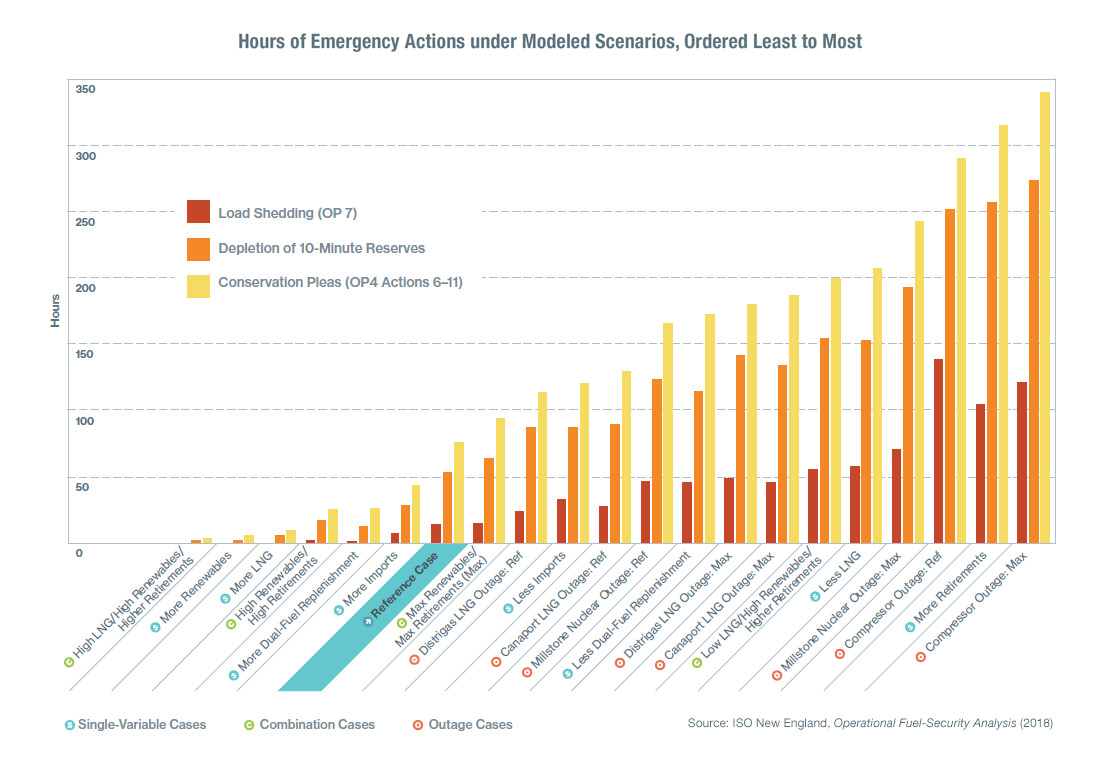 |
| ISO-NE chart of Hours of Emergency Actions under Modeled Scenarios, Ordered Least to Most, Operational Fuel-Security Analysis (2018) |
The study identified six major conclusions:
Outages: The region is vulnerable to the season-long outage of any of several major energy facilities.
Stored fuels: Power system reliability is heavily dependent on LNG and electricity imports; more dual-fuel capability is also a key reliability factor, but permitting for construction and emissions is difficult.
Logistics: The timely availability of fuel is critical, highlighting the importance of fuel-delivery logistics.
Risk trends: All but four scenarios result in fuel shortages requiring load shedding, indicating the trends affecting New England’s power system may intensify the region’s fuel-security risk.
Renewables: More renewable resources can help lessen the region’s fuel-security risk but are likely to drive coal- and oil-fired generation retirements, requiring high LNG imports to counteract the loss of stored fuels.
Positive outcomes: Higher levels of LNG, imports, and renewables can minimize system stress and maintain reliability; to attain these higher levels, delivery assurances for LNG and electricity imports, as well as transmission expansion, will be needed.
FERC grid reliability and resilience pricing questions
Tuesday, October 10, 2017
U.S. energy regulators have asked for public comment on a rule proposed by the Secretary of Energy that would require organized grid operators to pay certain electric generators for their grid reliability and resilience benefits.
On September 28, 2017, Secretary of Energy Rick Perry directed the Federal Energy Regulatory Commission to consider a proposed rule on an expedited basis. The proposed rule defines an "eligible grid reliability and resiliency resource" based on criteria including the ability to provide essential energy and ancillary reliability services and to have a 90-day fuel supply on site enabling it to operate during an emergency, extreme weather conditions, or a natural or man-made disaster. It would requires independent system operators and regional transmission organizations to establish a tariff that provides a " just and reasonable rate" for the purchase of electric energy from such resources including recovery of costs and a return on equity
On October 2, the Commission issued a Notice Inviting Comments, asking interested persons to submit comments regarding the proposal on or before October 23, 2017. Two days later, Commission staff followed up with a series of questions for public comment. Questions in that document cover topics including the need for reform, eligibility, implementation, and rates, as well as impacts on consumers.
Some questions posed by the Commission staff in its October 4, 2017 document are general, such as, "What is resilience, how is it measured, and how is it different from reliability? What levels of resilience and reliability are appropriate?" Others ask for whether commenters agree with references in the proposed rule to the 2014 "Polar Vortex" and "other extreme weather events, specifically hurricanes Irma, Harvey, Maria, and superstorm Sandy," as well as "the retirement of coal and nuclear resources and a concern from Congress about the potential further loss of valuable generation resources" as justifying the need for action.
As previously noticed by the Commission, initial comments on the proposed Grid Reliability and Resilience Pricing Rule in Docket No. RM18-1-000 are due on or before October 23, 2017 and reply comments due on or before November 7, 2017.
On September 28, 2017, Secretary of Energy Rick Perry directed the Federal Energy Regulatory Commission to consider a proposed rule on an expedited basis. The proposed rule defines an "eligible grid reliability and resiliency resource" based on criteria including the ability to provide essential energy and ancillary reliability services and to have a 90-day fuel supply on site enabling it to operate during an emergency, extreme weather conditions, or a natural or man-made disaster. It would requires independent system operators and regional transmission organizations to establish a tariff that provides a " just and reasonable rate" for the purchase of electric energy from such resources including recovery of costs and a return on equity
On October 2, the Commission issued a Notice Inviting Comments, asking interested persons to submit comments regarding the proposal on or before October 23, 2017. Two days later, Commission staff followed up with a series of questions for public comment. Questions in that document cover topics including the need for reform, eligibility, implementation, and rates, as well as impacts on consumers.
Some questions posed by the Commission staff in its October 4, 2017 document are general, such as, "What is resilience, how is it measured, and how is it different from reliability? What levels of resilience and reliability are appropriate?" Others ask for whether commenters agree with references in the proposed rule to the 2014 "Polar Vortex" and "other extreme weather events, specifically hurricanes Irma, Harvey, Maria, and superstorm Sandy," as well as "the retirement of coal and nuclear resources and a concern from Congress about the potential further loss of valuable generation resources" as justifying the need for action.
As previously noticed by the Commission, initial comments on the proposed Grid Reliability and Resilience Pricing Rule in Docket No. RM18-1-000 are due on or before October 23, 2017 and reply comments due on or before November 7, 2017.
Will Utah counties fund thorium reactor?
Thursday, August 17, 2017
Could a coalition of rural counties in Utah and a startup company develop a thorium-fueled nuclear reactor for electric power and other purposes?
According to its website, the Seven County Infrastructure Coalition is currently comprised of seven counties in eastern Utah: Carbon, Daggett, Duchesne, Emery, San Juan, Sevier, and Uintah. The website describes the Coalition’s main roles and mission as "to identify revenue-producing infrastructure assets that will benefit the region" and "to plan infrastructure corridors, procure funding, permit, design, secure rights-of-way and own such facilities," with operation and maintenance possibly outsourced to third parties.
Apparently under consideration by the Coalition are energy projects, including a "thorium energy" project and a "hydrogen plant" project. For example, the "Procurement" section of the Coalition's website includes a Request for Qualifications for Project Analyst for Potential Thorium Energy and Hydrogen Plant Projects, as well as a Request for Qualifications Project Financial Analyst on Potential Thorium Energy Project.
Under the Project Analyst RFQ, which closed August 1, 2017,
According to its website, Alpha Tech Research Corp.'s motto is "Changing the face of nuclear power with clean, safe, molten salt reactor technology." But little other public information is easy to find on the company.
Thorium is a radioactive element that can be used in a nuclear reactor as a fuel for power production. It is distinct from the uranium-based fuel used in traditional nuclear power plants. Some limited research and development was conducted on thorium-based reactors in the twentieth century, but recent projects and all commercial reactors rely the uranium fuel cycle. Proponents of thorium reactors suggest abundant fuel supplies and reduced weapons proliferation risk compared to uranium, combined with other advantages of nuclear power such as reliable baseload generation with zero carbon emissions. Some point to Utah's mineral richness as a cost-effective source for lithium, beryllium, and other materials that could be useful in molten salt reactor resign. But crucially the technology, regulation, and business structures necessary to support a thorium reactor may not yet exist.
Fifteen days after the Project Analyst RFQ closed, the Coalition issued another request for qualifications "to seek an individual or team to act as a Project Analyst to advise it and its member counties on a proposed project related to thorium energy. In addition, the Coalition seeks guidance on how to evaluate emerging technologies, and companies or groups proposing projects to the Coalition. The thorium energy facility for producing electricity, etc. is proposed by Alpha Tech Research Corporation." Proposals under this subsequent RFQ are due by 2:00 PM on October 2, 2017. According to the Salt Lake Tribune, a coalition representative reported, "The coalition’s initial request for qualifications drew no adequate responses by its Aug. 1 deadline." (Query why not.)
It's unclear how far the Utah counties' efforts can go. The coalition's stated criteria for evaluating potential projects include requiring appropriate project benefits (such as facilitating needs in rural Utah that would otherwise go unaddressed), as well as avoidance of any "fatal flaws" (such as "obvious non-Coalition sponsor that should take the lead", project success unlikely" and "low perceived benefit compared to cost.") The coalition is presumably at the stage where it is seeking expert advice to help it evaluate the thorium energy project under these criteria.
In its materials, the coalition emphasizes its expectation to rely on public-private partnerships, in part to allocate project risk to private entities with special expertise in taking those risks. But developing the first commercial thorium reactor inherently involves a variety of risks -- including developing a technology that works, securing all necessary regulatory approvals, and having business or financial arrangements in place that make the project a success. These risks could pan out in the counties' favor -- but might not. A coalition of South Carolina utilities developing what would have been the nation's first new commercial nuclear reactor recently announced a decision to suspend that project partway through construction, following years of delay, billions of dollars in cost overruns. While a thorium reactor might avoid some of these challenges, others are likely systemic to the state of the nuclear power industry from a technological, regulatory, and business perspective, and would be hard for the counties to avoid. The counties may also have more proximate opportunities to achieve similar goals, including by facilitating or developing renewable energy infrastructure.
At the same time, the coalition deserves credit for thinking proactively and considering its options. Whether the coalition continues to pursue thorium energy, or focuses on less speculative projects, the coalition's fundamental mission remains "to improve the quality of life through cooperative regional planning, increased economic opportunity, and sustainable implementation." With the right balance of risk and reward, its evaluation of proposed projects could advance that mission.
According to its website, the Seven County Infrastructure Coalition is currently comprised of seven counties in eastern Utah: Carbon, Daggett, Duchesne, Emery, San Juan, Sevier, and Uintah. The website describes the Coalition’s main roles and mission as "to identify revenue-producing infrastructure assets that will benefit the region" and "to plan infrastructure corridors, procure funding, permit, design, secure rights-of-way and own such facilities," with operation and maintenance possibly outsourced to third parties.
Apparently under consideration by the Coalition are energy projects, including a "thorium energy" project and a "hydrogen plant" project. For example, the "Procurement" section of the Coalition's website includes a Request for Qualifications for Project Analyst for Potential Thorium Energy and Hydrogen Plant Projects, as well as a Request for Qualifications Project Financial Analyst on Potential Thorium Energy Project.
Under the Project Analyst RFQ, which closed August 1, 2017,
The Coalition seeks an individual or team to act as a Project Analyst to advise it and its member counties on two proposed projects, how to evaluate emerging technologies, and the respective project teams. One project is a thorium energy facility for producing electricity, etc. as proposed by Alpha Tech Research Corporation. The second project consists of hydrogen plants to be used as fueling stations for hydrogen/electric semi-trucks as proposed by Nikola Motor Company, LLC.Responsibilities defined in this original RFQ would include evaluation of the thorium energy and hydrogen plant projects, including an evaluation of "the feasibility and viability of projects in general, as well as the proposed projects, and determine how the Coalition and its members may use their assets to best benefit the public."
According to its website, Alpha Tech Research Corp.'s motto is "Changing the face of nuclear power with clean, safe, molten salt reactor technology." But little other public information is easy to find on the company.
Thorium is a radioactive element that can be used in a nuclear reactor as a fuel for power production. It is distinct from the uranium-based fuel used in traditional nuclear power plants. Some limited research and development was conducted on thorium-based reactors in the twentieth century, but recent projects and all commercial reactors rely the uranium fuel cycle. Proponents of thorium reactors suggest abundant fuel supplies and reduced weapons proliferation risk compared to uranium, combined with other advantages of nuclear power such as reliable baseload generation with zero carbon emissions. Some point to Utah's mineral richness as a cost-effective source for lithium, beryllium, and other materials that could be useful in molten salt reactor resign. But crucially the technology, regulation, and business structures necessary to support a thorium reactor may not yet exist.
Fifteen days after the Project Analyst RFQ closed, the Coalition issued another request for qualifications "to seek an individual or team to act as a Project Analyst to advise it and its member counties on a proposed project related to thorium energy. In addition, the Coalition seeks guidance on how to evaluate emerging technologies, and companies or groups proposing projects to the Coalition. The thorium energy facility for producing electricity, etc. is proposed by Alpha Tech Research Corporation." Proposals under this subsequent RFQ are due by 2:00 PM on October 2, 2017. According to the Salt Lake Tribune, a coalition representative reported, "The coalition’s initial request for qualifications drew no adequate responses by its Aug. 1 deadline." (Query why not.)
It's unclear how far the Utah counties' efforts can go. The coalition's stated criteria for evaluating potential projects include requiring appropriate project benefits (such as facilitating needs in rural Utah that would otherwise go unaddressed), as well as avoidance of any "fatal flaws" (such as "obvious non-Coalition sponsor that should take the lead", project success unlikely" and "low perceived benefit compared to cost.") The coalition is presumably at the stage where it is seeking expert advice to help it evaluate the thorium energy project under these criteria.
In its materials, the coalition emphasizes its expectation to rely on public-private partnerships, in part to allocate project risk to private entities with special expertise in taking those risks. But developing the first commercial thorium reactor inherently involves a variety of risks -- including developing a technology that works, securing all necessary regulatory approvals, and having business or financial arrangements in place that make the project a success. These risks could pan out in the counties' favor -- but might not. A coalition of South Carolina utilities developing what would have been the nation's first new commercial nuclear reactor recently announced a decision to suspend that project partway through construction, following years of delay, billions of dollars in cost overruns. While a thorium reactor might avoid some of these challenges, others are likely systemic to the state of the nuclear power industry from a technological, regulatory, and business perspective, and would be hard for the counties to avoid. The counties may also have more proximate opportunities to achieve similar goals, including by facilitating or developing renewable energy infrastructure.
At the same time, the coalition deserves credit for thinking proactively and considering its options. Whether the coalition continues to pursue thorium energy, or focuses on less speculative projects, the coalition's fundamental mission remains "to improve the quality of life through cooperative regional planning, increased economic opportunity, and sustainable implementation." With the right balance of risk and reward, its evaluation of proposed projects could advance that mission.
US designates alternative fuel corridors for transportation
Thursday, November 3, 2016
U.S. federal highway administrators have announced the designation of 55 routes as "alternative fuel" corridors, capable of accommodating electric vehicles or those powered by hydrogen, propane, or natural gas. The announcement sets the stage for further federal action supporting alternative transportation fuels.
The U.S. Department of Transportation’s Federal Highway Administration (FHWA) oversees construction and maintenance of the nation's highways, bridges, and tunnels. FHWA data suggests U.S. drivers travel over 3.15 trillion miles per year. Overall, the U.S. transportation sector is a major consumer of energy, and among the largest contributors to domestic greenhouse gas emissions.
Congress and the Obama administration are now pursuing strategies to reduce the transportation sector's greenhouse gas emissions. Electric vehicles and alternative transportation fuels form one tool in these efforts. Under a 2015 law -- Section 1413 of the Fixing America's Surface Transportation (FAST) Act -- the Secretary of Transportation is required to designate national electric vehicle (EV) charging, hydrogen, propane, and natural gas fueling corridors. In July, the Department of Transportation asked states to nominate corridors along major highways, for EVs and other alternative fuels designated in the FAST Act.
In a November 3, 2016, announcement, the FHWA unveiled its designation of the nation's first alternative fuel corridors. The network is nearly 85,000 miles long, and crosses 35 states. Some corridors have been designed as "sign-ready," meaning alternative fueling stations are operational; these corridors are eligible to feature new signs showing where drivers can refuel.
The FHWA has posted maps of its alternative fuel corridors on its website. The agency intends to add more miles in the future, as additional charging and fueling stations are built.
 |
| An electric vehicle charging station, in an underground parking garage in Boston. |
The U.S. Department of Transportation’s Federal Highway Administration (FHWA) oversees construction and maintenance of the nation's highways, bridges, and tunnels. FHWA data suggests U.S. drivers travel over 3.15 trillion miles per year. Overall, the U.S. transportation sector is a major consumer of energy, and among the largest contributors to domestic greenhouse gas emissions.
Congress and the Obama administration are now pursuing strategies to reduce the transportation sector's greenhouse gas emissions. Electric vehicles and alternative transportation fuels form one tool in these efforts. Under a 2015 law -- Section 1413 of the Fixing America's Surface Transportation (FAST) Act -- the Secretary of Transportation is required to designate national electric vehicle (EV) charging, hydrogen, propane, and natural gas fueling corridors. In July, the Department of Transportation asked states to nominate corridors along major highways, for EVs and other alternative fuels designated in the FAST Act.
In a November 3, 2016, announcement, the FHWA unveiled its designation of the nation's first alternative fuel corridors. The network is nearly 85,000 miles long, and crosses 35 states. Some corridors have been designed as "sign-ready," meaning alternative fueling stations are operational; these corridors are eligible to feature new signs showing where drivers can refuel.
The FHWA has posted maps of its alternative fuel corridors on its website. The agency intends to add more miles in the future, as additional charging and fueling stations are built.
ISO-NE Winter Reliability Program 2016-2017
Thursday, September 1, 2016
As winter approaches, the operator of New England's wholesale electricity markets is preparing to run another seasonal Winter Reliability Program to address operational concerns related to fuel adequacy.
Since the winter of 2013-2014, ISO New England Inc. has operated a seasonal program to address winter fuel security and power system reliability concerns, relating largely to natural gas pipeline constraints. After two initial program years, last fall the Federal Energy Regulatory Commission approved a three-year plan for ISO-NE's Winter Reliability Program.
That program, developed chiefly by market participant group New England Power Pool (NEPOOL), was designed to address reliability concerns through at least 2017-2018, when new “Pay-for-Performance” incentives and penalties in New England's redesigned capacity market are set to take effect. The winter reliability program encourages generators fueled by oil and liquefied natural gas (LNG) to secure fuel before the winter season begins, by compensating them for some costs related to fuel inventory that remains unused at winter's end, and includes a demand response component. According to ISO-NE, last year's participants included 77 oil-fired units, 8 LNG units, and 6 demand response assets.
The program's rules are specified in Appendix K to Section III of the ISO New England Inc. Transmission, Markets and Services Tariff. As approved by FERC, the current program retains the three core components of the 2014-2015 Winter Reliability Program: (1) compensation for certain oil inventory that remains in New England following the end of each winter period; (2) end-of-season compensation for LNG contract volumes kept available for winter use but not actually called upon to produce energy; and (3) a supplemental demand response program.
ISO-NE has also published a memorandum describing payment rates for the 2016-2017 winter program. Under its tariff, ISO-NE first determines a "Set Rate," representing partial compensation for the per-barrel carrying costs of stored fuel oil. The Set Rate is translated into an equivalent rate for the other, non-oil services that are compensated through Appendix K.
Requests to participate in ISO New England's 2016-2017 Winter Reliability Program are due to ISO-NE by October 1, 2016.
Since the winter of 2013-2014, ISO New England Inc. has operated a seasonal program to address winter fuel security and power system reliability concerns, relating largely to natural gas pipeline constraints. After two initial program years, last fall the Federal Energy Regulatory Commission approved a three-year plan for ISO-NE's Winter Reliability Program.
That program, developed chiefly by market participant group New England Power Pool (NEPOOL), was designed to address reliability concerns through at least 2017-2018, when new “Pay-for-Performance” incentives and penalties in New England's redesigned capacity market are set to take effect. The winter reliability program encourages generators fueled by oil and liquefied natural gas (LNG) to secure fuel before the winter season begins, by compensating them for some costs related to fuel inventory that remains unused at winter's end, and includes a demand response component. According to ISO-NE, last year's participants included 77 oil-fired units, 8 LNG units, and 6 demand response assets.
The program's rules are specified in Appendix K to Section III of the ISO New England Inc. Transmission, Markets and Services Tariff. As approved by FERC, the current program retains the three core components of the 2014-2015 Winter Reliability Program: (1) compensation for certain oil inventory that remains in New England following the end of each winter period; (2) end-of-season compensation for LNG contract volumes kept available for winter use but not actually called upon to produce energy; and (3) a supplemental demand response program.
ISO-NE has also published a memorandum describing payment rates for the 2016-2017 winter program. Under its tariff, ISO-NE first determines a "Set Rate," representing partial compensation for the per-barrel carrying costs of stored fuel oil. The Set Rate is translated into an equivalent rate for the other, non-oil services that are compensated through Appendix K.
Requests to participate in ISO New England's 2016-2017 Winter Reliability Program are due to ISO-NE by October 1, 2016.
Declining demand for residual fuel oil?
Thursday, October 29, 2015
Global demand for residual fuel oil is expected to decline, according to the U.S. Energy Information Administration.
Residual fuel oil is basically what's left after gasoline and other lighter hydrocarbons are distilled from crude oil. Industry recognizes several grades of residual fuel oil, including No. 5 (used in steam-powered vessels in government service and inshore powerplants) and No. 6 (used for the production of electric power, space heating, vessel bunkering, and various industrial purposes.)
Because residual fuel oil is composed of the residue left after distillation, it can contain large amounts of contaminants such as sulfur, nitrogen, or heavy metals. As environmental regulations limit emissions of pollution, residual fuel oil can become less attractive (or more expensive) as a fuel source for electric power generation or marine transportation.
The EIA notes declining global demand for residual fuel oil since the mid-1980s. In a brief report, EIA projects that the electric power and heating sectors will likely be responsible for continuedlarge reductions in residual fuel oil demand.
EIA also points to tighter international emissions regulations for the marine transport sector. Rules under Annex VI of the International Maritime Organization through the International Convention of Pollution from Ships (MARPOL, or Marine Pollution) require global controls on emissions of sulfur and nitrogen oxides. While residual fuel oil with a sulfur level no more than 3.5% can be used to meet the MARPOL requirements throughout most of the oceans, stricter limits apply to designated emission control areas like the North Sea, the Baltic Sea, and coastal areas in North America and the Caribbean Sea. These strict limits effectively require 0.1% sulfur content residual fuel oil or lower in the covered emission control areas. EIA suggests that strategies for MARPOL compliance will likely include low-sulfur fuels (marine gasoil or intermediate fuel oil, or even liquefied natural gas or LNG), or using scrubbers or other technology to remove sulfur post-combustion from the exhaust.
At the same time, EIA notes that some developing countries' power sectors may rely on residual fuel oil as a "transitional fuel" if they are "more sensitive to price and less sensitive to environmental and health implications."
 |
| A Maine State Ferry Service boat near Vinalhaven, Maine. |
Residual fuel oil is basically what's left after gasoline and other lighter hydrocarbons are distilled from crude oil. Industry recognizes several grades of residual fuel oil, including No. 5 (used in steam-powered vessels in government service and inshore powerplants) and No. 6 (used for the production of electric power, space heating, vessel bunkering, and various industrial purposes.)
Because residual fuel oil is composed of the residue left after distillation, it can contain large amounts of contaminants such as sulfur, nitrogen, or heavy metals. As environmental regulations limit emissions of pollution, residual fuel oil can become less attractive (or more expensive) as a fuel source for electric power generation or marine transportation.
The EIA notes declining global demand for residual fuel oil since the mid-1980s. In a brief report, EIA projects that the electric power and heating sectors will likely be responsible for continuedlarge reductions in residual fuel oil demand.
EIA also points to tighter international emissions regulations for the marine transport sector. Rules under Annex VI of the International Maritime Organization through the International Convention of Pollution from Ships (MARPOL, or Marine Pollution) require global controls on emissions of sulfur and nitrogen oxides. While residual fuel oil with a sulfur level no more than 3.5% can be used to meet the MARPOL requirements throughout most of the oceans, stricter limits apply to designated emission control areas like the North Sea, the Baltic Sea, and coastal areas in North America and the Caribbean Sea. These strict limits effectively require 0.1% sulfur content residual fuel oil or lower in the covered emission control areas. EIA suggests that strategies for MARPOL compliance will likely include low-sulfur fuels (marine gasoil or intermediate fuel oil, or even liquefied natural gas or LNG), or using scrubbers or other technology to remove sulfur post-combustion from the exhaust.
At the same time, EIA notes that some developing countries' power sectors may rely on residual fuel oil as a "transitional fuel" if they are "more sensitive to price and less sensitive to environmental and health implications."
Polar vortex caused energy price spikes, says FERC staff
Monday, October 20, 2014
Why did energy prices rise during last winter's extremely cold "polar vortex" weather? A recent report by federal regulators suggests that inadequate infrastructure is largely to blame, while finding no evidence of widespread or sustained market manipulation.
The 2013 - 2014 winter season brought prolonged and unusually cold weather events in much of the United States. While the nation's major electric grids were generally able to maintain reliable operation, prices for natural gas and electricity spiked to unprecedented levels. Bottlenecks on interstate natural gas pipelines limited the amount of gas flowing into regions like the Northeast, while demand for gas for heating and electric power generation increased beyond the constrained pipelines' capacity. This imbalance of supply and demand for gas led to extremely high prices for gas as well as for electricity, because the price of natural gas often sets the price for power. Compounding the problem, some generators could not buy enough gas to operate, while others experienced outages due to equipment failure and frozen coal piles. In some regions, generators amounting to 30 percent of electric load faced forced outages.
As an immediate response, the Federal Energy Regulatory Commission took actions including changes to rules in the PJM, New York ISO and California ISO electricity markets, the Commission's first use of its emergency powers under the Interstate Commerce Act to direct Enterprise TE Products Pipeline to temporarily provide priority treatment to certain propane shipments, and approving a Winter Reliability Program in the ISO New England region.
According to a recently released report by the staff of the Federal Energy Regulatory Commission, the FERC Office of Enforcement also launched investigations into whether market participant behavior influenced regulated energy prices. In addition to the Commission's enforcement arm's regular surveillance of natural gas and electric markets for market manipulation and other improper conduct, the past winter's extreme price spikes prompted a closer look by the Office of Enforcement to determine if market manipulation was behind the historically high natural gas and electric prices.
On October 16, FERC’s enforcement staff reported that it found "no evidence of widespread or sustained market manipulation." Enforcement staff said it reached its conclusions after an extensive review and data analysis related to gas trading behavior, allegations received through the FERC hotline, generator offer behavior and outage behavior.
However, enforcement staff reported that three non-public investigations remain pending. At stake is whether any market participant was involved with the formation of a single monthly natural gas index to benefit its financial derivative positions, as well as whether certain generators improperly took advantage of constrained conditions in the electric markets by bidding in a way that increased their uplift payments.
Expect these enforcement investigations to continue, either to an informal resolution or a public enforcement process. With former Office of Enforcement head Norman Bay as the newest FERC Commissioner, FERC's enforcement arm appears to be growing in influence. Meanwhile, the coming winter may yet again test the nation's electricity and natural gas infrastructure. What will the 2014 - 2015 winter hold, in terms of energy reliability, pricing, and enforcement actions?
 |
| A recent winter in New England: cold ocean, cold snow. Must high energy prices follow? |
The 2013 - 2014 winter season brought prolonged and unusually cold weather events in much of the United States. While the nation's major electric grids were generally able to maintain reliable operation, prices for natural gas and electricity spiked to unprecedented levels. Bottlenecks on interstate natural gas pipelines limited the amount of gas flowing into regions like the Northeast, while demand for gas for heating and electric power generation increased beyond the constrained pipelines' capacity. This imbalance of supply and demand for gas led to extremely high prices for gas as well as for electricity, because the price of natural gas often sets the price for power. Compounding the problem, some generators could not buy enough gas to operate, while others experienced outages due to equipment failure and frozen coal piles. In some regions, generators amounting to 30 percent of electric load faced forced outages.
As an immediate response, the Federal Energy Regulatory Commission took actions including changes to rules in the PJM, New York ISO and California ISO electricity markets, the Commission's first use of its emergency powers under the Interstate Commerce Act to direct Enterprise TE Products Pipeline to temporarily provide priority treatment to certain propane shipments, and approving a Winter Reliability Program in the ISO New England region.
According to a recently released report by the staff of the Federal Energy Regulatory Commission, the FERC Office of Enforcement also launched investigations into whether market participant behavior influenced regulated energy prices. In addition to the Commission's enforcement arm's regular surveillance of natural gas and electric markets for market manipulation and other improper conduct, the past winter's extreme price spikes prompted a closer look by the Office of Enforcement to determine if market manipulation was behind the historically high natural gas and electric prices.
On October 16, FERC’s enforcement staff reported that it found "no evidence of widespread or sustained market manipulation." Enforcement staff said it reached its conclusions after an extensive review and data analysis related to gas trading behavior, allegations received through the FERC hotline, generator offer behavior and outage behavior.
However, enforcement staff reported that three non-public investigations remain pending. At stake is whether any market participant was involved with the formation of a single monthly natural gas index to benefit its financial derivative positions, as well as whether certain generators improperly took advantage of constrained conditions in the electric markets by bidding in a way that increased their uplift payments.
Expect these enforcement investigations to continue, either to an informal resolution or a public enforcement process. With former Office of Enforcement head Norman Bay as the newest FERC Commissioner, FERC's enforcement arm appears to be growing in influence. Meanwhile, the coming winter may yet again test the nation's electricity and natural gas infrastructure. What will the 2014 - 2015 winter hold, in terms of energy reliability, pricing, and enforcement actions?
Switch movie showing in Maine
Thursday, March 13, 2014
Tonight the Maine chapter of the U.S. Green Building Council and ReVision Energy are hosting a showing of the movie Switch at the Portland Public Library.

Switch, a 2009 documentary produced by Harry Lynch and geologist Dr. Scott Tinker, describes some of the changes affecting the production and consumption of energy resources around the world. From coal and oil, to nuclear power and renewable resources, to energy efficiency, the way society produces and converts fuels and other energy resources into useful power is shifting. These changes are driven by advances in technology, as well as market and regulatory forces. The movie features visits to places including a coal mine, geothermal power plant, and a hydropower station, coupled with interviews with industry and regulatory leaders about how they are responding to these forces.
Following the movie, the hosts have asked me to give a brief presentation on Maine's portfolio of energy resources and to answer questions from the audience. I'm looking forward to the event!
Switch, a 2009 documentary produced by Harry Lynch and geologist Dr. Scott Tinker, describes some of the changes affecting the production and consumption of energy resources around the world. From coal and oil, to nuclear power and renewable resources, to energy efficiency, the way society produces and converts fuels and other energy resources into useful power is shifting. These changes are driven by advances in technology, as well as market and regulatory forces. The movie features visits to places including a coal mine, geothermal power plant, and a hydropower station, coupled with interviews with industry and regulatory leaders about how they are responding to these forces.
Following the movie, the hosts have asked me to give a brief presentation on Maine's portfolio of energy resources and to answer questions from the audience. I'm looking forward to the event!
Predictions for renewable energy in 2013
Tuesday, October 8, 2013
With under three months left in 2013, we will soon learn whether this year's projections for the energy industry prove accurate. The U.S. Energy Information Administration publishes a series of short-term energy outlook reports covering crude oil and liquid fuels, natural gas, coal, and electricity. What has EIA forecast for the year in renewable energy?
EIA projects a continued increase in the consumption of renewable energy in the forms of electricity and heat generation. Overall, in 2013 EIA expects 4.5% growth over 2012's renewable energy consumption, with further growth of 2.3% in 2014.
EIA also predicts shifts in the resource mix providing this renewable energy. In 2013, EIA expects a 1.5% decline in hydropower production, offset by 8.3% average growth of nonhydropower renewables used for electricity and heat generation. In particular, EIA expects 2.5% growth in wind capacity this year, reaching a total installed capacity of about 61 gigawatts from wind. This capacity is predicted to enable generation from wind to increase 19% in 2013 and another 2.4% in 2014, at which point it is expected to reach over 4% of all electricity generated in the U.S.
Solar energy is expected to grow more sharply, but will remain a relatively small segment of the nation's overall energy portfolio. EIA expects solar generation by the electric power sector to increase a staggering 79% in 2013 and 80% in 2014. In recent years, customer-sited distributed generation projects have led the charge in new capacity additions, but EIA expects utility-scale projects to more than double in total installed capacity between 2012 and 2014. Most of this new utility-scale solar capacity will continue to come from photovoltaics, but several large solar thermal generation projects may come online the next two years. Despite this relative growth, the small absolute size of the U.S. solar market means that solar energy will only account for about 0.3% of energy consumed in 2014.
When 2013 has ended, will EIA's predictions come true? We will learn in several months.
 |
| Fall foliage and solar photovoltaic panels at Cider Hill Farm in Amesbury, Massachusetts. |
EIA projects a continued increase in the consumption of renewable energy in the forms of electricity and heat generation. Overall, in 2013 EIA expects 4.5% growth over 2012's renewable energy consumption, with further growth of 2.3% in 2014.
EIA also predicts shifts in the resource mix providing this renewable energy. In 2013, EIA expects a 1.5% decline in hydropower production, offset by 8.3% average growth of nonhydropower renewables used for electricity and heat generation. In particular, EIA expects 2.5% growth in wind capacity this year, reaching a total installed capacity of about 61 gigawatts from wind. This capacity is predicted to enable generation from wind to increase 19% in 2013 and another 2.4% in 2014, at which point it is expected to reach over 4% of all electricity generated in the U.S.
Solar energy is expected to grow more sharply, but will remain a relatively small segment of the nation's overall energy portfolio. EIA expects solar generation by the electric power sector to increase a staggering 79% in 2013 and 80% in 2014. In recent years, customer-sited distributed generation projects have led the charge in new capacity additions, but EIA expects utility-scale projects to more than double in total installed capacity between 2012 and 2014. Most of this new utility-scale solar capacity will continue to come from photovoltaics, but several large solar thermal generation projects may come online the next two years. Despite this relative growth, the small absolute size of the U.S. solar market means that solar energy will only account for about 0.3% of energy consumed in 2014.
When 2013 has ended, will EIA's predictions come true? We will learn in several months.
Does blending ethanol in transportation fuels lower costs?
Thursday, July 19, 2012
While widespread drought has driven corn prices up in the U.S., pinching ethanol producers, debate has emerged about the economic impacts of blending corn-based ethanol into gasoline and diesel used as transportation fuel.
Under the EPA's U.S. Renewable Fuel Standard program, transportation fuel sold in the United States must contain a certain amount of renewable fuel. Corn is the feedstock for the vast bulk of the ethanol biofuel used to meet the renewable fuel standard. Despite near-record levels of corn planting, drought across much of the country has led to crop reductions and high prices for corn. At the same time, the demand for gasoline and diesel has not grown as it had been projected to do. This slackening of demand comes from both increases in vehicle energy efficiency and decreases in fuel demand due to the economic slowdown. Between higher feedstock costs and reduced product demand, many biofuel ethanol producers are struggling or failing to turn a profit.
Some policy questions surrounding the blending of corn ethanol into transportation fuel remain controversial. One argument used to support the practice points to evidence that blending ethanol into gasoline and diesel reduces the cost of fuel. A widely-cited study by Xiaodong Du and Dermot Hayes titled "The Impact of Ethanol Production on U.S. and Regional Gasoline Markets" found that over the period of January 2000 to December 2011, growth in ethanol production for fuel reduced wholesale gasoline prices by an average of $0.29 per gallon. Looking at 2009 alone, they reported that the average effect across all regions increased to $1.09/gallon, with regional price suppression impacts ranging from $0.73/gallon in the Gulf Coast to $1.69/gallon in the Midwest.
Not so, according to a study released earlier this month by Christopher Knittel and Aaron Smith. Their July 12, 2012 paper, Ethanol Production and Gasoline Prices: A Spurious Correlation, disputes many of the findings of Du and Hayes's research. In Knittel and Smith's view, the previous researchers' results were "driven by implausible economic assumptions and spurious statistical correlations". Like Du and Hayes, Knittel and Smith provide a detailed analysis of the "crack spread" and "crack ratio", measures of the margin associated with refining. They challenge the accuracy of the previous study's results, arguing that "the empirical results are extremely sensitive to the empirical specification; however, empirical models that are most consistent with economic theory suggest effects that are near zero and statistically insignificant."
Which view is more accurate is a question that remains to be seen. The answer may have implications for the future course of U.S. policy on blending corn-based ethanol into gasoline and diesel fuels used for transportation.
 |
| As local gas pumps may tell you, U.S. transportation fuels may contain ethanol. |
Under the EPA's U.S. Renewable Fuel Standard program, transportation fuel sold in the United States must contain a certain amount of renewable fuel. Corn is the feedstock for the vast bulk of the ethanol biofuel used to meet the renewable fuel standard. Despite near-record levels of corn planting, drought across much of the country has led to crop reductions and high prices for corn. At the same time, the demand for gasoline and diesel has not grown as it had been projected to do. This slackening of demand comes from both increases in vehicle energy efficiency and decreases in fuel demand due to the economic slowdown. Between higher feedstock costs and reduced product demand, many biofuel ethanol producers are struggling or failing to turn a profit.
Some policy questions surrounding the blending of corn ethanol into transportation fuel remain controversial. One argument used to support the practice points to evidence that blending ethanol into gasoline and diesel reduces the cost of fuel. A widely-cited study by Xiaodong Du and Dermot Hayes titled "The Impact of Ethanol Production on U.S. and Regional Gasoline Markets" found that over the period of January 2000 to December 2011, growth in ethanol production for fuel reduced wholesale gasoline prices by an average of $0.29 per gallon. Looking at 2009 alone, they reported that the average effect across all regions increased to $1.09/gallon, with regional price suppression impacts ranging from $0.73/gallon in the Gulf Coast to $1.69/gallon in the Midwest.
Not so, according to a study released earlier this month by Christopher Knittel and Aaron Smith. Their July 12, 2012 paper, Ethanol Production and Gasoline Prices: A Spurious Correlation, disputes many of the findings of Du and Hayes's research. In Knittel and Smith's view, the previous researchers' results were "driven by implausible economic assumptions and spurious statistical correlations". Like Du and Hayes, Knittel and Smith provide a detailed analysis of the "crack spread" and "crack ratio", measures of the margin associated with refining. They challenge the accuracy of the previous study's results, arguing that "the empirical results are extremely sensitive to the empirical specification; however, empirical models that are most consistent with economic theory suggest effects that are near zero and statistically insignificant."
Which view is more accurate is a question that remains to be seen. The answer may have implications for the future course of U.S. policy on blending corn-based ethanol into gasoline and diesel fuels used for transportation.
Oil, from crude to fuels and chemicals
Monday, April 2, 2012
Petroleum - what we often think of as oil - powers a large sector of the world economy. Crude oil, a naturally-occurring mix of substances produced by ancient life and transformed by time and geological forces, lies trapped beneath soil, rock, and the sea floor. When captured and refined, the crude oil can be transformed into gasoline and diesel, but also into a wide variety of other fuels and chemicals.
In the U.S., crude oil is typically quantified in a 42-gallon unit known as the barrel. While this bears some historic tie to actual barrels of oil, crude oil today is seldom packed in actual 42-gallon barrels, more typically being shipped in large seagoing oil tankers or pipelines.
At a refinery, each of the components of the crude oil mix is separated. Some are converted from heavy, low-valued chemicals into lighter, higher-valued products like gasoline. Processes like cracking, coking, and alkylation allow the production of more exotic petroleum derivatives.
From 42 gallons of crude oils, refineries can produce about 45 gallons of refined petroleum products. Typically, these might include:
Most of this increase in total product volume comes as different fractions of the petroleum mix are distilled and transformed; the U.S. Energy Information Administration has described the increased volume after refining as "similar to what happens to popcorn, which gets bigger after it's popped".
Because each source of crude oil contains a different mix of hydrocarbons and other chemicals, the refining process yields different mixes of products for each type of crude. The demand for these products drives oil producers' decisions about where to drill and produce oil.
In the U.S., crude oil is typically quantified in a 42-gallon unit known as the barrel. While this bears some historic tie to actual barrels of oil, crude oil today is seldom packed in actual 42-gallon barrels, more typically being shipped in large seagoing oil tankers or pipelines.
At a refinery, each of the components of the crude oil mix is separated. Some are converted from heavy, low-valued chemicals into lighter, higher-valued products like gasoline. Processes like cracking, coking, and alkylation allow the production of more exotic petroleum derivatives.
From 42 gallons of crude oils, refineries can produce about 45 gallons of refined petroleum products. Typically, these might include:
- 19 gallons of gasoline
- 10 gallons of diesel
- 4 gallons of jet fuel
- 2 gallons of liquefied petroleum gases (propane, butane, etc.)
- 1 gallon of other distillates (heating oil)
- 2 gallons of residual fuel oil
- 7 gallons of other products
Most of this increase in total product volume comes as different fractions of the petroleum mix are distilled and transformed; the U.S. Energy Information Administration has described the increased volume after refining as "similar to what happens to popcorn, which gets bigger after it's popped".
Because each source of crude oil contains a different mix of hydrocarbons and other chemicals, the refining process yields different mixes of products for each type of crude. The demand for these products drives oil producers' decisions about where to drill and produce oil.
September 14, 2010 - net-zero modular homes; questions about electric vehicles
Tuesday, September 14, 2010
 |
| A waterfall deep in the Maine woods. This energy of this river was formerly used for log drives. |
- I've been following the bidding war to buy Ram Island Ledge Lighthouse on the edge of Casco Bay in Maine. Just as the bidding was set to close yesterday, a new bid came in for $185,000 -- giving other bidders another 24 hours to raise the stakes. We'll see what happens!
- Renewable home energy: Kaplan Thompson Architects and Keiser Industries LLC of Oxford, Maine have teamed up to design and manufacture modular net-zero homes: i.e. residences that are designed not only to minimize energy consumption, but also to be able to generate at least as much energy as they consume. Starting costs are around $205,000. The first models will be installed in an affordable housing development on Peaks Island in Portland -- but without the solar hot water and electric systems that will truly make later homes net zero.
- This Portland Press Herald article by Tom Walsh notes that plug-in electric vehicles rely on grid-purchased electricity to run, meaning that their fuel costs and that fuels' emissions characteristics will be determined by the policies affecting the overall electricity generation mix. Interestingly, he links former Maine Governor Angus King's current interest in land-based wind generation to Governor King's support for electricity market deregulation -- and the ISO-NE policies that mean that all resources get paid the marginal price of the last unit needed to clear to support load.
Subscribe to:
Posts (Atom)
