The municipal utility serving the town that hosts the headquarters for the operator of the regional electric grid has informed its customers that the utility “is unable to accommodate new natural gas service requests due to the lack of natural gas availability in the region.” Holyoke Gas & Electric adds, “Recent proposals that would increase natural gas capacity in the region have been met with opposition, and the current pipeline constraints are causing significant adverse environmental and economic impacts on the region's ratepayers."
Holyoke Gas & Electric is a consumer-owned municipal utility established in 1902 through the purchase
of a gas and electric plant from the Holyoke Water Power Company. According to the utility, the
town saw ownership of a municipal utility "as a way to
stabilize rates and keep local control over their energy services." As a municipal utility, Holyoke Gas & Electric is operated as a not-for-profit concern, and is owned by the community it serves. The utility cites public power advantages from this structure including operating in the local public interest, with local control over rates and services, local ownership, and reliance on local employees. In 1999, the utility acquired the Holyoke Dam, the city's canal system, and the remainder of the Holyoke Water Power Company's assets. The utility touts its ability to produce over 65% of its electricity needs from these renewable hydropower resources and cites "some of the lowest utility rates in New England."
Holyoke's Gas Division provides natural gas service through about 9,900 meters in Holyoke and Southampton. But on January 28, 2019, the utility gave its customers notice that it had placed a moratorium on most new natural gas service installations. According to that notice, the utility's natural gas customers are served by an interstate pipeline "which has become severely constrained due to a dramatic increase in demand over the last two decades," with "no corresponding increase in pipeline capacity to deliver additional supply to the region." As a result of significant growth in demand for natural gas by Holyoke's customers, HG&E said it is "forced to impose a moratorium on new natural gas connections until the capacity issue is addressed."
The utility further explained, "While inexpensive natural gas has never been more plentiful in the United States, there is insufficient pipeline capacity in our region to deliver additional load. Recent proposals that would increase natural gas capacity in the region have been met with opposition, and the current pipeline constraints are causing significant adverse environmental and economic impacts on the region's ratepayers." In its notice, the utility noted that due to the lack of natural gas during peak demand periods, "more electric generators are forced to switch to oil, while coal generators are called upon to operate, causing significant spikes in greenhouse gas emissions." Regional electric grid operator ISO New England, which is headquartered in Holyoke, reported that during a 15-day cold spell in January 2018, over two million barrels of oil were burned to generate electricity due to the lack of natural gas, more than the total amount of oil burned in 2017.
Beyond increased emissions, the utility also used ISO-NE data to show how "the lack of natural gas has a significant impact on energy costs throughout New England." Citing data from ISO-NE, the utility observed that during the two-week period from December 26, 2017 to January 8, 2018, electricity prices experienced an "approximately $700 million increase in energy costs for New England ratepayers compared to the prior year."
Holyoke Gas & Electric says it is working with gas utility Columbia Gas of Massachusetts to explore a solution involving system upgrades in other communities to "address local capacity issues, which will help reduce
regional carbon emissions, improve reliability, and support local
economic development." In the meantime, HG&E says its moratorium on new natural gas connections will remain in place "until the capacity issue is addressed."

Energy powers society; society's choices shape energy policy. A blog about our energy resources and the choices they present for society.
Showing posts with label constraint. Show all posts
Showing posts with label constraint. Show all posts
Holyoke utility imposes moratorium on new gas service, citing pipeline constraints
Friday, February 15, 2019

New England's electric grid and winter 2017-18
Monday, December 11, 2017
New England's electricity grid is ready for reliable operations this winter, says the region's grid operator -- but special operating procedures might be required in the case of unexpected outages or fuel delivery constraints.
According to ISO New England Inc., the independent, not-for-profit regional transmission organization responsible for almost all of New England, supplies of electricity should be sufficient to meet regional consumer demand this winter. The grid operator projects a peak demand of 21,197 megawatts under normal winter temperatures (about 7 degrees Fahrenheit), or 21,895 megawatts of peak demand if extreme weather occurs (2 degrees F).
These projections are higher than last winter's actual peak demand (19,647 MW on December 15, 2016, during the hour from 5 to 6 p.m.), but lower than the region's all-time winter peak (22,818 MW, on January 15, 2004) or the record peak (28,180 MW on August 2, 2006). ISO-NE notes that total energy consumption and regional peak demand have remained flat in recent years "as a result of increased use of energy-efficiency measures and behind-the-meter solar photovoltaic (PV) systems."
The grid operator projects that it has commitments from enough power plants and demand-side resources to meet the forecast peak demand under both normal and extreme weather conditions. ISO-NE also points to its fifth seasonal Winter Reliability Program provides incentives for generators to stock up on oil or contract for liquefied natural gas, and also for demand-side resources committing to be available. As noted by the grid operator, the availability of generators with fuel has been a key reliability factor during recent cold winters, thanks in part to the past winter reliability programs. ISO-NE says its new capacity market performance incentive rules which take effect June 1, 2018 should eliminate the need for future special programs.
At the same time, the grid operator warns of its "continuing concern" over the availability of fuel for those power plants to generate electricity when needed. In a press release, ISO-NE noted, "The region’s natural gas delivery infrastructure has expanded only incrementally, while reliance on natural gas as the predominant fuel for both power generation and heating continues to grow." It observed that over 4,000 megawatts of natural-gas-fired generating capacity is at risk of not being able to get fuel when needed, due to natural gas pipeline constraints.
The grid operator also cites changes to the regional portfolio of generating resources, such as the May 2017 retirement of a 1,500 MW coal- and oil-fired power plant. According to ISO-NE, the Brayton Point power plant's closure "removed a facility with stored fuel that helped meet demand when natural gas plants were unavailable." The reliability benefits of stockpiled fuel and baseload power and related proposals are currently under examination by the Federal Energy Regulatory Commission.
The grid operator listed challenges that could affect power system operations such as "if demand is higher than projected, if the region loses a large generator, electricity imports are affected, or when natural gas pipeline constraints limit the fuel available to natural-gas-fired power plants," as well as the special operating procedures it would invoke in those circumstances.
According to ISO New England Inc., the independent, not-for-profit regional transmission organization responsible for almost all of New England, supplies of electricity should be sufficient to meet regional consumer demand this winter. The grid operator projects a peak demand of 21,197 megawatts under normal winter temperatures (about 7 degrees Fahrenheit), or 21,895 megawatts of peak demand if extreme weather occurs (2 degrees F).
These projections are higher than last winter's actual peak demand (19,647 MW on December 15, 2016, during the hour from 5 to 6 p.m.), but lower than the region's all-time winter peak (22,818 MW, on January 15, 2004) or the record peak (28,180 MW on August 2, 2006). ISO-NE notes that total energy consumption and regional peak demand have remained flat in recent years "as a result of increased use of energy-efficiency measures and behind-the-meter solar photovoltaic (PV) systems."
The grid operator projects that it has commitments from enough power plants and demand-side resources to meet the forecast peak demand under both normal and extreme weather conditions. ISO-NE also points to its fifth seasonal Winter Reliability Program provides incentives for generators to stock up on oil or contract for liquefied natural gas, and also for demand-side resources committing to be available. As noted by the grid operator, the availability of generators with fuel has been a key reliability factor during recent cold winters, thanks in part to the past winter reliability programs. ISO-NE says its new capacity market performance incentive rules which take effect June 1, 2018 should eliminate the need for future special programs.
At the same time, the grid operator warns of its "continuing concern" over the availability of fuel for those power plants to generate electricity when needed. In a press release, ISO-NE noted, "The region’s natural gas delivery infrastructure has expanded only incrementally, while reliance on natural gas as the predominant fuel for both power generation and heating continues to grow." It observed that over 4,000 megawatts of natural-gas-fired generating capacity is at risk of not being able to get fuel when needed, due to natural gas pipeline constraints.
The grid operator also cites changes to the regional portfolio of generating resources, such as the May 2017 retirement of a 1,500 MW coal- and oil-fired power plant. According to ISO-NE, the Brayton Point power plant's closure "removed a facility with stored fuel that helped meet demand when natural gas plants were unavailable." The reliability benefits of stockpiled fuel and baseload power and related proposals are currently under examination by the Federal Energy Regulatory Commission.
The grid operator listed challenges that could affect power system operations such as "if demand is higher than projected, if the region loses a large generator, electricity imports are affected, or when natural gas pipeline constraints limit the fuel available to natural-gas-fired power plants," as well as the special operating procedures it would invoke in those circumstances.
ISO-NE winter electricity supply 2016-2017
Thursday, December 8, 2016
New England should have sufficient electricity supplies to meet consumer demand this winter, according to regional power grid operator ISO New England, Inc. But because natural gas pipeline constraints could limit electricity production, the grid operator has implemented a Winter Reliability Program to help ensure supply meets demand.
ISO-NE is the regional transmission organization responsible for most of New England's electric grid. In that role, it forecasts electricity demand, and operates markets to match up generation with demand.
On December 5, 2016, ISO-NE released a statement addressing winter 2016-2017 with respect to electricity reliability. The grid operator projects that at normal winter temperatures of about 7 degrees Fahrenheit, peak demand will reach 21,340 MW, or 22,028 MW if extreme winter weather of 2 degrees F occurs. This would be above the 2015-2016 winter peak demand of 19,545 MW (February 14, 2016, from the hour from 6 to 7 p.m.), and below the all-time regional winter peak of 22,818 MW (a cold snap on January 15, 2004).
According to the grid operator, electricity supplies should be sufficient to meet consumer demand this winter -- but natural gas pipeline constraints and other factors create risks that could affect reliability. Natural gas generated 49% of the region's electricity in 2015, and natural gas-fired power plants represent about 44% (or 14,850 megawatts) of the region's total generating capacity. But ISO-NE views about 3,450 MW of natural gas-fired generating capacity as "at risk" this winter due to the insufficiency of the region's natural gas infrastructure. Despite some new pipeline projects and the present availability of liquified natural gas (LNG), the region faces the loss of 1,500 MW of coal- and oil-fired generation this spring with the closure of the Brayton Point Power Station in Massachusetts.
ISO-NE touts its 2016-2017 Winter Reliability Program as designed to address these "multiple risks" of pipeline constraints and non-gas unit retirement. As previously approved by the Federal Energy Regulatory Commission, the program will run from December 1, 2016 to February 28, 2017, and includes an oil inventory component, an LNG component, and a demand response component.
In light of this planning, and barring "unexpected resource outages or fuel delivery constraints," ISO-NE projects New England's electricity supplies should be sufficient this winter to meet consumer demand.
ISO-NE is the regional transmission organization responsible for most of New England's electric grid. In that role, it forecasts electricity demand, and operates markets to match up generation with demand.
On December 5, 2016, ISO-NE released a statement addressing winter 2016-2017 with respect to electricity reliability. The grid operator projects that at normal winter temperatures of about 7 degrees Fahrenheit, peak demand will reach 21,340 MW, or 22,028 MW if extreme winter weather of 2 degrees F occurs. This would be above the 2015-2016 winter peak demand of 19,545 MW (February 14, 2016, from the hour from 6 to 7 p.m.), and below the all-time regional winter peak of 22,818 MW (a cold snap on January 15, 2004).
According to the grid operator, electricity supplies should be sufficient to meet consumer demand this winter -- but natural gas pipeline constraints and other factors create risks that could affect reliability. Natural gas generated 49% of the region's electricity in 2015, and natural gas-fired power plants represent about 44% (or 14,850 megawatts) of the region's total generating capacity. But ISO-NE views about 3,450 MW of natural gas-fired generating capacity as "at risk" this winter due to the insufficiency of the region's natural gas infrastructure. Despite some new pipeline projects and the present availability of liquified natural gas (LNG), the region faces the loss of 1,500 MW of coal- and oil-fired generation this spring with the closure of the Brayton Point Power Station in Massachusetts.
ISO-NE touts its 2016-2017 Winter Reliability Program as designed to address these "multiple risks" of pipeline constraints and non-gas unit retirement. As previously approved by the Federal Energy Regulatory Commission, the program will run from December 1, 2016 to February 28, 2017, and includes an oil inventory component, an LNG component, and a demand response component.
In light of this planning, and barring "unexpected resource outages or fuel delivery constraints," ISO-NE projects New England's electricity supplies should be sufficient this winter to meet consumer demand.
Record low prices in summer 2015 New England wholesale electricity market
Tuesday, November 3, 2015
The summer of 2015 brought New England the lowest wholesale
electricity prices since 2003, thanks to record low prices for natural
gas. According to regional grid operator ISO New England Inc., this
illustrates what happens "when New England power plants can access the
vast supply
of lower-priced, domestic natural gas being produced in the Marcellus
shale deposit."
In a post on its ISO Newswire site, the grid operator noted that the average real-time wholesale electricity price for June, July, and August 2015 was $26.86 per megawatt-hour (MWh). By comparison, the average real-time price of wholesale electric energy in 2014 was $63.32 per megawatt-hour. While summer energy prices have typically averaged lower than winter prices in New England, 2015's summer prices were low even in comparison to other recent summers: $34.31 in 2014, or $43.94 in 2013.
What explains New England's low wholesale electricity prices this summer? According to ISO New England, it's because existing natural gas-fired power plants could get fuel at a low price:
New England's average summer electricity price was even below that of other regions, like the Midwest. According to ISO-NE, "This summer’s prices indicate that the region’s electricity prices can be competitive, in the more commonly understood sense, with other regions of the US when low-cost fuel is available." Indeed, at times the price of natural gas in New England was below that of the benchmark Henry Hub.
The post also describes how heavy winter demand for natural gas for both heating and power generation, combined with pipeline constraints, yields high natural gas prices and thus high electricity prices. This has occurred repeatedly in recent winters, such as in January and February 2014 and February 2015. What is at issue is thus the ability of the interstate natural gas pipeline transportation network to ship enough gas into the Northeast -- a capability exceeded through much of the recent winters, with the resulting price paid in coal and oil emissions as well as dollars.
As ISO-NE notes, most customers' retail rates for electricity are set using mechanisms to reduce rate volatility, and time of use rates are not yet widely adopted. But the net movement of wholesale markets is eventually priced into retail rates. Can New England keep competitive with other regions?
 |
| ISO-NE, "Summer 2015: The lowest natural gas and power prices since 2003" |
In a post on its ISO Newswire site, the grid operator noted that the average real-time wholesale electricity price for June, July, and August 2015 was $26.86 per megawatt-hour (MWh). By comparison, the average real-time price of wholesale electric energy in 2014 was $63.32 per megawatt-hour. While summer energy prices have typically averaged lower than winter prices in New England, 2015's summer prices were low even in comparison to other recent summers: $34.31 in 2014, or $43.94 in 2013.
What explains New England's low wholesale electricity prices this summer? According to ISO New England, it's because existing natural gas-fired power plants could get fuel at a low price:
In essence, the reason was the low price of natural gas that could be delivered to the power plants that burn natural gas to make electricity. For most of the year, the price of natural gas is low in New England, and as a consequence, the demand for natural gas for both heating and power generation just continues to grow. In fact, in 2014, New England power generators using natural gas produced 44% of the region’s electricity.The ISO-NE post describes how low-priced natural gas plus adequate interstate pipeline transportation capacity yields New England low electricity prices. Indeed, the average price of natural gas in New England during June, July, and August averaged a record low $2/MMBtu. This is nearly 40% below last year's summer average ($3.27/MMBtu), itself the next-lowest summer record.
New England's average summer electricity price was even below that of other regions, like the Midwest. According to ISO-NE, "This summer’s prices indicate that the region’s electricity prices can be competitive, in the more commonly understood sense, with other regions of the US when low-cost fuel is available." Indeed, at times the price of natural gas in New England was below that of the benchmark Henry Hub.
The post also describes how heavy winter demand for natural gas for both heating and power generation, combined with pipeline constraints, yields high natural gas prices and thus high electricity prices. This has occurred repeatedly in recent winters, such as in January and February 2014 and February 2015. What is at issue is thus the ability of the interstate natural gas pipeline transportation network to ship enough gas into the Northeast -- a capability exceeded through much of the recent winters, with the resulting price paid in coal and oil emissions as well as dollars.
As ISO-NE notes, most customers' retail rates for electricity are set using mechanisms to reduce rate volatility, and time of use rates are not yet widely adopted. But the net movement of wholesale markets is eventually priced into retail rates. Can New England keep competitive with other regions?
Polar vortex caused energy price spikes, says FERC staff
Monday, October 20, 2014
Why did energy prices rise during last winter's extremely cold "polar vortex" weather? A recent report by federal regulators suggests that inadequate infrastructure is largely to blame, while finding no evidence of widespread or sustained market manipulation.
The 2013 - 2014 winter season brought prolonged and unusually cold weather events in much of the United States. While the nation's major electric grids were generally able to maintain reliable operation, prices for natural gas and electricity spiked to unprecedented levels. Bottlenecks on interstate natural gas pipelines limited the amount of gas flowing into regions like the Northeast, while demand for gas for heating and electric power generation increased beyond the constrained pipelines' capacity. This imbalance of supply and demand for gas led to extremely high prices for gas as well as for electricity, because the price of natural gas often sets the price for power. Compounding the problem, some generators could not buy enough gas to operate, while others experienced outages due to equipment failure and frozen coal piles. In some regions, generators amounting to 30 percent of electric load faced forced outages.
As an immediate response, the Federal Energy Regulatory Commission took actions including changes to rules in the PJM, New York ISO and California ISO electricity markets, the Commission's first use of its emergency powers under the Interstate Commerce Act to direct Enterprise TE Products Pipeline to temporarily provide priority treatment to certain propane shipments, and approving a Winter Reliability Program in the ISO New England region.
According to a recently released report by the staff of the Federal Energy Regulatory Commission, the FERC Office of Enforcement also launched investigations into whether market participant behavior influenced regulated energy prices. In addition to the Commission's enforcement arm's regular surveillance of natural gas and electric markets for market manipulation and other improper conduct, the past winter's extreme price spikes prompted a closer look by the Office of Enforcement to determine if market manipulation was behind the historically high natural gas and electric prices.
On October 16, FERC’s enforcement staff reported that it found "no evidence of widespread or sustained market manipulation." Enforcement staff said it reached its conclusions after an extensive review and data analysis related to gas trading behavior, allegations received through the FERC hotline, generator offer behavior and outage behavior.
However, enforcement staff reported that three non-public investigations remain pending. At stake is whether any market participant was involved with the formation of a single monthly natural gas index to benefit its financial derivative positions, as well as whether certain generators improperly took advantage of constrained conditions in the electric markets by bidding in a way that increased their uplift payments.
Expect these enforcement investigations to continue, either to an informal resolution or a public enforcement process. With former Office of Enforcement head Norman Bay as the newest FERC Commissioner, FERC's enforcement arm appears to be growing in influence. Meanwhile, the coming winter may yet again test the nation's electricity and natural gas infrastructure. What will the 2014 - 2015 winter hold, in terms of energy reliability, pricing, and enforcement actions?
 |
| A recent winter in New England: cold ocean, cold snow. Must high energy prices follow? |
The 2013 - 2014 winter season brought prolonged and unusually cold weather events in much of the United States. While the nation's major electric grids were generally able to maintain reliable operation, prices for natural gas and electricity spiked to unprecedented levels. Bottlenecks on interstate natural gas pipelines limited the amount of gas flowing into regions like the Northeast, while demand for gas for heating and electric power generation increased beyond the constrained pipelines' capacity. This imbalance of supply and demand for gas led to extremely high prices for gas as well as for electricity, because the price of natural gas often sets the price for power. Compounding the problem, some generators could not buy enough gas to operate, while others experienced outages due to equipment failure and frozen coal piles. In some regions, generators amounting to 30 percent of electric load faced forced outages.
As an immediate response, the Federal Energy Regulatory Commission took actions including changes to rules in the PJM, New York ISO and California ISO electricity markets, the Commission's first use of its emergency powers under the Interstate Commerce Act to direct Enterprise TE Products Pipeline to temporarily provide priority treatment to certain propane shipments, and approving a Winter Reliability Program in the ISO New England region.
According to a recently released report by the staff of the Federal Energy Regulatory Commission, the FERC Office of Enforcement also launched investigations into whether market participant behavior influenced regulated energy prices. In addition to the Commission's enforcement arm's regular surveillance of natural gas and electric markets for market manipulation and other improper conduct, the past winter's extreme price spikes prompted a closer look by the Office of Enforcement to determine if market manipulation was behind the historically high natural gas and electric prices.
On October 16, FERC’s enforcement staff reported that it found "no evidence of widespread or sustained market manipulation." Enforcement staff said it reached its conclusions after an extensive review and data analysis related to gas trading behavior, allegations received through the FERC hotline, generator offer behavior and outage behavior.
However, enforcement staff reported that three non-public investigations remain pending. At stake is whether any market participant was involved with the formation of a single monthly natural gas index to benefit its financial derivative positions, as well as whether certain generators improperly took advantage of constrained conditions in the electric markets by bidding in a way that increased their uplift payments.
Expect these enforcement investigations to continue, either to an informal resolution or a public enforcement process. With former Office of Enforcement head Norman Bay as the newest FERC Commissioner, FERC's enforcement arm appears to be growing in influence. Meanwhile, the coming winter may yet again test the nation's electricity and natural gas infrastructure. What will the 2014 - 2015 winter hold, in terms of energy reliability, pricing, and enforcement actions?
ISO New England's Winter Reliability Program 2014-2015
Wednesday, October 8, 2014
Keeping the lights on is what electric grid operators do
around the clock – but challenges in New England are leading its grid operator to
prepare for a winter when the availability of affordable electricity may be challenged. In preparation, ISO New England, Inc. has received federal approval for a new Winter Reliability Program for the 2014-2015 winter season.
 |
| Winter is coming. |
ISO New England is the federally-designated regional transmission
organization for almost all of New England.
In this role, it is responsible for planning and operating electricity markets
to balance supply and demand in real time.
The grid operator first turned to a Winter Reliability Program in 2013. ISO New England projected that a limited supply of natural gas
and the retirements of several major generating plants would lead to a shortage
of about 2 million megawatt-hours of energy during the winter months. To
insure against this gap, the grid operator held a competitive process to
procure up to 2.4 million megawatt-hours of energy for the winter season, from
a combination of oil-fired generators, dual-fuel generators, and demand
response assets. In exchange for their commitment to provide power when
called upon, the selected generators and demand response assets received
payments regardless of whether they were actually needed.
In ISO-NE's eyes, the 2013-2014 Winter Reliability Program proved essential in
maintaining reliability during the “polar vortex” and other unusually cold conditions.
After adjusting for resource
unavailability, the final cost of the 2013/2014 program was approximately $66
million, which came in below the original estimates of about $75 million.
While last year’s program was intended to be a one-time
solution to bridge a reliability gap, this summer ISO-NE and regional stakeholder body NEPOOL
identified additional challenges for the coming winter. Specifically, more severe pipeline constraints, difficulty replenishing oil inventories, and large-scale generator retirements continue to threaten the coming winter's reliability and expose consumers to
the risk of price spikes.
As a result, ISO-NE asked the Federal Energy Regulatory Commission to approve another program to mitigate reliability concerns for the 2014-2015 winter. The new program, which the FERC
accepted last month, combines features of last year’s program with further
modifications. For example, the new demand-response
component is much the same as in last year’s program, while permanent rules
related to auditing dual-fuel generators and the partial elimination of
higher-cost fuel requirements are based on similar features in last winter’s program.
On the other hand, the new program has been modified as a
result of several market changes that will be in effect prior to winter
2014/2015 as well as the FERC's clarification of what generators must do to
procure adequate fuel for their expected run times. The new program also adds a liquefied natural gas
(LNG) component to improve fuel neutrality, and changes the basis for compensation from upfront
inventory to actual unused inventory at the end of the winter. While participants in last year's program were paid on an as-bid basis, the new program provides compensation for the fuel inventory and demand response
programs based on a set rate of $18 per barrel. This $18 price is designed to represent
the carrying costs, price risk, availability cost and liquidity risk of the
last resource needed to meet a cumulative inventory of 3.5 million barrels of
oil.
The program also includes incentives for commissioning
duel-fuel capacity: the ability to run on either oil or gas. Generators that
have not operated on oil since at least December 1, 2011, and that demonstrate
a plan for commissioning, or recommissioning a mothballed dual-fuel unit, by
December 1, 2016, will be eligible for compensation to offset some of the
associated costs.
The new program is moving forward. On September 9, 2014, the FERC issued an order accepting the region’s proposed 2014/2015 Winter Reliability Program. In the order, FERC requires ISO-NE to initiate a stakeholder process by January 1, 2015, to develop a proposal to address reliability concerns for the 2015/2016 winter and future winters, as necessary, to schedule meetings and submit progress reports, and to include certain analysis and recommendations in its Annual Markets Report.
For the proposed 2014/2015 program, the Analysis Group estimated costs for the separate components: the maximum cost of the demand response component would be about $2.4 million; the cost of the unused oil inventory and LNG contract volume components would be based on how much fuel remains unused, and assuming, at the high end, that 100% of the targeted amount of fuel is unused, the estimated cost would be $82.6 million; and the maximum cost for the dual-fuel commissioning program is estimated to be $12.9 million for units that commission by December 1, 2015. The dual-fuel auditing provisions are estimated to cost a maximum, annually, of $7 million.
Consistent with the Commission’s order on the first winter program, the costs will be allocated to real-time load obligation, which is paid by load-serving entities, rather than to regional network load, which is paid by transmission owners.
Requests to Participate in the Oil Program, LNG Program, or Demand Response Program were due to ISO New England Customer Service by October 1, 2014. Dual Fuel Commissioning Requests are due by December 1, 2014
US energy consumers paid $14 billion more last winter
Tuesday, May 27, 2014
U.S. consumers paid $14 billion more for their energy needs during the winter of 2013-2014 compared to the previous winter, according to a report by the U.S. Energy Information Administration.
The cost of energy affects people and businesses across the country. Consumers are affected by both the price they pay per unit of electricity or fuel for transportation and heating and the volume of each energy commodity they demand. In much of the U.S., demand for energy increases during winter months. The winter season often sees prices increase as well, as more expensive supply is needed to meet consumer demand.
The winter of 2013-2014 was no exception, according to the EIA's data. U.S. consumers spent $14 billion more for energy during the fourth quarter of 2013 and first quarter of 2014 compared to the previous winter. This amounts to an increase of 4.4%, or a 0.1% increase when measured as a share of disposable income.
The biggest drivers of the increase in consumer energy costs were higher expenditures for electricity, natural gas, heating oil and propane. Electricity expenditures increased $7.9 billion, or 10%, last winter compared with the previous winter. Much of the increased cost of electricity came as a result of increased costs for natural gas, a key fuel used for electric power generation. Constraints on interstate natural gas pipelines drive fuel prices up as demand increases. Throughout much of the northeast region, interstate natural gas pipelines reach their maximum flow rates on an increasing number of winter days. When the pipelines begin to fill, the price of natural gas delivered into the constrained region increases. Ultimately, when the pipelines have reached their maximum capacity, no more natural gas can be bought at any price.
The price of natural gas also affects consumers directly, as consumers also rely upon natural gas for space heating and applications like drying. EIA's data show that consumer expenditures for natural gas increased by $5.8 billion, or 16%, last winter compared with the previous winter.
Expenditures for the other major heating fuels -- oil and propane -- also increased by $6.0 billion, or 27%, over the previous winter. As EIA notes, heating oil and propane are used predominantly for space heating and are used to heat a relatively small number of homes, but their use is concentrated in the Northeast -- the area of the country that experienced the coldest weather this winter. Propane consumers experienced not only price spikes but even shortages during the coldest parts of the season.
As costly as the past winter was, the increase in consumer energy costs would have been even higher if transportation-related costs had not decreased significantly. In fact, transportation accounts for the largest single share of U.S. consumers' energy budget -- often over two-thirds of energy expenditures during the summer driving season, and over half of energy expenditures even in the winter. But transportation fuel expenses decreased by $5.8 billion, or 3%, last winter compared with the previous winter. EIA cites reductions in demand for gasoline due to winter storms that reduced driving.
Weather is a significant factor affecting winter energy costs -- but policies and infrastructure also play major roles in shaping consumers' energy expenditures. What will next winter bring?
The cost of energy affects people and businesses across the country. Consumers are affected by both the price they pay per unit of electricity or fuel for transportation and heating and the volume of each energy commodity they demand. In much of the U.S., demand for energy increases during winter months. The winter season often sees prices increase as well, as more expensive supply is needed to meet consumer demand.
The winter of 2013-2014 was no exception, according to the EIA's data. U.S. consumers spent $14 billion more for energy during the fourth quarter of 2013 and first quarter of 2014 compared to the previous winter. This amounts to an increase of 4.4%, or a 0.1% increase when measured as a share of disposable income.
The biggest drivers of the increase in consumer energy costs were higher expenditures for electricity, natural gas, heating oil and propane. Electricity expenditures increased $7.9 billion, or 10%, last winter compared with the previous winter. Much of the increased cost of electricity came as a result of increased costs for natural gas, a key fuel used for electric power generation. Constraints on interstate natural gas pipelines drive fuel prices up as demand increases. Throughout much of the northeast region, interstate natural gas pipelines reach their maximum flow rates on an increasing number of winter days. When the pipelines begin to fill, the price of natural gas delivered into the constrained region increases. Ultimately, when the pipelines have reached their maximum capacity, no more natural gas can be bought at any price.
The price of natural gas also affects consumers directly, as consumers also rely upon natural gas for space heating and applications like drying. EIA's data show that consumer expenditures for natural gas increased by $5.8 billion, or 16%, last winter compared with the previous winter.
Expenditures for the other major heating fuels -- oil and propane -- also increased by $6.0 billion, or 27%, over the previous winter. As EIA notes, heating oil and propane are used predominantly for space heating and are used to heat a relatively small number of homes, but their use is concentrated in the Northeast -- the area of the country that experienced the coldest weather this winter. Propane consumers experienced not only price spikes but even shortages during the coldest parts of the season.
As costly as the past winter was, the increase in consumer energy costs would have been even higher if transportation-related costs had not decreased significantly. In fact, transportation accounts for the largest single share of U.S. consumers' energy budget -- often over two-thirds of energy expenditures during the summer driving season, and over half of energy expenditures even in the winter. But transportation fuel expenses decreased by $5.8 billion, or 3%, last winter compared with the previous winter. EIA cites reductions in demand for gasoline due to winter storms that reduced driving.
Weather is a significant factor affecting winter energy costs -- but policies and infrastructure also play major roles in shaping consumers' energy expenditures. What will next winter bring?
How New England plans to keep the lights on this winter
Thursday, October 10, 2013
Concerns over the reliability of New England's electricity grid this coming winter have led the regional grid operator to develop a new program designed to ensure sufficient energy is available. While natural gas remains the dominant cost-effective fuel for electric generation in New England, grid operator ISO New England expressed concern over its ability to ensure a reliable supply of electricity in the event of a natural gas shortage or supply disruption. As a result, the grid operator launched a so-called Winter Reliability Program to compensate oil-fired generators, dual-fuel generators, and demand response resources for their promise to stand ready to serve if needed. Is the program necessary? If so, will it prove sufficient to protect consumers against power outages and high prices?
ISO New England's Winter Reliability Program plan was designed to address the reliability risks arising from constraints on the interstate pipeline system's ability to meet demands for natural gas deliveries into New England, increased reliance on natural gas-fired generation, and generating resource performance during periods of stressed system conditions. While regional stakeholders are developing a longer-term fix for these risks, last winter highlighted the urgency of the problem, as natural gas pipelines supplying fuel to New England reached full capacity through the winter season, leaving natural gas more expensive and less available than it should be.
As a short-term solution, through its Winter Reliability Program, ISO New England will procure up to 2.4 million megawatt-hours of energy for the coming winter, from a combination of oil-fired generators, dual-fuel generators, and demand response assets. In exchange for their commitment to provide power when called upon, the selected generators and demand response assets will receive payments regardless of whether they are actually needed this winter.
This program was conditionally accepted by the Federal Energy Regulatory Commission last month, after which the grid operator held its competitive bidding process. When the bidding settled, ISO New England had failed to procure commitments to provide as much energy as it had sought. According to a FERC order accepting the bid results, market participants submitted bids totaling 2.29 million MWh, or 96 percent of the target, at a total offer price of $114.3 million. ISO New England proposed to trim the offered supply farther, accepting bids from 20 participants for just 1.995 million MWh, or 83.1 percent of the target, for a total price of $78.8 million.
How did ISO New England reach this result? According to the grid operator's filing to the FERC, the selected bids are all less than $31 per MWh-month. ISO New England says that beyond this point, the supply curve became steeper, and the grid operator wanted to balance fuel security for the region against the costs to consumers. But as the FERC found, ISO New England did not adequately explain its selection process, nor did it sufficiently describe why it cut off supply bids at $31 per MWh-month. As a result, the FERC directed the grid operator to submit a compliance filing within 15 days describing its process in more detail.
Once ISO New England submits its compliance filing, we will have better insight into the selection process. Further questions, such as whether the program will prove necessary or effective, cannot be answered until the winter season hits New England. Will ISO New England's Winter Reliability Program yield consumers value in excess of its $78.8 million cost?
ISO New England's Winter Reliability Program plan was designed to address the reliability risks arising from constraints on the interstate pipeline system's ability to meet demands for natural gas deliveries into New England, increased reliance on natural gas-fired generation, and generating resource performance during periods of stressed system conditions. While regional stakeholders are developing a longer-term fix for these risks, last winter highlighted the urgency of the problem, as natural gas pipelines supplying fuel to New England reached full capacity through the winter season, leaving natural gas more expensive and less available than it should be.
As a short-term solution, through its Winter Reliability Program, ISO New England will procure up to 2.4 million megawatt-hours of energy for the coming winter, from a combination of oil-fired generators, dual-fuel generators, and demand response assets. In exchange for their commitment to provide power when called upon, the selected generators and demand response assets will receive payments regardless of whether they are actually needed this winter.
This program was conditionally accepted by the Federal Energy Regulatory Commission last month, after which the grid operator held its competitive bidding process. When the bidding settled, ISO New England had failed to procure commitments to provide as much energy as it had sought. According to a FERC order accepting the bid results, market participants submitted bids totaling 2.29 million MWh, or 96 percent of the target, at a total offer price of $114.3 million. ISO New England proposed to trim the offered supply farther, accepting bids from 20 participants for just 1.995 million MWh, or 83.1 percent of the target, for a total price of $78.8 million.
How did ISO New England reach this result? According to the grid operator's filing to the FERC, the selected bids are all less than $31 per MWh-month. ISO New England says that beyond this point, the supply curve became steeper, and the grid operator wanted to balance fuel security for the region against the costs to consumers. But as the FERC found, ISO New England did not adequately explain its selection process, nor did it sufficiently describe why it cut off supply bids at $31 per MWh-month. As a result, the FERC directed the grid operator to submit a compliance filing within 15 days describing its process in more detail.
Once ISO New England submits its compliance filing, we will have better insight into the selection process. Further questions, such as whether the program will prove necessary or effective, cannot be answered until the winter season hits New England. Will ISO New England's Winter Reliability Program yield consumers value in excess of its $78.8 million cost?
Report: northeastern demand drives natural gas pipeline growth
Monday, March 25, 2013
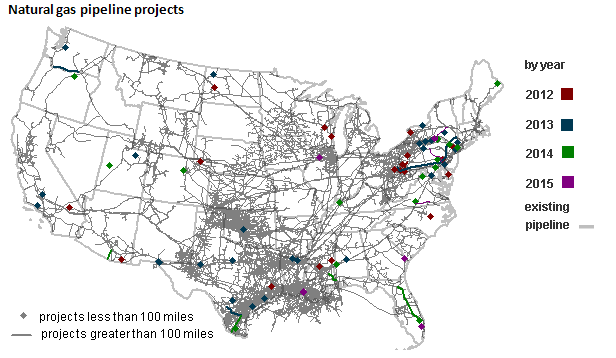
A federal energy agency has highlighted the demand for natural gas in the northeastern United States. The U.S. Energy Information Administration's report shows that over half of U.S. natural gas pipeline projects installed in 2012 were in the Northeast region. Low-cost gas produced from the Marcellus shale formation, combined with increased demand for gas in the Northeast, are driving pipeline expansion - but significant bottlenecks remain, keeping New England's natural gas prices higher and more volatile than those in the rest of the country.
For the past several years, natural gas pipeline capacity in the U.S. has grown. According to EIA, overall investment in domestic natural gas pipeline capacity slowed in 2012, but the northeast United States was home to the majority of growth. Other than facilities for gathering, storing, and distributing natural gas, natural gas pipeline capacity expansions totaled $1.8 billion in capital expenditures in 2012, adding 4.5 billion cubic feet per day of new pipeline capacity and 367 miles of pipe.
Most projects placed in service in 2012 focused on removing constraints that blocked natural gas from the booming Marcellus shale gas from reaching markets in the Northeast. Northeastern pipe additions accounted for two-thirds of all new pipeline mileage placed service in 2012. These additions included large projects such as the Appalachian Gateway Project and the Sunrise Project, both of which are designed to transport natural gas from the Marcellus production zone to markets in the Northeast.
Despite this growth, the New England and New York markets still experience frequent pipeline constraints, meaning that inbound pipeline capacity is insufficient to transport enough gas to meet consumer demand many days per year. This results in not only volatile natural gas pricing in New England, but fundamentally higher prices for consumers. Because the price of natural gas in New England sets the price of electricity most of the time, the result is a double-whammy of high wholesale prices for both electricity and natural gas.
Further pipeline capacity expansions into New England could alleviate these bottlenecks, but it is unclear who will build the capacity or when it will occur. Until it does, New England will remain exposed to high and volatile prices for natural gas and electricity.
 | ||
| Graphic courtesy of the U.S. Energy Information Administration, available at http://www.eia.gov/todayinenergy/detail.cfm?id=10511. |
For the past several years, natural gas pipeline capacity in the U.S. has grown. According to EIA, overall investment in domestic natural gas pipeline capacity slowed in 2012, but the northeast United States was home to the majority of growth. Other than facilities for gathering, storing, and distributing natural gas, natural gas pipeline capacity expansions totaled $1.8 billion in capital expenditures in 2012, adding 4.5 billion cubic feet per day of new pipeline capacity and 367 miles of pipe.
Most projects placed in service in 2012 focused on removing constraints that blocked natural gas from the booming Marcellus shale gas from reaching markets in the Northeast. Northeastern pipe additions accounted for two-thirds of all new pipeline mileage placed service in 2012. These additions included large projects such as the Appalachian Gateway Project and the Sunrise Project, both of which are designed to transport natural gas from the Marcellus production zone to markets in the Northeast.
Despite this growth, the New England and New York markets still experience frequent pipeline constraints, meaning that inbound pipeline capacity is insufficient to transport enough gas to meet consumer demand many days per year. This results in not only volatile natural gas pricing in New England, but fundamentally higher prices for consumers. Because the price of natural gas in New England sets the price of electricity most of the time, the result is a double-whammy of high wholesale prices for both electricity and natural gas.
Further pipeline capacity expansions into New England could alleviate these bottlenecks, but it is unclear who will build the capacity or when it will occur. Until it does, New England will remain exposed to high and volatile prices for natural gas and electricity.
Subscribe to:
Posts (Atom)
