Showing posts with label Northeast. Show all posts

Propane: winter shortages in 2014

Friday, May 16, 2014

Propane is widely used as a fuel -- but shortages this past winter led to an unprecedented emergency in the eyes of federal regulators.

Propane is a hydrocarbon produced as a byproduct from natural gas processing and crude oil refining.   Also known as liquefied petroleum gas, this natural gas liquid serves as a fuel in homes, businesses, and industry.  It is used for heating, cooling, cooking, motor vehicle transportation, and agriculture.  In the U.S., propane is transported on a network of pipelines stretching 56,000 miles long, and can also be shipped by rail and by truck.  In recent years, the U.S. propane industry has reached $10 billion in annual activity, with consumers using 15 billion gallons of propane annually for home, agricultural, industrial, and commercial uses.

A marker showing the location of an underground natural gas pipeline near Memphis, Tennessee.
This past winter, a propane shortage affected 24 states, primarily in the Midwest and Northeast regions.  Stored supplies of propane declined in the Midwest, and prices in some places increased by over 50% between January and February 2014.  As forecasts called for continued unseasonably cold weather, local, state, and federal agencies declared states of emergency.  The Federal Motor Carrier Safety Administration issued and extended emergency exemptions to provide regulatory relief for commercial motor vehicle operations directly supporting the delivery of propane and home heating fuels to areas under emergency, ultimately resulting in Congress's enactment of the Home Heating Emergency Assistance Through Transportation Act of 2014.

While the Federal Energy Regulatory Commission regulates neither propane as a commodity nor its storage or marketing, the Commission does regulate the transportation of propane on pipelines.  As this past winter's crisis deepened, some pipelines serving the Midwest voluntarily filed for permission to flow more propane into the region, but this was insufficient to meet demand.

In an unprecedented move, the Federal Energy Regulatory Commission exercised its emergency powers under the Interstate Commerce Act to require a pipeline company to temporarily provide priority treatment to propane shipments from Mont Belvieu, Texas, to locations in the Midwest and Northeast to help alleviate the shortage of propane supplies in those regions.  Citing school closures due to lack of heat, price hikes leading states to provide emergency heating assistance to those who could not afford fuel costs, and economic impacts on chicken farmers, pig farmers, and dairy farms in the South and Midwest who use propane to maintain the livelihood and health of their stock, the Commission found that an emergency existed requiring immediate action.

To address the emergency, the Commission targeted a pipeline owned by Enterprise TE Products Pipeline Company, LLC. In a February 7, 2014, Order Directing Priority Treatment, the Commission required the pipeline company to prioritize the shipment of propane on its natural gas liquids pipeline from the Mont Belvieu hub into the Midwest and Northeast.  That initial order provided for priority treatment for 7 days, which was extended once for another 7 days.

These actions apparently relieved the emergency.  According to testimony provided to the U.S. Senate Committee on Energy and Natural Resources by Commission staff member Nils Nichols, "no further action by the Commission with respect to propane supply was required this past winter."

Will propane again be in short supply next winter?  Will markets respond to align supply and demand at a reasonable price?  Will further regulatory action affect the U.S. propane industry?

Report: northeastern demand drives natural gas pipeline growth

Monday, March 25, 2013

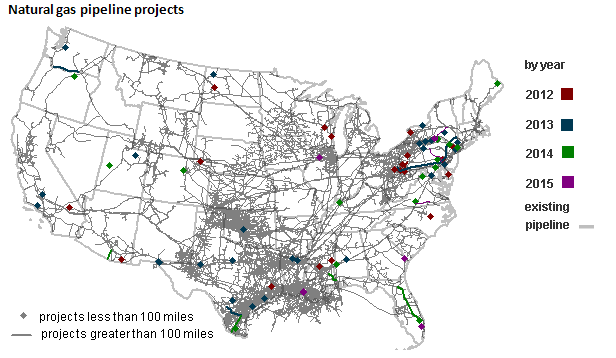
A federal energy agency has highlighted the demand for natural gas in the northeastern United States.  The U.S. Energy Information Administration's report shows that over half of U.S. natural gas pipeline projects installed in 2012 were in the Northeast region.  Low-cost gas produced from the Marcellus shale formation, combined with increased demand for gas in the Northeast, are driving pipeline expansion - but significant bottlenecks remain, keeping New England's natural gas prices higher and more volatile than those in the rest of the country.

Graphic courtesy of the U.S. Energy Information Administration, available at http://www.eia.gov/todayinenergy/detail.cfm?id=10511.


For the past several years, natural gas pipeline capacity in the U.S. has grown.  According to EIA, overall investment in domestic natural gas pipeline capacity slowed in 2012, but the northeast United States was home to the majority of growth.  Other than facilities for gathering, storing, and distributing natural gas, natural gas pipeline capacity expansions totaled $1.8 billion in capital expenditures in 2012, adding 4.5 billion cubic feet per day of new pipeline capacity and 367 miles of pipe.

Most projects placed in service in 2012 focused on removing constraints that blocked natural gas from the booming Marcellus shale gas from reaching markets in the Northeast.  Northeastern pipe additions accounted for two-thirds of all new pipeline mileage placed service in 2012.  These additions included large projects such as the Appalachian Gateway Project and the Sunrise Project, both of which are designed to transport natural gas from the Marcellus production zone to markets in the Northeast.

Despite this growth, the New England and New York markets still experience frequent pipeline constraints, meaning that inbound pipeline capacity is insufficient to transport enough gas to meet consumer demand many days per year.  This results in not only volatile natural gas pricing in New England, but fundamentally higher prices for consumers.  Because the price of natural gas in New England sets the price of electricity most of the time, the result is a double-whammy of high wholesale prices for both electricity and natural gas.

Further pipeline capacity expansions into New England could alleviate these bottlenecks, but it is unclear who will build the capacity or when it will occur.  Until it does, New England will remain exposed to high and volatile prices for natural gas and electricity.