Showing posts with label Marcellus. Show all posts

Energy in Maine's 2016 State of the State

Tuesday, February 9, 2016

Maine Governor Paul LePage has released his 2016 State of the State remarks in the form of a letter to the state legislature.  Among his top priorities detailed in the letter is addressing the high cost of electricity in the manufacturing and industrial sectors.  The eight-page letter also focuses on themes including welfare reform, lowering the income tax, reducing student debt and attracting youth, and fighting the drug crisis.

Energy issues appear in Governor LePage's letter as a focus for -- or obstacle to -- economic development.  In the letter, he repeats his position that "Maine's electricity prices are not competitive."  The letter criticizes legislative mandates supporting "long-term contracts for above-market rates" as adding $38 million in ratepayer costs.

The letter also addresses Maine's renewable energy policy, calling for support for Maine's biomass energy industry while criticizing the economics of wind and solar energy projects:
Socialists love to subsidize new wind and solar energy projects because they think it will save the earth, but that kind of expensive and inefficient energy benefits only a few wealthy investors, and our electrical generation is already one of the cleanest in the country. Instead, let's support the existing Maine-based biomass infrastructure that is already in place to take advantage of our plentiful natural resource: wood.
Indeed, references to socialism and socialists appear twelve times throughout Governor LePage's 2016 State of the State letter.  (A reference to Senator Bernie Sanders' candidacy for President?)

In his letter, Governor LePage also called for expansion of linear infrastructure like natural gas pipelines into New England and electric transmission lines to hydropower resources in Canada:
Meanwhile, my Administration continues to make progress working with other New England states to expand hydropower and natural gas into our region. Right now there is construction underway to expand our pipelines into New England, and clean and affordable hydropower is right next door in Quebec. It's time to switch off expensive energy. We must plug into the affordable reserves of nearby natural gas and hydropower. We must be willing to transmit hydropower to the states south of us.
These themes of energy infrastructure investment echo those playing out elsewhere in the Northeast U.S., as states explore expanded connections to natural gas from the Marcellus shale and Canadian hydropower.

Record low prices in summer 2015 New England wholesale electricity market

Tuesday, November 3, 2015

The summer of 2015 brought New England the lowest wholesale electricity prices since 2003, thanks to record low prices for natural gas.  According to regional grid operator ISO New England Inc., this illustrates what happens "when New England power plants can access the vast supply of lower-priced, domestic natural gas being produced in the Marcellus shale deposit."


ISO-NE, "Summer 2015: The lowest natural gas and power prices since 2003"

In a post on its ISO Newswire site, the grid operator noted that the average real-time wholesale electricity price for June, July, and August 2015 was $26.86 per megawatt-hour (MWh). By comparison, the average real-time price of wholesale electric energy in 2014 was $63.32 per megawatt-hour.  While summer energy prices have typically averaged lower than winter prices in New England, 2015's summer prices were low even in comparison to other recent summers: $34.31 in 2014, or $43.94 in 2013.

What explains New England's low wholesale electricity prices this summer?  According to ISO New England, it's because existing natural gas-fired power plants could get fuel at a low price:
In essence, the reason was the low price of natural gas that could be delivered to the power plants that burn natural gas to make electricity. For most of the year, the price of natural gas is low in New England, and as a consequence, the demand for natural gas for both heating and power generation just continues to grow. In fact, in 2014, New England power generators using natural gas produced 44% of the region’s electricity.
The ISO-NE post describes how low-priced natural gas plus adequate interstate pipeline transportation capacity yields New England low electricity prices.  Indeed, the average price of  natural gas in New England during June, July, and August averaged a record low $2/MMBtu.  This is nearly 40% below last year's summer average ($3.27/MMBtu), itself the next-lowest summer record.

New England's average summer electricity price was even below that of other regions, like the Midwest.  According to ISO-NE, "This summer’s prices indicate that the region’s electricity prices can be competitive, in the more commonly understood sense, with other regions of the US when low-cost fuel is available." Indeed, at times the price of natural gas in New England was below that of the benchmark Henry Hub.

The post also describes how heavy winter demand for natural gas for both heating and power generation, combined with pipeline constraints, yields high natural gas prices and thus high electricity prices.  This has occurred repeatedly in recent winters, such as in January and February 2014 and February 2015.  What is at issue is thus the ability of the interstate natural gas pipeline transportation network to ship enough gas into the Northeast -- a capability exceeded through much of the recent winters, with the resulting price paid in coal and oil emissions as well as dollars.

As ISO-NE notes, most customers' retail rates for electricity are set using mechanisms to reduce rate volatility, and time of use rates are not yet widely adopted.  But the net movement of wholesale markets is eventually priced into retail rates.  Can New England keep competitive with other regions?

Tackling New England natural gas pipeline constraints

Wednesday, July 10, 2013

Natural gas offers consumers a relatively low-cost energy source with fewer environmental impacts than coal or oil.  Throughout most of the United States, natural gas is displacing other fossil fuels in electric power generation, heating, and transportation.  But as a recent federal report found, inadequate pipeline infrastructure into New England is keeping prices for natural gas and electricity in the Northeast higher than in other regions.

In its 2012 State of the Markets report, the Federal Energy Regulatory Commission described how the availability of low-cost natural gas drove electricity prices downward last year.  However, as power plants, businesses, and homes convert to natural gas for their energy needs, growing competition between heating and electric load for a limited natural gas supply drives prices of both gas and electricity upward during the winter season.

New England's demand for natural gas peaks in the winter, due primarily to heating demand from the residential and commercial sectors.  As electric generators have increasingly turned to natural gas as the fuel of choice, total demand for gas has increased correspondingly.  In recent years, to meet peak demands for natural gas, New England has relied on imports of liquefied natural gas (LNG), as well as natural gas produced from Canada's offshore Sable Island field.  But last year, low domestic natural gas prices led to low imports of LNG and Canadian natural gas.  LNG imports hit their lowest level since 2002.  Sendout from the with Canaport LNG facility in St. John, New Brunswick, was drastically reduced, as LNG shippers chose to send their cargoes to higher-priced markets in Europe and Asia.  As FERC found: 
Lack of LNG and natural gas from Canada exacerbated pipeline constraints into New England from the southern supply corridor, including Marcellus Shale natural gas production, as New England relied more heavily on these pipelines for supply. This led to concerns that extreme cold weather could result in some service interruptions, particularly to power generators that generally rely on interruptible pipeline capacity to meet their fuel needs.
In particular, during cold snaps, demand from power plants coincides with peak residential and commercial natural gas demand.  Despite an unusually warm winter that suppressed residential and commercial load during the first quarter of 2012, demand reached pipeline capacity for part of the winter.  As a result, last winter New England consumers paid over a billion dollars more for natural gas and electricity than they would have if adequate pipeline capacity existed.

Unless LNG imports once again become economic, or domestic pipeline constraints are relieved, this situation is likely to repeat itself in New England next winter.  As consumers find wider uses for natural gas -- from converting vehicles and the transportation sector to compressed natural gas, to increased access to natural gas for home heating -- the number of days when demand reaches pipeline limits will likely grow.  This reality has led states like Maine to stimulate the development of new pipeline capacity by authorizing its Public Utilities Commission to enter into contracts for natural gas capacity.  While it may be several years until the constraints can be relieved, other states are likely to follow Maine in addressing the problem.

Report: northeastern demand drives natural gas pipeline growth

Monday, March 25, 2013

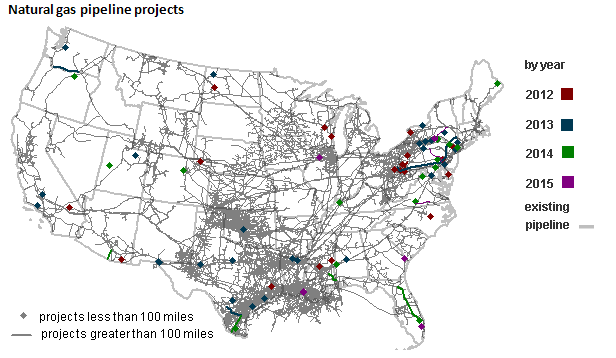
A federal energy agency has highlighted the demand for natural gas in the northeastern United States.  The U.S. Energy Information Administration's report shows that over half of U.S. natural gas pipeline projects installed in 2012 were in the Northeast region.  Low-cost gas produced from the Marcellus shale formation, combined with increased demand for gas in the Northeast, are driving pipeline expansion - but significant bottlenecks remain, keeping New England's natural gas prices higher and more volatile than those in the rest of the country.

Graphic courtesy of the U.S. Energy Information Administration, available at http://www.eia.gov/todayinenergy/detail.cfm?id=10511.


For the past several years, natural gas pipeline capacity in the U.S. has grown.  According to EIA, overall investment in domestic natural gas pipeline capacity slowed in 2012, but the northeast United States was home to the majority of growth.  Other than facilities for gathering, storing, and distributing natural gas, natural gas pipeline capacity expansions totaled $1.8 billion in capital expenditures in 2012, adding 4.5 billion cubic feet per day of new pipeline capacity and 367 miles of pipe.

Most projects placed in service in 2012 focused on removing constraints that blocked natural gas from the booming Marcellus shale gas from reaching markets in the Northeast.  Northeastern pipe additions accounted for two-thirds of all new pipeline mileage placed service in 2012.  These additions included large projects such as the Appalachian Gateway Project and the Sunrise Project, both of which are designed to transport natural gas from the Marcellus production zone to markets in the Northeast.

Despite this growth, the New England and New York markets still experience frequent pipeline constraints, meaning that inbound pipeline capacity is insufficient to transport enough gas to meet consumer demand many days per year.  This results in not only volatile natural gas pricing in New England, but fundamentally higher prices for consumers.  Because the price of natural gas in New England sets the price of electricity most of the time, the result is a double-whammy of high wholesale prices for both electricity and natural gas.

Further pipeline capacity expansions into New England could alleviate these bottlenecks, but it is unclear who will build the capacity or when it will occur.  Until it does, New England will remain exposed to high and volatile prices for natural gas and electricity.