Showing posts with label generation. Show all posts

ISO-NE 2022 generation portfolio emissions report

Tuesday, January 16, 2024

New England's electric power generation fleet emitting slightly less carbon dioxide in 2022 relative to 2021, according to the grid operator's 2022 ISO New England Electric Generator Air Emissions Report.

ISO New England operates the regional transmission grid and the wholesale market for electricity. In support of this role, ISO-NE tracks the portfolio of generation resources used in the region, as well as the resources' emission characteristics.

According to ISO-NE, New England generation emitted 33,382 kilotons of carbon dioxide in 2022, a decline of two-tenths of a percent relative to 2021. The grid operator reports an average 2022 emission rate of 643 pounds of CO2 per megawatt-hour of New England generation. 

Over longer time scales, air emissions from New England's power plants have decreased significantly. "From 2001 through 2022, CO2 emissions fell by 37%, NOx emissions fell by 79%, and SO2 emissions fell by 98%."

While carbon dioxide emissions decreased slightly again this year, sulfur dioxide (SO2) emissions increased to 3.38 kilotons, climbing over 60 percent relative to 2021. The grid operator attributes the sulfur emissions to increased reliance on fuel oil for electric generation:

More electricity came from oil-fired generators in 2022 than in the previous four years combined. At 1,845 GWh, production from these resources in 2022 was eight times higher than in 2021. Oil has a high sulfur content, so SO2 emissions rise when these resources produce more power.

The chart below shows the region's generation portfolio on a monthly basis for 2022; the red and black bars at the top of each month's column represent oil and coal use. The largest blue bars represent natural gas, while the largest orange bars represent nuclear power.

ISO-NE attributes increased use of oil for power generation to "record high natural gas prices associated with the Russia-Ukraine conflict, and thus an increase in regional reliance on oil versus natural gas." The grid operator also says that decreases in coal generation largely offset the increased oil use for purposes of CO2 and NOX emissions.


Electric utility rate cases on the rise

Monday, July 22, 2019

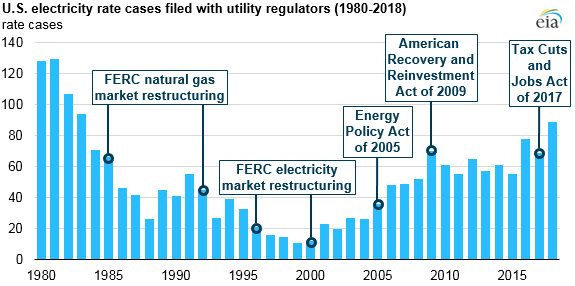
Federal data shows an increase in the number of U.S. electric utility rate cases filed in 2018, to the largest number since 1983. Of the 89 utilities filing rate cases in 2018, 10 proposed to decrease rates, one proposed a rate freeze until next year, and the remaining 78 utilities proposed to increase their rates.

Under typical state law, public electric utility companies must obtain regulatory approvals before changing the rates they charge their customers. According to the U.S. Energy Information Administration, 89 electric utilities sought to change their rates by filing rate cases with state regulatory commissions in 2018. This represents a significant increase relative to two decades ago.

Source: U.S. Energy Information Administration

According to EIA, the frequency or number of electric utility rate cases "typically reflects changes in the costs of generating and delivering electricity." For 2018, EIA pointed to increases in spending for electric transmission and delivery (as opposed to generation) as driving most of the rate increases that were ultimately approved.

EIA notes that the last time electric utility rate case filings were this active was the early 1980s, an era of significant rate increases: electricity rates increased at an average annual rate of 12% in the decade following the 1973 oil embargo. To explain that historic period of numerous rate cases, EIA points to factors including investments in coal and nuclear plants following the oil crisis; the enactment of the federal Public Utility Regulatory Policies Act of 1978 (PURPA), which required utilities to purchase electricity from generation from small, independently-owned renewable facilities, and the 1979 Three Mile Island nuclear plant accident which placed increased focus (and expense) on the safety of nuclear plants. By contrast, during a period of time when the Federal Energy Regulatory Commission was restructuring most electric markets (between 1995 and 2000), fewer than 20 rate cases were filed in most years.

Utilities typically ask for approval of significantly higher rate increases than are ultimately approved by regulators. According to EIA, in 2018, utilities asked for an aggregate rate increase $6.8 billion, but regulators approved a total increase of just $2.8 billion.

New Mexico legislature passes 100 percent renewable power law

Thursday, March 14, 2019

The New Mexico state legislature has passed a bill that requires public utilities other than rural electric cooperatives and municipalities to supply all retail sales of electricity in New Mexico with zero carbon resources by 2045.

The bill is SB 489, also known as the Energy Transition Act. Much of the Energy Transition Act focuses on procedures allowing utilities to obtain approval to abandon generating facilities which obtaining financing orders from the New Mexico Public Regulation Commission allowing the utilities to recover all of their energy transition costs through securitization -- issuing energy transition bonds whose costs the utilities pay by collecting an "energy transition charge" from their customers. The act creates funds to provide training and economic development in communities within 100 miles of abandoned facilities.

The law also revises New Mexico's renewable portfolio standard. It requires distribution cooperatives to sell at least 40 percent renewable energy by 2025 and at least 50 percent renewable energy by 2030, and sets a "zero carbon resource standard" target for distribution cooperatives by 2050, composed of at least 80 percent renewable energy, if feasible from technical, reliability, and affordability perspectives. For public utilities other than rural electric cooperatives and municipalities, the law requires similarly increasing percentages of renewable power, including 80 percent renewable energy resources by 2040 and 100 percent zero carbon resources by 2045. It allows public utilities to ask the Commission to provide financial or other incentives in excess of these amounts.

The bill passed the state senate with a vote of 32-9, and the state house with a vote of 43-22. It now goes to Governor Michelle Lujan Grisham for her signature. According to a statement Governor Lujan Grisham issued on March 12, "The Energy Transition Act is a promise to future generations of New Mexicans."

Other states are considering changes to their renewable portfolio standards, carbon emission limits, and other legal requirements affecting the electric power sector. If SB 489 is enacted into law, New Mexico will join California and Hawaii in having a future commitment or goal of 100 percent carbon-free electricity.

FERC, DOE to hold Security Investments for Energy Infrastructure Technical Conference

Tuesday, March 5, 2019

The Federal Energy Regulatory Commission and the United States Department of Energy have scheduled a joint technical conference to discuss current cyber and physical security practices used to protect energy infrastructure and possible federal and state incentives for related security investments.

According to a notice issued on February 4, the Security Investments for Energy Infrastructure Technical Conference will be led by one or more FERC Commissioners and DOE senior officials. Its agenda addresses two high-level topics: types of current and emerging cyber and physical security threats, and how federal and state authorities can facilitate investments to improve the cyber and physical security of energy infrastructure.

In a supplemental notice issued on March 1, the agencies noted that the Commission has adopted a "well-developed set of mandatory and enforceable reliability standards that set baseline protections for both cyber and physical security of the bulk electric system" as well as "policies that allow for the recovery of prudently incurred costs to comply with those mandatory reliability standards." The supplemental notice describes the technical conference as aimed at better understanding:
  1. the need for security investments that go beyond those measures already required by mandatory reliability standards, including in infrastructure not subject to those standards (e.g., natural gas pipelines);
  2. how the costs of such investments are or could be recovered; and
  3. whether additional incentives for making such investments are needed, and if so, how those incentives should be designed.
The supplemental notice describes two panels, the first of which will discuss types of cyber and physical security threats to energy infrastructure, particularly electric transmission, generation, and natural gas pipelines, as well as best practices for cyber and physical security mitigation beyond those measures already required by mandatory reliability standards and industry and government engagement needed to address these matters. The second panel will explore how federal and state authorities can provide incentives and cost recovery for security investments in energy infrastructure, particularly electric transmission, generation, and natural gas pipeline infrastructure

The federal agencies' Security Investments for Energy Infrastructure Technical Conference has been scheduled for on March 28, 2019.

Can challenges or prize competitions solve water supply problems?

Monday, March 26, 2018

How can challenges or prize competitions help society address barriers that may prevent long-term access to low-cost water supplies?

The U.S. Department of Energy's Office of Energy Efficiency and Renewable Energy (EERE) has published a Request for Information, seeking information from the public to understand the key technical and other barriers that may prevent long-term access to low-cost water supplies that could be best addressed through challenges and prize competitions.

Water is essential for human health, economic growth, and agricultural productivity, and plays significant roles in the U.S. energy sector. The Department of Energy uses the term "energy-water nexus" to describe the interconnected nature of energy and water systems. While the U.S. has generally benefited from access to low-cost water supplies, according to the Energy Department, "new challenges are emerging that, if left unaddressed, could threaten this paradigm" including competing uses and water quality problems.

The Energy Department operates a variety of programs to advance domestic energy policy, including programs focused on research and development and grant funding. But could the Department of Energy be more effective by offering challenges or prize competitions? Unlike traditional R&D funding in which participants are selected up front with funding provided at the beginning in order to pursue a target or goal, challenges and prize competitions typically define a problem and offer a reward to anyone finding a solution.

Challenges and prize competitions have been adopted by the federal government as well as private actors. Since 2010, federal entities have awarded millions of dollars in prize money and other incentives through over 740 challenges and prize competitions, and nonprofits and private companies have launched many more.

In a Request for Information published in the Federal Register on March 19, 2018, the Energy Department identified challenges and prize competitions as "tools and approaches the Federal government and others can use to engage a broad range of stakeholders, including the general public, to develop solutions to difficult problems. Challenges and prize competitions rely on competitive structures to drive innovation among participants and usually offer rewards (financial and/or other) to winners and/or finalists."

Through the request, the Energy Department asks for public feedback on a variety of issues relating to using prizes and challenges to solve problems around the energy-water nexus, including an identification of challenges whose solution would allow for a significant increase in the volume of available water produced from non-traditional sources, significant improvements in industrial and power-sector water efficiency, or reductions in the cost to treat and deliver drinking water and wastewater to consumers without harming water quality.

Responses to the Request for Information are due no later than 5:00 p.m. (ET) on May 14, 2018.

US warns of Russian Government Cyber Activity Targeting Energy and Other Critical Infrastructure

Thursday, March 22, 2018

The U.S. Department of Homeland Security has warned that for at least two years, Russian government cyber actors have targeted government entities and multiple U.S. critical infrastructure sectors, including the energy, nuclear, commercial facilities, water, aviation, and critical manufacturing sectors.

In a joint Technical Alert issued March 15, 2018 by the Department of Homeland Security's U.S. Computer Emergency Readiness Team (US-CERT) and the Federal Bureau of Investigation, the agencies warned of a "multi-stage intrusion campaign by Russian government cyber actors." The report follows an October 2017 alert by computer security firm Symantec of a re-emergence of a sophisticated cyber espionage group known as "Dragonfly."

According to the government agencies' report, the Russian cyber threat actors seem to have deliberately targeted specific organizations, as opposed to pursuing targets of opportunity. In an initial "staging" phase, the campaign used tools like malware, watering holes, and spear phishing to gain access to small commercial facilities' networks -- typically peripheral organizations like trusted third-party suppliers whose networks may be less secure. For example, the threat actors sent emails with malicious attachments appearing to be personnel resumes or contract documents. Clicking on links in the attachments exposed the victims to malware or data harvesting. In a subsequent phase, the threat actors made further use of the staging targets' networks as "pivot points and malware repositories" for use in targeting their final intended victims.

The report says that these Russian government cyber actors used this hacked access for network reconnaissance and collection of information pertaining to Industrial Control Systems (ICS). It describes multiple instances of threat actors accessing workstations and servers on corporate networks that contained data output from control systems within energy generation facilities.

Cyber security is now a significant concern, both domestically and abroad. A February 2018 report by the U.S. intelligence community described the targeting of national security information and proprietary information from US companies and research institutions involved with defense, energy, finance, dual-use technology, and other areas as "a persistent threat to US interests." Last month, U.S. electric grid reliability regulators imposed a $2.7 million penalty on an unidentified utility for its violations of mandatory reliability standards in connection with a data security breach -- the largest fine to date associated with U.S. utility cybersecurity regulation. In that case, a third-party contractor hired by the utility allegedly copied protected data from the utility's network to the contractor's unsecured network -- where it was accessible online without the need to enter a user ID or password, and where it was in fact accessed by one or more unknown outside entities.

In 2014, reports emerged that Russian hackers had found flaws in solar panel monitoring software that, if left unfixed, could allow malicious actors to damage the electric grid. Foreign state-sponsored cyber attacks in 2016 and 2017 against Ukraine and Saudi Arabia targeted multiple sectors across critical infrastructure, government, and commercial networks, causing disruption to Ukrainian energy distribution networks.

NYPA announces Albany microgrid plans

Wednesday, June 7, 2017

The New York Power Authority has announced plans to develop a microgrid to supply steam and electricity to the Governor Nelson A. Rockefeller Empire State Plaza in Albany.

NYPA, officially known as the Power Authority of the State of New York, is a state-level public power organization, operating power plants and transmission lines.

On May 22, 2017, NYPA announced its plans to convert a former waste-recovery steam plant located in Albany into a site for two new 8-megawatt natural gas-fired turbine generators with dual fuel capability.  The generators will be able to supply local needs, or sell power into the wholesale market, with the microgrid capable of operating in sync with the main grid or as an independent "island."  According to NYPA, the "resilient power generation facility will enable government services to continue in an emergency while the Plaza can be used as an emergency shelter for Albany residents."  The project is expected to supply 90 percent of the power for the state office complex, to save more than $2.7 million in annual energy costs, and to avoid the annual emission of 25,600 tons of greenhouse gases. 

The New York State Office of General Services will finance the project, supported by $2.5 million from NYSERDA.  NYPA has issued a request for proposals by developers; proposals are due to NYPA on July 13, with awards expected this fall.


FERC electric storage policy statement

Monday, January 23, 2017

U.S. energy regulators have issued a policy statement addressing how electric storage resources may provide services at a mix of cost-based and market-based rates.  The Federal Energy Regulatory Commission's January 19, 2017 policy statement on storage provides insight into how the Commission views its role in regulating the rates at which energy storage would be compensated -- but was accompanied by a dissenting view expressed by Commissioner LaFleur.   The result is a mix of both greater certainty and continued debate.

Electricity storage is a growing industry, both in terms of installed capacity and its capability to flexibly support the grid.  Today's electric storage resources can both charge and discharge electricity to and from the grid.  Moreover they can provide various services to multiple entities -- for example, consumers, grid operators, or transmission and distribution utilities -- and can switch nearly instantaneously between modes of operation or services provided.  In these ways, electric storage resources share some functions of consumer load, generation, transmission, and distribution. 

Some of these functions -- e.g. sales of electric energy at wholesale in an organized market -- may be compensated at market-based rates.  But other functions of energy storage could be compensated at cost-based rates under federal law -- perhaps functioning as a transmission asset, compensated through transmission rates.  Thus it's possible that a particular energy storage resource -- think a battery attached to the electric grid, perhaps sited at a factory or other consumer's location -- might be compensated for its operations under both cost-based and market-based rates.

This is a good thing, according to the Federal Energy Regulatory Commission.  According to the January 19, 2017 policy statement, "Enabling electric storage resources to provide multiple services (including both cost-based and market-based services) ensures that the full capabilities of these resources can be realized, thereby maximizing their efficiency and value for the system and to consumers."

But previous proceedings before the Federal Energy Regulatory Commission have exposed some concerns about allowing electric storage resources to recover costs through both cost-based and market-based rates concurrently.  As described by the Commission, these include "double recovery of costs to the detriment of cost-based ratepayers, potential for adverse competitive impacts in wholesale electric markets to the detriment of other competitors, and the need for independence of regional grid operators from market participants."

With respect to utilities subject to its jurisdiction, the Commission's recent policy statement, "Utilitzation of Electric Storage Resources for Multiple Services When Receiving Cost-Based Rate Recovery," provides guidance regarding these issues.  It details possible approaches for avoiding double recovery of costs.  The Commission notes that with regard to adverse market impacts, it "is not convinced there will be a detriment to other market competitors."  The policy statement also offers guidance on how grid operators and electric storage owners or operators should interact, to ensure independence as required by Commission policy.

Commissioner LaFleur issued a dissenting opinion, while nevertheless calling storage "an important and promising resource that warrants Commission attention to ensure that our markets are appropriately adapted to recognize storage’s unique characteristics and contributions."  While expressing an openness "to potential structures that compensate storage providing transmission service at a cost-based rate while participating in the wholesale markets", she expressed concern "about the broad rationale for this approach put forth in the Policy Statement," which she called "both flawed in its conclusions and premature in its timing."  In particular her dissent focused on what she described as "the Policy Statement’s sweeping conclusions about the potential impacts of multiple payment streams on pricing in wholesale electric markets" -- and whether it might have implications for resources other than storage that receive multiple payment streams.  She also disagreed with the Commission's decision to issue the policy statement separate from its pending Notice of Proposed Rulemaking on the participation of electric storage in wholesale markets.

Both the majority policy statement and Commissioner LaFleur's dissent shed light on how the Commission approaches energy storage rate issues.  Storage seems universally considered worth investigating or supporting, but disagreement remains within the Commission with respect to some aspects of how storage resources should be compensated (as well as procedural issues related to the Commission's consideration of these questions).  Nevertheless the policy statement does provide guidance and clarification into how a majority of the Commission views the compensation of storage resources under both cost- and market-based rate structures -- while also framing future discussions over how storage resources will be integrated into markets.

Vineyard Wind offshore project changes hands

Tuesday, August 30, 2016

Danish fund management company Copenhagen Infrastructure Partners has acquired Offshore MW LLC, the holder of an offshore wind energy lease issued by the U.S. Bureau of Ocean Energy Management over an area south of Massachusetts.

Copenhagen Infrastructure Partners describes itself as a fund management company founded in 2012. On August 25, 2016, CIP announced that on behalf of its fund Copenhagen Infrastructure II it had acquired 100% of Offshore MW LLC.

Acquired company Offshore MW LLC is developing the Vineyard Wind project over the Outer Continental Shelf south of Massachusetts.  The site is part of the Massachusetts Wind Energy Area originally designated by BOEM for leasing in 2012.  Offshore MW won the lease rights through a competitive lease auction held by the Bureau of Ocean Energy Management on January 29, 2015, in which it submitted the winning bid for Lease Area OCS-A 0501.  That lease area covers 166,886 acres, or roughly 260 square miles of sea space in federal waters off Massachusetts. 

According to CIP, it will continue with the Massachusetts project's development.  The Vineyard Wind project could receive a boost from recently enacted Massachusetts legislation that will require utilities to purchase about 1,600 megawatts worth of offshore wind energy by 2027.  That law, known as H. 4568, "An Act to promote energy diversity," requires electric distribution companies to issue an initial joint competitive solicitation for offshore wind proposals by June 30, 2017.

Vermont adopts Renewable Energy Standard

Thursday, August 25, 2016

This summer Vermont energy regulators issued an order implementing a Renewable Energy Standard.  This standard, or RES, requires Vermont electric utilities to procure an increasing share of electricity from renewable sources. 

Under a 2015 law called Act 56 (formerly called bill H.40), the Vermont Legislature directed the Public Service Board to issue an order implementing the RES to take effect on January 1, 2017.  Act 56 set certain rules for the RES, but left other issues to the Board.  Following working group meetings, workshops, and opportunities for written comment, the Board adopted the RES by order dated June 28, 2016.

The RES sets targets for utility procurement of renewable energy, starting at 55% of the electricity sold to customers from renewable sources in 2017, increasing gradually to 75% in 2032.   Of these amounts, at least 1% must come from new, distributed renewable generators, such as net-metering systems, rising to l0% by 2032.

The RES also establishes a category of "energy transformation projects," to encourage utility investment in projects that directly reduce customers' fossil-fuel consumption.  Energy transformation projects might include measures like weatherization, biomass heating, cold-climate heat pumps, demand management, or clean vehicle technologies.  To satisfy this requirement, utilities must demonstrate fossil-fuel savings equivalent to 2% of their annual retail sales (increasing to 12% by 2032) or procure an equal amount of additional renewable generation.  The Board has described the energy transformation project program as the first of its kind in the U.S.

Most states have adopted binding renewable portfolio standards for electricity supply.  Before the enactment of Act 56 and the Board's adoption of the RES, Vermont had renewable goals under its Sustainably Priced Energy Enterprise Development or SPEED program, but no mandatory renewable portfolio standard.

Under the act, the Vermont Public Service Board order adopting the RES will take effect on January 1, 2017.

FERC considers Primary Frequency Response reforms

Friday, February 19, 2016

U.S. energy regulators are considering whether reforms are needed to regulations for the provision and compensation of primary frequency response, a function essential to the electric grid's operation.

In general, the U.S. bulk power system operates on an alternating current.  For reliability and interoperability, that current must maintain its frequency within predetermined boundaries above and below 60 Hertz.  An interconnected grid’s ability to arrest and stabilize frequency deviations within those boundaries after a sudden loss of generation or load is called "frequency response." A grid's frequency response characteristics are affected by factors including inertial response (as spinning generators speed up or slow down when load changes), primary frequency response, and secondary frequency response.  Historically, most primary frequency response has been provided by baseload synchronous generators as an ancillary service.

But the U.S. electric grid's energy mix is changing.  In a Notice of Inquiry released on February 18, 2016, the Federal Energy Regulatory Commission notes that changes to the U.S. electric supply portfolio likely mean that fewer resources are now primary frequency response.  In particular, the U.S. has seen broad retirement of coal-fired baseload synchronous generators, some of which provide primary frequency response, while some have been replaced with variable energy resources such as wind and solar which do not typically have primary frequency response capabilities.

In response, FERC solicited public input on whether and what action is needed, including whether to:

  • Amend the pro forma Large Generator and Small Generator interconnection agreements to require that all new generation resources have frequency response capabilities as a precondition of interconnection;

  • Implement primary frequency response requirements for existing generation resources; and

  • Establish procurement and compensation mechanisms for primary frequency response.
FERC has docketed the matter as RM16-6-000, Essential Reliability Services and the Evolving Bulk-Power System — Primary Frequency Response.  Comments on the Notice of Inquiry are due 60 days after publication in the Federal Register.

Declining demand for residual fuel oil?

Thursday, October 29, 2015

Global demand for residual fuel oil is expected to decline, according to the U.S. Energy Information Administration.


A Maine State Ferry Service boat near Vinalhaven, Maine.


Residual fuel oil is basically what's left after gasoline and other lighter hydrocarbons are distilled from crude oil.  Industry recognizes several grades of residual fuel oil, including No. 5 (used in steam-powered vessels in government service and inshore powerplants) and No. 6 (used for the production of electric power, space heating, vessel bunkering, and various industrial purposes.) 

Because residual fuel oil is composed of the residue left after distillation, it can contain large amounts of contaminants such as sulfur, nitrogen, or heavy metals.  As environmental regulations limit emissions of pollution, residual fuel oil can become less attractive (or more expensive) as a fuel source for electric power generation or marine transportation.

The EIA notes declining global demand for residual fuel oil since the mid-1980s.  In a brief report, EIA projects that the electric power and heating sectors will likely be responsible for continuedlarge reductions in residual fuel oil demand.

EIA also points to tighter international emissions regulations for the marine transport sector.  Rules under Annex VI of the International Maritime Organization through the International Convention of Pollution from Ships (MARPOL, or Marine Pollution) require global controls on emissions of sulfur and nitrogen oxides.  While residual fuel oil with a sulfur level no more than 3.5% can be used to meet the MARPOL requirements throughout most of the oceans, stricter limits apply to designated emission control areas like the North Sea, the Baltic Sea, and coastal areas in North America and the Caribbean Sea.  These strict limits effectively require 0.1% sulfur content residual fuel oil or lower in the covered emission control areas.  EIA suggests that strategies for MARPOL compliance will likely include low-sulfur fuels (marine gasoil or intermediate fuel oil, or even liquefied natural gas or LNG), or using scrubbers or other technology to remove sulfur post-combustion from the exhaust.

At the same time, EIA notes that some developing countries' power sectors may rely on residual fuel oil as a "transitional fuel" if they are "more sensitive to price and less sensitive to environmental and health implications."

New York's 2015 Energy Plan

Tuesday, June 30, 2015

The state of New York has released a sweeping plan for its energy future, featuring strengthened commitments to clean energy over the next four decades.  The 2015 New York State Energy Plan includes reductions in greenhouse gas emissions, increased generation of renewable energy, and improved energy efficiency.

Article 6 of New York's energy law requires the state's energy planning board to develop period state energy plans.  The state released its two-volume 2015 report on June 25, presenting "a comprehensive strategy to create economic opportunities" in New York based on Governor Andrew Cuomo's previously-announced "Reforming the Energy Vision" or REV program.

Among the 2015 plan's elements are a series of clean energy targets, including a 40% reduction in greenhouse gas emissions from 1990 levels; 50% of electricity generation coming from carbon-free renewables; and 600 trillion Btu in energy efficiency gains, which equates to a 23% reduction
from 2012 in energy consumption in buildings.

Whether and how New York will implement its 2015 State Energy Plan remains to be seen.  Notably, the plan was produced by the state's executive branch; it is unclear whether legislators will support or thwart it.  Will the Empire State follow its latest plan?  If so, will it lead to the anticipated economic opportunities?

FERC approves Iberdrola-UIL merger

Tuesday, June 2, 2015

Federal utility regulators have issued an order authorizing transactions the merger of utilities affiliated with Iberdrola, S.A. and UIL Holding Corporation.

Iberdrola is a Spanish-owned utility holding company, owning electricity and natural gas systems and electric generation across four continents.  Its direct wholly owned subsidiary Iberdrola USA holds all of Iberdrola’s energy-related operations in the United States through two intermediate holding companies. Iberdrola USA Networks, Inc., holds transmission owning public utility affiliates, including New York State Electric & Gas Corporation (NYSEG), Rochester Gas and Electric Corporation, Central Maine Power Company, Maine Natural Gas Company, and interests in Maine Electric Power Company. Iberdrola Renewables Holdings, Inc. owns and operates its generation segment in the United States through a number of indirect subsidiaries.

UIL is in the business of ownership of operating regulated utilities in Connecticut and Massachusetts. It owns and controls the United Illuminating Company, a business engaged in purchasing, transmitting, and distributing electric power to customers in southwestern Connecticut. United Illuminating owns a 50 percent equity interest in GCE Holding LLC which in turn owns two companies owning 187.6 MW dual-fuel generating plants in Milford and Middletown, Connecticut. UIL also owns natural gas local distribution companies in central and southern Connecticut and western Massachusetts, as well as Total Peaking Services, LLC which provides liquefied natural gas storage services.

On February 26, 2015, Iberdrola S.A. announced the boards of directors of Iberdrola S.A. and Iberdrola USA had approved a combination of Iberdrola USA with UIL Holdings in a friendly transaction, reportedly for about $3 billion.  On March 25, 2015, Iberdrola and UIL applied to the Federal Energy Regulatory Commission for authorization under section 203(a)(1) and (a)(2) of the Federal Power Act (FPA) for a series of transactions in which UIL will become an indirect wholly owned subsidiary of Iberdrola USA and, in turn, a wholly owned subsidiary of Iberdrola.

In a Section 203 case, the Commission examines a merger’s effect on competition, rates and regulation, and the potential for cross-subsidization.  Applicants must demonstrate that a proposed disposition or acquisition of jurisdictional facilities meets the standards of Section 203.   In the Iberdrola-UIL case, the applicants stated that their subsidiaries' portfolios of generation, transmission, natural gas assets, and other jurisdictional facilities had only de minimis overlap, that the transaction would not adversely affect rates or regulation, or result in cross-subsidization of a nonutility associate company or pledge or encumbrance of utility assets for the benefit of an associate company.

On June 2, 2015, the Commission issued an order finding that the proposed transaction is consistent with the public interest and is authorized, subject to routine conditions.  While other regulatory approvals may be required before the merger can proceed, securing prior authorization under Section 203 is an important milestone for the proposed deal.

According to Iberdrola, the combined company will have a 2014 pro forma EBITDA of approximately $2 billion, net income of $570 million, 3.1 million of points of supply, around 6.7 GW of installed capacity.  Iberdrola anticipates that the company will become the US's second largest wind operator and one of the nation's largest utilities.

ISO-NE projects slow growth in electricity demand

Wednesday, May 13, 2015

New England's electric grid operator predicts slow growth in annual energy usage in the region over the next decade, with slightly quicker growth in peak demand.

A Maine power plant -- the ecomaine Waste-to-Energy plant in Portland, Maine.

ISO New England, Inc. develops an annual long-term load forecast using factors including state and regional economic forecasts and 40 years of weather history.  Its most recent baseline forecast projects a compound annual growth rate of 1.0% in total energy usage in New England from 2015 to 2024.  For 2015, ISO-NE projects 138,745 gigawatt-hours (GWh) of load, growing to 152,280 GWh in 2024.

ISO-NE's forecast also projects future peak demand, a measure of the highest amount of electricity used in a single hour in New England.  Often, peak demand drives the need for constructing and maintaining power plants and transmission lines (and energy efficiency investments).  According to the latest ISO-NE forecast, New England's peak electricity demand is projected to rise by a compound annual growth rate of 1.3%, from 28,395 MW this year to 31,905 MW in 2024.

These baseline projections for future peak demand and energy usage take into account load reductions that can be expected from future installations of distributed solar photovoltaic facilities.  ISO-NE has prepared a separate Distributed Generation Forecast to estimate the load-reducing effects of distributed solar facilities developed as a result of state policy goals.

ISO-NE's baseline projections do not account for significant energy-efficiency savings, neither those committed through the region’s three-year Forward Capacity Market (FCM) nor future savings that can be expected beyond the FCM timeframe.

EIA releases 2014 Annual Energy Outlook

Wednesday, May 14, 2014

The U.S. Energy Information Administration has released its annual report projecting long-term trends in energy markets.

The Energy Information Administration, or EIA, is the statistical and analytical agency within the U.S. Department of Energy.  Its 2014 Annual Energy Outlook (269-page PDF) presents long-term annual projections of energy supply, demand, and prices focused on the U.S. through 2040. Based on data-driven models, the report considers a reference case under which it assumes current laws and regulations remain unchanged, as well as alternative cases that explore important areas of uncertainty for markets, technologies, and policies in the U.S. energy economy.

The report's biggest findings include projections that:
  • Growing domestic production of natural gas and oil continues to reshape the U.S. energy economy, largely as a result of rising production from tight formations, but the effect could vary substantially depending on expectations about resources and technology.
  • Industrial production expands over the next 10 to 15 years as the competitive advantage of low natural gas prices provides a boost to the industrial sector with increasing natural gas use.
  • There is greater upside uncertainty than downside uncertainty in oil and natural gas production; higher production could spur even more industrial growth and lower the use of imported petroleum.
  • Improvement in light-duty vehicle (LDV) efficiency more than offsets modest growth in vehicle miles traveled (VMT) that reflects changing driving patterns, leading to a sharp decline in LDV energy use.
  • Evolving natural gas markets spur increased use of natural gas for electricity generation and transportation, as well as expanded export opportunities.
  • Improved efficiency of energy use in the residential and transportation sectors and a shift away from more carbon-intensive fuels such as coal for electricity generation help to stabilize U.S. energy-related carbon dioxide (CO2) emissions.
The full report includes a series of specific projections -- for example that most new electricity generation capacity added will use natural gas or renewable energy, that solar photovoltaic and wind will dominate new renewable capacity.  The report also projects that through 2040, energy use per capita decreases, largely due to gains in appliance efficiency, a shift in production from cooler to warmer regions, and an increase in vehicle efficiency standards.

How will EIA's projections fare over the coming years?

Report: climate change poses risks to US energy sector

Thursday, July 11, 2013

Climate change poses significant risks to U.S. energy infrastructure, and the reliability and cost of the services it enables, according to a report released yesterday by the U.S. Department of Energy.

The report - U.S. Energy Sector Vulnerabilities to Climate Change and Extreme Weather Report (4.2MB PDF) was developed as part of the Obama Administration’s efforts to support national climate change adaptation planning and to advance the U.S. Department of Energy’s goal of promoting energy security. These efforts are embodied by the Interagency Climate Change Adaptation Task Force and Strategic Sustainability Planning process established under Executive Order 13514.

The report is predicated on the findings that the U.S. climate is changing, and that these changes impact energy resources and infrastructure. As the report states, "Climatic conditions are already affecting energy production and delivery in the United States, causing supply disruptions of varying lengths and magnitude and affecting infrastructure and operations dependent upon energy supply." The report provides over 30 recent examples of energy infrastructure adversely impacted by climate change-related events such as power plant outages due to high temperatures or low water availability, storm damage to transmission lines, oil wells, pipelines and generators, and flooding-related disruption of fuel transportation systems.

Building on these findings, the report identifies a broad set of risks posed by climate trends, including increasing temperatures, decreasing water availability, and increasing storms, sea level rise, and flooding, as well as the current and potential future impacts of these climate trends on the U.S. energy sector. According to the report, each of these trends will independently, and in some cases in combination, affect the ability of the United States to produce and transmit electricity from fossil, nuclear, and existing and emerging renewable energy sources. These changes are also projected to affect the nation’s demand for energy and its ability to access, produce, and distribute oil and natural gas.

In particular, significant risks identified include:

  • Thermoelectric power generation facilities are at risk from decreasing water availability and increasing ambient air and water temperatures, which reduce the efficiency of cooling, increase the likelihood of exceeding water thermal intake or effluent limits that protect local ecology, and increase the risk of partial or full shutdowns of generation facilities
  • Energy infrastructure located along the coast is at risk from sea level rise, increasing intensity of storms, and higher storm surge and flooding, potentially disrupting oil and gas production, refining, and distribution, as well as electricity generation and distribution
  • Oil and gas production, including unconventional oil and gas production (which constitutes an expanding share of the nation’s energy supply) is vulnerable to decreasing water availability given the volumes of water required for enhanced oil recovery, hydraulic fracturing, and refining
  • Renewable energy resources, particularly hydropower, bioenergy, and concentrating solar power can be affected by changing precipitation patterns, increasing frequency and intensity of droughts, and increasing temperatures
  • Electricity transmission and distribution systems carry less current and operate less efficiently when ambient air temperatures are higher, and they may face increasing risks of physical damage from more intense and frequent storm events or wildfires
  • Fuel transport by rail and barge is susceptible to increased interruption and delay during more frequent periods of drought and flooding that affect water levels in rivers and ports
  • Onshore oil and gas operations in Arctic Alaska are vulnerable to thawing permafrost, which may cause damage to existing infrastructure and restrict seasonal access, while offshore operations could benefit from a longer sea ice-free season
  • Increasing temperatures will likely increase electricity demand for cooling and decrease fuel oil and natural gas demand for heating
Looking on the brighter side, the report notes that while climate change will, on balance, create challenges and costs for the energy sector, there are potential benefits to the energy sector as well. Examples include reduced average heating loads during the winter in parts of the United States, such as New England, and the opening of new regions to offshore oil and gas exploration due to shrinking sea ice cover in the Arctic. The report also covers adaptation actions underway, as well as other major opportunities to prepare for climate change through adaptation. Nevertheless, on balance, the report finds that the magnitude of the challenge posed by climate change on an aging and already stressed U.S. energy system could outpace current adaptation efforts, unless a more comprehensive and accelerated approach is adopted. Will the U.S. follow that path? What measures will it include? Will it make a difference?

FERC report shows investment in natural gas

Thursday, June 20, 2013

This week the Federal Energy Regulatory Commission issued its monthly energy infrastructure update covering May 2013.  The report details highlights in expansions of energy assets, ranging from natural gas pipelines to electric generation and transmission facilities.  It provides a monthly snapshot of recent activity, and can be used to spot trends in domestic energy development.  The current report illustrates increased investment in natural gas-related infrastructure, ranging from proposed new liquefied natural gas export terminals to newly installed natural gas-fired power plants.
The iconic U.S Capitol dome, where policies are made that shape energy investment.

Natural gas exports poised for growth.  Last month two facilities to liquefy natural gas for export advanced through the FERC regulatory process:
  • Jordan Cove Energy requested authorization to construct and operate four liquefaction trains and storage facilities at a proposed export terminal in Coos Bay, Oregon.  If authorized and built, the project could export up to 900 MMcf per day of liquefied natural gas (LNG).  This gas would likely be destined for Asian markets.
  • Golden Pass Products proposed a larger project in Texas.  Along with Golden Pass Pipeline, Golden Pass Products commenced the FERC prefiling process to construct and operate a 2,100 MMcf per day liquefaction facility for export at an existing import terminal located in Sabine Pass, Texas.  The Golden Pass project also includes proposed modification of an existing pipeline system to enable 2,500 MMcf per day of bidirectional capacity to the proposed export terminal.
These projects demonstrate increased interest in exporting natural gas to overseas markets.  The boom in domestic shale gas production has led to low natural gas prices in the U.S.  Domestic pricing is roughly one-third of the price that exporters can get by sending LNG to Europe or Asia.  Whether and to what extent the U.S. will allow exports remains to be seen, but in the interim, developers are scrambling to secure permits for export. 

New electric generation, mostly fueled by natural gas.  Last month a total of 33 new electric generation units came online.  Nearly three-quarters of the newly installed capacity is fueled by natural gas, adding 2,529 MW of new natural gas-fired electric generating capacity.  The new gas projects vary widely in scope:
  • The largest, Mitsubishi Corporation’s 850 MW CPV Sentinel Energy Expansion in Riverside County, consists of eight 106.25 MW units.  Mitsubishi’s generation is sold to Southern California Edison under a long-term contract.
  • In the middle, Procter & Gamble Company developed a 64 MW natural gas fired project to produce power for its paper products manufacturing facility in Wyoming County, Pennsylvania.
  • At the opposite end of the scale, two landfill gas-fired projects came online in New York.  Wehran Energy Corp.’s 4.5 MW Brookhaven facility consists of three 1.5 MW Caterpillar Inc. generators.  The Brookhaven project was also joined by a 1.6 MW expansion of Waste Management Inc.’s Oneida-Herkimer project.
These projects illustrate the diversity of new natural gas fired projects being developed this spring.  The abundance of low-cost natural gas drives interest in the utility scale gas projects, while a desire to capture landfill-produced methane and put it to use as biogas supports the smaller projects.  As a result, natural gas’s share of total installed operating generating capacity grew slightly to 42.56%.  Despite a resurgence of coal as a fuel for electric generation, coal remains in second place in the installed capacity race, representing 28.9% of total U.S. installed capacity.

While each monthly energy infrastructure update represents only one data point, in the aggregate, they paint a picture of the direction of U.S. energy infrastructure development.  Natural gas is squarely in the center of this picture.  Based on consensus projections that natural gaswill remain the most cost effective fuel for decades to come, increased expansion of natural related infrastructure is likely to continue for some time.

Mid-Atlantic electric grid operator plans $2.4 billion in upgrades due to fossil-fuel plant retirements

Tuesday, March 12, 2013

The operator of the mid-Atlantic electric grid has announced a need for $2.4 billion in grid upgrades to keep the lights on in the coming years, as fossil-fueled generators shut down.

PJM Interconnection LLC is the regional transmission organization that manages wholesale electricity markets and the transmission grid in all or parts of 13 states and the District of Columbia, covering about 60 million people.  In that role, PJM works with electric utilities and merchant generators to identify upgrades needed to maintain reliable electric service throughout its territory.  In 2012, PJM authorized more than 750 electric transmission improvement projects with a total cost of more than $5 billion.

PJM released its annual regional transmission expansion plan on March 7.  In that plan, PJM identified three major trends driving the need for further grid upgrades: upcoming power plant retirements, the rapid switch to natural gas, and the growth of wind power to meet states’ renewable energy requirements.

Of these, the large-scale retirement of fossil-fueled power plants may pose the greatest challenge.  Power plant operators must inform PJM if they plan to close their plants, and are doing so in droves.  PJM received 104 retirement requests between November 2011 and December 2012.  In all, these requests signal intents to shutter 13,868 megawatts of generation.  Retirement requests continue to roll in; in January 2013 alone, an additional 1,697 megawatts of generation filed notices of intents to retire.  This tide of closures is driven largely by relatively low electricity prices and increased costs for coal- and oil-fired generation due to environmental and emissions regulations. 

At the same time, 2012 brought a record amount of new generation to the PJM market, primarily fueled by natural gas. Meanwhile, the addition of new renewable resources to the grid - such as wind-powered generators - adds another layer of challenge, as these renewable projects are often located in relatively remote areas far from consumers in urban centers.

PJM must ensure enough power to keep its customers' lights on, a task that requires both having enough operating generators and the right amount of transmission to connect generators to customers.  As a result, PJM has identified 130 projects needed to maintain reliability.  These projects include new transmission lines, line rebuilds, equipment upgrades, and new and expanded substations, and substation additions.

Much of PJM's analysis is based on assumptions about which generation plants will close, which new generation plants will be built and come online, and how much consumer demand for electricity will grow.  Will PJM's predictions come true?  If so, consumers will bear the cost of PJM's identified grid fixes.

Champlain Hudson Power Express debated

Thursday, September 27, 2012

As policymakers seek to secure energy supplies for the future, how far abroad should they cast their nets?  In addition to cost, reliability, and energy mix goals like renewable electricity standards, should decisions be made based on other factors such as local economic development?

New York legislators debated these questions yesterday in hearings over a proposed transmission line that would connect New York City to Canadian hydroelectric generation.  The $2.2 billion high-voltage direct current line, known as the Champlain Hudson Power Express, would run from the U.S.-Canadian border to the New York metro area. The line would run underwater through Lake Champlain, the Hudson River, and East River for much of its route, with the remainder of the line buried underground.

The Champlain Hudson Power Express was first proposed in 2010, and has been the subject of controversy.  New York Governor Andrew Cuomo has launched the N.Y. Energy Highway program, a public-private initiative to upgrade and modernize New York State’s energy system.  The Champlain Hudson Power Express's developer, Blackstone Group, L.P. subsidiary Transmission Developers Inc., is promoting the line as part of that solution.  It would connect over 1,000 megawatts of Canadian generation - primarily Hydro-Quebec's hydropower projects, as well as some wind - to power-hungry consumers in the New York City area.

Some stakeholders question the effects of the line on existing and new generation in New York.  Older domestic power plants may be unable to compete with the Canadian power; if imports are priced just below what domestic generation needs to operate, the result could be a loss of jobs and tax revenues without significant consumer savings.  Stakeholders such as the International Brotherhood of Electrical Workers Local 97, representing more than 4,000 workers in electric generation and utility jobs in New York, have publicly opposed the project on these grounds, while calling for growth of domestic generation projects.

The Canadian power might also compete with existing and proposed indigenous renewable power projects.  New York has adopted a renewable portfolio standard of obtaining 30 percent of its electricity from renewable sources by 2015.  New York currently excludes large-scale hydropower projects from qualification for its RPS, but Canadian imports could dampen market demand for in-state renewable generation.

The Champlain Hudson Power Express reportedly featured prominently in a public hearing held yesterday by the New York Senate Standing Committee on Energy and Telecommunications to "consider and analyze the long-term base load energy generation and transmission needs of the State of New York".  Debate over the proposed line is likely to continue, with economics and regulation likely to play key roles in its fate.