Danish fund management company Copenhagen Infrastructure Partners has acquired Offshore MW LLC, the holder of an offshore wind energy lease issued by the
U.S. Bureau of Ocean Energy Management over an area south of Massachusetts.
Copenhagen Infrastructure Partners describes itself as a fund management company founded in 2012. On August 25, 2016, CIP announced that on behalf of its fund Copenhagen Infrastructure II it had acquired 100% of Offshore MW LLC.
Acquired company Offshore MW LLC is developing the Vineyard Wind project over the Outer Continental Shelf south of Massachusetts. The site is part of the Massachusetts Wind Energy Area originally designated by BOEM for leasing in 2012. Offshore MW won the lease rights through a competitive lease auction held by the Bureau of Ocean Energy Management on January 29, 2015, in which it submitted the winning bid for Lease Area OCS-A 0501. That lease area covers 166,886 acres, or roughly 260 square miles of sea space in federal waters off Massachusetts.
According to CIP, it will continue with the Massachusetts project's development. The Vineyard Wind project could receive a boost from recently enacted Massachusetts legislation that will require utilities to purchase about 1,600 megawatts worth of offshore wind energy by 2027. That law, known as H. 4568, "An Act to promote energy diversity," requires electric distribution companies to issue an initial joint competitive solicitation for offshore wind proposals by June 30, 2017.

Energy powers society; society's choices shape energy policy. A blog about our energy resources and the choices they present for society.
Showing posts with label Martha's Vineyard. Show all posts
Showing posts with label Martha's Vineyard. Show all posts

Edgartown's Muskeget tidal project faces questions
Tuesday, June 28, 2016
A municipal tidal power project proposed for the Massachusetts island of Martha's Vineyard faces federal deadlines if its licensing process is to continue. The Muskeget Channel Tidal Energy Project, proposed by the Town of Edgartown, is seeking a pilot project license from the Federal Energy Regulatory Commission -- but faces questions from Commission staff.
On February 1, 2011, the Town of Edgartown filed, pursuant to the Commission’s pilot licensing procedures, a draft license application for the proposed Muskeget Channel Tidal Energy Project. The project would feature an array of 14 marine hydrokinetic tidal turbines, with a commercial generating capacity of 5 megawatts or less.
But that license application remains incomplete. On April 1, 2011, Commission staff issued a letter requesting that Edgartown provide additional information, including details about the proposed project and multiple plans, drawings, and reports. Over the ensuing years, Edgartown filed some responsive information, but according to the Commission, Edgartown did not file the remaining information by the deadline or provide a schedule indicating when the information would be filed after the deadline was missed.
Over two years after the deadline, on April 21, 2016, Commission staff issued a letter requiring Edgartown to show cause, within 30 days, why Commission staff should not terminate the prefiling licensing process for the project. According to the Commission, Edgartown did not respond, but Congressman William Keating asked the Commission to extend the show cause deadline until the Massachusetts Clean Energy Commission decides whether to award the project a grant.
In a June 2 letter, Commission staff directed Edgartown to, within 30 days, provide a schedule specifying when it will file with the Commission each of the outstanding items requested in Commission staff’s April 1, 2011 letter. The letter says, "Upon receipt of this information, Commission staff will make a determination on how to proceed with the incomplete application for the Muskeget Channel Tidal Energy Project." For now, the prelicensing process for the Muskeget tidal project remains pending.
On February 1, 2011, the Town of Edgartown filed, pursuant to the Commission’s pilot licensing procedures, a draft license application for the proposed Muskeget Channel Tidal Energy Project. The project would feature an array of 14 marine hydrokinetic tidal turbines, with a commercial generating capacity of 5 megawatts or less.
But that license application remains incomplete. On April 1, 2011, Commission staff issued a letter requesting that Edgartown provide additional information, including details about the proposed project and multiple plans, drawings, and reports. Over the ensuing years, Edgartown filed some responsive information, but according to the Commission, Edgartown did not file the remaining information by the deadline or provide a schedule indicating when the information would be filed after the deadline was missed.
Over two years after the deadline, on April 21, 2016, Commission staff issued a letter requiring Edgartown to show cause, within 30 days, why Commission staff should not terminate the prefiling licensing process for the project. According to the Commission, Edgartown did not respond, but Congressman William Keating asked the Commission to extend the show cause deadline until the Massachusetts Clean Energy Commission decides whether to award the project a grant.
In a June 2 letter, Commission staff directed Edgartown to, within 30 days, provide a schedule specifying when it will file with the Commission each of the outstanding items requested in Commission staff’s April 1, 2011 letter. The letter says, "Upon receipt of this information, Commission staff will make a determination on how to proceed with the incomplete application for the Muskeget Channel Tidal Energy Project." For now, the prelicensing process for the Muskeget tidal project remains pending.
Hydrokinetic energy projects in 2014
Wednesday, April 2, 2014
Hydrokinetic energy projects generate electricity from moving water, capturing the power embodied in tides, waves, and currents without the use of dams. Hydrokinetic energy resources are estimated to have a tremendous power potential -- according to one U.S. Department of Energy study, approximately 1,420 terawatt-hours per year, or approximately one-third of the nation's total annual electricity usage. The technologies required are relatively new, do not have decades of operational experience, and remain relatively expensive. Nevertheless, federal records show growth in hydrokinetic project development.
The Federal Energy Regulatory Commission regulates most hydrokinetic energy projects under its hydropower jurisdiction pursuant to the Federal Power Act. Project developers may seek preliminary permits granting the right to study a particular site and priority to apply for a project license.
Relatively few projects have received licenses to date. In 2012, the Commission issued a pilot project license for the Roosevelt Island Tidal Energy project in the East River near New York City. Last month, the Commission issued a pilot project license to the Public Utility District No. 1 of Snohomish County for a 600 kilowatt tidal project in Puget Sound, Washington.
As of last month, six projects have been issued preliminary permits that remain in effect:
The Federal Energy Regulatory Commission regulates most hydrokinetic energy projects under its hydropower jurisdiction pursuant to the Federal Power Act. Project developers may seek preliminary permits granting the right to study a particular site and priority to apply for a project license.
Relatively few projects have received licenses to date. In 2012, the Commission issued a pilot project license for the Roosevelt Island Tidal Energy project in the East River near New York City. Last month, the Commission issued a pilot project license to the Public Utility District No. 1 of Snohomish County for a 600 kilowatt tidal project in Puget Sound, Washington.
As of last month, six projects have been issued preliminary permits that remain in effect:
- Ecosponsible, Inc.'s Niagara Community project, a 1.25 megawatt inland project proposed for the Niagara River in New York
- Ecosponsible, Inc.'s Niagara Community #2 project, a similar 1.25 megawatt inland project proposed for the Niagara River in New York
- Iguigig Village Council's Iguigig RISEC project, a 40 kilowatt inland project proposed for the Kvichak River in Alaska
- The Town of Edgartown, Massachusetts's Muskeget Channel Tidal Energy project, a 4.94 megawatt project proposed for the Muskeget Channel off the island of Martha's Vineyard
- Turnagain Arm Tidal Energy's Turnagain Arm Tidal project, a 240 megawatt tidal project proposed for Cook Inlet, Alaska
- Resolute Marine Energy, Inc.'s Yakutat project, a 750 kilowatt wave project proposed in the Gulf of Alaska
New England offshore wind advances
Friday, February 24, 2012
Plans to generate electricity from offshore winds off the southern New England coast appear to be gathering some momentum, as a series of events unrolling this month favor offshore wind development.
On February 3, the U.S. Bureau of Ocean Energy Management took the initial steps in its process to lease sites for offshore wind projects in federal waters off Massachusetts. BOEM requested information about uses of an area of sea about about 12 nautical miles south of the islands of Martha’s Vineyard and Nantucket, as well as expressions of interest by developers identifying particular sites. Responses to the call for information and nominations, as the key document is known, are due in mid-March.
Last week, Massachusetts officials announced a proposed settlement that would allow utilities NSTAR and Northeast Utilities to merge, but only on the condition that the resulting utility sign a long-term contract to buy power from the proposed Cape Wind project. Cape Wind already has a power purchase agreement with utility National Grid for half the project's output; if the NSTAR deal is approved, Cape Wind would have power purchase agreements in place for 77.5% of its expected output. Proponents hope that this increased certainty around the project's revenues could enable the project to be financed and built.
This week, Boston hosted a major offshore wind industry conference. Today, the U.S. Bureau of Ocean Energy Management plans to make an announcement "latest milestone in commercial wind energy planning and leasing in the area of mutual interest offshore of Rhode Island and Massachusetts."
None of these steps alone may be sufficient to spur offshore wind development in New England waters, but collectively these steps illustrate how multiple levels of government are promoting offshore wind. Will their collective result produce power in the near term?
On February 3, the U.S. Bureau of Ocean Energy Management took the initial steps in its process to lease sites for offshore wind projects in federal waters off Massachusetts. BOEM requested information about uses of an area of sea about about 12 nautical miles south of the islands of Martha’s Vineyard and Nantucket, as well as expressions of interest by developers identifying particular sites. Responses to the call for information and nominations, as the key document is known, are due in mid-March.
Last week, Massachusetts officials announced a proposed settlement that would allow utilities NSTAR and Northeast Utilities to merge, but only on the condition that the resulting utility sign a long-term contract to buy power from the proposed Cape Wind project. Cape Wind already has a power purchase agreement with utility National Grid for half the project's output; if the NSTAR deal is approved, Cape Wind would have power purchase agreements in place for 77.5% of its expected output. Proponents hope that this increased certainty around the project's revenues could enable the project to be financed and built.
This week, Boston hosted a major offshore wind industry conference. Today, the U.S. Bureau of Ocean Energy Management plans to make an announcement "latest milestone in commercial wind energy planning and leasing in the area of mutual interest offshore of Rhode Island and Massachusetts."
None of these steps alone may be sufficient to spur offshore wind development in New England waters, but collectively these steps illustrate how multiple levels of government are promoting offshore wind. Will their collective result produce power in the near term?
Massachusetts offshore wind meetings held
Wednesday, February 15, 2012
Federal ocean managers plan to lease ocean waters south of Massachusetts to developers of offshore wind energy projects. This month the Bureau of Ocean Energy Management opened its leasing process for 826,241 acres of water about 12 nautical miles south of Martha's Vineyard and Nantucket.
The newly opened leasing area is relatively large -- about 6% larger than the state of Rhode Island, or about 50 times larger than the 25 square mile footprint proposed for the Cape Wind project. Nevertheless it is less than half of the size of the area originally proposed for offshore wind leasing off Massachusetts.
BOEM's "Smart from the Start" leasing process includes holding public meetings to allow stakeholders to weigh in. This week BOEM held meetings in Vineyard Haven, New Bedford, and Boston.
BOEM's Call for Information and Nominations for the waters off Massachusetts asks developers to indicate interest by March 22, 2012.
The newly opened leasing area is relatively large -- about 6% larger than the state of Rhode Island, or about 50 times larger than the 25 square mile footprint proposed for the Cape Wind project. Nevertheless it is less than half of the size of the area originally proposed for offshore wind leasing off Massachusetts.
BOEM's "Smart from the Start" leasing process includes holding public meetings to allow stakeholders to weigh in. This week BOEM held meetings in Vineyard Haven, New Bedford, and Boston.
BOEM's Call for Information and Nominations for the waters off Massachusetts asks developers to indicate interest by March 22, 2012.
November 10, 2010 - dam removal on Martha's Vineyard
Wednesday, November 10, 2010
This summer I was fortunate to spend a week on the island of Martha's Vineyard in Massachusetts. I learned about the island's energy resources, including solar and wind on Martha's Vineyard.
Following up on my recent looks at dam removal, today I'm looking at some possible dam removal activity on Martha's Vineyard. It's what you might term a large-sized island: 87.48 square miles (231.75 km²), making it the third-largest island on the east coast of the US, and the largest island on the east coast not tied to land by a bridge or tunnel. Population-wise, the year-round population of about 15,000 residents is augmented by tourists and seasonal residents, peaking at up to 75,000 people in summer. Still, it's a manageable size, with all points of the island relatively accessible to visitors.
It's the relatively moderate size of Martha's Vineyard that made me surprised to learn that the island is home to at least 3,000 dams. That's about 13 dams per square kilometer, or 34 dams per square mile. The vast majority of these dams were built in the last 200 years to provide power, water, or both to mills -- almost all of which are no longer in operation. With no maintenance, and no ongoing operations like hydropower production, many of these dams have become overgrown, forgotten, and in poor condition.
In response to a near-disaster in 2005 when rain-induced flooding nearly broke an old dam in a densely-populated area, the Commonwealth of Massachusetts enacted new dam safety and liability laws. These changes made it more clear that whoever owns a dam is responsible for its safety -- and for the consequences of its failure. Many property owners did not even realize that they owned aging dams when they purchased former industrial sites, like the Briggsville Dam in Clarksburg whose owner was surprised to find itself responsible for costly repairs or removal.
When costly repairs are required to maintain state and federal licenses and certifications, dam removal is one option. Some dams on the Vineyard still provide valuable services, like flood control or providing water supply to residents and businesses. Others, like the Mill Pond dam in West Tisbury, impound water for scenic and recreational purposes. Still others remain in streams, holding back small ponds, in unknown condition. Some may be candidates for removal, while others may be candidates for powering up as small hydro-electric sites. As an island interested in sustainability, as well as reliability, it will be interesting to see which Martha's Vineyard dams are removed, and which will be restored.
 |
| Photo: wind power near the islands: Falmouth, Massachusetts. |
Following up on my recent looks at dam removal, today I'm looking at some possible dam removal activity on Martha's Vineyard. It's what you might term a large-sized island: 87.48 square miles (231.75 km²), making it the third-largest island on the east coast of the US, and the largest island on the east coast not tied to land by a bridge or tunnel. Population-wise, the year-round population of about 15,000 residents is augmented by tourists and seasonal residents, peaking at up to 75,000 people in summer. Still, it's a manageable size, with all points of the island relatively accessible to visitors.
It's the relatively moderate size of Martha's Vineyard that made me surprised to learn that the island is home to at least 3,000 dams. That's about 13 dams per square kilometer, or 34 dams per square mile. The vast majority of these dams were built in the last 200 years to provide power, water, or both to mills -- almost all of which are no longer in operation. With no maintenance, and no ongoing operations like hydropower production, many of these dams have become overgrown, forgotten, and in poor condition.
In response to a near-disaster in 2005 when rain-induced flooding nearly broke an old dam in a densely-populated area, the Commonwealth of Massachusetts enacted new dam safety and liability laws. These changes made it more clear that whoever owns a dam is responsible for its safety -- and for the consequences of its failure. Many property owners did not even realize that they owned aging dams when they purchased former industrial sites, like the Briggsville Dam in Clarksburg whose owner was surprised to find itself responsible for costly repairs or removal.
When costly repairs are required to maintain state and federal licenses and certifications, dam removal is one option. Some dams on the Vineyard still provide valuable services, like flood control or providing water supply to residents and businesses. Others, like the Mill Pond dam in West Tisbury, impound water for scenic and recreational purposes. Still others remain in streams, holding back small ponds, in unknown condition. Some may be candidates for removal, while others may be candidates for powering up as small hydro-electric sites. As an island interested in sustainability, as well as reliability, it will be interesting to see which Martha's Vineyard dams are removed, and which will be restored.
August 13, 2010 - Martha's Vineyard solar power; China
Friday, August 13, 2010
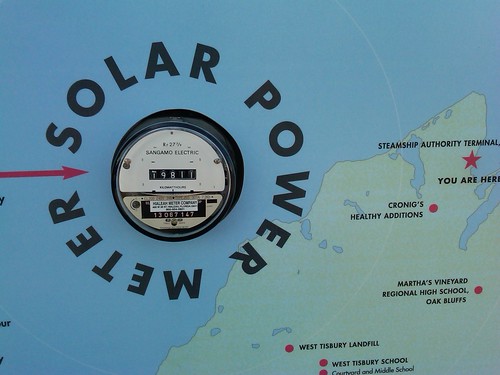
First, a solar power meter installed at the docks in Vineyard Haven on the island of Martha's Vineyard, Massachusetts. Martha's Vineyard is home to a variety of innovative energy solutions designed to stabilize and lower rates, strengthen reliability and security, and reduce air emissions.
China's energy footprint continues to make news. In July, a report by the International Energy Agency (IEA) said that in 2009, China was the world's largest energy consumer. According to the IEA, in 2009, China consumed 2.25 billion tons of oil equivalent in 2009. (Compare the U.S. at 2.17 billion tons -- close, but a lower number.) China subsequently ordered over 2,000 industrial facilities to close over their energy consumption. Now, China is refuting the IEA study's results. Chinese statistical agencies now point to a 2009 energy consumption in China of 2.15 billion tons, arguably due to differences in how consumption is estimated. Whatever China's total energy footprint is, China's large population means that China's energy intensity -- measured in energy consumed per capita -- is roughly 20% of that of the U.S.
The World Meteorological Organization is publicly linking flooding in places like China, Pakistan, and the U.S. with renewed predictions of disaster due to climate change.
Russia is reporting that Iran will soon load fuel into its nuclear reactor.
China's energy footprint continues to make news. In July, a report by the International Energy Agency (IEA) said that in 2009, China was the world's largest energy consumer. According to the IEA, in 2009, China consumed 2.25 billion tons of oil equivalent in 2009. (Compare the U.S. at 2.17 billion tons -- close, but a lower number.) China subsequently ordered over 2,000 industrial facilities to close over their energy consumption. Now, China is refuting the IEA study's results. Chinese statistical agencies now point to a 2009 energy consumption in China of 2.15 billion tons, arguably due to differences in how consumption is estimated. Whatever China's total energy footprint is, China's large population means that China's energy intensity -- measured in energy consumed per capita -- is roughly 20% of that of the U.S.
The World Meteorological Organization is publicly linking flooding in places like China, Pakistan, and the U.S. with renewed predictions of disaster due to climate change.
Russia is reporting that Iran will soon load fuel into its nuclear reactor.
August 10, 2010 - Martha's Vineyard wind; Ocean Energy Institute
Tuesday, August 10, 2010
In ocean energy news, Matthew Simmons, the founder of the Rockland, Maine-based Ocean Energy Institute has died. Simmons was the founder Simmons & Co. International, an investment banking firm focusing on energy. Convinced of the value of ocean energy, in 2007, he founded the Ocean Energy Institute as "a think-tank and venture capital fund addressing the challenges of U.S. offshore renewable energy". Echoing a trope we have heard often lately, Simmons once gave a slideshow in which he is reported to have said, "The Gulf of Maine will soon become a Silicon Valley and begin proving ocean energy can be captured, processed and turned into a replacement for modern energy and water."
The city of South Portland, Maine is considering forming a nonprofit energy supply company to save citizens money on their electricity supply. The business, putatively called South Portland Energy, would buy power at wholesale in the NEPOOL market and sell it to the city -- and perhaps also to residential and commercial ratepayers. This kind of nonprofit competitive electricity supplier can cut ratepayers' supply costs, without requiring the formation of a municipal electric transmission and distribution utility.
Railroad tracks form an important kind of infrastructure; walking and hiking paths form another. The balance between replacing rail tracks with hiking trails is an interesting policy question. This Portland Press Herald editorial suggests that foot paths should not replace rail; the two can coexist, but a path should not preclude the use of the right of way for passenger and freight service.
Cogentrix has signed a 20 year contract with Xcel Energy subsidiary Public Service Company of Colorado for the output of its 30 MW concentrating photovoltaic solar energy plant. The project, located in southern Colorado, relies on a concentrating photovoltaic technology using lenses to focus incoming sunlight onto solar photovoltaic cells. This results in a higher energy density (in kW per acre) than other solar technologies.
Subscribe to:
Posts (Atom)
