The U.S. has formally ratified the global climate change agreement reached in Paris last year, as has China. This moves the Paris climate agreement closer to legal effectiveness -- but more nations must accept the pact before it can enter into force.
At issue is the Paris Agreement, an agreement brokered at the 21st Conference of the Parties of the United Nations Framework Convention on Climate Change (UNFCCC). In December 2015, over 190 countries meeting under UNFCCC adopted the Paris Agreement agreement to limit global warming. The Paris Agreement describes climate change as an
"urgent threat" and a "common concern of humankind." The agreement's aim is to strengthen global response to this threat, through a variety of means. These include the creation of individual national commitments to reduce greenhouse gas emissions, increased adaptation to climate change, and assistance for developing nations.
But the Paris Agreement has not yet taken its full legal force, because it contains a provision limiting its effectiveness until enough nations agree to comply. As is common for multilateral international agreements, the Paris Agreement calls for parties to express their consent to be bound by the agreement, by depositing instruments of ratification, acceptance, approval or accession with the depositary established by the convention. In this way, the agreement draws a distinction between Parties -- those signing the Agreement -- and those nations which have deposited their ratification instruments.
Under its Article 21, the Paris Agreement "shall enter into force
on the thirtieth day after the date on which at least 55
Parties to the Convention accounting in total for at least an
estimated 55 percent of the total global greenhouse gas emissions have
deposited their instruments of ratification, acceptance, approval or
accession." Practically speaking, this means that as new countries submit their ratifications, the convention's secretariat must calculate the total greenhouse gas emissions of Parties that have ratified
the Paris Agreement, as a percentage of global greenhouse gas emissions. Once the 55 percent threshold is hit, the Paris Agreement will become legally effective and operational. The
UNFCCC has said that while it cannot predict when this will occur, "it is conceivable that the Agreement may enter into force before 2020."
On April 22, 2016, the Paris Agreement was opened for signature. At the opening ceremony, 15 states deposited instruments of ratification. By September 1, reportedly 24 states accounting for just over 1% of global greenhouse gas emissions had ratified the agreement.
The Paris Agreement's path to effectiveness advanced on September 3, when President Obama announced that the U.S. and China had formally joined the Paris agreement in a ceremony in China. In recent years, these nations have been among the world's top emitters of carbon dioxide. As described by the White House, "Both leaders expressed satisfaction with jointly joining the Paris climate agreement and pledged to work together and with other parties to bring the Paris agreement into force as early as possible." The Obama administration also noted other recent U.S. climate actions taken jointly with China, including support for a proposed amendment to the Montreal Protocol to phase down the consumption and production of hydrofluorocarbons (HFCs) globally, and efforts to address international aviation emissions.
Following the U.S.-China announcement, the convention secretariat announced that as of September 7, 27 states had deposited instruments of ratification, acceptance or approval
accounting in total for 39.08% of the total global greenhouse gas emissions.

Energy powers society; society's choices shape energy policy. A blog about our energy resources and the choices they present for society.
Showing posts with label China. Show all posts
Showing posts with label China. Show all posts

Energy and State of the Union 2015
Thursday, January 22, 2015
President Obama delivered his 2015 State of the Union address on January 20, 2015. In his remarks as prepared for delivery, he addressed energy-related themes including the growth of U.S. energy resource production and climate change.
As in his 2013 and 2014 addresses, increased domestic production of energy resources featured prominently in the 2015 State of the Union speech, for its economic, political, and national security benefits:
EIA also predicts continued growth in the use of renewable energy resources to produce electricity and heat. In 2014, 6.4% of electric generation came from hydropower and 6.7% from nonhydropower renewables. EIA projects continued growth of nonhydropower renewables, reaching an electricity generation share of 7.9% by 2016. Wind is the largest source of nonhydropower renewable generation, and it is projected to contribute 5.3% of total electricity generation in 2016.
President Obama also addressed climate change in this year's State of the Union address, and his administration's efforts to combat and mitigate its effects:
Will U.S. production of energy continue to grow? What economic, political, and national security impacts will flow from the shifts in and growth of the U.S. energy sector? Will the U.S. continue to act -- or take more serious action -- on climate change? The remainder of 2015 -- and of President Obama's term in office, which runs into January 2017 -- will show how these themes evolve.
As in his 2013 and 2014 addresses, increased domestic production of energy resources featured prominently in the 2015 State of the Union speech, for its economic, political, and national security benefits:
At this moment – with a growing economy, shrinking deficits, bustling industry, and booming energy production – we have risen from recession freer to write our own future than any other nation on Earth. It’s now up to us to choose who we want to be over the next fifteen years, and for decades to come...
We believed we could reduce our dependence on foreign oil and protect our planet. And today, America is number one in oil and gas. America is number one in wind power. Every three weeks, we bring online as much solar power as we did in all of 2008. And thanks to lower gas prices and higher fuel standards, the typical family this year should save $750 at the pump.During the past several years, U.S. production of oil and natural gas has increased significantly. According to the U.S. Energy Information Administration, total U.S. crude oil production averaged an estimated 9.2 million barrels per day (bbl/d) in December 2014, and forecasts for oil productino continue to grow. EIA predicts that projected crude oil production will reach 9.5 million bbl/d in 2016, constituting the second-highest annual average level of production in U.S. history (after 9.6 million bbl/d in 1970.)
EIA also predicts continued growth in the use of renewable energy resources to produce electricity and heat. In 2014, 6.4% of electric generation came from hydropower and 6.7% from nonhydropower renewables. EIA projects continued growth of nonhydropower renewables, reaching an electricity generation share of 7.9% by 2016. Wind is the largest source of nonhydropower renewable generation, and it is projected to contribute 5.3% of total electricity generation in 2016.
President Obama also addressed climate change in this year's State of the Union address, and his administration's efforts to combat and mitigate its effects:
2014 was the planet’s warmest year on record. Now, one year doesn’t make a trend, but this does – 14 of the 15 warmest years on record have all fallen in the first 15 years of this century.
I’ve heard some folks try to dodge the evidence by saying they’re not scientists; that we don’t have enough information to act. Well, I’m not a scientist, either. But you know what – I know a lot of really good scientists at NASA, and NOAA, and at our major universities. The best scientists in the world are all telling us that our activities are changing the climate, and if we do not act forcefully, we’ll continue to see rising oceans, longer, hotter heat waves, dangerous droughts and floods, and massive disruptions that can trigger greater migration, conflict, and hunger around the globe. The Pentagon says that climate change poses immediate risks to our national security. We should act like it.
That’s why, over the past six years, we’ve done more than ever before to combat climate change, from the way we produce energy, to the way we use it. That’s why we’ve set aside more public lands and waters than any administration in history. And that’s why I will not let this Congress endanger the health of our children by turning back the clock on our efforts. I am determined to make sure American leadership drives international action. In Beijing, we made an historic announcement – the United States will double the pace at which we cut carbon pollution, and China committed, for the first time, to limiting their emissions. And because the world’s two largest economies came together, other nations are now stepping up, and offering hope that, this year, the world will finally reach an agreement to protect the one planet we’ve got.His 2015 remarks on climate change reflect a belief or fear that Congress will not act on the issue, or will act to frustrate the Obama administration's efforts on climate change. In 2013, President Obama asked Congress to develop a market-based solution to climate change, but said he would take executive action if Congress failed to act. In 2014, he noted Congress's apparent unwillingness to act, and highlighted his administration's proposed new standards on power plant emissions of carbon. This year's remarks continue the trend of featuring executive-branch solutions, and downplaying the likelihood of near-term legislative support.
Will U.S. production of energy continue to grow? What economic, political, and national security impacts will flow from the shifts in and growth of the U.S. energy sector? Will the U.S. continue to act -- or take more serious action -- on climate change? The remainder of 2015 -- and of President Obama's term in office, which runs into January 2017 -- will show how these themes evolve.
Oregon coal export plans stopped
Thursday, May 9, 2013
The United
States is one of the world’s top coal producers and exporters, but recent plans
to add coal export capacity in the Pacific Northwest have not been fulfilled,
as several proposed export terminals have been withdrawn. Plans for yet another terminal have been
scrapped, as yesterday Kinder Morgan Energy Partners LP canceled its proposed
Clatskanie, Oregon project. What does
this mean for U.S. coal exports and for domestic pricing?
Kinder Morgan Energy Partners is a publicly traded master-limited partnership,or MLP, focused on pipeline infrastructure. Along with fellow Kinder Morgan family companies Kinder Morgan, Inc., Kinder Morgan Management, LLC, and El Paso Pipeline Partners, Kinder Morgan claims to be the largest midstream and the third largest energy company (based on combined enterprise value) in North America. The company owns or operates about 80,000 miles of pipelines and 180 terminals handling products like natural gas, refined petroleum products, crude oil, and carbon dioxide, as well as gasoline, jet fuel, ethanol, coal, petroleum coke and steel. It boasts of operating primarily “like a giant toll road”, and seeks to avoid commodity price risk through a fee-for-service model.
Most coal export capacity in the U.S. is located in the Midatlantic and Gulf Coast regions. While Asia dominates the world coal import market, major markets for U.S. coal exports include Canada, Brazil, the Netherlands, and the European Union. The principal West Coast coal export port is Los Angeles/Long Beach, with virtually no export capacity in the Pacific Northwest. Kinder Morgan had proposed a terminal to be built at the Port Westward industrial park on the Columbia River near Clatskanie. Yesterday project partner Port of St. Helens stated that Kinder Morgan had announced that it would not be pursuing the project.
Up to six Pacific Northwest coal export terminates have been proposed in recent years, but to date none have been built. The Kinder Morgan proposal joins a series of other canceled Pacific Northwest coal export plans. RailAmerica Inc. announced last year that it would not pursue a coal storage and export facility at Washington’s Port of Grays Harbor. Earlier this year, the Oregon International Port of Coos Bay announced the end of its exclusive negotiating agreement between with Metropolitan Stevedoring Company (Metro Ports) to build a thermal coal and biomass export facility. With the Kinder Morgan project gone, three potential terminals remain: Australian company Ambre Energy’s barge-loading operation at the port of Morrow and Port Westward, Millennium Bulk Terminals’ proposed $643 million dock west of Longview, and SSA Marine’s proposed $600 million coal terminal at Cherry Point.
Kinder Morgan Energy Partners is a publicly traded master-limited partnership,or MLP, focused on pipeline infrastructure. Along with fellow Kinder Morgan family companies Kinder Morgan, Inc., Kinder Morgan Management, LLC, and El Paso Pipeline Partners, Kinder Morgan claims to be the largest midstream and the third largest energy company (based on combined enterprise value) in North America. The company owns or operates about 80,000 miles of pipelines and 180 terminals handling products like natural gas, refined petroleum products, crude oil, and carbon dioxide, as well as gasoline, jet fuel, ethanol, coal, petroleum coke and steel. It boasts of operating primarily “like a giant toll road”, and seeks to avoid commodity price risk through a fee-for-service model.
Most coal export capacity in the U.S. is located in the Midatlantic and Gulf Coast regions. While Asia dominates the world coal import market, major markets for U.S. coal exports include Canada, Brazil, the Netherlands, and the European Union. The principal West Coast coal export port is Los Angeles/Long Beach, with virtually no export capacity in the Pacific Northwest. Kinder Morgan had proposed a terminal to be built at the Port Westward industrial park on the Columbia River near Clatskanie. Yesterday project partner Port of St. Helens stated that Kinder Morgan had announced that it would not be pursuing the project.
Up to six Pacific Northwest coal export terminates have been proposed in recent years, but to date none have been built. The Kinder Morgan proposal joins a series of other canceled Pacific Northwest coal export plans. RailAmerica Inc. announced last year that it would not pursue a coal storage and export facility at Washington’s Port of Grays Harbor. Earlier this year, the Oregon International Port of Coos Bay announced the end of its exclusive negotiating agreement between with Metropolitan Stevedoring Company (Metro Ports) to build a thermal coal and biomass export facility. With the Kinder Morgan project gone, three potential terminals remain: Australian company Ambre Energy’s barge-loading operation at the port of Morrow and Port Westward, Millennium Bulk Terminals’ proposed $643 million dock west of Longview, and SSA Marine’s proposed $600 million coal terminal at Cherry Point.
Whether a coal export terminal will be developed in the Pacific
Northwest is uncertain. If not, it will
continue to be difficult for coal produced in the western U.S. to reach the
world’s largest demands for coal imports.
China, Japan,
South Korea, India, and even the relatively small Chinese Taipei have led the demand
for coal imports in recent years. This opens significant economic activity. At the
same time, environmentalists argue that new export projects would contribute to
global pollution and greenhouse gas emissions.
Combined with the pressures of the commodity market for coal and other
fuels, these dynamics may continue to block expanded West Coast export plans. As is being argued over the issue of
liquefied natural gas exports, whether coal exports are expanded could also
have impacts for U.S. coal pricing.
Obama blocks Chinese co wind acquisition
Monday, October 1, 2012
President Obama has blocked a Chinese-owned company's acquisition of four Oregon wind farm development companies, citing "credible evidence" that
the company "might take action that threatens to impair the national
security of the United States."
Wind energy project Ralls Corporation had acquired four wind project development companies in Oregon earlier this year. Those companies -- Lower Ridge Windfarm, LLC, High Plateau Windfarm, LLC, Mule Hollow Windfarm, LLC, and Pine City Windfarm, LLC -- were developing wind projects in or near restricted airspace at the Naval Weapons Systems Training Facility in Boardman, Oregon. Ralls is owned by two executives of Chinese wind turbine manufacturer Sany Group, whose turbines were to used in the Oregon projects.
Earlier this summer, as Ralls acquired the project companies from Terna Energy USA Holdings Corporation, the Committee on Foreign Investment in the United States (CFIUS) began to review the transactions. The CFIUS -- an interagency panel whose purpose is to review transactions that could result in the control of a U.S. business by a foreign person in order to determine the effect of such transactions on the national security of the United States -- determined that "there are national security risks to the United States that arise as a result of the Transaction" and issued a series of orders compelling Ralls and the project companies to cease work and stay away from the project sites.
In an order issued last Friday, President Obama formally prohibited the transaction, and ordered Ralls to divest itself of the project companies and their assets within 90 days. Ralls is prohibited from selling the companies and assets until it removes everything from the project sites, and must give the CFIUS an opportunity to reject the proposed third-party buyer. The order cites Section 721 of the Defense Production Act of 1950 as authority. The Ralls order appears to be the first presidential exercise of this power since 1990, when President George Bush issued an order banning the China National Aero-Technology Import and Export Corporation from acquiring a Seattle-based aerospace developer.
Ralls has reportedly challenged the order in a lawsuit filed with the U.S. District Court in Washington, D.C.
Wind energy project Ralls Corporation had acquired four wind project development companies in Oregon earlier this year. Those companies -- Lower Ridge Windfarm, LLC, High Plateau Windfarm, LLC, Mule Hollow Windfarm, LLC, and Pine City Windfarm, LLC -- were developing wind projects in or near restricted airspace at the Naval Weapons Systems Training Facility in Boardman, Oregon. Ralls is owned by two executives of Chinese wind turbine manufacturer Sany Group, whose turbines were to used in the Oregon projects.
Earlier this summer, as Ralls acquired the project companies from Terna Energy USA Holdings Corporation, the Committee on Foreign Investment in the United States (CFIUS) began to review the transactions. The CFIUS -- an interagency panel whose purpose is to review transactions that could result in the control of a U.S. business by a foreign person in order to determine the effect of such transactions on the national security of the United States -- determined that "there are national security risks to the United States that arise as a result of the Transaction" and issued a series of orders compelling Ralls and the project companies to cease work and stay away from the project sites.
In an order issued last Friday, President Obama formally prohibited the transaction, and ordered Ralls to divest itself of the project companies and their assets within 90 days. Ralls is prohibited from selling the companies and assets until it removes everything from the project sites, and must give the CFIUS an opportunity to reject the proposed third-party buyer. The order cites Section 721 of the Defense Production Act of 1950 as authority. The Ralls order appears to be the first presidential exercise of this power since 1990, when President George Bush issued an order banning the China National Aero-Technology Import and Export Corporation from acquiring a Seattle-based aerospace developer.
Ralls has reportedly challenged the order in a lawsuit filed with the U.S. District Court in Washington, D.C.
Large hydroelectric projects around the world
Friday, September 30, 2011
Hydroelectricity provides a significant amount of usable power across the world. According to the U.S. Energy Information Administration, in 2008 hydroelectric generation produced 3,119,012 million kilowatt-hours, or 16% of the total electricity produced in the world. In the U.S. between 1998 and 2009, hydroelectric generation produced between 6-9% of the nation's total electric generation, depending on water availability.
Hydroelectricity is also responsible for many of the largest generating facilities. For example, the federal Grand Coulee Dam in Washington has a summer nameplate capacity of 7,079 megawatts, making it nearly twice as large as the next biggest U.S. power plant (Arizona's Palo Verde nuclear generating station).
Around the world, large hydroelectric projects produce immense amounts of power. When China's Three Gorges Dam project on the Yangtze River is complete, it is projected to include 32 separate 700 megawatt generators, producing a total project capacity of 22.5 gigawatts. This will make the Three Gorges Dam not only the largest hydroelectric dam in the world, but also the largest power station of any type.
Brazil's Itaipu Dam, producing up to about 14 gigawatts from the Paraná River along the Brazil-Paraguay border, is both the second largest hydroelectric plant and the world's second largest power station of any type.
Brazilian developers have also proposed the Belo Monte dam on the Amazonian Xingu River, which has received key environmental permits despite opposition on social and environmental grounds. If built, Belo Monte would be able to produce up to about 11 gigawatts of power, making it the third largest hydroelectric facility in the world. This week, a Brazilian judge issued a legal injunction against the Belo Monte development, noting the risk that fisheries would be damaged by its construction and operation. Will Belo Monte become the world's third largest power plant?
Hydroelectricity is also responsible for many of the largest generating facilities. For example, the federal Grand Coulee Dam in Washington has a summer nameplate capacity of 7,079 megawatts, making it nearly twice as large as the next biggest U.S. power plant (Arizona's Palo Verde nuclear generating station).
Around the world, large hydroelectric projects produce immense amounts of power. When China's Three Gorges Dam project on the Yangtze River is complete, it is projected to include 32 separate 700 megawatt generators, producing a total project capacity of 22.5 gigawatts. This will make the Three Gorges Dam not only the largest hydroelectric dam in the world, but also the largest power station of any type.
Brazil's Itaipu Dam, producing up to about 14 gigawatts from the Paraná River along the Brazil-Paraguay border, is both the second largest hydroelectric plant and the world's second largest power station of any type.
Brazilian developers have also proposed the Belo Monte dam on the Amazonian Xingu River, which has received key environmental permits despite opposition on social and environmental grounds. If built, Belo Monte would be able to produce up to about 11 gigawatts of power, making it the third largest hydroelectric facility in the world. This week, a Brazilian judge issued a legal injunction against the Belo Monte development, noting the risk that fisheries would be damaged by its construction and operation. Will Belo Monte become the world's third largest power plant?
June 8 - BP reports China passes US in energy consumption
Wednesday, June 8, 2011
As China's economy grows, it appears to have passed the U.S. in terms of total energy consumption.
Back in July 2010, I noted that the International Energy Agency claimed that China had passed the U.S. in terms of total energy consumed. That IEA report showed that China used 2.252 billion tons of oil equivalent, whereas the U.S. used only 2.170 billion tons of oil equivalent.
Now, another observer (and key energy player) has confirmed China's leap to being the top energy consumer. BP’s 60th annual Statistical Review of World Energy corroborates the IEA's findings, placing China in the top consumer slot as of 2010. According to BP, China consumed 20.3% of total global energy demand last year. This beats the U.S., which BP reports consumed 19% of the total global energy demand for 2010.
This reverses the trend for more than the past 100 years, when the United States has been considered to consume more energy than any other country. While energy consumption has traditionally been viewed as directly correlated to GDP, this shift breaks that trend as well. Commentators point to China's increased industrial activity, particularly significant in light of the current state of the American economy.
Interestingly, American energy intensity remains high: the average U.S. citizen uses five times as much energy as does the average Chinese citizen. What will happen when China reaches the energy intensity of the U.S.?
Back in July 2010, I noted that the International Energy Agency claimed that China had passed the U.S. in terms of total energy consumed. That IEA report showed that China used 2.252 billion tons of oil equivalent, whereas the U.S. used only 2.170 billion tons of oil equivalent.
Now, another observer (and key energy player) has confirmed China's leap to being the top energy consumer. BP’s 60th annual Statistical Review of World Energy corroborates the IEA's findings, placing China in the top consumer slot as of 2010. According to BP, China consumed 20.3% of total global energy demand last year. This beats the U.S., which BP reports consumed 19% of the total global energy demand for 2010.
This reverses the trend for more than the past 100 years, when the United States has been considered to consume more energy than any other country. While energy consumption has traditionally been viewed as directly correlated to GDP, this shift breaks that trend as well. Commentators point to China's increased industrial activity, particularly significant in light of the current state of the American economy.
Interestingly, American energy intensity remains high: the average U.S. citizen uses five times as much energy as does the average Chinese citizen. What will happen when China reaches the energy intensity of the U.S.?
August 19 - roundup
Thursday, August 19, 2010
An article about wind turbine parts squeezing through bridges on Maine's rural roads.
Patriot Renewables LLC plans to invest up to $228 million for up to 50 turbines in Maine.
Some local opposition to certain wind turbine siting issues in Dixfield, Maine, at a hearing held by opponents of wind in Maine's mountains.
China, Maine is implementing a PACE program.
Ocean Renewable Power Company says its first commercial-scale ocean energy turbine is a success.
Patriot Renewables LLC plans to invest up to $228 million for up to 50 turbines in Maine.
Some local opposition to certain wind turbine siting issues in Dixfield, Maine, at a hearing held by opponents of wind in Maine's mountains.
China, Maine is implementing a PACE program.
Ocean Renewable Power Company says its first commercial-scale ocean energy turbine is a success.
August 13, 2010 - Martha's Vineyard solar power; China
Friday, August 13, 2010
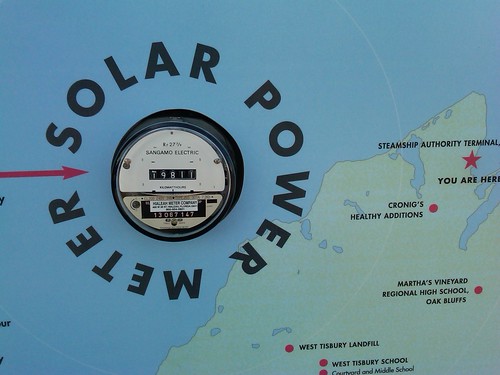
First, a solar power meter installed at the docks in Vineyard Haven on the island of Martha's Vineyard, Massachusetts. Martha's Vineyard is home to a variety of innovative energy solutions designed to stabilize and lower rates, strengthen reliability and security, and reduce air emissions.
China's energy footprint continues to make news. In July, a report by the International Energy Agency (IEA) said that in 2009, China was the world's largest energy consumer. According to the IEA, in 2009, China consumed 2.25 billion tons of oil equivalent in 2009. (Compare the U.S. at 2.17 billion tons -- close, but a lower number.) China subsequently ordered over 2,000 industrial facilities to close over their energy consumption. Now, China is refuting the IEA study's results. Chinese statistical agencies now point to a 2009 energy consumption in China of 2.15 billion tons, arguably due to differences in how consumption is estimated. Whatever China's total energy footprint is, China's large population means that China's energy intensity -- measured in energy consumed per capita -- is roughly 20% of that of the U.S.
The World Meteorological Organization is publicly linking flooding in places like China, Pakistan, and the U.S. with renewed predictions of disaster due to climate change.
Russia is reporting that Iran will soon load fuel into its nuclear reactor.
China's energy footprint continues to make news. In July, a report by the International Energy Agency (IEA) said that in 2009, China was the world's largest energy consumer. According to the IEA, in 2009, China consumed 2.25 billion tons of oil equivalent in 2009. (Compare the U.S. at 2.17 billion tons -- close, but a lower number.) China subsequently ordered over 2,000 industrial facilities to close over their energy consumption. Now, China is refuting the IEA study's results. Chinese statistical agencies now point to a 2009 energy consumption in China of 2.15 billion tons, arguably due to differences in how consumption is estimated. Whatever China's total energy footprint is, China's large population means that China's energy intensity -- measured in energy consumed per capita -- is roughly 20% of that of the U.S.
The World Meteorological Organization is publicly linking flooding in places like China, Pakistan, and the U.S. with renewed predictions of disaster due to climate change.
Russia is reporting that Iran will soon load fuel into its nuclear reactor.
August 9, 2010 - new nuclear, flywheel storage, China energy efficiency crackdown
Monday, August 9, 2010
Nuclear power is a hot topic -- specifically the construction of new nuclear plants, something that most countries in the world have been slow to do in recent years. Now the United Kingdom says it anticipates building its first new nuclear plant in 2018, most likely on-site at existing nuclear facilities.
Meanwhile, in midcoast Maine, where the spent fuel from the decommissioned Maine Yankee nuclear plant has been stored on-site in Wiscasset, an editorial in the Brunswick Times Record calls for the nuclear waste to be shipped away. The editorial notes that citizens were told that waste would be removed by 2010 -- and with Yucca Mountain no longer viable as a storage site, area residents see no prospect of the waste being taken away as promised.
Just as oil and natural gas tank storage capacity can be used to smooth out swings in the availability and market price of fuel, energy storage can play a major role in ensuring power service while dampening price swings. Frequency regulation -- keeping the alternating current at 60 Hz, which essentially requires smoothing out the gap between supply and demand on an instantaneous basis -- is an important service that all electric grids need. As more and more intermittent generation resources come online, like wind, grids need more and more frequency regulation. Massive mechanical flywheels can provide this service. In today's news, Beacon Power Corporation has closed on a $43 million DOE-backstopped loan, completing the financing for the 20 MW flywheel energy storage plant Beacon is building in Stephentown, New York. The plant, which is under construction and on budget, is projected to cost $69 million, about 80% of which represents direct facility costs. The Federal Financing Bank, part of the U.S. Treasury, provided the $43 million loan. NYSERDA provided a $2 million grant, with Beacon putting up the remaining $26 million in cash, in-kind assets, and project costs. Beacon is also planning two more 20 MW flywheel projects: one in Glenville, NY, and one in the PJM Interconnection.
Supporting renewable and energy efficiency projects through grant funding programs is one way to improve a state's energy efficiency and emissions. In China, the world's largest energy consumer, the government is taking a different approach: ordering 2,087 industrial manufacturers rated as having low energy efficiency to close. Affected facilities, which produce steel, concrete, paper, coke, and forest products, will lose their emissions licenses next month. Just to be sure, the government will order utilities and banks to cease dealings with the sanctioned businesses. The government's stated motivations include slippage on its five-year plan energy efficiency plan, as China's economic recovery and booming construction industry drive energy consumption up.
Maine is moving forward with PACE financing -- but municipalities need to take a bit of action to open the door to residential energy efficiency in their communities.
Two quick links to Lewiston Sun Journal pieces about wind. First, a story by Naomi Schalit critical of the results of Governor Baldacci's pro-wind efforts. Second, a letter from my friend and Leadership Maine classmate Paul Williamson providing a counterpoint to last month's Jonathan Carter column critical of Maine mountaintop wind. More to follow on these stories soon.
Meanwhile, in midcoast Maine, where the spent fuel from the decommissioned Maine Yankee nuclear plant has been stored on-site in Wiscasset, an editorial in the Brunswick Times Record calls for the nuclear waste to be shipped away. The editorial notes that citizens were told that waste would be removed by 2010 -- and with Yucca Mountain no longer viable as a storage site, area residents see no prospect of the waste being taken away as promised.
Just as oil and natural gas tank storage capacity can be used to smooth out swings in the availability and market price of fuel, energy storage can play a major role in ensuring power service while dampening price swings. Frequency regulation -- keeping the alternating current at 60 Hz, which essentially requires smoothing out the gap between supply and demand on an instantaneous basis -- is an important service that all electric grids need. As more and more intermittent generation resources come online, like wind, grids need more and more frequency regulation. Massive mechanical flywheels can provide this service. In today's news, Beacon Power Corporation has closed on a $43 million DOE-backstopped loan, completing the financing for the 20 MW flywheel energy storage plant Beacon is building in Stephentown, New York. The plant, which is under construction and on budget, is projected to cost $69 million, about 80% of which represents direct facility costs. The Federal Financing Bank, part of the U.S. Treasury, provided the $43 million loan. NYSERDA provided a $2 million grant, with Beacon putting up the remaining $26 million in cash, in-kind assets, and project costs. Beacon is also planning two more 20 MW flywheel projects: one in Glenville, NY, and one in the PJM Interconnection.
Supporting renewable and energy efficiency projects through grant funding programs is one way to improve a state's energy efficiency and emissions. In China, the world's largest energy consumer, the government is taking a different approach: ordering 2,087 industrial manufacturers rated as having low energy efficiency to close. Affected facilities, which produce steel, concrete, paper, coke, and forest products, will lose their emissions licenses next month. Just to be sure, the government will order utilities and banks to cease dealings with the sanctioned businesses. The government's stated motivations include slippage on its five-year plan energy efficiency plan, as China's economic recovery and booming construction industry drive energy consumption up.
Maine is moving forward with PACE financing -- but municipalities need to take a bit of action to open the door to residential energy efficiency in their communities.
Two quick links to Lewiston Sun Journal pieces about wind. First, a story by Naomi Schalit critical of the results of Governor Baldacci's pro-wind efforts. Second, a letter from my friend and Leadership Maine classmate Paul Williamson providing a counterpoint to last month's Jonathan Carter column critical of Maine mountaintop wind. More to follow on these stories soon.
July 21, 2010 - balancing wind into the grid; underperforming community wind turbine; China's Three Gorges Dam flooding
Wednesday, July 21, 2010
License plate seen in Maine:
How much wind can we really integrate into today's power grid? An interesting article in the Oregonian highlights the challenges. Take, for example, what happened on May 19, when the wind shifted and Bonneville Power Authority grid operators had to make room on the wires for 1000 turbines' worth of wind (nearly 2000 MW). This is a lot of power: more power than the BPA control area needs, more than the amount of hydro production that could be ramped down, and more than BPA could export to neighboring control areas. So what did BPA do? It told wind generators to feather their blades and cut their production -- a less than ideal solution.
In a parallel scenario, Venezuela is undergoing rolling blackouts. Venezuela relies on hydroelectricity for 70% of its power, and a long-lasting drought has crippled power production. Critics also point to chronic mismanagement and underinvestment by the nationalized companies that operate the power grid.
The City of Saco, Maine, is in a bit of a pickle over its community wind project. Back in 2007, Saco bought the turbine and tower for $207,000 from Entegrity Wind Systems. (As mentioned in an earlier blog post, Kittery also bought a turbine from Entegrity. It did better than Saco's, but Kittery's turbine underperformed as well.) At the time, community-scale wind was all the rage. The Maine Legislature had directed the Maine Public Utilities Commission to organize a stakeholder process to evaluate the state's opportunities for community wind. Although this process ultimately resulted in a report concluding that community wind was not generally economic under current conditions, many people and communities decided to pursue small- and medium-scale renewable project for their civic, educational and environmental values.
When Saco bought the turbine, Entegrity told Saco that the unit would generate 90,000 kilowatt-hours annually (about $12,600 worth of electricity) for 10 years. The unit came online in February 2008. It never performed as well as Entegrity had represented. At some point, former Entegrity head James Heath offered to buy the turbine back for $130,000. Then the turbine broke. In the meantime, Entegrity Wind Systems went bankrupt. The City was left holding the underperforming turbine.
Now, the Saco City Council is considering its options. Repair the turbine? Sell the turbine? Negotiate with James Heath? Litigation?
In other news: China's Three Gorges Dam is facing record flooding, comparable to the 1988 floods that killed over 4000 people. The dam had been touted as offering protection against floods. So far the dam is holding, but the massive reservoir is within 20 meters of full. More water is on its way.
A new report by the Maine State Chamber of Commerce and the Maine Development Foundation suggests that Maine businesses' most critical challenges come from health insurance costs, energy, taxes, regulations and transportation, in that order. A Lewiston Sun Journal editorial calls for an end to "destructive regulatory practices" that drive money, businesses and people out of Maine.
WCSH 6 reports on the plans of Ocean Energy Institute founder Matt Simmons to transform Maine into the "Silicon Valley of ocean energy". The Ocean Energy Institute has previously expressed interest in exploring links between offshore wind and ammonia production for energy storage.
 |
| From Energy Policy Update |
How much wind can we really integrate into today's power grid? An interesting article in the Oregonian highlights the challenges. Take, for example, what happened on May 19, when the wind shifted and Bonneville Power Authority grid operators had to make room on the wires for 1000 turbines' worth of wind (nearly 2000 MW). This is a lot of power: more power than the BPA control area needs, more than the amount of hydro production that could be ramped down, and more than BPA could export to neighboring control areas. So what did BPA do? It told wind generators to feather their blades and cut their production -- a less than ideal solution.
In a parallel scenario, Venezuela is undergoing rolling blackouts. Venezuela relies on hydroelectricity for 70% of its power, and a long-lasting drought has crippled power production. Critics also point to chronic mismanagement and underinvestment by the nationalized companies that operate the power grid.
The City of Saco, Maine, is in a bit of a pickle over its community wind project. Back in 2007, Saco bought the turbine and tower for $207,000 from Entegrity Wind Systems. (As mentioned in an earlier blog post, Kittery also bought a turbine from Entegrity. It did better than Saco's, but Kittery's turbine underperformed as well.) At the time, community-scale wind was all the rage. The Maine Legislature had directed the Maine Public Utilities Commission to organize a stakeholder process to evaluate the state's opportunities for community wind. Although this process ultimately resulted in a report concluding that community wind was not generally economic under current conditions, many people and communities decided to pursue small- and medium-scale renewable project for their civic, educational and environmental values.
When Saco bought the turbine, Entegrity told Saco that the unit would generate 90,000 kilowatt-hours annually (about $12,600 worth of electricity) for 10 years. The unit came online in February 2008. It never performed as well as Entegrity had represented. At some point, former Entegrity head James Heath offered to buy the turbine back for $130,000. Then the turbine broke. In the meantime, Entegrity Wind Systems went bankrupt. The City was left holding the underperforming turbine.
Now, the Saco City Council is considering its options. Repair the turbine? Sell the turbine? Negotiate with James Heath? Litigation?
In other news: China's Three Gorges Dam is facing record flooding, comparable to the 1988 floods that killed over 4000 people. The dam had been touted as offering protection against floods. So far the dam is holding, but the massive reservoir is within 20 meters of full. More water is on its way.
A new report by the Maine State Chamber of Commerce and the Maine Development Foundation suggests that Maine businesses' most critical challenges come from health insurance costs, energy, taxes, regulations and transportation, in that order. A Lewiston Sun Journal editorial calls for an end to "destructive regulatory practices" that drive money, businesses and people out of Maine.
WCSH 6 reports on the plans of Ocean Energy Institute founder Matt Simmons to transform Maine into the "Silicon Valley of ocean energy". The Ocean Energy Institute has previously expressed interest in exploring links between offshore wind and ammonia production for energy storage.
July 20, 2010 - China passes US as world's largest energy consumer; NextEra signs wind deal with Google
Tuesday, July 20, 2010
China has passed the United States as the world's largest consumer of energy. The International Energy Agency measures states' energy consumption in a unit called "oil equivalent". The most recent IEA report shows that China used 2.252 billion tons of oil equivalent, whereas the U.S. used only 2.170 billion tons of oil equivalent. This reverses the trend for more than the past 100 years, when the United States has been considered to consume more energy than any other country. While energy consumption has traditionally been viewed as directly correlated to GDP, this shift breaks that trend as well. Commentators point to China's increased industrial activity, particularly in light of the stagnant consumer-driven American economy.
Interestingly, American energy intensity remains high: the average U.S. citizen uses five times as much energy as does the average Chinese citizen. What will happen when China reaches the energy intensity of the U.S.?
NextEra's competitive energy subsidiary, NextEra Energy Resources, has entered into a power purchase agreement with Google Energy, LLC. Under the deal, Google will buy 114 megawatts of power from NextEra Energy Resources' Story II Wind Energy Center in Iowa.
Interestingly, American energy intensity remains high: the average U.S. citizen uses five times as much energy as does the average Chinese citizen. What will happen when China reaches the energy intensity of the U.S.?
NextEra's competitive energy subsidiary, NextEra Energy Resources, has entered into a power purchase agreement with Google Energy, LLC. Under the deal, Google will buy 114 megawatts of power from NextEra Energy Resources' Story II Wind Energy Center in Iowa.
3/31/10
Wednesday, March 31, 2010
It's a record: 11 inches of rain in Portland, Maine this March. The Portland Press Herald has some nice pictures of the effects of the Colcord Pond dam breach I mentioned yesterday. In Rhode Island, the flooding is bad enough -- 12 feet over the banks of the Pawtuxet River -- to greatly constrain the capacity of the Warwick wastewater treatment plant.
President Obama will announce more offshore oil drilling off the East Coast. Meanwhile oil prices are on the rise.
On Monday, Energy Secretary Steven Chu announced $37.5 million in funding for the U.S.-China Clean Energy Research Center, a virtual campus located at existing research sites in both countries. The Center will focus on energy efficiency, clean vehicles and carbon capture from coal-fueled power plants -- something China has a lot of.
A panel of British lawmakers investigating the "climategate" leaked email scandal have labeled British climate change research as "damaged" by the incident. The 59-page report by the Commons Science and Technology Committee says that climate change research must become more transparent.
In California, Kaiser Permanente Medical Center will start generating 10% of its power needs through 15 MW of solar photovoltaic arrays. Kaiser has entered into power purchase agreements with Recurrent Energy, who will own and operate the solar panels and sell the power to Kaiser, while Kaiser will retain the rights to the renewable energy credits. Meanwhile other projects in California are in a permitting backlog, jeopardizing their chances at earning the 30% cash grant in lieu of investment tax credit, which requires ground to be broken this year.
The Los Angeles City Council has backed a much smaller rate hike than proposed by Mayor Villaraigosa: 0.1-cent increase per kilowatt-hour in the rates paid by residential and commercial customers of the Los Angeles Department of Water and Power, with the initial money to go toward establishing a trust fund for renewable-energy production and energy efficiency.
Wisconsin wants in on the manufacturing associated with renewable deployment.
President Obama will announce more offshore oil drilling off the East Coast. Meanwhile oil prices are on the rise.
On Monday, Energy Secretary Steven Chu announced $37.5 million in funding for the U.S.-China Clean Energy Research Center, a virtual campus located at existing research sites in both countries. The Center will focus on energy efficiency, clean vehicles and carbon capture from coal-fueled power plants -- something China has a lot of.
A panel of British lawmakers investigating the "climategate" leaked email scandal have labeled British climate change research as "damaged" by the incident. The 59-page report by the Commons Science and Technology Committee says that climate change research must become more transparent.
In California, Kaiser Permanente Medical Center will start generating 10% of its power needs through 15 MW of solar photovoltaic arrays. Kaiser has entered into power purchase agreements with Recurrent Energy, who will own and operate the solar panels and sell the power to Kaiser, while Kaiser will retain the rights to the renewable energy credits. Meanwhile other projects in California are in a permitting backlog, jeopardizing their chances at earning the 30% cash grant in lieu of investment tax credit, which requires ground to be broken this year.
The Los Angeles City Council has backed a much smaller rate hike than proposed by Mayor Villaraigosa: 0.1-cent increase per kilowatt-hour in the rates paid by residential and commercial customers of the Los Angeles Department of Water and Power, with the initial money to go toward establishing a trust fund for renewable-energy production and energy efficiency.
Wisconsin wants in on the manufacturing associated with renewable deployment.
3/18/10
Thursday, March 18, 2010
As Maine considers its energy future, there are many concerns about Hydro-Quebec, and what will happen if we allow our powerful northern neighbor to build transmission lines connecting their nearly limitless hydropower with New England markets.
Thorndike voters will pass judgment on a proposed wind turbine siting ordinance, including a one-mile setback and noise regulations. Two companies have proposed projects on a ridge extending through Thorndike and into Dixmont and Jackson.
The Dallas (TX) Morning News reports that China is enacting protectionist measures to ensure that China, not the US, will manufacture the components needed for the massive anticipated build-out of wind generation in Asia and worldwide.
Los Angeles mayor Villaraigosa has proposed a significant new tax on electricity, with the proceeds going to a newly-created Renewable Energy and Efficiency Trust Fund, to pay for new conservation programs and a solar feed-in tariff. Everyone's bill will go up by 9% to 28%, with the brunt of the tax falling on business and industrial energy consumers. LA has set a 20% RPS by the end of 2010.
What's going on with federal energy and climate change legislation? Lots of talk. Yesterday Senator John Kerry (D-Mass.), Lindsey Graham (R-S.C.) and Joe Lieberman (I-Conn.) met with major industry groups to present an 8-page concept outline. Supposedly this draft calls for greenhouse gas curbs across the board, reducing emissions 17 percent below 2005 levels by 2020 and 80 percent by 2050. The draft starts by regulating power plant emissions in 2012, with other major industrial sources emitting over 25,000 tons per year of GHGs phased in starting in 2016. Notably, this draft preempts U.S. EPA climate regulations under the Clean Air Act and supplants dozens of state climate laws.
Thorndike voters will pass judgment on a proposed wind turbine siting ordinance, including a one-mile setback and noise regulations. Two companies have proposed projects on a ridge extending through Thorndike and into Dixmont and Jackson.
The Dallas (TX) Morning News reports that China is enacting protectionist measures to ensure that China, not the US, will manufacture the components needed for the massive anticipated build-out of wind generation in Asia and worldwide.
Los Angeles mayor Villaraigosa has proposed a significant new tax on electricity, with the proceeds going to a newly-created Renewable Energy and Efficiency Trust Fund, to pay for new conservation programs and a solar feed-in tariff. Everyone's bill will go up by 9% to 28%, with the brunt of the tax falling on business and industrial energy consumers. LA has set a 20% RPS by the end of 2010.
What's going on with federal energy and climate change legislation? Lots of talk. Yesterday Senator John Kerry (D-Mass.), Lindsey Graham (R-S.C.) and Joe Lieberman (I-Conn.) met with major industry groups to present an 8-page concept outline. Supposedly this draft calls for greenhouse gas curbs across the board, reducing emissions 17 percent below 2005 levels by 2020 and 80 percent by 2050. The draft starts by regulating power plant emissions in 2012, with other major industrial sources emitting over 25,000 tons per year of GHGs phased in starting in 2016. Notably, this draft preempts U.S. EPA climate regulations under the Clean Air Act and supplants dozens of state climate laws.
March 10, 2010
Wednesday, March 10, 2010
Yarmouth, Maine, is considering an alternative energy source to power its wastewater treatment plant: hydrogen gas, created through technology proposed by Ronny Bar-Gadda, founder and chief executive officer of Genesys LLC. The Portland Press Herald provides a description:
From the physics and thermodynamics perspectives, I am very interested to see how this plays out.
Strong, Maine pellet producer Geneva Wood Fuels has been fined $27,000 by OSHA for violations ranging from missing handrails to potential problems with wood dust management -- and it's wood dust that may have been behind the explosion at the plant last year.
China has announced that it is back on track to meet its target of lowering energy intensity -- which is energy consumption per unit of GDP -- by 20% over 2006 levels by year's end. How? Government control. The Chinese government shuttered 60 gigawatts of older, inefficient thermal electricity units, and cracked down on manufacturers of iron, steel and cement.
It's CERAWeek in Houston, and apparently traditional fossil-fuel generators are laughing at the federal government's promotion of renewables. CERAWeek is the big conference sponsored by energy consultants IHS Cambridge Energy Research Associates.
US Department of Energy's Energy Information Administration says we'll pay more than $3 per gallon of gasoline in summer 2010. EIA also predicts oil prices rising from above $80 per barrel this spring to $82 per barrel by the end of 2009 and $85 per barrel by the end of 2011. EIA also predicts flat residential electricity prices: 11.5 cents per kilowatthour for this year, rising to 11.6 cents per kilowatthour in 2011.
Letter to the Editor of the Bangor Daily News from David Gordon of Oakfield talking about his town's approach to ensuring that wind development within the town provides benefits to ratepayers. Well written David.
He has developed a proprietary technology called radiant energy transfer. It uses electromagnetic radiation to break the hydrogen-oxygen bond at certain frequencies. The process was demonstrated last fall in the lab by filling a balloon with hydrogen made from wastewater. The radiant energy transfer unit, as Bar-Gadda calls it, can be scaled up in modules, uses minimal energy and produces hydrogen at a rapid rate.
From the physics and thermodynamics perspectives, I am very interested to see how this plays out.
Strong, Maine pellet producer Geneva Wood Fuels has been fined $27,000 by OSHA for violations ranging from missing handrails to potential problems with wood dust management -- and it's wood dust that may have been behind the explosion at the plant last year.
China has announced that it is back on track to meet its target of lowering energy intensity -- which is energy consumption per unit of GDP -- by 20% over 2006 levels by year's end. How? Government control. The Chinese government shuttered 60 gigawatts of older, inefficient thermal electricity units, and cracked down on manufacturers of iron, steel and cement.
It's CERAWeek in Houston, and apparently traditional fossil-fuel generators are laughing at the federal government's promotion of renewables. CERAWeek is the big conference sponsored by energy consultants IHS Cambridge Energy Research Associates.
US Department of Energy's Energy Information Administration says we'll pay more than $3 per gallon of gasoline in summer 2010. EIA also predicts oil prices rising from above $80 per barrel this spring to $82 per barrel by the end of 2009 and $85 per barrel by the end of 2011. EIA also predicts flat residential electricity prices: 11.5 cents per kilowatthour for this year, rising to 11.6 cents per kilowatthour in 2011.
Letter to the Editor of the Bangor Daily News from David Gordon of Oakfield talking about his town's approach to ensuring that wind development within the town provides benefits to ratepayers. Well written David.
1/27/2010
Wednesday, January 27, 2010
US federal climate change legislation continues to brew on a back burner, although with last week's change to the Senate balance, the focus should be on enacting realistic measures that will provide a benefit but are politically viable. In addition to Martha Coakley, other losers may include the notion of a cap-and-trade mechanism, which even the lopsided Senate hinted it could not pass. We are more likely to end up with a watered-down bill that offers more carrots for good behavior than sticks raising the cost of "bad" behavior. (Think of increased incentives for efficiency upgrades, but not increased taxes on the rest of us who don't change our wicked ways.) Remember that in the meantime, EPA continues to move forward with its own administrative regulation of carbon emissions, which many consider likely to be more costly than any congressional action.
Following on yesterday's news of lackluster demand for wind turbines, Michigan (with 143 MW of installed wind capacity) and Minnesota (with 1,809 MW of wind) both report declines in the rate of new wind capacity being developed. (Meanwhile, China installed 12,000 MW of wind in 2009, nearly doubling its total wind capacity. The US added 9,000 MW in total.)
Following on yesterday's news of lackluster demand for wind turbines, Michigan (with 143 MW of installed wind capacity) and Minnesota (with 1,809 MW of wind) both report declines in the rate of new wind capacity being developed. (Meanwhile, China installed 12,000 MW of wind in 2009, nearly doubling its total wind capacity. The US added 9,000 MW in total.)
1/11/10
Monday, January 11, 2010
Looks like despite a lack of governmental support, businesses in China are solar thermal technology -- using mirrors to concentrate light, make steam, and turn turbines to generate electricity. As usual, the story emphasizes not only the value of siting generation in China, but also the value of producing solar thermal components for sales abroad -- the classic energy/manufacturing complex that is touted for deepwater offshore wind in Maine. Commercially, up to 2,000 MW of capacity may be developed by a partnership between Californian developer eSolar and Chinese manufacturer Penglai Electric. However, the Chinese government is officially skeptical about the merits of solar thermal, on the theory that China lacks sites where there is abundant water, sun, and cheap land.
Climate change? Global warming? A number of places around the world continue to face record low temperatures, which have remained in place for weeks. NYT reports that this is the largest and most persistent Arctic high pressure system to take hold since the 1950. This Arctic high deflects the jet stream south of our latitude, bathing us in cold Canadian air.
In Maine news, we have the $9 million in RGGI grants for industrial energy efficiency projects announced last week, a $12.4 million grant for the UMaine composites lab for deepwater offshore wind research, and rebates of $1500 to $3000 to homeowners for qualifying energy audits and weatherization projects.
Climate change? Global warming? A number of places around the world continue to face record low temperatures, which have remained in place for weeks. NYT reports that this is the largest and most persistent Arctic high pressure system to take hold since the 1950. This Arctic high deflects the jet stream south of our latitude, bathing us in cold Canadian air.
In Maine news, we have the $9 million in RGGI grants for industrial energy efficiency projects announced last week, a $12.4 million grant for the UMaine composites lab for deepwater offshore wind research, and rebates of $1500 to $3000 to homeowners for qualifying energy audits and weatherization projects.
Subscribe to:
Posts (Atom)
