Showing posts with label export. Show all posts

Crypto miner seeks to export US electricity for Canadian servers

Friday, June 26, 2020

In what has been called "a maiden effort by an energy-hungry cryptocurrency-mining industry to import electricity from the United States to Canada to meet its significant power demands", a Canadian company has applied to the U.S. Department of Energy for authority to export power from the U.S. into Canada to power blockchain-related computer servers -- but a nonprofit advocacy group has warned that federal approval of this "first-ever application to export power by a cryptocurrency miner" may result in a rush of similar applications.

Under U.S. federal law, the Department of Energy regulates exports of electricity from the United States to a foreign country, which require authorization under section 202(e) of the Federal Power Act. On May 21, 2020, DMG Blockchain Solutions Inc. filed an application with the U.S. Department of Energy, seeking authority under the Federal Power Act to transmit electric energy from the United States to Canada for a term of five years.

According to the website dmgblockchain.com, "DMG is a diversified cryptocurrency and blockchain platform company that is focused on the two primary opportunities in the sector – mining public blockchains and applying permissioned blockchain technology. DMG focuses on mining bitcoin, providing hosting services for industrial mining clients, earning revenues from block rewards and transaction fees, developing data analytics and forensic software products, working with auditors, law firms, and law enforcement to provide technical expertise, DMG’s permissioned blockchain technology is focused on developing enterprise software for the supply chain management of controlled products."

DMG's application to the Department of Energy describes the company as "a consumer of power, whose primary business is to host servers whose primary function is to ensure the security of public blockchains as well as other high-performance computing applications." DMG's application notes, "This business requires large amounts of power, which DMG is currently consuming approximately 15 megawatts on a steady load basis and has plans to grow to up to 60 megawatts in the next year with potentially larger amounts in the future as DMG may add new facilities." The application requests DOE export authorization over any of a long list of cross-border transmission facilities with Presidential Permits, in states including Maine, Vermont, New York, Pennsylvania, Michigan, Minnesota, North Dakota, Montana, and Washington.

But at least one entity has weighed in to urge the Department of Energy to proceed with caution, as it considers this request to export electricity to power foreign blockchain servers and computers. A Motion to Intervene and Comment filed with the Department of Energy on June 25, 2020, by watchdog organization Public Citizen, Inc. frames that organization's concern:
Despite cryptocurrency mining’s status as a relatively immature industry, its alarming power consumption footprint raises concerns about its sustainability and suitability in localized power markets, resulting in moratoria on new cryptocurrency mining operations issued by select U.S. utility districts and government agencies.
Citing language in Section 202(e) of the Federal Power Act requiring applications to export electricity to neither “impair the sufficiency of electric supply within the United States” nor “impede the coordination in the public interest of facilities subject to the jurisdiction of the Commission", Public Citizen commented:
Cryptocurrency mining is extraordinarily energy-intensive and can lead to major strains on local U.S. power supplies. At the same time, the process of mining is designed in a manner that wastes the overwhelming majority of the energy it consumes. U.S. cryptocurrency miners are struggling to meet their own power demands. This appears to be the first-ever application to export power by a cryptocurrency miner, and approval may result in a rush of similar applications.
Public Citizen's comments assert that this "maiden effort by an energy-hungry cryptocurrency-mining industry to import electricity from the United States to Canada to meet its significant power demands... raises serious, potentially fatal concerns under section 202(e)." Public Citizen concludes that the Department should proceed with extreme caution and "likely should deny the application or, if granting it, place conditions on it."

The pending export authorization proceeding before the U.S. Department of Energy is OE Docket No. EA-482, DMG Blockchain Solutions Inc. Application To Export Electric Energy.

U.S. to export more energy by 2020 than it imports, projects EIA

Tuesday, January 29, 2019

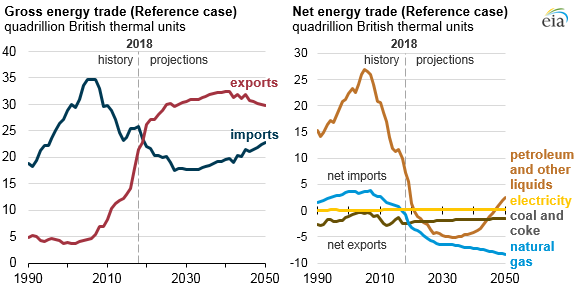
Federal energy analysts project that the United States will export more energy than it imports by 2020, making the nation a net energy exporter for the first time since the 1950s. Fossil fuels represent the largest volumes of this international trade.

Source: U.S. Energy Information Administration
The United States both exports and imports energy in a variety of forms, including natural gas, coal and coke, petroleum and other liquids, and electricity. According to the U.S. Energy Information Administration, the United States has long been a net exporter of coal and coke. In 2017, the nation began exporting more natural gas than it imports, primarily in the form of liquified natural gas or LNG. EIA notes that electricity trades with neighboring Canada and Mexico represent "a relatively small part of U.S. net energy trade flows."

The EIA projects that domestic production of crude oil, natural gas, and natural gas plant liquids will continue to grow at a faster rate than U.S. energy consumption over the next decade, meaning the balance of these fuels will be exported. EIA projects that due to "evolving trade flows of liquid fuels and natural gas," increasing exports of these fuels will tip the trade balance to where the U.S. is a net exporter of energy by 2020. When this shift occurs, it will represent the first time that the United States exports more energy than it imports on an annual basis since 1953.

Exactly how large the nation's net exports might be -- and how long the net-exporter status might last -- depend on a variety of assumptions about matters including oil and gas prices, resource extraction technologies, and possible changes to law. Under EIA's reference case which reflects current laws and regulations, the U.S. begins exporting more energy than it imports on an annual basis in 2020 and maintains that status through 2050. In other cases featuring lower prices or extraction rates for oil and gas, EIA projects that U.S. will return to net-importer status by the mid- to late-2030s.

Source: U.S. Energy Information Administration
Changes to laws and regulations could also affect the trade balance for energy products.

PNGTS applies for Westbrook XPress Phase I pipeline project

Monday, January 21, 2019

An interstate natural gas pipeline system bringing gas from eastern Canada into Maine has asked U.S. regulators for approvals necessary for a project that would marginally increase the system's capacity to bring gas to Maine and the New England market.

At issue is Portland Natural Gas Transmission System (PNGTS), a pipeline that spans New England from the Canadian border to pipeline connections in New Hampshire, Maine, and Massachusetts. Its facilities include 142 miles of wholly-owned mainline from an interconnection with Trans-Québec & Maritimes Pipeline Inc. at the U.S./Canada border to Westbrook, Maine plus two laterals, as well as 101 miles of mainline from Westbrook to Dracut, Massachusets, which PNGTS owns jointly with another interstate pipeline, Maritimes & Northeast Pipeline, L.L.C. PNGTS operates pursuant to a number of federal approvals, including a certificate issued by the Federal Energy Regulatory Commission and a Presidential Permit authorizing its facilities for importing gas from (or exporting gas to) Canada.

On December 21, PNGTS applied to the Commission for authorization for Phase I its "Westbrook Xpress Project," which would increase the certificated capacity on the northern portion of its system from Pittsburg, New Hampshire, to Westbrook, Maine, by 42.482 million cubic feet per day (MMcf/d), effective November 1, 2019. The pipeline's application includes both public materials and materials that are protected against public disclosure as "controlled unclassified information", including privileged information and "critical energy infrastructure information."

In the public materials, PNGTS describes continued increased demand for natural gas: "Growing demand for natural gas for space heating, industrial processes and electric generation is driving a commensurate demand for incremental pipeline deliverability from abundant North American supply basins." PNGTS says its Westbrook XPress project "will provide access to, and allow for the transportation of, natural gas supplies from key North American supply basins such as Marcellus, Utica, and others" via Canadian pipelines. The company describes its Westbrook Xpress project is "a solution to meet this growing demand in areas of North America that have some of the highest residential gas prices in the winter." It envisions two distinct phases of the project: Phase I with an incremental 42.482 million cubic feet per day of certificated capacity, with an anticipated Phase II to bring an incremental 62.989 million cubic feet per day of capacity.

The Commission has docketed PNGTS's application for Phase I of the Westbrook XPress project as Docket No. CP19-32, and has issued public notice of the opportunity to intervene or comment through 5:00 pm Eastern Time on January 29, 2019.

Sabine Pass LNG tanks leaked, says regulator

Monday, February 12, 2018

U.S. regulators of natural gas infrastructure have issued an order requiring the owner of a liquefied natural gas terminal in Louisiana to remove part of that facility from service, following the discovery of unintended releases of LNG from the facility.

At issue is Sabine Pass Liquefaction, LLC's Sabine Pass Liquefaction Facility. The company is a subsidiary of Cheniere Energy, Inc. The Sabine Pass LNG terminal includes five LNG storage tanks with capacity of approximately 16.9 billion cubic feet equivalent (Bcfe), two marine berths that can accommodate vessels with nominal capacity of up to 266,000 cubic meters and vaporizers with regasification capacity of approximately 4.0 Bcf/d, adjacent to a series of liquefaction trains. The facility has received U.S. Department of Energy authorization for export of LNG by vessel.

According to a Corrective Action Order issued by the Pipeline and Hazardous Materials Safety Administration on February 8, 2018, on January 22, 2018, workers at the Sabine Pass plant discovered a release of LNG from a storage tank at the facility. The order states that LNG escaped from the tank into the annulus -- the space between the tank's inner and outer walls -- which eventually caused cracks in the outer tank wall and the pooling of LNG in a secondary containment area. It also says that the federal investigation into this incident discovered additional LNG releases from multiple cracks in another tank at the site, with evidence of "brittle failures" in the carbon steel outer tank wall.

The order says Sabine took steps upon discovery of the incident including commencing de-inventorying LNG from the tank, reducing system pressures, and deploying an emergency management team. Sabine reported no injuries or fatalities as a result of the incident, and there were no reported fires or explosions. The cause of the incident has not yet been determined.

The PHMSA order requiring corrective action includes a finding "that the continued operation of the Affected Tanks without corrective measures is or would be hazardous to life, property and the environment." It describes unintended releases of LNG as "rare ... low -frequency, high-consequence" events which "can result in a serious hazard to people and property." It notes, "To date, Sabine has been unable to correct the long-standing safety concerns described above involving the Affected Tanks, cannot validate the exact source or amount of the LNG that may have leaked into the annulus of the Affected Tanks, and cannot identify the circumstances that allowed the LNG to escape containment in the first place."

The order requires Sabine to develop a timeline and plan for removing the two "Affected Tanks" and their associated systems from service. A third tank is described in a footnote to the order as having experienced releases of LNG from the inner tank into the annular space, but is not included as one of the "Affected Tanks" covered by the order requiring corrective action. It requires Sabine to develop a work-plan including tank-specific purging plans, a root-cause analysis plan, a detailed repair and modification plan, a continuing operation plan for facilities that remain in service, and a plan to return the affected tanks to service, and prohibits Sabine from returning the affected tanks to service until authorized to do so by the Director of PHMSA.

Energy policy in the 2018 State of the Union

Wednesday, January 31, 2018

U.S. President Donald Trump delivered the 2018 edition of the State of the Union speech on January 30, 2018. Unlike many previous such addresses, this one barely covered energy policy, focusing instead on a variety of other matters. But the speech offers insight into the Trump administration's view of the national situation, as well as into its priorities.

Energy policy and resources have often featured prominently in previous State of the Union addresses, and in remarks in 2017 President Trump advocated for a national strategy of "energy dominance." By contrast, President Trump's 2018 State of the Union speech mentioned U.S. regulation, production, and trade in energy only briefly, emphasizing his deregulatory agenda and pro-export philosophy.

The Trump administration posted an online version of his 2018 remarks as prepared for delivery. In that version, only two sentences use the word "energy":
We have ended the war on American Energy — and we have ended the war on clean coal.  We are now an exporter of energy to the world.
A transcript released by the U.K. media source The Independent suggests President Trump stuck close to his script on this (and other points):
We have ended the war on American energy, and we have ended the war on beautiful clean coal. We are now very proudly an exporter of energy to the world. 
These statements appear to relate to announcements made over the last year. Back in March 2017, President Trump signed an executive order which he described as "putting an end to the war on coal. We’re going to have clean coal — really clean coal." The U.S. does export a significant amount of energy -- and last year the Energy Information Administration projected that the U.S. would likely become a net exporter of energy within several years "as petroleum liquid imports fall and natural gas exports rise." Subsequent developments over the last year have lent preliminary support to this prediction.

President Trump's 2018 State of the Union speech did not otherwise directly address energy policy. That said, he did emphasize policy goals and achievements with respect to economic factors, such as tax cuts, job creation in manufacturing and other sectors, and improved small business confidence, as well as matters like national defense and immigration.

It can be tempting to infer administrative priorities from what is or isn't covered in a speech like this. At the same time, any leader has limited time to cover a host of important topics. With respect to energy matters, the speech emphasizes the Trump administration's focus on reducing regulations and increasing exports of America-produced energy resources.

FERC denies Oregon LNG project applications

Tuesday, March 15, 2016

U.S. energy regulators have denied applications to site, construct, and operate the proposed Jordan Cove liquefied natural gas (LNG) export terminal, an associated pipeline and related facilities slated for development in Oregon.

The Jordan Cove LNG Terminal and the Pacific Connector Pipeline were proposed as two segments of a single, integrated project.  According to the FERC record, the applicants designed the facilities to enable the production of up to 6.8 million metric tons per annum (MMTPA) of LNG, using a feed of approximately 1.04 billion standard cubic feet per day (Bcf/d) of natural gas, for export to international or domestic markets in the non-contiguous United States.  The proposed pipeline would carry natural gas to the LNG terminal, for liquefaction, storage in cryogenic tanks, and loading onto ocean-going vessels.

Under U.S. federal law, the Federal Energy Regulatory Commission exercises permitting authority over several types of natural gas infrastructure, including LNG terminals and interstate pipelines.  In 2013, Jordan Cove Energy Project, L.P. applied under section 3 of the Natural Gas Act (NGA) and Parts 153 and 380 of the Commission’s regulations to site, construct, and operate the LNG terminal.  Several weeks later, Pacific Connector Gas Pipeline, LP applied under NGA section 7(c) and Part 157 of the Commission’s regulations for a certificate of public convenience and necessity to construct and operate an approximately 232-mile-long, 36-inch-diameter interstate natural gas pipeline running to the Jordan Cove LNG Terminal.

Over the next few years, Commission staff engaged in a back-and-forth with the applicants over the status of liquefaction contracts for the LNG terminal and precedent agreements for pipeline capacity.  The Sierra Club and others intervened and filed protests.  Concerns stated included environmental issues and landowner complaints, as well as an alleged lack of need for the projects.  Meanwhile the Commission issued the project a generally favorable environmental assessment.

The Commission ultimately denied the applications on March 11, 2016.  In its order denying the applications, the Commission cited its Certificate Policy Statement as providing "guidance for evaluating proposals to certificate new construction."  In the Commission's words:
The Certificate Policy Statement establishes criteria for determining whether there is a need for a proposed project and whether the proposed project will serve the public interest. The Certificate Policy Statement explains that in deciding whether to authorize the construction of major new pipeline facilities, the Commission balances the public benefits against the potential adverse consequences. The Commission’s goal is to give appropriate consideration to the enhancement of competitive transportation alternatives, the possibility of overbuilding, subsidization by existing customers, the applicant’s responsibility for unsubscribed capacity, the avoidance of unnecessary disruptions of the environment, and the unneeded exercise of eminent domain in evaluating new pipeline construction. 
The threshold requirement for pipelines proposing new projects under this policy is that the pipeline must be prepared to financially support the project without relying on subsidization from its existing customers.  In this case, the Commission found that Pacific Connector satisfies the threshold "no subsidization" requirement of the Certificate Policy Statement because it is a new natural gas company and does not have existing customers. 

Next, the Commission determine whether the applicant has made efforts to eliminate or minimize any adverse effects the project might have on the applicant’s existing customers, existing pipelines in the market and their captive customers, or landowners and communities affected by the route of the new pipeline. If these interest groups face residual adverse effects after efforts have been made to minimize them, the Commission essentially performs an economic balancing test on the evidence of public benefits to be achieved as compared to the residual adverse effects. Only when the benefits outweigh the adverse effects on economic interests will the Commission proceed to complete the environmental analysis where other interests are considered.

The benefits test proved problematic for the Pacific Connector pipeline.  The Commission found no adverse impact to existing customers, existing pipelines in the market or their captive customers.  But the Commission noted the landowner concerns, and a lack of evidence that the applicant had obtained any easement or right-of-way agreements for the necessary use of private lands.  In the Commission's view, these concerns must be weighed against the benefits to be gained from the project.

But the Commission found that "Pacific Connector has presented little or no evidence of need for the Pacific Connector Pipeline."  The Commission noted that the pipeline applicant had "neither entered into any precedent agreements for its project, nor conducted an open season, which might (or might not) have resulted in “expressions of interest” the company could have claimed as indicia of demand." According to the Commission, the applicant offered only "generalized allegations of need."  These did include the fact that Jordan Cove received U.S. Department of Energy authorization for export of LNG to free trade agreement and non-free trade agreement nations as "consistent with the public interest."  But the FERC noted that this DOE authorization for LNG was pursuant to different statutes, and moreover did not apply to the pipeline

The Commission noted that it "has not previously found a proposed pipeline to be required by the public convenience and necessity under NGA section 7 on the basis of a DOE finding under NGA section 3 that the importation or exportation of the commodity natural gas by an entity proposing to use the services of an associated LNG facility is consistent with the public interest."  As a result, the Commission found that "the generalized allegations of need proffered by Pacific Connector do not outweigh the potential for adverse impact on landowners and communities." Because the record did not support a finding that the public benefits of the Pacific Connector Pipeline outweigh the adverse effects on landowners, the Commission denied Pacific Connector’s request for certificate authority to construct and operate its project.

Turning next to the LNG terminal, the Commission noted that the Pacific Connector Pipeline is the only proposed transportation path for natural gas to reach the Jordan Cove LNG Terminal, and that the Commission has not previously authorized LNG export terminal facilities without a known transportation source of natural gas. Because the Commission concluded that the record did not support a finding that the Jordan Cove LNG Terminal can operate to liquefy and export LNG absent the Pacific Connector Pipeline, the Commission instead found that authorizing its construction would be inconsistent with the public interest. Therefore, it also denied Jordan Cove’s request for authorization to site, construct and operate the Jordan Cove LNG Terminal.

NERC suggests Clean Power Plan reliability considerations

Thursday, January 28, 2016

The electric reliability organization for North America has issued an assessment of reliability considerations it thinks state electricity and environmental regulators should take into account in crafting state plans to comply with the Clean Power Plan.

The North American Electric Reliability Corporation (NERC) is a not‐for‐profit regulatory authority whose mission is to assure the reliability of North America's bulk power system.

Last year, the U.S. Environmental Protection Agency (EPA) issued its Clean Power Plan, a final rule limiting carbon dioxide emissions for existing electric generation facilities.  States are expected to prepare individual or collaborative plans to comply with the regulation.  Because reducing the carbon intensity of electric power generation is the goal, EPA expects that some plans will include a shift from coal-fired power plants to less carbon-intensive sources.  As NERC wrote in its assessment:
The BPS is already undergoing a broad transformation with retirements of coal units and some nuclear units, and additions of resources fueled by natural gas, wind, and solar. Distributed generation, energy efficiency, and demand response are also changing the way in which system planners must account for resources. The CPP has the potential to hasten the transformation of the electric system started by market and political factors such as natural gas supply and pricing and federal and state policy decisions with respect to renewables and energy efficiency and other environmental regulations.
But reliability is a key issue at stake in any shift in the portfolio of generating resources.  The Clean Power Plan rule explicitly requires that states consider reliability as part of their plans.

NERC's assessment, Reliability Considerations for Clean Power Plan Development, presents its view of "aspects of plan design that need to be considered to reliably accommodate this broad transformation."  NERC's ten key reliability considerations are:

  • State coordination with system planning entities - planners and coordinators working together
  • Essential reliability services - "In order to maintain an adequate level of reliability through this transition, generation resources need to provide sufficient voltage control, frequency support, and ramping capability — essential components to the reliable operation of the BPS. It is necessary for policy makers to recognize the need for these services by ensuring that interconnection requirements, market mechanisms, or other reliability requirements provide sufficient means of adapting the system to accommodate large amounts of variable and/or distributed energy resources (DERs)."
  • Timing considerations for energy infrastructure development - "Retirements can happen quickly, but adequate replacement facilities must be in service prior to retirement. As natural gas‐fired generation replaces coal‐fired generation the requisite timeline for natural gas pipeline infrastructure becomes even more relevant."
  • Electricity imports and exports - "If a state intends to use resources from nearby states as part of a compliance strategy, it is important to determine if the necessary transmission capability is available to reliably transport electricity from those resources."
  • Change in generator cycling and operations - coal plants may serve more seasonal peak demands, so "states should take account of changes in maintenance requirements likely due to cycling and the risk of increased forced outages of these coal‐fired plants. Additionally, increased and sufficient coordination between gas and electric system operators becomes much more critical to ensure adequate amounts of fuel are available."
  • Reserve margin assessment - "As more variable and energy ‐ limited resources are added, the system will likely require additional reserve capacity to maintain a similar level of reliability compared to a system with all conventional generation."
  • Energy efficiency - "Given that EE can be used as a potential CPP compliance tool, it is important that states evaluate the realistic potential for EE to displace load and the likely duration of those impacts. Shorter term EE measures may serve as a potential bridge to meet CPP requirements."
  • Emissions trading - "In general, emissions trading promotes additional reliability compliance options by effectively broadening the compliance region as well as the availability of allowances and credits. However, some resource options that might be assumed available through emissions trading may not be, due to another state’s plan. Because trading is optional, states should coordinate to ensure the most beneficial approach of trading is considered."
  • Reliability safety valve - "States must understand how the Reliability Safety Valve works and its limits, recognizing that it cannot be used as a planning tool to meet CPP requirements."
  • North American and European precedents - states should review carbon market precedents like RGGI and shifts in Canada and Europe toward renewable and distributed resources as case studies for potential strategies, lessons learned in implementation, and insights as they develop their plans.
Some states are already developing Clean Power Plan compliance plans.  Meanwhile, judicial challenges have been filed.  Initial plans are due to the EPA later this year.

US Presidential Permits for cross-border infrastructure

Monday, December 8, 2014

As the U.S.'s international trade in energy grows, so too has interest in the process for securing a federally required approval known as a Presidential Permit.

A marker shows the route of a natural gas pipeline in Utah.

The construction, operation, and maintenance of infrastructure that crosses the U.S.'s border with Mexico or Canada -- think pipelines, transmission lines, and bridges -- generally requires prior authorization by the federal government in the form of a Presidential Permit.  How you obtain a Presidential Permit depends on the type of facilities in question, as permits may be issued by several federal agencies under different legal authorities.

Presidential permits for oil, petroleum products, and other liquids pipelines have been issued by the U.S. State Department since since the promulgation of Executive Order 11423 in 1968.  Executive Order 11423 provided that, except with respect to cross-border permits for electric energy facilities, natural gas facilities, and submarine facilities:
The Secretary of State is hereby designated and empowered to receive all applications for permits for the construction, connection, operation, or maintenance, at the borders of the United States, of: (i) pipelines, conveyor belts, and similar facilities for the exportation or importation of petroleum, petroleum products, coal, minerals, or other products to or from a foreign country; (ii) facilities for the exportation or importation of water or sewage to or from a foreign country; (iii) monorails, aerial cable cars, aerial tramways and similar facilities for the transportation of persons or things, or both, to or from a foreign country; and (iv) bridges, to the extent that congressional authorization is not required.
The State Department's Bureau of Energy Resources Office of Energy Diplomacy receives and processes permit applications for liquid product pipelines, including water and petroleum products.  The standard by which the Secretary of State reviews applications for presidential permits is prescribed by an executive order issued in 2004.  Executive Order 13337 directs the Secretary of State to authorize those border crossing facilities that the Secretary has determined would “serve the national interest."

By contrast, cross-border natural gas pipelines are regulated by the Federal Energy Regulatory Commission, while electric transmission infrastructure is regulated by the Department of Energy.  Section 3 of the Natural Gas Act requires any person desiring to export any natural gas from the United States to a foreign country or to import any natural gas from a foreign country to the United States to obtain an order from the Federal Power Commission authorizing it to do so.   Section 202(e) of the Federal Power Act requires any person desiring to transmit any electric energy from the United States to a foreign country to obtain an order from the Federal Power Commission authorizing it to do so.

Executive Order 10485 designated the FERC's predecessor agency, the Federal Power Commission, to receive applications for natural gas and electricity facilities.  When the Department of Energy Organization Act of 1977 eliminated the Federal Power Commission, it shifted most of the FPC's responsibilities to the FERC, but Section 402(f) of that act specifically reserved import/export permitting functions for the Department of Energy.  For facilities governed by the Department of Energy, the Presidential Permit process is governed by Part 205 of the Department's rules.  In 2006, the Department delegated its authority to issue Presidential Permits for natural gas pipeline border crossings to FERC, via DOE Delegation Order No. 00-004.00A.

Infrastructure projects subject to the Presidential Permit process range widely in type, scope, and controversy, from the proposed Keystone XL oil pipeline from Canada to the proposed Champlain Hudson Express high-voltage direct current electric transmission line.

Exporting compressed natural gas from the US

Monday, October 6, 2014

In a divided opinion, the Federal Energy Regulatory Commission has found that it does not have jurisdiction over facilities proposed by Emera CNG, LLC to compress natural gas for export to the Bahamas by ship.

Natural gas is an important fuel used globally for electric power generation, heating, and industry.  Throughout most of the U.S., an abundant supply of natural gas means domestic pricing for gas is lower than overseas.  This creates a potentially profitable opportunity to export natural gas from the U.S., if regulatory conditions allow.

Natural gas can be exported by pipeline as a gas, or by truck or ship as either compressed natural gas (CNG) or liquefied natural gas (LNG). Liquefying natural gas enables massive quantities of gas to be transported anywhere in the world, but requires the construction of expensive facilities to liquefy and regasify the fuel.  The federal Natural Gas Act gives the Federal Energy Regulatory Commission jurisdiction over the siting and construction of most LNG facilities in the U.S., and authorizes FERC to issue certificates of public convenience and necessity for LNG facilities engaged in interstate natural gas transportation by pipeline.  For example, Dominion Cove Point LNG, LP recently secured the FERC's approval for its Cove Point LNG export facility.

By comparison, compressing natural gas to high pressures is a relatively lower-cost way to improve the energy density of the fuel and reduce its transportation costs, albeit not to the degree of LNG.  CNG exports are already happening, and may soon increase.

Emera recently proposed to construct a CNG compression and truck-loading facility at the existing Port of Palm Beach in Riviera Beach, Florida, in order to export CNG to the Commonwealth of the Bahamas.  At the site, Emera would draw natural gas from the Riviera Lateral, a pipeline owned and operated by Peninsula Pipeline Company.  Emera would then dehydrate and compress the gas to fill containers that would be loaded onto trucks.  The proposed CNG facility would initially be capable of loading 6 million cubic feet per day (MMcf/d) of CNG, with expansion capabilities up to 25 MMcf/d.  Once loaded onto trucks, Emera will haul the containers to a berth about a quarter mile away at the Port of Palm Beach.  At the port, the containers will be loaded onto a roll-on/roll-off ocean-going carrier and shipped to Freeport, Grand Bahama Island, where the containers would be unloaded, the CNG decompressed and injected into a pipeline for transport to electric generation plants owned and operated by Emera affiliate Grand Bahama Power Company and other customers on Grand Bahama Island.

To reduce regulatory uncertainty, Emera petitioned the Federal Energy Regulatory Commission for a declaratory order that its project will not be subject to the Commission’s jurisdiction under the Natural Gas Act.  Last month, a majority of the FERC Commissioners found that the construction and operation of the CNG facility described by Emera would not be subject to FERC's authority over natural gas exports under the Natural Gas Act.  In particular, the majority opinion held that Emera’s facilities to compress and load CNG onto trucks are not jurisdictional export facilities.

In reaching this conclusion, the majority found that the proposed CNG facilities were unlike the border-crossing pipelines and coastal LNG terminals that the Commission traditionally has regulated under section 3 as import/export facilities, and more like existing, unregulated facilities that deliver LNG into trucks which are subsequently driven across the border into Canada or Mexico.  Indeed, the opinion cites the example of Xpress Natural Gas, which has a CNG plant in Maine that receives gas from an interstate pipeline and loads CNG containers onto trucks for delivery to customers in Canada and in New England.  The Commission does not regulate the CNG facility under either section 3 or 7, nor does it exercise jurisdiction over the trucks’ passage across the border under section 3.

The majority opinion similarly found that because Emera said that all of the natural gas to be compressed at Emera’s planned facility will be exported in foreign commerce to the Commonwealth of the Bahamas, the Commission’s section 7 jurisdiction over transportation and sales of gas for resale in interstate commerce would not be implicated by Emera’s proposal.

Notably, new Commissioner Norman Bay dissented from the majority opinion.  Noting language in section 3 of the Natural Gas Act giving FERC jurisdiction over natural gas exports, Commissioner Bay's dissent describes the majority’s argument as that because the CNG will leave Emera’s facility by truck and travel a quarter of mile before being loaded onto ocean-going carriers for export – rather than by a pipeline running across a border or to a tanker – the facility is not an “export facility” under section 3 of the Natural Gas Act. In Commissioner Bay's words, "It cannot be that the Commission’s jurisdiction turns on this 440-yard truck journey."

With FERC regulation under the Natural Gas Act behind it, Emera will still need other approvals to export CNG; for example, Emera has filed an application with the U.S. Department of Energy's Office of Fossil Energy for authorization under Section 3 of the Natural Gas Act for export of natural gas.

What role will CNG exports play in the U.S.'s energy future?

Feds approve Quebec-to-NY power line

Wednesday, October 1, 2014

A proposed electric transmission line connecting Quebec to New York will receive a key federal approval, according to the U.S. Department of Energy.  The Energy Department's decision to issue a Presidential permit to Champlain Hudson Power Express, Inc. focuses attention on the nation's international trade in electricity, and may suggest increased reliance on power imports.

Pursuant to two Executive Orders -- EO 10485 (September 9, 1953), as amended by EO 12038 (February 7, 1978) -- no electricity transmission facilities may be constructed, operated, maintained, or connected at the U.S. border without first obtaining a Presidential permit from the Department of Energy.  In 2010, Champlain Hudson Power Express, Inc. applied to DOE for a Presidential permit to construct, operate, maintain, and connect a 1,000-megawatt (MW), high-voltage direct current (HVDC) merchant electric power transmission system across the U.S./Canada border.

As currently envisioned, the Champlain Hudson Power Express project would cross the U.S./Canada border near the town of Champlain in northeastern New York State.  From there, the line would extend southward about 336 miles to the Consolidated Edison Company of New York, Inc. Rainey substation in Queens, New York.  Notably, the aquatic portions of the transmission line would primarily be buried in sediments of Lake Champlain and the Hudson, Harlem, and East rivers, while the terrestrial portions of the line would be buried within existing roadway and railroad rights-of-way.

The Department may issue or amend a permit if it determines that the permit is in the public interest and after obtaining favorable recommendations from the U.S. Departments of State and Defense.  In making this determination, DOE considers factors including the proposed project's potential impacts on the environment and electricity reliability.

In the case of the Champlain Hudson Power Express, the Department of Energy's record of decision states that its decision to grant the Presidential permit was based on "consideration of the potential environmental impacts, impacts on the reliability of the U.S. electric power supply system under normal and contingency conditions, and the favorable recommendations of the U.S. Departments of State and Defense."  With the Presidential permit in hand, the project developer will be one step closer to success -- but additional steps remain, including both securing regulatory approvals and completing the commercial arrangements necessary for project development.

If the project is built, New York consumers may soon have increased access to electricity generated from Canadian hydropower and other resources across their northern border.  Will the U.S. soon import more power from Canada?  If so, how much, and at what cost?  How will market forces and regulatory agendas combine to affect Canadian exports of electricity to the U.S.?

FERC approves Maryland LNG project

Tuesday, September 30, 2014

A proposed Maryland natural gas liquefaction facility won a key federal approval yesterday, as the Federal Energy Regulatory Commission authorized Dominion Cove Point LNG, LP to build the Cove Point Liquefaction Project in Calvert County, Maryland, and related facilities at an existing compressor station and at metering and regulating sites in Virginia.

Natural gas is an important fuel used globally for electric power generation and heating.  While pipelines offer the most efficient way to transport large volumes of natural gas, liquefied natural gas or LNG can more easily be transported by ship to distant markets.  As US natural gas production has increased in recent years, so too has interest in building facilities to liquefy gas for export or other use.

Under Section 3 of the Natural Gas Act, the Federal Energy Regulatory Commission or FERC authorizes the siting and construction of onshore and near-shore LNG import or export facilities. Section 7 of the Natural Gas Act authorizes FERC to issue certificates of public convenience and necessity for LNG facilities engaged in interstate natural gas transportation by pipeline.

On April 1, 2013, Dominion applied to the FERC for approval under Section 3 of the Natural Gas Act to site, construct, and operate the Cove Point Liquefaction Project for the liquefaction and export of domestically-produced natural gas at Dominion’s existing LNG import terminal in Calvert County, Maryland.  Dominion also requested authority under section 7(c) of the Natural Gas Act to construct and operate facilities at its existing compressor station and metering and regulating sites in Virginia.  Collectively, the project will enable Dominion to transport up to 860,000 dekatherms per day of natural gas form existing pipeline interconnects near the west end of the Cove Point Pipeline to the Cove Point terminal for the export of up to 5.75 metric tons of liquefied natural gas per year.

Dominion's requests triggered a case that stretched for over two years of consideration.  During this time, the FERC heard from more than 140 speakers at three public meetings related to an assessment of the project's environmental impacts, and received more than 650 comments from the public and federal, state and local agencies on the application.  In the end, the FERC determined that Dominion’s proposal, as approved with 79 specific conditions required by the Commission’sauthorization, will minimize potential adverse impacts on landowners and the environment.

According to the FERC, Dominion proposes to complete construction of the liquefaction project so that facilities may start service in June 2017.  Notably, the U.S. Department of Energy has already approved Dominion Cove Point’s export of gas to both Free Trade Agreement and non-Free Trade Agreement countries.

The same economic forces motivating the Dominion project support other proposed LNG export projects.  Indeed, FERC has approved three other LNG export projects, all in the Gulf of Mexico -- the Sabine Pass Liquefaction Project, the Freeport LNG Project, and the Cameron LNG Project -- and 14 more LNG export proposals remain pending.

EIA releases 2014 Annual Energy Outlook

Wednesday, May 14, 2014

The U.S. Energy Information Administration has released its annual report projecting long-term trends in energy markets.

The Energy Information Administration, or EIA, is the statistical and analytical agency within the U.S. Department of Energy.  Its 2014 Annual Energy Outlook (269-page PDF) presents long-term annual projections of energy supply, demand, and prices focused on the U.S. through 2040. Based on data-driven models, the report considers a reference case under which it assumes current laws and regulations remain unchanged, as well as alternative cases that explore important areas of uncertainty for markets, technologies, and policies in the U.S. energy economy.

The report's biggest findings include projections that:
  • Growing domestic production of natural gas and oil continues to reshape the U.S. energy economy, largely as a result of rising production from tight formations, but the effect could vary substantially depending on expectations about resources and technology.
  • Industrial production expands over the next 10 to 15 years as the competitive advantage of low natural gas prices provides a boost to the industrial sector with increasing natural gas use.
  • There is greater upside uncertainty than downside uncertainty in oil and natural gas production; higher production could spur even more industrial growth and lower the use of imported petroleum.
  • Improvement in light-duty vehicle (LDV) efficiency more than offsets modest growth in vehicle miles traveled (VMT) that reflects changing driving patterns, leading to a sharp decline in LDV energy use.
  • Evolving natural gas markets spur increased use of natural gas for electricity generation and transportation, as well as expanded export opportunities.
  • Improved efficiency of energy use in the residential and transportation sectors and a shift away from more carbon-intensive fuels such as coal for electricity generation help to stabilize U.S. energy-related carbon dioxide (CO2) emissions.
The full report includes a series of specific projections -- for example that most new electricity generation capacity added will use natural gas or renewable energy, that solar photovoltaic and wind will dominate new renewable capacity.  The report also projects that through 2040, energy use per capita decreases, largely due to gains in appliance efficiency, a shift in production from cooler to warmer regions, and an increase in vehicle efficiency standards.

How will EIA's projections fare over the coming years?

Coal freighter traverses Northwest Passage

Friday, September 27, 2013

Today, a sea freighter capable of carrying 75,000 tons of cargo is traversing the Northwest Passage.  The Nordic Orion is carrying coal from Vancouver, British Columbia, to Finland.  Does this trip illustrate a new trend?

The traditionally ice-bound Northwest Passage across the Arctic edge of the North American continent is increasingly ice-free during summer months.  For shippers, the route offers a significant savings in distance, fuel, and cost compared to alternatives.  For example, cargo shipments between the west coast of Canada and northern Europe can cut off over 1,000 nautical miles by taking the Northwest Passage instead of the Panama Canal.  This saves time and money, and enables ships to carry more cargo (and less fuel) per trip.  It can also reduce carbon dioxide emissions associated with the shipping industry.

The Nordic Orion's cargo - coal - highlights another trend.  If the Northwest Passage becomes practical as a shipping route, Canadian west-coast ports become that much closer to markets in Europe and elsewhere along the Atlantic.  Plans to increase U.S. coal exports from Pacific ports are facing headwinds, but the economics of Canadian exports may improve if coal can be shipped east through the Northwest Passage.

At the same time, transit routes through the Northwest Passage come with risks, including icebergs, less well-mapped hazards, and local impacts to the Arctic environment.  Royal Dutch Shell PLC's aborted attempts to drill for oil in U.S. Arctic waters in 2012 illustrate some of these hazards.

Will cargo traffic through the Northwest Passage continue to increase?  How will it affect global markets?  What impacts will it have to the Arctic?

eBay OKed for wholesale electricity sales

Friday, September 13, 2013

As customer-sited electric generation becomes increasingly economic, major companies outside the energy sector are entering electricity markets.  Federal regulators this month granted eBay Inc.'s request for authorization to sell electricity at wholesale.  What does this mean?

U.S. wholesale electricity markets are generally regulated by the Federal Energy Regulatory Commission.  Most sellers in those markets are regulated as public utilities - but in recent years, the category of "utilities" has expanded beyond the traditional vertically-integrated utility serving retail customers with electricity.  The growth in this sector has come largely from end-users of electricity who have developed on-site generation to meet their needs - and to sell excess power into wholesale markets.  Recent big-name entries into the wholesale electricity market include Google Inc. and Wal-Mart Stores Inc. - and now eBay.

On September 5, 2013, the Commission granted eBay market-based rate authority.  This approval enables eBay to sell electric energy, capacity, and other products.  As described in the Commission's order, eBay plans to own and operate a 6 megawatt fuel cell generation facility located at its data center in South Jordan, Utah.  In a June 21 filing, eBay described plans to install five natural gas-fueled "Bloom Box" units at the data center to provide power to run the facility. 

eBay's plans bear some resemblance to the fuel cell system Apple developed at its data center in Maiden, North Carolina.  Data centers consume significant amounts of energy, both for processing and for cooling.  In many cases, on-site generation projects offer data centers a way to cut costs while improving their reliability and their environmental footprint.

Maximizing the cost-effectiveness of a distributed generation project requires it to be sized appropriately for the load to be served.  In some applications, there may be little to no excess power available for sale at wholesale to the grid, while other on-site generation projects may be capable of exporting significant amounts of energy to the grid.  With its market-based rate authorization in hand, eBay stands ready to enter the wholesale market with any excess power its Utah fuel cells produce.

Northern Pass transmission line faces public hearings

Wednesday, September 11, 2013

A proposed high-voltage transmission line across the U.S.-Canada border in northern New Hampshire faces a series of public hearings this month.  The Northern Pass transmission line would provide an additional tie between Hydro-Quebec's electric grid and the New England grid, and would expand U.S. imports of electricity from Canada.

The project is proposed by Northern Pass Transmission LLC, an entity jointly owned by NU Transmission Ventures, Inc., a wholly-owned subsidiary of Northeast Utilities, a publicly held public utility holding company, and NSTAR Transmission Ventures, Inc., a wholly-owned subsidiary of NSTAR, a publicly held public utility holding company.

The project includes a high-voltage direct current or HVDC transmission line capable of transmitting up to 1,200 megawatts of power from Canada to the U.S. or from the U.S. to Canada.  45 miles of line would connect the northern HVDC converter terminal in Québec to the U.S.-Canada border into New Hampshire.  The line would extend south from the international border approximately 140 miles to an HVDC converter terminal that would be constructed in the city of Franklin, NH. 

Federal law governs the import and export of electricity.  To construct, operate, maintain, or connect an electric transmission facility crossing the borders of the United States, Northern Pass must first obtain a Presidential permit issued by the U.S. Department of Energy.  Under the National Environmental Policy Act, this approval requires the Department of Energy to consider the environmental impacts of granting the permit.

Since its unveiling in 2011, the Northern Pass project has provoked controversy.  The public has voiced concerns over the environmental and economic impacts of large-scale Canadian hydropower, the risk of private property being seized by the developer through eminent domain, and a route through New Hampshire's White Mountain National Forest and nearby mountains and woodlands.  In response, Northern Pass retooled its route, triggering a need to revise the project's environmental impact statement.  As part of that process, the Department of Energy has scheduled four additional scoping meetings in New Hampshire:
  • Concord, NH, Grappone Conference Center, 70 Constitution Avenue, Monday, September 23, 2013, 6-9 p.m.;
  • Plymouth, NH, Plymouth State University, Silver Center for the Arts, Hanaway Theater, 17 High Street, Tuesday, September 24, 2013, 5-8 p.m.;
  • Whitefield, NH, Mountain View Grand Resort; Spa, Presidential Room, 101 Mountain View Road, Wednesday, September 25, 2013, 5-8 p.m.; and
  • West Stewartstown, NH, The Outback Pub at The Spa Restaurant, 869 Washington Street, Thursday, September 26, 2013, 5-8 p.m.
Thousands of stakeholders attended the first round of scoping meetings in 2011, overwhelmingly expressing concerns about the project and its route.  While Northern Pass has made some efforts to address and accommodate these concerns, many - like New Hampshire Governor Maggie Hassan - continue to express concerns about the project's potential impacts on the White Mountain National Forest, as well as on New Hampshire's economy, environment, natural resources, communities and people.  This month's events may draw similar attendance to those in 2011 - the New Hampshire Congressional delegation has asked the U.S. Department of Energy to move the West Stewartstown meeting to Colebrook to accomodate more seating.  Public testimony at this month's scoping sessions will shape the Department of Energy's environmental review process, and may affect whether and how the line is eventually developed.

Oregon coal export plans stopped

Thursday, May 9, 2013

The United States is one of the world’s top coal producers and exporters, but recent plans to add coal export capacity in the Pacific Northwest have not been fulfilled, as several proposed export terminals have been withdrawn.  Plans for yet another terminal have been scrapped, as yesterday Kinder Morgan Energy Partners LP canceled its proposed Clatskanie, Oregon project.  What does this mean for U.S. coal exports and for domestic pricing?

Kinder Morgan Energy Partners is a publicly traded master-limited partnership,or MLP, focused on pipeline infrastructure.  Along with fellow Kinder Morgan family companies Kinder Morgan, Inc., Kinder Morgan Management, LLC, and El Paso Pipeline Partners, Kinder Morgan claims to be the largest midstream and the third largest energy company (based on combined enterprise value) in North America.  The company owns or operates about 80,000 miles of pipelines and 180 terminals handling products like natural gas, refined petroleum products, crude oil, and carbon dioxide, as well as gasoline, jet fuel, ethanol, coal, petroleum coke and steel. It boasts of operating primarily “like a giant toll road”, and seeks to avoid commodity price risk through a fee-for-service model.

Most coal export capacity in the U.S. is located in the Midatlantic and Gulf Coast regions.  While Asia dominates the world coal import market, major markets for U.S. coal exports include Canada, Brazil, the Netherlands, and the European Union.  The principal West Coast coal export port is Los Angeles/Long Beach, with virtually no export capacity in the Pacific Northwest.  Kinder Morgan had proposed a terminal to be built at the Port Westward industrial park on the Columbia River near Clatskanie.  Yesterday project partner Port of St. Helens stated that Kinder Morgan had announced that it would not be pursuing the project.

Up to six Pacific Northwest coal export terminates have been proposed in recent years, but to date none have been built.  The Kinder Morgan proposal joins a series of other canceled Pacific Northwest coal export plans.  RailAmerica Inc. announced last year that it would not pursue a coal storage and export facility at Washington’s Port of Grays Harbor.  Earlier this year, the Oregon International Port of Coos Bay announced the end of its exclusive negotiating agreement between with Metropolitan Stevedoring Company (Metro Ports) to build a thermal coal and biomass export facility.  With the Kinder Morgan project gone, three potential terminals remain:  Australian  company Ambre Energy’s barge-loading operation at the port of Morrow and Port Westward, Millennium Bulk Terminals’ proposed $643 million dock west of Longview, and SSA Marine’s proposed $600 million coal terminal at Cherry Point.

Whether a coal export terminal will be developed in the Pacific Northwest is uncertain.  If not, it will continue to be difficult for coal produced in the western U.S. to reach the world’s largest demands for coal imports.  China, Japan, South Korea, India, and even the relatively small Chinese Taipei have led the demand for coal imports in recent years.  This opens significant economic activity. At the same time, environmentalists argue that new export projects would contribute to global pollution and greenhouse gas emissions.  Combined with the pressures of the commodity market for coal and other fuels, these dynamics may continue to block expanded West Coast export plans.  As is being argued over the issue of liquefied natural gas exports, whether coal exports are expanded could also have impacts for U.S. coal pricing.

Shell announces LNG plants for transportation sector

Wednesday, March 6, 2013

Energy company Royal Dutch Shell PLC has announced plans to build two liquified natural gas (LNG) plants in North America to produce fuel for marine and heavy-duty on-road transportation.

Shell, a global group of energy and petrochemicals companies, may be most famous for its roadside gas stations, but also operates businesses in crude oil and natural gas production, refining, marketing, and research and development. According to a press release issued yesterday, Shell and its affiliates now plan to develop two liquefaction units to turn natural gas into LNG.

By cooling natural gas to around -260°F, it can be liquefied.  The resulting LNG takes up significantly less volume than the gas did, making it easier to ship and store.  Unlike gas taken directly off a pipeline, LNG can also be used as a mobile fuel source for transportation.  Compared to oil-based fuels such as diesel and gasoline, LNG can be less expensive and may create fewer emissions of carbon dioxide and pollutants.

Shell's newly announced plants will be built in Geismar, Louisiana and Sarnia, Ontario, Canada.  The Geismar plant will supply LNG along the Mississippi River, the Intra-Coastal Waterway and to the offshore Gulf of Mexico and the onshore oil and gas exploration areas of Texas and Louisiana.  Shell is partnering with companies including subsidiaries of Martin Resource Management Corporation and Edison Chouest Offshore to supply LNG fuel to marine vessels that operate in the Gulf of Mexico.  Under Shell's vision, LNG produced at Geismar will be barged to Port Fourchon, Louisiana, where it will be bunkered into customer vessels.  Shell also announced plans for a similar liquefaction unit at its Shell Sarnia Manufacturing Centre in Sarnia, Ontario, Canada.  The Sarnia project is designed to supply LNG fuel to all five Great Lakes, their bordering U.S. states and Canadian provinces and the St. Lawrence Seaway.

Each facility will be relatively small-scale, capable of producing 250,000 tons of gas per year. According to Shell, pending final regulatory permitting, the liquefaction units may begin operations and production in about three years.  Shell is currently developing a similar gas processing facility in Alberta, Canada, and plans to sell LNG at truck stops in that province.

Several years ago, energy companies rushed to develop LNG import terminals in the U.S. to increase supplies of natural gas in the interstate pipeline system.  Hydraulic fracturing and the resulting development of feasible production of domestic natural gas from shale resources turned LNG imports' economics on their heads.  Now that natural gas in most of the U.S. is significantly cheaper than imported LNG, companies like Cheniere Energy Inc. are now seeking to export LNG to other countries.  Domestic use of LNG in the transportation sector represents an alternative way for energy companies to profit from the shale gas boom.

Presidential permits for cross-border energy facilities

Thursday, November 3, 2011

Presidential permits for the import and export of energy resources across the United States' borders are critical to the development of cross-border energy facilities.

Millions of dollars of energy resources flow across the United States' borders every day.  Trade in energy resources with Canada and Mexico accounts for the bulk of these transactions.  Canada is the single largest foreign supplier of energy to the United States, providing about 20% of U.S. oil imports and 18% of U.S. natural gas imports according to the U.S. State Department.  Canada and the United States share an integrated electricity grid and provide all of each other's electricity imports.  Today and tomorrow, members and guests of the New England - Canada Business Council are meeting in Boston to discuss this close relationship.

Facilities spanning the border -- whether pipelines for oil or natural gas or transmission lines for electricity -- can only be built and operated once a federal approval called a "presidential permit" has been obtained.  Since a 1968 Executive Order, presidential permits have been issued by the State Department.  Presidential permits cover not only the facilities themselves, but also the commodities (oil, gas, electricity) transmitted over those facilities.

For example, the proposed Keystone XL pipeline from Canada to Texas will require a presidential permit.  In today's news, President Obama is reported as saying that he will be the one to make the final decision on whether TransCanada will obtain its permit.

June 17, 2010 - hay is for horses

Thursday, June 17, 2010

Yesterday, I looked at the U.S.'s historic energy usage.  In 1900, according to the U.S. Census, there were 76,094,000Americans, who consumed an estimated 9.587 quad of energy.  This works out to 125 million Btu per capita -- about 38% of today's U.S. per capita energy intensity.  As noted yesterday, I suspect this figure does not include the substantial energy that was used to feed draft livestock in 1900.  We don't usually think of livestock fodder as containing solar energy, but in a very real way, photosynthesis has been a major energy base for millennia.

To that end, I found an interesting note in the Thirty-Fifth Annual Report of the Secretary of the Maine Board of Agriculture, from 1892:

OUR HAY CROP.
By W. B. Kendall, Delivered at Clinton.

IMPORTANCE.

' On July 4th of each year our State of Maine celebrates its agricultural independence, by presenting its farmers with a constant, and never-failing million ton crop of grasses, the great basis of our agricultural life and wealth, in this northern clime.

So constantly do we gather this king of all crops into our barns, that, while almost every year, some of our cultivated crops, through drought, flood, insect blight or "season" are failures, the great hay crop, because ever present, is not given the gravity of consideration it demands. The hay crop of Maine has averaged, for the past ten years, one and one quarter million tons. At 87 per ton in the field $8,750,000 and at 810 per ton in the barn, $12,250,000,or more than the value of all others combined. We hear much of Maine's great lumber crop, and industry, but even this does not, in primal value, nor in the capital invested in its manufacture, nor in value after it is manufactured, amount to as much as the value of the hay crop in the field, the labor, machinery and barns for its storage and the cash value of the same delivered in Boston market, or consumed on the farm.

Our hay crop, the basis of our dairy industry, supports through our northern winters 1,100,000 head of cattle, horses and sheep.

In fact, a total failure of our hay crop for three years would practically depopulate our State, farm, town and city.

The agricultural report focuses on Maine's export of hay to southern New England, both to feed livestock used for food production (like the dairy farms) and to feed draft animals.  When you drive around the Maine countryside today, and see the hay fields that remain scattered here and there, it's easy to forget that all that hay is a vehicle for storing and consuming solar energy -- and that Maine has a long history of exporting that energy southward.