The U.S. Bureau of Ocean Energy Management has conditionally approved an oil and gas company's plan to drill four exploration wells into the federal submerged lands of the Beaufort Sea in the U.S. Arctic.
On July 12, 2017, BOEM announced that it had conditionally approved a Beaufort Sea exploration plan (EP) it received from Eni US Operating Co. Inc. The company is a subsidiary of Italian multinational oil and gas company Eni S.p.A.
Under federal law, BOEM regulates exploration and production activities on the Outer Continental Shelf. It requires a developer to file and receive approval of an Exploration Plan or EP before most activities can begin. An EP describes all exploration activities planned by the operator
for a specific lease or leases, including the timing of these
activities, information concerning drilling processes, the surface
location of each planned well, and actions to be taken to meet important
safety and environmental standards and to protect access to subsistence
resources, but it does not allow actual production of oil -- for that, an operator is required to obtain BOEM approval of a
Development and Production Plan (DPP).
Eni US had applied to BOEM for approval of a plan to drill four exploration wells from its existing Spy Island Drillsite, located in Alaska state waters. The Nikaitchuq North Project's wells would run down from Spy Island, then extend below the ocean floor to federal leases on the Outer Continental Shelf. Eni proposed exploratory drilling activities commencing in December 2017, and continuing into 2019.
BOEM deemed Eni US's exploration plan application to be submitted in June 2017, triggering a 30-day review period including a site-specific Environmental Assessment of the proposed
exploration activities pursuant to the National Environmental Policy
Act. That NEPA process concluded with a Finding of No Significant Impact (FONSI), and on July 12 BOEM issued its conditional approval of the Exploration Plan. Conditions include a requirement that Eni procure all other appropriate permits from state and federal
agencies, as well as certain mitigation measures.
In a statement announcing the conditional approval, BOEM's acting
director, Walter Cruickshank, described Eni's exploration plan as "a solid, well-considered plan,” and noted the existence of "vast oil and gas
resources under the Beaufort Sea.”

Energy powers society; society's choices shape energy policy. A blog about our energy resources and the choices they present for society.
Showing posts with label arctic. Show all posts
Showing posts with label arctic. Show all posts

US considers Arctic offshore oil exploration
Monday, June 19, 2017
U.S. regulators are evaluating an application by a company seeking to explore for oil in the Arctic.
On June 12, the federal Bureau of Ocean Energy Management or BOEM announced that it had deemed Eni US Operating Co.'s exploration plan (or EP) to be submitted, and invited public comment on the plan. The company is a subsidiary of the Italian gas and oil company Eni S.p.A.
Under federal law, an Exploration Plan describes all exploration activities planned by the operator for a specific lease or leases, including information on locations, timing, drilling processes, and actions to be taken to meet safety and environmental standards and to protect access to subsistence resources.
According to its Exploration Plan for the Nikaitchuq North Project dated March 2017, Eni proposes to drill into submerged lands on the Outer Continental Shelf beneath the Beaufort Sea, from its existing Spy Island drillsite which is located in Alaska state-jurisdictional waters. Eni has secured federal leases for the "Alaska – Harrison Bay Block 6423 Unit".
BOEM's decision to deem the Exploration Plan as submitted triggers various deadlines:
On June 12, the federal Bureau of Ocean Energy Management or BOEM announced that it had deemed Eni US Operating Co.'s exploration plan (or EP) to be submitted, and invited public comment on the plan. The company is a subsidiary of the Italian gas and oil company Eni S.p.A.
Under federal law, an Exploration Plan describes all exploration activities planned by the operator for a specific lease or leases, including information on locations, timing, drilling processes, and actions to be taken to meet safety and environmental standards and to protect access to subsistence resources.
According to its Exploration Plan for the Nikaitchuq North Project dated March 2017, Eni proposes to drill into submerged lands on the Outer Continental Shelf beneath the Beaufort Sea, from its existing Spy Island drillsite which is located in Alaska state-jurisdictional waters. Eni has secured federal leases for the "Alaska – Harrison Bay Block 6423 Unit".
BOEM's decision to deem the Exploration Plan as submitted triggers various deadlines:
- BOEM has opened a 10-day public comment window to provide information on issues that should be examined in the application's Environmental Assessment. This window closes at midnight Eastern Time on Thursday, June 22.
- BOEM opened a 21-day public comment window for comments on the Exploration Plan itself. This window closes at midnight Eastern Time on Monday, July 3.
- BOEM has 30 days within which it must evaluate the Exploration Plan, including a site-specific Environmental Assessment under the National Environmental Policy Act. By the end of the 30-day period BOEM may approve the EP, require modifications to the EP, or disapprove the EP.
Coal freighter traverses Northwest Passage
Friday, September 27, 2013
Today, a sea freighter capable of carrying 75,000 tons of cargo is traversing the Northwest Passage. The Nordic Orion is carrying coal from Vancouver, British Columbia, to Finland. Does this trip illustrate a new trend?
The traditionally ice-bound Northwest Passage across the Arctic edge of the North American continent is increasingly ice-free during summer months. For shippers, the route offers a significant savings in distance, fuel, and cost compared to alternatives. For example, cargo shipments between the west coast of Canada and northern Europe can cut off over 1,000 nautical miles by taking the Northwest Passage instead of the Panama Canal. This saves time and money, and enables ships to carry more cargo (and less fuel) per trip. It can also reduce carbon dioxide emissions associated with the shipping industry.
The Nordic Orion's cargo - coal - highlights another trend. If the Northwest Passage becomes practical as a shipping route, Canadian west-coast ports become that much closer to markets in Europe and elsewhere along the Atlantic. Plans to increase U.S. coal exports from Pacific ports are facing headwinds, but the economics of Canadian exports may improve if coal can be shipped east through the Northwest Passage.
At the same time, transit routes through the Northwest Passage come with risks, including icebergs, less well-mapped hazards, and local impacts to the Arctic environment. Royal Dutch Shell PLC's aborted attempts to drill for oil in U.S. Arctic waters in 2012 illustrate some of these hazards.
Will cargo traffic through the Northwest Passage continue to increase? How will it affect global markets? What impacts will it have to the Arctic?
The traditionally ice-bound Northwest Passage across the Arctic edge of the North American continent is increasingly ice-free during summer months. For shippers, the route offers a significant savings in distance, fuel, and cost compared to alternatives. For example, cargo shipments between the west coast of Canada and northern Europe can cut off over 1,000 nautical miles by taking the Northwest Passage instead of the Panama Canal. This saves time and money, and enables ships to carry more cargo (and less fuel) per trip. It can also reduce carbon dioxide emissions associated with the shipping industry.
The Nordic Orion's cargo - coal - highlights another trend. If the Northwest Passage becomes practical as a shipping route, Canadian west-coast ports become that much closer to markets in Europe and elsewhere along the Atlantic. Plans to increase U.S. coal exports from Pacific ports are facing headwinds, but the economics of Canadian exports may improve if coal can be shipped east through the Northwest Passage.
At the same time, transit routes through the Northwest Passage come with risks, including icebergs, less well-mapped hazards, and local impacts to the Arctic environment. Royal Dutch Shell PLC's aborted attempts to drill for oil in U.S. Arctic waters in 2012 illustrate some of these hazards.
Will cargo traffic through the Northwest Passage continue to increase? How will it affect global markets? What impacts will it have to the Arctic?
Preparing for an ice-free Arctic?
Thursday, February 23, 2012
As the Arctic climate changes, the possibility of an ice-free Arctic Ocean is looming. In recent history, almost all of the Arctic Ocean is covered by sea ice in winter, and perennial ice persists throughout the year over much of the basin. Arctic sea ice is now reducing in both volume and coverage. Some predictions, including the National Oceanic and Atmospheric Administration (NOAA), suggest that based on observed 2007/2008 summer sea ice extents, the Arctic could be nearly sea ice free in summertime within 30 years.
Setting aside the root causes of these changes, Arctic nations are preparing for a less icy future. Many stakeholders, like US Senator Lisa Murkowski of Alaska, believe that reduced ice cover over the Arctic could lead to future subsea resource discoveries. Indeed, the Arctic sea floor is already known to be home
to abundant energy resources including petroleum, natural gas, as well as metal and mineral deposits. In addition, the ocean and sea bed are home to significant marine life.
Beyond opening up potential for underwater resource extraction, a reduction in ice cover could also open up commercial navigation across the fabled Northwest Passage or other routes. This could reduce the cost of shipping goods across the globe, but could significantly increase marine traffic in the Arctic Ocean.
Arctic nations are gearing up for this possible future. For example, Canada has ordered new icebreakers and offshore patrol boats, and the head of the Royal Canadian Navy has recommended increasing military staffing in the region.
What will the future hold for the Arctic? Will perennial ice cover be significantly reduced within decades? If so, what will it mean for the environments, economies, and national security interests of countries in the Arctic region?
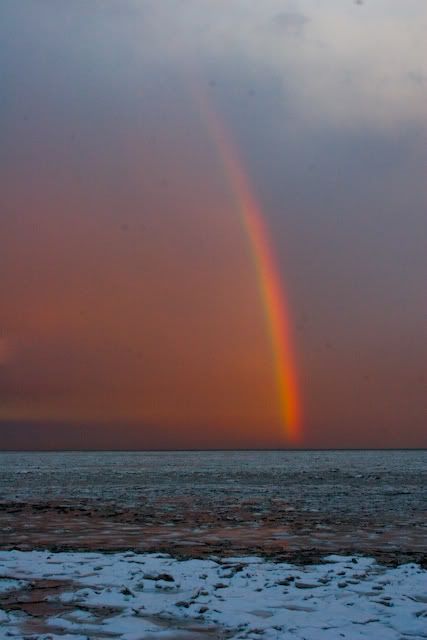 |
| Rainbow over Canada's icy St. Lawrence River near Petite-Riviere-Saint-Francois, Quebec. |
Beyond opening up potential for underwater resource extraction, a reduction in ice cover could also open up commercial navigation across the fabled Northwest Passage or other routes. This could reduce the cost of shipping goods across the globe, but could significantly increase marine traffic in the Arctic Ocean.
Arctic nations are gearing up for this possible future. For example, Canada has ordered new icebreakers and offshore patrol boats, and the head of the Royal Canadian Navy has recommended increasing military staffing in the region.
What will the future hold for the Arctic? Will perennial ice cover be significantly reduced within decades? If so, what will it mean for the environments, economies, and national security interests of countries in the Arctic region?
September 3, 2010 - Elwha dam removal; Northwest Passage
Friday, September 3, 2010
Hydroelectricity: I'm continuing to follow the removal of two dams on the Elwha River in Washington.
Here is a map I created showing the two dam sites.
Here is the Bureau of Reclamation's information on sedimentation behind the Elwha River dams: nearly 18 million cubic yards of sediment behind Glines Canyon Dam and Elwha Dam. The Bureau gives this history:
Meanwhile, in Maine, a graphic example of how business climate can make a difference: an entire lumber mill, closed for the past four years, is up for sale and might be moved piece by piece to Siberia. People often talk about how jobs move overseas; here, not only the (already lost) jobs but the workplace may move.
The situation on the Sebasticook River continues to brew after the Fort Halifax dam removal; now, town officials are considering a renewed investigation into erosion of the riverbanks after drawdown and dam breach.
An interesting bit of fisheries news: Native Americans from the Passamaquoddy Tribe continue to fish federal waters, despite being cited for lack of permits and certain mandatory safety gear during a scallop fishing trip off Nantucket. The natives point to their indigenous fishing rights.
Arctic news: I have a special interest in the Canadian Arctic, including the fabled Northwest Passage. Today comes news that a fuel tanker has run aground along that shipping route on a sandbar near Gjoa Haven.
Here is a map I created showing the two dam sites.
Here is the Bureau of Reclamation's information on sedimentation behind the Elwha River dams: nearly 18 million cubic yards of sediment behind Glines Canyon Dam and Elwha Dam. The Bureau gives this history:
Private companies constructed two large dams on the Elwha River during the early 1900’s. Elwha Dam, constructed during the period 1910-13, is a 105-foot high concrete gravity dam that forms Lake Aldwell 8 miles upstream from the river's mouth. Glines Canyon Dam, built in 1927, is a 210-foot high concrete arch dam that forms Lake Mills 13 miles upstream from the river's mouth. When the dams were first built, they were significant producers of electricity on the Olympic Peninsula. Today, the dams are operated in a run-of-the river mode and generate about 40 percent of the electricity needs for the Diashowa America paper mill in Port Angeles, Washington.The Bureau also has interesting information on erosion after drawdown. As we've seen before, drawdown can be done to minimize harms but can also cause serious problems if the newly exposed slopes of the impoundment or riverbank are unstable.
Meanwhile, in Maine, a graphic example of how business climate can make a difference: an entire lumber mill, closed for the past four years, is up for sale and might be moved piece by piece to Siberia. People often talk about how jobs move overseas; here, not only the (already lost) jobs but the workplace may move.
The situation on the Sebasticook River continues to brew after the Fort Halifax dam removal; now, town officials are considering a renewed investigation into erosion of the riverbanks after drawdown and dam breach.
An interesting bit of fisheries news: Native Americans from the Passamaquoddy Tribe continue to fish federal waters, despite being cited for lack of permits and certain mandatory safety gear during a scallop fishing trip off Nantucket. The natives point to their indigenous fishing rights.
Arctic news: I have a special interest in the Canadian Arctic, including the fabled Northwest Passage. Today comes news that a fuel tanker has run aground along that shipping route on a sandbar near Gjoa Haven.
July 26, 2010 - Energy department blogs; Senate energy bill
Monday, July 26, 2010
First, today's picture (from several days ago): the view from the Maine island of Islesford (Little Cranberry Island), across the town field:

Blogging is hot these days, so hot in fact that the U.S. Department of Energy has unveiled its own blog: "Energy Blog". (Perhaps a contest could be held to suggest a more distinctive name?)
Those of us looking for a Senate energy bill are expecting to see more details today. While it seems nearly certain that this draft won't include a renewable portfolio standard (or as federal types seem to prefer, a renewable energy standard), a broad coalition sent a letter to Senator Reid on Friday asking for a national renewable minimum standard (hosted at the American Wind Energy Association's blog). The letter was signed by diverse parties such as:
As the Senate has dropped its current consideration of a climate bill, Senator John Kerry has apparently predicted "an ice-free Arctic" in "five or 10 years."
Blogging is hot these days, so hot in fact that the U.S. Department of Energy has unveiled its own blog: "Energy Blog". (Perhaps a contest could be held to suggest a more distinctive name?)
Those of us looking for a Senate energy bill are expecting to see more details today. While it seems nearly certain that this draft won't include a renewable portfolio standard (or as federal types seem to prefer, a renewable energy standard), a broad coalition sent a letter to Senator Reid on Friday asking for a national renewable minimum standard (hosted at the American Wind Energy Association's blog). The letter was signed by diverse parties such as:
- labor representatives (Blue Green Alliance, United Steelworkers, Utility Workers Union of America)
- environmentalists (Environment America, League of Conservation Voters, Natural Resources Defense Council, Pew Environment Group)
- renewable energy groups (American Wind Energy Association, Biomass Power Association, Energy Recovery Council, National Hydropower Association, RES Alliance for Jobs), and
- utilities (AES Corporation, NextEra Energy Resources, Inc., Xcel Energy)
As the Senate has dropped its current consideration of a climate bill, Senator John Kerry has apparently predicted "an ice-free Arctic" in "five or 10 years."
Subscribe to:
Posts (Atom)
