Solar energy project developer Solar Trust of America filed for bankruptcy this Monday, delivering a setback to what would be the largest solar energy project in the U.S.: the proposed 1,000 megawatt Blythe solar project under construction in the California desert.
Last April, I noted that the U.S. Department of Energy offered a conditional loan guarantee commitment to Solar Trust of America, a joint venture of German companies Solar Millennium AG and
Ferrostaal Inc., for its solar energy project outside the
city of Blythe, California, near the Arizona border. DOE's conditional loan guarantee was offered to help finance the first two
units at Blythe, which were originally planned to use parabolic trough mirrors to concentrate
solar energy to boil water in a closed loop. The resulting steam would
spin turbine-generator sets to generate electricity.
In August 2011, as photovoltaic cell prices fell, project partner Solar Millenium announced plans to convert the first 500 MW phase of the Blythe project to solar photovoltaics. Photovoltaic technology appeared lower cost and more proven than the relatively complex solar thermal steam turbine generation originally conceived of for the project. However, this shift in project design meant that the Blythe project could no longer take advantage of the federal loan guarantee.
Now, Solar Trust of America has filed for bankruptcy. In its Chapter 11 filing, Solar Trust notes that its operations relied on funding from parent Solar Millenium - which filed for bankruptcy in December 2011, cutting off operating funds to Solar Trust. Likewise, negotiations to sell the company and its projects failed when the prospective buyer, German firm solarhybrid, also went bankrupt.
What does the future hold for the Blythe project? Along with the nearby Palen project (a two-phase, 500 MW solar thermal development, the Blythe project is Solar Trust's largest asset. Whether Solar Trust or some successor picks up the pieces and moves forward remains to be seen, but presumably the investment to date in the Blythe project still retains significant value.

Energy powers society; society's choices shape energy policy. A blog about our energy resources and the choices they present for society.
Showing posts with label solar PV. Show all posts
Showing posts with label solar PV. Show all posts

Net metering and utility charges
Thursday, March 29, 2012
As more electricity customers are installing solar panels and other distributed generation, many are participating in net metering programs under which they can run their utility meter backwards -- but utilities are complaining that net metering customers don't pay their share of the grid's operating costs.
In states and utility territories where net metering is allowed, customers can use eligible distributed generation (typically renewable generation like solar photovoltaic or small-scale wind, or micro combined heat and power) to offset their consumption of electricity from the grid. Even if the customer draws power from the grid at some times and injects power back onto the grid at other times, net metering or net energy billing allows the customer to offset distributed generation against purchases.
While many states embrace net metering as a policy, some utilities complain that net metering customers can be free riders. If a customer's solar panels produce as much power in a month as the customer consumed, net metering could credit that customer with a zero utility bill - even though at various times times, the customer relied on the grid for imports and exports. As a result, some utilities are seeking to impose new charges on customers for net metering. For example, last fall Virginia regulators approved part of utility Dominion's request to impose "standby" charges on certain net metering customers. Solar advocates and other distributed generation interests typically oppose such charges as roadblocks to achieving the societal benefits of net metering.
The issue continues to simmer around the country. California utility San Diego Gas & Electric Co. recently proposed adding a "network use charge" onto customers' bills. SDG&E's concept was that the charge -- about $22 per month for the average net metering customer with a solar PV system -- would properly allocate the cost of maintaining the grid to these customers. The utility argued that without the charge, net energy metering customers were being subsidized by all other customers. Earlier this year, California regulators rejected the idea (see the 16-page order at the California Public Utilities Commission website), noting concerns that the proposed charge "may be inconsistent with current law, regardless of whether it is justified by cost causation principles or an analysis of the crosssubsidies inherent in current policies." As a result, SDG&E refiled its rate application without the charge.
In states and utility territories where net metering is allowed, customers can use eligible distributed generation (typically renewable generation like solar photovoltaic or small-scale wind, or micro combined heat and power) to offset their consumption of electricity from the grid. Even if the customer draws power from the grid at some times and injects power back onto the grid at other times, net metering or net energy billing allows the customer to offset distributed generation against purchases.
While many states embrace net metering as a policy, some utilities complain that net metering customers can be free riders. If a customer's solar panels produce as much power in a month as the customer consumed, net metering could credit that customer with a zero utility bill - even though at various times times, the customer relied on the grid for imports and exports. As a result, some utilities are seeking to impose new charges on customers for net metering. For example, last fall Virginia regulators approved part of utility Dominion's request to impose "standby" charges on certain net metering customers. Solar advocates and other distributed generation interests typically oppose such charges as roadblocks to achieving the societal benefits of net metering.
The issue continues to simmer around the country. California utility San Diego Gas & Electric Co. recently proposed adding a "network use charge" onto customers' bills. SDG&E's concept was that the charge -- about $22 per month for the average net metering customer with a solar PV system -- would properly allocate the cost of maintaining the grid to these customers. The utility argued that without the charge, net energy metering customers were being subsidized by all other customers. Earlier this year, California regulators rejected the idea (see the 16-page order at the California Public Utilities Commission website), noting concerns that the proposed charge "may be inconsistent with current law, regardless of whether it is justified by cost causation principles or an analysis of the crosssubsidies inherent in current policies." As a result, SDG&E refiled its rate application without the charge.
Park and forest service renewable energy
Tuesday, January 10, 2012
Managers of national and state parks and forests are considering whether they can cut their energy bill by developing distributed generation projects. In many cases, distributed generation such as solar photovoltaic systems can be a good match for powering facilities like park headquarters, campgrounds, and maintenance buildings. This can be especially true for places that are off the main electric grid, such as pockets of development within preserved lands. It can also be true for grid-tied facilities, as incentives like net metering can make rooftop solar or other projects cost-effective for the end user.
Whether developed by a national park or state forest, connecting renewable generation to the grid involves working with the local electric utility. In many parts of the country, interconnecting with the utility can be a challenging process. Utilities typically must study whether the proposed generation can work with the existing set of transmission and distribution wires, and may get into disputes with customers over whether and how much upgrading is needed. Some utilities claim to be swamped with interconnection requests, and are missing deadlines for studying system impacts and cooperating with customers.
In California, a different set of difficulties is preventing millions of dollars of renewable energy projects on federal land from connecting to the grid. In response to economic incentives favoring distributed generation, the National Park Service and U.S. Forest Service have developed major new renewable projects at a variety of sites in California. For example, the Park Service developed an $800,000 solar project at Death Valley National Park, anticipated to cut 70% off the visitor center's annual electric bill of about $45,724. The Forest Service developed a large solar project at its Mono Lake facilities, along with other projects at existing sites. However, the federal agencies have been unable to sign interconnection agreements with utility Southern California Edison, meaning the parks' renewable projects remain idle despite federal policy supporting sustainable operations.
At issue is a provision of federal law that prevents agencies from signing contracts exposing them to the risk of unknown future damages because such contracts would commit money outside the congressional budgeting process. Federal agencies have been able to work around this restriction with other utilities, as evidenced by Yosemite National Park's successful interconnection of its $5.8 million solar photovoltaic project with the Pacific Gas & Electric grid. Southern California Edison appears to be a holdout.
Will 2012 see a continuation of the trend toward replacing diesel electric generation in parks and national forests with alternative resources?
 |
| Solar photovoltaic panels power the campground at Goblin Valley State Park, Utah. |
Whether developed by a national park or state forest, connecting renewable generation to the grid involves working with the local electric utility. In many parts of the country, interconnecting with the utility can be a challenging process. Utilities typically must study whether the proposed generation can work with the existing set of transmission and distribution wires, and may get into disputes with customers over whether and how much upgrading is needed. Some utilities claim to be swamped with interconnection requests, and are missing deadlines for studying system impacts and cooperating with customers.
In California, a different set of difficulties is preventing millions of dollars of renewable energy projects on federal land from connecting to the grid. In response to economic incentives favoring distributed generation, the National Park Service and U.S. Forest Service have developed major new renewable projects at a variety of sites in California. For example, the Park Service developed an $800,000 solar project at Death Valley National Park, anticipated to cut 70% off the visitor center's annual electric bill of about $45,724. The Forest Service developed a large solar project at its Mono Lake facilities, along with other projects at existing sites. However, the federal agencies have been unable to sign interconnection agreements with utility Southern California Edison, meaning the parks' renewable projects remain idle despite federal policy supporting sustainable operations.
At issue is a provision of federal law that prevents agencies from signing contracts exposing them to the risk of unknown future damages because such contracts would commit money outside the congressional budgeting process. Federal agencies have been able to work around this restriction with other utilities, as evidenced by Yosemite National Park's successful interconnection of its $5.8 million solar photovoltaic project with the Pacific Gas & Electric grid. Southern California Edison appears to be a holdout.
Will 2012 see a continuation of the trend toward replacing diesel electric generation in parks and national forests with alternative resources?
National park energy use and strategies
Friday, December 9, 2011
Small-scale alternative energy resources play an increasing role in how the U.S. National Park Service manages its lands, budget, and energy usage.
The United States National Park Service manages about 84.4 million acres of land in the form of national parks, national monuments, and other historic and conservation properties. While much of the Park Service's holdings are preserved as undeveloped backcountry properties, the NPS provides visitor amenities like lodging, food and other concession services.
The remote locations of many Park Service sites make traditional energy resources expensive and challenging. Ranger stations and campground bathrooms may be located far from the traditional utility electric grid. Diesel generators can be used if road access to the site is possible, but have drawbacks: fuel is expensive, and generators can be loud, produce emissions, and may be out of character for a particular national park site.
In some cases, the Park Service is turning away from traditional energy resources to alternative and distributed energy resources like solar power. In fact, the Park Service has deployed distributed solar photovoltaic generation for over a decade.
Consider the example of Devil's Garden Campground in Arches National Park in Utah. While the campground is relatively remote (located at the end of a 30-mile dead-end road inside the park), Park Service facilities in the campground need electricity. These facilities include two campground hosts, three bathrooms, an amphitheater and a ranger station.
Historically, electricity for the campground facilities came from on-site diesel generators. These units ran 24 hours a day, consuming over 6,400 gallons of fuel per year. Producing electricity from diesel is seldom cost-competitive today; generating electricity from diesel at Devil's Garden Campground cost the National Park Service over $22,400 per year. This meant that the Park Service was generating electricity for a price of 28 cents per kilowatt-hour (kWh), about four times higher than the current average Utah price.
(As expensive as this is, it's still about a third of the cost of diesel-generated electricity on the remote Maine island of Monhegan. In 2010, electricity on Monhegan cost an average of 74.51 cents per kWh.)
As early as 1995, the Park Service joined with the state of Utah to develop four photovoltaic/diesel hybrid systems at Devil's Garden Campground. Each system is composed of a 1.4 kilowatt (kW) tracking array, a 4 kW inverter and a 40 kWh battery bank. Diesel units remain on-site and ready, but now run less than 4 hours per day. This cut the Park Service's annual operation and maintenance costs for the diesel generators from $22,400 to $10,000. The project dramatically reduced the noise level in the campground, and significantly cut the diesels' emissions of carbon dioxide, carbon monoxide, nitrogen oxides, and sulfur oxides.
As this example shows, sites that are already off the grid can be good candidates for small-scale distributed generation projects relying on alternative technologies like solar. Depending on project economics and other objectives (like the Park Service's sustainability initiative, improving noise levels and air quality, or education), replacing diesel with renewable energy -- and making energy efficiency improvements -- can make sense.
Other units in the National Park Service system are following the Arches example by turning to distributed renewable energy and energy efficiency. In 2011, Yosemite National Park installed a 672 kilowatt grid-tied solar array. The $5.8 million Yosemite project is bigger in scale (the Park Service's largest solar energy project) and is tied to the utility electric grid, but represents a similar strategy to that used in Arches and throughout the Park Service.
 |
| Solar panels line the roof of the comfort station at Devil's Garden Campground in Arches National Park, Utah. |
The United States National Park Service manages about 84.4 million acres of land in the form of national parks, national monuments, and other historic and conservation properties. While much of the Park Service's holdings are preserved as undeveloped backcountry properties, the NPS provides visitor amenities like lodging, food and other concession services.
The remote locations of many Park Service sites make traditional energy resources expensive and challenging. Ranger stations and campground bathrooms may be located far from the traditional utility electric grid. Diesel generators can be used if road access to the site is possible, but have drawbacks: fuel is expensive, and generators can be loud, produce emissions, and may be out of character for a particular national park site.
In some cases, the Park Service is turning away from traditional energy resources to alternative and distributed energy resources like solar power. In fact, the Park Service has deployed distributed solar photovoltaic generation for over a decade.
Consider the example of Devil's Garden Campground in Arches National Park in Utah. While the campground is relatively remote (located at the end of a 30-mile dead-end road inside the park), Park Service facilities in the campground need electricity. These facilities include two campground hosts, three bathrooms, an amphitheater and a ranger station.
Historically, electricity for the campground facilities came from on-site diesel generators. These units ran 24 hours a day, consuming over 6,400 gallons of fuel per year. Producing electricity from diesel is seldom cost-competitive today; generating electricity from diesel at Devil's Garden Campground cost the National Park Service over $22,400 per year. This meant that the Park Service was generating electricity for a price of 28 cents per kilowatt-hour (kWh), about four times higher than the current average Utah price.
(As expensive as this is, it's still about a third of the cost of diesel-generated electricity on the remote Maine island of Monhegan. In 2010, electricity on Monhegan cost an average of 74.51 cents per kWh.)
As early as 1995, the Park Service joined with the state of Utah to develop four photovoltaic/diesel hybrid systems at Devil's Garden Campground. Each system is composed of a 1.4 kilowatt (kW) tracking array, a 4 kW inverter and a 40 kWh battery bank. Diesel units remain on-site and ready, but now run less than 4 hours per day. This cut the Park Service's annual operation and maintenance costs for the diesel generators from $22,400 to $10,000. The project dramatically reduced the noise level in the campground, and significantly cut the diesels' emissions of carbon dioxide, carbon monoxide, nitrogen oxides, and sulfur oxides.
As this example shows, sites that are already off the grid can be good candidates for small-scale distributed generation projects relying on alternative technologies like solar. Depending on project economics and other objectives (like the Park Service's sustainability initiative, improving noise levels and air quality, or education), replacing diesel with renewable energy -- and making energy efficiency improvements -- can make sense.
Other units in the National Park Service system are following the Arches example by turning to distributed renewable energy and energy efficiency. In 2011, Yosemite National Park installed a 672 kilowatt grid-tied solar array. The $5.8 million Yosemite project is bigger in scale (the Park Service's largest solar energy project) and is tied to the utility electric grid, but represents a similar strategy to that used in Arches and throughout the Park Service.
Virginia considers net metering and utility standby charges
Tuesday, November 8, 2011
Virginia, like many states, allows grid-connected electricity customers to use customer-sited generation to offset its electric bill. This practice is called net metering.
Virginia regulators are now considering a proposal by utility Dominion Virginia Power to impose two “standby” charges on net-metered solar photovoltaic systems larger than 10 kW. The policy questions raised by this case appear in other contexts where incentives for clean, distributed generation run up against utility ratemaking considerations. Utilities typically argue that they need to allocate costs fairly among their customers, while customer-sited generation advocates point to both the value of distributed generation and the array of incentives promoting customer-sited generation.
Virginia regulators are now considering a proposal by utility Dominion Virginia Power to impose two “standby” charges on net-metered solar photovoltaic systems larger than 10 kW. The policy questions raised by this case appear in other contexts where incentives for clean, distributed generation run up against utility ratemaking considerations. Utilities typically argue that they need to allocate costs fairly among their customers, while customer-sited generation advocates point to both the value of distributed generation and the array of incentives promoting customer-sited generation.
In June 2011, the Virginia legislature enacted House Bill 1983, directing Dominion to allow residential customers to net meter solar photovoltaicsystems between 10 kW and 20 kW. Dominion
responded by petitioning the Virginia State Corporation Commission (SCC) for approval
of tariff changes that it argued are necessary to reflect its
actual costs in supporting these customers’ peak loads. The utility proposed
to add monthly standby charges for transmission and distribution service based
on each net-metered customer’s highest 30-minute demand.
Utilities often argue that their fixed costs
in serving net-metering customers – maintaining wires, transformers, and other
infrastructure – are the same as if the customers had no generation. If a customer can be self-sufficient most of
the time, the utility grid must still be of a sufficient size to deliver the
customers’ peak demand when it is needed, such as when customer-sited generation fails. Dominion requested approval of its standby
charges to ensure fair cost allocation among customers.
Distributed generation advocates, on the other hand, argue
that the standby charges would result in overcharging net-metered
customers. In Dominion's case, a witness for the Maryland,
District of Columbia and Virginia Solar Energy Industries Association testified the
standby charge would result in higher charges for a net-metered customer than a
regular customer consuming the same amount of grid-purchased electricity. The witness also testified that net-metering
customers should receive credits for generating cost-effective energy, and for reducing the utility’s
transmission line losses. Diverse distributed
generation may also reduce utilities’ distribution costs. The solar association argued that Dominion's standby charges ignored these benefits, and would chill distributed solar development in spite of Virginia's net-metering policy.
The Virginia State Corporation Commission held a hearing on
Dominion's request last week, and is expected to issue an order resolving the matter.
Demand response, customer-provided grid support
Friday, August 26, 2011
This summer, the electric grid has largely weathered the increased demand for power during heat waves. Grid operators have a variety of tools to ensure sufficient energy supply to meet peak demands. In recent years, the smart-grid star in the grid's toolkit has been demand response: programs that allow customers to respond to signals about the scarcity of electricity by temporarily reducing their consumption from the grid. This summer, customer-provided demand response has not only kept the lights on, but has also reduced society’s energy costs by reducing the need for the most expensive marginal peaking generation units.
Last March, the Federal Energy Regulatory Commission issued a landmark ruling that demand response should be compensated fairly. In this ruling – Order No. 745 – FERC held that demand resources should be paid at market-based prices when two criteria are met: capability and cost-effectiveness. When demand resources can displace the need for bringing additional generation online, and when doing so lowers our grid costs, Order No. 745 requires organized wholesale energy market operators to pay demand response resources for the full value they provide to the grid.
Now, some regional grid operators are proposing major changes to their demand response programs. While some of these changes are designed to comply with Order No. 745, other changes seek to place new limits on who can participate in demand response. For example, northeastern grid operator ISO New England has asked FERC to approve its proposal to eliminate the demand response value provided by consumers capable of using existing on-site generation to produce power to support the grid during times of crisis.
Decades of federal and state policy have supported investment in distributed generation projects, ranging from micro-combined heat and power (micro-CHP) and cogeneration to small and medium-sized wind, rooftop solar photovoltaic systems and even fuel cells. Distributed generation has a strong history of policy support, but if FERC accepts ISO New England’s proposal to limit behind-the-meter generation’s ability to provide demand response, the region will need other resources to keep the lights on during times of peak demand – new generating units, transmission lines, and substations.
FERC has docketed ISO New England’s request as Docket No. ER11-4336-000, and is accepting public comment through 5:00 pm Eastern time on Friday, September 09, 2011.
FERC has docketed ISO New England’s request as Docket No. ER11-4336-000, and is accepting public comment through 5:00 pm Eastern time on Friday, September 09, 2011.
Blythe shifts from concentrating solar to PV
Tuesday, August 23, 2011
One of the world's largest solar projects may partially shift from concentrating solar thermal to photovoltaic technology. If it happens, this technological shift demonstrates how different technologies compete for market share even within a given project.
Over the past year, I've written several times about the Blythe solar energy project under development in California. Proposed by Solar Trust of America, a joint venture between German developers Solar Millenium AG and Ferrostaal AG, the full-scale project could add about 1,000 megawatts of new solar capacity to the regional grid -- about as much capacity as a nuclear plant, although less capable of producing that full value around the clock. As originally proposed, the Blythe project would rely on mirrors to concentrate the sun's rays to heat water, making steam to run turbine generators.
Solar Millenium has now announced plans to convert the first 500 MW phase of the Blythe project to solar photovoltaics. With this decision, the Blythe project is now on track to follow nearly 1,850 MW more California solar capacity changing from solar thermal to solar PV in just the last year. Observers note that this shift is spurred in part by lower photovoltaic costs as a result of greater market penetration, with solar panel elements falling nearly 50% in cost in recent months.
The Blythe developers have not yet selected a PV panel manufacturer, nor have they specified the technology for a second 500 MW phase of the project.
Over the past year, I've written several times about the Blythe solar energy project under development in California. Proposed by Solar Trust of America, a joint venture between German developers Solar Millenium AG and Ferrostaal AG, the full-scale project could add about 1,000 megawatts of new solar capacity to the regional grid -- about as much capacity as a nuclear plant, although less capable of producing that full value around the clock. As originally proposed, the Blythe project would rely on mirrors to concentrate the sun's rays to heat water, making steam to run turbine generators.
Solar Millenium has now announced plans to convert the first 500 MW phase of the Blythe project to solar photovoltaics. With this decision, the Blythe project is now on track to follow nearly 1,850 MW more California solar capacity changing from solar thermal to solar PV in just the last year. Observers note that this shift is spurred in part by lower photovoltaic costs as a result of greater market penetration, with solar panel elements falling nearly 50% in cost in recent months.
The Blythe developers have not yet selected a PV panel manufacturer, nor have they specified the technology for a second 500 MW phase of the project.
August 15, 2011 - Canadian utility versus distributed solar
Monday, August 15, 2011
State and provincial governments are implementing programs designed to promote the growth of small-scale distributed renewable energy projects like solar photovoltaic installations. For these programs to succeed, new distributed energy projects need to be able to interconnect into the existing utility grid on a fair and predictable timeline. For this reason, feed-in tariff and other distributed generation programs must work hand-in-hand with utility tariffs requiring fair interconnection access – but some solar and renewable industry groups are concerned that utilities may not be honoring these obligations.
 |
| A small solar array serving the Utah Communications Agency Network radio system atop Beaver Mountain, UT. |
Consider the example of the Canadian province of Ontario. The Ontario Power Authority – the entity charged with ensuring an adequate, long-term supply of electricity in Ontario – offers feed-in tariff programs for qualified generation. Ontario’s “micro-FIT” program gives developers of small renewable power projects – 10 kW or less – long-term contracts to sell the projects’ output at a fixed price. For rooftop solar projects, these contracts pay 80.2 ¢ per kWh for a 20-year term – about ten times the most recent regulated retail electricity price in Ontario.
As anticipated, this program has drawn interest from thousands of developers of small generating units – perhaps as many as 25,000 by earlier this year. Each of these projects is entitled to interconnect to the electric grid in a timely fashion, but doing so requires the local utility to evaluate the technical and engineering aspects of the interconnection to ensure safety and system reliability. For example, a utility must formally offer to interconnect with a project within 15 days if it is at an existing interconnection point, with actual interconnection to be completed within 5 days after the utility receives its customer’s payment and signed agreement.
Some utilities are having trouble complying with this schedule. In a case currently pending before Ontario’s energy regulator, one utility has asked for a waiver of the interconnection timeline. Hydro One Networks Inc.’s April 2011 petition to the Ontario Energy Board, docketed as case EB-2011-118, notes that it was in non-compliance on an estimated 442 interconnection applications based on the utility’s failure to meet tariffed deadlines. As a result, the utility asked to be relieved of its scheduling commitments for six months.
Businesses, homeowners, and the solar installation industry have objected to this request, pointing out that they have already suffered great harm as a result of the utility’s failure to meet its interconnection timing deadlines. Evidence submitted in the case suggests millions of dollars in lost revenue, layoffs, and business closures as a direct result of the utility’s missed deadlines.
The Ontario Energy Board conducted hearings on the utility’s waiver request, but has not yet issued a ruling. When it does, it may affect not only people interested in solar energy development but moreover the balance between traditional centralized utility organization and Ontario’s pro-distributed generation feed-in tariff policy.
July 28, 2011 - Vermont's largest solar array compared to California's
Thursday, July 28, 2011
Solar energy projects come in a variety of shapes and sizes: photovoltaic (PV) or thermal, large or small. A look at Vermont's new largest solar project, and how it compares to the largest solar project in the US under development in California, highlights the range of solar power projects.
Yesterday, Vermont Governor Peter Shumlin officially activated a 2.2-megawatt solar photovoltaic system in South Burlington, Vermont. Located on a 25 acre site amidst farmland on the fringes of Burlington's metro area, the $12 million project owned by Chittenden County Solar Partners is projected to produce 2.91 million kWh annually. This output will be sold to Vermont's Sustainably Priced Energy Development (SPEED) Program under a 25-year power purchase agreement. This PPA, made possible by Vermont's standard offer law, lets sell the solar project sell its output to Vermont utilities at a guaranteed price set by state regulators: in this case, 30 cents per kilowatt-hour. This is about twice the average retail price for all electricity sold to residential users in Vermont. Developers note that long-term contracts with guaranteed pricing are often necessary in order to finance projects. While the Vermont Public Service Board has since lowered the standard offer to 24 cents, the South Burlington project's contract guarantees it the contract price.
Meanwhile, the largest solar project under construction may be the Blythe Solar Power Project in Southern California. When the project is complete at 968 MW, this solar thermal power station will dward the scale of a distributed photovoltaic project like AllEarth's in Vermont.
What these two projects have in common is that they will both operate by capturing usable energy from the sun. Both are new, meaning there are jobs involved in designing, constructing, and operating them. Both can be expected to displace fossil fuel-fired generation, and qualify as renewable under federal and state policy.
The differences are perhaps more striking. The Blythe project is a massive centralized project, while one of the key features of the Vermont project is its distributed nature. Not only can distributed generation projects avoid the need to build new large transmission lines just to get the project's power to market -- a significant issue for centralized projects like those in California -- but distributed generation can even enhance the strength of the existing grid by shoring up voltages and reducing line losses. Combined with the different technologies involved and the different overall project scales, these two solar energy projects illustrate the broad range of projects falling under the solar power umbrella.
June 6, 2011 - concentrating solar
Monday, June 6, 2011
Today, a quick look at concentrating solar power technology and its potential to power business and society.
When most people think about solar power, they picture solar photovoltaic panels: rectangular panels composed of a grid of individual solar PV cells, mounted perhaps on a building's roof or a nearby stand. Photovoltaic cells convert solar energy into electricity, which flows through wires to power electric equipment.
Some people might also think of solar hot water panels, which function somewhat like a greenhouse and use solar energy to heat water circulating through a series of pipes or hoses. The hot water can then be used for domestic hot water (perhaps after a secondary heating in a more traditional water heater) or for space heating.
Spread around houses or commercial buildings, these two solar energy conversion technologies - solar photovoltaics and solar thermal - have significant potential as distributed energy resources.
At the utility scale, it can be more cost-effective to concentrate the Sun's rays before converting the energy into a usable form, particularly if electricity is the desired end product. In a concentrating solar application, a series of mirrors -- an array of either flat panels or trough-shaped parabolic mirrors -- can be used to concentrate the solar energy from a large surface area of the ground onto a relatively small area. Concentrating solar technology works for both photovoltaics and for thermal systems. In fact, given the larger amount of solar energy that is brought to bear through concentration, solar energy can be used to evaporate water into steam directly. Concentrated solar energy can also be used to heat another medium, like molten sodium, which can in turn be used to evaporate water into steam. The resulting steam can be used to spin turbine and generator sets to produce electricity.
Not all sites are well suited for concentrating solar, and today's technology continues to be refined through research and development. The coming years may show whether photovoltaics or thermal installations prove more cost-effective. For now, the race is on.
When most people think about solar power, they picture solar photovoltaic panels: rectangular panels composed of a grid of individual solar PV cells, mounted perhaps on a building's roof or a nearby stand. Photovoltaic cells convert solar energy into electricity, which flows through wires to power electric equipment.
Some people might also think of solar hot water panels, which function somewhat like a greenhouse and use solar energy to heat water circulating through a series of pipes or hoses. The hot water can then be used for domestic hot water (perhaps after a secondary heating in a more traditional water heater) or for space heating.
Spread around houses or commercial buildings, these two solar energy conversion technologies - solar photovoltaics and solar thermal - have significant potential as distributed energy resources.
At the utility scale, it can be more cost-effective to concentrate the Sun's rays before converting the energy into a usable form, particularly if electricity is the desired end product. In a concentrating solar application, a series of mirrors -- an array of either flat panels or trough-shaped parabolic mirrors -- can be used to concentrate the solar energy from a large surface area of the ground onto a relatively small area. Concentrating solar technology works for both photovoltaics and for thermal systems. In fact, given the larger amount of solar energy that is brought to bear through concentration, solar energy can be used to evaporate water into steam directly. Concentrated solar energy can also be used to heat another medium, like molten sodium, which can in turn be used to evaporate water into steam. The resulting steam can be used to spin turbine and generator sets to produce electricity.
Not all sites are well suited for concentrating solar, and today's technology continues to be refined through research and development. The coming years may show whether photovoltaics or thermal installations prove more cost-effective. For now, the race is on.
April 26, 2011 - Ivanpah solar deals with tortoise impacts
Tuesday, April 26, 2011
Two weeks ago, I noted Google's investment in the 392 MW Ivanpah solar project in California's Mojave Desert, and how it benefited from $1.6 billion in Department of Energy loan guarantees. Developer BrightSource Energy started construction on Phase I of the Ivanpah project in October 2010, with two subsequent phases slated for development shortly thereafter. BrightSource's business plan also includes an initial public offering, which led the company to file an S-1 securities registration with the U.S. Securities and Exchange Commission.
The Ivanpah project has now hit a speedbump in the form of a tortoise. The desert tortoise (Gopherus agassizii) lives in the Mojave desert, including in the area where the Ivanpah project is proposed. As a result, BrightSource has apparently stopped work on the construction of Ivanpah's second and third phases.
BrightSource noted in its S-1 filing that "in April 2011, the U.S. Bureau of Land Management, or BLM, advised us that it will require the issuance of a revised biological opinion by the U.S. Fish & Wildlife Service, or FWS, prior to providing permission to proceed with the construction of Ivanpah’s second and third phases".
The Fish and Wildlife Service is reportedly developing that opinion now, which should be finalized over the summer.
|
| Solar photovoltaic panels above Beaver Mountain ski area near Logan, Utah. |
BrightSource noted in its S-1 filing that "in April 2011, the U.S. Bureau of Land Management, or BLM, advised us that it will require the issuance of a revised biological opinion by the U.S. Fish & Wildlife Service, or FWS, prior to providing permission to proceed with the construction of Ivanpah’s second and third phases".
The Fish and Wildlife Service is reportedly developing that opinion now, which should be finalized over the summer.
April 19, 2011 - 400 MW solar project proposed in California
Monday, April 18, 2011
Last week I noted Google's investment in the 392 megawatt Ivanpah solar project in California. That project, which is currently under construction in the Mojave Desert, is on track to be the world's largest solar thermal project. Ivanpah uses heliostat mirrors to focus sunlight on centrally located solar power towers. The towers use the solar energy to generate steam. The steam runs through steam turbines and a generator to produce electricity.
Now an even larger solar project has been proposed for California -- this time solar photovoltaic. Developer Pegasus Energy has proposed a 400 MW solar PV power plant on about 2,000 acres in Alameda County California. The Mountain House Solar Farm would sell power to local utility PG&E, and might break ground in early 2013.
As we often see, the twin challenges of financing and regulatory uncertainty team up to add a wrinkle to these plans. The developer has built a financing model based on using an incentive authorized by the American Recovery and Reinvestment Act: a cash grant in lieu of the federal 30% business energy investment tax credit (ITC). That incentive program, known as the 1603 grant program, is currently slated to end this year. The developer is reportedly hopeful that grant funds will be extended until January 1, 2013, and would be available to help finance the project. This may be a realistic hope, as the 1603 program has already been extended once (by Section 707 of the Tax Relief, Unemployment Insurance Reauthorization and Job Creation Act of 2010), so renewal is possible. On the other hand, recent struggles over the federal budget do call into question the continued survival of any given clean energy incentive programs. Will Congress renew the 1603 energy grant program?
 |
| "Turn your grocery bags into green energy" - seen at a Vermont market |
As we often see, the twin challenges of financing and regulatory uncertainty team up to add a wrinkle to these plans. The developer has built a financing model based on using an incentive authorized by the American Recovery and Reinvestment Act: a cash grant in lieu of the federal 30% business energy investment tax credit (ITC). That incentive program, known as the 1603 grant program, is currently slated to end this year. The developer is reportedly hopeful that grant funds will be extended until January 1, 2013, and would be available to help finance the project. This may be a realistic hope, as the 1603 program has already been extended once (by Section 707 of the Tax Relief, Unemployment Insurance Reauthorization and Job Creation Act of 2010), so renewal is possible. On the other hand, recent struggles over the federal budget do call into question the continued survival of any given clean energy incentive programs. Will Congress renew the 1603 energy grant program?
March 1, 2011 - solar ships
Tuesday, March 1, 2011
For millennia, humans have used renewable energy to propel ships over the oceans. The winds that have filled the sails of hundreds of generations' most technologically advanced vessels gained their power from the Sun's radiation shining on land and sea, creating temperature differentials that in turn caused the winds to blow. Archaeological evidence suggests that the first sailboats may have been used by the Egyptians over 6,000 years ago. Sail technology may have arisen in multiple separate regions of the world over time, but whoever was responsible for the first sailboats clearly started something big: harnessing renewable energy to move people and cargo over the water.
Sailcraft still ply the world's waters of course, though the development of commercially-viable steam engines in the 18th century significantly changed the course of ship design and technology. Naval engineers and marine architects continue to make advances in sailcraft design, using new materials and new design tools to create faster and more efficient vessels. At the same time, a new kind of renewable propulsion system is arising: solar-powered ships.
As you read this, the 100-foot MS Turanor PlanetSolar has crossed the Atlantic, traversed the Panama Canal, and is well under way across the Pacific in its bid to be the first solar-powered vessel to circumnavigate the globe. Constructed by Knierim Yacht Club, in Kiel, Germany, the PlanetSolar uses 537 m2 of solar PV panels to generate up to 93.5 kW of power - about 125 hp. The solar PV panels have an efficiency of 18.8%, and are linked to six 388-volt lithium ion batteries with an aggregate storage capacity of 2910 amp-hours (Ah). (Compare the current Toyota Prius hybrid drive battery, which has a nominal capacity of 6 Ah.)
 |
| Photo: winter in Northeast Harbor, Mount Desert Island, Maine. |
As you read this, the 100-foot MS Turanor PlanetSolar has crossed the Atlantic, traversed the Panama Canal, and is well under way across the Pacific in its bid to be the first solar-powered vessel to circumnavigate the globe. Constructed by Knierim Yacht Club, in Kiel, Germany, the PlanetSolar uses 537 m2 of solar PV panels to generate up to 93.5 kW of power - about 125 hp. The solar PV panels have an efficiency of 18.8%, and are linked to six 388-volt lithium ion batteries with an aggregate storage capacity of 2910 amp-hours (Ah). (Compare the current Toyota Prius hybrid drive battery, which has a nominal capacity of 6 Ah.)
December 16, 2010 - a tale of two solar projects
Thursday, December 16, 2010
Let's celebrate a milestone: I've now been blogging here for over a year.
 |
| Florida solar? Setting sun over the Everglades. |
First, South Carolina utility Santee Cooper is building that state's largest solar array. Santee Cooper's $1.3 million Grand Strand Solar Station project is under development in Myrtle Beach. The utility is installing 1,300 solar photovoltaic panels on the roof and surrounding grounds of a warehouse it owns there. In total, the project is expected to produce a peak of 311 kW under optimal conditions. Adding this 311 kW will increase South Carolina's solar PV power production by 50%.
August 18, 2010 - quick update
Wednesday, August 18, 2010
Quick update today. In Massachusetts, candidates for governor are debating the merits of offshore wind including the Cape Wind project.
President Obama declares his clean energy policy will create 800,000 jobs by 2012.
Wildly large numbers coming out of an Ontario, Canada feed-in tariff:
President Obama declares his clean energy policy will create 800,000 jobs by 2012.
Wildly large numbers coming out of an Ontario, Canada feed-in tariff:
August 16, 2010 - renewable energy standards and goals
Monday, August 16, 2010
NPR has an interesting set of graphics today illustrating the diversity of U.S. states' policies on renewable energy. As we saw last month, the U.S. does not have a federal-level renewable energy standard, or even a specific goal for renewable development defined in terms of capacity (megawatts, or more realistically gigawatts).
The first factory built-to-order solar-powered integrated electric-vehicle charging station has been unveiled in Korea: the SunPods SP-300. The unit, also known as the "EV Plug-N-Go", was first displayed at International Green Energy Expo Korea 2010 in Deagu, South Korea.
The first factory built-to-order solar-powered integrated electric-vehicle charging station has been unveiled in Korea: the SunPods SP-300. The unit, also known as the "EV Plug-N-Go", was first displayed at International Green Energy Expo Korea 2010 in Deagu, South Korea.
August 13, 2010 - Martha's Vineyard solar power; China
Friday, August 13, 2010
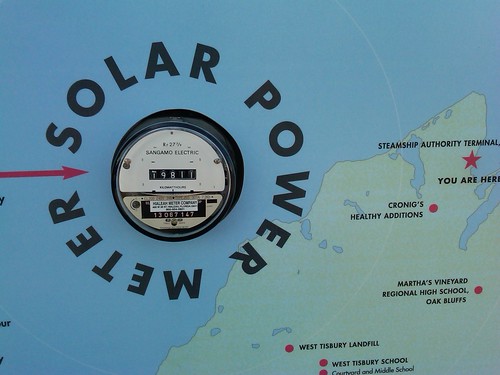
First, a solar power meter installed at the docks in Vineyard Haven on the island of Martha's Vineyard, Massachusetts. Martha's Vineyard is home to a variety of innovative energy solutions designed to stabilize and lower rates, strengthen reliability and security, and reduce air emissions.
China's energy footprint continues to make news. In July, a report by the International Energy Agency (IEA) said that in 2009, China was the world's largest energy consumer. According to the IEA, in 2009, China consumed 2.25 billion tons of oil equivalent in 2009. (Compare the U.S. at 2.17 billion tons -- close, but a lower number.) China subsequently ordered over 2,000 industrial facilities to close over their energy consumption. Now, China is refuting the IEA study's results. Chinese statistical agencies now point to a 2009 energy consumption in China of 2.15 billion tons, arguably due to differences in how consumption is estimated. Whatever China's total energy footprint is, China's large population means that China's energy intensity -- measured in energy consumed per capita -- is roughly 20% of that of the U.S.
The World Meteorological Organization is publicly linking flooding in places like China, Pakistan, and the U.S. with renewed predictions of disaster due to climate change.
Russia is reporting that Iran will soon load fuel into its nuclear reactor.
China's energy footprint continues to make news. In July, a report by the International Energy Agency (IEA) said that in 2009, China was the world's largest energy consumer. According to the IEA, in 2009, China consumed 2.25 billion tons of oil equivalent in 2009. (Compare the U.S. at 2.17 billion tons -- close, but a lower number.) China subsequently ordered over 2,000 industrial facilities to close over their energy consumption. Now, China is refuting the IEA study's results. Chinese statistical agencies now point to a 2009 energy consumption in China of 2.15 billion tons, arguably due to differences in how consumption is estimated. Whatever China's total energy footprint is, China's large population means that China's energy intensity -- measured in energy consumed per capita -- is roughly 20% of that of the U.S.
The World Meteorological Organization is publicly linking flooding in places like China, Pakistan, and the U.S. with renewed predictions of disaster due to climate change.
Russia is reporting that Iran will soon load fuel into its nuclear reactor.
June 24, 2010 - FPL's De Soto Next Generation Solar facility; Patriot Renewables and Maine wind
Thursday, June 24, 2010
In past entries, I've looked at FPL's Martin Next Generation Solar Energy Center, which will combine solar thermal energy with existing steam boilers to power combined-cycle turbines. As it turns out, FPL and its NextEra siblings already operate the largest solar photovoltaic power plant in the United States: the 25-megawatt DeSoto Next Generation Solar Energy Center. At DeSoto, over 90,500 PV panels are projected to generate about 42,000 megawatt-hours annually, enough power to serve about 3,000 homes. Over 30 years, the DeSoto facility's generation will decrease fossil-fuel usage by approximately 7 billion cubic feet of natural gas and 277,000 barrels of oil. This shift will displace more than 575,000 tons of greenhouse gas emissions, equivalent of removing more than 4,500 cars from the road every year for the entire life of the project.
How about costs? The DeSoto facility cost $150 million to construct (and was $22 million under budget). This translates roughly into a capital cost of 12 cents per kWh over the 30-year lifetime of the plant.
In Maine renewable news, the Lewiston Sun Journal reports that a petition is circulating in Dixfield that asks to leave wind siting decisions to a vote of the townspeople. The second of two successive six-month moratorium periods will end this fall. Dixfield wind energy isn't just a hypothetical situation; Massachusetts-based Patriot Renewables LLC has proposed developing the wind energy potential on Colonel Holman Mountain and its surrounding ridges. Patriot Renewables also has a project proposed in nearby Carthage and Woodstock. (Woodstock and Carthage have both rejected moratoria recently.) The area is also home to proposed projects by First Wind and Independence Wind in Rumford and Roxbury. (Thanks to Mike Novello for straightening me out on the projects in this area of Maine.)
How about costs? The DeSoto facility cost $150 million to construct (and was $22 million under budget). This translates roughly into a capital cost of 12 cents per kWh over the 30-year lifetime of the plant.
In Maine renewable news, the Lewiston Sun Journal reports that a petition is circulating in Dixfield that asks to leave wind siting decisions to a vote of the townspeople. The second of two successive six-month moratorium periods will end this fall. Dixfield wind energy isn't just a hypothetical situation; Massachusetts-based Patriot Renewables LLC has proposed developing the wind energy potential on Colonel Holman Mountain and its surrounding ridges. Patriot Renewables also has a project proposed in nearby Carthage and Woodstock. (Woodstock and Carthage have both rejected moratoria recently.) The area is also home to proposed projects by First Wind and Independence Wind in Rumford and Roxbury. (Thanks to Mike Novello for straightening me out on the projects in this area of Maine.)
Subscribe to:
Posts (Atom)
