The Fox Islands Wind project on the Maine island of Vinalhaven continues to make news. A recent New York Times article addresses issues relating to the siting of wind towers - including noise, lights, and flicker effects - across the country. The columnist cites Vinalhaven as one example of where local residents are seeking to balance their interest in renewable energy (particularly on Vinalhaven, where residents are served by an electric cooperative) against siting concerns.
Meanwhile, U.S. Secretary of the Interior Ken Salazar has signed the lease for the Cape Wind project. This act will empower the first commercial wind development in U.S. federal waters. So what is Cape Wind leasing? 25 square miles of Nantucket Sound, for a 28-year term.

Energy powers society; society's choices shape energy policy. A blog about our energy resources and the choices they present for society.
Showing posts with label Vinalhaven. Show all posts
Showing posts with label Vinalhaven. Show all posts

September 13, 2010 - Ram Island Ledge; Vinalhaven wind noise?
Monday, September 13, 2010
 |
| Ram Island Ledge Lighthouse - currently for sale. |
- Want to buy a lighthouse? Ram Island Ledge Light is for sale.
- In August, the Maine PUC responded to a Freedom of Access Act request with a $36,000 charge -- which was stated to be required to cover the cost of production of emails from former PUC Chairman Kurt Adams. leaving his state job to take a top position with the private wind energy firm First Wind. Now, the PUC takes it back: the actual costs should have been only $160, and the Commission will waive those fees.
- An article in today's Bangor Daily News states that a Maine Department of Environmental Protection consultant has concluded that the Fox Islands Wind project on the island of Vinalhaven may have noise levels in excess of the regulatory standards. On the other hand, the project's own consultant analyzed the same data and reached the opposite conclusion. One of the issues may be how to account for ambient noise, like the wind in the trees.
August 10, 2010 - Martha's Vineyard wind; Ocean Energy Institute
Tuesday, August 10, 2010
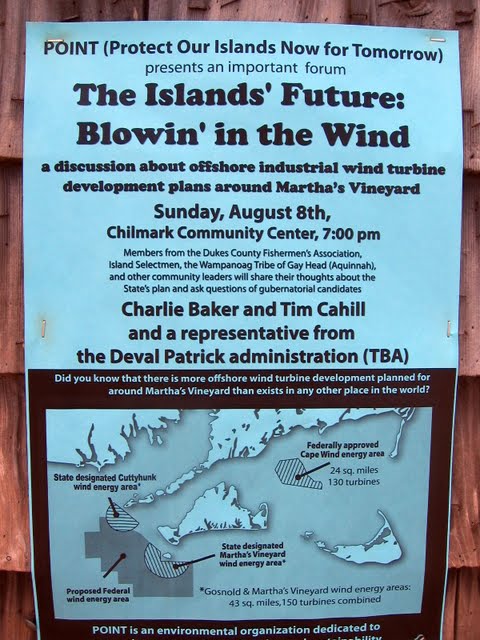
In ocean energy news, Matthew Simmons, the founder of the Rockland, Maine-based Ocean Energy Institute has died. Simmons was the founder Simmons & Co. International, an investment banking firm focusing on energy. Convinced of the value of ocean energy, in 2007, he founded the Ocean Energy Institute as "a think-tank and venture capital fund addressing the challenges of U.S. offshore renewable energy". Echoing a trope we have heard often lately, Simmons once gave a slideshow in which he is reported to have said, "The Gulf of Maine will soon become a Silicon Valley and begin proving ocean energy can be captured, processed and turned into a replacement for modern energy and water."
The city of South Portland, Maine is considering forming a nonprofit energy supply company to save citizens money on their electricity supply. The business, putatively called South Portland Energy, would buy power at wholesale in the NEPOOL market and sell it to the city -- and perhaps also to residential and commercial ratepayers. This kind of nonprofit competitive electricity supplier can cut ratepayers' supply costs, without requiring the formation of a municipal electric transmission and distribution utility.
Railroad tracks form an important kind of infrastructure; walking and hiking paths form another. The balance between replacing rail tracks with hiking trails is an interesting policy question. This Portland Press Herald editorial suggests that foot paths should not replace rail; the two can coexist, but a path should not preclude the use of the right of way for passenger and freight service.
Cogentrix has signed a 20 year contract with Xcel Energy subsidiary Public Service Company of Colorado for the output of its 30 MW concentrating photovoltaic solar energy plant. The project, located in southern Colorado, relies on a concentrating photovoltaic technology using lenses to focus incoming sunlight onto solar photovoltaic cells. This results in a higher energy density (in kW per acre) than other solar technologies.
July 29, 2010 - demand response; Alaska energy advisor challenged
Thursday, July 29, 2010
Today's energy related snapshot: a truck hauling wood chips near the Capitol in Augusta, Maine. Woody biomass is one of Maine's major energy resources, and we see thousands of tons of it trucked across the state on a daily basis. After all, Governor Baldacci has called Maine the "Saudi Arabia of biomass".

Put on your policymaker hat and let's talk about the power grid. It is summer, and it is hot. In addition to running businesses and households as usual, people are using a lot of air conditioning. This places a large demand on the electric grid. Specifically, grid planners need to make sure there's enough generation available to cover the region's demand for electricity. Traditionally, this has included both baseload and peaking generation. Baseload generation serves the portion of electric demand that is constant throughout the year, while peaking generation is used less frequently to meet spikes in demand. In some cases, particularly where electric demand has flattened due to loss of industrial load, peaking units might not run even one day per year. (In New England, this generally doesn't disqualify them from receiving payments for the capacity value they provide. In the market makers' view, it isn't the peaking generator's fault that load diminished.)
In recent years, we've found another way to cover peak electric load without having to build an expensive new generator that may only run infrequently: demand response. In essence, demand response means covering electric load by having individuals or companies volunteer not to use power from the grid in response to peak demand conditions. In exchange, these demand response participants should be compensated -- not only for the energy they didn't use, but also for the value of the service they provide to the grid. Generally, this service has a value comparable to the corresponding amount of generation avoided. Demand response thus lowers electric rates and the cost of the electricity that is being provided into the system.
Alaska, like many states, is focusing its government on energy issues. Gov. Sean Parnell named former state senator Gene Therriault (whose district is "North Pole" - no joke) as his energy advisor -- not an unusual move. This occurred at about the same time Senator Therriault stepped down from elected office. However, there is a claim that the position of energy advisor was created during Therriault's term as an active legislator. If so, under the Alaska Constitution and state law, he could not take any state job created while he was in office for one year. An Anchorage Daily News editorial now calls for his resignation.
The Arizona Corporation Commission has adopted a strong energy efficiency and conservation standard. Arizona regulated electric utilities will be required to reduce the amount of power they sell by 22 percent over 2005 levels (adjusted for population growth) by the year 2020 through conservation and efficiency. They can take credit for efficiency projects funded since 2005. The Southwest Energy Efficiency Project led the charge for this measure; they project ratepayer savings of $9 billion over the next ten years. 2% of the savings must come from demand response.
Here's an interesting Time article on underground coal fires -- which are more widespread and emit more pollution than we may know.
In Maine, a $50,000 grant from Time Warner Cable will help fund a new energy efficiency education program at two island schools. The Island Institute is starting its "Energy for ME" program, designed to teach students about energy issues and how -- and why -- they should conserve. About 75 kids on Vinalhaven and North Haven at North Haven Community School and Vinalhaven School are expected to participate in the program next year.
1/25/2010
Monday, January 25, 2010
A trio of Maine news stories, all surrounding offshore wind. First, a report of noise complaints from the three turbines installed this fall on the island of Vinalhaven.
Next, proposed legislation by Sen. (and Gov.-candidate) Peter Mills would create a standard "benefits package" of annual payments of $8,000 or $14,000 per megawatt of installed wind energy capacity to hosting municipalities. Existing wind developments pay either full taxes, or a negotiated rate. For example, the town of Mars Hill is projected to receive $9.8 million from First Wind over 20 year -- about $487,000 a year or $11,600 per MW of capacity; NRCM projects that the town of Oakfield, where Maine DEP has approved the siting of a 34-turbine facility, would receive roughly $11.8 million over 20 years, or $588,300 a year and $16,400 per MW. The wind industry and supporting players are concerned about raising the cost of doing business in Maine even higher, which would drive away investment. To give a sense of the value to the Maine economy of promoting wind development, John Cooney of Maine-based construction company Reed & Reed -- which itself is transitioning to wind from its traditional bridge- and road-building, estimated that his company has spent $288,000 in wages per MW of wind energy installed on Kibby Mountain, more than 95 percent of which went to Maine residents earning an average hourly wage of $31. Not bad, green-collar economy!
Finally, the Rockland-based Ocean Energy Institute (a not-for-profit) is developing plans for a pilot project in Maine that would take hydrogen from seawater and nitrogen from the air to form ammonia, which then can be used as a type of fuel similar to propane. Distributed wind generation can be used to generate energy, which could then be stored as ammonia until needed (e.g. when the wind stops blowing). OEI faces technical and commercial challenges, as well as regulatory ones -- for example, ammonia is not classified as a fuel by US DOE, which would need to be changed for OEI's plans to take flight.
Subscribe to:
Posts (Atom)
