Showing posts with label PUC. Show all posts

Maine PUC inquires into storm costs and grid resilience

Wednesday, August 14, 2024

Citing "increasing storm frequency and severity, and escalating storm restoration costs", Maine utility regulators have opened an inquiry to obtain information about the problem and how it could be addressed.

On July 25, 2024, the Maine Public Utilities Commission (PUC) issued a Notice of Inquiry in docket 2024-00191. According to that notice:

Maine is experiencing increasing storm frequency and severity, and escalating storm restoration costs. While utilities are developing their grid plans and doing the vulnerability assessments and preparing resiliency/mitigation plans, the Commission opens this inquiry to look for some shorter-term efforts to reduce the impact of storm damage to the system and study ways in which Maine’s electric utilities may more proactively address escalating storm costs.

The PUC's notice includes a list of questions and prompts for comment by September 4, 2024. Some questions ask how other states are addressing storm- and resilience-related costs. Others seek information on how Maine utilities might behave differently -- for example, leveraging data systems to prioritize resilience upgrades, shifting away from wood poles, or changing tree trimming protocols and other vegetation management programs. The questions also ask about what "resilience" means and how it can be quantified.

Under PUC practice, an inquiry is a relatively informal proceeding initiated by the PUC to gather information. After the PUC collects information through an inquiry, it can use what it learned to inform a subsequent adjudicatory proceeding (like an investigation) or a rulemaking. 

Outside this inquiry, a recently enacted law requires each of Maine's investor-owned transmission and distribution utilities to develop "a 10-year integrated grid plan designed to improve system reliability and resiliency and enable the cost-effective achievement of the State’s greenhouse gas reduction obligations and climate policies." The utilities must file their proposed grid plans by January 12, 2026.

A separate statute requires each utility to file a 10-year climate change protection plan that includes specific actions for addressing the expected effects of climate change on the utility's assets needed to transmit and distribute electricity to its customers. The first climate change protection plans were due on December 31, 2023, and must be updated every three years.

Maine PUC examines pandemic effect on utility customers

Monday, May 4, 2020

The Maine Public Utilities Commission has opened an inquiry into the effect of the coronavirus pandemic on customers’ ability to pay their bills from transmission-and-distribution utilities and natural-gas local distribution companies, as well as any newly available federal resources to help customers manage their utility payments or to assist the utilities themselves with meeting their ongoing obligations.

On April 28, 2020, the Commission issued a Notice of Inquiry in Docket No. 2020-00136, a new docket opened to house the inquiry. The Notice describes the "sea change in daily life" wrought by the pandemic and resulting national and state-level emergency declarations, as well as previous Commission action in response including the March 16 announcement of a moratorium on utility disconnections until further notice.

The Notice then frames two issues:
Rapidly rising levels of unemployment in Maine and other adverse effects of the coronavirus pandemic raise questions about customers’ ability to pay their utility bills, the effect of that and of closed businesses on utilities’ accounts receivable, and the potential for significant future rate adjustments from these circumstances. Also, it is possible that federal legislation could be adopted, federal agencies’ rules amended, or policies adopted that directly affect customers’ ability to pay and utilities’ management of their operations. 
The Notice lists specific information requested by the Commission to assist it in understanding the scope of this problem and available resources. One set of questions relates to "the changing landscape of federal resources available to T&D utilities, LDCs, and their customers" including new federal legislation or changes in federal regulations or policies to assist customers in managing their utility bills or utilities in their ongoing operations and obligations under the present circumstances.

Another set of questions addresses the effect of the coronavirus pandemic on customers’ ability to pay and utilities’ accounts-receivable balances. The Commission directed electricity transmission and distribution utilities and natural gas local distribution companies to begin providing monthly reports, within 15 days, of data including accounts receivable, charge-offs, and sales and billing information.

Further regulatory action in response to the pandemic is broadly expected, whether under executive orders issued by Governor Mills, or under state and federal laws.

Electric utility rate cases on the rise

Monday, July 22, 2019

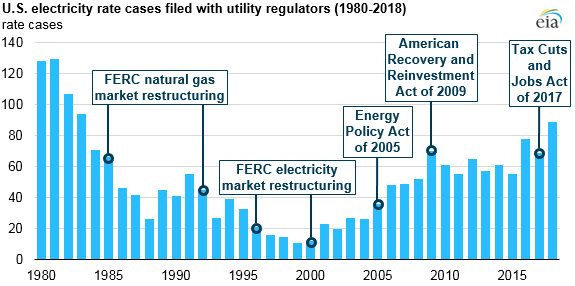
Federal data shows an increase in the number of U.S. electric utility rate cases filed in 2018, to the largest number since 1983. Of the 89 utilities filing rate cases in 2018, 10 proposed to decrease rates, one proposed a rate freeze until next year, and the remaining 78 utilities proposed to increase their rates.

Under typical state law, public electric utility companies must obtain regulatory approvals before changing the rates they charge their customers. According to the U.S. Energy Information Administration, 89 electric utilities sought to change their rates by filing rate cases with state regulatory commissions in 2018. This represents a significant increase relative to two decades ago.

Source: U.S. Energy Information Administration

According to EIA, the frequency or number of electric utility rate cases "typically reflects changes in the costs of generating and delivering electricity." For 2018, EIA pointed to increases in spending for electric transmission and delivery (as opposed to generation) as driving most of the rate increases that were ultimately approved.

EIA notes that the last time electric utility rate case filings were this active was the early 1980s, an era of significant rate increases: electricity rates increased at an average annual rate of 12% in the decade following the 1973 oil embargo. To explain that historic period of numerous rate cases, EIA points to factors including investments in coal and nuclear plants following the oil crisis; the enactment of the federal Public Utility Regulatory Policies Act of 1978 (PURPA), which required utilities to purchase electricity from generation from small, independently-owned renewable facilities, and the 1979 Three Mile Island nuclear plant accident which placed increased focus (and expense) on the safety of nuclear plants. By contrast, during a period of time when the Federal Energy Regulatory Commission was restructuring most electric markets (between 1995 and 2000), fewer than 20 rate cases were filed in most years.

Utilities typically ask for approval of significantly higher rate increases than are ultimately approved by regulators. According to EIA, in 2018, utilities asked for an aggregate rate increase $6.8 billion, but regulators approved a total increase of just $2.8 billion.

Maine regulators approve long-term contract

Friday, July 19, 2019

Maine utility regulators have approved a long-term contract to purchase the output of a 72.6-megawatt wind power project under development by Weaver Wind, LLC in Hancock County, Maine. The 20-year contract bears a price of 3.5 cents per kilowatt-hour, escalating at 2.5 percent per year.

A Maine statute enacted in 2006 authorizes the Public Utilities Commission to direct investor-owned transmission and distribution utilities to enter into long-term contracts, to the degree necessary to ensure reliability, meet energy efficiency program requirements, or reduce customer costs. In 2008, the Commission used this law to order a contract with the Rollins Wind project. After three subsequent procurement rounds, in 2017 the Commission approved a contract to buy 75 megawatts from Dirigo Solar, LLC, at a price of 3.4 cents/kWh escalating at 2.5% annually for 20 years.

In response to its most recent solicitation, earlier this year the Commission approved a term sheet for a contract to buy 100 megawatts from Three Rivers Solar Power, LLC’s solar project, with a price of 3.5 cents/kWh escalating at 2.5% annually for 10 years. Most recently, on July 12, 2019, the Commission approved a contract to buy the output of the Weaver Wind project, also at a price of 3.5 cents/kWh escalating at 2.5% annually for 10 years.

In addition to this existing law, in 2019 the Maine state legislature enacted several additional long-term contracting programs. One new law creates a new "Class IA" renewable portfolio standard, and requires the procurement by December 31, 2020 of energy or renewable energy credits from Class IA resources sufficient to cover between 7 and 10 percent of Maine's retail electricity sales, with a second round bringing the total procurement to 14 percent of Maine's retail electricity sales. Another new law requires the procurement of 375 megawatts from distributed generation resources between 2020 and 2024, with each project sized at less than 5 megawatts, and specific requirements for participation by non-residential and "community" or shared-ownership projects.

Collectively, these laws create a variety of opportunities for electric power generation projects to compete for and win long-term contracts to sell their output to Maine utilities.

NH PUC considers efficiency plan

Thursday, November 2, 2017

New Hampshire utility regulators are considering a three-year statewide energy efficiency plan proposed by several electric and gas utilities. The case could shape the near-term future of New Hampshire energy efficiency programming.

Under a 2016 settlement agreement, the New Hampshire Public Utilities Commission approved the implementation of an Energy Efficiency Resource Standard (EERS) beginning 2018, subject to Commission approval of the specific programs proposed to meet this standard. On September 1, 2017, utilities Liberty Utilities, Public Service Company of New Hampshire, Unitil Energy Systems, Inc. and Northern Utilities, Inc. jointly proposed a 2018-2020 Statewide Energy Efficiency Plan for approval by the Commission. The proposed 2018-2020 New Hampshire Statewide Energy Efficiency Plan document spans 369 pages, and is supported by testimony filed by the utilities.

As described by the utilities, their proposals would extend and expand existing "NHSaves" programs for another 3 years, and would add new initiatives including "a new residential energy audit option, a financing option for moderate income residents, new measure offerings in both residential and commercial programs, and multi -year energy planning to encourage long-term energy savings projects among large commercial customers."

According to the utilities, the measures implemented through the 2018-2020 Plan will save more than 4 billion electric kilowatt-hours and 7.5 million natural gas MMBtu, plus another 5.4 million MMBtus from other fuels, yielding customer energy cost savings of more than $867 million in energy costs over the life of the measures. The utilities also project that the measures "will reduce peak demand by 39 MW, which in tum will reduce costs for all customers."

The Commission has docketed the proceeding as Docket No. DE 17-136, and set a procedural schedule for the case including the filing of testimony and pursuit of possible settlement through November 2017, with hearings on the merits in early December.

California grid prepares for solar eclipse

Monday, July 31, 2017

As a total solar eclipse approaches for North America, California electricity regulators have launched a voluntary demand response program designed to reduce power consumption during the eclipse while solar panel output is reduced.

The eclipse will occur on August 21, 2017, and is projected to reduce solar photovoltaic production in the California ISO region by 4,194 megawatts.  Taking gross load increases and estimated wind production into account, CAISO has been told to expect a net load increase of 6,008 MW during the eclipse.

According to the nation's electric reliability organization, NERC, the August 21 eclipse "is not expected to impact the reliability of the bulk power system."  But as NERC also noted, "As the number of photovoltaic generators on the power system increases, the risk created by solar eclipses to reliable system operations will increase as well."

Now, the California Public Utilities Commission has launched a "Do Your Thing for the Sun" or "Cal Eclipse" program.  On its website, the Commission asks, "While our utilities and grid operator have all the tools necessary to manage the grid during the eclipse, what if millions of Californians stepped in to allow our hard working sun to take a break, rather than relying on expensive and inefficient natural gas peaking power plants?"

The website asks consumers to "Take the Pledge", emphasizing the value of "joining a movement of Californians who are taking action during the eclipse to give the sun a break by saving energy and reducing GHG emissions." According to a two-page FAQ posted on the website, consumers can reduce electricity consumption by turning off electronics when leaving, and permanently decrease electricity consumption with energy efficiency measures.  Actions suggested on the pledge website include replacing light bulbs with LEDs, reducing lighting use and electronics charging, unplugging unused appliances, and increasing air conditioning temperature setpoints by 2-5 degrees.

According to the Commission's FAQ, "There is no reason to anticipate any eclipse-related electric service outages because of the reduced solar generation."

Maine considers community solar rules

Thursday, December 1, 2016

As Maine utility regulators consider changes to the state’s net metering rule for solar panels and other customer-owned generation, revisions proposed by the Public Utilities Commission could change how consumers can participate in community and shared ownership solar projects.

For years, the Maine Public Utilities Commission’s rules have allowed “net energy billing,” a metering and billing mechanism that promotes the development and operation of smaller renewable generation facilities. Net metering is responsible for nearly all customer-owned solar power projects developed in Maine to date, including a handful of shared ownership or community solar farms. But as utility Central Maine Power Company reported that its customers' net metering reached 1% of peak load last year, the Commission launched a process to consider revisions to its net energy billing rules.

On September 14, 2016, the Commission released a Notice of Rulemaking along with proposed amendments to its rule. As proposed by the Commission, the amended rule would expand net energy billing in Maine in several ways. It would increases the size cap for an eligible facility by 50%, from 660 kilowatts to one megawatt. It would also recognize four different types of net energy billing arrangements that would be allowed: individual customer; customer leases; shared ownership; and community NEB.

Under the shared ownership model, each participating customer must have a shared ownership interest in the eligible facility under which the customers have joint responsibility for the costs of the shared ownership facility and have rights to the output of the shared ownership facility in proportion to their cost responsibilities. Under shared ownership net energy billing, the transmission and distribution utility would allocate the nettable energy of the shared ownership facility to customers in proportion to each customer’s ownership interest in the eligible facility.

The proposed rule would also explicitly allow for “community” net energy billing, a model that the Commission recognized as “increasing as a means to promote smaller solar installations.” The proposal suggests that community projects would have similarities to shared ownership projects, with additional registration and consumer protection provisions, but potentially with different ownership requirements.

The case over the rule change’s adoption remains pending for now. While some elements of the proposal would expand net metering opportunities, the proposal would also ratchet down the amount of energy that new projects could net against their T&D bill, from 100% in 2016 to 0% for new NEB customers after 2025. Elements of the Commission’s proposal remain controversial. Nevertheless the Commission’s proposal suggests a potential direction for future community solar projects in Maine.

Maine utility water supply inquiry

Wednesday, November 30, 2016

As Maine utility regulators consider how drought and other factors affect water utility supplies, staff at the Maine Public Utilities Commission have again requested comments and information on water supply emergencies and regulatory responses.  The feedback will inform a preliminary staff recommendation to be released in January 2017, which could lead to changes in how Maine regulates water utility supplies.

Drought and water shortage are affecting parts of the U.S., including much of New England.  In October, the Maine Public Utilities Commission issued a Notice of Inquiry (NOI) into water supply issues.  The Commission requested information about water supply problems, potential solutions, and development of plans to address any problems identified.  Specifically, the Commission posed 14 questions about water supply emergencies, plus 9 more questions about how the Commission should respond to water supply emergencies.  The Commission requested responses to these questions by November 4, 2016.

Some Maine water utilities responded to the Commission's water supply Notice of Inquiry, but many did not file a public response.  In a November 28, 2016 Procedural Order, Commission staff expressed a firm belief "that the more input the Commission receives from affected parties, the greater the likelihood that the final outcome in this Inquiry will meet the needs of those affected parties."  Accordingly, the procedural order invites any entity that did not initially respond to the NOI to do so by December 23, 2016.

The November 28 procedural order establishes a schedule for the remainder of the inquiry.  Staff intends to issue a Preliminary Recommendation in January, to which interested persons will be invited to respond during February, whether orally or in writing.  The schedule contemplates that staff would incorporate written and oral comments regarding the Preliminary Recommendation into a Final Recommendation in March, for presentation to the Commissioners during April.

The Commission has docketed the Maine water supply inquiry as Docket No. 2016-000233.

Northern Pass Transmission public utility status

Thursday, October 27, 2016

New Hampshire utility regulators have issued an order conditionally authorizing Northern Pass Transmission LLC to operate as a public utility, with respect to its proposed 192-mile, high-voltage electric transmission line from Canada into New Hampshire.  The New Hampshire Public Utilities Commission's Order No. 25,953 approves a settlement agreement between the transmission line developer and Commission staff.  Among its conditions are requirements that NPT obtain all necessary permits, contribute $20 million over 10 years to support energy efficiency and clean energy initiatives, and hold New Hampshire electric ratepayers harmless from costs associated with the possible regional allocation of costs for a portion of the Northern Pass transmission line.

Proposed by two companies affiliated under the Eversource family -- Northern Pass Transmission LLC and Public Service Company of New Hampshire d/b/a Eversource Energy -- the Northern Pass line would include new direct current transmission lines and an AC-DC converter station.  A variety of federal and state approvals are required for the line's development, including certification of site and facility by the state Site Evaluation Commission, plus several approvals from the Public Utilities Commission.

NPT secured one of those approvals this month, in the form of Public Utilities Commission Order No. 25,953, which conditionally authorizes NPT to operate as a public utilities in municipalities along its route.  In the Order, the Commission found "that NPT has the necessary technical, managerial, and financial expertise to operate as a public utility."

The Commission next found that the terms and conditions of a settlement agreement between Commission staff and NPT "ensure that granting NPT authority to commence business as a public utility is for the public good."
  • First, the Commission noted public benefit, in the form of transparency, from the fact that the settlement recites a list of applicable statutes and rules.
  • Second, the settlement called for a $20 million public interest payment, to be paid in installments of $2 million per year over the first 10 years of the operation of the Northern Pass Project; the Commission noted that this payment "will benefit customers by allowing the Commission to direct the use of this payment to energy efficiency programs and clean energy projects under its supervision."
  • Third, the Commission noted that its grant of public utility status is conditioned on NPT procuring all necessary approvals for the Northern Pass Project, including obtaining a certificate of site and facility from the SEC.
  • Finally, the Commission noted a provision in the settlement that "NPT must hold New Hampshire electric ratepayers harmless from costs associated with the possible regional allocation of costs for a portion of the Northern Pass transmission line."  The Commission expressed a belief "that the rate treatment provision applicable to the DC portion of the line could constitute a significant benefit to ratepayers in the event the ISO-NE designates this portion as eligible for regional cost recovery.
On this basis, the Commission approved the settlement agreement in its entirety, adopted its conditions, and found that commencement of business as public utility subject to those terms and conditions will be for the public good.

Meanwhile, NPT continues to pursue other approvals, such as PUC approval for crossings of public waters, and the SEC certificate of site and facility itself.

Drought and state water utility regulation

Tuesday, October 18, 2016


As drought affects parts of the U.S., some state regulators have expressed concerns over whether shortages will cause water supply emergencies for water utilities.  A recent Notice of Inquiry issued by the Maine Public Utilities Commission illustrates one approach to regulation of water supply management.

New England is abnormally dry this fall.  According to the U.S. Drought Monitor's National Drought Summary for October 11, 2016, "All areas except extreme northern Maine are now in abnormally dry or drought status. Moderate drought was expanded over eastern New York and Vermont while severe drought was expanded in southern New York and northern New Jersey."

Drought can mean water shortages, both for water utilities and for their customers.  As noted by the Maine Public Utilities Commission in an October 5, 2016 Notice of Inquiry into water supply issues, "Some are as of Maine are currently experiencing the impacts of drought. Some of Maine's water systems, which are located in areas where sources of supply are limited , are particularly challenged during dry conditions. In addition to a limited source of supply, some of these systems may also be disproportionately affected by seasonal demands, antiquated infrastructure, and/or high levels of non-revenue water."

As a result, the Commission opened an inquiry "to gather information that will allow it to identify problems which may exist, solicit input on ways to address any problems that are identified, and work collaboratively and proactively with Maine's water utilities and their customers, as well as other State agencies and interested persons and organizations, to develop a plan for addressing the problems that are identified."  The Commission also indicated interest in challenges other than drought that may significantly constrain a utility's source of supply.

The Commission divided its questions into two primary categories.  The first set seeks information to help the Commission to identify current and potential water supply problems and specific solutions to those problems.  These questions relate to recent water supply problems and their impacts, utility responses like voluntary or mandatory conservation measures, and communications with state agencies.

The Commission's second set of questions seeks input on what procedural steps the Commission should take to best address those problems.  This second set focuses on "the extent to which the Commission should be proactively involved in the development of a plan to deal with water supply emergencies and how the Commission should respond when a water supply emergency occurs."
 
The Commission requested that comments and responses be filed in Docket No. 2016-00233 by November 4, 2016.

Maine biomass resource RFP issued

Wednesday, June 22, 2016

The Maine Public Utilities Commission has issued an order approving a Request for Proposals for biomass energy resources.  At stake are two-year contracts through which biomass resources may sell energy and related products to Maine transmission and distribution utilities.

Earlier this year, the Maine legislature enacted An Act to Establish a Process for the Procurement of Biomass Resources.  Originally proposed as LD 1676 and enacted as Public Law 2015, Chapter 483, that law requires the Public Utilities Commission to initiate a competitive solicitation for 2-year contracts for up to 80 megawatts of biomass resources. 

By order dated June 17, 2016, the Commission approved a Request for Proposals pursuant to its authority under the Act.  The RFP document -- formally styled a Request for Proposals for the Sale of Energy from Biomass Resources -- was released at the same time. It asks for proposals from Biomass Resources for the sale of energy under one or more two-year contracts; bidders may also offer to sell capacity and/or renewable energy attributes as part of the contract.

The RFP defines a Biomass Resource as "a source of electrical generation fueled by wood, wood waste or landfill gas that produces energy delivered to the ISO-NE or NMISA region."  Additional requirements and criteria apply, including minimum capacity factor thresholds and preferences for creating in-state benefits.  It is possible that no contracts will be awarded, or that there won't be money to pay under those contracts.  If the Commission concludes that this solicitation is not competitive, based either on the solicitation process or the resulting bids, no bidders may be selected.  By law, payments are also contingent on the availability of funding for any above-market portion of the contracts, from a Cost Recovery Fund established by the Act.

Contract proposals are due on or before July 29, 2016. According to the Commission's materials, the RFP and all related documents and information will be available on the Commission's RFP website.

Maine opens net metering inquiry

Tuesday, June 14, 2016

The Maine Public Utilities Commission has issued a Notice of Inquiry to obtain feedback on whether its net energy billing rules should be modified, or other action taken to affect Maine's net metering policy.

Rooftop solar panels on a Maine business.

Under Chapter 313 of the Commission's rules, Maine electricity customers may net the output of qualified solar panels or other distributed generation resources against their utility loads.  To date, this rate treatment, known as "net energy billing," has been a major incentive for the development of solar photovoltaic and other customer-sited renewable energy projects in Maine.  Most other U.S. jurisdictions have adopted similar net metering programs.

But the Maine regulations provide for a review by the Commission of its rules once a utility gives notice that net metered capacity reaches 1% of peak demand.  Maine transmission and distribution utility Central Maine Power Company gave that notice earlier this year.

At a deliberative session held on June 14, the Commission unanimously decided to initiate an inquiry into the matter.  The Commission's 4-page Notice of Inquiry seeks comment and information on a list of specific issues related to the net metering rules.  Issues identified in that notice include possible changes to the value of net metering credits or the kinds of customer generating facilities may be net metered, grandfathering of existing systems, the adoption of consumer protection standards, and an alternative contracting structure:
1. In what respects (if at all) should Chapter 313 be revised, and what objective is each such revision intended to achieve?
2. In what respects (if at all) should there be revisions to the retail rate components that are netted such that less than the full retail rate (T&D and supply) would be netted, and what objectives are such revisions intended to achieve?
3. Should the Commission consider changes in the current kWh (660kW) threshold for qualified projects? What is the rationale for such a change?
4. If there are revisions to NEB, should existing NEB customers be “grandfathered” with respect to any future changes that affect NEB? Please provide the rationale for your answer, and, if yes, for how long should customers be grandfathered?
5. How can an NEB program be designed to track changes in the costs of distributed generation facilities?
6. Should issues of revenue loss and rate impacts be addressed through T&D utility rate design? How should rate design be approached--through cost of service, avoided cost, or a value of solar approach? Please discuss any equity issues that might arise from these approaches.
7. With respect to the structural app roach discussed in the Commission’s Report to the Legislature Regarding Market-Based Solar Policy Design Stakeholder Process Pursuant to Resolves 2015, ch. 37 (Jan. 30, 2016) (which was the basic structural approach that was considered by the Legislature last session through LD 1649) in which the output from solar facilities would be purchased and re-sold into the wholesale market, please comment on the statutory authority under which the Commission could implement such an approach. In the event the Commission has the statutory authority, should the Commission pursue such an approach and, if so, how should the purchase price be established for the various distributed generation resources that participate in NEB?
8. Should solar PV be treated differently than other NEB eligible resources with regard to any changes that might be adopted to the program?
9. How should any changes to NEB arising from CMP’s January 14, 2016 letter request for review apply to Emera Maine and the consumer-owned utilities?
10. Does the Commission have statutory authority to regulate or oversee lease arrangements or other custom er agreements that involve NEB? If so, should the Commission consider additional consumer protection standards with respect to distributed generation lease programs or other customer arrangements (i.e., sales of community solar project shares)?
11. Please comment on any other issues related to NEB?
The Commission requested comments on these issues by July 22, 2016.  Public comment and information will help inform the Commission's review of its Chapter 313 rules.

Maine biomass procurement competitive standards

Thursday, May 19, 2016

As the Maine Public Utilities Commission prepares for its upcoming procurement of biomass power resources, the Commission has requested public comment on the standards and criteria to be used in evaluating whether the solicitation is "not competitive."

This spring, the Maine State Legislature enacted An Act To Establish a Process for the Procurement of Biomass Resources.  The law directs the Maine Public Utilities Commission to initiate a competitive solicitation as soon as practicable, seeking proposals for 2-year contracts for up to 80 megawatts of biomass resources.  

But largely due to fairness and cost-containment concerns, the legislature created a "safety valve" in case the solicitation turns out to be "not competitive."  The Act specifies that “If the commission concludes that the solicitation ... is not competitive, no bidders may be selected and the commission is not obligated to enter into a contract.”

On May 17, 2016, the Commission issued a request for comment in its Procurement of Biomass Resources docket.  That request describes the Commission's plans to initiate the procurement process "in the near future" through the issuance of a request for proposals or RFP.  But before issuing the RFP, the Commission has requested comment on the standards and criteria to be used to determine whether the solicitation is “not competitive” pursuant to the Act.

Comments are requested by May 30, 2016.

NH regulation of solar PPAs, leases

Thursday, April 14, 2016

As distributed energy resources like solar panels become more widely adopted, how do typical solar business models like solar power purchase agreements or solar leases match up to state utility laws?  While the answer may vary from state to state, an order issued by the New Hampshire Public Utilities Commission earlier this year found found that offering solar power purchase agreements or solar leases to customers in New Hampshire would not subject a solar company to Commission regulation under any of several theories.  The order finding no regulation required is consistent with other state policy and precedent supporting distributed generation, and could be a model for other states.

Federal law controls some many aspects of the U.S. electricity industry, but states can and do regulate public utilities and competitive electric power suppliers.  Knowing who these state-regulated utilities and suppliers were was straightforward under the dominant utility models of the twentieth century.  But as new technologies like solar photovoltaic panels or other distributed energy resources become more widely adopted, and new business models like solar power purchase agreements and solar leases arise, their regulatory status can be uncertain.  If a solar company installs solar panels on a customer's roofs, and sells that customers the power produced, will it be regulated like a public utility or supplier under state law?  What if the company leases the panels to the customer?

The New Hampshire Public Utilities Commission recently addressed these questions in answering a 2015 petition by Vivint Solar, Inc.  In that petition, Vivint asked the New Hampshire Public Utilities Commission for a declaratory ruling that it would not regulate Vivint as a public utility, competitive electric power supplier, or limited producer of electrical energy under state law, for offering solar power purchase agreements or solar leases to residential customers in New Hampshire.

In a January 15, 2016 order -- Order No. 25,859 -- the Commission granted Vivint's petition.  First, the Commission noted the value of regulatory certainty:
We believe it is important for a party planning to do business in the state to have a vehicle through which it may clarify its regulatory status prior to entering the marketplace, provided that it can describe in sufficient detail its business plans and practices and these plans and practices are not hypothetical or speculative.
Next, the Commission concluded that the operations described by Vivint would not constitute sales to or for the "public" within the meaning of the statutory definition of "public utility."  Key factors recited in the order included the "conditional nature and relative complexity of Vivint’s relationships with its customers."

The Commission then analyzed its rules regarding competitive electric power suppliers, concluding that although Vivint might meet the regulatory definition of a supplier, that definition "should not be read in isolation but in the context of the overall purpose and effect" of the rules in their entirety.  The Commission then noted that those "Puc 2000" rules "seem intended to regulate  a set of relationships and related transactions that is quite different from those undertaken in the context of customer-sited, behind-the-meter, distributed generation development involving sales of electricity directly to the host customers pursuant to the terms and conditions of PPAs."

Finally, the Commission concluded that neither Vivint's PPAs nor solar leases should be subject to Commission regulation under the New Hampshire Limited Electrical Energy Producers Act.  The Commission interpreted that act's retail sales provisions "as applicable to sales of electricity off-site from the generation facilities," not "on-site and behind-the-meter" sales of power as contemplated by Vivint.

The New Hampshire Public Utilities Commission noted that while the petition and briefs in the case focused on the residential solar energy market, its analysis and conclusions "would not be different if the relevant customers were non - residential, assuming that the Systems were installed on the customers’ premises behind the utility retail electric meter, we re sized no larger than necessary to meet the customers’ reasonably anticipated electric consumption, and involved sales of electricity directly to the host customer or leases of the installed Systems to the host customer."

While the ruling technically applies to the company and facts asserted in the petition, it confirms the possibility of an important role for third-party involvement in distributed generation.

Maine PUC considers NTA coordinator

Friday, April 8, 2016

Maine utility regulators have launched an investigation into the designation of a "Non-Transmission Alternative Coordinator."  The case could shape whether and how Maine coordinates alternatives to electric transmission line development.

Non-transmission alternatives or NTAs are smart grid programs and technologies that complement and improve operation of existing electricity transmission systems, deferring or eliminating the need for upgrades to the transmission system.  NTAs can an deliver improvements to the grid at a lower cost than some transmission projects.  Distributed generation, storage, and demand response can play roles in NTA projects.

In Maine, legislative policy supports selecting NTAs over transmission development if an NTA can meet an identified reliability need at a lower cost to consumers than the proposed transmission project.  But under current law, no single entity formally coordinates or is required to postulate alternatives to transmission development.

In previous cases, the Maine Public Utilities Commission has investigated the need for a smart grid coordinator, approved a non-transmission alternative pilot project in the Boothbay region, and considered the scope of what an NTA Coordinator might do.  From these dockets, a vision has emerged of the NTA Coordinator as an entity that would develop cost-effective alternatives to transmission projects.  Under this vision, the NTA Coordinator would address the policy and goals of the Maine's Smart Grid Policy Act to “improve the overall reliability and efficiency of the electric system, reduce ratepayers’ costs in a way that improves the overall efficiency of electric energy resources, reduce and better manage energy consumption and reduce greenhouse gas emissions.”

But key questions remain, including whether and how an NTA Coordinator will be designated, the scope of its functions and duties.  Another fundamental question is whether these functions will be performed by transmission and distribution utilities, or by some third party entity.

In a Notice of Investigation dated April 4, 2016, the Maine Public Utilities Commission opened its investigation into these questions.  The notice describes the proceeding as focused on one approach to economically optimizing the electric system between generation and transmission:
Specifically, through this proceeding, the Commission expects to address this legislative policy by (1) developing the framework for selecting a NTA Coordinator and (2) determining the scope of the NTA Coordinator’s functions and duties. The Commission will also resolve the question of whether a third party entity or the transmission and distribution (T&D) utilities should perform the NTA Coordinator functions. This investigation will also address the role of an Advisory Planning Committee (APC) and the process for NTA development both within a CPCN proceeding and for transmission and distribution projects that are not required to file a CPCN petition. Finally, an end-product of this proceeding will be either the contours of an RFP or that of a rate incentive proposal should the Commission determine that the utility and not a third party should perform the functions of an NTA Coordinator.
Along with the notice of investigation, the Commission also issued "Strawman" and "Process Chart" documents for comment.

The notice set deadlines for filing petitions to intervene by April 21, 2016, and for comments on the Strawman and Process Chart by April 28, 2016.  An initial case conference was scheduled for May 12, 2016.

Maine Green Power offer provider selected

Thursday, April 7, 2016

Maine energy regulators have chosen a manager for the Maine Green Power program.  In an April 4, 2016 order, the Maine Public Utilities Commission selected 3Degrees Group, Inc. to manage the program.  3Degrees has operated the program since its 2013 launch, and now has the Commission's approval to run the program for another five-year term, with some changes to pricing, renewable energy certificate procurement, and risk mitigation procedures.

Maine's green power offer was established by a 2009 Maine law requiring the Commission to arrange for a green power offer -- a fully renewable competitive electricity supply option -- and to ensure its availability to residential and small commercial electricity customers.  Following a 2010 RFP, the Commission selected 3Degrees, Inc. to provide the first round green power offer.  Its program, named Maine Green Power, was officially launched in April 2013.  It featured blocks of 500 kilowatt-hours per month of renewable energy.  Its existing term of service expired on March 31, 2016.

Legislation enacted in 2015 extended the green power program's sunset date to April 1, 2021. On November 12, 2015, the Commission solicited proposals from providers to manage the program for a five-year term beginning on April 1, 2016.  According to the April 4, 2016 order selecting 3Degrees, the Commission evaluated proposals "based on cost considerations, non-cost aspects such as supplier experience, customer sign-up ease, and the potential use of renewable energy credits (RECs) from community-based renewable energy projects."

The Commission found "that the proposal submitted by 3Degrees, Inc. best suits the needs of the green power program."  According to the order, that proposal maintained the 500 kWh block structure, with a 19% increase in pricing.  3Degrees also proposed separate commercial pricing that includes a reduction in the per kWh price for higher usage.

The Commission also approved changes to the program's REC procurement and risk mitigation processes "in light of the five-year contract and the potential volatility in REC prices in future years":
Because of significant concerns about the price of Maine RECs in the next five years, particularly Maine Class I RECs, 3Degrees has proposed that it shall be required to use no less than $5.50 per REC of revenues paid by program participants for REC procurement purposes, as calculated as an average over the most recent three year period. At the proposed pricing for a residential customer of $8.95 for a 500 kWh block of green power, a customer would pay $17.90 for one REC. The 3Degrees proposal would require that no less than $5.50, or approximately 30%, of the funds paid by customers be spent directly on procuring RECs for the program.
The order also approved a risk mitigation mechanism.  If the procurement cost of Maine-based RECs exceeds $6.50 per REC on average (including Class I and Class II), 3Degrees could procure RECs from resources elsewhere in New England, or even from outside New England with Commission approval.  But because the program is promoted as Maine-based, the Commission directed 3Degrees to develop appropriate consumer education materials to explain the potential that, under certain circumstances, RECs may be sourced from outside of Maine or even the New England market.

Maine renewable energy report released

Saturday, April 2, 2016

The Maine Public Utilities Commission has issued its latest annual report on Maine's use of renewable electricity, covering the 2014 calendar year.  The report shows the impact of Maine's renewable portfolio standard, a state law requiring electricity suppliers to source specified percentages of their electricity from renewable resources.  The report found that compliance costs have fallen nearly in half since 2013.

The Maine State House.

Since Maine's electric industry restructuring in 2000, state law has required competitive electricity providers -- retail suppliers -- to procure 30% of their load served from "eligible resources." These are generally defined in statute as renewable or cogeneration facilities.  A 2007 act of the Maine legislature added a mandate that specified percentages of electricity that supply Maine’s consumers be sourced from “new” renewable resources.  Generally, these are renewable facilities that have an in-service date, resumed operation or were refurbished after September 1, 2005.  This "Class I" renewable portfolio standard began at one percent of load in 2008, and increases in one percentage point each year until reaching ten percent in 2017.  The older "eligible resource" standard became known as "Class II."

The 2007 renewables law required the Public Utilities Commission to report annually to the legislature on the program and compliance.  Each year's report is based largely on the most recently filed Competitive Electricity Provider (CEP) annual compliance reports, which are filed each July, covering the prior calendar year.  So there is some lag between the events being tracked and the publication of the report.

The Commission has just released its report covering calendar year 2014. The report notes "approximately 75 certified facilities, with a total capacity of approximately 1220 MW," although some are not operating or are eligible for other states' renewable portfolio requirements.

In 2014, most suppliers complied with the Maine renewable portfolio requirement through the use of renewable energy certificates or RECs.  According to the report, RECs from 22 facilities were used by suppliers to comply with the 2014 new renewable resource requirement.  Of these, 18 are biomass, 3 are hydro, and 1 is a wind facility. 20 of the 22 facilities are located in Maine, one is located in Connecticut and one is located in Massachusetts. Maine facilities, mostly refurbished biomass plants, supplied 99% of the approximately 811,476 RECs purchased to meet the 2014 portfolio requirement.

For calendar year 2014, 78.05% of the Class I RPS requirement was satisfied through the purchase of RECs during that year, 0.0004 % was satisfied through an alternative compliance mechanism, 21.88% was satisfied using RECs banked from 2013 and 0.1130 % will be satisfied during a 2015 cure period allowed by rule. On top of this activity, 181,595 RECs were purchased in 2014 and banked for future use and an additional 8 RECs were purchased where the supplier did not indicate whether the certificates were to be banked or would not be used.

As the Commission notes in its report, "the prices for Maine Class I RECs declined substantially over the two years leading up to 2014. This has occurred because Maine’s portfolio requirement includes, as an eligible resource, refurbished biomass facilities (which are not generally eligible in other New England states)."

One result is that the annual cost of Class I compliance fell roughly in half since the last report, with a total cost of $14,296,249 in 2014 compared to just $6,947,269 in 2013.  The report describes the cost of Class I RECs used for compliance in 2014 as ranging from approximately $1.72 per MWh to $22.33 per MWh, with an average cost of $8.56 per MWh.  Adding $198 for one supplier who satisfied a portion of the portfolio requirement through alternative compliance mechanism at the rate of $66.16 per MWh, the report describes a total Class I compliance cost to ratepayers during 2014 of $6,947,269.  The Commission translated this into "an average rate impact of about 0.06 cents per kWh (or about 30 to 35 cents monthly for a typical residential bill). In percentage terms, this translates to a residential customer bill impact of about one half of 1%."

The report also describes the cost of Class II RECs used to satisfy the eligible resource portfolio requirement as ranging from $0.00 per MWh (some RECs were provided for free as part of an energy transaction) to $1.80 per MWh, with an average cost of $0.52 per MWh and a total cost of $1,834,314. According to the Commission, this translates into less than ten cents per month on a typical residential bill.

E2Tech solar forum 2016

Wednesday, February 3, 2016

Today the Environmental and Energy Technology Council of Maine, better known as E2Tech, held its E2Tech forum on solar energy.

A panel of solar policy experts shared their perspectives on the issues facing Maine.  The panel included:
Panelists and audience members discussed some of the recent and ongoing solar energy policy discussions and outcomes in Maine, including a stakeholder process before the Maine Public Utilities Commission to explore an alternative policy complementary to net metering.  That process is expected to wrap up this winter with a report to the legislative committee with jurisdiction over energy matters.

The event also featured Preti Flaherty's launch of its First Light initiative.  Grounded in the Preti team’s experience helping consumers benefit from distributed or “behind the meter” generation, the firm has created a special focus on the commercialization of solar power by and for all consumers.  This strategic initiative will help qualified new entrants, as well as larger, existing companies, navigate legal and business challenges to harness the power of the sun. It will also help site owners participate in solar energy as project hosts, through site leasing and power purchase agreements or other arrangements.  Contact Todd Griset for more information about qualifying for the Preti First Light program.


Maine utility requests net metering review

Friday, January 15, 2016

Maine transmission and distribution company Central Maine Power Company has asked the Maine Public Utilities Commission to review whether the state's net metering program should continue or be modified.

Maine allows customers with qualifying distributed electric generation to net the power they produce against their consumption of power from the grid.  The Maine Public Utilities Commission adopted rules governing this "net energy billing" or net metering arrangement.  Most customer-scale solar photovoltaic projects in Maine rely on net energy billing, including those located in the service territory of utility Central Maine Power or CMP.

One provision of those rules, found in Section 3(J) of Chapter 313, provides for regulatory review of net metering once a utility reaches a threshold of installed net metering capacity:
A transmission and distribution utility shall notify the Commission if the cumulative capacity of generating facilities subject to the provisions of this Chapter reaches 1.0 percent of its peak demand. Upon notification, the Commission will review this Chapter to determine whether net energy billing pursuant to this Chapter should continue or be modified.
On January 14, 2016, CMP filed a letter with the Maine Commission requesting that the Commission undertake the review of net energy billing described in Section 3(J) of Chapter 313.  In support of that request, CMP notes:
As of the end of calendar year 2015, the cumulative capacity of the generating facilities for which CMP has net energy billing agreements under Chapter 313 is approximately 1.04% of CMP’s annual peak demand. The 1.04% is based upon the ratio of 16.261/1,565.300, where the numerator is the megawatts of nameplate capacity of contracted net energy billing facilities and the denominator represents the Company’s 2015 annual hourly peak demand.
The Maine Public Utilities Commission has docketed CMP's request as 2015-00008.  At the same time, the Commission is concluding a months-long legislatively mandated stakeholder process to consider alternatives to net energy billing, after which the Commission is scheduled to present a report to the state's legislative energy committee.

These two proceedings have different direct origins, but their effects could be similar.  CMP's letter under Chapter 313 says it was triggered by growth of enrolled net metering capacity, while the stakeholder process resulted from a direct legislative requirement.  Nevertheless both proceedings may affect the future of net metering in Maine.

NH regulation of solar PPAs, leases

Monday, September 21, 2015

If a solar energy company installs solar panels on its customers' roofs, and sells those customers the power they produce, will it be regulated like a public utility under state law?  A petition by Vivint Solar, Inc. has asked the New Hampshire Public Utilities Commission to declare that it will not regulate Vivint Solar as a public utility, competitive electric power supplier, or limited producer of electrical energy under state law.

Vivint Solar describes itself as the second largest installer of residential solar energy systems in the U.S. residential market, with approximately 42,000 residential customers and 274 megawatts of solar systems installed.  The company describes two primary business structures for residential solar projects: long-term power purchase agreements or PPAs, under which a customer agrees to purchase all of the power generated by a solar energy system installed on the customer’s rooftop; and solar leases, under which a customer leases the solar energy system which is installed at the customer’s site. In either case, the solar facilities are owned by Vivint Solar’s affiliates and financing parties to enable efficient use of tax benefits and low-to-no upfront costs for customers.

In its August 14, 2015 petition, Vivint Solar asked New Hampshire regulators for “regulatory clarity on how it may be regulated” if it enters the state to offer its PPAs and solar leases to New Hampshire customers. In particular, Vivint Solar argues that because it would not sell the electricity generated by its solar energy systems to the broad “public,” it is not a public utility under New Hampshire law. Vivint Solar also argues that its contractual relationship with residential customers is fundamentally different from the relationship between a competitive electric power suppliers and its customers, largely because Vivint Solar’s activity occurs on the customer’s side of the utility meter. The company  also asks the Commission to declare that it would not be a limited producer of electric energy, a kind of generator regulated lightly by the Commission. Vivint Solar also notes that its PPAs and solar leases promote New Hampshire’s goal of encouraging competition for retail access, and customer choice for more affordable electricity, as well as New Hampshire’s renewable portfolio standard and other clean energy policies.

The New Hampshire Public Utilities Commission has issued an Order of Notice in the case, with interventions due and a prehearing conference scheduled for early October.