If a solar energy company installs solar panels on its customers' roofs, and sells those customers the power they produce, will it be regulated like a public utility under state law? A petition by Vivint Solar, Inc. has asked the New Hampshire Public Utilities Commission to declare that it will not regulate Vivint Solar as a public utility, competitive electric power supplier, or limited producer of electrical energy under state law.
Vivint Solar describes itself as the second largest
installer
of residential solar energy systems in
the U.S.
residential market,
with
approximately
42,000
residential customers and
274
megawatts of
solar systems installed. The company describes two primary business structures for residential solar projects: long-term power purchase agreements or PPAs, under which a customer agrees to purchase all of the power generated by a solar energy system installed on the customer’s rooftop; and solar leases, under which a customer leases the solar energy system which is installed at the customer’s site. In either case, the solar facilities are owned by Vivint Solar’s affiliates and financing parties to enable efficient use of tax benefits and low-to-no upfront costs for customers.
In its August 14, 2015 petition, Vivint Solar asked New Hampshire regulators for “regulatory clarity on how it may be regulated” if it enters the state to offer its PPAs and solar leases to New Hampshire customers. In particular, Vivint Solar argues that because it would not sell the electricity generated by its solar energy systems to the broad “public,” it is not a public utility under New Hampshire law. Vivint Solar also argues that its contractual relationship with residential customers is fundamentally different from the relationship between a competitive electric power suppliers and its customers, largely because Vivint Solar’s activity occurs on the customer’s side of the utility meter. The company also asks the Commission to declare that it would not be a limited producer of electric energy, a kind of generator regulated lightly by the Commission.
Vivint Solar also notes that its PPAs and solar leases promote New Hampshire’s goal of encouraging competition for retail access, and customer choice for more affordable electricity, as well as New Hampshire’s renewable portfolio standard and other clean energy policies.
The New Hampshire Public Utilities Commission has issued an Order of Notice in the case, with interventions due and a prehearing conference scheduled for early October.

Energy powers society; society's choices shape energy policy. A blog about our energy resources and the choices they present for society.
Showing posts with label rooftop. Show all posts
Showing posts with label rooftop. Show all posts

July 27, 2010 - NY improves net metering for businesses; PGE develops rooftop solar in Oregon
Tuesday, July 27, 2010
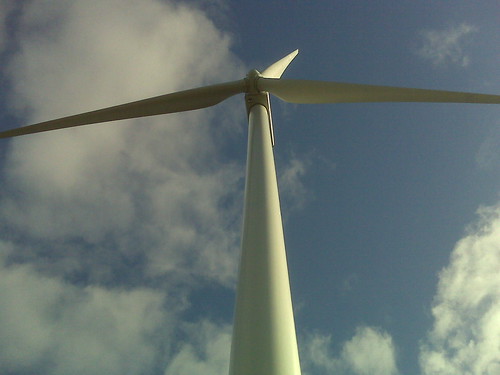
Today I open with another photo shot on a Maine island: this time one of the wind towers on Vinalhaven run by the Fox Islands Wind project. At 4.5 MW of installed capacity, Fox Islands Wind touts itself as the largest community wind-power facility on the East Coast of the United States. My colleague Drew Landry snapped this shot when he was on Vinalhaven celebrating the project's ribbon cutting in November 2009.
The state of New York's Public Service Commission has adopted a revised set of rules governing net metering of distributed solar and wind generation at non-residential customers' sites. These rules will make it easier for non-residential customers to site larger distributed generation behind their meters. Until recently, a non-residential customer's solar or wind electric generating equipment was limited in capacity to the lesser of 2 MW or the customer's highest historic peak usage during the previous 12 months. In practice, this meant that consumers demanding less than 2 MW of on-peak usage could not fully benefit from net metering opportunities, as their sales to the grid were capped at their own historic peak demand. Once the revised rules take effect, New York businesses will be able to sell up to 2 MW to the grid. For more information, see NY PSC Case Numbers 10-E-0133, 10-E-0134, 10-E-0135, 10-E-0136, 10-E-0137, or 10-E-013.
In the Pacific Northwest, Portland General Electric has installed the largest rooftop solar project in the region. PGE is a fully integrated electric utility that serves more than 817,000 residential, commercial and industrial customers in Oregon. Its project, spread atop the roofs of seven ProLogis distribution warehouses, covers 673,000 square feet and is rated at 2.4 MW. Cost? $14 million, $2.3 million of which is coming through incentives from the Energy Trust of Oregon. This project brings PGE to a total portfolio of 14.3 megawatts of solar capacity. This portfolio includes more than 10.7 megawatts of customer-owned solar projects supported through PGE's net metering program, as well as a 104-kilowatt solar highway demonstration project with the Oregon Department of Transportation. Oregon has recently adopted the "Solar Payment Option program", an incentive-based pilot program anticipated to bring another 17.5 megawatts of customer-owned solar projects online within the next 5 years.
It is hay harvest time in Maine, and farmers report that the season's good growing conditions have led to a very good harvest.
Also in Maine, utility Central Maine Power has acquired the final Army Corps permit it needs to build its $1.4 billion Maine Power Reliability Program transmission upgrade.
The state of New York's Public Service Commission has adopted a revised set of rules governing net metering of distributed solar and wind generation at non-residential customers' sites. These rules will make it easier for non-residential customers to site larger distributed generation behind their meters. Until recently, a non-residential customer's solar or wind electric generating equipment was limited in capacity to the lesser of 2 MW or the customer's highest historic peak usage during the previous 12 months. In practice, this meant that consumers demanding less than 2 MW of on-peak usage could not fully benefit from net metering opportunities, as their sales to the grid were capped at their own historic peak demand. Once the revised rules take effect, New York businesses will be able to sell up to 2 MW to the grid. For more information, see NY PSC Case Numbers 10-E-0133, 10-E-0134, 10-E-0135, 10-E-0136, 10-E-0137, or 10-E-013.
In the Pacific Northwest, Portland General Electric has installed the largest rooftop solar project in the region. PGE is a fully integrated electric utility that serves more than 817,000 residential, commercial and industrial customers in Oregon. Its project, spread atop the roofs of seven ProLogis distribution warehouses, covers 673,000 square feet and is rated at 2.4 MW. Cost? $14 million, $2.3 million of which is coming through incentives from the Energy Trust of Oregon. This project brings PGE to a total portfolio of 14.3 megawatts of solar capacity. This portfolio includes more than 10.7 megawatts of customer-owned solar projects supported through PGE's net metering program, as well as a 104-kilowatt solar highway demonstration project with the Oregon Department of Transportation. Oregon has recently adopted the "Solar Payment Option program", an incentive-based pilot program anticipated to bring another 17.5 megawatts of customer-owned solar projects online within the next 5 years.
It is hay harvest time in Maine, and farmers report that the season's good growing conditions have led to a very good harvest.
Also in Maine, utility Central Maine Power has acquired the final Army Corps permit it needs to build its $1.4 billion Maine Power Reliability Program transmission upgrade.
Subscribe to:
Posts (Atom)
