Showing posts with label MPRP. Show all posts

Maine utility storm damage and response in question

Thursday, November 9, 2017

As Maine recovers from widespread power outages following a storm, what will the event mean for how its public utilities design, operate, and maintain their electric grids?

On October 30, 2017, a storm brought winds and heavy rain to much of New England. In Maine, about 500,000 people lost power, with the state's largest utility Central Maine Power Company reporting the largest number of outages in the company's history and Emera Maine reporting the most widespread outages since 1998.

The utilities had taken some steps to prepare for the storm, describing advance planning to "ensure that adequate resources are in place to restore power outages that might occur as a result of the storm." After the storm passed, line crews from out of state arrived to provide mutual aid. Maine Governor Paul LePage issued an emergency proclamation to allow drivers of electrical line repair vehicles to operate additional hours during storm restoration efforts. By November 5 -- about one week after the storm -- the utility reported that it had restored power to about 99 percent of customers who had lost service, with about 6,000 customers left to go.

A convoy of utility repair trucks after the storm.

Now that the lights are back on in most homes and businesses, most people have cleaned spoiled food from refrigerators and freezers and are back at work. But the storm and outage have thrown a spotlight on the reliability of Maine's electricity grid, and utility preparation and response to storms. Some customers are complaining, pointing to the loss to the state economy caused by the blackouts, on top of personal inconvenience. As with past storms and outages such as the 1998 New England ice storm, preparation, operational response, and communications with customers and policymakers are focal points for complaint.

Some of the present complaints focus on the fact that what has been called the worst power outage in Maine history comes just two years after CMP completed its $1.4 billion Maine Power Reliability Program transmission upgrades. Other complaints focus on the utility's communications with customers -- while CMP's website provided real-time outage information during the storm including estimates on when service will be restored, the Portland Press Herald reported that CMP has acknowledged problems with the web listings, causing customer frustration over inaccurate information.

The Bangor Daily News cites a Maine Public Utilities Commission spokesman as saying that, following further information gathering, the regulatory agency may consider changes to regulation to better hold transmission and distribution utilities accountable for outages and storm restoration efforts. Maine law also allows the Commission to institute a complaint or investigation proceeding into any matter affecting utility service, and requires the Commission to investigate if ten or more aggrieved people file a complaint against a utility.

Electric vehicle pilot program proposed in Maine

Monday, July 23, 2012

A pilot program proposed by a Maine utility could lead to more electric vehicles on the road.  Central Maine Power Co. has asked the Maine Public Utilities Commission to approve its Electric Vehicle Pilot Project No. 2, which includes a limited number of grants to help customers purchase or lease an electric vehicle. 

As described in CMP's June 21 filing with the Commission, the electric vehicle pilot project consists of grant funding, CMP promotion of electric vehicles, and the collection of data on vehicle usage.  CMP envisions issuing cash grants of up to $15,000 each to ten selected organizations located in CMP’s service territory.  These organizations, selected through a public solicitation process, could use these grants to help them purchase or lease ten electric vehicles.  Each organization can also apply a portion of the grant toward the purchase and installation of a Level 2 (208V or 240V) rapid charging station, if it so chooses.

The project arises out of a requirement approved by the Commission as part of the settlement of a 2008 case over CMP's Maine Power Reliability Program, or MPRP.  As part of a deal allowing CMP to invest $1.4 billion in transmission infrastructure in its territory, the Commission required CMP to develop a process for pilot projects to facilitate the increased use of hybrid and electric cars in Maine, and to promote the storage of renewable and other energy generated off-peak to replace fuels with greater climate impacts.  Using off-peak electricity to power transportation could both save money for consumers and allow the utility to make more full use of its transmission and distribution grid.

Specifically, the stipulation required CMP to bring forward at least three pilot projects to facilitate the increased use of hybrid and electric cars by the end of 2012.  CMP's first pilot project entails integrating a limited number of electric vehicles into CMP's fleet.  This project, which is currently being implemented, is designed to give the utility first-hand experience with EVs, in a manner that minimizes costs and risks.

If approved, CMP's second project would introduce ten vehicles into the broader community.  The utility has said that its objective is to build awareness and lessen consumers' concerns by getting more of the new EV models into the public's hands.  Its ultimate stated goal is to create interest and "buzz" about EVs, particularly among innovative early adopters who would be most likely to purchase an EV.

A third phase is still under development, but CMP has said it will propose reducing barriers to EV use through education, participate in the development of public charging infrastructure, and assess a lower off-peak rate for EV charging.

The Maine Public Utilities Commission is reviewing CMP's proposal and is expected to issue its decision later this year.

July 27, 2010 - NY improves net metering for businesses; PGE develops rooftop solar in Oregon

Tuesday, July 27, 2010

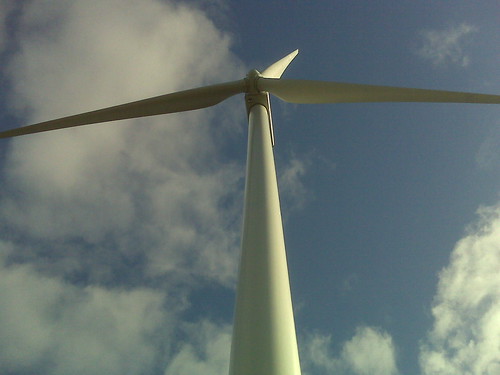
Today I open with another photo shot on a Maine island: this time one of the wind towers on Vinalhaven run by the Fox Islands Wind project.  At 4.5 MW of installed capacity, Fox Islands Wind touts itself as the largest community wind-power facility on the East Coast of the United States.  My colleague Drew Landry snapped this shot when he was on Vinalhaven celebrating the project's ribbon cutting in November 2009.

IMG00208

The state of New York's Public Service Commission has adopted a revised set of rules governing net metering of distributed solar and wind generation at non-residential customers' sites.  These rules will make it easier for non-residential customers to site larger distributed generation behind their meters.  Until recently, a non-residential customer's solar or wind electric generating equipment was limited in capacity to the lesser of 2 MW or the customer's highest historic peak usage during the previous 12 months.  In practice, this meant that consumers demanding less than 2 MW of on-peak usage could not fully benefit from net metering opportunities, as their sales to the grid were capped at their own historic peak demand.  Once the revised rules take effect, New York businesses will be able to sell up to 2 MW to the grid.  For more information, see NY PSC Case Numbers 10-E-0133, 10-E-0134, 10-E-0135, 10-E-0136, 10-E-0137, or 10-E-013.

In the Pacific Northwest, Portland General Electric has installed the largest rooftop solar project in the region.  PGE is a fully integrated electric utility that serves more than 817,000 residential, commercial and industrial customers in Oregon.  Its project, spread atop the roofs of seven ProLogis distribution warehouses, covers 673,000 square feet and is rated at 2.4 MW.  Cost?  $14 million, $2.3 million of which is coming through incentives from the Energy Trust of Oregon. This project brings PGE to a total portfolio of 14.3 megawatts of solar capacity.  This portfolio includes more than 10.7 megawatts of customer-owned solar projects supported through PGE's net metering program, as well as a 104-kilowatt solar highway demonstration project with the Oregon Department of Transportation.  Oregon has recently adopted the "Solar Payment Option program", an incentive-based pilot program anticipated to bring another 17.5 megawatts of customer-owned solar projects online within the next 5 years.

It is hay harvest time in Maine, and farmers report that the season's good growing conditions have led to a very good harvest.

Also in Maine, utility Central Maine Power has acquired the final Army Corps permit it needs to build its $1.4 billion Maine Power Reliability Program transmission upgrade.

3/25/10

Thursday, March 25, 2010

The big news in this corner of the continent is that Hydro-Quebec and New Brunswick Power have canceled their proposed deal. Details are still coming out, but key factors include the radical unpopularity of the deal in NB -- with some reports of as low as 8% of New Brunswickers supporting the deal -- and "increased costs and risk" for HQ. More to follow for sure.

In Maine legislative news:
The Utilities and Energy Committee has voted out an amended version of LD 1810, the Ocean Energy Task Force bill. This bill, proposed by Governor Baldacci's Ocean Energy Task Force, underwent a significant scaling back during the committee process, largely due to concerns over impacts to electric ratepayers. The Task Force, whose members included former Central Maine Power utility chief David Flanagan, was told to propose legislation that would remove obstacles to building 5000 MW of offshore and coastal wind and tidal energy in Maine. The result was a bill that included mandates to overbuild transmission, loosen the standards for the PUC's approval of transmission lines, have ratepayers finance generator lead lines, and expose all ratepayers to rates of up to 25 cents per kWh in order to pay for long-term contracts for ocean energy. Through extensive questioning by legislators and stakeholder involvement, the result is a dramatically scaled-back bill voted out of the Committee unanimously this evening. As voted out, the amended bill eliminates much of the the pro-transmission prejudices embodied in the original bill, and the provisions that would have had ratepayers backstop generator lead lines. The Committee also transformed an ocean energy RFP process that would have exposed ratepayers to potentially significant cost increases into a voluntary "ocean energy standard offer". This is a good result that will empower Maine's renewable energy industry and economy, without inappropriately exposing ratepayers to costs and risk.

When dam owner FPL Energy got approval to remove its Fort Halifax dam and hydroelectric station on the Sebasticook River in Winslow, Maine, many people voiced concerns ranging from bad energy policy (why remove clean hydro when we're doing all we can to install more renewable capacity?) to bankside erosion causing damage to houses. The naysayers were right about the erosion; yesterday, the town completed its $725,000 buyout and demolition project of the six houses on Dallaire Street that were in peril of falling into the river.

Central Maine Power's $1.6 billion MPRP transmission project runs into new trouble: the Sierra Club says the MPRP will harm wetlands.