This summer Vermont energy regulators issued an order implementing a Renewable Energy Standard. This standard, or RES, requires
Vermont
electric
utilities to
procure
an
increasing
share
of electricity from
renewable
sources.
Under a 2015 law called Act 56 (formerly called bill H.40), the Vermont Legislature directed the Public Service Board
to
issue
an
order
implementing
the
RES
to
take
effect
on
January 1, 2017. Act 56 set certain rules for the RES, but left other issues to the Board. Following working group meetings, workshops, and opportunities for written comment, the Board adopted the RES by order dated June 28, 2016.
The RES sets targets for utility procurement of renewable energy, starting at 55%
of
the
electricity
sold
to
customers
from
renewable
sources
in 2017,
increasing
gradually
to
75% in 2032.
Of
these
amounts,
at least 1%
must
come
from
new,
distributed
renewable
generators,
such
as
net-metering
systems,
rising
to
l0% by
2032.
The
RES
also
establishes
a category of
"energy
transformation
projects," to encourage
utility investment in
projects
that
directly
reduce
customers' fossil-fuel
consumption. Energy transformation projects might include measures
like
weatherization, biomass heating, cold-climate
heat
pumps, demand management,
or
clean
vehicle
technologies. To satisfy this requirement, utilities
must
demonstrate
fossil-fuel
savings
equivalent
to
2% of
their
annual
retail
sales
(increasing to 12% by
2032) or
procure
an
equal
amount
of
additional
renewable
generation. The Board has described the energy transformation project program as the first of its kind in the U.S.
Most states have adopted binding renewable portfolio standards for electricity supply. Before the enactment of Act 56 and the Board's adoption of the RES, Vermont had renewable goals under its Sustainably Priced Energy Enterprise Development or SPEED program, but no mandatory renewable portfolio standard.
Under the act, the Vermont Public Service Board order adopting the RES will take effect on January 1, 2017.

Energy powers society; society's choices shape energy policy. A blog about our energy resources and the choices they present for society.
Showing posts with label energy mix. Show all posts
Showing posts with label energy mix. Show all posts

NY Clean Energy Standard adopted
Wednesday, August 3, 2016
The New York Public Service Commission has issued an order adopting a clean energy standard. The standard will require 50% of New York’s electricity to be
generated by renewable sources by 2030. This so-called "50 by 30" mandate is consistent with the State Energy Plan's strategy to
reduce statewide greenhouse gas emissions by 40% by 2030. It will also provide support for existing nuclear power plants said to be at risk for closure without state support. This is a time of change for the New York energy industry, as the Clean Energy Standard adds to
the regulatory and retail market
changes that the state is already pursuing
under
its
Reforming the Energy Vision or REV program.
The New York commission noted that the state has adopted "strongly proactive policies to combat climate change and modernize the electric system to improve the efficiency, affordability, resiliency, and sustainability of the system." The state's 2015 State Energy Plan called for the "50 by 30" goal for renewable energy.
In the Commission's words, it determined "that a series of deliberate and mandatory actions to build upon and enhance opportunities for consumer choice are necessary to achieve State environmental, public health, climate policy and economic goals; to enhance and animate voluntary retail markets for energy efficiency, clean energy and renewable resources; to preserve existing zero-emissions nuclear generation resources as a bridge to the clean energy future; to ensure a modern and resilient energy system; and to accomplish its objectives in a fair and cost-effective manner."
As a result, the Commission adopted a Clean Energy Standard or CES consisting of a Renewable Energy Standard and a Zero-Emissions Credit Requirement program. The Commission also adopted supporting structures, which it describes as including:
The Clean Energy Standard order also creates a Zero-Emissions Credit or ZEC requirement, along with a process through which state energy agency NYSERDA will offer qualifying nuclear facilities a multi-year contract for the purchase of ZECs, at a price ultimately derived from the calculations of "social cost of carbon." NYSERDA will ultimately resell the ZECs to New York load serving entities, who will recover costs from ratepayers through commodity charges on customer bills. The Commission described the ZEC mechanism as "the best way for the State to preserve the nuclear units’ environmental attributes while staying within the State’s jurisdictional boundaries. "
As described in the order, the Renewable Energy Standard and ZEC components "are interrelated but the goals are additive," meaning efforts to comply with the RES will not count toward the ZEC requirement, even if the combination will "contribute toward the State's comprehensive greenhouse gas reduction goals."
The New York commission noted that the state has adopted "strongly proactive policies to combat climate change and modernize the electric system to improve the efficiency, affordability, resiliency, and sustainability of the system." The state's 2015 State Energy Plan called for the "50 by 30" goal for renewable energy.
In the Commission's words, it determined "that a series of deliberate and mandatory actions to build upon and enhance opportunities for consumer choice are necessary to achieve State environmental, public health, climate policy and economic goals; to enhance and animate voluntary retail markets for energy efficiency, clean energy and renewable resources; to preserve existing zero-emissions nuclear generation resources as a bridge to the clean energy future; to ensure a modern and resilient energy system; and to accomplish its objectives in a fair and cost-effective manner."
As a result, the Commission adopted a Clean Energy Standard or CES consisting of a Renewable Energy Standard and a Zero-Emissions Credit Requirement program. The Commission also adopted supporting structures, which it describes as including:
(a) program and market structures to encourage consumer-initiated clean energy purchases or investments; (b) obligations on load serving entities to financially support new renewable generation resources to serve their retail customers; (c) a requirement for regular renewable energy credit (REC) procurement solicitations; (d) obligations on distribution utilities on behalf of all retail customers to continue to financially support the maintenance of certain existing at-risk small hydro, wind and biomass generation attributes; (e) a program to maximize the value potential of new offshore wind resources; and (f) obligations on load serving entities to financially support the preservation of existing at- risk nuclear zero-emissions attributes to serve their retail customers.As described by Governor Andrew Cuomo, the program will feature a ramp-up of renewable power sourcing. Utilities and other energy suppliers will be initially required to procure 26.32 percent of the state's total electricity load from renewable sources in 2017, increasing to 30.54 percent by 2021. The Commission described the 50 by 30 goal as "not only part of a larger greenhouse gas goal, it is part of the State’s sweeping initiative to transform the way energy is produced, delivered, and consumed" through the REV process.
The Clean Energy Standard order also creates a Zero-Emissions Credit or ZEC requirement, along with a process through which state energy agency NYSERDA will offer qualifying nuclear facilities a multi-year contract for the purchase of ZECs, at a price ultimately derived from the calculations of "social cost of carbon." NYSERDA will ultimately resell the ZECs to New York load serving entities, who will recover costs from ratepayers through commodity charges on customer bills. The Commission described the ZEC mechanism as "the best way for the State to preserve the nuclear units’ environmental attributes while staying within the State’s jurisdictional boundaries. "
As described in the order, the Renewable Energy Standard and ZEC components "are interrelated but the goals are additive," meaning efforts to comply with the RES will not count toward the ZEC requirement, even if the combination will "contribute toward the State's comprehensive greenhouse gas reduction goals."
Wind, solar lead new generation in Jan. 2016
Wednesday, March 9, 2016
Wind and solar projects accounted for all new electric power generation placed in service in the U.S. in January 2016, according to a report by federal energy regulators.
The Federal Energy Regulatory Commission's Office of Energy Projects releases a monthly Energy Infrastructure Update. These reports provide summary data and narrative highlights of energy infrastructure developments in the past month. Energy Infrastructure Update reports typically cover natural gas, nonfederal hydropower, electric generation, and electric transmission.
The report for January 2016 shows that all tracked electric generation placed in service that month was powered by either wind or solar. The report notes 5 wind projects placed in service in January 2016, with a total installed capacity of 468 megawatts. These projects are:
The January 2016 infrastructure update also notes that a battery storage project in Ohio has come online. Willey Battery Utility LLC’s Willey Battery Storage Project in Hamilton County, Ohio is described as providing supply-demand balancing service for the frequency regulation market in the PJM region. Under FERC Order No. 755, battery storage and other innovative technologies can be compensated for offering frequency regulation to the grid.
The Federal Energy Regulatory Commission's Office of Energy Projects releases a monthly Energy Infrastructure Update. These reports provide summary data and narrative highlights of energy infrastructure developments in the past month. Energy Infrastructure Update reports typically cover natural gas, nonfederal hydropower, electric generation, and electric transmission.
The report for January 2016 shows that all tracked electric generation placed in service that month was powered by either wind or solar. The report notes 5 wind projects placed in service in January 2016, with a total installed capacity of 468 megawatts. These projects are:
- MidAmerican Energy Co.’s 153.4 MW Adams Wind Project in Adams County, Iowa
- Fowler Ridge IV Wind Farm LLC’s 150 MW Amazon Wind Farm Expansion Project in Benton County, Indiana -- developed by Pattern Energy; power generated is sold to Amazon Web Services under long-term contract
- Los Vientos Windpower IV LLC’s 110 MW Los Vientos Windpower Phase 2 Expansion Project in Starr County, Texas -- power generated is sold to Bryan Texas Utilities, Garland Power and Light, and Greenville Electric Utility System under long-term contract
- Milo Wind Project LLC’s 50 MW Milo Wind Project in Roosevelt County, New Mexico -- power generated is sold to Southwestern Public Service Co. under long-term contract
- Patriot Renewables LLC’s 4.5 MW Beaver Ridge Hill Wind Project in Waldo County, Maine
The January 2016 infrastructure update also notes that a battery storage project in Ohio has come online. Willey Battery Utility LLC’s Willey Battery Storage Project in Hamilton County, Ohio is described as providing supply-demand balancing service for the frequency regulation market in the PJM region. Under FERC Order No. 755, battery storage and other innovative technologies can be compensated for offering frequency regulation to the grid.
ISO New England Regional Electricity Outlook 2016
Wednesday, March 2, 2016
The New England regional power system is in a state of major transformation, according to regional grid operator ISO New England, Inc.'s 2016 Regional Electric Outlook.
ISO New England is the private, non-profit entity that serves as the regional transmission organization for New England. In this role, the ISO plans and operates the New England bulk power system, administers New England’s organized wholesale electricity market, and has some responsibility over system reliability.
The 2016 Regional Electric Outlook report is the latest annual installment of the grid operator's update on the state of the grid and the ISO’s efforts to ensure reliable electricity and to improve services and performance. This year's report describes the New England grid administrator as "in the vanguard of a major transformation in how electricity is produced and delivered in the US."
Three waves of change -- natural gas, renewable energy and demand resources, and distributed generation -- are affecting New England's fleet of power resources, according to the report:
The report also describes the ISO's tactics for managing the reliability risks associated with these shifts in the region's energy mix, including stronger "pay for performance" financial incentives for power resources to perform as required. It cites various ISO studies indicating "that, ultimately improving the natural-gas-delivery infrastructure in New England" will best address reliability concerns, price spikes, and unnecessary emission impacts from oil and coal units during winter.
The report, along with previous years' reports, are available on the ISO's website.
ISO New England is the private, non-profit entity that serves as the regional transmission organization for New England. In this role, the ISO plans and operates the New England bulk power system, administers New England’s organized wholesale electricity market, and has some responsibility over system reliability.
The 2016 Regional Electric Outlook report is the latest annual installment of the grid operator's update on the state of the grid and the ISO’s efforts to ensure reliable electricity and to improve services and performance. This year's report describes the New England grid administrator as "in the vanguard of a major transformation in how electricity is produced and delivered in the US."
Three waves of change -- natural gas, renewable energy and demand resources, and distributed generation -- are affecting New England's fleet of power resources, according to the report:
Natural-gas-fired generation has displaced older coal, oil, and nuclear plants. Weather-dependent renewable power resources and energy-efficiency measures are multiplying. On the horizon comes a “hybrid grid”—a combination of large power resources supplying the regional system while smaller ones directly supply consumer sites.According to the report, coal, oil, and nuclear resources are retiring; it noted that resources representing about 30% of regional capacity have committed to cease operation or are at risk of retirement by 2020. Most power plants planned to replace them will rely in part or in whole on natural gas or renewable generation. The report notes:
Our region's natural-gas-fired power resources are among the newest, most efficient, and lowest-emitting plants in the country. When their access to low-priced gas from the Marcellus shale is unrestricted, New England has reliable, low-priced electricity.The report also states that "wintertime access to natural gas has grown tight over recent years because the regional fuel transportation network has not kept up with demand from both generation and heating sectors." As a result of pipeline constraints, the ISO notes "grid reliability challenges, emission increases during winter, and spikes in wholesale electricity prices."
The report also describes the ISO's tactics for managing the reliability risks associated with these shifts in the region's energy mix, including stronger "pay for performance" financial incentives for power resources to perform as required. It cites various ISO studies indicating "that, ultimately improving the natural-gas-delivery infrastructure in New England" will best address reliability concerns, price spikes, and unnecessary emission impacts from oil and coal units during winter.
The report, along with previous years' reports, are available on the ISO's website.
NECA Renewable Energy Conference 2016
Monday, February 22, 2016
The Northeast Energy and Commerce Association (NECA) will hold its thirteenth annual renewable energy conference on March 3, 2016.
NECA is New England's oldest and most broadly-based, non-profit trade association serving the competitive electric power industry. NECA facilitates an open forum among all electric power stakeholders to foster the development and maturation of competitive power markets.
NECA's 2016 Renewable Energy conference features panel discussions on hydropower imports, distribution network policy, reliability, transmission and storage, and emerging trends in renewable finance/economics. Of particular interest this year are state efforts to support large scale and distributed renewables like wind and solar, broad retirements of coal-fired and other central generating power plants, proposed new infrastructure like electric transmission and natural gas pipelines, and shifts in the balance of resources New England relies upon for energy.
Registration for the event is available on the NECA website.
NECA is New England's oldest and most broadly-based, non-profit trade association serving the competitive electric power industry. NECA facilitates an open forum among all electric power stakeholders to foster the development and maturation of competitive power markets.
NECA's 2016 Renewable Energy conference features panel discussions on hydropower imports, distribution network policy, reliability, transmission and storage, and emerging trends in renewable finance/economics. Of particular interest this year are state efforts to support large scale and distributed renewables like wind and solar, broad retirements of coal-fired and other central generating power plants, proposed new infrastructure like electric transmission and natural gas pipelines, and shifts in the balance of resources New England relies upon for energy.
Registration for the event is available on the NECA website.
FERC considers Primary Frequency Response reforms
Friday, February 19, 2016
U.S. energy regulators are considering whether reforms are needed to regulations for the provision and compensation of primary frequency response, a function essential to the electric grid's operation.
In general, the U.S. bulk power system operates on an alternating current. For reliability and interoperability, that current must maintain its frequency within predetermined boundaries above and below 60 Hertz. An interconnected grid’s ability to arrest and stabilize frequency deviations within those boundaries after a sudden loss of generation or load is called "frequency response." A grid's frequency response characteristics are affected by factors including inertial response (as spinning generators speed up or slow down when load changes), primary frequency response, and secondary frequency response. Historically, most primary frequency response has been provided by baseload synchronous generators as an ancillary service.
But the U.S. electric grid's energy mix is changing. In a Notice of Inquiry released on February 18, 2016, the Federal Energy Regulatory Commission notes that changes to the U.S. electric supply portfolio likely mean that fewer resources are now primary frequency response. In particular, the U.S. has seen broad retirement of coal-fired baseload synchronous generators, some of which provide primary frequency response, while some have been replaced with variable energy resources such as wind and solar which do not typically have primary frequency response capabilities.
In response, FERC solicited public input on whether and what action is needed, including whether to:
In general, the U.S. bulk power system operates on an alternating current. For reliability and interoperability, that current must maintain its frequency within predetermined boundaries above and below 60 Hertz. An interconnected grid’s ability to arrest and stabilize frequency deviations within those boundaries after a sudden loss of generation or load is called "frequency response." A grid's frequency response characteristics are affected by factors including inertial response (as spinning generators speed up or slow down when load changes), primary frequency response, and secondary frequency response. Historically, most primary frequency response has been provided by baseload synchronous generators as an ancillary service.
But the U.S. electric grid's energy mix is changing. In a Notice of Inquiry released on February 18, 2016, the Federal Energy Regulatory Commission notes that changes to the U.S. electric supply portfolio likely mean that fewer resources are now primary frequency response. In particular, the U.S. has seen broad retirement of coal-fired baseload synchronous generators, some of which provide primary frequency response, while some have been replaced with variable energy resources such as wind and solar which do not typically have primary frequency response capabilities.
In response, FERC solicited public input on whether and what action is needed, including whether to:
- Amend the pro forma Large Generator and Small Generator interconnection agreements to require that all new generation resources have frequency response capabilities as a precondition of interconnection;
- Implement primary frequency response requirements for existing generation resources; and
- Establish procurement and compensation mechanisms for primary frequency response.
FERC has docketed the matter as RM16-6-000, Essential Reliability Services and the Evolving Bulk-Power System — Primary Frequency Response. Comments on the Notice of Inquiry are due 60 days after publication in the Federal Register.
US Clean Power Plan adopted
Monday, August 3, 2015
President Obama will formally unveil the Clean Power Plan today, a set of regulations by the U.S. Environmental Protection Agency (EPA) to reduce carbon emissions associated with the electric power industry. A blog post by EPA Administrator Gina McCarthy
emphasizes the Clean Power Plan's protection of health and the
environment, states' rights to choose their own implementation paths,
reduction of future energy costs, and leadership on climate issues. But some politicians, utilities and states have expressed concern about the regulations' impact, and could launch legal challenges -- or states might refuse to comply. What's in store for the Clean Power Plan?
It has been just over a year since EPA first released its draft Clean Power Plan in June 2014. These regulations under Section 111(d) of the Clean Air Act are designed to reduce the carbon intensity of the U.S. electric power sector -- essentially, how many pounds of carbon are emitted per megawatt-hour of electric energy produced. Under the draft Clean Power Plan, EPA sets carbon intensity limits for each state, collectively designed to reduce carbon emissions by 30% below 2005 levels. Each state then designs its own compliance plan using any combination of "building blocks": types of measures like improving the efficiency of fossil fuel power plants, switching out coal- and oil-fired power plants in favor of natural gas, and increasing low- and zero-carbon generation.
While the final Clean Power Plan's basic structure remains much the same, EPA has made some modifications in reaction to concerns about the greenhouse gas regulations' costs and impacts to grid reliability.
Changes from the 2014 draft include:
It has been just over a year since EPA first released its draft Clean Power Plan in June 2014. These regulations under Section 111(d) of the Clean Air Act are designed to reduce the carbon intensity of the U.S. electric power sector -- essentially, how many pounds of carbon are emitted per megawatt-hour of electric energy produced. Under the draft Clean Power Plan, EPA sets carbon intensity limits for each state, collectively designed to reduce carbon emissions by 30% below 2005 levels. Each state then designs its own compliance plan using any combination of "building blocks": types of measures like improving the efficiency of fossil fuel power plants, switching out coal- and oil-fired power plants in favor of natural gas, and increasing low- and zero-carbon generation.
While the final Clean Power Plan's basic structure remains much the same, EPA has made some modifications in reaction to concerns about the greenhouse gas regulations' costs and impacts to grid reliability.
Changes from the 2014 draft include:
- Two extra years (until 2022) for states to meet their targets, and greater flexibility for states to form regional pacts to facilitate emissions-cutting projects across state lines, such as the Regional Greenhouse Gas Initiative.
- A new “safety valve” feature, to let states appeal for extensions and other relief if complying with the regulations causes disruptions to power supply.
- Increased social justice incentives for utilities to construct renewable energy projects in poorer neighborhoods, reducing pollution-related illness and eventually lowering electricity rates.
- Energy efficiency is still encouraged, but has been eliminated as one of the rule’s "building blocks” for states to use in building their own carbon-reduction plans.
2014: natural gas, wind, solar led new projects
Friday, January 30, 2015
Natural gas, wind, and solar power projects dominated the rankings of new U.S. electric generation placed in service in 2014.
According to the Federal Energy Regulatory Commission staff's December 2014 Energy Infrastructure Update, developers placed in service 15,384 megawatts of new utility-scale electric generation capacity in 2014. This new capacity buildout is within 4% of 2013's figure (15,886 megawatts).
Of 2014's new generating capacity, nearly half (7,485 megawatts, or 49%) is powered by natural gas. U.S. production of natural gas has increased significantly in recent years, and natural gas prices have decreased in most regions of the country. At the same time, new environmental regulations have made historically dominant coal relatively more expensive as a fuel source, while relatively low carbon emissions have made natural gas more attractive. 2014 thus continued the trends of coal-fired power plant retirement and the construction of new natural gas-fired generating capacity.
Wind represents the next largest category of new U.S. electric generating capacity placed in service in 2014. Nearly 27% of 2014's new capacity, or 4,080 megawatts, is powered by wind. As President Obama noted in his 2015 State of the Union address, the U.S. has more wind energy supplying its electrical grid than any other country.
Solar energy represents the third largest category of new generation placed in service last year. Over 20% of new 2014 capacity, or 3,139 megawatts, is powered by solar energy. The rapid growth of solar energy in the U.S. was also featured in President Obama's 2015 State of the Union speech, in which he noted, "Every three weeks, we bring online as much solar power as we did in all of 2008."
Combined, these three energy sources (natural gas, wind, and solar) account for over 95% of all new utility-scale generation capacity placed in service in 2014. Of the remaining capacity, biomass took the largest share (1.6% of total new capacity), with a diverse mix of other sources including water power, coal, and nuclear rounding out the list. Notably, renewable sources including wind, solar, biomass, and hydropower account for nearly half of all new capacity placed in service in 2014.
What will 2015 bring?
According to the Federal Energy Regulatory Commission staff's December 2014 Energy Infrastructure Update, developers placed in service 15,384 megawatts of new utility-scale electric generation capacity in 2014. This new capacity buildout is within 4% of 2013's figure (15,886 megawatts).
Of 2014's new generating capacity, nearly half (7,485 megawatts, or 49%) is powered by natural gas. U.S. production of natural gas has increased significantly in recent years, and natural gas prices have decreased in most regions of the country. At the same time, new environmental regulations have made historically dominant coal relatively more expensive as a fuel source, while relatively low carbon emissions have made natural gas more attractive. 2014 thus continued the trends of coal-fired power plant retirement and the construction of new natural gas-fired generating capacity.
Wind represents the next largest category of new U.S. electric generating capacity placed in service in 2014. Nearly 27% of 2014's new capacity, or 4,080 megawatts, is powered by wind. As President Obama noted in his 2015 State of the Union address, the U.S. has more wind energy supplying its electrical grid than any other country.
Solar energy represents the third largest category of new generation placed in service last year. Over 20% of new 2014 capacity, or 3,139 megawatts, is powered by solar energy. The rapid growth of solar energy in the U.S. was also featured in President Obama's 2015 State of the Union speech, in which he noted, "Every three weeks, we bring online as much solar power as we did in all of 2008."
Combined, these three energy sources (natural gas, wind, and solar) account for over 95% of all new utility-scale generation capacity placed in service in 2014. Of the remaining capacity, biomass took the largest share (1.6% of total new capacity), with a diverse mix of other sources including water power, coal, and nuclear rounding out the list. Notably, renewable sources including wind, solar, biomass, and hydropower account for nearly half of all new capacity placed in service in 2014.
What will 2015 bring?
New generation in 2014 mostly gas, solar, wind
Wednesday, September 17, 2014
Most new power plants placed in service in the first half of 2014 are powered by natural gas, with new solar and wind capacity coming in second and third, respectively, according to the U.S. Energy Information Administration. Meanwhile, no new coal-fired electric generating capacity was added during that period.
From January through June 2014, EIA data shows the U.S. added 4,350 megawatts of new
utility-scale generating capacity. Combined-cycle natural gas plants contributed 2,179 MW of new capacity. Of this, over half is located at Florida Power & Light's Riviera Beach Next Generation Clean Energy Center in Florida. New combustion turbine plants added another 131 MW. In all, natural gas powers over 53% of new capacity coming online in the first half of 2014. Most of the nation has access to low cost natural gas, which offers significant environmental benefits over other fossil fuels like coal and oil.
Solar projects came in second, with 1,146 MW of new capacity coming online. Solar capacity is growing quickly, with an increase of almost 70% in new capacity added over the same period in 2013. Nearly 75% of this solar capacity is located in California, with most of the rest in Arizona, Nevada, and Massachusetts. Notably, the EIA's data only covers utility-scale projects; it omits most rooftop solar projects and any other solar capacity additions below 1 MW in size.
New wind capacity came in third, with 675 MW added. Most of the new capacity is sited in California, Nebraska, Michigan, and Minnesota.
Coal was notably absent from the ranks of new generating capacity added in the first half of 2014. New coal plants face steep headwinds in the form of environmental regulations and stiff competition against natural gas plants. EIA reports that only two coal plants are planned to come online in 2014.
As regulations and market forces shape the nation's energy mix, where will the new equilibrium be found -- and for how long?
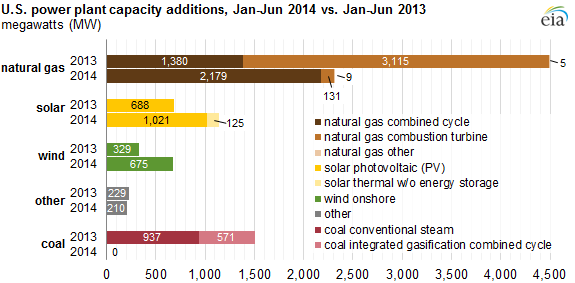 |
| Source: U.S. Energy Information Administration, Electric Power Monthly, August 2014 edition with June 2014 data Note: Data include facilities with a net summer capacity of 1 MW and above only. |
Solar projects came in second, with 1,146 MW of new capacity coming online. Solar capacity is growing quickly, with an increase of almost 70% in new capacity added over the same period in 2013. Nearly 75% of this solar capacity is located in California, with most of the rest in Arizona, Nevada, and Massachusetts. Notably, the EIA's data only covers utility-scale projects; it omits most rooftop solar projects and any other solar capacity additions below 1 MW in size.
New wind capacity came in third, with 675 MW added. Most of the new capacity is sited in California, Nebraska, Michigan, and Minnesota.
Coal was notably absent from the ranks of new generating capacity added in the first half of 2014. New coal plants face steep headwinds in the form of environmental regulations and stiff competition against natural gas plants. EIA reports that only two coal plants are planned to come online in 2014.
As regulations and market forces shape the nation's energy mix, where will the new equilibrium be found -- and for how long?
Report projects modest need for electric generation capacity growth
Thursday, July 24, 2014
The U.S. Energy Information Administration has projected that 351 gigawatts of new electric generating capacity will be added to the U.S. grid between 2013 and 2040. This projected new capacity, most of which EIA expects to be fueled by natural gas, will replace older power plants as they retire, as well as modestly increasing the country's net installed capacity.
EIA's forecast implies a growth rate well below recent annual levels observed. Under EIA's projection, capacity additions through 2016 will average 16 GW per year. But from 2017 through 2022, EIA expects additions of less than 9 GW per year as the existing generating fleet will be sufficient to meet expected demand growth in most regions. From 2025 to 2040, annual additions increase to an average 14 GW per year, but remain below recent levels.
EIA expects that natural gas will be the primary fuel source for the projected added capacity, accounting for 73% of capacity additions in the reference case (or 255 GW).
Renewables will account for 24% of the new capacity (or 83 MW). Of renewable capacity additions, 39 GW are solar photovoltaic (PV) systems (60% of which are rooftop installations). Another 28 GW are wind, most of which will occur by 2015 to qualify for federal renewable energy production tax credits).
New nuclear capacity will total about 3% (or 10 GW), including 6 GW of plants currently under construction and 4 GW projected after 2027.
EIA also projects that 1% of capacity additions (or less than 3 GW) will come from coal, with more than 80% of that total currently under construction. EIA notes that federal and state environmental regulations and uncertainty about future limits on greenhouse gas emissions reduce the attractiveness and economic merits of coal-fired plants.
Like any forecast, EIA's projections rest upon a series of assumptions. Under alternative cases, we might experience actual capacity additions that differ from EIA's forecasts. Nevertheless, the EIA Annual Energy Outlook 2014 offers a glimpse of changes to the portfolio composing our energy mix may come in the next decades.
EIA's forecast implies a growth rate well below recent annual levels observed. Under EIA's projection, capacity additions through 2016 will average 16 GW per year. But from 2017 through 2022, EIA expects additions of less than 9 GW per year as the existing generating fleet will be sufficient to meet expected demand growth in most regions. From 2025 to 2040, annual additions increase to an average 14 GW per year, but remain below recent levels.
EIA expects that natural gas will be the primary fuel source for the projected added capacity, accounting for 73% of capacity additions in the reference case (or 255 GW).
Renewables will account for 24% of the new capacity (or 83 MW). Of renewable capacity additions, 39 GW are solar photovoltaic (PV) systems (60% of which are rooftop installations). Another 28 GW are wind, most of which will occur by 2015 to qualify for federal renewable energy production tax credits).
New nuclear capacity will total about 3% (or 10 GW), including 6 GW of plants currently under construction and 4 GW projected after 2027.
EIA also projects that 1% of capacity additions (or less than 3 GW) will come from coal, with more than 80% of that total currently under construction. EIA notes that federal and state environmental regulations and uncertainty about future limits on greenhouse gas emissions reduce the attractiveness and economic merits of coal-fired plants.
Like any forecast, EIA's projections rest upon a series of assumptions. Under alternative cases, we might experience actual capacity additions that differ from EIA's forecasts. Nevertheless, the EIA Annual Energy Outlook 2014 offers a glimpse of changes to the portfolio composing our energy mix may come in the next decades.
Atlantic offshore wind energy targeted
Tuesday, July 15, 2014
A report released by the National Wildlife Foundation highlights the potential of U.S. states on the Atlantic Ocean to generate electricity from offshore wind -- and calls upon state leaders to take action to promote offshore wind development.
The 24-page report, Catching the Wind: State Actions Needed to Seize the Golden Opportunity of U.S. Offshore Wind Power, describes responsibly developed offshore wind as "a golden opportunity to meet our coastal energy needs with a clean, local resource that will spur investments in local economies." In particular, the Atlantic coast offers a high-quality wind resource in close proximity to power-thirsty coastal cities.
Key findings in the report include:
The report calls on state leaders to:
The 24-page report, Catching the Wind: State Actions Needed to Seize the Golden Opportunity of U.S. Offshore Wind Power, describes responsibly developed offshore wind as "a golden opportunity to meet our coastal energy needs with a clean, local resource that will spur investments in local economies." In particular, the Atlantic coast offers a high-quality wind resource in close proximity to power-thirsty coastal cities.
Key findings in the report include:
- Offshore winds off New England and New York blow consistently during periods of high electric demand, including summer heat waves and winter cold snaps.
- Federal environmental reviews are complete for over 1.5 million acres of Atlantic sea space, with over 16,000 megawatts of potential wind capacity.
- Diversifying states' energy mix with offshore wind can reduce prices and offset volatility, citing a 2014 study showing New England would save $350 million per year in reduced energy costs, or 2%, if 1,200 megawatts of offshore wind is added.
- Offshore wind reduces air pollution, including carbon emissions.
- Offshore wind development creates jobs, and can be done in an environmentally responsible manner.
The report calls on state leaders to:
- Set a bold goal for offshore wind in the state's energy plan.
- Take action to ensure a competitive market for offshore wind power.
- Advance power contracts for offshore wind.
- Ensure an efficient, transparent, and environmentally responsible offshore wind leasing process that protects wildlife.
- Invest in key research, initiatives, and infrastructure needed to spur offshore wind development.
EPA proposes carbon goals for power plants
Monday, June 2, 2014
The U.S. Environmental Protection Agency has proposed its plan to reduce carbon emissions from the nation's power plants by 30% below 2005 levels.
Formally known as "Carbon Pollution Emission Guidelines for Existing Stationary Sources: Electric Utility Generating Units", EPA's proposed rule spans 645 pages (PDF). The so-called Clean Power Plan builds on President Obama's 2013 Climate Action Plan, relying on the agency's authority under Section 111(d) of the Clean Air Act. Generally, Section 111 provides for the establishment of nationwide emission standards for major stationary sources of air pollution such as power plants. Current regulations limit power plants' emissions of arsenic, mercury, sulfur dioxide, nitrogen oxides, and particle pollution, but there are currently no national limits on carbon pollution levels.
EPA's Clean Power Plan would, for the first time, provide federal regulation of power plants' carbon emissions. EPA envisions a collaborative process through which federal limits are established for each state, but where states have the flexibility to identify their own path forward using either current or new electricity production and pollution control policies to meet the goals of the proposed program. Each state's carbon emissions limit would be stated as a rate of allowable pounds of carbon emissions per megawatt-hour of electric energy generated. EPA would set these rates based on a case-by-case evaluation of each state's energy mix -- including its portfolio of generation resources -- and EPA's evaluation of opportunities to reduce carbon emissions.
States would then be free to design a program to achieve those rates in a way that makes the most sense for each state's unique situation, combining diverse fuels, energy efficiency and demand-side management to create a tailored solution for each state. EPA also envisions collaboration among states, including the development of multi-state plans. Some states have already organized collaborative programs to reduce the electric power sector's carbon emissions -- for example, the Regional Greenhouse Gas Initiative (RGGI) program in the eastern states.
If adopted, EPA's rule would require states to submit their plans to EPA for review in June 2016. But EPA's plan is not yet final. It first faces public comment through the summer, including public hearings during the week of July 28 in Denver, Atlanta, Washington, DC and Pittsburgh. EPA anticipates finalizing its standards in June 2015.
Additional materials, including fact sheets and a regulatory analysis, are posted on the EPA's Clean Power Plan program website.
 |
| Stacks rise from the coal-fired Salem Harbor Station power plant, which closed on June 1, 2014. |
Formally known as "Carbon Pollution Emission Guidelines for Existing Stationary Sources: Electric Utility Generating Units", EPA's proposed rule spans 645 pages (PDF). The so-called Clean Power Plan builds on President Obama's 2013 Climate Action Plan, relying on the agency's authority under Section 111(d) of the Clean Air Act. Generally, Section 111 provides for the establishment of nationwide emission standards for major stationary sources of air pollution such as power plants. Current regulations limit power plants' emissions of arsenic, mercury, sulfur dioxide, nitrogen oxides, and particle pollution, but there are currently no national limits on carbon pollution levels.
EPA's Clean Power Plan would, for the first time, provide federal regulation of power plants' carbon emissions. EPA envisions a collaborative process through which federal limits are established for each state, but where states have the flexibility to identify their own path forward using either current or new electricity production and pollution control policies to meet the goals of the proposed program. Each state's carbon emissions limit would be stated as a rate of allowable pounds of carbon emissions per megawatt-hour of electric energy generated. EPA would set these rates based on a case-by-case evaluation of each state's energy mix -- including its portfolio of generation resources -- and EPA's evaluation of opportunities to reduce carbon emissions.
States would then be free to design a program to achieve those rates in a way that makes the most sense for each state's unique situation, combining diverse fuels, energy efficiency and demand-side management to create a tailored solution for each state. EPA also envisions collaboration among states, including the development of multi-state plans. Some states have already organized collaborative programs to reduce the electric power sector's carbon emissions -- for example, the Regional Greenhouse Gas Initiative (RGGI) program in the eastern states.
If adopted, EPA's rule would require states to submit their plans to EPA for review in June 2016. But EPA's plan is not yet final. It first faces public comment through the summer, including public hearings during the week of July 28 in Denver, Atlanta, Washington, DC and Pittsburgh. EPA anticipates finalizing its standards in June 2015.
Additional materials, including fact sheets and a regulatory analysis, are posted on the EPA's Clean Power Plan program website.
U.S. natural gas to pass coal as electricity fuel in 2035
Thursday, May 15, 2014
Coal will continue to fuel the largest share of electricity generated in the U.S. until 2035, when natural gas will surpass it, according to a recent federal report.
The U.S. Energy Information Administration's 2014 Annual Energy Outlook presents a long-term forecast of energy supply, demand, and prices from the present through 2040. Its scope includes predictions about shifts in the portfolio of types of electricity generating resources used to produce power. The largest such trend projected in EIA's 2014 report is that the market share of coal and nuclear generators will likely decline over the next two decades, as natural gas-fired and renewable electricity sources grow in prominence.
Historically, coal has fueled the largest share of electricity generated in the U.S. Typically operating as baseload generation, coal has traditionally been a relatively low-cost fuel for electric production. Coal's share of the electricity mix peaked in 2007, at 49% of all electric power generated. Since then, coal's share has declined; in 2012, coal-fired generators produced 39% of all electricity generated by utilities -- still the largest piece of the generation portfolio, despite a significant decline.
Coal's role in the nation's energy mix is under challenge from multiple fronts. Economically, the increased availability of lower-cost natural gas has made coal less competitive. Meanwhile, tighter environmental regulations -- such as the U.S. Environmental Protection Agency's Mercury and Air Toxics Standards, or MATS rules -- have placed additional pressure on coal plant operators to either invest in upgraded environmental controls or shut down.
At the end of 2012, 310 gigawatts of coal-fired generating capacity was available to run in the U.S. Of that, EIA projects that 50 gigawatts will be retired by 2020 under its base case model.
Under EIA's model, natural gas will grow its market share while coal declines. EIA projects that 70% of all new capacity added before 2040 will be fueled by natural gas. If EIA's assumptions hold, natural gas will surpass coal as a fuel for electricity generation in 2035.
While EIA's model rests on a series of assumptions, all of the alternative cases examined by EIA assume that coal-fired capacity will be retired, while natural gas-fired and renewable generation will grow. What will the future hold for the U.S. energy mix?
The U.S. Energy Information Administration's 2014 Annual Energy Outlook presents a long-term forecast of energy supply, demand, and prices from the present through 2040. Its scope includes predictions about shifts in the portfolio of types of electricity generating resources used to produce power. The largest such trend projected in EIA's 2014 report is that the market share of coal and nuclear generators will likely decline over the next two decades, as natural gas-fired and renewable electricity sources grow in prominence.
Historically, coal has fueled the largest share of electricity generated in the U.S. Typically operating as baseload generation, coal has traditionally been a relatively low-cost fuel for electric production. Coal's share of the electricity mix peaked in 2007, at 49% of all electric power generated. Since then, coal's share has declined; in 2012, coal-fired generators produced 39% of all electricity generated by utilities -- still the largest piece of the generation portfolio, despite a significant decline.
Coal's role in the nation's energy mix is under challenge from multiple fronts. Economically, the increased availability of lower-cost natural gas has made coal less competitive. Meanwhile, tighter environmental regulations -- such as the U.S. Environmental Protection Agency's Mercury and Air Toxics Standards, or MATS rules -- have placed additional pressure on coal plant operators to either invest in upgraded environmental controls or shut down.
At the end of 2012, 310 gigawatts of coal-fired generating capacity was available to run in the U.S. Of that, EIA projects that 50 gigawatts will be retired by 2020 under its base case model.
Under EIA's model, natural gas will grow its market share while coal declines. EIA projects that 70% of all new capacity added before 2040 will be fueled by natural gas. If EIA's assumptions hold, natural gas will surpass coal as a fuel for electricity generation in 2035.
While EIA's model rests on a series of assumptions, all of the alternative cases examined by EIA assume that coal-fired capacity will be retired, while natural gas-fired and renewable generation will grow. What will the future hold for the U.S. energy mix?
Biofuels lead growth in U.S. biomass energy
Monday, March 24, 2014
The use of energy from biomass resources in the United States grew more than 60% over the decade between 2002 and 2013 -- primarily in the form of increased use of biofuels like ethanol and biodiesel that are produced from biomass.
According to the U.S. Energy Information Administration, biomass accounted for about half of all renewable energy consumed in 2013 and 5% of total U.S. energy consumed. The three primary sources of this biomass are wood and forest products byproducts, waste including municipal solid waste and landfill gas, and raw organic feedstocks like corn and soybean oil used to produce biofuels.
Of biomass energy resources, biofuels experienced the greatest growth over the last decade. From 2002 to 2013, biofuels created from biomass grew more than 500%, driven largely by increases in U.S. production of ethanol and biodiesel for blending as transportation fuels. These biofuels are typically produced from feedstocks such as agricultural crops and other plant material, animal byproducts, and recycled waste. For U.S. ethanol production, corn is the dominant feedstock, while biodiesel producers rely on soybean oil for just over half of feedstock needs and an array of biomass resources for the rest. Market demand for these biofuels comes in part from federal mandates such as the U.S. Environmental Protection Agency's Renewable Fuel Standard, which requires the blending of certain volumes of biofuels into gasoline and diesel.
Meanwhile, EIA data shows that consumption of wood and waste energy increased just 4% over the decade. About two-thirds of U.S. wood energy is consumed for industrial processes, while nearly all U.S. waste energy is consumed for electric generation or industrial processes.
If this trend continues, woody biomass and waste energy will continue to hold their positions in our portfolio of energy resources, while continued growth in the conversion of biomass into biofuels for transportation and other needs will increase biofuels' weighting in the nation's energy mix. At the same time, debates continue over the cost and value of programs encouraging the growth of corn as a biofuel feedstock. What does the future hold for biomass in the U.S.?
 |
| A fuel pump displays prices for gasoline blended with up to 10% ethanol. |
According to the U.S. Energy Information Administration, biomass accounted for about half of all renewable energy consumed in 2013 and 5% of total U.S. energy consumed. The three primary sources of this biomass are wood and forest products byproducts, waste including municipal solid waste and landfill gas, and raw organic feedstocks like corn and soybean oil used to produce biofuels.
Of biomass energy resources, biofuels experienced the greatest growth over the last decade. From 2002 to 2013, biofuels created from biomass grew more than 500%, driven largely by increases in U.S. production of ethanol and biodiesel for blending as transportation fuels. These biofuels are typically produced from feedstocks such as agricultural crops and other plant material, animal byproducts, and recycled waste. For U.S. ethanol production, corn is the dominant feedstock, while biodiesel producers rely on soybean oil for just over half of feedstock needs and an array of biomass resources for the rest. Market demand for these biofuels comes in part from federal mandates such as the U.S. Environmental Protection Agency's Renewable Fuel Standard, which requires the blending of certain volumes of biofuels into gasoline and diesel.
Meanwhile, EIA data shows that consumption of wood and waste energy increased just 4% over the decade. About two-thirds of U.S. wood energy is consumed for industrial processes, while nearly all U.S. waste energy is consumed for electric generation or industrial processes.
If this trend continues, woody biomass and waste energy will continue to hold their positions in our portfolio of energy resources, while continued growth in the conversion of biomass into biofuels for transportation and other needs will increase biofuels' weighting in the nation's energy mix. At the same time, debates continue over the cost and value of programs encouraging the growth of corn as a biofuel feedstock. What does the future hold for biomass in the U.S.?
Solar energy led new installations in October 2013
Monday, November 25, 2013
Solar-powered projects led new electric generation capacity installed in October 2013. According to the Federal Energy Regulatory Commission's October 2013 Energy Infrastructure Update, most of the electric generation placed in service in October relies on solar energy technologies. Developers placed 504 megawatts of solar capacity online in October, out of 699 megawatts of total new capacity for the month. Solar also led the month in terms of the number of projects installed, accounting for 12 of 21 projects.
The solar energy projects placed in service last month vary widely in scale and in technology. The largest, Abengoa SA's Solana Generating Station in Arizona, generates up to 280 megawatts of power using a thermal concentrating solar power technology. 2,700 parabolic trough mirrors focus the sun's rays on a pipe containing a synthetic oil. This heat transfer fluid can reach 735 degrees Fahrenheit, and is sent to boilers where it produces steam from water. The steam turns turbines attached to generators, much as in a conventional thermal power plant. The Solana plant also features energy storage in the form of molten salt tanks that can enable it to generate electricity for up to 6 hours after sunset.
On the other end of the spectrum, Constellation Solar New York LLC placed its 2 MW Owens Corning Delmar Solar photovoltaic project online. The project, located at an Owens Corning factory in Delmar, New York, consists of about 9,000 ground-mounted, photovoltaic panels covering over 9 acres. Power produced by the project is sold to Owens Corning under a long-term power purchase agreement for use at the thermal and acoustical insulation factory; the project is expected to cover about 6 percent of the plant's annual electricity need.
While the use of solar energy is increasing rapidly, it remains a relatively small component of the nation's overall energy mix. Solar powered projects account for 6.79 gigawatts of capacity, just 0.59% of the 1,158 gigawatts of existing electric generation capacity nationwide. Nevertheless, the relatively small market penetration of solar technologies suggests that rapid growth may continue for the near term.
 |
| Solar photovoltaic panels line the roof of the visitor center at the Parker River National Wildlife Refuge in Massachusetts. |
The solar energy projects placed in service last month vary widely in scale and in technology. The largest, Abengoa SA's Solana Generating Station in Arizona, generates up to 280 megawatts of power using a thermal concentrating solar power technology. 2,700 parabolic trough mirrors focus the sun's rays on a pipe containing a synthetic oil. This heat transfer fluid can reach 735 degrees Fahrenheit, and is sent to boilers where it produces steam from water. The steam turns turbines attached to generators, much as in a conventional thermal power plant. The Solana plant also features energy storage in the form of molten salt tanks that can enable it to generate electricity for up to 6 hours after sunset.
On the other end of the spectrum, Constellation Solar New York LLC placed its 2 MW Owens Corning Delmar Solar photovoltaic project online. The project, located at an Owens Corning factory in Delmar, New York, consists of about 9,000 ground-mounted, photovoltaic panels covering over 9 acres. Power produced by the project is sold to Owens Corning under a long-term power purchase agreement for use at the thermal and acoustical insulation factory; the project is expected to cover about 6 percent of the plant's annual electricity need.
While the use of solar energy is increasing rapidly, it remains a relatively small component of the nation's overall energy mix. Solar powered projects account for 6.79 gigawatts of capacity, just 0.59% of the 1,158 gigawatts of existing electric generation capacity nationwide. Nevertheless, the relatively small market penetration of solar technologies suggests that rapid growth may continue for the near term.
Japan's floating offshore wind turbines
Wednesday, November 13, 2013
A recently-installed floating wind turbine off the Japanese coast marks the second operating floating project in Asia. Located about 12 miles off the coast of the site of the 2011 Fukushima nuclear power disaster, the government-funded project is being developed by a consortium led by Marubeni Corp. So far, it consists of a single 2-megawatt Hitachi turbine coupled with a floating substation, with near-term plans to add two 7-megawatt Mitsubishi Heavy Industries Ltd. turbines, and a longer-term vision of installing 1,000 megawatts of capacity.
The Fukushima project follows a 2-megawatt floating offshore wind project installed off Nagasaki. The Nagasaki project is located about 1 kilometer off the island of Kabashima, a 9-sq.-km island with some 110 households, and followed a 100-kilowatt test project deployed in 2012.
Japan's push for offshore wind development is motivated in large part by the Fukushima nuclear disaster. Before 2011, nuclear power provided about 30% of Japan's electricity, but all 54 of Japan's nuclear reactors were shut down or inoperable after the disaster.
As an island nation with extensive coastal resources and little if any native fossil fuels, offshore wind may be a natural fit for Japan. Relatively deep waters surrounding Japan make seabed-mounted towers impractical, so floating platforms may enable greater use of renewable wind energy. The floating pilot projects off Nagasaki and Fukushima are designed in part to test different technologies, and may help reduce the costs of future projects.
Under the Japanese approach, each of these projects is funded by a separate ministry: the Fukushima project is supported by the Ministry of Economy, Trade and Industry, while the Nagasaki project is funded chiefly by the Environment Ministry.
Will Japan continue to develop its deepwater offshore wind resources? Will floating platforms and turbines play a significant role in powering Japanese society? Will the pilot projects lead to engineering and manufacturing knowledge that could place Japan at the forefront of the growing deepwater offshore wind industry?
The Fukushima project follows a 2-megawatt floating offshore wind project installed off Nagasaki. The Nagasaki project is located about 1 kilometer off the island of Kabashima, a 9-sq.-km island with some 110 households, and followed a 100-kilowatt test project deployed in 2012.
Japan's push for offshore wind development is motivated in large part by the Fukushima nuclear disaster. Before 2011, nuclear power provided about 30% of Japan's electricity, but all 54 of Japan's nuclear reactors were shut down or inoperable after the disaster.
As an island nation with extensive coastal resources and little if any native fossil fuels, offshore wind may be a natural fit for Japan. Relatively deep waters surrounding Japan make seabed-mounted towers impractical, so floating platforms may enable greater use of renewable wind energy. The floating pilot projects off Nagasaki and Fukushima are designed in part to test different technologies, and may help reduce the costs of future projects.
Under the Japanese approach, each of these projects is funded by a separate ministry: the Fukushima project is supported by the Ministry of Economy, Trade and Industry, while the Nagasaki project is funded chiefly by the Environment Ministry.
Will Japan continue to develop its deepwater offshore wind resources? Will floating platforms and turbines play a significant role in powering Japanese society? Will the pilot projects lead to engineering and manufacturing knowledge that could place Japan at the forefront of the growing deepwater offshore wind industry?
Changes in how New England generates electricity
Tuesday, April 30, 2013
Society can use a number of different energy resources to generate electricity. We typically rely on a portfolio of multiple fuels to meet our needs, but the composition of this energy resource mix can affect the reliability, cost and environmental impacts of electricity generation. Through most of the twentieth century, in most regions of the United States, coal dominated the mix. Today, new resources like natural gas and nuclear power play major roles. The resource mix continues to evolve, with significant changes since 2000 alone.
New England provides a prime example of these shifts. According to regional grid operator ISO New England's 2013 Regional Energy Outlook (48-page PDF), in 2000 the largest share of power generated in the region came from nuclear power (31%). Nuclear power continued to provide a similar share of our electricity in 2012, but it has been bypassed by natural gas-fired generation as the largest source of our power. While natural gas contributed just 15% of regional electricity in 2000, last year it provided more than half (52%) of all electricity in New England. The growth of natural gas comes as the result of several trends, including the availability of relatively low-cost gas as well as natural gas's favorable emissions and environmental impacts compared to oil and coal.
Indeed, the amount of power generated by burning oil and coal in New England has fallen sharply. While oil-fired generation provided 22% of our needs in 2000, last year less than 1% of our power came from oil. The high cost of oil, combined with the availability of extensive capacity to generate electricity from natural gas, drove this marked decrease in the electric power sector's use of oil. Likewise, coal-fueled power has declined from 18% in 2000 to just 3% in 2012. Tighter federal air emissions standards and pollution control requirements, combined with the age of the coal-powered fleet and the availability of low-cost natural gas, have made coal-fired power largely uneconomic in New England.
According to the numbers, natural gas's ascendancy has not come at the expense of renewable power. The share of regional electricity produced from hydropower and other renewable energy resources held steady at 13% from 2000 to 2012.
What are the implications of this shift in New England's portfolio of energy resources? Lower average wholesale energy prices are one result. As electricity produced from oil and coal became more expensive, the cost of electricity produced from natural gas fell. Combined with the shift in the resource mix, these changes have led to relatively lower prices for electricity. This price decrease has been partially offset by increases in the cost of utility transmission and distribution service, but most consumers see lower electricity prices today than they did in 2000.
New England provides a prime example of these shifts. According to regional grid operator ISO New England's 2013 Regional Energy Outlook (48-page PDF), in 2000 the largest share of power generated in the region came from nuclear power (31%). Nuclear power continued to provide a similar share of our electricity in 2012, but it has been bypassed by natural gas-fired generation as the largest source of our power. While natural gas contributed just 15% of regional electricity in 2000, last year it provided more than half (52%) of all electricity in New England. The growth of natural gas comes as the result of several trends, including the availability of relatively low-cost gas as well as natural gas's favorable emissions and environmental impacts compared to oil and coal.
Indeed, the amount of power generated by burning oil and coal in New England has fallen sharply. While oil-fired generation provided 22% of our needs in 2000, last year less than 1% of our power came from oil. The high cost of oil, combined with the availability of extensive capacity to generate electricity from natural gas, drove this marked decrease in the electric power sector's use of oil. Likewise, coal-fueled power has declined from 18% in 2000 to just 3% in 2012. Tighter federal air emissions standards and pollution control requirements, combined with the age of the coal-powered fleet and the availability of low-cost natural gas, have made coal-fired power largely uneconomic in New England.
According to the numbers, natural gas's ascendancy has not come at the expense of renewable power. The share of regional electricity produced from hydropower and other renewable energy resources held steady at 13% from 2000 to 2012.
What are the implications of this shift in New England's portfolio of energy resources? Lower average wholesale energy prices are one result. As electricity produced from oil and coal became more expensive, the cost of electricity produced from natural gas fell. Combined with the shift in the resource mix, these changes have led to relatively lower prices for electricity. This price decrease has been partially offset by increases in the cost of utility transmission and distribution service, but most consumers see lower electricity prices today than they did in 2000.
Maine utility launches time-of-use rates
Wednesday, December 12, 2012
A Maine electric utility has launched a program to offer residential consumers rates that vary depending on whether the consumption occurs during times of peak demand on the electric grid. Central Maine Power Company's residential time-of-use rates are designed to encourage consumers to shift their use of electricity-intensive equipment to off-peak hours, generally between 8:00 p.m. and 7:00 a.m. and on weekends. How many customers will choose this option? What effects will it have, both for the consumers opting in and for society as a whole?
Traditionally, electric ratepayers pay the same price for every kilowatt-hour of energy they consume, without regard to the time of consumption or to conditions on the grid. But the cost of producing a given kilowatt-hour of electricity depends on factors including the portfolio of generators operating at the time, as well as on the instantaneous demand for electricity in the overall regional market. Because they are not directly exposed to the real-time price of power, consumers individually and collectively may not make efficiency choices about how much power they consume, and when they consume it. For example, energy prices are typically lower at night, when demand is reduced, but consumers have not traditionally had any incentive to shift their consumption to lower-priced nighttime hours. Some utilities have offered industrial and commercial businesses time-of-use rates to encourage efficiency, but most residential ratepayers have not had this option in recent years.
Central Maine Power now offers residential consumers the option to choose time-of-use rates. Prices during peak hours will be about 15 percent higher than under the default rate schedule, with off-peak prices about 20 percent below the default rates. The structure offers the opportunity for consumers to choose to shift heavy-consuming applications like air conditioning and heating to off-peak hours. This could save these consumers money - but it would require them to modify their behavior, invest in new "smart" technology, or both. Will consumers find the opportunity for savings to be worth these changes?
The current enrollment window is open through January 31, 2013.
Traditionally, electric ratepayers pay the same price for every kilowatt-hour of energy they consume, without regard to the time of consumption or to conditions on the grid. But the cost of producing a given kilowatt-hour of electricity depends on factors including the portfolio of generators operating at the time, as well as on the instantaneous demand for electricity in the overall regional market. Because they are not directly exposed to the real-time price of power, consumers individually and collectively may not make efficiency choices about how much power they consume, and when they consume it. For example, energy prices are typically lower at night, when demand is reduced, but consumers have not traditionally had any incentive to shift their consumption to lower-priced nighttime hours. Some utilities have offered industrial and commercial businesses time-of-use rates to encourage efficiency, but most residential ratepayers have not had this option in recent years.
Central Maine Power now offers residential consumers the option to choose time-of-use rates. Prices during peak hours will be about 15 percent higher than under the default rate schedule, with off-peak prices about 20 percent below the default rates. The structure offers the opportunity for consumers to choose to shift heavy-consuming applications like air conditioning and heating to off-peak hours. This could save these consumers money - but it would require them to modify their behavior, invest in new "smart" technology, or both. Will consumers find the opportunity for savings to be worth these changes?
The current enrollment window is open through January 31, 2013.
Renewables dominate new electric generating capacity
Wednesday, October 24, 2012
In September 2012, the United States added 433 megawatts of new utility-scale electric generating capacity - and according to a federal report, it all came from renewable resources.
The Federal Energy Regulatory Commission's September 2012 energy infrastructure update provides a summary of recent developments of natural gas, hydropower, electric generation, and electric transmission facilities. For electric generation, the report provides a breakdown of newly installed capacity by resource type.
According to the report, 5 wind projects came online in September, totaling 300 megawatts of capacity:
The Federal Energy Regulatory Commission's September 2012 energy infrastructure update provides a summary of recent developments of natural gas, hydropower, electric generation, and electric transmission facilities. For electric generation, the report provides a breakdown of newly installed capacity by resource type.
According to the report, 5 wind projects came online in September, totaling 300 megawatts of capacity:
- EDF Group’s 140 MW Phase 1 Pacific Wind in Kern County, California
- Forsyth Street Advisor LLC’s 57.6 MW Phase 1 Horse Butt Wind Farm in Bonneville County, Idaho
- KODE Novus I LLC’s 80 MW Phase 1 Novus Wind Farm in Texas County, Oklahoma
- Fire Island Wind LLC’s 17.6 MW Phase 1 Fire Island Wind Project in Anchorage Borough, Alaska
- Kodiak Electric Association’s 4.5 MW Phase 2 Pillar Mountain Wind project expansion in Kodiak Island Borough, Alaska
- NRG Energy & MidAmerican Renewables, LLC’s 50 MW Phase 5 Aqua Caliente Solar Project expansion in Yuma County, Arizona came online. The expansion brings the Aqua Caliente Project's operational photovoltaic capacity to 250 MW, making it currently the largest photovoltaic facility in the country.
- Zongyi Solar America’s 20 MW Tinton Falls Solar in Monmouth County, New Jersey, the largest photovoltaic project in New Jersey
- Southern Sky Renewable Energy LLC’s 5.6 MW Canton Landfill Solar Project in Canton County, Massachusetts, the largest solar facility in New England
Utility coal plants closing, natural gas to replace
Monday, September 17, 2012
A North Carolina utility closed one of its coal-fired power plants this past weekend, to be replaced with a natural gas-fueled combined cycle combustion turbine facility. Duke Energy subsidiary Carolina Power & Light, which does business as Progress Energy Carolinas, announced on Friday that it would close its coal-fired H.F. Lee facility on September 15. The Lee Plant closure is part of a broader shift away from utility and non-utility "merchant" use of coal to generate electricity, in favor of natural gas and other fuels.
Progress Energy Carolinas provides electricity to about 1.5 million customers in both North Carolina and South Carolina. The utility owns more than 12,200 megawatts in generation capacity, and serves a 34,000 square mile territory, including the cities of Raleigh, Wilmington and Asheville in North Carolina and Florence and Sumter in South Carolina.
The Lee Plant's story resembles that of a number of other coal plants across the country. Built in 1951 on the Neuse River near the town of Goldsboro, the plant was gradually expanded over time. By the 1960s, the Lee Plant hosted three coal-fired units with a total generating capacity of 382 megawatts. Four oil-fueled combustion turbine units were also added to the plant, adding another 75 MW of generating capacity, will be retired Oct. 1, 2012.
U.S. energy markets and environmental regulations continued to develop over the ensuing decades. Most recently, tighter federal air emissions regulations and an abundant supply of low-cost natural gas have made older and smaller coal-fueled power plants uneconomic to operate. As a result, owners are retiring these plants, and converting others to alternative fuels. For example, last week utility Dominion Virginia Power announced plans to convert its Bremo Power Station in Virginia from coal to natural gas.
Progress Energy Carolinas is following this trend. The utility closed its coal-fired W.H. Weatherspoon power plant near Lumberton, N.C. last year. It also plans to retire the remainder of its coal-fired plants without advanced environmental controls by the end of 2013: the Cape Fear Plant near Moncure, N.C., the Robinson coal-fired unit near Hartsville, S.C., and the L.V. Sutton Plant near Wilmington, N.C. These coal-fired unit retirements will represent about a third of the utility's coal-powered fleet, or about 1,600 MW of generating capacity.
To replace the power produced from these closing plants, Progress Energy Carolinas is building new natural gas-fueled combined-cycle units. Adjacent to the Lee Plant site, the utility is extending an existing natural gas pipeline and building a new, 920-MW natural gas-fueled combined-cycle facility. This plant, along with the five dual-fueled combustion turbines at the existing Wayne County Energy Complex, will be called the H.F. Lee Energy Complex when complete.
Projections suggest that natural gas will remain available at a relatively low cost for the next twenty years. At the same time, environmental regulations tend to grow tighter over time. These two factors suggest that the current trend of utilities switching from coal to natural gas to fuel electric generation may continue for the foreseeable future.
Progress Energy Carolinas provides electricity to about 1.5 million customers in both North Carolina and South Carolina. The utility owns more than 12,200 megawatts in generation capacity, and serves a 34,000 square mile territory, including the cities of Raleigh, Wilmington and Asheville in North Carolina and Florence and Sumter in South Carolina.
The Lee Plant's story resembles that of a number of other coal plants across the country. Built in 1951 on the Neuse River near the town of Goldsboro, the plant was gradually expanded over time. By the 1960s, the Lee Plant hosted three coal-fired units with a total generating capacity of 382 megawatts. Four oil-fueled combustion turbine units were also added to the plant, adding another 75 MW of generating capacity, will be retired Oct. 1, 2012.
U.S. energy markets and environmental regulations continued to develop over the ensuing decades. Most recently, tighter federal air emissions regulations and an abundant supply of low-cost natural gas have made older and smaller coal-fueled power plants uneconomic to operate. As a result, owners are retiring these plants, and converting others to alternative fuels. For example, last week utility Dominion Virginia Power announced plans to convert its Bremo Power Station in Virginia from coal to natural gas.
Progress Energy Carolinas is following this trend. The utility closed its coal-fired W.H. Weatherspoon power plant near Lumberton, N.C. last year. It also plans to retire the remainder of its coal-fired plants without advanced environmental controls by the end of 2013: the Cape Fear Plant near Moncure, N.C., the Robinson coal-fired unit near Hartsville, S.C., and the L.V. Sutton Plant near Wilmington, N.C. These coal-fired unit retirements will represent about a third of the utility's coal-powered fleet, or about 1,600 MW of generating capacity.
To replace the power produced from these closing plants, Progress Energy Carolinas is building new natural gas-fueled combined-cycle units. Adjacent to the Lee Plant site, the utility is extending an existing natural gas pipeline and building a new, 920-MW natural gas-fueled combined-cycle facility. This plant, along with the five dual-fueled combustion turbines at the existing Wayne County Energy Complex, will be called the H.F. Lee Energy Complex when complete.
Projections suggest that natural gas will remain available at a relatively low cost for the next twenty years. At the same time, environmental regulations tend to grow tighter over time. These two factors suggest that the current trend of utilities switching from coal to natural gas to fuel electric generation may continue for the foreseeable future.
Subscribe to:
Posts (Atom)
