Showing posts with label small hydro. Show all posts

Alta Ski Area conduit micro-hydro project

Friday, May 27, 2016

Alta Ski Area has proposed developing a micro-hydropower project along an existing pipeline, and hopes to benefit from a streamlined regulatory process.  Federal regulators have made a preliminary determination that the proposed Alta Micro-Hydro Project, in Alta, Utah, satisfies the requirements to be treated as a "qualifying conduit hydropower facility," which would not require licensing under the Federal Power Act.

Alta's proposed project would include a new powerhouse to be built along the existing underground 6-inch-diameter snowmaking water supply pipeline delivering water from Cecret Lake to the Wildcat Pump House, a new turbine/generating unit with an installed capacity of 75 kilowatts, intake and discharge pipes, and appurtenant facilities.  The unit is estimated to generate between 115 and 225 megawatt-hours annually.  There is no dam associated with the project.  Alta presented its micro-hydro project as part of a 2012 request to update its master plan, which the U.S. Forest Service accepted.

Ski areas with snowmaking capacity typically have existing pipelines and water infrastructure, coupled with significant vertical relief.  This can create opportunities to generate electricity using energy harvested from water flowing downhill through a pipeline, particularly if reducing system pressure (like a pressure relief valve) is otherwise needed. 

A 2013 law was designed to help small conduit-based hydropower projects by eliminating their need for a license or exemption from licensing issued by the Federal Energy Regulatory Commission.  Section 4 of the Hydropower Regulatory Efficiency Act of 2013 amended Section 30 of the Federal Power Act.  Section 30 now provides that a "qualifying conduit hydropower facility" -- one that is determined or deemed to meet defined criteria -- is not required to be licensed or exempted from licensing under the Federal Power Act.  These criteria include:

  • The conduit the facility uses a tunnel, canal, pipeline, aqueduct, flume, ditch, or similar manmade water conveyance that is operated for the distribution of water for agricultural, municipal, or industrial consumption and not primarily for the generation of electricity.
  • The facility is constructed, operated, or maintained for the generation of electric power and uses for such generation only the hydroelectric potential of a non-federally owned conduit.
  • The facility has an installed capacity that does not exceed 5 megawatts. 
  • On or before August 9, 2013, the facility is not licensed, or exempted from the licensing requirements of Part I of the FPA.

The Federal Energy Regulatory Commission administers this statute.  To start the regulatory process, on May 16, 2016, Alta filed a notice of intent to construct a qualifying conduit hydropower facility.  Alta supplemented its notice on May 20 to clarify that the project "will only operate when there is excess capacity available in the pipeline and when water is hydrologically available", generally after the winter snowmaking season, during spring runoff.  Alta also restated that the pipeline's main purpose will continue to be snowmaking.

Yesterday the FERC issued its notice of preliminary determination of a qualifying conduit hydropower facility for Alta's project.  That notice examines the project relative to each of the four statutory criteria, and then provides the Commission's preliminary determination:

The proposed addition of the hydroelectric project along the existing water supply pipeline will not alter its primary consumptive purpose. Therefore, based upon the above criteria, Commission staff preliminarily determines that the proposal satisfies the requirements for a qualifying conduit hydropower facility, which is not required to be licensed or exempted from licensing.
The notice also sets a 30-day deadline for filing motions to intervene, and a 45-day deadline for filing comments contesting whether the facility meets the qualifying criteria and providing an evidentiary basis.

Other recently proposed conduit hydro projects have been determined to be qualifying conduit hydropower facilities, including a Colorado project using an existing "ditch drop," a Castle Valley, Utah water treatment project, a California wholesale water agency conduit project, and a New Hampshire water works.

FERC and microhydro licensing

Wednesday, May 18, 2016

Federal energy regulators have ruled that a micro-hydroelectric project proposed in New York cannot be constructed or operated without a license.

The proposed Henson Micro Hydroelectric Project would be located on the West Branch of Onondaga Creek, near Onondaga, New York.  It would include an existing 14-foot-high concrete dam, plus new construction including a penstock, a powerhouse, and a 10 kilowatt generating unit.  The dam was rebuilt in 2002, and had previously been used to power a grist mill.  The project developer, an individual, proposed to use the project power to provide electricity to his home and barn.
 
In his declaration of intention, the developer described himself and his approach to project development and compliance:
I would like to point out that I am not a corporation, or a rich man just a simple middle class Joe. I am an hourly employee at AT&T. Although blessed beyond what I actually deserve, I do not have a bunch of money that I could spend. In fact I am using funds recently obtained from a loss of use settlement from the NYS Workers Compensation Board to fund this. I am trying to do the right thing for the environment and save some money on my power bill. I am hoping that we can work this out to everyone’s satisfaction based upon the material and information that I currently have available. Of course, if additional information is required by you folks I will do everything to comply.
Identifying what approvals are necessary is a core step in developing any project.  Under section 23(b)(1) of the Federal Power Act, a non-federal hydroelectric project must be licensed by the Federal Energy Regulatory Commission (unless it has a still-valid pre-1920 federal permit) if it:
(a) is located on a navigable water of the United States;
(b) occupies lands or reservations of the United States;
(c) utilizes surplus water or waterpower from a government dam; or
(d) is located on a stream over which Congress has Commerce clause jurisdiction, is constructed or modified on or after August 26, 1935, and affects the interests of interstate or foreign commerce.
To reduce uncertainty over whether a project will require licensing, a developer may file a Declaration of Intention with the FERC describing the project.  Following public notice and an opportunity for protests, comments, and motions to intervene, FERC will rule on the jurisdictional questions raised by the declaration.

In the Henson project's case, the developer filed a Declaration of Intention on December 18, 2015.  That declaration was supplemented; after the second supplement, FERC issued its public notice of the declaration.  No protests, comments, or motions to intervene were filed.

On May 10, FERC issued its ruling on the declaration, finding that licensing is required.  FERC easily found that the project would not occupy any public lands or reservations of the United States or use surplus water or waterpower from a Federal government dam.  It found "insufficient evidence" to determine whether the West Branch of the Onondaga Creek is navigable.

However, FERC found that the West Branch of Onondaga Creek is a headwater or tributary of the Oswego River, a navigable water of the United States.  As a result, FERC concluded the project would be located on a "Commerce Clause stream."  FERC noted the project would be constructed after 1935.

FERC also concluded that the project would affect interstate commerce through its connection to the interstate grid, relying on precedent that "small hydroelectric projects that are connected to the interstate grid affect interstate commerce by displacing power from the grid, and the cumulative effect of the national class of these small projects is significant."  Thus even though the Hanson project's developer proposed using project power for the onsite home and barn, the fact that those buildings were grid-tied drove FERC to conclude that licensing was required. 

On this reasoning, FERC concluded that construction, operation, and maintenance would require a license.  As an alternative, FERC suggested the developer consider applying for an exemption from licensing as a small hydroelectric power project.


By contrast, another recent FERC decision concluded that a micro-hydro system proposed in Massachusetts did not require licensing, because (among other reasons) neither the project nor the structures it would serve would be grid-tied.  Thus whether or not the project and the facilities it serves are grid-tied or off-grid can be an important factor in whether a FERC hydropower license is required.

Texas small hydro project loses exemption

Wednesday, March 25, 2015

What happens to a proposed hydroelectric project takes longer than anticipated to be built, due to difficulties with project financing and severe flooding?  As the developer of a proposed project in Texas recently found out, federal regulators can be lenient up to a point -- but under some circumstances the developer can lose its federal authorization to develop and operate the project.

The A.H. Smith Dam on the San Marcos River in Martindale, Texas was originally constructed in about 1894 to provide mechanical power a cotton gin; later, electric generation was installed, but power production ceased in the 1940s when low wholesale energy prices made operation uneconomic.  Modern hydropower facilities rated at 150 kilowatts were installed in 1984, but were ultimately abandoned.

In 2005, developer Hydraco Power, Inc. applied to the Federal Energy Regulatory Commission for an exemption from the licensing requirements of Part I of the Federal Power Act for its proposed A.H. Smith Dam Project.  Hydraco's project included refurbishing and restoring the operation of the existing turbine located at the dam's powerhouse, installing a new buried transmission line and a water surface elevation gate in the headpond.

On June 2, 2006, the Commission granted Hydraco an exemption for the project.  As a standard condition of exemptions, the Commission retained the right to revoke the exemption if any term or condition was violated.  Among the terms was a requirement that Hydraco file within 120 days a
plan and schedule to install the new transmission line and restore the powerhouse, turbine, and trash racks to operating condition, as well as notice that the Commission could terminate the exemption if actual construction of any proposed or required facility had not begun within two years or had not been completed within four years of the date of issuance of the exemption.

Over the next 8 years, Hydraco filed a series of construction plans and schedules, but never completed the project despite obtaining repeated extensions of key deadlines.  After multiple prompts by Commission staff to file a revised plan and schedule for restoring project operation or an application to surrender the exemption, the Commission noted that Hydraco either failed to respond or responded by stating that it could not estimate a schedule for restoring project operation because project construction, including major component repairs, was on hold due to lack of funds.

After the Commission issued a public notice in August 2014 stating its intent to terminate the project exemption "due to Hydraco’s longstanding violation of exemption Article 10 and its failure to provide a timeframe for restoring project generation", on November 20, 2014, the Commission issued an Order Terminating Exemption. That order found that "Hydraco has only performed minimal work at the project since obtaining its exemption in 2006 and that it lacks the funding to proceed with the necessary component repairs, including construction of the powerhouse interior and generating unit."

Hydraco filed a request for rehearing of the Order Terminating Exemption.  On rehearing, Hydraco asserted that it had reached a financing agreement with a new investor and, consequently, it is ready to perform the work needed to comply with its exemption. Hydraco also objected to the findings that project construction was at a standstill and that Hydraco intended to abandon the project, noting that the Commission should excuse construction delays caused by severe flooding.

Last week, the Commission issued an Order Denying Rehearing in the case.  It first noted that Hydraco had not demonstrated that it now has the money needed to bring the project on line.  Not only did Hydraco not show evidence of a final financing agreement, but the documents showed a source of only half of the funding needed for project restoration.  Second, the Commission noted that Hydraco's recent activities -- regularly inspecting the dam and removing debris from its spillway, trashracks, and grates, securing the site against vandalism and installing lighting, and repairing damage caused by a flood -- are "either maintenance or repair, not project development."  Finally, the Commission articulated its "doctrine of implied surrender", which it applies where the entity responsible for the project has, by action or inaction, clearly indicated its intent to abandon the project, but has not filed a surrender application.

With the exemption terminated and Hydraco's request for rehearing denied, the A.H. Smith Dam project faces an uncertain future.  On the one hand, the site presumably still offers many of the same values that Hydraco hoped to capture -- use an existing dam, with existing generation facilities, to generate renewable electricity.  However, the loss of the FERC exemption means that Hydraco (or any other developer) will have to start the federal hydropower process over if it hopes to redevelop the dam as a hydroelectric generating site.

The case of the A.H. Smith Dam project illustrates a number of themes: interest in restoring existing hydropower infrastructure to generate renewable energy with relatively less environmental impact than newly-built dams, the challenge of securing financing for small hydropower projects -- and perhaps most importantly the value of compliance with FERC hydropower rules.

MA considers expanding net metering for small hydro

Tuesday, November 25, 2014

Massachusetts energy regulators are investigating whether to allow more small hydroelectric projects to benefit from a policy known as "net metering."
 
Net metering allows electric customers with their own small generators to sell the power they produce to the utility grid, offsetting the customer's bill for power purchased from the grid.  This effectively incentivizes electricity consumers to develop customer-sited generation that can generate power at a lower cost than grid-delivered power.  Many states have adopted net metering programs to encourage renewable and other distributed generation.  Most states' programs are restricted by size (a project's maximum generating capacity, or the program's total enrolled capacity) and by technology (e.g. solar photovoltaics usually qualify, but coal usually doesn't).

Massachusetts' current version of net metering allows customers to qualify by installing any type of generating facility, including a hydroelectric facility, as long as the facility is smaller than 60 kilowatts.  Size limits are larger for certain projects powered by wind, solar photovoltaics, or anaerobic digestion, as well as for farm-related "Agricultural Net Metering Facilities" -- up to 2 megawatts for most such projects, or 10 MW for some publicly owned facilities.  But under Massachusetts' current rules, hydroelectric facilities that are larger than 60 kW and are not Agricultural Net Metering Facilities are not eligible for net metering.

Whether that restriction makes sense is now the subject of an investigation by the Massachusetts Department of Public Utilities.  The 2014 enactment by the state legislature of An Act Relative to Credit for Thermal Energy Generated with Renewable Fuels, Chapter 251 of the Acts of 2014, directed the Department to study the feasibility, impacts and benefits of allowing customers to net meter electricity generated by micro-hydro and other small hydroelectric facilities.  The Act directed the Department to develop a report based on this analysis, and to submit the report to the legislature by July 1, 2015.

The Massachusetts DPU opened its investigation on October 16, 2014.  In the Department's order opening the investigation, it posed 13 questions to the public.  Topics ranged from the proper definition of "small hydroelectric" to the pros and cons of allowing new or existing small hydroelectric projects to net meter.   Written comments on these questions are due by the close of business on December 5, 2014.  In addition, the DPU held a technical conference on November 7 at which these issues were explored.

What will the Massachusetts Department of Public Utilities find regarding net metering and small hydroelectric projects?  How will the state legislature respond to the DPU's report expected this coming summer?  Will Massachusetts expand net metering opportunities for small hydropower?

FERC Order 800 eases hydropower regulations

Friday, September 19, 2014

The Federal Energy Regulatory Commission has issued an order streamlining its regulations for some small hydropower projects.  FERC Order No. 800 conforms the Commission's regulations to the Hydropower Regulatory Efficiency Act of 2013.  Between Order 800 and the Hydropower Efficiency Act, regulatory processes for developing some small hydropower projects have recently become easier.

Hydropower is one of the nation's most abundant sources of renewable energy -- and yet about 97 percent of the estimated 80,000 dams in the United States do not generate electricity.  While not all are great candidates for hydropower, some non-power dam sites offer significant opportunities to generate renewable electricity with minimal incremental environmental impact.

Congress had these dams in mind when it enacted the Hydropower Efficiency Act on August 9, 2013.  To encourage the use of these dams for electric generation, the Act aims to reduce the costs and regulatory burden on project developers during the project study and licensing stages.  In particular, the Act amended previous statutory provisions covering both preliminary permits and projects that are exempt from licensing.  These statutory changes prompted FERC to update its regulations to conform to the Hydropower Efficiency Act.

Order No. 800 formalizes the Commission's compliance procedures in its revised regulations on preliminary permits, small conduit hydroelectric facilities, and small hydroelectric power projects, and in a new subpart on qualifying conduit hydropower facilities.  Key changes include:
  • New regulations recognize the Commission's new statutory authority to extend a preliminary permit once for not more than two additional years, allowing permittees up to 5 total years to complete their feasibility studies without facing possible competition for the site from others.
  • Exempt small conduit hydroelectric facilities may now be located on federal lands, and all exempt small conduit hydroelectric facilities may now have an installed capacity of up to 40 megawatts.  Previously, non-municipal small conduit exemptions were limited to 15 megawatts.
  • Exempt small hydroelectric power project facilities may now have an installed capacity of up to 10 megawatts.
  • Qualifying conduit hydropower facilities, which do not require licensure under the Federal Power Act but do require the filing with FERC of a notice of intent to construct, are now covered under the regulations.
While several of these categories of facility appear similar, each is defined separately by statute.
  • A small conduit hydroelectric facility, as defined in section 30 of the Federal Power Act, is an existing or proposed hydroelectric facility that utilizes for electric power generation the hydroelectric potential of a conduit, or any tunnel, canal, pipeline, aqueduct, flume, ditch, or similar manmade water conveyance that is operated for the distribution of water for agricultural, municipal, or industrial consumption and not primarily for the generation of electricity.
  • A small hydroelectric power project, as defined in the Public Utilities Regulatory Policies Act of 1978 (PURPA), is a project that utilizes for electric generation the water potential of either an existing non-federal dam or a natural water feature (e.g., natural lake, water fall, gradient of a stream, etc.) without the need for a dam or man-made impoundment.
  • A qualifying conduit hydropower facility, as defined in the Hydropower Efficiency Act, is a facility that meets the following qualifying criteria: (1) the facility would be constructed, operated, or maintained for the generation of electric power using only the hydroelectric potential of a non-federally owned conduit, without the need for a dam or impoundment; (2) the facility would have a total installed capacity that does not exceed 5 MW; and (3) the facility is not licensed under, or exempted from, the license requirements in Part I of the FPA on or before the date of enactment of the Hydropower Efficiency Act (i.e., August 9, 2013).
In Order 800, the Commission is merely formalizing several practices it has already adopted since the enactment of the Hydropower Efficiency Act.  For example, the Commission has issued two-year extensions to preliminary permit holders, granted a small conduit exemption on federal lands, and issued conduit facility determinations on whether proposed projects are qualifying conduit hydropower facilities.  Nevertheless, the Act and Order No. 800 work together to offer an easier regulatory path for developers of small hydropower projects without new dams.

Small hydro helped by Hydropower Regulatory Efficiency Act of 2013

Tuesday, September 10, 2013

Hydropower in the United States may soon expand thanks to recently enacted federal legislation.  The Hydropower Regulatory Efficiency Act of 2013, signed into law on August 9, 2013, is designed to promote hydropower by streamlining the Federal Energy Regulatory Commission's process for developing and operating hydroelectric projects.


The Hydropower Regulatory Efficiency Act of 2013 is predicated on the value of hydropower in providing renewable electricity - and on hydropower's estimated growth potential.  Congressional findings in the Act include that "hydropower is the largest source of clean, renewable electricity in the United States", producing about 7 percent of the nation's power and about 100,000 megawatts of capacity, and employing approximately 300,000 workers across the country.  Yet only 3 percent of the 80,000 dams in the United States generate electricity, highlighting substantial potential for adding hydropower generation to nonpowered dams.  According to one study, by utilizing currently untapped resources, the United States could add approximately 60,000 megawatts of new hydropower capacity by 2025.

To promote the use of these "currently untapped" resources, the Act enhances and streamlines the regulatory framework for some hydropower projects.  For example, the Act exempts certain so-called "conduit" hydropower facilities from the licensing requirements of the Federal Power Act.  Conduit facilities generate electric power using only the hydroelectric potential of a non-federally owned conduit, such as a tunnel, canal, pipeline, aqueduct, flume, ditch, or similar manmade water conveyance that is operated for the distribution of water for agricultural, municipal, or industrial consumption, and is not primarily for the generation of electricity.  To qualify, conduit facilities must have an installed generating capacity that does not exceed 5 megawatts (MW), and must not have been licensed or exempted from the licensing requirements of Part I of the Federal Power Act on or before August 9, 2013.  While qualifying conduit hydropower facilities are not required to be licensed or exempted by the Commission, developers of qualifying facilities must file a Notice of Intent to Construct a Qualifying Conduit Hydropower Facility with the Commission.

The Act also streamlines other regulatory procedures.  For example, it amends Section 405 of the Public Utility Regulatory Policies Act of 1978 to define "small hydroelectric power projects" as having an installed capacity that does not exceed 10,000 kilowatts.  The Act also authorizes the Federal Energy Regulatory Commission to extend the term of preliminary permits for hydropower development for up to 2 additional years beyond the 3 years previously allowed under Section 5 of the Federal Power Act.  It also directs the Commission to investigate the feasibility of a 2-year licensing process for hydropower development at non-powered dams and closed-loop pump storage projects.

The Commission is moving forward with the implementation of the Act.  The conduit, 10-megawatt exemption, and preliminary permit processes are already underway.  On October 2, 2013, the Commission will hold a workshop to launch its investigation of the feasibility of a two-year process for issuing a license for hydropower development at non-powered dams and closed-loop pumped storage projects.

Will the Act lead to the development of more hydropower in the U.S.?  While the Act eases regulatory burdens on project developers and operators, the rate of project development is also driven by market forces.  The intersection of regulations and these market forces will determine the addition of new hydropower capacity.  Nevertheless, the reductions in regulatory burden and uncertainty appear poised to support the buildout of hydroelectric generation from previously untapped resources.

"Small hydro" bill before Congress

Tuesday, March 6, 2012

Today the full U.S. House of Representatives considers a bill to create jobs and expand production of clean and renewable energy by eliminating red tape on hydropower projects in some small canals and pipelines.  Sponsored by Rep. Scott Tipton of Colorado, H.R. 2842 is better known as the Bureau of Reclamation Small Conduit Hydropower Development and Rural Jobs Act of 2011.

The U.S. Bureau of Reclamation is a federal water management agency within the Department of the Interior.  The Bureau has built over 600 dams and reservoirs in 17 Western states, and is the largest wholesaler of water in the country as well as the second largest producer of hydroelectric power in the western United States. The Bureau's 58 powerplants produce over 40 billion kilowatt hours annually, generating nearly a billion dollars in revenue for the federal government.

Beyond these traditional hydroelectric plants, the Bureau of Reclamation's infrastructure systems include canals and pipes holding water capable of producing hydroelectricity but which are not currently doing so.  H.R. 2842 would streamline the regulatory process and reduce administrative costs for small hydropower development at existing Bureau of Reclamation canals and pipes.  It would allow the Bureau to contract with water utilities or other small hydro developers to install up to 1.5 MW of electric generation equipment into an existing canal or conduit without triggering environmental review requirements under the National Environmental Policy Act (NEPA).  It would also direct the Bureau to offer preference to water user organizations for the development of such projects under a federal lease of power privilege.

Some environmentalists have criticized the bill for relaxing environmental protections, although the House Natural Resources Committee found that the environmental impact of adding hydropower to these assets would be minimal to none because they existing man-made facilities  on disturbed ground.  If the bill passes, the Congressional Budget Office estimates that it could generate $5 million in additional federal revenues through increased hydropower production over the next decade.

Additionally, the bill could be seen as empowering small hydro projects, although its current scope is limited to projects using existing Bureau of Reclamation canals and conduits.  Nevertheless, if the bill is enacted following today's House action, it could represent a tip toward renewed small hydro development in the U.S.

Small hydro approved under fast process

Monday, September 19, 2011

This month, federal energy regulators approved a small hydroelectric project within two months of its formal proposal under an innovative streamlined regulatory path.

Recognizing the potential of small hydro projects, the Federal Energy Regulatory Commission (FERC) is interested in simplifying the regulatory process for small projects.  Last year, FERC signed a Memorandum of Understanding with the state of Colorado to streamline the procedures for developing small-scale hydropower projects in that state.  Colorado has identified hundreds of small (5 MW or smaller) or conduit hydropower projects (turbines in water pipes and irrigation canals) whose total capacity could exceed 1,400 MW.  Under the Memorandum of Understanding, Colorado is developing a pilot program to test ways to simplify the processes through which project developers obtain exemptions for small projects.  For example, the application is presented to multiple agencies for simultaneous comment, rather than a prolonged multi-agency back and forth process.

Last week, FERC approved Colorado's first hydroelectric project under the Memorandum of Understanding.  Docketed as Project P-14230, the Meeker Wenschhof hydroelectric project will be developed on an existing ranch irrigation pipeline in northwestern Colorado.  Historically, water flowing through the pipe has been slowed by a valve before being stored in an underground cistern.  As approved by FERC, the rancher will install a 23-kilowatt turbine in place of the valve.  The project is expected to generate 100,000 kilowatt-hours per year on average.

The Meeker Wenschhof project's engineering details are interesting, making innovative and efficient use of the power of flowing water.  Equally interesting is the speed with which the project flew through the regulatory approval process, with the application granted just two months after it was filed with FERC.  Admittedly, this expedited process is currently limited to small hydro and conduit projects.  Nevertheless, the Meeker Wenschhof project's rapid approval illustrates how quickly the regulatory process can be completed if it is designed to accommodate developers' needs.

April 28, 2011 - storms knock TVA nuclear plant offline

Thursday, April 28, 2011

The rash of tornadoes and powerful storms across the American midwest and south have knocked three nuclear reactors in Alabama offline.
This small dam maintains water levels in Haley Pond in the village of Rangeley, Maine.
I've previously noted the Tennessee Valley Authority's nuclear power program, and how stormy weather can impact generation and the electric grid.  Yesterday, a series of severe storms and tornadoes damaged eleven major transmission lines in the Southeast, cutting the power supply to TVA's Browns Ferry nuclear plant in Alabama.  Browns Ferry is home to three reactors with a combined capacity of 3,274 megawatts.


The TVA is a congressionally-chartered federal corporation operating a variety of generation resources.  Most famous among these may be the TVA's 29 hydroelectric dams, although TVA also operates three nuclear power plants (totaling six reactors), as well as coal plants, natural gas combined-cycle plants, and some non-hydro renewable power.


The storms may have some electric upside: TVA is running 8 of its 9 dams on the Tennessee River at full production -- primarily to control flooding, but producing hydroelectricity at the same time.

November 9, 2010 - removal of the Brantley Dam, Virginia?

Tuesday, November 9, 2010

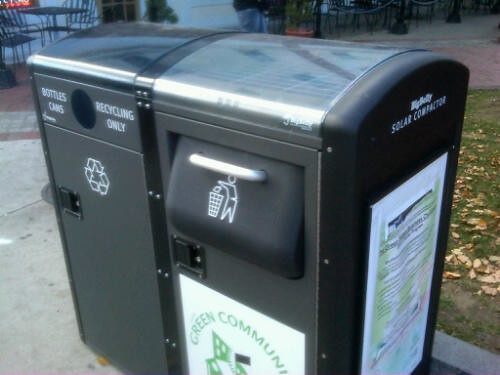
Photo: a solar-powered Big Belly trash compactor seen in Salem, Massachusetts, next to a recycling bin.  Solar photovoltaic panels power this receptacle.

Today I'd like to comment on the story of the Brantley Dam on the Dan River in Danville, Virginia (about 4 hours west of Norfolk).  This older dam once provided water to the now-closed Brantley Steam Plant.  Over the years of changing ownership and possibly insufficient maintenance, the dam has recently become unpopular.  Dam safety is a major issue, with 4 deaths since 1965 attributed to the dam.

The City of Danville Public Works department has issued a report recommending that the Brantley Dam be removed.  The City is now considering removing the dam, and whether sediments trapped in the impoundment behind the dam may be toxic or polluted.  The report suggests a variety of costs for dam removal, ranging from $90,000 for a "simple removal", $110,000 for a “staged removal" - or about $307,000 to remove the dam along with the entirety of the trapped sediments.  Based on the relatively low amount of sediments, the report suggests simple removal is appropriate.

I'm curious to see what will happen with dam removal on the Dan River.  A number of other dams exist across the watershed, some of which are privately owned, and at least one of which (at a water treatment plant) is a partially breached low-head dam - picture a 30' breach in the middle of a short, curving structure.

In this case, the dam played a role in energy generation, though not through hydroelectric capacity; rather, like the Briggsville Dam in Clarksburg, Massachusetts, it was built to provide a steady supply of water for industrial processes.  In this case, the Brantley Dam supplied water to the steam plant electric generation station.  As the economy of industrial production has shifted over the past century, the underlying factory or power plant may change its operations, leaving the dam without its original purpose.  In Brantley Dam's case, the steam plant was ultimately shut down by the utility.

At some point, if the dam poses harms identified by society (safety at the Brantley Dam) without commensurate benefits, the dominant pressures may result in dam removal.  In other cases, especially where hydroelectric production is possible, if dam removal is threatened absent improved fish passage, developers may find it worthwhile to maintain the dam in compliance with the regulations.  In either case, it's a balancing act.

In Maine, last month I noted that the towns of Canton and Hartford were looking for ways to fund a dam repair project on Whitney Brook.  This dam maintains the water levels in Lake Anasagunticook.  The state had condemned the original dam, and the temporary dam needed repairs.  In today's news, the towns have announced that the Maine Outdoor Heritage Fund has awarded them a $5,000 grant for the project.  This fund is funded by designated lottery tickets, and can be used to acquire land and secure public access.  One portion of the project includes a new boat launch and park, triggering eligibility for this grant.

November 3, 2010 - New Hampshire dam removal

Wednesday, November 3, 2010

Dam removal activities are ongoing across the country, and New Hampshire dam removals are among them.  Continuing my survey of dams being removed: today, a look at recent and potential future dam removal activity in New Hampshire.  (If you're looking for Maine dam removal information, check out my post here.)

Photo: a half-forgotten cemetery hidden in the woods just off the beaten track.

According to the New Hampshire Department of Environmental Services, the following New Hampshire rivers have seen dams removed in the last decade:
  • Ashuelot River, McGoldrick Dam, Hinsdale (Removed, 2001)
  • Ashuelot River, Winchester Dam, Winchester (Removed, 2002)
  • Bearcamp River, Bearcamp River Dam, South Tamworth (Removed, 2003)
  • Bellamy River, Bellamy River Dam #5, Dover (Removed, 2004)
  • Contoocook River, West Henniker Dam, Henniker (Removed, 2004)
  • Tioga River, Badger Pond Dam, Belmont (Breached, 2004)
  • Champlin Pond Dam and Champlin Farm Pond Dam, Rochester (Removed, 2005)
  • Pearl Lake Brook, Pearl Lake Brook Dam, Lisbon (Removed 2007)
  • Souhegan River, Merrimack Village Dam, Merrimack (Removed 2008)
  • Black Brook, Maxwell Pond Dam, Manchester (Removed 2009)
  • Winnicut River, Winnicut River Dam, Greenland (Removed 2009)
To this list, we can add at least one 2010 removal:
  • Ashuelot River, Homestead Woolen Mill Dam, West Swanzey

November 1, 2010 - Great Works dam removal?

Monday, November 1, 2010


Brilliant fall colors in the Basin, Phippsburg, Maine.

Continuing my look at dams targeted for removal: today, the Great Works dam on the Penobscot River in Maine.  This is an interesting tale of mills, dams, changes in ownership, and changes in use.  Like the Briggsville Dam in Clarksburg, Massachusetts, the Great Works dam was built to support a mill -- but like the Boston Felt dam, the Great Works dam produced renewable power.

The Great Works Hydroelectric Project (FERC project no. 2312) is located adjacent to the Old Town mill (which has changed hands over the years, and is now owned by Old Town Fuel and Fiber).  Originally built in the late 1800s, the Great Works project's FERC license was issued in 1963, with an original expiration date of March 31, 2002.

In its most recent incarnation, Great Works consisted of a powerhouse containing 11 turbine-generator units totaling about 8 MW of installed capacity; a non-overflow section with two operating fishways and three gated outlet pipes (one 6 foot square, two 9 foot diameter); and a spillway equipped with flashboards extending from the non-overflow section across the river to the east river bank in the Town of Bradley. The total length of the Project is approximately 1,353 feet. The dam forms a 128-acre impoundment at a normal impoundment elevation of 81.73 feet. The tailrace is separated from the main river by an earthen dike and the powerhouse discharges to the tailrace. The presence of the earthen dike creates a bypass reach of approximately 1,200 feet in length, and approximately 1,000 feet of which is a backwater. The project also includes two operating Denil-type fish ladders, one located in the tailrace, the other at the west end of the spillway. An older abandoned fish ladder is located near the center of the spillway.

In March 1997, James River Paper Company owned both the mill and the dam.  James River filed a notice of intent to file an application for a new license.  Shortly thereafter, the dam changed hands to PPL Great Works, LLC.  In 2003, Commission staff suspended the processing of the project's relicense application to allow negotiation of a multi-project, "basin-wide settlement agreement" - a comprehensive agreement covering water flows and dams throughout the Penobscot River watershed.

That agreement - the Lower Penobscot Basin Comprehensive Settlement Accord - ensued on June 25, 2004.  Seven conservation groups, hydroelectric company PPL Corp., the Penobscot Indian Nation and state and federal agencies, agreed to the removal of both the Great Works and Milford dams as well as the removal of flashboards and the installation of a fish bypass at the Howland Dam. 


Pursuant to the settlement agreement, on November 7, 2008, PPL Great Works and the Penobscot River Restoration Trust (Trust) filed an application to transfer the license to the Trust, and the Trust filed an application to surrender the license for the Great Works Project and remove the project’s dam.

On June 16, 2010, FERC issued its order approving the surrender of the project license (29 page PDF of the order).  In its order, FERC described the process to be used in removing the Great Works dam:

The Great Works Project impoundment would be drawn down through the opening of gates and removal of the flashboards. Then, an upstream access road would be constructed from the east bank along the entire length of the spillway. Another road would be constructed downstream out to mid-channel to allow removal of the abandoned fish ladder. The spillway would be removed in sections from west to east with concurrent removal of the access road. Following this, another road would be constructed from the west bank across the upstream side of the powerhouse. From this road, the remaining portion of the spillway immediately adjacent to the powerhouse would be removed along with the two operational fish ladders. The forebay area would be filled and graded and the access road removed. The project’s powerhouse is proposed to remain because it houses equipment for an adjacent pulp mill.
Removal of the Great Works dam may occur in 2012, bringing a close (or at least a new chapter) to this tale of a mill and its dam.  In this case, the greater Lower Penobscot Basin Comprehensive Settlement Accord and the actions of the Penobscot River Restoration Trust played a major role.  In a coming edition, I'll look at the policy considerations that went into that settlement agreement, including the promises of both improved sea-run fish passage and continued hydroelectric generation elsewhere on the Penobscot River.

October 29, 2010 - removing the Briggsville Dam

Friday, October 29, 2010

Photo: down by the West Point dock, Phippsburg.

In Clarksburg, Massachusetts, the Briggsville Dam on the North Branch of the Hoosic River is slated for removal next week.  Preliminary site work has already begun.  At 15 feet in height and 200 feet in length, the Briggsville Dam once provided cooling water to the adjacent Strong-Hewatt Mill.

Here is an interesting article on the pros and cons of removing the Briggsville dam. It's a story whose general contours will resonate with a lot of people in historic mill towns. We have a dam built in the early to mid-1900s to support a manufacturing facility. The factory changes hands several times, until a new mill owner finds it also owns the aging dam. For safety reasons (and in many places, to facilitate fish passage), the dam needs expensive upgrades -- or faces removal.

This is the story of many small dams and hydroelectric facilities across the country.  In Clarksburg, the mill was the Strong-Hewatt woolen mill.  The current owner is Cascade School Supplies Co.,who was apparently surprised to find that the building it acquired came with an aging dam.  Although fish passage will be improved by the removal of the Briggsville Dam, the primary driver of its removal are the safety issues caused by its poor condition.  Dam safety is an important issue, and without the proper capital investments in maintenance and repairs, maintaining an older dam can become an expensive liability.  (For example, see what's going on in Canton, Maine, with the Whitney Brook dam and Lake Anasagunticook.  Or what happened when the Colcord Pond dam failed this past spring.)

In this case, the Briggsville Dam appears to have been used to provide cooling water to the mill, not to generate electricity, so any policy reasons to leave it in are more clearly outweighed by the safety issues. Moreover, it will help the mill property owner avoid the costs of repairing the dam, letting Cascade stay in business at that location.

Certainly an interesting issue.  If you're near Clarksburg, swing by and take a last look at the Briggsville Dam.

October 28, 2010 - Maine dam removal?

Thursday, October 28, 2010

Fiery fall foliage in Phippsburg, Maine.
Yesterday, I mentioned a list of recently-removed Maine dams.  That list describes 20 dams as having been removed as of January 1, 2010, with another ten dams described as "currently proposed or under study for removal":


* Boston Felt Dam Lebanon, ME & Rochester, NH Salmon Falls River

* Coopers Mills Dam Whitefield Sheepscot River

* Gardiner Paperboard Dam Gardiner Cobbosseecontee Stream

* Great Works Dam Old Town & Bradley Penobscot River

* Montsweag Dam Wiscasset & Woolwich Montsweag Brook

* Veazie Dam Veazie & Eddington Penobscot River

* West Winterport Dam Winterport & Frankfort Marsh Stream

* Juliet Mill Dam Lisbon Sabattus River

* Farwell Mill Dam Lisbon Sabattus River

* Martin Brook Upper Dam Madawaska Martin Brook

Of these, several more have been removed.  For example, the Montsweag dam is gone.  The West Winterport dam is also gone.

Let's take a deeper look at one of the dams on this list.  The Boston Felt dam (Project No. 4542–013), which formerly produced 150 kW, was granted an exemption from licensing on August 29, 1983 (24 FERC ¶ 62,240). The project stopped operations in May 2006, due to a breach of the project dam by high river flows.  Project owner Bacon Felt Company, Inc., stated that a 20-foot long, 6-foot wide section of the wooden frame dam was carried away by the flooding.

After the water level dropped, the Federal Energy Regulator Commission ordered the owner to repair the dam.  US Fish and Wildlife Service also gave a directive regarding the installation of fish passage.  The owner allegedly explained why the project was inoperable (damage to the dam) and told FERC that resumption of generation at the project may be beyond its available resources, and said it would file a compliance plan and progress reports.  By September 2009, FERC issued a notice of revocation of exemption by surrender, based on allegations that exemptee had not taken responsive action.

In an October 2009 response, Bacon Felt filed a protest, stating that it had in fact replied to the Commission's information request and had requested a 120-day review period.  By February 2010, the project owner filed a formal motion requesting withdrawal of the notice of revocation of its exemption to maintain the project.  Bacon pointed to a host of changes, including a change in ownership of the company, changes to their manufacturing strategy, and an overall increase in the price of purchased power.  Bacon then argued that it had not surrendered its exemption, nor had it abandoned the project triggering an implied surrender.  Bacon pointed to examples of what implied surrender usually looks like, including:
  • James Lichoulas Jr., 124 F.E.R.C. ¶ 61,255, P 23 (implied surrender found where “the building over the substructure generating facilities [had] been demolished, the generating equipment [was] covered with collapsed building materials, and the wicket gate operators of the turbines appear[ed] to be inoperable.”), on reh’g, 125 F.E.R.C. ¶ 61,195 (2008)
  • New England Fish Co., 38 F.E.R.C. ¶ 61,106, at 61,285 (1987) (finding surrender where the licensee “abandoned good-faith operation of the project in 1964” and “never filed an application for new license when the term of the original license expired in 1977.”)
  • Pinedale Power & Light Co., 38 F.E.R.C. ¶ 61,036 (1987) (finding surrender where the licensee abandoned the project 15 years prior to the surrender decision and sold the property 12 years prior to it).
Bacon then argued that current energy policy still favors the development of suitable waterways, and that it could continue (or resume) producing low-cost renewable power from the project.

The case remains pending before the Commission.


October 26, 2010 - funding for dam rebuilding to maintain lake levels?

Tuesday, October 26, 2010

Fall foliage in the Basin, Phippsburg, above an old tide mill site.

In the past, I've looked at issues relating to dams and the water level of their ponds and impoundments.  For example, in March 2010, dam repair issues on Cobbosseecontee Stream resulted in a drawdown of Pleasant Pond by a foot or so.  Then again, in September 2010, owners considered further dam repair on the Cobbosseecontee that would affect lake levels and users.

Today, a news item from Canton, Maine.  A committee is exploring grant funding to rebuild a dam on Whitney Brook that maintains the water level in Lake Anasagunticook in Canton and Hartford.

The Dam Advisory Committee is now seeking funding to conduct an archeological survey in order to obtain a Community Block Development Grant.  Currently, the old bridge piers remain in the river, while a temporary dam is in place.  If the project is developed, the site will also feature both a boat launching site and a park.

Lake Anasagunticook's water level, and the steps taken to maintain that level, have been the subjects of some contention in recent years.  This 10/30/2009 Kleinschmidt report describes the recent history of the situation:

Several dam safety issues with the existing structure and embankments were identified by the Maine Emergency Management Agency (MEMA) during a dam safety inspection by MBP Consulting in August 1997. Subsequent to issuance of the dam inspection report, MEMA issued a Dam Safety Order to undertake remedial actions to address the dam safety issues. The former dam owner did not comply with this order, dated December 4, 2006. On May 8, 2007, a Supplemental Dam Safety Order was issued by MEMA ordering that the four gates be left open until such time that an acceptable remedial action plan is implemented. Since that date, the gates have been open, thereby reducing the water level in Anasagunticook Lake by approximately 6-feet. The Town of Canton acquired the Anasagunticook Lake Dam through an eminent domain proceeding in 2008.

It will be interesting to see what happens on the lake, and what funding sources are available to support any development.  Even for a project without any energy-related tax credits or incentives, Community Block Development Grants and other federal funding sources may be available for a dam rebuilding project to maintain lake levels.

October 11, 2010 - permitting small and low-impact hydropower projects

Monday, October 11, 2010

As states and the federal government implement policies to promote both renewable power production and greater energy independence, small and low-impact hydropower projects provide a relatively accessible way to participate and benefit from these favorable policies. Today we'll take a walk through three different paths to getting approval from the Federal Energy Regulatory Commission (FERC) for a small hydro project.

First, a quick review of FERC's general licensing procedures. FERC has three licensing processes for hydro projects, all with similar names: the Traditional Licensing Process (TLP), the Alternative Licensing Process (ALP), and the Integrated Licensing Process (ILP).

The TLP is the longest-standing process, with origins dating back to 1935 and Part I of the Federal Power Act. In a TLP, the licensee engages in a three-stage pre-filing consultation process. Once a final application is filed, FERC issues public notice of the application, and solicits comments and intervention by other stakeholders. After further process including an environmental assessment or environmental impact statement, FERC is ready to issue (or deny) the requested license.

While applicants have traditionally used the TLP (hence its name), effective July 23, 2005, the Integrated Licensing Process (ILP) is the default process for filing an application for an original, new, or subsequent license. In fact, Commission approval is now needed to use either the Traditional or the Alternative Licensing Process for larger projects.

The ALP allowed for somewhat more flexibility in the process. For example, in an ALP, an applicant can modify the pre-filing consultation process depending on the circumstances. The ALP allows applicants to streamline the pre-filing consultation process and environmental review processes under the National Environmental Policy Act and other laws. This is achieved in part through a collaborative workgroup to study and resolve issues. Finally, the ALP allows the applicant to prepare a preliminary draft environmental assessment, or allows an environmental impact statement to be drafted by a FERC-selected contractor at the applicant's expense. This allows scoping of environmental issues to occur prior to the application being filed with the Commission. However, the ALP has proved cumbersome in some instances, with a lengthy total process time.

The ILP combines some of the features of both the traditional and alternative processes, including a more formal study development process than under the TLP. This five-year process was adopted by FERC in 2003.

So what about small and low-impact hydropower projects? The Traditional Licensing Process is still used to prepare applications for small projects that qualify for either of two exemptions from FERC's licensing provisions under the Federal Power Act: the "conduit" exemption and the 5-MW exemption.

The conduit exemption operates to simplify the process for a hydropower project on an existing conduit (for example an irrigation canal). Conduit exemptions are authorized for generating capacities 15 megawatts or less for non-municipal and 40 megawatts or less for a municipal project. The conduit has to have been constructed primarily for purposes other than power production and be located entirely on non-federal lands.

Another exemption applies to small hydropower projects, which are 5 megawatts or less, that will be built at an existing dam, or projects that utilize a natural water feature for head or an existing project that has a capacity of 5 megawatts or less and proposes to increase capacity.

September 9, 2010 - Lightship Nantucket; FERC signs Colorado MOU on small hydro

Thursday, September 9, 2010

The Lightship Nantucket WLV61, in port on Martha's Vineyard in summer 2010.  Until 1983, lightships such as this were used to mark shoals; they have since been functionally replaced (if not aesthetically so) by automated buoys.
The Federal Energy Regulatory Commission (FERC) is working with states to promote the development (or redevelopment) of small hydropower projects across the country.  FERC has recently signed Memoranda of Understanding (MOUs) with four states on the development of hydrokinetic projects: California, Washington, Maine, and Oregon.  Now FERC has signed an MOU with Colorado to streamline the procedures for developing small-scale hydropower projects in Colorado.  According to a recent federal survey, Colorado could be host to several hundred potential small (5 MW or smaller) hydropower projects.  Altogether, these small projects could add up to a combined capacity of more than 1,400 MW.

The MOU focuses on the development by Colorado of a pilot program to test procedural options for simplifying the processes for developers to obtain conduit exemptions and small (5MW or less) project exemptions.

The MOU opens the door for developers of small projects in Colorado to participate in the pilot program.  Colorado and FERC are both expected to take input from project developers about the kind of obstacles they face in permitting and exempting small projects - and about what can be done to help more projects be developed.

As we've seen in Maine, developing or redeveloping small hydro projects can run into siting and permitting challenges at the federal, state, and local levels.  For example, the Scribner's Mill dam reconstruction and repowering project on the Crooked River in Maine faces opposition on water quality, environmental and fisheries concerns.  While an MOU like that between FERC and Colorado might not eliminate these challenges, stakeholders are hopeful that a resolution will be reached that allows environmentally responsible projects to move forward.

August 2, 2010 - my electricity supply mix; repowering small hydro

Monday, August 2, 2010

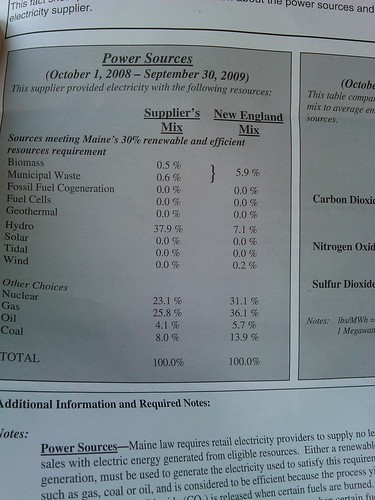
Do you know where the energy you consume came from? Electricity consumers in Maine like me get mailings detailing the fuel mix behind our electric generation. Here's the one I received last week:

Standard offer supply mix

This shows that the largest share of my kilowatt-hours (37.9%) comes from hydro-electric generation. Natural gas is next (25.8%), with nuclear from Seabrook close behind (23.1%). For the remaining renewables, I get 0.5% from biomass and 0.6% from municipal solid waste combustion -- totaling a renewable portfolio of 39%. This is well in excess of Maine's basic 30% RPS, suggesting that renewables can be very cost-effective at providing energy, at least in light of the current basket of renewable power incentives like grants, tax credits, and long-term contracts.

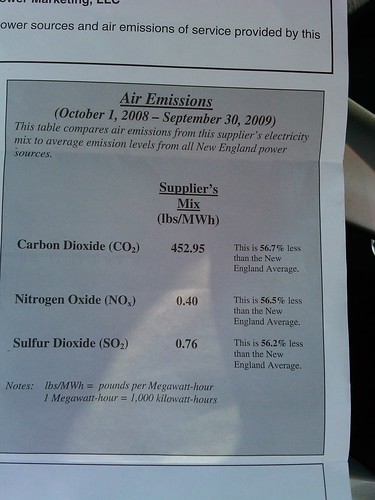
The mailings also provide information on air emissions from this generation mix.
Standard offer 2

This supplier's mix averaged 452.95 lbs CO2 per MWh generated, which is stated as 56.7% below the New England average. (Credit our reliance on renewables, as well as natural gas, for this number.) The supplier's mix also emitted 0.4 lbs NOx per MWh, and 0.7 lbs SOx per MWh -- all over 56% below New England's average.


An interesting bit of late-breaking news: Maine Governor Baldacci has nominated David Littell to fill the vacant seat on the Maine Public Utilities Commission. Dave is currently the Commissioner of the Maine Department of Environmental Protection.

After 378 years of continuous ownership and operation, what is believed to be the country's oldest family farm is up for sale.

As we look for renewable energy sources, many people are considering repowering small hydro dams. Many dams formerly had energy development, either mechanical or hydroelectric. Scribner's Mill, in the Maine town of Harrison, once had such a small dam and sawmill. Now, a group of historical enthusiasts called Scribner's Mill Preservation Inc. is proposing to rebuild the dam to power the restored sawmill. The Maine DEP is now reviewing their plans.