Showing posts with label sawmill. Show all posts

FERC rules off-grid micro-hydro needs no license

Thursday, March 24, 2016

Federal hydropower regulators have granted reconsideration of a 2015 order finding licensing required for an off-grid micro-hydropower project proposed in Massachusetts.  Based on newly submitted evidence that the proposed project would not be connected to an interstate grid, the order granting reconsideration finds that Section 23(b)(1) of the Federal Power Act does not require licensing of the proposed Egnaczak Net Zero Hydro Project.

The case involves a project proposed by Kenneth and Susan Egnaczak, to be located at an existing water-powered mill complex on the Hoosic River in Cheshire, Massachusetts.  The so-called "Egnaczak Net Zero Hydro Project" would have a total generating capacity of 10.7 kilowatts.  The power would be used at a home and workshop proposed for construction along the river.

Under Section 23(b)(1) of the Federal Power Act, an entity proposing a hydropower project must generally file with the Federal Energy Regulatory Commission either a hydropower license application, or a Declaration of Intention to determine if the proposed project requires a license.  The Egnaczaks filed a Declaration of Intention for the project in February 2015.  On September 11, 2015, Commission staff issued an order finding that the Federal Power Act requires a license to be issued for the project's construction, maintenance, and operation.

Section 23(b)(1) of the Federal Power Act requires a non-federal hydroelectric project to be licensed if it falls into any of four categories: (1) is located on “navigable waters of the United States;” (2) occupies lands or reservations of the United States; (3) uses surplus water or water power from a federal dam; or (4) is located on a non-navigable stream which is subject to the authority of Congress under the Commerce Clause, affects the interests of interstate or foreign commerce, and is constructed or enlarged after August 26, 1935.

In its September 2015 order on the Egnaczak project, Commission staff analyzed the facts as applied to these facts.  On category 1, staff found that there is insufficient evidence to determine whether the Hoosic River is navigable at the project site.  Staff readily dispensed with categories 2 and 3, finding that the project would neither occupy any public lands or reservations of the United States nor use surplus water or waterpower from a Federal government dam.

In September, staff found that the project fell into the fourth category.  In the order, staff noted that it would be located on a non-navigable Commerce Clause stream, would be constructed after 1935, and would affect the interests of interstate commerce because the project would offset both electrical and heating needs for the applicants’ home and workshop that would have been otherwise supplied by the interstate grid.  The order cited judicial precedent, noting, "It is well settled that small hydroelectric projects that are connected to the interstate grid affect interstate commerce by displacing power from the grid, and the cumulative effect of the national class of these small projects is significant for purposes of FPA section 23(b)(1)." Staff therefore determined that the project requires licensing under FPA section 23(b)(1).

But on January 6, 2016, the applicants filed a request for reconsideration and additional evidence in support of their argument that the project does not require licensing.  This evidence focused on the fact that the project would not be connected to the interstate grid and thus would not affect interstate commerce.  As later described by the Commission:
They state that, because neither their home nor workshop has been constructed, they have no existing grid connection. Further, they explain that the project alone will power their home and workshop. The applicants state that the project would produce hydro-mechanical power using a waterwheel, Archimedes Screw, or turbine. The mechanical power would be connected to the hydro generator units to produce electricity or to power rotating equipment, such as a sawmill. In addition, the applicants state that they will use backup power from a fossil fuel electric generator and storage batteries, which would be charged by the hydro generators or the fossil fuel electric generator.
In a March 24, 2016 order, the Commission staff found that the applicants had demonstrated that the Net Zero Project would not be connected to an interstate grid.  That order finds that the micro-hydro project would not displace power that would otherwise be supplied by the grid and thus would not affect interstate commerce.  As a result, it concludes that "section 23(b)(1) of the FPA does not require licensing of the proposed Net Zero Project."

The March 24 order does include a warning: "if the project or the applicants’ unconstructed home or workshop are connected to the interstate grid in the future, section 23(b)(1) of the FPA would require licensing and the Commission could require the applicants to apply for a license under section 4(g) of the FPA."

Thus in at least this one case, the off-grid nature of the micro-hydro project was a critical factor in the order finding that Section 23(b)(1) of the Federal Power Act does not require licensing of the proposed Egnaczak Net Zero Hydro Project.  The key to the revised finding that the project would have no effect on interstate commerce appears to be the fact that power would be consumed in buildings not yet built, with no existing grid tie.

June 10, 2011 - Idaho restricts wind/solar incentive

Friday, June 10, 2011

Regulators in Idaho have restricted an incentive for certain small wind and solar projects, but renewable projects can still qualify for the right to sell their power to utilities.  At its heart, the issue is an old one: who should pay for renewable development, and how much should they pay.

The federal Public Utilities Regulatory Policy Act of 1978 (PURPA) authorizes FERC to require utilities to purchase power from renewable “qualifying facilities”.  Under PURPA, utilities must sign contracts  with qualifying facilities to buy their output at a rate capped at the utility's "avoided cost", or marginal cost to produce the next incremental kilowatt-hour.

Because utilities’ avoided costs are typically set based on the default fleet of generators, a qualifying facility cannot use PURPA to receive a price premium over the marginal conventional resource.  However, having the right to require a utility to buy your power is a valuable incentive for developing a renewable project. 

Each state sets the avoided cost rates for its own qualifying facilities.  In Idaho, large generators have to negotiate individual avoided cost rates with utilities.  To help smaller qualifying facilities, projects smaller than a specified threshold don’t have to negotiate, but can sell power to utilities at “published” avoided cost rates which are generally more favorable for project developers.

Where that threshold is set affects who can qualify for those published rates.  Originally, facilities whose average output was 10 MW or smaller qualified for the published rates.   However, utilities complained to the Idaho Public Utilities Commission, asking for the threshold to be lowered to 100 kW.  Utilities complained that ratepayers should not have to bear above-market costs, particularly not costs in excess of the actual avoided cost limit set by PURPA.  Commenters also complained about large projects trying to circumvent the threshold by characterizing themselves as a series of smaller projects in order to qualify for the incentive.  At the end of 2010, the Commission temporarily reduced the threshold to 100 kW for wind and solar resources, leaving it at 10 aMW for other resources. 

This week, the Idaho Public Utilities Commission has issued an order (Order No. 23362, 10 page PDF) leaving the lowered 100 kW threshold for wind and solar in place.  The Commission noted that it would be "illegal pursuant to PURPA" to allow large projects to obtain a rate that does not accurately reflect the utility's avoided cost.  As a result, Idaho wind and solar projects' right to sell power at the more favorable published avoided cost rates is now limited to projects smaller than 100 kW.  Larger projects can still avail themselves of negotiated avoided cost rates.

August 27, 2010 - restoring old dams? sunken treasure

Friday, August 27, 2010

Storm over the Kennebec River near Dresden

Earlier this month, I wrote about the situation at Scribner's Mill on the Crooked River in Maine.  The Scribner's Mill Preservation Project is doing a great job of restoring the old sawmill located on the banks of the river.  Formerly, the sawmill was paired with a nine-foot dam that was breached in 1972; prior to dam breach, the impounded water fell through water wheels to power the mill directly.  The mill preservationists are again proposing to build a dam on the site to allow the mill to regain its status as a working water mill.  Two years ago, they proposed putting up a 4' dam; the Maine Department of Environmental Protection rejected their efforts.  Now they're proposing a 3' dam.

Arguments against rebuilding the dam include ones based on the importance of the Crooked River to the entire Sebago Lake ecosystem.  The Crooked River is the principal spawning habitat for the famous wild landlocked salmon in the lake.  Landlocks are the same species as Atlantic salmon, but spend their entire lives in fresh water.  Maine has a special fishery for wild landlocked salmon, and Sebago Lake is one of its most accessible waterbodies.  In addition to fisheries concerns, the Crooked River is also the principal surface inflow of water into the lake, which is the drinking source for about 200,000 people in Maine.

Last night, Maine Public Broadcasting Network ran a good story on the debate.

In other renewable news: following on the recent ORPC tidal energy turbine installation at a Coast Guard facility in Eastport, today the Coast Guard is raising a wind turbine at a Southwest Harbor facility.


Who doesn't love a tale of a forgotten shipwreck holding a sunken treasure?  During a blizzard in February 1944, the British freighter Empire Knight foundered on a covered reef near Boon Island off York, Maine.  The ship broke up and sank.  In 1990, the Coast Guard learned that the ship contained over 17,000 pounds of mercury.  Divers recovered a small portion of the mercury and contaminated material, but found that 16,000 pounds had escaped and was loose in a cargo hold.  The Coast Guard closed the site.  Now, a treasure hunter wants to recover the mercury in an environmentally responsible manner -- and also what he believes may be copper-platinum wire worth $200 million (a bit more valuable than the copper wire commonly stolen!), plus a "secret cargo" that could be worth from $10 million on up.

August 2, 2010 - my electricity supply mix; repowering small hydro

Monday, August 2, 2010

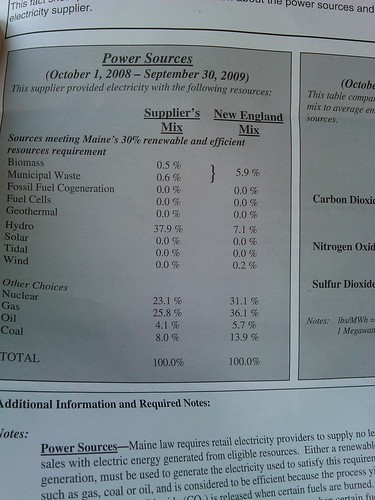
Do you know where the energy you consume came from? Electricity consumers in Maine like me get mailings detailing the fuel mix behind our electric generation. Here's the one I received last week:

Standard offer supply mix

This shows that the largest share of my kilowatt-hours (37.9%) comes from hydro-electric generation. Natural gas is next (25.8%), with nuclear from Seabrook close behind (23.1%). For the remaining renewables, I get 0.5% from biomass and 0.6% from municipal solid waste combustion -- totaling a renewable portfolio of 39%. This is well in excess of Maine's basic 30% RPS, suggesting that renewables can be very cost-effective at providing energy, at least in light of the current basket of renewable power incentives like grants, tax credits, and long-term contracts.

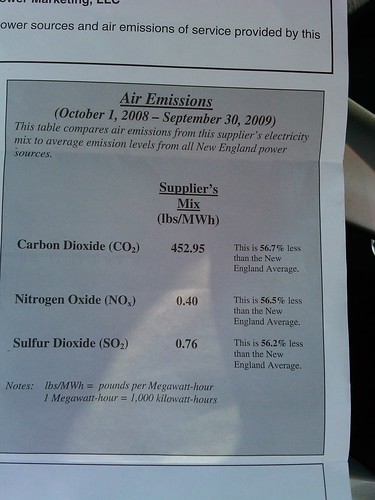
The mailings also provide information on air emissions from this generation mix.
Standard offer 2

This supplier's mix averaged 452.95 lbs CO2 per MWh generated, which is stated as 56.7% below the New England average. (Credit our reliance on renewables, as well as natural gas, for this number.) The supplier's mix also emitted 0.4 lbs NOx per MWh, and 0.7 lbs SOx per MWh -- all over 56% below New England's average.


An interesting bit of late-breaking news: Maine Governor Baldacci has nominated David Littell to fill the vacant seat on the Maine Public Utilities Commission. Dave is currently the Commissioner of the Maine Department of Environmental Protection.

After 378 years of continuous ownership and operation, what is believed to be the country's oldest family farm is up for sale.

As we look for renewable energy sources, many people are considering repowering small hydro dams. Many dams formerly had energy development, either mechanical or hydroelectric. Scribner's Mill, in the Maine town of Harrison, once had such a small dam and sawmill. Now, a group of historical enthusiasts called Scribner's Mill Preservation Inc. is proposing to rebuild the dam to power the restored sawmill. The Maine DEP is now reviewing their plans.