Showing posts with label Scribner's Mill. Show all posts
September 9, 2010 - Lightship Nantucket; FERC signs Colorado MOU on small hydro
Thursday, September 9, 2010
The MOU focuses on the development by Colorado of a pilot program to test procedural options for simplifying the processes for developers to obtain conduit exemptions and small (5MW or less) project exemptions.
The MOU opens the door for developers of small projects in Colorado to participate in the pilot program. Colorado and FERC are both expected to take input from project developers about the kind of obstacles they face in permitting and exempting small projects - and about what can be done to help more projects be developed.
As we've seen in Maine, developing or redeveloping small hydro projects can run into siting and permitting challenges at the federal, state, and local levels. For example, the Scribner's Mill dam reconstruction and repowering project on the Crooked River in Maine faces opposition on water quality, environmental and fisheries concerns. While an MOU like that between FERC and Colorado might not eliminate these challenges, stakeholders are hopeful that a resolution will be reached that allows environmentally responsible projects to move forward.
August 27, 2010 - restoring old dams? sunken treasure
Friday, August 27, 2010
![]() |
| Storm over the Kennebec River near Dresden |
Earlier this month, I wrote about the situation at Scribner's Mill on the Crooked River in Maine. The Scribner's Mill Preservation Project is doing a great job of restoring the old sawmill located on the banks of the river. Formerly, the sawmill was paired with a nine-foot dam that was breached in 1972; prior to dam breach, the impounded water fell through water wheels to power the mill directly. The mill preservationists are again proposing to build a dam on the site to allow the mill to regain its status as a working water mill. Two years ago, they proposed putting up a 4' dam; the Maine Department of Environmental Protection rejected their efforts. Now they're proposing a 3' dam.
Arguments against rebuilding the dam include ones based on the importance of the Crooked River to the entire Sebago Lake ecosystem. The Crooked River is the principal spawning habitat for the famous wild landlocked salmon in the lake. Landlocks are the same species as Atlantic salmon, but spend their entire lives in fresh water. Maine has a special fishery for wild landlocked salmon, and Sebago Lake is one of its most accessible waterbodies. In addition to fisheries concerns, the Crooked River is also the principal surface inflow of water into the lake, which is the drinking source for about 200,000 people in Maine.
Last night, Maine Public Broadcasting Network ran a good story on the debate.
In other renewable news: following on the recent ORPC tidal energy turbine installation at a Coast Guard facility in Eastport, today the Coast Guard is raising a wind turbine at a Southwest Harbor facility.
Who doesn't love a tale of a forgotten shipwreck holding a sunken treasure? During a blizzard in February 1944, the British freighter Empire Knight foundered on a covered reef near Boon Island off York, Maine. The ship broke up and sank. In 1990, the Coast Guard learned that the ship contained over 17,000 pounds of mercury. Divers recovered a small portion of the mercury and contaminated material, but found that 16,000 pounds had escaped and was loose in a cargo hold. The Coast Guard closed the site. Now, a treasure hunter wants to recover the mercury in an environmentally responsible manner -- and also what he believes may be copper-platinum wire worth $200 million (a bit more valuable than the copper wire commonly stolen!), plus a "secret cargo" that could be worth from $10 million on up.
Labels:
Coast Guard,
copper,
Crooked River,
dam removal,
dam restoration,
mercury,
ORPC,
platinum,
salmon,
sawmill,
Scribner's Mill,
Sebago,
shipwreck,
tidal energy,
treasure,
wind,
York County
August 2, 2010 - my electricity supply mix; repowering small hydro
Monday, August 2, 2010
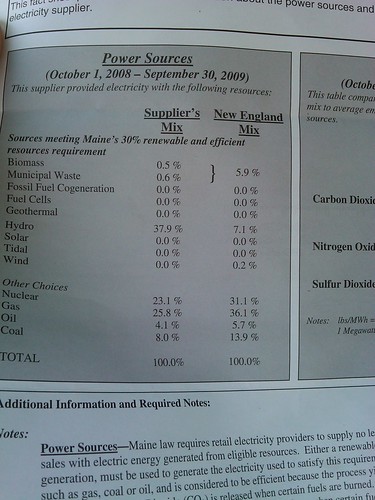
Do you know where the energy you consume came from? Electricity consumers in Maine like me get mailings detailing the fuel mix behind our electric generation. Here's the one I received last week:

This shows that the largest share of my kilowatt-hours (37.9%) comes from hydro-electric generation. Natural gas is next (25.8%), with nuclear from Seabrook close behind (23.1%). For the remaining renewables, I get 0.5% from biomass and 0.6% from municipal solid waste combustion -- totaling a renewable portfolio of 39%. This is well in excess of Maine's basic 30% RPS, suggesting that renewables can be very cost-effective at providing energy, at least in light of the current basket of renewable power incentives like grants, tax credits, and long-term contracts.
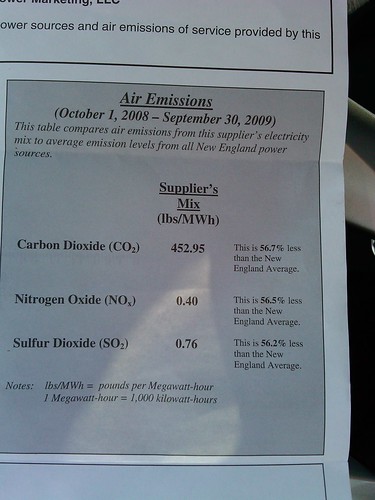
The mailings also provide information on air emissions from this generation mix.

This supplier's mix averaged 452.95 lbs CO2 per MWh generated, which is stated as 56.7% below the New England average. (Credit our reliance on renewables, as well as natural gas, for this number.) The supplier's mix also emitted 0.4 lbs NOx per MWh, and 0.7 lbs SOx per MWh -- all over 56% below New England's average.
An interesting bit of late-breaking news: Maine Governor Baldacci has nominated David Littell to fill the vacant seat on the Maine Public Utilities Commission. Dave is currently the Commissioner of the Maine Department of Environmental Protection.
After 378 years of continuous ownership and operation, what is believed to be the country's oldest family farm is up for sale.
As we look for renewable energy sources, many people are considering repowering small hydro dams. Many dams formerly had energy development, either mechanical or hydroelectric. Scribner's Mill, in the Maine town of Harrison, once had such a small dam and sawmill. Now, a group of historical enthusiasts called Scribner's Mill Preservation Inc. is proposing to rebuild the dam to power the restored sawmill. The Maine DEP is now reviewing their plans.
Labels:
carbon,
dam,
emissions,
generation,
Maine,
mix,
renewable portfolio standard,
renewables,
repowering,
sawmill,
Scribner's Mill,
small hydro
Subscribe to:
Posts (Atom)