August 10, 2010 - Martha's Vineyard wind; Ocean Energy Institute

Tuesday, August 10, 2010

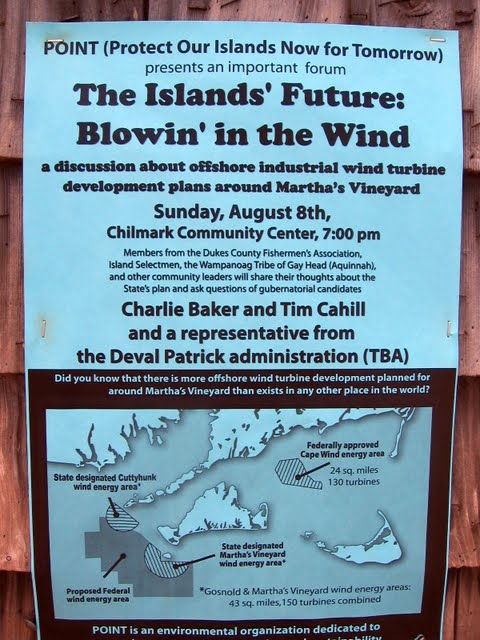
A sign seen on the shore of Martha's Vineyard at Aquinnah.  Like Martha's Vineyard and Vinalhaven, many island communities are considering whether wind turbines -- either onshore or offshore -- are a wise move.

In ocean energy news, Matthew Simmons, the founder of the Rockland, Maine-based Ocean Energy Institute has died.  Simmons was the founder Simmons & Co. International, an investment banking firm focusing on energy.  Convinced of the value of ocean energy, in 2007, he founded the Ocean Energy Institute as "a think-tank and venture capital fund addressing the challenges of U.S. offshore renewable energy".  Echoing a trope we have heard often lately, Simmons once gave a slideshow in which he is reported to have said, "The Gulf of Maine will soon become a Silicon Valley and begin proving ocean energy can be captured, processed and turned into a replacement for modern energy and water."

The city of South Portland, Maine is considering forming a nonprofit energy supply company to save citizens money on their electricity supply.  The business, putatively called South Portland Energy, would buy power at wholesale in the NEPOOL market and sell it to the city -- and perhaps also to residential and commercial ratepayers.  This kind of nonprofit competitive electricity supplier can cut ratepayers' supply costs, without requiring the formation of a municipal electric transmission and distribution utility.

Railroad tracks form an important kind of infrastructure; walking and hiking paths form another.  The balance between replacing rail tracks with hiking trails is an interesting policy question.  This Portland Press Herald editorial suggests that foot paths should not replace rail; the two can coexist, but a path should not preclude the use of the right of way for passenger and freight service.

Cogentrix has signed a 20 year contract with Xcel Energy subsidiary Public Service Company of Colorado for the output of its 30 MW concentrating photovoltaic solar energy plant.  The project, located in southern Colorado, relies on a concentrating photovoltaic technology using lenses to focus incoming sunlight onto solar photovoltaic cells.  This results in a higher energy density (in kW per acre) than other solar technologies.

August 9, 2010 - new nuclear, flywheel storage, China energy efficiency crackdown

Monday, August 9, 2010

Nuclear power is a hot topic -- specifically the construction of new nuclear plants, something that most countries in the world have been slow to do in recent years.  Now the United Kingdom says it anticipates building its first new nuclear plant in 2018,  most likely on-site at existing nuclear facilities.

Meanwhile, in midcoast Maine, where the spent fuel from the decommissioned Maine Yankee nuclear plant has been stored on-site in Wiscasset, an editorial in the Brunswick Times Record calls for the nuclear waste to be shipped away.  The editorial notes that citizens were told that waste would be removed by 2010 -- and with Yucca Mountain no longer viable as a storage site, area residents see no prospect of the waste being taken away as promised.

Just as oil and natural gas tank storage capacity can be used to smooth out swings in the availability and market price of fuel, energy storage can play a major role in ensuring power service while dampening price swings.  Frequency regulation -- keeping the alternating current at 60 Hz, which essentially requires smoothing out the gap between supply and demand on an instantaneous basis -- is an important service that all electric grids need.  As more and more intermittent generation resources come online, like wind, grids need more and more frequency regulation.  Massive mechanical flywheels can provide this service. In today's news, Beacon Power Corporation has closed on a $43 million DOE-backstopped loan, completing the financing for the 20 MW flywheel energy storage plant Beacon is building in Stephentown, New York.  The plant, which is under construction and on budget, is projected to cost $69 million, about 80% of which represents direct facility costs.  The Federal Financing Bank, part of the U.S. Treasury, provided the $43 million loan. NYSERDA provided a $2 million grant, with Beacon putting up the remaining $26 million in cash, in-kind assets, and project costs.  Beacon is also planning two more 20 MW flywheel projects: one in Glenville, NY, and one in the PJM Interconnection.

Supporting renewable and energy efficiency projects through grant funding programs is one way to improve a state's energy efficiency and emissions.  In China, the world's largest energy consumer, the government is taking a different approach: ordering 2,087 industrial manufacturers rated as having low energy efficiency to close.  Affected facilities, which produce steel, concrete, paper, coke, and forest products, will lose their emissions licenses next month.  Just to be sure, the government will order utilities and banks to cease dealings with the sanctioned businesses.  The government's stated motivations include slippage on its five-year plan energy efficiency plan, as China's economic recovery and booming construction industry drive energy consumption up.

Maine is moving forward with PACE financing -- but municipalities need to take a bit of action to open the door to residential energy efficiency in their communities.

Two quick links to Lewiston Sun Journal pieces about wind.  First, a story by Naomi Schalit critical of the results of Governor Baldacci's pro-wind efforts.  Second, a letter from my friend and Leadership Maine classmate Paul Williamson providing a counterpoint to last month's Jonathan Carter column critical of Maine mountaintop wind.  More to follow on these stories soon.

August 6, 2010 -

Thursday, August 5, 2010

Getting utility service to Maine's island communities has always been a challenge.  Many remain separated from mainland utility infrastructure like electric distribution lines; most do not have water or sewer pipeline connections to the mainland.  Squirrel Island, near Boothbay Harbor, is one exception, with a water pipe from the mainland.  Back in 1919, this pipe -- and who should pay for it -- was the subject of legislative debate.

August 5, 2010 - Patriot Place gets solar power; integrating wind into the grid

 
 Solar power in action: making wind, pushing sails past Ram Island Light, Boothbay Harbor, Maine.

Several large utilities including Duke Energy Corp. have reported significantly increased power sales for the second quarter of 2010, particularly from industrial customers.  Duke now projects that 2010 power sales will rise 2%.  At its midwestern operating companies, Duke noted 20% growth in industrial power sales.

Here's a short letter to the editor of the Lewiston Sun Journal about old swimming holes now gone, including the impoundments behind older mill dams like the Barker Mill Dam on the Little Androscoggin River.

Add another high-profile place to the list of large businesses adding solar power: Patriot Place, the shopping mall adjoining the New England Patriots' Gillette Stadium, has installed a 525 kW solar array.  They turned to Constellation Energy for the installation, but the solar photovoltaic panels themselves were manufactured by Evergreen Solar of Massachusetts.

Wind turbine prices are flat, averaging about $1.37 million per megawatt of capacity according to a survey by Bloomberg New Energy Finance.  (Note that this is just the turbine price; towers, transmission and installation are all in addition to the turbine price.)  Turbine pricing is down about 15% from its peak in 2008, likely due to a mix of factors including new technology and increased production capacity, but also some decreased demand compared to the initial fervor.

Meanwhile, people continue to solve the problem of how to integrate wind into the grid.  Energy storage is one major approach.  Xcel Energy has issued a report on its experiments with massive 1 megawatt batteries to smooth out voltage and current from wind farms.  Xcel's project in Minnesota is promoted as America's first direct wind-energy-storage project.

August 4, 2010 - House CLEAR Act; Monhegan energy

Wednesday, August 4, 2010

One of the dominant forms of energy on Monhegan Island, Maine: propane tanks.  About 10 miles offshore, Monhegan does not have any electric cables to the mainland, relying instead on a 300-kilowatt diesel generator. For home heating, cooking, lighting and even refrigeration, many island residents still use propane.  Monhegan is also considering wind resources.

On July 30, 2010, the House of Representatives passed H.R. 3534, the Consolidated Land, Energy, and Aquatic Resources (CLEAR) Act by a vote of 209 to 193.  Much of CLEAR came from the previous Blowout Prevention Act of 2010 (H.R. 5626) (things like requiring blowout preventers, CEO accountability, etc.)

CLEAR also does the following:

  • Shifts around Dept of Interior agencies (abolishes the Minerals Management Service)
  • Reforms Outer Continental Shelf Lands Act and Federal Onshore Oil and Gas Leasing Program to protect environment and safety, and to repeal certain royalty relief and royalty-in-kind provisions
  • Reforms oil and gas royalties.
  • Full funding for the Land and Water Conservation and Historic Preservation Funds.
  • Alternative energy development, specifically leasing federal land for commercial wind and solar leasing program.  The Bureau of Land Management and US Forest Service can lease land for commercial wind and solar projects.  It has a transmission savings provision ("Nothing in this title shall affect the authority of a Federal agency to issue right-of-way grants for electric transmission facilities.")
  • Coordination and planning.  Better interagency coordination on the use of Federal energy resources.
  • Geothemal production expansion.
  • Conservation fee on all oil and gas leases on Federal onshore and offshore lands.  $2 per barrel of oil, 20 cents per million Btu of gas, sunsetting in 2021.

August 3, 2010 - Horsetooth Reservoir; Maine wind; firewood

Tuesday, August 3, 2010

If you're feeling the heat today, perhaps you'll take comfort in this wintry picture from last January.  You're looking west across Horsetooth Reservoir outside Fort Collins, Colorado.  Horsetooth Reservoir is part of the Colorado-Big Thompson Project, which includes water diversion from the west slope to feed the more populous Front Range area of Colorado.  Horsetooth Reservoir also provides water storage for hydroelectric generation.


The Maine Forest Service is reminding people that there is a ban on using out-of-state firewood in Maine, due to concerns over invasive species including insects and fungal pathogens.  Firewood is a major source of energy in Maine, but pests like the Asian Longhorned Beetle threaten to severely damage Maine's valuable forests.  The Asian Longhorned Beetle is already present in Massachusetts, but has not officially been documented in Maine.

Today brings more coverage of yesterday's nomination of David Littell to fill the vacancy on the Maine Public Utilities Commission.

Here's an editorial by Norman Kalloch in the Lewiston Sun Journal criticizing what the author sees as hype over wind energy.  He compares current tropes like "Maine is the Saudi Arabia of wind" to past busts, like nuclear power being perceived as "too cheap to meter.  (This isn't Mr. Kalloch's first such editorial; here's one he wrote this spring.)  Here's the punchline:
"In reality, commercial wind power is an unreliable, environmentally degrading, overpriced form of power generation. Nothing short of massive amounts of public money can make those projects happen, because no developer in his right mind would undertake a project without public money."

We're in for a blast of solar radiation tonight, as ions thrown off by the Sun during Sunday's coronal mass ejection.

How about energy efficient street lighting?  The town of Lexington, Massachusetts, has approved a $930,000 plan to replace existing bulbs with compact fluorescent lights (CFLs).  Lexington's 3,400 streetlights have consumed nearly 2 million kilowatt-hours per year; this project will save 1.3 million kWh per year, totalling almost $190,000 annually.  This project is projected to pay for itself within 3.6 years, thanks in part to a $237,724 grant from utility NStar.

August 2, 2010 - my electricity supply mix; repowering small hydro

Monday, August 2, 2010

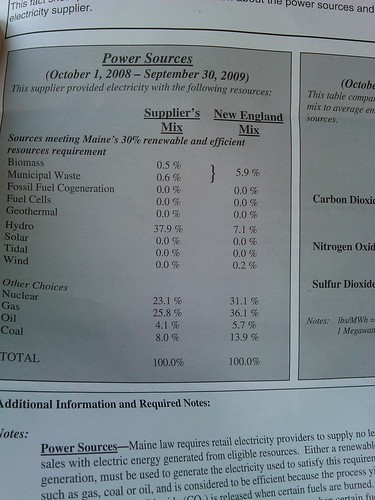
Do you know where the energy you consume came from? Electricity consumers in Maine like me get mailings detailing the fuel mix behind our electric generation. Here's the one I received last week:

Standard offer supply mix

This shows that the largest share of my kilowatt-hours (37.9%) comes from hydro-electric generation. Natural gas is next (25.8%), with nuclear from Seabrook close behind (23.1%). For the remaining renewables, I get 0.5% from biomass and 0.6% from municipal solid waste combustion -- totaling a renewable portfolio of 39%. This is well in excess of Maine's basic 30% RPS, suggesting that renewables can be very cost-effective at providing energy, at least in light of the current basket of renewable power incentives like grants, tax credits, and long-term contracts.

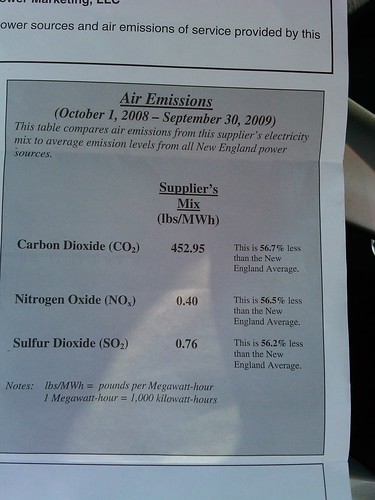
The mailings also provide information on air emissions from this generation mix.
Standard offer 2

This supplier's mix averaged 452.95 lbs CO2 per MWh generated, which is stated as 56.7% below the New England average. (Credit our reliance on renewables, as well as natural gas, for this number.) The supplier's mix also emitted 0.4 lbs NOx per MWh, and 0.7 lbs SOx per MWh -- all over 56% below New England's average.


An interesting bit of late-breaking news: Maine Governor Baldacci has nominated David Littell to fill the vacant seat on the Maine Public Utilities Commission. Dave is currently the Commissioner of the Maine Department of Environmental Protection.

After 378 years of continuous ownership and operation, what is believed to be the country's oldest family farm is up for sale.

As we look for renewable energy sources, many people are considering repowering small hydro dams. Many dams formerly had energy development, either mechanical or hydroelectric. Scribner's Mill, in the Maine town of Harrison, once had such a small dam and sawmill. Now, a group of historical enthusiasts called Scribner's Mill Preservation Inc. is proposing to rebuild the dam to power the restored sawmill. The Maine DEP is now reviewing their plans.