Showing posts with label cost. Show all posts

Maine PUC inquires into storm costs and grid resilience

Wednesday, August 14, 2024

Citing "increasing storm frequency and severity, and escalating storm restoration costs", Maine utility regulators have opened an inquiry to obtain information about the problem and how it could be addressed.

On July 25, 2024, the Maine Public Utilities Commission (PUC) issued a Notice of Inquiry in docket 2024-00191. According to that notice:

Maine is experiencing increasing storm frequency and severity, and escalating storm restoration costs. While utilities are developing their grid plans and doing the vulnerability assessments and preparing resiliency/mitigation plans, the Commission opens this inquiry to look for some shorter-term efforts to reduce the impact of storm damage to the system and study ways in which Maine’s electric utilities may more proactively address escalating storm costs.

The PUC's notice includes a list of questions and prompts for comment by September 4, 2024. Some questions ask how other states are addressing storm- and resilience-related costs. Others seek information on how Maine utilities might behave differently -- for example, leveraging data systems to prioritize resilience upgrades, shifting away from wood poles, or changing tree trimming protocols and other vegetation management programs. The questions also ask about what "resilience" means and how it can be quantified.

Under PUC practice, an inquiry is a relatively informal proceeding initiated by the PUC to gather information. After the PUC collects information through an inquiry, it can use what it learned to inform a subsequent adjudicatory proceeding (like an investigation) or a rulemaking. 

Outside this inquiry, a recently enacted law requires each of Maine's investor-owned transmission and distribution utilities to develop "a 10-year integrated grid plan designed to improve system reliability and resiliency and enable the cost-effective achievement of the State’s greenhouse gas reduction obligations and climate policies." The utilities must file their proposed grid plans by January 12, 2026.

A separate statute requires each utility to file a 10-year climate change protection plan that includes specific actions for addressing the expected effects of climate change on the utility's assets needed to transmit and distribute electricity to its customers. The first climate change protection plans were due on December 31, 2023, and must be updated every three years.

Holyoke utility imposes moratorium on new gas service, citing pipeline constraints

Friday, February 15, 2019

The municipal utility serving the town that hosts the headquarters for the operator of the regional electric grid has informed its customers that the utility “is unable to accommodate new natural gas service requests due to the lack of natural gas availability in the region.” Holyoke Gas & Electric adds, “Recent proposals that would increase natural gas capacity in the region have been met with opposition, and the current pipeline constraints are causing significant adverse environmental and economic impacts on the region's ratepayers."

Holyoke Gas & Electric is a consumer-owned municipal utility established in 1902 through the purchase of a gas and electric plant from the Holyoke Water Power Company. According to the utility, the town saw ownership of a municipal utility "as a way to stabilize rates and keep local control over their energy services." As a municipal utility, Holyoke Gas & Electric is operated as a not-for-profit concern, and is owned by the community it serves. The utility cites public power advantages from this structure including operating in the local public interest, with local control over rates and services, local ownership, and reliance on local employees. In 1999, the utility acquired the Holyoke Dam, the city's canal system, and the remainder of the Holyoke Water Power Company's assets. The utility touts its ability to produce over 65% of its electricity needs from these renewable hydropower resources and cites "some of the lowest utility rates in New England."

Holyoke's Gas Division provides natural gas service through about 9,900 meters in Holyoke and Southampton. But on January 28, 2019, the utility gave its customers notice that it had placed a moratorium on most new natural gas service installations. According to that notice, the utility's natural gas customers are served by an interstate pipeline "which has become severely constrained due to a dramatic increase in demand over the last two decades," with "no corresponding increase in pipeline capacity to deliver additional supply to the region." As a result of significant growth in demand for natural gas by Holyoke's customers, HG&E said it is "forced to impose a moratorium on new natural gas connections until the capacity issue is addressed."

The utility further explained, "While inexpensive natural gas has never been more plentiful in the United States, there is insufficient pipeline capacity in our region to deliver additional load. Recent proposals that would increase natural gas capacity in the region have been met with opposition, and the current pipeline constraints are causing significant adverse environmental and economic impacts on the region's ratepayers." In its notice, the utility noted that due to the lack of natural gas during peak demand periods, "more electric generators are forced to switch to oil, while coal generators are called upon to operate, causing significant spikes in greenhouse gas emissions." Regional electric grid operator ISO New England, which is headquartered in Holyoke, reported that during a 15-day cold spell in January 2018, over two million barrels of oil were burned to generate electricity due to the lack of natural gas, more than the total amount of oil burned in 2017.

Beyond increased emissions, the utility also used ISO-NE data to show how "the lack of natural gas has a significant impact on energy costs throughout New England." Citing data from ISO-NE, the utility observed that during the two-week period from December 26, 2017 to January 8, 2018, electricity prices experienced an "approximately $700 million increase in energy costs for New England ratepayers compared to the prior year."

Holyoke Gas & Electric says it is working with gas utility Columbia Gas of Massachusetts to explore a solution involving system upgrades in other communities to "address local capacity issues, which will help reduce regional carbon emissions, improve reliability, and support local economic development." In the meantime, HG&E says its moratorium on new natural gas connections will remain in place "until the capacity issue is addressed."

EIA says 2016 U.S. energy expenditures declined to lowest share of GDP since 1970

Thursday, January 24, 2019

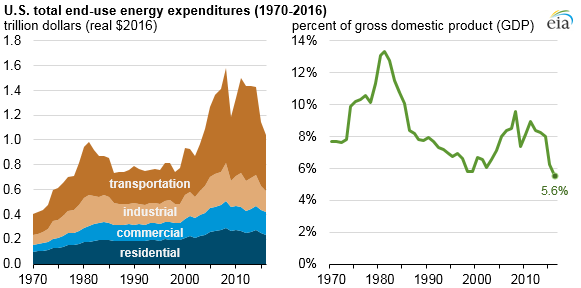
According to the most recent data released by the U.S. Energy Information Administration, in 2016, U.S. energy expenditures declined for the fifth consecutive year, reaching $1.0 trillion in 2016. This represents a 9% decrease in real terms from 2015.

Adjusted for inflation, total energy expenditures in 2016 were the lowest since 2003. Expressed as a percent of gross domestic product (GDP), total energy expenditures were 5.6% in 2016, the lowest share of GDP since at least 1970. According to EIA, contributing factors include steady annual increases in GDP since 2010, coupled with steady annual decreases in total energy expenditures since 2011.

Source: EIA, "In 2016, U.S. energy expenditures per unit GDP were the lowest since at least 1970"

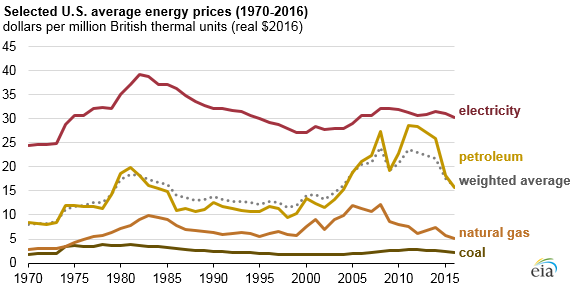
Meanwhile, annual total U.S. energy consumption has remained virtually flat since 2013. So the recent decreases in total energy expenditures are generally the result of lower energy prices. But EIA says it doesn’t expect this trend to continue, as average energy prices of products such as motor gasoline, natural gas, and retail electricity have all increased since 2016.

Source: EIA, "In 2016, U.S. energy expenditures per unit GDP were the lowest since at least 1970"
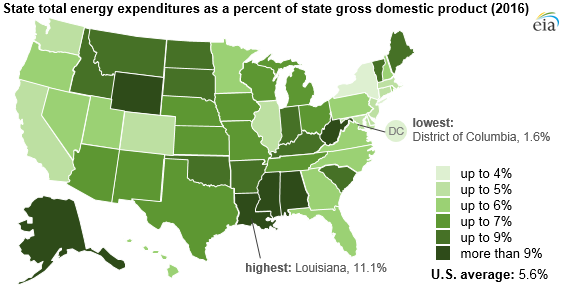
EIA also notes significant geographic variation in state total energy expenditures as a percent of state GDP. In 2016, Louisiana led the pack as it has every year since EIA started tracking this metric in 1997, with 2016 energy expenditures per GDP of 11.1% in 2016. EIA points to Louisiana’s large industrial sector consumption, including its energy-intensive petrochemical industry, as the biggest piece of the explanation.

Source: EIA, "In 2016, U.S. energy expenditures per unit GDP were the lowest since at least 1970"

But even while leading the nation, Louisiana set its own record-low ratio of energy expenditures per GDP, at a level that was less than half of the state’s previous high (26.5%) which was reached in 2008. Meanwhile, District of Columbia (1.6%), New York (3.3%), Massachusetts (4.3%), California (4.3%), and Delaware (4.4%) had the lowest energy expenditures per GDP in 2016. EIA says this reflects relatively high consumption in less energy-intensive residential and commercial sectors as well as relatively high state GDP.

Maine Gov. LePage's 2018 State of the State and energy policy

Tuesday, February 13, 2018

Maine Governor Paul R. LePage delivered his final State of the State address this evening. Here's a recap of some of his remarks on energy policy in previous speeches of that sort.
Addendum as of 9 PM: WMTW has posted a transcript of Governor LePage's 2018 State of the State speech on its website, as prepared. That draft covers topics including "skyrocketing property taxes," Medicaid expansion, and fiscal responsibility. It calls for increased investment in Maine and workforce development. It proposes bonds focused on commercializing technologies, as well as on research and development, saying, "We must invest in commercialization as we do in research." However the prepared remarks did not mention energy, nor does it directly reference energy policy.

Nevertheless, the Bangor Daily News reports that his remarks as delivered did address energy, calling for lower energy prices.

Winter 2017-18 and the New England electric grid

Friday, October 27, 2017

With measures in place to ensure the reliability of New England's electric grid for the coming winter season, grid operator ISO New England, Inc. expects to have adequate electricity supplies this winter -- but according to a recent presentation to federal regulators, the biggest challenges could come in the form of extended cold weather when fuel inventories are already depleted or a day when gas supplies are constrained and suddenly a large non-gas resource is lost.

According to an October 19, 2017 presentation by ISO-NE to the Federal Energy Regulatory Commission, in 2016 nearly half of the electricity produced in New England came from natural gas, and the availability of gas impacts both grid reliability and production costs.  At the same time, the gas pipeline infrastructure serving New England is limited, with pipelines reaching their maximum capacity at times including winter months when demand peaks for gas for heating.

In response to concerns over reliability and past events like the January 2004 "cold snap" and the 2014 "polar vortex", ISO-NE has taken steps including developing operating procedures, a Winter Reliability Program and "Pay for Performance" changes to market rules that incentivize investment in operational improvements and secure fuel arrangements, as well as improving communication and coordination with generators, pipelines, and other stakeholders.

With those measures in place, ISO-NE recently told the Commission it expects to have adequate electricity supplies this winter, but that gas pipeline constraints continue to be a concern.  ISO-NE noted that while Spectra Energy placed its Algonquin Incremental Market project in service providing some relief last winter, that relief "was short-lived due to the retirement in 2017 of more than 1,500 MW of non-gas units (Brayton Point Power Station)."  The grid operator also noted that "LNG shipments are unknown" and that "Non-gas resources will continue to play a vital role in maintaining reliability."

Citing the biggest challenges this winter as extended cold weather when fuel inventories are depleted or a day when gas supplies are constrained and the region is using primarily nuclear, coal, and oil resources and suddenly a large non- gas resource is lost, ISO-NE noted that while the region has adequate generating capacity to serve load under those conditions, "the ability to meet energy needs is at risk if gas cannot be supplied to gas-fired generators."

Maine PUC releases 2015 renewable report

Wednesday, April 19, 2017

Maine energy regulators have released a report on the state's electricity renewable portfolio standard, presenting data from 2015.  The Maine Public Utilities Commission's Annual Report on New Renewable Resource Portfolio Requirement - Report for 2015 Activity [PDF] provides a look at Maine's renewables law, now in its tenth year on the books.  It may also inform legislative discussions later this spring about the future of Maine's renewable portfolio standard.

In 2007, the Maine legislature enacted a law requiring that specified percentages of electricity that supply Maine’s consumers come from “new” or Class 1 renewable resources, ranging from 1% in 2008 to 10% in 2017.  The law also required the Commission to report annually to the legislative energy committee on the status of this requirement and related compliance matters.

According to the report, Maine suppliers sourced approximately 891,757 renewable energy certificates or RECs, from 30 facilities, to comply with the 2015 requirement.  Of these, 20 facilities were fueled by biomass, 4 by hydropower, 3 by wind and 1 by landfill gas.  25 out of the 30 facilities were located in Maine, with 2 in New York, and one each in Connecticut, Massachusetts, and Vermont.  By REC volume, 99% came from facilities located in Maine.

The report also estimates the cost to Maine ratepayers of Maine's new renewable resource portfolio requirement.  According to the report, the cost of RECs used for compliance in 2015 ranged from "approximately $2.00 per MWh to $42.50 per MWh, with an average cost of $13.16 per MWh and a total cost of $11,738,174."  Adding in $3,018 in alternative compliance payments by one supplier, the report estimates a total cost to ratepayers during 2015 of $11,741,192.  The report translates this total cost into "an average rate impact of about one-tenth of a cent per kWh. This is equivalent to about 55 cents per month, or 1%, for a typical residential customer; $50 per month for a medium commercial customer that uses 50,000 kWh per month; and $500 per month for a large commercial/industrial customer that uses 500,000 kWh per month."

Maine law also includes a Class 2 renewable portfolio standard, requiring an additional 30% of electricity come from existing renewables and other Class 2 resources.  According to the Commission's report, the average cost of a Class 2 REC in 2015 was $0.28 per MWh, with a total cost of $965,818.  The report notes that this is "equivalent to about 5 cents per month for a typical residential customer, and $4 and $40 per month for medium and large commercial/industrial customers with the usage levels described above, respectively."

This session, the 128th Maine Legislature is considering several bills that could affect Maine's renewable energy laws, including LD 532, An Act To Remove the 100-megawatt Limit on Hydroelectric Generators under the Renewable Resources Laws, as well as LD 1185, a concept draft which "proposes to enact measures designed to update Maine's renewable portfolio standards."

Massachusetts develops next solar incentive

Wednesday, August 24, 2016

The Massachusetts Department of Energy Resources (DOER) is designing a new solar incentive program to encourage the continued development of solar renewable energy generating sources by residential, commercial, governmental and industrial electricity customers, based on a state law enacted this spring. The so-called "next solar initiative" program could affect the pace of solar photovoltaic project development in Massachusetts, as policymakers seek a smooth transition from the current SREC II program as it reaches full capacity.

On April 11, 2016, Governor Charlie Baker signed into law An Act Relative to Solar Energy, also known as Chapter 75 of the Acts of 2016.  The law preserved and expanded net metering, preserving the value of that policy for projects developed by residential, small commercial, municipal and government customers.

As described by the Baker administration, the law also allows DOER and the Department of Public Utilities to "gradually transition the solar industry to a more self-sustaining model." In particular, section 11 of the act directed DOER to "develop a statewide solar incentive program to encourage the continued development of solar renewable energy generating sources by residential, commercial, governmental and industrial electricity customers throughout the commonwealth."

The law prescribed twelve requisite characteristics of the solar incentive program, but left the creation of rules and regulations to DOER.  Some criteria are process-oriented, such as that the program "promotes the orderly transition to a stable and self-sustaining solar market at a reasonable cost to ratepayers," or considers underlying system costs, environmental benefits, energy demand reduction and other avoided costs provided by solar renewable energy generating facilities.

Other criteria define structural requirements for the program, such as that it "relies on market-based mechanisms or price signals as much as possible to set incentive levels," "differentiates incentive levels to support diverse installation types and sizes that provide unique benefits," and "features a known or easily estimated budget to achieve program goals through use of a declining adjustable block incentive, a competitive procurement model, tariff or other declining incentive framework."  The law also requires the program to promote investor confidence through long-term incentive revenue certainty and market stability.

After the solar bill's enactment, DOER held two public listening sessions, and solicited comments on the development of the "next solar incentive" through June 30, 2016.  Many commenters expressed support for a continuation of the SREC framework, such as "SREC III."  Other comments focused on locational issues, such as proposing policies to deter the development of projects located on farmland or other undeveloped "greenfield" sites.

DOER is expected to release a first draft of its next solar incentive program this summer.

Maine PUC considers NTA coordinator

Friday, April 8, 2016

Maine utility regulators have launched an investigation into the designation of a "Non-Transmission Alternative Coordinator."  The case could shape whether and how Maine coordinates alternatives to electric transmission line development.

Non-transmission alternatives or NTAs are smart grid programs and technologies that complement and improve operation of existing electricity transmission systems, deferring or eliminating the need for upgrades to the transmission system.  NTAs can an deliver improvements to the grid at a lower cost than some transmission projects.  Distributed generation, storage, and demand response can play roles in NTA projects.

In Maine, legislative policy supports selecting NTAs over transmission development if an NTA can meet an identified reliability need at a lower cost to consumers than the proposed transmission project.  But under current law, no single entity formally coordinates or is required to postulate alternatives to transmission development.

In previous cases, the Maine Public Utilities Commission has investigated the need for a smart grid coordinator, approved a non-transmission alternative pilot project in the Boothbay region, and considered the scope of what an NTA Coordinator might do.  From these dockets, a vision has emerged of the NTA Coordinator as an entity that would develop cost-effective alternatives to transmission projects.  Under this vision, the NTA Coordinator would address the policy and goals of the Maine's Smart Grid Policy Act to “improve the overall reliability and efficiency of the electric system, reduce ratepayers’ costs in a way that improves the overall efficiency of electric energy resources, reduce and better manage energy consumption and reduce greenhouse gas emissions.”

But key questions remain, including whether and how an NTA Coordinator will be designated, the scope of its functions and duties.  Another fundamental question is whether these functions will be performed by transmission and distribution utilities, or by some third party entity.

In a Notice of Investigation dated April 4, 2016, the Maine Public Utilities Commission opened its investigation into these questions.  The notice describes the proceeding as focused on one approach to economically optimizing the electric system between generation and transmission:
Specifically, through this proceeding, the Commission expects to address this legislative policy by (1) developing the framework for selecting a NTA Coordinator and (2) determining the scope of the NTA Coordinator’s functions and duties. The Commission will also resolve the question of whether a third party entity or the transmission and distribution (T&D) utilities should perform the NTA Coordinator functions. This investigation will also address the role of an Advisory Planning Committee (APC) and the process for NTA development both within a CPCN proceeding and for transmission and distribution projects that are not required to file a CPCN petition. Finally, an end-product of this proceeding will be either the contours of an RFP or that of a rate incentive proposal should the Commission determine that the utility and not a third party should perform the functions of an NTA Coordinator.
Along with the notice of investigation, the Commission also issued "Strawman" and "Process Chart" documents for comment.

The notice set deadlines for filing petitions to intervene by April 21, 2016, and for comments on the Strawman and Process Chart by April 28, 2016.  An initial case conference was scheduled for May 12, 2016.

Waterbury hydro need and economics

Friday, February 26, 2016

A recent order issuing a new hydropower license to Green Mountain Power Corporation's Waterbury Hydroelectric Project sheds insight into the project's operations and economics.

The Waterbury project is located at a dam built in 1938, and licensed for hydropower development since 1954.  After a 16-year relicensing process, the Federal Energy Regulatory Commission issued a new license for the project in February 2016, authorizing 5.52 megawatts of generating capacity.  That relicensing process illustrates how the Commission considers the need for power from the project, as well as project economics, when considering whether to relicense a hydropower project.

By regulation, the Commission's process for reviewing a license application includes an evaluation of the "need of the applicant over the short and long term for the electricity generated by the project or projects to serve its customers."  In the Waterbury project's relicensing case, this consideration of the applicant's "need for power" involved observations about the project's expected output as well as the regional power market.  The order notes historic average generation from the Waterbury Project of 17,562 MWh annually, but observes that under the new license average annual generation will be reduced to 14,767 MWh.

The order then states, "Electricity generated from the Waterbury Project will help supply the power needs in northern Vermont."  It also cites a 10-year forecast by electric reliability organization North American Electric Reliability Corporation (NERC) showing summer peak demand in the region is expected to increase at an average rate of 0.84 percent per year between 2014 and 2023.  Based on this, the order concludes that "the project's power will help meet the regional need for power."

The Commission's process for determining whether to issue a new license for an existing hydroelectric project also includes consideration of public interest factors, such as the economic benefits of project power.  A 1995 decision established the Commission’s approach to evaluating the economics of hydropower projects.  Under that approach, the Commission uses current costs to compare the costs of the project and likely alternative power with no forecasts concerning potential future inflation, escalation, or deflation beyond the license issuance date.  The Commission has described the basic purpose of this economic analysis as to provide a general estimate of the potential power benefits and the costs of a project, and of reasonable alternatives to project power, "to support an informed decision concerning what is in the public interest with respect to a proposed license."

For the Waterbury project, as ultimately licensed with mandatory conditions and staff measures, the Commission concluded that:
  • the levelized annual cost of operating the project is $711,735, or $48.20/MWh
  • the proposed project would generate an average of 14,767 MWh of energy annually.
  • average generation is multiplied by the alternative power cost of $44.12/MWh, for a total value of the project’s power is $651,520, in 2015 dollars.
Therefore, the Commission concluded that in the first year of operation, the project would cost $60,215, or $4.08/MWh, more than the likely alternative cost of power.  As the order notes, "Although staff’s analysis shows that the project as licensed herein would cost more to operate than the estimated cost of alternative power, it is the applicant who must decide whether to accept this license and any financial risk that entails."

The Commission did note that its consideration of public interest factors also considers that "hydroelectric projects offer unique operational benefits to the electric utility system", including ancillary services like stability and rapid response.  The order also notes that while staff did not explicitly account for the effects inflation may have on the future cost of electricity, hydropower generation is relatively insensitive to inflation compared to fossil fueled generators -- illustrating why "project economics is only one of the many public interest factors the Commission considers in determining whether or not, and under what conditions, to issue a license."

US Supreme Court upholds wholesale demand response

Monday, January 25, 2016

The Supreme Court of the United States has issued an opinion upholding regional electricity grid operators' ability to operate wholesale demand response programs under federal authority.  In that opinion, FERC v. Electric Power Supply Assn., the Supreme Court reversed a lower court's decision invalidating the Federal Energy Regulatory Commission's regulation of electricity demand response.   While further evolution of demand response will continue, the Supreme Court's 6-to-2 ruling puts regional wholesale demand response programs back on surer footing after the uncertainty injected by the lower court's previous ruling.  A grid portfolio including some degree of demand response can provide beneficial environmental, reliability, and economic effects compared to pure generation.  It appears relatively more likely that existing regional wholesale demand response programs may continue to operate under federal authority, and relatively less likely that a new state-driven demand response paradigm will arise.


As described in the Supreme Court opinion, wholesale electricity demand response programs pay consumers for commitments to reduce their consumption of electricity during peak demand periods or other times of scarcity or high prices.  For about 15 years, wholesale market operators have increasingly adopted wholesale demand response programs, with the blessing of both Congress and the FERC.  In 2011, the FERC issued its Order No. 745, establishing a rule requiring market operators to pay the same price to cost-effective demand response providers for conserving energy as to generators for producing it. 

But that order was challenged by an association of generators, among others.  In May 2014, the D.C. Circuit Court of Appeals issued a ruling in Electric Power Supply Association v. Federal Energy Regulatory Commission vacating Order No. 745.  Its chief logic was that FERC lacked authority to issue the order on jurisdictional grounds -- because in the lower court's view, Order No. 745 directly regulates the retail electric market.  Under the Federal Power Act, FERC is authorized to regulate "the sale of electric energy at wholesale in interstate commerce," but cannot regulate "any other sale" (i.e. any retail sale) of electricity.

But today's Supreme Court ruling held that the Federal Power Act does provide FERC with the authority to regulate wholesale market operators' compensation of demand response bids.  The Court divided its analysis of this point in three parts.

First, the Supreme Court held that the practices at issue directly affect wholesale rates.  In the Court's words, "Wholesale demand response is all about reducing wholesale rates; so too the rules and practices that determine how those programs operate."

Second, the Supreme Court noted that FERC has not regulated retail sales.  "Here, every aspect of FERC's regulatory plan happens exclusively on the wholesale market and governs exclusively that market's rules.  The Commission's justifications for regulating demand response are likewise only about improving the wholesale market."  Putting the first and second sets of conclusions together, the Court found that the rule established by Order No. 745 complies with the plain terms of the Federal Power Act.

Third, the Court noted that adopting a contrary view would conflict with the core purposes of the Federal Power Act: "The FPA should not be read, against its clear terms, to halt a practice that so evidently enables FERC to fulfill its statutory duties of holding down prices and enhancing reliability in the wholesale energy market."

The Supreme Court also addressed an alternative holding by the D.C. Circuit Court that the Order No. 745 compensation scheme is arbitrary and capricious under the Administrative Procedure Act.  The Supreme Court noted that its "important but limited role" in reviewing FERC's decision "is to ensure that FERC engaged in reasoned decisionmaking."  Noting FERC's detailed explanation of its choice to compensate demand response providers at LMP, the same price paid to generators, and its lengthy responses to contrary views, the Supreme Court held that "FERC's serious and careful discussion of the issue satisfies the arbitrary and capricious standard."

Justice Kagan delivered the Court's opinion, joined by Chief Justice Roberts and Justices Kennedy, Ginsburg, Breyer, and Sotomayor.   Justice Scalia filed a dissenting opinion, in which Justice Thomas joined, noting his belief that the Federal Power Act prohibits the FERC from regulating the demand response of "retail purchasers of power."  Justice Alito did not participate in the case.

The case now returns to the D.C. Circuit for "further proceedings consistent with this opinion." If Order No. 745 stands and FERC retains jurisdiction over the compensation paid to wholesale demand response market participants, it seems likely that existing regional wholesale demand response programs will continue to operate under federal authority.  As the Supreme Court found, these wholesale demand response programs can provide significant consumer savings when properly implemented.  How will demand response continue to evolve in the wake of FERC v. EPSA?  How does this decision reshape the boundary between wholesale (federal) and retail (state) jurisdictions?  What's next for demand response?

Northern Pass proposes new transmission plan

Monday, August 24, 2015

The developer of a proposed $1.4 billion electric transmission line connecting Quebec to New Hampshire has released a revised route for the project, following public opposition to earlier plans.  The new vision for the Northern Pass project would bury more of the line underground and reduce the project's overall capacity to haul power.  Will this version of the Northern Pass gain more traction?

First proposed in 2009, the Northern Pass would be a 192-mile high-voltage direct current (HVDC) transmission line.  It would bring up to 1,000 megawatts of power from Canadian power plants into New England, running from the Canadian border to a proposed converter terminal in Franklin, New Hampshire.  From there, a new alternating current (AC) transmission line would deliver the energy to New England’s electric grid at an existing substation in Deerfield, New Hampshire. 

Since it was first proposed, the Northern Pass route has drawn criticism; the project was delayed, and despite revisions to the route public opposition remained.  Throughout the process, many comments have focused on local siting impacts, like the effect of above-ground transmission lines and poles through Franconia Notch State Park, the White Mountain National Forest, and the Appalachian Trail.  Eversource proposed running 8 miles of cable underground to reduce these impacts, but argued that undergrounding more would make the project too expensive.

But the forces motivating the Northern Pass project and other proposed HVDC lines from Canada remain strong: demand in New England and New York for electricity, and in particular for hydropower and other renewable electricity imported from Canada.

On August 18, project lead Eversource Energy announced changes to the route and scope of the project.  While the previous vision included 8 miles of underground cable to avoid visual impacts, the so-called "Forward New Hampshire Plan" now includes 60 miles of underground cable. Eversource described its revised route as striking "a balance between New Hampshire and our region’s need for a reliable new energy source and avoiding potential impacts to the state’s scenic landscapes."  At the same time, the revised proposal reduces the line's capacity from 1,200 megawatts to 1,000 megawatts, ostensibly to hold total costs at the previously estimated $1.4 billion.  The plan now includes $200 million to establish the "Forward NH Fund", a pool of money designed to support clean energy innovations, economic development, community investment, and tourism.

The Northern Pass project now faces public hearings.  Eversource is expected to file an application for site review with the New Hampshire Site Evaluation Committee in mid-October.

Supreme Court rules on EPA power plant regulations

Wednesday, July 1, 2015

The Supreme Court of the United States has ruled that the U.S. Environmental Protection Agency acted unreasonably in developing new regulations on hazardous air emissions from power plants without considering the cost impact of those regulations.  This ruling reinjects uncertainty into EPA's "Mercury and Air Toxics Standards" and other efforts to regulate power plant emissions under the Clean Air Act.

The federal Clean Air Act was designed to improve environmental quality and human health, among other goals.  It broadly allows federal regulation of air emissions of pollutants of various types and from various sources.

Because certain specific provisions in the Clean Air Act applied specifically to power plants, Congress placed a special restriction on EPA's regulation of power plant emissions under Section 7412(n)(1)(A) of the Clean Air Act.  That provision allows EPA to regulate emissions of hazardous air pollutants from power plants under Section 7412 only if it “finds such regulation is appropriate and necessary.”  In 2000, after a study, EPA concluded that regulating power plants under Section 7412 was "appropriate and necessary."  EPA reaffirmed this finding in 2012, and promulgated standards for emissions from power plants.

Along with those standards, EPA issued a “Regulatory Impact Analysis” estimating that the regulation would force power plants to bear costs of $9.6 billion per year.  That analysis also found that while benefits were hard to fully quantify, estimated benefits were worth $4 to $6 million per year.  Based on this analysis, compliance costs to power plants were thus between 1,600 and 2,400 times as great as the quantifiable benefits from reduced emissions of hazardous air pollutants.  At the same time, EPA argued that it did not have to consider costs in establishing its standards.

Following the issuance of these standards, 23 states sought review of EPA’s rule in the D. C. Circuit Court of Appeals in a series of cases which were later consolidated.  The D.C. Circuit upheld EPA's refusal to consider costs in its decision to regulate, at which point petitioners appealed to the Supreme Court. As my partner Jeff Talbert explains, in a 5-4 decision issued June 29, the Supreme Court held that EPA interpreted §7412(n)(1)(A) unreasonably when it deemed cost irrelevant to the decision to regulate power plants.

So what does the Supreme Court's ruling mean for U.S. power plants?  Uncertainty -- but not necessarily freedom from regulation.  The Supreme Court remanded the case back to the D.C. Circuit for further consideration.  The D.C. Circuit could uphold the rule again (on new grounds, compliant with the Supreme Court's decision) -- or it could invalidate the rule based on the Supreme Court ruling.  If that happens, EPA will likely have to resume the process of developing new regulations for hazardous air emissions from power plants under Section 7412.

Maine RGGI report 2015: price impact "relatively modest", programs helpful

Friday, June 12, 2015

For 8 years, states in the Northeastern U.S. have participated in the Regional Greenhouse Gas Initiative.  RGGI, the first market-based greenhouse gas regulatory program in the United States, represents a cooperative effort by participating states to cap and reduce greenhouse gas emissions from the electric power sector, coupled with a market for auctioning and trading emission allowances.  While some groups feared that the RGGI program would increase electricity prices, a recent report by the Maine Public Utilities Commission found that the impact of RGGI on electricity prices in Maine has been relatively modest -- while finding that RGGI-funded programs contribute to economic development and reduce greenhouse gas emissions.

RGGI formed in 2007, when ten states -- Connecticut, Delaware, Maine, Maryland, Massachusetts, New Hampshire, New Jersey, New York, Rhode Island and Vermont -- agreed to first cap, and then slowly reduce, the greenhouse gas emissions of their electrical energy sectors by 10% by 2018.  While New Jersey withdrew in 2012, the program has remained strong; in 2014, the remaining states subsequently tightened the RGGI cap for 2014 from 165 million short tons of carbon to 91 million short tons, then further declining 2.5% per year from 2015 to 2020.

While each participating state adopted its own laws implementing RGGI, in general the RGGI laws require certain generators of electricity to track their carbon emissions and acquire an “allowance” for every ton of carbon dioxide or its equivalent that they emit.  States conduct periodic auctions of allowances, and market participants are free to engage in secondary market trades.  Generators must purchase or trade for enough emissions allowances to match the number of tons of CO2-equivalent emitted.  The cost of acquiring these allowances gives generators an incentive to improve their efficiency or switch to fuels with a lower carbon intensity.

Each state also adopted its own laws governing the use of funds raised by state auctions of RGGI allowances.  In Maine, most funds go to the Efficiency Maine Trust for purposes including measures, investments and arrangements that reduce electricity consumption or reduce greenhouse gas emissions and lower energy costs at commercial or industrial facilities, and for investment in measures that lower residential heating energy demand and reduce greenhouse gas emissions.

RGGI has conducted 27 quarterly allowance auctions since September 2008, through which Maine has received a cumulative total of $ 62.22 million in RGGI auction proceeds.  Maine’s auction proceeds in 2014 totaled $11.37 million. According to the Maine Public Utilities Commission's report:
the annual cost to Maine ratepayers of the RGGI program was approximately $0.0024 per kWh. For the average Maine residential customer using 530 kWh per month, the 2014 RGGI program cost was approximately $ 1.27 per month. For a commercial customer using 25,000 kWh per month the 2014 RGGI program cost was approximately $60.00 per month. A large commercial or industrial customer using 500,000 kWh per month would have had a 2014 RGGI program cost of approximately $1,200 per month.
On the benefits side of the ledger, the Commission's report cites a finding that "all RGGI proceeds since 2008 are expected to return more than $2 billion in lifetime energy bill savings to more than 3 million households and more than 12,000 businesses across the eight states taking part in RGGI."  The Commission also cited its July 2014 report to the Legislature quantifying the increases in employment, real personal income, and gross state product expected to occur in Maine as a result of the cap tightening and other changes implemented in 2014.  That report found:
economic impacts for the New England region include a cumulative increase in Gross Regional Product of over $2 billion, a cumulative increase in employment of 38,900 job-years, and a cumulative increase in real personal income of $1.5 billion including a cumulative increase in Maine Gross State Product of $200 million, a cumulative increase in employment of more than 5,000 job-years, and a cumulative increase in real personal income of $100 million.
Based on these observations, the Maine Public Utilities Commission's 2015 report on RGGI concludes that "the impact of RGGI on electricity prices has been relatively modest, while RGGI-funded programs contribute to the gross state product, job growth, and personal income, and also reduce greenhouse gas emissions."

Coal power plants retiring in 2015

Thursday, May 21, 2015

The U.S. portfolio of electric power plants will continue to shift in 2015, according to a federal assessment projecting that nearly 16 gigawatts (GW) of generating capacity will retire in 2015.  Most of the capacity to be retired this year is coal-fired generation.  This continues a multi-year trend away from coal, and toward natural gas and renewable resources.

According to the U.S. Energy Information Administration, nearly 16 GW of generating capacity is expected to retire in 2015.  Of this, 81% (12.9 GW) is coal-fired generation.  Generator retirements are heavily composed of coal-fired generation, split between bituminous coal (10.2 GW) and subbituminous coal (2.8 GW).  Most of this retiring coal capacity is found in the Appalachian region, with slightly more than 8 GW combined in Ohio, West Virginia, Kentucky, Virginia, and Indiana.

New environmental regulations and struggles to remain cost-competitive explain most of these retirements.  This year, the Environmental Protection Agency's Mercury and Air Toxics Standards (MATS) take effect.  MATS requires existing large coal- and oil-fired electric generators to meet stricter emissions standards by retrofitting the units with new emissions control technologies.  While some units have been granted extensions to operate through April 2016, some power plant operators are choosing to retire units instead of making cost-prohibitive investments in pollution control.

Most of the coal-fired units slated for retirement are smaller and operate at a lower capacity factor than average coal-fired units in the United States.  According to EIA, the to-be-retired units have an average summer nameplate capacity of 158 MW, just 60% as big as the 261 MW average for other coal-fired units.  In 2014, the average capacity factor for all coal units was 61%, but the subset of coal units retiring in 2015 had an average capacity factor of just 36%.  The relatively small size and low capacity factor of these power plants make it harder for them to compete economically against other generation sources.  This competition is especially difficult if sufficient natural gas-fired generating capacity is available, as the cost of natural gas has fallen to levels not seen since 2012.

The coal capacity retiring in 2015 accounted for 1.6% of total U.S. generation during 2014.  At the same time, electric generating companies expect to add more than 20 GW of utility-scale generating capacity to the power grid.  This new capacity is dominated by wind (9.8 GW), natural gas (6.3 GW), and solar (2.2 GW), which together compose 91% of expected new capacity in 2015.

ISO New England's Winter Reliability Program 2014-2015

Wednesday, October 8, 2014

Keeping the lights on is what electric grid operators do around the clock – but challenges in New England are leading its grid operator to prepare for a winter when the availability of affordable electricity may be challenged.  In preparation, ISO New England, Inc. has received federal approval for a new Winter Reliability Program for the 2014-2015 winter season.

Winter is coming.
ISO New England is the federally-designated regional transmission organization for almost all of New England.  In this role, it is responsible for planning and operating electricity markets to balance supply and demand in real time.   

The grid operator first turned to a Winter Reliability Program in 2013.  ISO New England projected that a limited supply of natural gas and the retirements of several major generating plants would lead to a shortage of about 2 million megawatt-hours of energy during the winter months.  To insure against this gap, the grid operator held a competitive process to procure up to 2.4 million megawatt-hours of energy for the winter season, from a combination of oil-fired generators, dual-fuel generators, and demand response assets.  In exchange for their commitment to provide power when called upon, the selected generators and demand response assets received payments regardless of whether they were actually needed.

In ISO-NE's eyes, the 2013-2014 Winter Reliability Program proved essential in maintaining reliability during the “polar vortex” and other unusually cold conditions.  After adjusting for resource unavailability, the final cost of the 2013/2014 program was approximately $66 million, which came in below the original estimates of about $75 million.

While last year’s program was intended to be a one-time solution to bridge a reliability gap, this summer ISO-NE and regional stakeholder body NEPOOL identified additional challenges for the coming winter.  Specifically, more severe pipeline constraints, difficulty replenishing oil inventories, and large-scale generator retirements continue to threaten the coming winter's reliability and expose consumers to the risk of price spikes.

As a result, ISO-NE asked the Federal Energy Regulatory Commission to approve another program to mitigate reliability concerns for the 2014-2015 winter.  The new program, which the FERC accepted last month, combines features of last year’s program with further modifications.  For example, the new demand-response component is much the same as in last year’s program, while permanent rules related to auditing dual-fuel generators and the partial elimination of higher-cost fuel requirements are based on similar features in last winter’s program.

On the other hand, the new program has been modified as a result of several market changes that will be in effect prior to winter 2014/2015 as well as the FERC's clarification of what generators must do to procure adequate fuel for their expected run times.  The new program also adds a liquefied natural gas (LNG) component to improve fuel neutrality, and changes the basis for compensation from upfront inventory to actual unused inventory at the end of the winter.  While participants in last year's program were paid on an as-bid basis, the new program provides compensation for the fuel inventory and demand response programs based on a set rate of $18 per barrel.  This $18 price is designed to represent the carrying costs, price risk, availability cost and liquidity risk of the last resource needed to meet a cumulative inventory of 3.5 million barrels of oil.

The program also includes incentives for commissioning duel-fuel capacity: the ability to run on either oil or gas. Generators that have not operated on oil since at least December 1, 2011, and that demonstrate a plan for commissioning, or recommissioning a mothballed dual-fuel unit, by December 1, 2016, will be eligible for compensation to offset some of the associated costs.

The new program is moving forward.  On September 9, 2014, the FERC issued an order accepting the region’s proposed 2014/2015 Winter Reliability Program.  In the order, FERC requires ISO-NE to initiate a stakeholder process by January 1, 2015, to develop a proposal to address reliability concerns for the 2015/2016 winter and future winters, as necessary, to schedule meetings and submit progress reports, and to include certain analysis and recommendations in its Annual Markets Report.

For the proposed 2014/2015 program, the Analysis Group estimated costs for the separate components: the maximum cost of the demand response component would be about $2.4 million; the cost of the unused oil inventory and LNG contract volume components would be based on how much fuel remains unused, and assuming, at the high end, that 100% of the targeted amount of fuel is unused, the estimated cost would be $82.6 million; and the maximum cost for the dual-fuel commissioning program is estimated to be $12.9 million for units that commission by December 1, 2015.  The dual-fuel auditing provisions are estimated to cost a maximum, annually, of $7 million.

Consistent with the Commission’s order on the first winter program, the costs will be allocated to real-time load obligation, which is paid by load-serving entities, rather than to regional network load, which is paid by transmission owners.

Requests to Participate in the Oil Program, LNG Program, or Demand Response Program were due to ISO New England Customer Service by October 1, 2014. Dual Fuel Commissioning Requests are due by December 1, 2014

FERC authorizes mine drainage microhydro

Friday, September 5, 2014

The Federal Energy Regulatory Commission has issued a hydropower license to a project whose turbines generate electricity from acid mine drainage. The micro-hydropower license issued to the Antrim Treatment Trust illustrates this unusual approach to the twin challenges of mine remediation and renewable energy.

The power of falling water, in the White Mountain National Forest in New Hampshire.
In the 1980s, Antrim Mining, Inc. operated a surface bituminous coal mine in Pennsylvania.  When water draining through the mine and into streams and rivers was found to exceed pollution limits, the Commonwealth of Pennsylvania charged the company with violations of mining and reclamation law.  The charges led to a series of settlements through which Antrim agreed to improved water treatment facilities, including an off-the-grid hydroelectric facility.  This micro-hydro plant would be powered by treated effluent flowing downhill out of lagoons.  Antrim created the Antrim Treatment Trust to manage treatment of the mine water in 1991, then went out of business.

In an attempt to reduce the cost of treating the site's severe acid mine drainage, the Babb Creek Watershed Association identified micro-hydropower as an option for the site.  In 2008, the association received an Energy Harvest Grant from the Pennsylvania Department of Environmental Protection.  This $428,710 award was designed to support the installation of two hydroelectric turbines on the treatment plant's discharge, which was completed in 2012.

While the Federal Power Act requires most hydropower projects to secure a license from the Federal Energy Regulatory Commission, some off-grid hydropower projects that do not use the waters of the United States do not require licensure.  In 2010, the Antrim Treatment Trust filed a Declaration of
Intent for a 40-kilowatt grid-connected project, but quickly revised its project to be off-grid after the Commission issued an order finding that a license was required for the grid-connected project.  Once the project was off-grid, the Commission ruled that no license was required.

The Antrim treatment plant seems to have then operated one turbine, but left the second turbine non-operational. A 2012 article in the Williamsport Sun-Gazette suggested that with both turbines running and selling power into the electricity grid, the treatment plant could cut $12,000 in annual power costs and make $10,000 per year in new revenue.  But this could require a FERC license, because the project would become connected to the utility grid.

The Trust appears to have decided that these economics were worth pursuing, because in 2013 it filed an application for a project license for a 40-kilowatt project.  In the application, Antrim Trust proposed to bring a second identical turbine (currently in place but non-operational) online by installing additional indoor wiring with appurtenances within the existing powerhouse and treatment plant, and operate both turbines as a grid-connected project using the treated and/or untreated water.

As licensed, the Commission estimates the annual cost to develop and maintain the proposed 40-kW project is $9,356 or $37.42/megawatt-hour (MWh).  The project will generate an estimated average of 250 MWh of energy annually.  Based on Commission staff’s view of the alternative cost of power ($56.93/MWh), the total value of the project’s power is $14,233 in 2013 dollars.  To determine whether the proposed project is currently economically beneficial, staff subtracts the project’s cost from the value of the project’s power. Therefore, in the first year of operation, the project is expected to cost $4,877 or $19.51/MWh less than the likely alternative cost of power - demonstrating economic benefit.

Micro-hydropower projects can make economic sense in some mine drainage situations and other places where water treatment is required and a suitable vertical drop or pressure is available.  In Antrim's case, the project's success can partially be explained by the existence and purpose of the Trust, as well as the DEP grant to support project construction.  If treated and untreated mine drainage can be used to generate hydroelectricity, what other unusual sources of power will arise?

Muskrat Falls megahydro cost increases

Wednesday, July 2, 2014

The Canadian province of Newfoundland and Labrador is promoting the development of a multi-phase, gigawatt-scale hydropower project on the Churchill River in Labrador.  But estimates of the so-called megaproject's construction costs continue to mount, now reaching nearly $7 billion (Canadian).

The Churchill River drains much of western Labrador, combining large volumes of water with a significant drop in elevation.  For these reasons, Canadian provinces and utilities have long sought to harness its power.  In 1971, the Churchill Falls dam and hydropower plant came online; today, the Churchill Falls facility can generate 5,428 megawatts of power, giving it the second largest capacity of any power station in North America.

In 2010, Newfoundland and Labrador utility Nalcor Energy and Nova Scotia utility Emera announced the Lower Churchill project.  The first phase proposed, Muskrat Falls, entails the construction of a dam with an 824 megawatt power house, with the subsequent Gull Falls dam bringing the proposed Lower Churchill project's total capacity to over 3,000 megawatts.  The Muskrat Falls project received a key approval by provincial government in December 2012, and construction is now underway.  90 per cent of the project contracts have been awarded, and 98 per cent of the engineering on the project has been done.

Back in 2010 when Nalcor and Emera first announced the project, the cost forecast for the Newfoundland and Labrador portion was $5 billion.  But as the St. John's Telegram reports, the latest cost estimate for building the Muskrat Falls project has jumped by about $800 million, to $6.99 billion.

This estimate does not include the cost of the Maritime Link transmission system to be built by Emera, connecting Newfoundland to Nova Scotia via undersea cable.  The Maritime Link is expected to cost an additional $1.5 billion.

Despite the cost overruns, the project is reported to be on schedule to be completed in 2017.

EPA carbon rule: cost and benefit

Friday, June 6, 2014

Monday, the U.S. Environmental Protection Agency proposed a rule aimed at reducing carbon dioxide emissions from power plants.  Part of the EPA's "Clean Power Plan", the rule would rely on states developing and implementing their own plans to reduce the amount of carbon emitted by the electric power sector per unit of electricity generated.  EPA projects that if fully implemented, meeting this goal would reduce the power sector's carbon emissions to 30% below 2005 levels by 2030.  But what will this cost -- and what will the benefits be?

Steam rises from the Con Edison power plant at 14th Street and Avenue C, in New York City.  The plant can burn fuels including oil and natural gas.

Power plants represent the largest source of carbon dioxide emissions in the U.S., accounting for about one-third of the nation's greenhouse gas emissions.  Building on President Obama's 2013 Climate Action Plan and the May 2014 release of the third National Climate Assessment, the Clean Power Plan is premised upon the finding that greenhouse gas pollution "threatens the American public by leading to potentially rapid, damaging and long-lasting changes in our climate that can have a range of severe negative effects on human health and the environment."  The proposed rule targets carbon dioxide because is the most prevalent greenhouse gas, accounting for 82% of U.S. greenhouse gas emissions.

The Clean Power Plan requires states to develop plans to reduce the carbon intensity, or amount of carbon emitted per unit of useful energy, of their power plants.  Each state is allowed to select the measures it wishes to use to reach its carbon intensity goal.  This allows states flexibility to craft policies to reduce carbon pollution that:
1) continue to rely on a diverse set of energy resources, 2) ensure electric system reliability, 3) provide affordable electricity, 4) recognize investments that states and power companies are already making, and 5) can be tailored to meet the specific energy, environmental and economic needs and goals of each state .
The economic impacts of the Clean Power Plan will form a key theme in the debate over its implementation.  The flexibility afforded states makes projections of costs and benefits hard to quantify, even before consideration of the global social cost of carbon or economic concepts like the appropriate discount rate to apply to future costs and benefits.  With those caveats stated, EPA has analyzed two illustrative cases: a collaborative, regional compliance approach (perhaps along the lines of the Regional Greenhouse Gas Initiative) and a state-by-state approach.

Under EPA's analysis as stated in its proposed rule documents, the Clean Power Plan will produce economic benefits far in excess of its costs.  In 2020, EPA projects the regional compliance approach would have total costs of $5 billion, climate benefits of approximately $17 billion, and health co-benefits associated with reduced particulate matter and other emissions -- mostly in the form of reduced premature fatalities -- of between $16 billion and $37 billion.  In this scenario, the Clean Power Plan would yield net economic benefits of between $28 billion and $47 billion by 2020.  EPA's analysis of a state-by-state approach yields similar costs and benefits: a cost of $7.5 billion by 2020, climate benefits of approximately $18 billion, and health co-benefits of between $17 billion and $40 billion.  Under either case, net benefits continue to grow through 2030, reaching between $48 billion and $84 billion.

EPA also projects "job gains and losses relative to base case for the electric generation, coal and natural gas production, and demand side energy efficiency sectors."  In 2020, EPA projects job growth of 25,900 to 28,000 job-years in the power production and fuel extraction sectors, and an increase of 78,000 jobs in the demand-side energy efficiency sector.

What the ultimate costs and benefits of the Clean Power Plan will be remains uncertain, as does EPA's adoption of a final rule implementing the plan.  In the meantime, electric generators, consumers, and policymakers are taking close looks at the plan to ascertain its impacts.

US energy consumers paid $14 billion more last winter

Tuesday, May 27, 2014

U.S. consumers paid $14 billion more for their energy needs during the winter of 2013-2014 compared to the previous winter, according to a report by the U.S. Energy Information Administration.

The cost of energy affects people and businesses across the country.  Consumers are affected by both the price they pay per unit of electricity or fuel for transportation and heating and the volume of each energy commodity they demand.  In much of the U.S., demand for energy increases during winter months.  The winter season often sees prices increase as well, as more expensive supply is needed to meet consumer demand.

The winter of 2013-2014 was no exception, according to the EIA's data.  U.S. consumers spent $14 billion more for energy during the fourth quarter of 2013 and first quarter of 2014 compared to the previous winter.  This amounts to an increase of 4.4%, or a 0.1% increase when measured as a share of disposable income.

The biggest drivers of the increase in consumer energy costs were higher expenditures for electricity, natural gas, heating oil and propane.  Electricity expenditures increased $7.9 billion, or 10%, last winter compared with the previous winter.  Much of the increased cost of electricity came as a result of increased costs for natural gas, a key fuel used for electric power generation.  Constraints on interstate natural gas pipelines drive fuel prices up as demand increases.  Throughout much of the northeast region, interstate natural gas pipelines reach their maximum flow rates on an increasing number of winter days.  When the pipelines begin to fill, the price of natural gas delivered into the constrained region increases.  Ultimately, when the pipelines have reached their maximum capacity, no more natural gas can be bought at any price.

The price of natural gas also affects consumers directly, as consumers also rely upon natural gas for space heating and applications like drying.  EIA's data show that consumer expenditures for natural gas increased by $5.8 billion, or 16%, last winter compared with the previous winter.

Expenditures for the other major heating fuels -- oil and propane -- also increased by $6.0 billion, or 27%, over the previous winter.  As EIA notes, heating oil and propane are used predominantly for space heating and are used to heat a relatively small number of homes, but their use is concentrated in the Northeast -- the area of the country that experienced the coldest weather this winter.  Propane consumers experienced not only price spikes but even shortages during the coldest parts of the season.

As costly as the past winter was, the increase in consumer energy costs would have been even higher if transportation-related costs had not decreased significantly.  In fact, transportation accounts for the largest single share of U.S. consumers' energy budget -- often over two-thirds of energy expenditures during the summer driving season, and over half of energy expenditures even in the winter.  But transportation fuel expenses decreased by $5.8 billion, or 3%, last winter compared with the previous winter.  EIA cites reductions in demand for gasoline due to winter storms that reduced driving.

Weather is a significant factor affecting winter energy costs -- but policies and infrastructure also play major roles in shaping consumers' energy expenditures.  What will next winter bring?

Snohomish tidal project wins FERC pilot license

Friday, March 21, 2014

Federal regulators have issued a pilot license for a proposed tidal energy project in Washington.

Tidal waters off the Maine coast.
Yesterday, the Federal Energy Regulatory Commission issued a 10-year pilot license to Public Utility District No. 1 of Snohomish County for the proposed Admiralty Inlet Pilot Tidal Project.  The 600-kilowatt hydrokinetic project, to be located in Puget Sound in the state of Washington, is designed as a temporary, experimental project to evaluate the commercial viability of tidal energy development in Puget Sound.

According to the Commission's Order Issuing Pilot Project License (85-page PDF), the proposed project features two tidal turbines to be manufactured by OpenHydro, each measuring 6 meters in diameter, secured to the seabed by the turbines' 414-ton weight.  Peak tidal currents at the site exceed 3 meters per second.  The Public Utility District plans to connect the project to the mainland grid via subsea cables connecting to District-leased land south of the Coupeville Ferry Terminal.

In granting the pilot license, the Commission considered a range of possible resource impacts from the project.  The site lies near key shipping lanes to the ports of Seattle, Tacoma, Olympia, and Everett, and is near a key trans-oceanic fiber optic cable connecting North America to Japan.  To address concerns over impacts to these resources, the Commission imposed conditions and monitoring requirements on the project.

The Commission's pilot licensure program differs somewhat from its general licensing of hydropower projects.  As described in a whitepaper on the pilot project licensing process prepared by Commission staff, pilot projects should be (1) small; (2) short term; (3) located in non-sensitive areas based on the Commission’s review of the record; (4) removable and able to be shut down on short notice; (5) removed, with the site restored, before the end of the license term (unless a new license is granted); and (6) initiated by a draft application in a form sufficient to support environmental analysis. Projects meeting these criteria enjoy a streamlined regulatory review process.

With the pilot license in hand, the Public Utility District may prepare for project development.  But if the project goes forward, the District may have to justify its costs.  As noted in the Commission’s order, the project has relatively high capital, operation, and maintenance costs with respect to the amount of power produced.  According to the Commission’s order, the levelized annual cost of operating the project will be about $1,848,294, or $7,574.98 per megawatt-hour of energy generated -- significantly higher than the estimated $30/MWh cost of alternative power.  Based on an estimated average annual generation of 244,000 kilowatt-hours as licensed, Commission staff projects that in the first year of operation, the project power will cost $1,840,974 more than the cost of alternative power.

Admittedly, the Snohomish project is designed as an experiment -- a pilot project to test technology and project feasibility.  The Snohomish project is among the first hydrokinetic projects in the country to receive a FERC license.  The first pilot project issued for a tidal project, the Roosevelt Island Tidal Energy Project, similarly faces projected above-market energy costs.  Like the Roosevelt Island project, the Snohomish project will be relatively small.  But given its financial picture, will the Snohomish project go forward?