The Federal Energy Regulatory Commission has issued an order issuing a new hydropower license to utility Pacific Gas & Electric Company for its Poe Hydroelectric Project.
The 143-megawatt project is located on the North Fork Feather River in northern California, and includes land within the Plumas National Forest. Originally licensed in 1953, the project includes two dams impounding reservoirs, a 33,000-foot-long pressure tunnel bypassing about 7.6 miles of the river, and a powerhouse with two turbines.
The Commission issued a new 40-year license for the Poe project to PG&E on December 17, 2018. In relicensing proceedings, the Commission considers a number of public interest factors, including the economic benefits of project power. In general, the Commission evaluates the economics of a hydropower project by comparing the current costs of the project to likely alternative power, without considering forecasts concerning potential future inflation, escalation, or deflation beyond the license issuance date. The Commission says the basic purpose of its economic analysis is to provide a general estimate of the potential power benefits and the costs of a project, and of reasonable alternatives to project power.
In the Poe project's case, the Commission noted that after considering mandatory conditions and other measures suggested by Commission staff, PG&E's annual cost of operating the project would be about $9,590,000. Assuming that the project would generate an average of 498,113 megawatt-hours of energy annually, this works out to $19.3 per megawatt-hour. By comparison, the Commission found that the project's the corresponding alternative energy cost plus the value of its dependable capacity gave this power a value of $50,800,000, or $102 per megawatt-hour in the first year of operation, the project would cost $41,210,000 or $82.7 per megawatt-hour less than the likely alternative cost of power.

Energy powers society; society's choices shape energy policy. A blog about our energy resources and the choices they present for society.
Showing posts with label economics. Show all posts
Showing posts with label economics. Show all posts

Feds predict US coal consumption falling to 1979 levels
Tuesday, December 4, 2018
U.S. coal consumption in 2018 will reach its lowest level since 1979, according to a prediction by the U.S. Energy Information Administration. Reduced coal use for electricity generation is the largest contributor to the decline, driven by factors including economics and environmental regulations.
The EIA tracks total U.S. coal consumption. According to its latest forecast, EIA expects total U.S. coal consumption in 2018 to fall to 691 million short tons. This represents a 4% decline from 2017, and would bring coal use in line with 1979 levels.
EIA cites reductions in the use of coal to generate electricity as the largest contributor to this decline. Between 2007 and 2018, 93% of total U.S. coal consumption was for electricity generation. But shifts in how the country generates power -- including retirements of over 66 gigawatts of coal-fired power plants since 2007, plus decreases in the utilization or capacity factor of most remaining coal-fired generators -- have reduced the nation's consumption of coal.
Part of the shift away from coal-fired power production can be explained by economics. Natural gas prices have generally remained relatively low compared to coal prices over the past decade, and fuel-free renewable power projects are on the rise.
Environmental regulations such as the Mercury and Air Toxics Standards (which took effect in 2015) have also contributed to the shift, both directly (for example, restricting carbon emissions) and indirectly (by affecting the economics of coal-fired power generation and prompting further plant retirements instead of investments in environmental controls).
EIA predicts that the trend away from coal will continue in the short term, projecting power sector coal consumption to fall by a further 8% in 2019.
The EIA tracks total U.S. coal consumption. According to its latest forecast, EIA expects total U.S. coal consumption in 2018 to fall to 691 million short tons. This represents a 4% decline from 2017, and would bring coal use in line with 1979 levels.
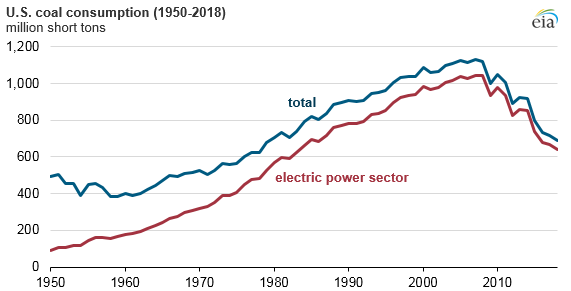 |
| Source: U.S. Energy Information Administration |
EIA cites reductions in the use of coal to generate electricity as the largest contributor to this decline. Between 2007 and 2018, 93% of total U.S. coal consumption was for electricity generation. But shifts in how the country generates power -- including retirements of over 66 gigawatts of coal-fired power plants since 2007, plus decreases in the utilization or capacity factor of most remaining coal-fired generators -- have reduced the nation's consumption of coal.
Part of the shift away from coal-fired power production can be explained by economics. Natural gas prices have generally remained relatively low compared to coal prices over the past decade, and fuel-free renewable power projects are on the rise.
Environmental regulations such as the Mercury and Air Toxics Standards (which took effect in 2015) have also contributed to the shift, both directly (for example, restricting carbon emissions) and indirectly (by affecting the economics of coal-fired power generation and prompting further plant retirements instead of investments in environmental controls).
EIA predicts that the trend away from coal will continue in the short term, projecting power sector coal consumption to fall by a further 8% in 2019.
Waterbury hydro need and economics
Friday, February 26, 2016
A recent order issuing a new hydropower license to Green Mountain Power Corporation's Waterbury Hydroelectric Project sheds insight into the project's operations and economics.
The Waterbury project is located at a dam built in 1938, and licensed for hydropower development since 1954. After a 16-year relicensing process, the Federal Energy Regulatory Commission issued a new license for the project in February 2016, authorizing 5.52 megawatts of generating capacity. That relicensing process illustrates how the Commission considers the need for power from the project, as well as project economics, when considering whether to relicense a hydropower project.
By regulation, the Commission's process for reviewing a license application includes an evaluation of the "need of the applicant over the short and long term for the electricity generated by the project or projects to serve its customers." In the Waterbury project's relicensing case, this consideration of the applicant's "need for power" involved observations about the project's expected output as well as the regional power market. The order notes historic average generation from the Waterbury Project of 17,562 MWh annually, but observes that under the new license average annual generation will be reduced to 14,767 MWh.
The order then states, "Electricity generated from the Waterbury Project will help supply the power needs in northern Vermont." It also cites a 10-year forecast by electric reliability organization North American Electric Reliability Corporation (NERC) showing summer peak demand in the region is expected to increase at an average rate of 0.84 percent per year between 2014 and 2023. Based on this, the order concludes that "the project's power will help meet the regional need for power."
The Commission's process for determining whether to issue a new license for an existing hydroelectric project also includes consideration of public interest factors, such as the economic benefits of project power. A 1995 decision established the Commission’s approach to evaluating the economics of hydropower projects. Under that approach, the Commission uses current costs to compare the costs of the project and likely alternative power with no forecasts concerning potential future inflation, escalation, or deflation beyond the license issuance date. The Commission has described the basic purpose of this economic analysis as to provide a general estimate of the potential power benefits and the costs of a project, and of reasonable alternatives to project power, "to support an informed decision concerning what is in the public interest with respect to a proposed license."
For the Waterbury project, as ultimately licensed with mandatory conditions and staff measures, the Commission concluded that:
The Commission did note that its consideration of public interest factors also considers that "hydroelectric projects offer unique operational benefits to the electric utility system", including ancillary services like stability and rapid response. The order also notes that while staff did not explicitly account for the effects inflation may have on the future cost of electricity, hydropower generation is relatively insensitive to inflation compared to fossil fueled generators -- illustrating why "project economics is only one of the many public interest factors the Commission considers in determining whether or not, and under what conditions, to issue a license."
The Waterbury project is located at a dam built in 1938, and licensed for hydropower development since 1954. After a 16-year relicensing process, the Federal Energy Regulatory Commission issued a new license for the project in February 2016, authorizing 5.52 megawatts of generating capacity. That relicensing process illustrates how the Commission considers the need for power from the project, as well as project economics, when considering whether to relicense a hydropower project.
By regulation, the Commission's process for reviewing a license application includes an evaluation of the "need of the applicant over the short and long term for the electricity generated by the project or projects to serve its customers." In the Waterbury project's relicensing case, this consideration of the applicant's "need for power" involved observations about the project's expected output as well as the regional power market. The order notes historic average generation from the Waterbury Project of 17,562 MWh annually, but observes that under the new license average annual generation will be reduced to 14,767 MWh.
The order then states, "Electricity generated from the Waterbury Project will help supply the power needs in northern Vermont." It also cites a 10-year forecast by electric reliability organization North American Electric Reliability Corporation (NERC) showing summer peak demand in the region is expected to increase at an average rate of 0.84 percent per year between 2014 and 2023. Based on this, the order concludes that "the project's power will help meet the regional need for power."
The Commission's process for determining whether to issue a new license for an existing hydroelectric project also includes consideration of public interest factors, such as the economic benefits of project power. A 1995 decision established the Commission’s approach to evaluating the economics of hydropower projects. Under that approach, the Commission uses current costs to compare the costs of the project and likely alternative power with no forecasts concerning potential future inflation, escalation, or deflation beyond the license issuance date. The Commission has described the basic purpose of this economic analysis as to provide a general estimate of the potential power benefits and the costs of a project, and of reasonable alternatives to project power, "to support an informed decision concerning what is in the public interest with respect to a proposed license."
For the Waterbury project, as ultimately licensed with mandatory conditions and staff measures, the Commission concluded that:
- the levelized annual cost of operating the project is $711,735, or $48.20/MWh
- the proposed project would generate an average of 14,767 MWh of energy annually.
- average generation is multiplied by the alternative power cost of $44.12/MWh, for a total value of the project’s power is $651,520, in 2015 dollars.
The Commission did note that its consideration of public interest factors also considers that "hydroelectric projects offer unique operational benefits to the electric utility system", including ancillary services like stability and rapid response. The order also notes that while staff did not explicitly account for the effects inflation may have on the future cost of electricity, hydropower generation is relatively insensitive to inflation compared to fossil fueled generators -- illustrating why "project economics is only one of the many public interest factors the Commission considers in determining whether or not, and under what conditions, to issue a license."
NECA Renewable Energy Conference 2016
Monday, February 22, 2016
The Northeast Energy and Commerce Association (NECA) will hold its thirteenth annual renewable energy conference on March 3, 2016.
NECA is New England's oldest and most broadly-based, non-profit trade association serving the competitive electric power industry. NECA facilitates an open forum among all electric power stakeholders to foster the development and maturation of competitive power markets.
NECA's 2016 Renewable Energy conference features panel discussions on hydropower imports, distribution network policy, reliability, transmission and storage, and emerging trends in renewable finance/economics. Of particular interest this year are state efforts to support large scale and distributed renewables like wind and solar, broad retirements of coal-fired and other central generating power plants, proposed new infrastructure like electric transmission and natural gas pipelines, and shifts in the balance of resources New England relies upon for energy.
Registration for the event is available on the NECA website.
NECA is New England's oldest and most broadly-based, non-profit trade association serving the competitive electric power industry. NECA facilitates an open forum among all electric power stakeholders to foster the development and maturation of competitive power markets.
NECA's 2016 Renewable Energy conference features panel discussions on hydropower imports, distribution network policy, reliability, transmission and storage, and emerging trends in renewable finance/economics. Of particular interest this year are state efforts to support large scale and distributed renewables like wind and solar, broad retirements of coal-fired and other central generating power plants, proposed new infrastructure like electric transmission and natural gas pipelines, and shifts in the balance of resources New England relies upon for energy.
Registration for the event is available on the NECA website.
FERC authorizes mine drainage microhydro
Friday, September 5, 2014
The Federal Energy Regulatory Commission has issued a hydropower license to a project whose turbines generate electricity from acid mine drainage. The micro-hydropower license issued to the Antrim Treatment Trust illustrates this unusual approach to the twin challenges of mine remediation and renewable energy.
In the 1980s, Antrim Mining, Inc. operated a surface bituminous coal mine in Pennsylvania. When water draining through the mine and into streams and rivers was found to exceed pollution limits, the Commonwealth of Pennsylvania charged the company with violations of mining and reclamation law. The charges led to a series of settlements through which Antrim agreed to improved water treatment facilities, including an off-the-grid hydroelectric facility. This micro-hydro plant would be powered by treated effluent flowing downhill out of lagoons. Antrim created the Antrim Treatment Trust to manage treatment of the mine water in 1991, then went out of business.
In an attempt to reduce the cost of treating the site's severe acid mine drainage, the Babb Creek Watershed Association identified micro-hydropower as an option for the site. In 2008, the association received an Energy Harvest Grant from the Pennsylvania Department of Environmental Protection. This $428,710 award was designed to support the installation of two hydroelectric turbines on the treatment plant's discharge, which was completed in 2012.
While the Federal Power Act requires most hydropower projects to secure a license from the Federal Energy Regulatory Commission, some off-grid hydropower projects that do not use the waters of the United States do not require licensure. In 2010, the Antrim Treatment Trust filed a Declaration of
Intent for a 40-kilowatt grid-connected project, but quickly revised its project to be off-grid after the Commission issued an order finding that a license was required for the grid-connected project. Once the project was off-grid, the Commission ruled that no license was required.
The Antrim treatment plant seems to have then operated one turbine, but left the second turbine non-operational. A 2012 article in the Williamsport Sun-Gazette suggested that with both turbines running and selling power into the electricity grid, the treatment plant could cut $12,000 in annual power costs and make $10,000 per year in new revenue. But this could require a FERC license, because the project would become connected to the utility grid.
The Trust appears to have decided that these economics were worth pursuing, because in 2013 it filed an application for a project license for a 40-kilowatt project. In the application, Antrim Trust proposed to bring a second identical turbine (currently in place but non-operational) online by installing additional indoor wiring with appurtenances within the existing powerhouse and treatment plant, and operate both turbines as a grid-connected project using the treated and/or untreated water.
As licensed, the Commission estimates the annual cost to develop and maintain the proposed 40-kW project is $9,356 or $37.42/megawatt-hour (MWh). The project will generate an estimated average of 250 MWh of energy annually. Based on Commission staff’s view of the alternative cost of power ($56.93/MWh), the total value of the project’s power is $14,233 in 2013 dollars. To determine whether the proposed project is currently economically beneficial, staff subtracts the project’s cost from the value of the project’s power. Therefore, in the first year of operation, the project is expected to cost $4,877 or $19.51/MWh less than the likely alternative cost of power - demonstrating economic benefit.
Micro-hydropower projects can make economic sense in some mine drainage situations and other places where water treatment is required and a suitable vertical drop or pressure is available. In Antrim's case, the project's success can partially be explained by the existence and purpose of the Trust, as well as the DEP grant to support project construction. If treated and untreated mine drainage can be used to generate hydroelectricity, what other unusual sources of power will arise?
 |
| The power of falling water, in the White Mountain National Forest in New Hampshire. |
In an attempt to reduce the cost of treating the site's severe acid mine drainage, the Babb Creek Watershed Association identified micro-hydropower as an option for the site. In 2008, the association received an Energy Harvest Grant from the Pennsylvania Department of Environmental Protection. This $428,710 award was designed to support the installation of two hydroelectric turbines on the treatment plant's discharge, which was completed in 2012.
While the Federal Power Act requires most hydropower projects to secure a license from the Federal Energy Regulatory Commission, some off-grid hydropower projects that do not use the waters of the United States do not require licensure. In 2010, the Antrim Treatment Trust filed a Declaration of
Intent for a 40-kilowatt grid-connected project, but quickly revised its project to be off-grid after the Commission issued an order finding that a license was required for the grid-connected project. Once the project was off-grid, the Commission ruled that no license was required.
The Antrim treatment plant seems to have then operated one turbine, but left the second turbine non-operational. A 2012 article in the Williamsport Sun-Gazette suggested that with both turbines running and selling power into the electricity grid, the treatment plant could cut $12,000 in annual power costs and make $10,000 per year in new revenue. But this could require a FERC license, because the project would become connected to the utility grid.
The Trust appears to have decided that these economics were worth pursuing, because in 2013 it filed an application for a project license for a 40-kilowatt project. In the application, Antrim Trust proposed to bring a second identical turbine (currently in place but non-operational) online by installing additional indoor wiring with appurtenances within the existing powerhouse and treatment plant, and operate both turbines as a grid-connected project using the treated and/or untreated water.
As licensed, the Commission estimates the annual cost to develop and maintain the proposed 40-kW project is $9,356 or $37.42/megawatt-hour (MWh). The project will generate an estimated average of 250 MWh of energy annually. Based on Commission staff’s view of the alternative cost of power ($56.93/MWh), the total value of the project’s power is $14,233 in 2013 dollars. To determine whether the proposed project is currently economically beneficial, staff subtracts the project’s cost from the value of the project’s power. Therefore, in the first year of operation, the project is expected to cost $4,877 or $19.51/MWh less than the likely alternative cost of power - demonstrating economic benefit.
Micro-hydropower projects can make economic sense in some mine drainage situations and other places where water treatment is required and a suitable vertical drop or pressure is available. In Antrim's case, the project's success can partially be explained by the existence and purpose of the Trust, as well as the DEP grant to support project construction. If treated and untreated mine drainage can be used to generate hydroelectricity, what other unusual sources of power will arise?
Subscribe to:
Posts (Atom)
