Federal electricity regulators have given New England's regional grid operator more time to develop proposed new mechanisms to enhance long-term fuel security, after states and market participants asked for an extension to allow continued stakeholder discussions. At stake are what could be significant reforms to the region's electricity markets, including new opportunities for generators to earn revenue for providing fuel security, as well as the prospect of significant new costs for consumers.
ISO New England Inc. is the regional transmission organization and independent system operator for the electric grid serving nearly all of New England. In this role, it develops and administers markets for electric energy, capacity, and other products. ISO-NE also engages in regional system planning, and manages proposals to retire or close power plants that provide capacity to the region.
In 2018, the owner of the Mystic Generating Station, the largest power station in Massachusetts by nameplate capacity, proposed to retire its units in 2022. But after a study of the remaining electric system, ISO-NE determined that the retirement of Mystic's units 8 and 9 would present "unacceptable fuel security risks" that could lead to rolling blackouts as soon as the winters of 2022 through 2024. In response, ISO-NE asked the Federal Energy Regulatory Commission for waivers to allow the grid operator to retain the Mystic units to meet fuel security needs.
Some stakeholders disagreed that the Mystic units' retirement posed a reliability risk; others argued the costs of retaining them would outweigh any benefits. While the Commission denied ISO-NE's waiver request, it ultimately approved a short-term cost-of-service agreement under which regional ratepayers will pay to keep the Mystic units online. But the Commission also made a preliminary finding that ISO-NE's tariff may be unjust and unreasonable, and directed ISO-NE to file proposed tariff revisions creating a long-term fuel security mechanism by July 1, 2019. At the grid operator's request, the Commission later extended that deadline to November 15, 2019, to allow more time for proposal development and stakeholder discussion.
In the meantime, this spring ISO-NE filed a proposed short-term "inventoried energy program" from December 1
through the end of February during winters 2023/2024 and 2024/2025 as "a
bridge to a long-term, market-based solution that more comprehensively
addresses the region’s energy security risks" -- but Commission staff identified that filing as "deficient" and requested additional information, which prompted ISO-NE to provide additional information. In the absence of a Commission quorum willing to vote, those revisions became effective by operation of law on August 6, 2019, although parties have sought rehearing regarding the Commission's failure to act.
But even more time may be necessary. On July 31, 2019, the New England States Committee on Electricity (NESCOE) filed a motion requesting an additional six-month extension of time to allow ISO-NE and the region to work through issues related to ISO-NE’s proposed long-term fuel security mechanism. Representing the governors of the six New England states, NESCOE said granting its request would "enable a more complete
and holistic filing in response to the directives in the July 2018
Order, allow ISO-NE to address core consumer protection elements that
are fundamental to state support, and remove barriers to achieving a
greater degree of regional coalescence around a proposal." Several commenters supported the motion.
Ultimately, the Commission granted an extension of time up to and including April 15, 2020 for ISO-NE to file its long-term fuel security mechanism. While New England will soon be forced to address the issue of fuel security for its electric generating portfolio, these short-term and long-term market changes proposed by the grid operator are on hold for now.

Energy powers society; society's choices shape energy policy. A blog about our energy resources and the choices they present for society.
Showing posts with label retirement. Show all posts
Showing posts with label retirement. Show all posts

Feds predict US coal consumption falling to 1979 levels
Tuesday, December 4, 2018
U.S. coal consumption in 2018 will reach its lowest level since 1979, according to a prediction by the U.S. Energy Information Administration. Reduced coal use for electricity generation is the largest contributor to the decline, driven by factors including economics and environmental regulations.
The EIA tracks total U.S. coal consumption. According to its latest forecast, EIA expects total U.S. coal consumption in 2018 to fall to 691 million short tons. This represents a 4% decline from 2017, and would bring coal use in line with 1979 levels.
EIA cites reductions in the use of coal to generate electricity as the largest contributor to this decline. Between 2007 and 2018, 93% of total U.S. coal consumption was for electricity generation. But shifts in how the country generates power -- including retirements of over 66 gigawatts of coal-fired power plants since 2007, plus decreases in the utilization or capacity factor of most remaining coal-fired generators -- have reduced the nation's consumption of coal.
Part of the shift away from coal-fired power production can be explained by economics. Natural gas prices have generally remained relatively low compared to coal prices over the past decade, and fuel-free renewable power projects are on the rise.
Environmental regulations such as the Mercury and Air Toxics Standards (which took effect in 2015) have also contributed to the shift, both directly (for example, restricting carbon emissions) and indirectly (by affecting the economics of coal-fired power generation and prompting further plant retirements instead of investments in environmental controls).
EIA predicts that the trend away from coal will continue in the short term, projecting power sector coal consumption to fall by a further 8% in 2019.
The EIA tracks total U.S. coal consumption. According to its latest forecast, EIA expects total U.S. coal consumption in 2018 to fall to 691 million short tons. This represents a 4% decline from 2017, and would bring coal use in line with 1979 levels.
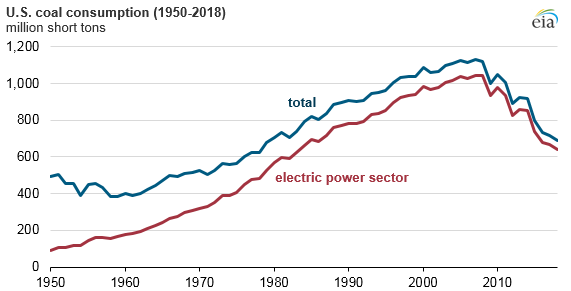 |
| Source: U.S. Energy Information Administration |
EIA cites reductions in the use of coal to generate electricity as the largest contributor to this decline. Between 2007 and 2018, 93% of total U.S. coal consumption was for electricity generation. But shifts in how the country generates power -- including retirements of over 66 gigawatts of coal-fired power plants since 2007, plus decreases in the utilization or capacity factor of most remaining coal-fired generators -- have reduced the nation's consumption of coal.
Part of the shift away from coal-fired power production can be explained by economics. Natural gas prices have generally remained relatively low compared to coal prices over the past decade, and fuel-free renewable power projects are on the rise.
Environmental regulations such as the Mercury and Air Toxics Standards (which took effect in 2015) have also contributed to the shift, both directly (for example, restricting carbon emissions) and indirectly (by affecting the economics of coal-fired power generation and prompting further plant retirements instead of investments in environmental controls).
EIA predicts that the trend away from coal will continue in the short term, projecting power sector coal consumption to fall by a further 8% in 2019.
FERC Order 842 requires primary frequency response by generators
Monday, March 12, 2018
U.S. energy regulators have issued an order amending standard interconnection agreements to require new generators to install, maintain and operate a functioning governor or equivalent controls capable of primary frequency response as a precondition of interconnection. The Federal Energy Regulatory Commission's Order No. 842 also amended the pro forma interconnection agreements to include certain operating requirements including maximum droop and deadband parameters, and sustained response provisions.
As described by the Commission, reliable operation of an alternating current grid requires maintaining system frequency within predetermined boundaries above and below 60 Hertz. Frequency response describes an interconnected grid’s ability to arrest and stabilize deviations from this predetermined range of frequencies after a sudden loss of generation or load.
Historically, the U.S. grid's primary frequency response capability came from baseload synchronous generators such as coal-fired power plants. But many such plants have retired in recent years, with further retirements expected. In 2016, the Commission noted that shifts in the portfolio of U.S. electric generators meant fewer resources could likely provide primary frequency response, especially if new variable energy resources such as wind and solar did not provide this service. In response, it opened an inquiry into what primary frequency response reforms it should make.
On February 15, 2018, the Commission issued its Order No. 842 revising its regulations to require newly interconnecting large and small generating facilities, both synchronous and non-synchronous, to install, maintain, and operate equipment capable of providing primary frequency response as a condition of interconnection. The final rule also amends the Commission's pro forma interconnection agreements to include certain operating requirements including maximum droop and deadband parameters, and sustained response provisions. It provides exemptions for nuclear power plants and some combined heat-and-power plants.
These requirements will apply to most newly interconnecting generation facilities that execute, or request the unexecuted filing of, an LGIA or SGIA on or after the rule’s effective date, as well as to existing large and small generating facilities that take any action that requires the submission of a new interconnection request that results in the filing of an executed or unexecuted interconnection agreement on or after the effective date.
In a press release, the Commission said its action was intended to address "the increasing impact of the evolving generation resource mix." Commissioner LaFleur made a separate statement in which she noted that while decreases in the nation's portfolio percentage of synchronous generation have contributed to declining frequency response performance, "recent technological advancements have enabled new non-synchronous generating facilities, such as wind and solar, to cost-effectively include primary frequency response capabilities in their facilities." Improved inverters and battery storage are among these innovations.
The Commission has also recently noted the potential of electric storage resources to provide frequency response and other services. Its Order No. 841 is designed to remove barriers to the participation of electric storage resources in wholesale markets operated by regional transmission organization and independent system operators, including markets for frequency response.
As described by the Commission, reliable operation of an alternating current grid requires maintaining system frequency within predetermined boundaries above and below 60 Hertz. Frequency response describes an interconnected grid’s ability to arrest and stabilize deviations from this predetermined range of frequencies after a sudden loss of generation or load.
Historically, the U.S. grid's primary frequency response capability came from baseload synchronous generators such as coal-fired power plants. But many such plants have retired in recent years, with further retirements expected. In 2016, the Commission noted that shifts in the portfolio of U.S. electric generators meant fewer resources could likely provide primary frequency response, especially if new variable energy resources such as wind and solar did not provide this service. In response, it opened an inquiry into what primary frequency response reforms it should make.
On February 15, 2018, the Commission issued its Order No. 842 revising its regulations to require newly interconnecting large and small generating facilities, both synchronous and non-synchronous, to install, maintain, and operate equipment capable of providing primary frequency response as a condition of interconnection. The final rule also amends the Commission's pro forma interconnection agreements to include certain operating requirements including maximum droop and deadband parameters, and sustained response provisions. It provides exemptions for nuclear power plants and some combined heat-and-power plants.
These requirements will apply to most newly interconnecting generation facilities that execute, or request the unexecuted filing of, an LGIA or SGIA on or after the rule’s effective date, as well as to existing large and small generating facilities that take any action that requires the submission of a new interconnection request that results in the filing of an executed or unexecuted interconnection agreement on or after the effective date.
In a press release, the Commission said its action was intended to address "the increasing impact of the evolving generation resource mix." Commissioner LaFleur made a separate statement in which she noted that while decreases in the nation's portfolio percentage of synchronous generation have contributed to declining frequency response performance, "recent technological advancements have enabled new non-synchronous generating facilities, such as wind and solar, to cost-effectively include primary frequency response capabilities in their facilities." Improved inverters and battery storage are among these innovations.
The Commission has also recently noted the potential of electric storage resources to provide frequency response and other services. Its Order No. 841 is designed to remove barriers to the participation of electric storage resources in wholesale markets operated by regional transmission organization and independent system operators, including markets for frequency response.
ISO-NE 2018 Regional Electricity Outlook
Thursday, February 15, 2018
Regional electricity grid operator ISO New England, Inc. has released its 2018 Regional Electricity Outlook. According to the report, "the biggest challenge to the
reliability of the grid is the lack of fuel infrastructure to supply the fleet of natural-gas-fired generators,
further emission restrictions on oil-fired generation, and the reality that older oil and nuclear generators
are becoming less economically competitive and may retire before the region has added sufficient new
energy sources to replace them."
The report cites competitive forces has having "unleashed new approaches for producing electricity in a cleaner way and integrating technology that enables different types of resources to participate in the wholesale markets." It notes new resource types entering the wholesale market, including demand resources, and fast-responding energy storage devices.
With respect to energy supply, the 2018 outlook notes that the amount of wind and solar power in New England continues to grow "and is making a difference in how the ISO operates the power system and designs the wholesale markets." In 2017, the amount of new wind power seeking interconnection in New England surpassed proposed new natural-gas-fired generation for the first time, including significant amounts in Maine and offshore of Massachusetts.
On the demand side, it notes that significant investments in solar resources and energy-efficiency measures have moderated demand for wholesale electricity, but that electrifying the transportation and heating sectors to reduce their carbon emissions could lead to increased demand.
ISO-NE has previously identified the risk that power plants will run out of fuel as the foremost challenge to a reliable power grid in New England. Last month, ISO-NE released an operational fuel security study analyzing fuel security risks facing region's power plants under a wide range of hypothetical future scenarios. That report concluded that maintaining the electric grid's reliability "is likely to become more challenging, especially if current power system trends continue."
The 2018 Regional Electricity Outlook notes that while ISO-NE plays a role in addressing regional fuel-delivery constraints, "it will be up to market participants and state officials to take actions to secure forward fuel arrangements or bolster supply- or demand-side infrastructure." The report identifies potentially appropriate investments as including "enhancements to natural gas infrastructure or the supply chains for liquefied natural gas and oil; relaxation of rules to allow easier permitting and operation of dual-fuel resources; investments in even more renewable energy and any transmission needed to deliver it; or further measures to significantly reduce demand on the power system or the gas system," or some combination of these.
While reliability is core to the grid operator's priorities, the report acknowledges that New England's policymakers, businesses and citizens also value economic and environmental goals. The report specifically highlighted what it called "the reliability, economic, and environmental consequences of our situation: that regional action to resolve fuel-security risks will involve costly infrastructure investments and perhaps the retention of certain critical energy resources, but inaction will also come with a bill for high energy prices when energy supply is constrained—as well as the potential for greater risks to power system reliability and higher emissions."
The report cites competitive forces has having "unleashed new approaches for producing electricity in a cleaner way and integrating technology that enables different types of resources to participate in the wholesale markets." It notes new resource types entering the wholesale market, including demand resources, and fast-responding energy storage devices.
With respect to energy supply, the 2018 outlook notes that the amount of wind and solar power in New England continues to grow "and is making a difference in how the ISO operates the power system and designs the wholesale markets." In 2017, the amount of new wind power seeking interconnection in New England surpassed proposed new natural-gas-fired generation for the first time, including significant amounts in Maine and offshore of Massachusetts.
On the demand side, it notes that significant investments in solar resources and energy-efficiency measures have moderated demand for wholesale electricity, but that electrifying the transportation and heating sectors to reduce their carbon emissions could lead to increased demand.
ISO-NE has previously identified the risk that power plants will run out of fuel as the foremost challenge to a reliable power grid in New England. Last month, ISO-NE released an operational fuel security study analyzing fuel security risks facing region's power plants under a wide range of hypothetical future scenarios. That report concluded that maintaining the electric grid's reliability "is likely to become more challenging, especially if current power system trends continue."
The 2018 Regional Electricity Outlook notes that while ISO-NE plays a role in addressing regional fuel-delivery constraints, "it will be up to market participants and state officials to take actions to secure forward fuel arrangements or bolster supply- or demand-side infrastructure." The report identifies potentially appropriate investments as including "enhancements to natural gas infrastructure or the supply chains for liquefied natural gas and oil; relaxation of rules to allow easier permitting and operation of dual-fuel resources; investments in even more renewable energy and any transmission needed to deliver it; or further measures to significantly reduce demand on the power system or the gas system," or some combination of these.
While reliability is core to the grid operator's priorities, the report acknowledges that New England's policymakers, businesses and citizens also value economic and environmental goals. The report specifically highlighted what it called "the reliability, economic, and environmental consequences of our situation: that regional action to resolve fuel-security risks will involve costly infrastructure investments and perhaps the retention of certain critical energy resources, but inaction will also come with a bill for high energy prices when energy supply is constrained—as well as the potential for greater risks to power system reliability and higher emissions."
New England's electric grid and winter 2017-18
Monday, December 11, 2017
New England's electricity grid is ready for reliable operations this winter, says the region's grid operator -- but special operating procedures might be required in the case of unexpected outages or fuel delivery constraints.
According to ISO New England Inc., the independent, not-for-profit regional transmission organization responsible for almost all of New England, supplies of electricity should be sufficient to meet regional consumer demand this winter. The grid operator projects a peak demand of 21,197 megawatts under normal winter temperatures (about 7 degrees Fahrenheit), or 21,895 megawatts of peak demand if extreme weather occurs (2 degrees F).
These projections are higher than last winter's actual peak demand (19,647 MW on December 15, 2016, during the hour from 5 to 6 p.m.), but lower than the region's all-time winter peak (22,818 MW, on January 15, 2004) or the record peak (28,180 MW on August 2, 2006). ISO-NE notes that total energy consumption and regional peak demand have remained flat in recent years "as a result of increased use of energy-efficiency measures and behind-the-meter solar photovoltaic (PV) systems."
The grid operator projects that it has commitments from enough power plants and demand-side resources to meet the forecast peak demand under both normal and extreme weather conditions. ISO-NE also points to its fifth seasonal Winter Reliability Program provides incentives for generators to stock up on oil or contract for liquefied natural gas, and also for demand-side resources committing to be available. As noted by the grid operator, the availability of generators with fuel has been a key reliability factor during recent cold winters, thanks in part to the past winter reliability programs. ISO-NE says its new capacity market performance incentive rules which take effect June 1, 2018 should eliminate the need for future special programs.
At the same time, the grid operator warns of its "continuing concern" over the availability of fuel for those power plants to generate electricity when needed. In a press release, ISO-NE noted, "The region’s natural gas delivery infrastructure has expanded only incrementally, while reliance on natural gas as the predominant fuel for both power generation and heating continues to grow." It observed that over 4,000 megawatts of natural-gas-fired generating capacity is at risk of not being able to get fuel when needed, due to natural gas pipeline constraints.
The grid operator also cites changes to the regional portfolio of generating resources, such as the May 2017 retirement of a 1,500 MW coal- and oil-fired power plant. According to ISO-NE, the Brayton Point power plant's closure "removed a facility with stored fuel that helped meet demand when natural gas plants were unavailable." The reliability benefits of stockpiled fuel and baseload power and related proposals are currently under examination by the Federal Energy Regulatory Commission.
The grid operator listed challenges that could affect power system operations such as "if demand is higher than projected, if the region loses a large generator, electricity imports are affected, or when natural gas pipeline constraints limit the fuel available to natural-gas-fired power plants," as well as the special operating procedures it would invoke in those circumstances.
According to ISO New England Inc., the independent, not-for-profit regional transmission organization responsible for almost all of New England, supplies of electricity should be sufficient to meet regional consumer demand this winter. The grid operator projects a peak demand of 21,197 megawatts under normal winter temperatures (about 7 degrees Fahrenheit), or 21,895 megawatts of peak demand if extreme weather occurs (2 degrees F).
These projections are higher than last winter's actual peak demand (19,647 MW on December 15, 2016, during the hour from 5 to 6 p.m.), but lower than the region's all-time winter peak (22,818 MW, on January 15, 2004) or the record peak (28,180 MW on August 2, 2006). ISO-NE notes that total energy consumption and regional peak demand have remained flat in recent years "as a result of increased use of energy-efficiency measures and behind-the-meter solar photovoltaic (PV) systems."
The grid operator projects that it has commitments from enough power plants and demand-side resources to meet the forecast peak demand under both normal and extreme weather conditions. ISO-NE also points to its fifth seasonal Winter Reliability Program provides incentives for generators to stock up on oil or contract for liquefied natural gas, and also for demand-side resources committing to be available. As noted by the grid operator, the availability of generators with fuel has been a key reliability factor during recent cold winters, thanks in part to the past winter reliability programs. ISO-NE says its new capacity market performance incentive rules which take effect June 1, 2018 should eliminate the need for future special programs.
At the same time, the grid operator warns of its "continuing concern" over the availability of fuel for those power plants to generate electricity when needed. In a press release, ISO-NE noted, "The region’s natural gas delivery infrastructure has expanded only incrementally, while reliance on natural gas as the predominant fuel for both power generation and heating continues to grow." It observed that over 4,000 megawatts of natural-gas-fired generating capacity is at risk of not being able to get fuel when needed, due to natural gas pipeline constraints.
The grid operator also cites changes to the regional portfolio of generating resources, such as the May 2017 retirement of a 1,500 MW coal- and oil-fired power plant. According to ISO-NE, the Brayton Point power plant's closure "removed a facility with stored fuel that helped meet demand when natural gas plants were unavailable." The reliability benefits of stockpiled fuel and baseload power and related proposals are currently under examination by the Federal Energy Regulatory Commission.
The grid operator listed challenges that could affect power system operations such as "if demand is higher than projected, if the region loses a large generator, electricity imports are affected, or when natural gas pipeline constraints limit the fuel available to natural-gas-fired power plants," as well as the special operating procedures it would invoke in those circumstances.
Winter 2017-18 and the New England electric grid
Friday, October 27, 2017
With measures in place to ensure the reliability of New England's electric grid for the coming winter season, grid operator ISO New England, Inc. expects to have adequate electricity supplies this winter -- but according to a recent presentation to federal regulators, the biggest challenges could come in the form of extended cold weather when fuel inventories are already depleted
or a day when gas supplies are constrained and suddenly a large non-gas resource is lost.
According to an October 19, 2017 presentation by ISO-NE to the Federal Energy Regulatory Commission, in 2016 nearly half of the electricity produced in New England came from natural gas, and the availability of gas impacts both grid reliability and production costs. At the same time, the gas pipeline infrastructure serving New England is limited, with pipelines reaching their maximum capacity at times including winter months when demand peaks for gas for heating.
In response to concerns over reliability and past events like the January 2004 "cold snap" and the 2014 "polar vortex", ISO-NE has taken steps including developing operating procedures, a Winter Reliability Program and "Pay for Performance" changes to market rules that incentivize investment in operational improvements and secure fuel arrangements, as well as improving communication and coordination with generators, pipelines, and other stakeholders.
With those measures in place, ISO-NE recently told the Commission it expects to have adequate electricity supplies this winter, but that gas pipeline constraints continue to be a concern. ISO-NE noted that while Spectra Energy placed its Algonquin Incremental Market project in service providing some relief last winter, that relief "was short-lived due to the retirement in 2017 of more than 1,500 MW of non-gas units (Brayton Point Power Station)." The grid operator also noted that "LNG shipments are unknown" and that "Non-gas resources will continue to play a vital role in maintaining reliability."
Citing the biggest challenges this winter as extended cold weather when fuel inventories are depleted or a day when gas supplies are constrained and the region is using primarily nuclear, coal, and oil resources and suddenly a large non- gas resource is lost, ISO-NE noted that while the region has adequate generating capacity to serve load under those conditions, "the ability to meet energy needs is at risk if gas cannot be supplied to gas-fired generators."
According to an October 19, 2017 presentation by ISO-NE to the Federal Energy Regulatory Commission, in 2016 nearly half of the electricity produced in New England came from natural gas, and the availability of gas impacts both grid reliability and production costs. At the same time, the gas pipeline infrastructure serving New England is limited, with pipelines reaching their maximum capacity at times including winter months when demand peaks for gas for heating.
In response to concerns over reliability and past events like the January 2004 "cold snap" and the 2014 "polar vortex", ISO-NE has taken steps including developing operating procedures, a Winter Reliability Program and "Pay for Performance" changes to market rules that incentivize investment in operational improvements and secure fuel arrangements, as well as improving communication and coordination with generators, pipelines, and other stakeholders.
With those measures in place, ISO-NE recently told the Commission it expects to have adequate electricity supplies this winter, but that gas pipeline constraints continue to be a concern. ISO-NE noted that while Spectra Energy placed its Algonquin Incremental Market project in service providing some relief last winter, that relief "was short-lived due to the retirement in 2017 of more than 1,500 MW of non-gas units (Brayton Point Power Station)." The grid operator also noted that "LNG shipments are unknown" and that "Non-gas resources will continue to play a vital role in maintaining reliability."
Citing the biggest challenges this winter as extended cold weather when fuel inventories are depleted or a day when gas supplies are constrained and the region is using primarily nuclear, coal, and oil resources and suddenly a large non- gas resource is lost, ISO-NE noted that while the region has adequate generating capacity to serve load under those conditions, "the ability to meet energy needs is at risk if gas cannot be supplied to gas-fired generators."
ISO-NE winter electricity supply 2016-2017
Thursday, December 8, 2016
New England should have sufficient electricity supplies to meet consumer demand this winter, according to regional power grid operator ISO New England, Inc. But because natural gas pipeline constraints could limit electricity production, the grid operator has implemented a Winter Reliability Program to help ensure supply meets demand.
ISO-NE is the regional transmission organization responsible for most of New England's electric grid. In that role, it forecasts electricity demand, and operates markets to match up generation with demand.
On December 5, 2016, ISO-NE released a statement addressing winter 2016-2017 with respect to electricity reliability. The grid operator projects that at normal winter temperatures of about 7 degrees Fahrenheit, peak demand will reach 21,340 MW, or 22,028 MW if extreme winter weather of 2 degrees F occurs. This would be above the 2015-2016 winter peak demand of 19,545 MW (February 14, 2016, from the hour from 6 to 7 p.m.), and below the all-time regional winter peak of 22,818 MW (a cold snap on January 15, 2004).
According to the grid operator, electricity supplies should be sufficient to meet consumer demand this winter -- but natural gas pipeline constraints and other factors create risks that could affect reliability. Natural gas generated 49% of the region's electricity in 2015, and natural gas-fired power plants represent about 44% (or 14,850 megawatts) of the region's total generating capacity. But ISO-NE views about 3,450 MW of natural gas-fired generating capacity as "at risk" this winter due to the insufficiency of the region's natural gas infrastructure. Despite some new pipeline projects and the present availability of liquified natural gas (LNG), the region faces the loss of 1,500 MW of coal- and oil-fired generation this spring with the closure of the Brayton Point Power Station in Massachusetts.
ISO-NE touts its 2016-2017 Winter Reliability Program as designed to address these "multiple risks" of pipeline constraints and non-gas unit retirement. As previously approved by the Federal Energy Regulatory Commission, the program will run from December 1, 2016 to February 28, 2017, and includes an oil inventory component, an LNG component, and a demand response component.
In light of this planning, and barring "unexpected resource outages or fuel delivery constraints," ISO-NE projects New England's electricity supplies should be sufficient this winter to meet consumer demand.
ISO-NE is the regional transmission organization responsible for most of New England's electric grid. In that role, it forecasts electricity demand, and operates markets to match up generation with demand.
On December 5, 2016, ISO-NE released a statement addressing winter 2016-2017 with respect to electricity reliability. The grid operator projects that at normal winter temperatures of about 7 degrees Fahrenheit, peak demand will reach 21,340 MW, or 22,028 MW if extreme winter weather of 2 degrees F occurs. This would be above the 2015-2016 winter peak demand of 19,545 MW (February 14, 2016, from the hour from 6 to 7 p.m.), and below the all-time regional winter peak of 22,818 MW (a cold snap on January 15, 2004).
According to the grid operator, electricity supplies should be sufficient to meet consumer demand this winter -- but natural gas pipeline constraints and other factors create risks that could affect reliability. Natural gas generated 49% of the region's electricity in 2015, and natural gas-fired power plants represent about 44% (or 14,850 megawatts) of the region's total generating capacity. But ISO-NE views about 3,450 MW of natural gas-fired generating capacity as "at risk" this winter due to the insufficiency of the region's natural gas infrastructure. Despite some new pipeline projects and the present availability of liquified natural gas (LNG), the region faces the loss of 1,500 MW of coal- and oil-fired generation this spring with the closure of the Brayton Point Power Station in Massachusetts.
ISO-NE touts its 2016-2017 Winter Reliability Program as designed to address these "multiple risks" of pipeline constraints and non-gas unit retirement. As previously approved by the Federal Energy Regulatory Commission, the program will run from December 1, 2016 to February 28, 2017, and includes an oil inventory component, an LNG component, and a demand response component.
In light of this planning, and barring "unexpected resource outages or fuel delivery constraints," ISO-NE projects New England's electricity supplies should be sufficient this winter to meet consumer demand.
FERC Summer 2016 energy market and reliability report
Friday, May 20, 2016
Federal energy regulatory staff have presented their 2016 Summer Seasonal Assessment to the Federal Energy Regulatory Commission. The "Summer 2016 Energy Market and Reliability Assessment" presents an summer outlook by FERC's Office of Electric Reliability and Office of Enforcement on electricity and natural gas markets and reliability issues.
Highlights include:
Highlights include:
- "low natural gas prices that have resulted from robust production and near record levels of natural gas in storage"
- electric system reserve margins are expected to be adequate this summer, though tighter in Texas
- total U.S. load forecast, when weather-adjusted, is essentially unchanged in recent years, largely due to little to no load growth in commercial and residential sectors
- the total generating capacity in the U.S. has decreased by approximately 2 percent since last summer, primarily due to coal retirements. According to the report, "The factors that prompted these closures include increased competition from natural gas, environmental regulations and an average fleet age that exceeded 50 years old."
- Over 18 gigawatts of new generating capacity will be installed nationwide through the summer, with a majority of these capacity additions coming from renewables such as wind and solar, plus the first new U.S. nuclear unit in over 20 years.
- Organized markets are attempting to manage the growing impacts of renewable generation.
- FERC staff expects natural gas fired generation to remain robust; natural gas fired generation has surpassed coal plant output since July 2015. Meanwhile coal stockpiles are growing due to a decrease in coal generation.
- Natural gas future prices have fallen since last year, though the Boston region's price drop is not significant. Basis swaps -- financial instruments that represent the natural gas price differential between a specific point and the Henry Hub -- for Boston are priced higher than last summer, "suggesting expectations for greater congestion due to above-normal temperatures and a reduction in capacity along the Algonquin pipeline because of planned maintenance to tie in the Algonquin Incremental Market (AIM) expansion project this summer."
ISO New England Regional Electricity Outlook 2016
Wednesday, March 2, 2016
The New England regional power system is in a state of major transformation, according to regional grid operator ISO New England, Inc.'s 2016 Regional Electric Outlook.
ISO New England is the private, non-profit entity that serves as the regional transmission organization for New England. In this role, the ISO plans and operates the New England bulk power system, administers New England’s organized wholesale electricity market, and has some responsibility over system reliability.
The 2016 Regional Electric Outlook report is the latest annual installment of the grid operator's update on the state of the grid and the ISO’s efforts to ensure reliable electricity and to improve services and performance. This year's report describes the New England grid administrator as "in the vanguard of a major transformation in how electricity is produced and delivered in the US."
Three waves of change -- natural gas, renewable energy and demand resources, and distributed generation -- are affecting New England's fleet of power resources, according to the report:
The report also describes the ISO's tactics for managing the reliability risks associated with these shifts in the region's energy mix, including stronger "pay for performance" financial incentives for power resources to perform as required. It cites various ISO studies indicating "that, ultimately improving the natural-gas-delivery infrastructure in New England" will best address reliability concerns, price spikes, and unnecessary emission impacts from oil and coal units during winter.
The report, along with previous years' reports, are available on the ISO's website.
ISO New England is the private, non-profit entity that serves as the regional transmission organization for New England. In this role, the ISO plans and operates the New England bulk power system, administers New England’s organized wholesale electricity market, and has some responsibility over system reliability.
The 2016 Regional Electric Outlook report is the latest annual installment of the grid operator's update on the state of the grid and the ISO’s efforts to ensure reliable electricity and to improve services and performance. This year's report describes the New England grid administrator as "in the vanguard of a major transformation in how electricity is produced and delivered in the US."
Three waves of change -- natural gas, renewable energy and demand resources, and distributed generation -- are affecting New England's fleet of power resources, according to the report:
Natural-gas-fired generation has displaced older coal, oil, and nuclear plants. Weather-dependent renewable power resources and energy-efficiency measures are multiplying. On the horizon comes a “hybrid grid”—a combination of large power resources supplying the regional system while smaller ones directly supply consumer sites.According to the report, coal, oil, and nuclear resources are retiring; it noted that resources representing about 30% of regional capacity have committed to cease operation or are at risk of retirement by 2020. Most power plants planned to replace them will rely in part or in whole on natural gas or renewable generation. The report notes:
Our region's natural-gas-fired power resources are among the newest, most efficient, and lowest-emitting plants in the country. When their access to low-priced gas from the Marcellus shale is unrestricted, New England has reliable, low-priced electricity.The report also states that "wintertime access to natural gas has grown tight over recent years because the regional fuel transportation network has not kept up with demand from both generation and heating sectors." As a result of pipeline constraints, the ISO notes "grid reliability challenges, emission increases during winter, and spikes in wholesale electricity prices."
The report also describes the ISO's tactics for managing the reliability risks associated with these shifts in the region's energy mix, including stronger "pay for performance" financial incentives for power resources to perform as required. It cites various ISO studies indicating "that, ultimately improving the natural-gas-delivery infrastructure in New England" will best address reliability concerns, price spikes, and unnecessary emission impacts from oil and coal units during winter.
The report, along with previous years' reports, are available on the ISO's website.
NECA Renewable Energy Conference 2016
Monday, February 22, 2016
The Northeast Energy and Commerce Association (NECA) will hold its thirteenth annual renewable energy conference on March 3, 2016.
NECA is New England's oldest and most broadly-based, non-profit trade association serving the competitive electric power industry. NECA facilitates an open forum among all electric power stakeholders to foster the development and maturation of competitive power markets.
NECA's 2016 Renewable Energy conference features panel discussions on hydropower imports, distribution network policy, reliability, transmission and storage, and emerging trends in renewable finance/economics. Of particular interest this year are state efforts to support large scale and distributed renewables like wind and solar, broad retirements of coal-fired and other central generating power plants, proposed new infrastructure like electric transmission and natural gas pipelines, and shifts in the balance of resources New England relies upon for energy.
Registration for the event is available on the NECA website.
NECA is New England's oldest and most broadly-based, non-profit trade association serving the competitive electric power industry. NECA facilitates an open forum among all electric power stakeholders to foster the development and maturation of competitive power markets.
NECA's 2016 Renewable Energy conference features panel discussions on hydropower imports, distribution network policy, reliability, transmission and storage, and emerging trends in renewable finance/economics. Of particular interest this year are state efforts to support large scale and distributed renewables like wind and solar, broad retirements of coal-fired and other central generating power plants, proposed new infrastructure like electric transmission and natural gas pipelines, and shifts in the balance of resources New England relies upon for energy.
Registration for the event is available on the NECA website.
FERC considers Primary Frequency Response reforms
Friday, February 19, 2016
U.S. energy regulators are considering whether reforms are needed to regulations for the provision and compensation of primary frequency response, a function essential to the electric grid's operation.
In general, the U.S. bulk power system operates on an alternating current. For reliability and interoperability, that current must maintain its frequency within predetermined boundaries above and below 60 Hertz. An interconnected grid’s ability to arrest and stabilize frequency deviations within those boundaries after a sudden loss of generation or load is called "frequency response." A grid's frequency response characteristics are affected by factors including inertial response (as spinning generators speed up or slow down when load changes), primary frequency response, and secondary frequency response. Historically, most primary frequency response has been provided by baseload synchronous generators as an ancillary service.
But the U.S. electric grid's energy mix is changing. In a Notice of Inquiry released on February 18, 2016, the Federal Energy Regulatory Commission notes that changes to the U.S. electric supply portfolio likely mean that fewer resources are now primary frequency response. In particular, the U.S. has seen broad retirement of coal-fired baseload synchronous generators, some of which provide primary frequency response, while some have been replaced with variable energy resources such as wind and solar which do not typically have primary frequency response capabilities.
In response, FERC solicited public input on whether and what action is needed, including whether to:
In general, the U.S. bulk power system operates on an alternating current. For reliability and interoperability, that current must maintain its frequency within predetermined boundaries above and below 60 Hertz. An interconnected grid’s ability to arrest and stabilize frequency deviations within those boundaries after a sudden loss of generation or load is called "frequency response." A grid's frequency response characteristics are affected by factors including inertial response (as spinning generators speed up or slow down when load changes), primary frequency response, and secondary frequency response. Historically, most primary frequency response has been provided by baseload synchronous generators as an ancillary service.
But the U.S. electric grid's energy mix is changing. In a Notice of Inquiry released on February 18, 2016, the Federal Energy Regulatory Commission notes that changes to the U.S. electric supply portfolio likely mean that fewer resources are now primary frequency response. In particular, the U.S. has seen broad retirement of coal-fired baseload synchronous generators, some of which provide primary frequency response, while some have been replaced with variable energy resources such as wind and solar which do not typically have primary frequency response capabilities.
In response, FERC solicited public input on whether and what action is needed, including whether to:
- Amend the pro forma Large Generator and Small Generator interconnection agreements to require that all new generation resources have frequency response capabilities as a precondition of interconnection;
- Implement primary frequency response requirements for existing generation resources; and
- Establish procurement and compensation mechanisms for primary frequency response.
FERC has docketed the matter as RM16-6-000, Essential Reliability Services and the Evolving Bulk-Power System — Primary Frequency Response. Comments on the Notice of Inquiry are due 60 days after publication in the Federal Register.
NERC suggests Clean Power Plan reliability considerations
Thursday, January 28, 2016
The electric reliability organization for North America has issued an assessment of reliability considerations it thinks state electricity and environmental regulators should take into account in crafting state plans to comply with the Clean Power Plan.
The North American Electric Reliability Corporation (NERC) is a not‐for‐profit regulatory authority whose mission is to assure the reliability of North America's bulk power system.
Last year, the U.S. Environmental Protection Agency (EPA) issued its Clean Power Plan, a final rule limiting carbon dioxide emissions for existing electric generation facilities. States are expected to prepare individual or collaborative plans to comply with the regulation. Because reducing the carbon intensity of electric power generation is the goal, EPA expects that some plans will include a shift from coal-fired power plants to less carbon-intensive sources. As NERC wrote in its assessment:
NERC's assessment, Reliability Considerations for Clean Power Plan Development, presents its view of "aspects of plan design that need to be considered to reliably accommodate this broad transformation." NERC's ten key reliability considerations are:
The North American Electric Reliability Corporation (NERC) is a not‐for‐profit regulatory authority whose mission is to assure the reliability of North America's bulk power system.
Last year, the U.S. Environmental Protection Agency (EPA) issued its Clean Power Plan, a final rule limiting carbon dioxide emissions for existing electric generation facilities. States are expected to prepare individual or collaborative plans to comply with the regulation. Because reducing the carbon intensity of electric power generation is the goal, EPA expects that some plans will include a shift from coal-fired power plants to less carbon-intensive sources. As NERC wrote in its assessment:
The BPS is already undergoing a broad transformation with retirements of coal units and some nuclear units, and additions of resources fueled by natural gas, wind, and solar. Distributed generation, energy efficiency, and demand response are also changing the way in which system planners must account for resources. The CPP has the potential to hasten the transformation of the electric system started by market and political factors such as natural gas supply and pricing and federal and state policy decisions with respect to renewables and energy efficiency and other environmental regulations.But reliability is a key issue at stake in any shift in the portfolio of generating resources. The Clean Power Plan rule explicitly requires that states consider reliability as part of their plans.
NERC's assessment, Reliability Considerations for Clean Power Plan Development, presents its view of "aspects of plan design that need to be considered to reliably accommodate this broad transformation." NERC's ten key reliability considerations are:
- State coordination with system planning entities - planners and coordinators working together
- Essential reliability services - "In order to maintain an adequate level of reliability through this transition, generation resources need to provide sufficient voltage control, frequency support, and ramping capability — essential components to the reliable operation of the BPS. It is necessary for policy makers to recognize the need for these services by ensuring that interconnection requirements, market mechanisms, or other reliability requirements provide sufficient means of adapting the system to accommodate large amounts of variable and/or distributed energy resources (DERs)."
- Timing considerations for energy infrastructure development - "Retirements can happen quickly, but adequate replacement facilities must be in service prior to retirement. As natural gas‐fired generation replaces coal‐fired generation the requisite timeline for natural gas pipeline infrastructure becomes even more relevant."
- Electricity imports and exports - "If a state intends to use resources from nearby states as part of a compliance strategy, it is important to determine if the necessary transmission capability is available to reliably transport electricity from those resources."
- Change in generator cycling and operations - coal plants may serve more seasonal peak demands, so "states should take account of changes in maintenance requirements likely due to cycling and the risk of increased forced outages of these coal‐fired plants. Additionally, increased and sufficient coordination between gas and electric system operators becomes much more critical to ensure adequate amounts of fuel are available."
- Reserve margin assessment - "As more variable and energy ‐ limited resources are added, the system will likely require additional reserve capacity to maintain a similar level of reliability compared to a system with all conventional generation."
- Energy efficiency - "Given that EE can be used as a potential CPP compliance tool, it is important that states evaluate the realistic potential for EE to displace load and the likely duration of those impacts. Shorter term EE measures may serve as a potential bridge to meet CPP requirements."
- Emissions trading - "In general, emissions trading promotes additional reliability compliance options by effectively broadening the compliance region as well as the availability of allowances and credits. However, some resource options that might be assumed available through emissions trading may not be, due to another state’s plan. Because trading is optional, states should coordinate to ensure the most beneficial approach of trading is considered."
- Reliability safety valve - "States must understand how the Reliability Safety Valve works and its limits, recognizing that it cannot be used as a planning tool to meet CPP requirements."
- North American and European precedents - states should review carbon market precedents like RGGI and shifts in Canada and Europe toward renewable and distributed resources as case studies for potential strategies, lessons learned in implementation, and insights as they develop their plans.
Coal power plants retiring in 2015
Thursday, May 21, 2015
The U.S. portfolio of electric power plants will continue to shift in 2015, according to a federal assessment projecting that nearly 16 gigawatts (GW) of generating capacity will retire in 2015. Most of the capacity to be retired this year is coal-fired generation. This continues a multi-year trend away from coal, and toward natural gas and renewable resources.
According to the U.S. Energy Information Administration, nearly 16 GW of generating capacity is expected to retire in 2015. Of this, 81% (12.9 GW) is coal-fired generation. Generator retirements are heavily composed of coal-fired generation, split between bituminous coal (10.2 GW) and subbituminous coal (2.8 GW). Most of this retiring coal capacity is found in the Appalachian region, with slightly more than 8 GW combined in Ohio, West Virginia, Kentucky, Virginia, and Indiana.
New environmental regulations and struggles to remain cost-competitive explain most of these retirements. This year, the Environmental Protection Agency's Mercury and Air Toxics Standards (MATS) take effect. MATS requires existing large coal- and oil-fired electric generators to meet stricter emissions standards by retrofitting the units with new emissions control technologies. While some units have been granted extensions to operate through April 2016, some power plant operators are choosing to retire units instead of making cost-prohibitive investments in pollution control.
Most of the coal-fired units slated for retirement are smaller and operate at a lower capacity factor than average coal-fired units in the United States. According to EIA, the to-be-retired units have an average summer nameplate capacity of 158 MW, just 60% as big as the 261 MW average for other coal-fired units. In 2014, the average capacity factor for all coal units was 61%, but the subset of coal units retiring in 2015 had an average capacity factor of just 36%. The relatively small size and low capacity factor of these power plants make it harder for them to compete economically against other generation sources. This competition is especially difficult if sufficient natural gas-fired generating capacity is available, as the cost of natural gas has fallen to levels not seen since 2012.
The coal capacity retiring in 2015 accounted for 1.6% of total U.S. generation during 2014. At the same time, electric generating companies expect to add more than 20 GW of utility-scale generating capacity to the power grid. This new capacity is dominated by wind (9.8 GW), natural gas (6.3 GW), and solar (2.2 GW), which together compose 91% of expected new capacity in 2015.
According to the U.S. Energy Information Administration, nearly 16 GW of generating capacity is expected to retire in 2015. Of this, 81% (12.9 GW) is coal-fired generation. Generator retirements are heavily composed of coal-fired generation, split between bituminous coal (10.2 GW) and subbituminous coal (2.8 GW). Most of this retiring coal capacity is found in the Appalachian region, with slightly more than 8 GW combined in Ohio, West Virginia, Kentucky, Virginia, and Indiana.
New environmental regulations and struggles to remain cost-competitive explain most of these retirements. This year, the Environmental Protection Agency's Mercury and Air Toxics Standards (MATS) take effect. MATS requires existing large coal- and oil-fired electric generators to meet stricter emissions standards by retrofitting the units with new emissions control technologies. While some units have been granted extensions to operate through April 2016, some power plant operators are choosing to retire units instead of making cost-prohibitive investments in pollution control.
Most of the coal-fired units slated for retirement are smaller and operate at a lower capacity factor than average coal-fired units in the United States. According to EIA, the to-be-retired units have an average summer nameplate capacity of 158 MW, just 60% as big as the 261 MW average for other coal-fired units. In 2014, the average capacity factor for all coal units was 61%, but the subset of coal units retiring in 2015 had an average capacity factor of just 36%. The relatively small size and low capacity factor of these power plants make it harder for them to compete economically against other generation sources. This competition is especially difficult if sufficient natural gas-fired generating capacity is available, as the cost of natural gas has fallen to levels not seen since 2012.
The coal capacity retiring in 2015 accounted for 1.6% of total U.S. generation during 2014. At the same time, electric generating companies expect to add more than 20 GW of utility-scale generating capacity to the power grid. This new capacity is dominated by wind (9.8 GW), natural gas (6.3 GW), and solar (2.2 GW), which together compose 91% of expected new capacity in 2015.
2014: natural gas, wind, solar led new projects
Friday, January 30, 2015
Natural gas, wind, and solar power projects dominated the rankings of new U.S. electric generation placed in service in 2014.
According to the Federal Energy Regulatory Commission staff's December 2014 Energy Infrastructure Update, developers placed in service 15,384 megawatts of new utility-scale electric generation capacity in 2014. This new capacity buildout is within 4% of 2013's figure (15,886 megawatts).
Of 2014's new generating capacity, nearly half (7,485 megawatts, or 49%) is powered by natural gas. U.S. production of natural gas has increased significantly in recent years, and natural gas prices have decreased in most regions of the country. At the same time, new environmental regulations have made historically dominant coal relatively more expensive as a fuel source, while relatively low carbon emissions have made natural gas more attractive. 2014 thus continued the trends of coal-fired power plant retirement and the construction of new natural gas-fired generating capacity.
Wind represents the next largest category of new U.S. electric generating capacity placed in service in 2014. Nearly 27% of 2014's new capacity, or 4,080 megawatts, is powered by wind. As President Obama noted in his 2015 State of the Union address, the U.S. has more wind energy supplying its electrical grid than any other country.
Solar energy represents the third largest category of new generation placed in service last year. Over 20% of new 2014 capacity, or 3,139 megawatts, is powered by solar energy. The rapid growth of solar energy in the U.S. was also featured in President Obama's 2015 State of the Union speech, in which he noted, "Every three weeks, we bring online as much solar power as we did in all of 2008."
Combined, these three energy sources (natural gas, wind, and solar) account for over 95% of all new utility-scale generation capacity placed in service in 2014. Of the remaining capacity, biomass took the largest share (1.6% of total new capacity), with a diverse mix of other sources including water power, coal, and nuclear rounding out the list. Notably, renewable sources including wind, solar, biomass, and hydropower account for nearly half of all new capacity placed in service in 2014.
What will 2015 bring?
According to the Federal Energy Regulatory Commission staff's December 2014 Energy Infrastructure Update, developers placed in service 15,384 megawatts of new utility-scale electric generation capacity in 2014. This new capacity buildout is within 4% of 2013's figure (15,886 megawatts).
Of 2014's new generating capacity, nearly half (7,485 megawatts, or 49%) is powered by natural gas. U.S. production of natural gas has increased significantly in recent years, and natural gas prices have decreased in most regions of the country. At the same time, new environmental regulations have made historically dominant coal relatively more expensive as a fuel source, while relatively low carbon emissions have made natural gas more attractive. 2014 thus continued the trends of coal-fired power plant retirement and the construction of new natural gas-fired generating capacity.
Wind represents the next largest category of new U.S. electric generating capacity placed in service in 2014. Nearly 27% of 2014's new capacity, or 4,080 megawatts, is powered by wind. As President Obama noted in his 2015 State of the Union address, the U.S. has more wind energy supplying its electrical grid than any other country.
Solar energy represents the third largest category of new generation placed in service last year. Over 20% of new 2014 capacity, or 3,139 megawatts, is powered by solar energy. The rapid growth of solar energy in the U.S. was also featured in President Obama's 2015 State of the Union speech, in which he noted, "Every three weeks, we bring online as much solar power as we did in all of 2008."
Combined, these three energy sources (natural gas, wind, and solar) account for over 95% of all new utility-scale generation capacity placed in service in 2014. Of the remaining capacity, biomass took the largest share (1.6% of total new capacity), with a diverse mix of other sources including water power, coal, and nuclear rounding out the list. Notably, renewable sources including wind, solar, biomass, and hydropower account for nearly half of all new capacity placed in service in 2014.
What will 2015 bring?
Salem power plant wins market deferral
Wednesday, December 10, 2014
Federal regulators have granted a request by the developer of a power plant in Salem, Massachusetts, to defer its commitment to provide power to the New England market. The process reflects challenges inherent to developing power plants in the Boston area, as well as methods to mitigate the impacts of those challenges.
Footprint Power Salem Harbor Development LP is in the process of redeveloping the site of a defunct coal-powered generation plant. The former Salem Harbor Power Station could produce up to 745 megawatts of power, fueled by coal and oil. In 2010, Footprint identified the site as a potential facility for redevelopment and, on August 3, 2012, it acquired the plant from Dominion Energy Salem Harbor, LLC. Footprint now plans to build what the Federal Energy Regulatory Commission has described as two state-of-the art, efficient, low-emission, quick-start natural gas turbine generators; two steam-turbine generators; and two heat-recovery steam generators, including pollution control equipment, with aggregate generating capacity of 674 megawatts.
The New England electricity market compensates generators and other resources for two main products: energy and capacity. Energy represents the volume of power sold by a market participant (measured in megawatt-hours), while capacity represents the intended full-load sustained output of a facility (measured in megawatts). Regional grid operator ISO New England, Inc. operates a forward capacity market, under which generators can lock in the payments for capacity several years in advance of actually operating. This structure is designed to ensure that the region has sufficient generating capacity to meet future needs, as well as to help new generation projects secure financing and be built despite long permitting and construction lead times.
Footprint bid its proposed natural gas power plant into New England's seventh Forward Capacity Auction, also known as FCA7. That auction was held in February 2013, and gave Footprint a future capacity market revenue stream in exchange for the obligation to provide capacity over a one-year capacity commitment period starting on June 1, 2016. According to Footprint, it then had 39 months to obtain all necessary permits, secure financing arrangements and complete construction of the plant, a process that had never been tested for a new plant not subsidized or sponsored by a state.
While Footprint secured many of the necessary permits promptly, one permit in particular -- a federal Prevention of Significant Deterioration (PSD) permit under the Clean Air Act -- took longer than expected. Obtaining a PSD permit from the Massachusetts Department of Environmental Protection, acting under federally delegated authority, involves a five-phase process: (1) pre-application; (2) application; (3) draft permit preparation; (4) public participation; and (5) final decision to issue or deny a PSD permit. While Footprint finally obtained its PSD permit -- and survived a last-minute appeal of that permit's issuance -- Footprint says the delay and revenue uncertainty the resulting uncertainty of revenues impaired its ability to finance the project. While Footprint had exercised an option to lock in its capacity rates for five years, without the deferral one full year of stable revenue would be lost, making potential lenders and equity providers unwilling to provide financing.
Under ISO-NE's tariff, a market participant may seek a deferral of its capacity supply obligation if three criteria are met. First, the resource must first request and receive from ISO-NE a written reliability determination indicating that the absence of the resource's capacity would result in a transmission system reliability issue in both the associated Capacity Commitment Period and the next Capacity Commitment Period. If ISO-NE makes such a determination, then the resource may file with the Federal Energy Regulatory Commission for a one-year deferral of its Capacity Supply Obligation. The resource must include in its filing to the Commission (1) the reliability determination from ISO-NE; (2) a demonstration that the project's development delay is due to factors beyond the control of the resource; and (3) a demonstration that the deferral is critical to the resource's ability to achieve commercial operation.
Footprint applied to the Commission for such a deferral on October 7, 2014. On December 5, the Commission granted Footprint's request. The Commission noted that ISO-NE had issued a reliability determination finding that the Footprint facility is needed for reliability in the 2016-2017 Capacity Commitment Period and the subsequent 2017-2018 period, that Footprint had demonstrated that it has failed to achieve commercial operation on time due to factors beyond its control, and that Footprint has demonstrated that the deferral is critical to the Facility’s ability to achieve commercial operation.
Footprint's experience highlights several key dynamics affecting New England power plant development. The story is framed by the retirement of an aging coal plant and its replacement with natural gas-fired generation, a trend occurring across the U.S. It features the challenges of securing necessary environmental permits and surviving appeals by project opponents. Footprint's experience also highlights the features of the New England forward capacity market, and how it affects developers of new power plants.
 |
| Stacks of the former Salem Harbor Power Station, before its decommissioning. |
Footprint Power Salem Harbor Development LP is in the process of redeveloping the site of a defunct coal-powered generation plant. The former Salem Harbor Power Station could produce up to 745 megawatts of power, fueled by coal and oil. In 2010, Footprint identified the site as a potential facility for redevelopment and, on August 3, 2012, it acquired the plant from Dominion Energy Salem Harbor, LLC. Footprint now plans to build what the Federal Energy Regulatory Commission has described as two state-of-the art, efficient, low-emission, quick-start natural gas turbine generators; two steam-turbine generators; and two heat-recovery steam generators, including pollution control equipment, with aggregate generating capacity of 674 megawatts.
The New England electricity market compensates generators and other resources for two main products: energy and capacity. Energy represents the volume of power sold by a market participant (measured in megawatt-hours), while capacity represents the intended full-load sustained output of a facility (measured in megawatts). Regional grid operator ISO New England, Inc. operates a forward capacity market, under which generators can lock in the payments for capacity several years in advance of actually operating. This structure is designed to ensure that the region has sufficient generating capacity to meet future needs, as well as to help new generation projects secure financing and be built despite long permitting and construction lead times.
Footprint bid its proposed natural gas power plant into New England's seventh Forward Capacity Auction, also known as FCA7. That auction was held in February 2013, and gave Footprint a future capacity market revenue stream in exchange for the obligation to provide capacity over a one-year capacity commitment period starting on June 1, 2016. According to Footprint, it then had 39 months to obtain all necessary permits, secure financing arrangements and complete construction of the plant, a process that had never been tested for a new plant not subsidized or sponsored by a state.
While Footprint secured many of the necessary permits promptly, one permit in particular -- a federal Prevention of Significant Deterioration (PSD) permit under the Clean Air Act -- took longer than expected. Obtaining a PSD permit from the Massachusetts Department of Environmental Protection, acting under federally delegated authority, involves a five-phase process: (1) pre-application; (2) application; (3) draft permit preparation; (4) public participation; and (5) final decision to issue or deny a PSD permit. While Footprint finally obtained its PSD permit -- and survived a last-minute appeal of that permit's issuance -- Footprint says the delay and revenue uncertainty the resulting uncertainty of revenues impaired its ability to finance the project. While Footprint had exercised an option to lock in its capacity rates for five years, without the deferral one full year of stable revenue would be lost, making potential lenders and equity providers unwilling to provide financing.
Under ISO-NE's tariff, a market participant may seek a deferral of its capacity supply obligation if three criteria are met. First, the resource must first request and receive from ISO-NE a written reliability determination indicating that the absence of the resource's capacity would result in a transmission system reliability issue in both the associated Capacity Commitment Period and the next Capacity Commitment Period. If ISO-NE makes such a determination, then the resource may file with the Federal Energy Regulatory Commission for a one-year deferral of its Capacity Supply Obligation. The resource must include in its filing to the Commission (1) the reliability determination from ISO-NE; (2) a demonstration that the project's development delay is due to factors beyond the control of the resource; and (3) a demonstration that the deferral is critical to the resource's ability to achieve commercial operation.
Footprint applied to the Commission for such a deferral on October 7, 2014. On December 5, the Commission granted Footprint's request. The Commission noted that ISO-NE had issued a reliability determination finding that the Footprint facility is needed for reliability in the 2016-2017 Capacity Commitment Period and the subsequent 2017-2018 period, that Footprint had demonstrated that it has failed to achieve commercial operation on time due to factors beyond its control, and that Footprint has demonstrated that the deferral is critical to the Facility’s ability to achieve commercial operation.
Footprint's experience highlights several key dynamics affecting New England power plant development. The story is framed by the retirement of an aging coal plant and its replacement with natural gas-fired generation, a trend occurring across the U.S. It features the challenges of securing necessary environmental permits and surviving appeals by project opponents. Footprint's experience also highlights the features of the New England forward capacity market, and how it affects developers of new power plants.
ISO New England's Winter Reliability Program 2014-2015
Wednesday, October 8, 2014
Keeping the lights on is what electric grid operators do
around the clock – but challenges in New England are leading its grid operator to
prepare for a winter when the availability of affordable electricity may be challenged. In preparation, ISO New England, Inc. has received federal approval for a new Winter Reliability Program for the 2014-2015 winter season.
 |
| Winter is coming. |
ISO New England is the federally-designated regional transmission
organization for almost all of New England.
In this role, it is responsible for planning and operating electricity markets
to balance supply and demand in real time.
The grid operator first turned to a Winter Reliability Program in 2013. ISO New England projected that a limited supply of natural gas
and the retirements of several major generating plants would lead to a shortage
of about 2 million megawatt-hours of energy during the winter months. To
insure against this gap, the grid operator held a competitive process to
procure up to 2.4 million megawatt-hours of energy for the winter season, from
a combination of oil-fired generators, dual-fuel generators, and demand
response assets. In exchange for their commitment to provide power when
called upon, the selected generators and demand response assets received
payments regardless of whether they were actually needed.
In ISO-NE's eyes, the 2013-2014 Winter Reliability Program proved essential in
maintaining reliability during the “polar vortex” and other unusually cold conditions.
After adjusting for resource
unavailability, the final cost of the 2013/2014 program was approximately $66
million, which came in below the original estimates of about $75 million.
While last year’s program was intended to be a one-time
solution to bridge a reliability gap, this summer ISO-NE and regional stakeholder body NEPOOL
identified additional challenges for the coming winter. Specifically, more severe pipeline constraints, difficulty replenishing oil inventories, and large-scale generator retirements continue to threaten the coming winter's reliability and expose consumers to
the risk of price spikes.
As a result, ISO-NE asked the Federal Energy Regulatory Commission to approve another program to mitigate reliability concerns for the 2014-2015 winter. The new program, which the FERC
accepted last month, combines features of last year’s program with further
modifications. For example, the new demand-response
component is much the same as in last year’s program, while permanent rules
related to auditing dual-fuel generators and the partial elimination of
higher-cost fuel requirements are based on similar features in last winter’s program.
On the other hand, the new program has been modified as a
result of several market changes that will be in effect prior to winter
2014/2015 as well as the FERC's clarification of what generators must do to
procure adequate fuel for their expected run times. The new program also adds a liquefied natural gas
(LNG) component to improve fuel neutrality, and changes the basis for compensation from upfront
inventory to actual unused inventory at the end of the winter. While participants in last year's program were paid on an as-bid basis, the new program provides compensation for the fuel inventory and demand response
programs based on a set rate of $18 per barrel. This $18 price is designed to represent
the carrying costs, price risk, availability cost and liquidity risk of the
last resource needed to meet a cumulative inventory of 3.5 million barrels of
oil.
The program also includes incentives for commissioning
duel-fuel capacity: the ability to run on either oil or gas. Generators that
have not operated on oil since at least December 1, 2011, and that demonstrate
a plan for commissioning, or recommissioning a mothballed dual-fuel unit, by
December 1, 2016, will be eligible for compensation to offset some of the
associated costs.
The new program is moving forward. On September 9, 2014, the FERC issued an order accepting the region’s proposed 2014/2015 Winter Reliability Program. In the order, FERC requires ISO-NE to initiate a stakeholder process by January 1, 2015, to develop a proposal to address reliability concerns for the 2015/2016 winter and future winters, as necessary, to schedule meetings and submit progress reports, and to include certain analysis and recommendations in its Annual Markets Report.
For the proposed 2014/2015 program, the Analysis Group estimated costs for the separate components: the maximum cost of the demand response component would be about $2.4 million; the cost of the unused oil inventory and LNG contract volume components would be based on how much fuel remains unused, and assuming, at the high end, that 100% of the targeted amount of fuel is unused, the estimated cost would be $82.6 million; and the maximum cost for the dual-fuel commissioning program is estimated to be $12.9 million for units that commission by December 1, 2015. The dual-fuel auditing provisions are estimated to cost a maximum, annually, of $7 million.
Consistent with the Commission’s order on the first winter program, the costs will be allocated to real-time load obligation, which is paid by load-serving entities, rather than to regional network load, which is paid by transmission owners.
Requests to Participate in the Oil Program, LNG Program, or Demand Response Program were due to ISO New England Customer Service by October 1, 2014. Dual Fuel Commissioning Requests are due by December 1, 2014
Mid-Atlantic electric grid operator plans $2.4 billion in upgrades due to fossil-fuel plant retirements
Tuesday, March 12, 2013
The operator of the mid-Atlantic electric grid has announced a need for $2.4 billion in grid upgrades to keep the lights on in the coming years, as fossil-fueled generators shut down.
PJM Interconnection LLC is the regional transmission organization that manages wholesale electricity markets and the transmission grid in all or parts of 13 states and the District of Columbia, covering about 60 million people. In that role, PJM works with electric utilities and merchant generators to identify upgrades needed to maintain reliable electric service throughout its territory. In 2012, PJM authorized more than 750 electric transmission improvement projects with a total cost of more than $5 billion.
PJM released its annual regional transmission expansion plan on March 7. In that plan, PJM identified three major trends driving the need for further grid upgrades: upcoming power plant retirements, the rapid switch to natural gas, and the growth of wind power to meet states’ renewable energy requirements.
Of these, the large-scale retirement of fossil-fueled power plants may pose the greatest challenge. Power plant operators must inform PJM if they plan to close their plants, and are doing so in droves. PJM received 104 retirement requests between November 2011 and December 2012. In all, these requests signal intents to shutter 13,868 megawatts of generation. Retirement requests continue to roll in; in January 2013 alone, an additional 1,697 megawatts of generation filed notices of intents to retire. This tide of closures is driven largely by relatively low electricity prices and increased costs for coal- and oil-fired generation due to environmental and emissions regulations.
At the same time, 2012 brought a record amount of new generation to the PJM market, primarily fueled by natural gas. Meanwhile, the addition of new renewable resources to the grid - such as wind-powered generators - adds another layer of challenge, as these renewable projects are often located in relatively remote areas far from consumers in urban centers.
PJM must ensure enough power to keep its customers' lights on, a task that requires both having enough operating generators and the right amount of transmission to connect generators to customers. As a result, PJM has identified 130 projects needed to maintain reliability. These projects include new transmission lines, line rebuilds, equipment upgrades, and new and expanded substations, and substation additions.
Much of PJM's analysis is based on assumptions about which generation plants will close, which new generation plants will be built and come online, and how much consumer demand for electricity will grow. Will PJM's predictions come true? If so, consumers will bear the cost of PJM's identified grid fixes.
PJM Interconnection LLC is the regional transmission organization that manages wholesale electricity markets and the transmission grid in all or parts of 13 states and the District of Columbia, covering about 60 million people. In that role, PJM works with electric utilities and merchant generators to identify upgrades needed to maintain reliable electric service throughout its territory. In 2012, PJM authorized more than 750 electric transmission improvement projects with a total cost of more than $5 billion.
PJM released its annual regional transmission expansion plan on March 7. In that plan, PJM identified three major trends driving the need for further grid upgrades: upcoming power plant retirements, the rapid switch to natural gas, and the growth of wind power to meet states’ renewable energy requirements.
Of these, the large-scale retirement of fossil-fueled power plants may pose the greatest challenge. Power plant operators must inform PJM if they plan to close their plants, and are doing so in droves. PJM received 104 retirement requests between November 2011 and December 2012. In all, these requests signal intents to shutter 13,868 megawatts of generation. Retirement requests continue to roll in; in January 2013 alone, an additional 1,697 megawatts of generation filed notices of intents to retire. This tide of closures is driven largely by relatively low electricity prices and increased costs for coal- and oil-fired generation due to environmental and emissions regulations.
At the same time, 2012 brought a record amount of new generation to the PJM market, primarily fueled by natural gas. Meanwhile, the addition of new renewable resources to the grid - such as wind-powered generators - adds another layer of challenge, as these renewable projects are often located in relatively remote areas far from consumers in urban centers.
PJM must ensure enough power to keep its customers' lights on, a task that requires both having enough operating generators and the right amount of transmission to connect generators to customers. As a result, PJM has identified 130 projects needed to maintain reliability. These projects include new transmission lines, line rebuilds, equipment upgrades, and new and expanded substations, and substation additions.
Much of PJM's analysis is based on assumptions about which generation plants will close, which new generation plants will be built and come online, and how much consumer demand for electricity will grow. Will PJM's predictions come true? If so, consumers will bear the cost of PJM's identified grid fixes.
Environmental regulations and grid reliability
Friday, January 6, 2012
As newly approved air emissions regulations for electric utility plants begin to take effect, federal and state regulators are forming plans to maintain the reliability of the electric grid while complying with the new regulations. Last month, the U.S. Environmental Protection Agency issued its final Mercury and Air Toxics Standards. The MATS rules require many utility generation units to use "maximum achievable control technology". For this reason, the rules are sometimes also known as "utility MACT".
Before the rules were finalized, the nation's electric reliability organization NERC expressed concerns that the new air emissions rules could increase the risk of power outages and stress on the grid by forcing the early retirement of a significant portion of the nation's coal-fired generating stations. In a battle of words that played out over November and December 2011, EPA and the U.S. Department of Energy countered by pointing out flaws in NERC's analysis. The federal agencies also noted that NERC seemed to assume that no one would plan for or manage grid reliability in the face of coal plant retirements. Nevertheless, the mercury standards and other anticipated rules are likely to affect the electric power industry to some degree.
Now that the air standards are final, federal and state energy regulators are planning a series of meetings to explore reliability issues provoked by these new and pending environmental rules for the power sector. Commissioners from the Federal Energy Regulatory Commission (FERC) and will meet with members of the National Association of Regulatory Utility Commissioners (NARUC), the national organization of state public utilities commissioners.
FERC and NARUC hope that the open forum will provoke a broad discussion of utility issues in the wake of the new environmental regulations. The first meeting of the FERC-NARUC Forum on Reliability and the Environment will take place in Washington on February 7, 2012.
Before the rules were finalized, the nation's electric reliability organization NERC expressed concerns that the new air emissions rules could increase the risk of power outages and stress on the grid by forcing the early retirement of a significant portion of the nation's coal-fired generating stations. In a battle of words that played out over November and December 2011, EPA and the U.S. Department of Energy countered by pointing out flaws in NERC's analysis. The federal agencies also noted that NERC seemed to assume that no one would plan for or manage grid reliability in the face of coal plant retirements. Nevertheless, the mercury standards and other anticipated rules are likely to affect the electric power industry to some degree.
Now that the air standards are final, federal and state energy regulators are planning a series of meetings to explore reliability issues provoked by these new and pending environmental rules for the power sector. Commissioners from the Federal Energy Regulatory Commission (FERC) and will meet with members of the National Association of Regulatory Utility Commissioners (NARUC), the national organization of state public utilities commissioners.
FERC and NARUC hope that the open forum will provoke a broad discussion of utility issues in the wake of the new environmental regulations. The first meeting of the FERC-NARUC Forum on Reliability and the Environment will take place in Washington on February 7, 2012.
Subscribe to:
Posts (Atom)
