Showing posts with label LNG. Show all posts

U.S. to export more energy by 2020 than it imports, projects EIA

Tuesday, January 29, 2019

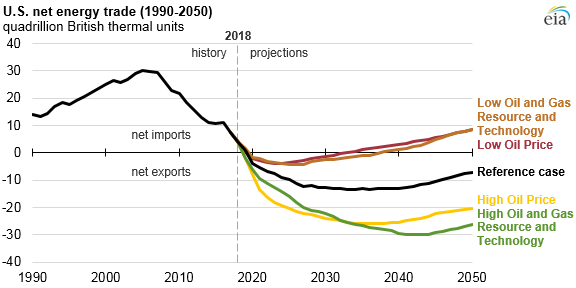
Federal energy analysts project that the United States will export more energy than it imports by 2020, making the nation a net energy exporter for the first time since the 1950s. Fossil fuels represent the largest volumes of this international trade.

Source: U.S. Energy Information Administration
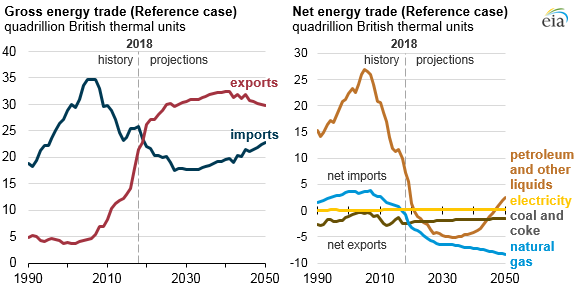
The United States both exports and imports energy in a variety of forms, including natural gas, coal and coke, petroleum and other liquids, and electricity. According to the U.S. Energy Information Administration, the United States has long been a net exporter of coal and coke. In 2017, the nation began exporting more natural gas than it imports, primarily in the form of liquified natural gas or LNG. EIA notes that electricity trades with neighboring Canada and Mexico represent "a relatively small part of U.S. net energy trade flows."

The EIA projects that domestic production of crude oil, natural gas, and natural gas plant liquids will continue to grow at a faster rate than U.S. energy consumption over the next decade, meaning the balance of these fuels will be exported. EIA projects that due to "evolving trade flows of liquid fuels and natural gas," increasing exports of these fuels will tip the trade balance to where the U.S. is a net exporter of energy by 2020. When this shift occurs, it will represent the first time that the United States exports more energy than it imports on an annual basis since 1953.

Exactly how large the nation's net exports might be -- and how long the net-exporter status might last -- depend on a variety of assumptions about matters including oil and gas prices, resource extraction technologies, and possible changes to law. Under EIA's reference case which reflects current laws and regulations, the U.S. begins exporting more energy than it imports on an annual basis in 2020 and maintains that status through 2050. In other cases featuring lower prices or extraction rates for oil and gas, EIA projects that U.S. will return to net-importer status by the mid- to late-2030s.

Source: U.S. Energy Information Administration
Changes to laws and regulations could also affect the trade balance for energy products.

NECA Fuels Conference 2018

Thursday, September 20, 2018

Northeast Energy and Commerce Association holds its 2018 Fuels Conference on September 27, 2018, in Marlborough, Massachusetts.

NECA is New England's oldest and most broadly-based, non-profit trade association serving the competitive electric power industry.

The program for NECA's 2018 Fuels Conference features diverse perspectives on fuels including natural gas (pipeline and LNG), biogas, oil, and other fuels, and in their uses such as electric power generation, heating, and transportation. Speakers will share their outlook for U.S. and New England natural gas markets, address the trend towards electrification of sectors like heating and transportation, explain the portfolio of fuels used to heat and power the region, and discuss what consumers can expect from lawmakers, regulators, and energy providers.

Registration is available through NECA's website.

https://www.necanews.org/events/EventDetails.aspx?id=1109543&group=

ISO-NE 2018 Regional Electricity Outlook

Thursday, February 15, 2018

Regional electricity grid operator ISO New England, Inc. has released its 2018 Regional Electricity Outlook. According to the report, "the biggest challenge to the reliability of the grid is the lack of fuel infrastructure to supply the fleet of natural-gas-fired generators, further emission restrictions on oil-fired generation, and the reality that older oil and nuclear generators are becoming less economically competitive and may retire before the region has added sufficient new energy sources to replace them."

The report cites competitive forces has having "unleashed new approaches for producing electricity in a cleaner way and integrating technology that enables different types of resources to participate in the wholesale markets." It notes new resource types entering the wholesale market, including demand resources, and fast-responding energy storage devices.

With respect to energy supply, the 2018 outlook notes that the amount of wind and solar power in New England continues to grow "and is making a difference in how the ISO operates the power system and designs the wholesale markets." In 2017, the amount of new wind power seeking interconnection in New England surpassed proposed new natural-gas-fired generation for the first time, including significant amounts in Maine and offshore of Massachusetts.

On the demand side, it notes that significant investments in solar resources and energy-efficiency measures have moderated demand for wholesale electricity, but that electrifying the transportation and heating sectors to reduce their carbon emissions could lead to increased demand.

ISO-NE has previously identified the risk that power plants will run out of fuel as the foremost challenge to a reliable power grid in New England. Last month, ISO-NE released an operational fuel security study analyzing fuel security risks facing region's power plants under a wide range of hypothetical future scenarios. That report concluded that maintaining the electric grid's reliability "is likely to become more challenging, especially if current power system trends continue."

The 2018 Regional Electricity Outlook notes that while ISO-NE plays a role in addressing regional fuel-delivery constraints, "it will be up to market participants and state officials to take actions to secure forward fuel arrangements or bolster supply- or demand-side infrastructure." The report identifies potentially appropriate investments as including "enhancements to natural gas infrastructure or the supply chains for liquefied natural gas and oil; relaxation of rules to allow easier permitting and operation of dual-fuel resources; investments in even more renewable energy and any transmission needed to deliver it; or further measures to significantly reduce demand on the power system or the gas system," or some combination of these.

While reliability is core to the grid operator's priorities, the report acknowledges that New England's policymakers, businesses and citizens also value economic and environmental goals. The report specifically highlighted what it called "the reliability, economic, and environmental consequences of our situation: that regional action to resolve fuel-security risks will involve costly infrastructure investments and perhaps the retention of certain critical energy resources, but inaction will also come with a bill for high energy prices when energy supply is constrained—as well as the potential for greater risks to power system reliability and higher emissions."

Sabine Pass LNG tanks leaked, says regulator

Monday, February 12, 2018

U.S. regulators of natural gas infrastructure have issued an order requiring the owner of a liquefied natural gas terminal in Louisiana to remove part of that facility from service, following the discovery of unintended releases of LNG from the facility.

At issue is Sabine Pass Liquefaction, LLC's Sabine Pass Liquefaction Facility. The company is a subsidiary of Cheniere Energy, Inc. The Sabine Pass LNG terminal includes five LNG storage tanks with capacity of approximately 16.9 billion cubic feet equivalent (Bcfe), two marine berths that can accommodate vessels with nominal capacity of up to 266,000 cubic meters and vaporizers with regasification capacity of approximately 4.0 Bcf/d, adjacent to a series of liquefaction trains. The facility has received U.S. Department of Energy authorization for export of LNG by vessel.

According to a Corrective Action Order issued by the Pipeline and Hazardous Materials Safety Administration on February 8, 2018, on January 22, 2018, workers at the Sabine Pass plant discovered a release of LNG from a storage tank at the facility. The order states that LNG escaped from the tank into the annulus -- the space between the tank's inner and outer walls -- which eventually caused cracks in the outer tank wall and the pooling of LNG in a secondary containment area. It also says that the federal investigation into this incident discovered additional LNG releases from multiple cracks in another tank at the site, with evidence of "brittle failures" in the carbon steel outer tank wall.

The order says Sabine took steps upon discovery of the incident including commencing de-inventorying LNG from the tank, reducing system pressures, and deploying an emergency management team. Sabine reported no injuries or fatalities as a result of the incident, and there were no reported fires or explosions. The cause of the incident has not yet been determined.

The PHMSA order requiring corrective action includes a finding "that the continued operation of the Affected Tanks without corrective measures is or would be hazardous to life, property and the environment." It describes unintended releases of LNG as "rare ... low -frequency, high-consequence" events which "can result in a serious hazard to people and property." It notes, "To date, Sabine has been unable to correct the long-standing safety concerns described above involving the Affected Tanks, cannot validate the exact source or amount of the LNG that may have leaked into the annulus of the Affected Tanks, and cannot identify the circumstances that allowed the LNG to escape containment in the first place."

The order requires Sabine to develop a timeline and plan for removing the two "Affected Tanks" and their associated systems from service. A third tank is described in a footnote to the order as having experienced releases of LNG from the inner tank into the annular space, but is not included as one of the "Affected Tanks" covered by the order requiring corrective action. It requires Sabine to develop a work-plan including tank-specific purging plans, a root-cause analysis plan, a detailed repair and modification plan, a continuing operation plan for facilities that remain in service, and a plan to return the affected tanks to service, and prohibits Sabine from returning the affected tanks to service until authorized to do so by the Director of PHMSA.

New England Operational Fuel-Security Analysis released

Tuesday, January 23, 2018

The risk that power plants will run out of fuel is the foremost challenge to a reliable power grid in New England, according to the region's grid operator, and the region is vulnerable to the season-long outage of any of several major energy facilities.

While the ability to count on a portfolio of power plants to generate power is considered the cornerstone of reliable electricity supply, ISO New England has noted several factors that make fuel security a growing concern for the region. These factors include the inadequacy of the region’s natural gas infrastructure to meet winter needs for both heating and power, and the retirement of many of the region’s coal, oil, and nuclear power plants due to economic and environmental pressures.

On January 17, 2018, ISO New England released its Operational Fuel-Security Analysis, a 56-page report studying the possible fuel security risks facing region's power plants under a wide range of hypothetical future scenarios. Prepared following about two years of study, the report found that maintaining the electric grid's reliability "is likely to become more challenging, especially if current power system trends continue."

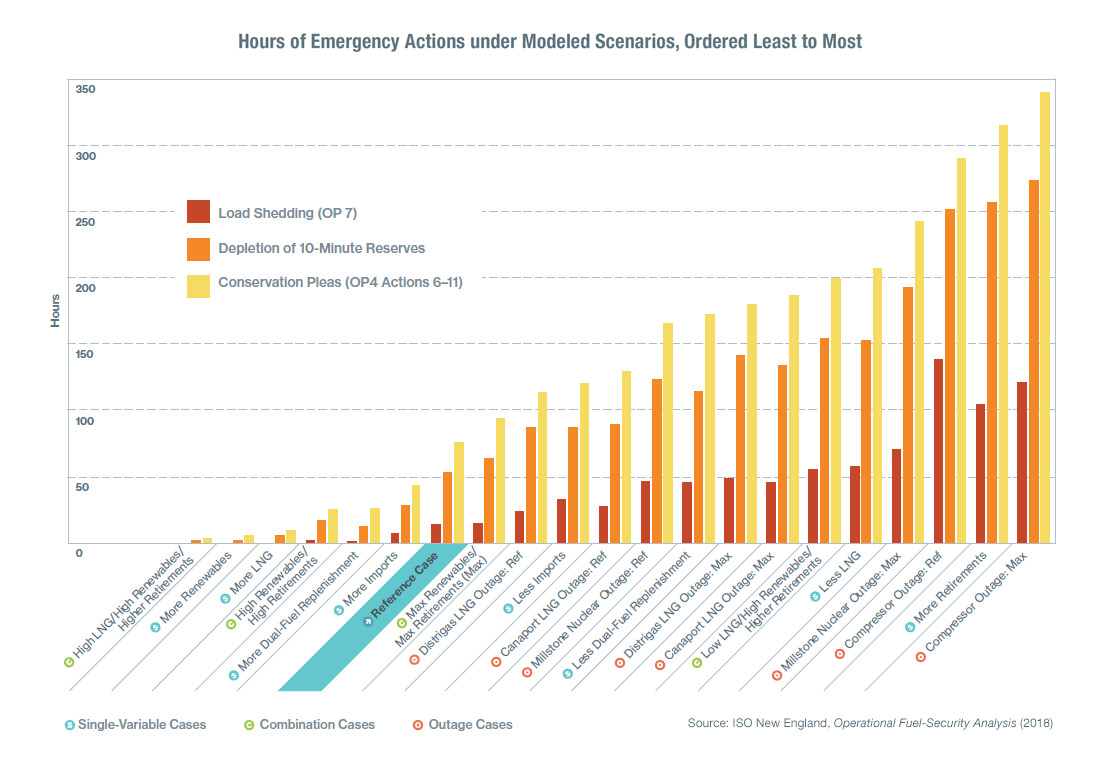
The report considered a 23 possible range of possible future power resource combinations that could materialize for the winter period from December 1, 2024 through February 28, 2025, to examine whether enough fuel would be available to meet demand and to quantify the operational risks. Each scenario assumed no new natural gas pipeline capacity would be added to serve generators, but considered variation in five other key factors for power system reliability: resource retirements, LNG availability, oil tank inventories, imported electricity, and renewable resources.

ISO-NE chart of Hours of Emergency Actions under Modeled Scenarios, Ordered Least to Most, Operational Fuel-Security Analysis (2018)

The study identified six major conclusions:
  1. Outages: The region is vulnerable to the season-long outage of any of several major energy facilities.
  2. Stored fuels: Power system reliability is heavily dependent on LNG and electricity imports; more dual-fuel capability is also a key reliability factor, but permitting for construction and emissions is difficult.
  3. Logistics: The timely availability of fuel is critical, highlighting the importance of fuel-delivery logistics.
  4. Risk trends: All but four scenarios result in fuel shortages requiring load shedding, indicating the trends affecting New England’s power system may intensify the region’s fuel-security risk.
  5. Renewables: More renewable resources can help lessen the region’s fuel-security risk but are likely to drive coal- and oil-fired generation retirements, requiring high LNG imports to counteract the loss of stored fuels.
  6. Positive outcomes: Higher levels of LNG, imports, and renewables can minimize system stress and maintain reliability; to attain these higher levels, delivery assurances for LNG and electricity imports, as well as transmission expansion, will be needed.
According to ISO-NE, quantifying the level of risk over a wide range of possible combinations provides information the region can use to consider approaches to ensuring power system reliability. The grid operator has said it plans to engage with stakeholders, regulators, and policymakers through 2018 to discuss the operational fuel-security analysis -- and how much risk the ISO and region would be willing to tolerate.

Winter 2017-18 and the New England electric grid

Friday, October 27, 2017

With measures in place to ensure the reliability of New England's electric grid for the coming winter season, grid operator ISO New England, Inc. expects to have adequate electricity supplies this winter -- but according to a recent presentation to federal regulators, the biggest challenges could come in the form of extended cold weather when fuel inventories are already depleted or a day when gas supplies are constrained and suddenly a large non-gas resource is lost.

According to an October 19, 2017 presentation by ISO-NE to the Federal Energy Regulatory Commission, in 2016 nearly half of the electricity produced in New England came from natural gas, and the availability of gas impacts both grid reliability and production costs.  At the same time, the gas pipeline infrastructure serving New England is limited, with pipelines reaching their maximum capacity at times including winter months when demand peaks for gas for heating.

In response to concerns over reliability and past events like the January 2004 "cold snap" and the 2014 "polar vortex", ISO-NE has taken steps including developing operating procedures, a Winter Reliability Program and "Pay for Performance" changes to market rules that incentivize investment in operational improvements and secure fuel arrangements, as well as improving communication and coordination with generators, pipelines, and other stakeholders.

With those measures in place, ISO-NE recently told the Commission it expects to have adequate electricity supplies this winter, but that gas pipeline constraints continue to be a concern.  ISO-NE noted that while Spectra Energy placed its Algonquin Incremental Market project in service providing some relief last winter, that relief "was short-lived due to the retirement in 2017 of more than 1,500 MW of non-gas units (Brayton Point Power Station)."  The grid operator also noted that "LNG shipments are unknown" and that "Non-gas resources will continue to play a vital role in maintaining reliability."

Citing the biggest challenges this winter as extended cold weather when fuel inventories are depleted or a day when gas supplies are constrained and the region is using primarily nuclear, coal, and oil resources and suddenly a large non- gas resource is lost, ISO-NE noted that while the region has adequate generating capacity to serve load under those conditions, "the ability to meet energy needs is at risk if gas cannot be supplied to gas-fired generators."

ISO-NE winter electricity supply 2016-2017

Thursday, December 8, 2016

New England should have sufficient electricity supplies to meet consumer demand this winter, according to regional power grid operator ISO New England, Inc.  But because natural gas pipeline constraints could limit electricity production, the grid operator has implemented a Winter Reliability Program to help ensure supply meets demand.

ISO-NE is the regional transmission organization responsible for most of New England's electric grid.  In that role, it forecasts electricity demand, and operates markets to match up generation with demand.

On December 5, 2016, ISO-NE released a statement addressing winter 2016-2017 with respect to electricity reliability.  The grid operator projects that at normal winter temperatures of about 7 degrees Fahrenheit, peak demand will reach 21,340 MW, or 22,028 MW if extreme winter weather of 2 degrees F occurs.  This would be above the 2015-2016 winter peak demand of 19,545 MW (February 14, 2016, from the hour from 6 to 7 p.m.), and below the all-time regional winter peak of 22,818 MW (a cold snap on January 15, 2004).

According to the grid operator, electricity supplies should be sufficient to meet consumer demand this winter -- but natural gas pipeline constraints and other factors create risks that could affect reliability.  Natural gas generated 49% of the region's electricity in 2015, and natural gas-fired power plants represent about 44% (or 14,850 megawatts) of the region's total generating capacity. But ISO-NE views about 3,450 MW of natural gas-fired generating capacity as "at risk" this winter due to the insufficiency of the region's natural gas infrastructure.  Despite some new pipeline projects and the present availability of liquified natural gas (LNG), the region faces the loss of 1,500 MW of coal- and oil-fired generation this spring with the closure of the Brayton Point Power Station in Massachusetts.

ISO-NE touts its 2016-2017 Winter Reliability Program as designed to address these "multiple risks" of pipeline constraints and non-gas unit retirement. As previously approved by the Federal Energy Regulatory Commission, the program will run from December 1, 2016 to February 28, 2017, and includes an oil inventory component, an LNG component, and a demand response component.

In light of this planning, and barring "unexpected resource outages or fuel delivery constraints," ISO-NE projects New England's electricity supplies should be sufficient this winter to meet consumer demand.

ISO-NE Winter Reliability Program 2016-2017

Thursday, September 1, 2016

As winter approaches, the operator of New England's wholesale electricity markets is preparing to run another seasonal Winter Reliability Program to address operational concerns related to fuel adequacy.

Since the winter of 2013-2014, ISO New England Inc. has operated a seasonal program to address winter fuel security and power system reliability concerns, relating largely to natural gas pipeline constraints.  After two initial program years, last fall the Federal Energy Regulatory Commission approved a three-year plan for ISO-NE's Winter Reliability Program.

That program, developed chiefly by market participant group New England Power Pool (NEPOOL), was designed to address reliability concerns through at least 2017-2018, when new “Pay-for-Performance” incentives and penalties in New England's redesigned capacity market are set to take effect.  The winter reliability program encourages generators fueled by oil and liquefied natural gas (LNG) to secure fuel before the winter season begins, by compensating them for some costs related to fuel inventory that remains unused at winter's end, and includes a demand response component.  According to ISO-NE, last year's participants included 77 oil-fired units, 8 LNG units, and 6 demand response assets.

The program's rules are specified in Appendix K to Section III of the ISO New England Inc. Transmission, Markets and Services Tariff.  As approved by FERC, the current program retains the three core components of the 2014-2015 Winter Reliability Program: (1) compensation for certain oil inventory that remains in New England following the end of each winter period; (2) end-of-season compensation for LNG contract volumes kept available for winter use but not actually called upon to produce energy; and (3) a supplemental demand response program.

ISO-NE has also published a memorandum describing payment rates for the 2016-2017 winter program.  Under its tariff, ISO-NE first determines a "Set Rate," representing partial compensation for the per-barrel carrying costs of stored fuel oil.  The Set Rate is translated into an equivalent rate for the other, non-oil services that are compensated through Appendix K.

Requests to participate in ISO New England's 2016-2017 Winter Reliability Program are due to ISO-NE by October 1, 2016

ISONE External Market Monitor report 2015

Monday, July 11, 2016

A report by the New England electricity market's external monitor has found that "the markets performed competitively in 2015."

ISO New England operates wholesale electricity markets covering most of New England.  It employs two independent market monitors -- one internal to ISO-NE, one a hired external consultant -- to regularly review, analyze, and report on market results, and offer recommendations on market improvements.

Potomac Economics serves as the External Market Monitor for ISO-NE. In this role, it is charged with evaluating the competitive performance, design, and operation of the wholesale electricity markets operated by ISO-NE.  Last month, the external market monitor released its "2015 Assessment of the ISO New England Electricity Markets" (102-page PDF), presenting its perspective on the New England electricity markets.

Among other findings, the report notes that energy market trends "have been dominated by reductions in fuel prices over the last two years.  In particular, from 2014 to 2015:
  • Natural gas prices declined more than 40 percent, falling to multi -year lows in mid -2015 largely because of higher shale production from the Marcellus and Utica regions; and
  • Fuel oil prices fell by more than 35 percent because of increased global supply, and world liquefied natural gas (LNG) prices have fallen similarly. These reductions helped limit the increase in natural gas prices during tight gas supply conditions in the winter. 
The report notes that as a result, energy prices dropped 35 percent over the same time.  According to the external market monitor, "The strong relationship between energy and natural gas prices indicated by these results is expected in a well-functioning, competitive market. Natural gas-fired resources were the marginal source of supply in most intervals in 2015 and competition compels suppliers submit offers consistent with their marginal costs, most of which are resources’ fuel costs."

ISO New England's internal market monitor released its 2015 Annual Markets Report earlier this year.  That report similarly found that overall, "the ISO New England capacity, energy, and ancillary service markets performed well in 2015."

FERC proposes FAST Act CEII rules

Friday, June 17, 2016

The Federal Energy Regulatory Commission has proposed amending its regulations designed to protect critical information about utility infrastructure.  If adopted, the new regulations would govern the treatment of Critical Energy/Electric Infrastructure Information (CEII) whose disclosure and misuse could put the electric grid at risk.

In the wake of the September 11, 2011 terrorist attacks, the Commission took steps to identify and protect sensitive information it considered "Critical Energy Infrastructure Information," or CEII.  In general, FERC defined CEII as specific engineering, vulnerability, or detailed design information about proposed or existing critical infrastructure (physical or virtual) that:
  1. Relates details about the production, generation, transmission, or distribution of energy;
  2. Could be useful to a person planning an attack on critical infrastructure;
  3. Is exempt from mandatory disclosure under the Freedom of Information Act; and
  4. Gives strategic information beyond the location of the critical infrastructure.
Some previously public material was designated as CEII, and going forward newly filed or issued documents had to be screened for CEII.  FERC also created a process to allow individuals with a valid or legitimate need to access CEII, while protecting it from other disclosure.

But last year, Congress weighed in on the protection of certain sensitive information about infrastructure.  The Fixing America's Surface Transportation (FAST) Act, signed into law on December 4, 2015, included provisions designed to improve the security and resilience of energy infrastructure in the face of emergencies.  In particular, the FAST Act added section 215A to the Federal Power Act, directing the Commission to issue regulations covering the security and sharing of "Critical Electric Infrastructure Information."

Federal Power Act section 215A(a)(3) defines the new term Critical Electric Infrastructure Information as:
information related to critical electric infrastructure, or proposed critical electrical infrastructure, generated by or provided to the Commission or other Federal agency, other than classified national security information... Such term includes information that qualifies as critical energy infrastructure information under the Commission’s regulations.
As interpreted by the Commission, this encompasses "not only information regarding the Bulk-Power System but also information regarding other energy infrastructure (i.e., gas pipelines, LNG, oil, and hydroelectric infrastructure) to the extent such information qualifies as Critical Energy Infrastructure Information under the Commission’s current regulations. "

On June 16, 2016, the Commission issued a Notice of Proposed Rulemaking, proposing to amend its regulations to implement the provisions of the FAST Act pertaining to the designation, protection and sharing of critical electric infrastructure information, and also proposing to amend its existing regulations pertaining to CEII. The proposed changes include criteria and procedures for designating information as CEII, a specific prohibition on unauthorized disclosure of that information, and sanctions for knowing and willful wrongful disclosure of CEII by federal personnel.

Comments on the Notice of Proposed Rulemaking are due 45 days after its publication in the Federal Register.

FERC denies Oregon LNG project applications

Tuesday, March 15, 2016

U.S. energy regulators have denied applications to site, construct, and operate the proposed Jordan Cove liquefied natural gas (LNG) export terminal, an associated pipeline and related facilities slated for development in Oregon.

The Jordan Cove LNG Terminal and the Pacific Connector Pipeline were proposed as two segments of a single, integrated project.  According to the FERC record, the applicants designed the facilities to enable the production of up to 6.8 million metric tons per annum (MMTPA) of LNG, using a feed of approximately 1.04 billion standard cubic feet per day (Bcf/d) of natural gas, for export to international or domestic markets in the non-contiguous United States.  The proposed pipeline would carry natural gas to the LNG terminal, for liquefaction, storage in cryogenic tanks, and loading onto ocean-going vessels.

Under U.S. federal law, the Federal Energy Regulatory Commission exercises permitting authority over several types of natural gas infrastructure, including LNG terminals and interstate pipelines.  In 2013, Jordan Cove Energy Project, L.P. applied under section 3 of the Natural Gas Act (NGA) and Parts 153 and 380 of the Commission’s regulations to site, construct, and operate the LNG terminal.  Several weeks later, Pacific Connector Gas Pipeline, LP applied under NGA section 7(c) and Part 157 of the Commission’s regulations for a certificate of public convenience and necessity to construct and operate an approximately 232-mile-long, 36-inch-diameter interstate natural gas pipeline running to the Jordan Cove LNG Terminal.

Over the next few years, Commission staff engaged in a back-and-forth with the applicants over the status of liquefaction contracts for the LNG terminal and precedent agreements for pipeline capacity.  The Sierra Club and others intervened and filed protests.  Concerns stated included environmental issues and landowner complaints, as well as an alleged lack of need for the projects.  Meanwhile the Commission issued the project a generally favorable environmental assessment.

The Commission ultimately denied the applications on March 11, 2016.  In its order denying the applications, the Commission cited its Certificate Policy Statement as providing "guidance for evaluating proposals to certificate new construction."  In the Commission's words:
The Certificate Policy Statement establishes criteria for determining whether there is a need for a proposed project and whether the proposed project will serve the public interest. The Certificate Policy Statement explains that in deciding whether to authorize the construction of major new pipeline facilities, the Commission balances the public benefits against the potential adverse consequences. The Commission’s goal is to give appropriate consideration to the enhancement of competitive transportation alternatives, the possibility of overbuilding, subsidization by existing customers, the applicant’s responsibility for unsubscribed capacity, the avoidance of unnecessary disruptions of the environment, and the unneeded exercise of eminent domain in evaluating new pipeline construction. 
The threshold requirement for pipelines proposing new projects under this policy is that the pipeline must be prepared to financially support the project without relying on subsidization from its existing customers.  In this case, the Commission found that Pacific Connector satisfies the threshold "no subsidization" requirement of the Certificate Policy Statement because it is a new natural gas company and does not have existing customers. 

Next, the Commission determine whether the applicant has made efforts to eliminate or minimize any adverse effects the project might have on the applicant’s existing customers, existing pipelines in the market and their captive customers, or landowners and communities affected by the route of the new pipeline. If these interest groups face residual adverse effects after efforts have been made to minimize them, the Commission essentially performs an economic balancing test on the evidence of public benefits to be achieved as compared to the residual adverse effects. Only when the benefits outweigh the adverse effects on economic interests will the Commission proceed to complete the environmental analysis where other interests are considered.

The benefits test proved problematic for the Pacific Connector pipeline.  The Commission found no adverse impact to existing customers, existing pipelines in the market or their captive customers.  But the Commission noted the landowner concerns, and a lack of evidence that the applicant had obtained any easement or right-of-way agreements for the necessary use of private lands.  In the Commission's view, these concerns must be weighed against the benefits to be gained from the project.

But the Commission found that "Pacific Connector has presented little or no evidence of need for the Pacific Connector Pipeline."  The Commission noted that the pipeline applicant had "neither entered into any precedent agreements for its project, nor conducted an open season, which might (or might not) have resulted in “expressions of interest” the company could have claimed as indicia of demand." According to the Commission, the applicant offered only "generalized allegations of need."  These did include the fact that Jordan Cove received U.S. Department of Energy authorization for export of LNG to free trade agreement and non-free trade agreement nations as "consistent with the public interest."  But the FERC noted that this DOE authorization for LNG was pursuant to different statutes, and moreover did not apply to the pipeline

The Commission noted that it "has not previously found a proposed pipeline to be required by the public convenience and necessity under NGA section 7 on the basis of a DOE finding under NGA section 3 that the importation or exportation of the commodity natural gas by an entity proposing to use the services of an associated LNG facility is consistent with the public interest."  As a result, the Commission found that "the generalized allegations of need proffered by Pacific Connector do not outweigh the potential for adverse impact on landowners and communities." Because the record did not support a finding that the public benefits of the Pacific Connector Pipeline outweigh the adverse effects on landowners, the Commission denied Pacific Connector’s request for certificate authority to construct and operate its project.

Turning next to the LNG terminal, the Commission noted that the Pacific Connector Pipeline is the only proposed transportation path for natural gas to reach the Jordan Cove LNG Terminal, and that the Commission has not previously authorized LNG export terminal facilities without a known transportation source of natural gas. Because the Commission concluded that the record did not support a finding that the Jordan Cove LNG Terminal can operate to liquefy and export LNG absent the Pacific Connector Pipeline, the Commission instead found that authorizing its construction would be inconsistent with the public interest. Therefore, it also denied Jordan Cove’s request for authorization to site, construct and operate the Jordan Cove LNG Terminal.

ISO-NE Winter Reliability Program 2015 by the numbers

Tuesday, December 22, 2015

The operator of New England's electric grid is running a special Winter Reliability Program to address fuel security and power system reliability concerns, relating largely to natural gas pipeline constraints.  A December 2015 presentation by ISO New England, Inc.'s CEO provides initial cost and participation data on this winter's program.

More than 45% — about 13,650 MW—of the total generating capacity in New England uses natural gas as its primary fuel.  Out of this gas-fired capacity, ISO-NE's Winter Outlook has identified 4,220 MW of natural gas-fired generation at risk of not being able to get fuel when needed due to constraints on interstate natural gas pipelines.

As in 2013 and 2014, in 2015 ISO-NE again proposed a Winter Reliability Program to address concerns over reliability.  The 2015-2016 program includes 4 main components: oil, LNG, demand response, and dual-fuel commissioning.  According to a December 2015 presentation to the NEPOOL Participants Committee, program participation and expected cost exposure breaks down as follows:

Oil Program
  • 81 units submitted intent to provide 4.464 million barrels
  • Total eligible oil is anticipated to be 2.965 million barrels
  • Total oil program cost exposure is anticipated to be $38.25M (@$12.90/barrel

LNG Program
  • 8 units submitted intent to provide at least 1.42 million MMBTU
  • Total eligible LNG is 1.278 million MMBTU
  • Total LNG program cost exposure is anticipated to be $2.75M (@$2.15/MMBTU

Demand Response Program
  • 7 assets submitted an intent to participate; 6 accepted by ISO-NE, to provide at least 26.5 MW of interruption capability
  • Total DR program cost exposure is anticipated to be $132K

Dual-fuel Commissioning Program
  •  6 units submitted intent to commission Dual Fuel Capability
    • 4 units for 2014/15 (1,039 MW)
    • 2 units for 2015/16 (735 MW)
  • Total additional winter seasonal claimed capability represented: 1,774 MW

ISO-NE will release additional information on actual 2015/2016 Winter Reliability Program operations and costs over the winter period.

House subcommittee holds hearing on FERC oversight

Tuesday, December 1, 2015

Members of the Federal Energy Regulatory Commission testify today before the House Energy & Commerce Committee, Subcommittee on Energy and Power, as that committee considers its oversight of the FERC.


The FERC is an independent administrative agency within the Department of Energy.  Its mandate includes regulating the transmission, reliability, and wholesale sale of electricity in interstate commerce pursuant to the Federal Power Act; the transmission and sale of natural gas for resale in interstate commerce pursuant to the Natural Gas Act; the transportation of oil by pipeline in interstate commerce pursuant to the Interstate Commerce Act; and evaluating proposals to build liquefied natural gas (LNG) terminals and interstate natural gas pipelines, as well as the licensing of non - federal hydropower projects.

As described in a committee background memorandum for today's hearing, the Subcommittee on Energy and Power is exploring whether FERC’s statutory authorities require modernization to reflect current energy realities.  Chief among those statutory authorities are the Federal Power Act and the Natural Gas Act.  The committee memorandum also notes an interest in evaluating "whether FERC is overstepping its existing statutory boundaries to pursue policy goals not intended by Congress."

Specific issues expected to be examined at the hearing include:

Based on prefiled documents, today's hearing features:
More information about today's hearing can be found on the committee's webpage.

Report: New England electric sector will face gas supply deficit

Friday, November 21, 2014

A recently released report on the adequacy of New England’s natural gas pipeline infrastructure has identified the potential for shortfalls in gas supply to electric generators through 2020.  The November 20, 2014 report, Assessment of New England’s Natural Gas Pipeline Capacity to Satisfy Short and Near-Term Electric Generation Needs: Phase II, was prepared by consulting group ICF International for regional electric grid operator ISO New England Inc.  It found “a high probability that the electric sector will have a gas supply deficit on 24 to 34 day per winter by 2019/20.”

The Phase II report follows on a 2011/12 “Phase I” study by ICF of the adequacy of the natural gas pipeline infrastructure in New England to serve the combined needs of the core natural gas market and the regional electric generation fleet.  In the years since the Phase I study, existing natural gas and electric power systems have experienced significant changes, with further changes projected.  ISO-NE also identified the need to extend the power sector gas supply adequacy analysis beyond the peak winter and summer demand day, to examine supply adequacy throughout the peak winter demand period (December 1 through February 28).

ICF’s Phase II report presents its updated findings given these changes.  Its conclusions include:
  • Despite the likelihood of 450 MMcf/d of new interstate natural gas transportation capacity being added by the end of 2016, the New England market is likely to remain supply constrained through 2020.
  • Updating projections for energy efficiency has a significant impact on projected gas consumption for electric generation. The studied cases reduced projection winter peak day gas consumption by as much as 550,000 Dth by 2019/20.  However, this was not sufficient to eliminate the projected winter peak day supply deficits.
  • Future imports of liquefied natural gas (LNG) into the region are likely to be well below the rated capacity of the import terminals.  Neither the Northeast Gateway nor Neptune offshore import terminal has received any shipments since 2010, and neither was projected to receive any future LNG shipments in this study.
  • The Maritimes & Northeast Pipeline from Eastern Canada into New England is expected to continue to flow at full capacity on a peak winter day. Eastern Canadian gas production is expected to decline overall from 2015 through 2020, even as the Deep Panuke field ramps up its production. Historically, the Canaport LNG terminal in St. John, New Brunswick, has been managed to keep the pipeline full on peak winter days (when New England gas demand and gas prices are highest). In the future, with fewer LNG shipments coming in, the pipeline will flow full on fewer winter days, reducing natural gas supplies into New England.
  • The Winter Near-Peak analysis indicates that gas supply deficits may occur not just on peak days, but also on multiple high demand days throughout the winter. Based on projected gas supplies, local distribution company (LDC) demands for retail gas supply, and electric generator gas demands, there is a high probability that the electric sector will have a gas supply deficit on 24 to 34 day per winter by 2019/20.
With the Phase II report now in ISO New England's hands, the grid operator has an updated analysis of the adequacy of the region's natural gas pipeline infrastructure to meet all the demands on it through 2020.  ISO New England describes itself as playing three critical roles: grid operation, market administration, and power system planning.  From all three of these perspectives, projections of a high probability of gas supply deficit for the electric power sector are troubling.  ICF's findings thus may shape how ISO New England -- or state and federal regulators -- reforms the New England gas and electric markets.

ISO New England's Winter Reliability Program 2014-2015

Wednesday, October 8, 2014

Keeping the lights on is what electric grid operators do around the clock – but challenges in New England are leading its grid operator to prepare for a winter when the availability of affordable electricity may be challenged.  In preparation, ISO New England, Inc. has received federal approval for a new Winter Reliability Program for the 2014-2015 winter season.

Winter is coming.
ISO New England is the federally-designated regional transmission organization for almost all of New England.  In this role, it is responsible for planning and operating electricity markets to balance supply and demand in real time.   

The grid operator first turned to a Winter Reliability Program in 2013.  ISO New England projected that a limited supply of natural gas and the retirements of several major generating plants would lead to a shortage of about 2 million megawatt-hours of energy during the winter months.  To insure against this gap, the grid operator held a competitive process to procure up to 2.4 million megawatt-hours of energy for the winter season, from a combination of oil-fired generators, dual-fuel generators, and demand response assets.  In exchange for their commitment to provide power when called upon, the selected generators and demand response assets received payments regardless of whether they were actually needed.

In ISO-NE's eyes, the 2013-2014 Winter Reliability Program proved essential in maintaining reliability during the “polar vortex” and other unusually cold conditions.  After adjusting for resource unavailability, the final cost of the 2013/2014 program was approximately $66 million, which came in below the original estimates of about $75 million.

While last year’s program was intended to be a one-time solution to bridge a reliability gap, this summer ISO-NE and regional stakeholder body NEPOOL identified additional challenges for the coming winter.  Specifically, more severe pipeline constraints, difficulty replenishing oil inventories, and large-scale generator retirements continue to threaten the coming winter's reliability and expose consumers to the risk of price spikes.

As a result, ISO-NE asked the Federal Energy Regulatory Commission to approve another program to mitigate reliability concerns for the 2014-2015 winter.  The new program, which the FERC accepted last month, combines features of last year’s program with further modifications.  For example, the new demand-response component is much the same as in last year’s program, while permanent rules related to auditing dual-fuel generators and the partial elimination of higher-cost fuel requirements are based on similar features in last winter’s program.

On the other hand, the new program has been modified as a result of several market changes that will be in effect prior to winter 2014/2015 as well as the FERC's clarification of what generators must do to procure adequate fuel for their expected run times.  The new program also adds a liquefied natural gas (LNG) component to improve fuel neutrality, and changes the basis for compensation from upfront inventory to actual unused inventory at the end of the winter.  While participants in last year's program were paid on an as-bid basis, the new program provides compensation for the fuel inventory and demand response programs based on a set rate of $18 per barrel.  This $18 price is designed to represent the carrying costs, price risk, availability cost and liquidity risk of the last resource needed to meet a cumulative inventory of 3.5 million barrels of oil.

The program also includes incentives for commissioning duel-fuel capacity: the ability to run on either oil or gas. Generators that have not operated on oil since at least December 1, 2011, and that demonstrate a plan for commissioning, or recommissioning a mothballed dual-fuel unit, by December 1, 2016, will be eligible for compensation to offset some of the associated costs.

The new program is moving forward.  On September 9, 2014, the FERC issued an order accepting the region’s proposed 2014/2015 Winter Reliability Program.  In the order, FERC requires ISO-NE to initiate a stakeholder process by January 1, 2015, to develop a proposal to address reliability concerns for the 2015/2016 winter and future winters, as necessary, to schedule meetings and submit progress reports, and to include certain analysis and recommendations in its Annual Markets Report.

For the proposed 2014/2015 program, the Analysis Group estimated costs for the separate components: the maximum cost of the demand response component would be about $2.4 million; the cost of the unused oil inventory and LNG contract volume components would be based on how much fuel remains unused, and assuming, at the high end, that 100% of the targeted amount of fuel is unused, the estimated cost would be $82.6 million; and the maximum cost for the dual-fuel commissioning program is estimated to be $12.9 million for units that commission by December 1, 2015.  The dual-fuel auditing provisions are estimated to cost a maximum, annually, of $7 million.

Consistent with the Commission’s order on the first winter program, the costs will be allocated to real-time load obligation, which is paid by load-serving entities, rather than to regional network load, which is paid by transmission owners.

Requests to Participate in the Oil Program, LNG Program, or Demand Response Program were due to ISO New England Customer Service by October 1, 2014. Dual Fuel Commissioning Requests are due by December 1, 2014

Exporting compressed natural gas from the US

Monday, October 6, 2014

In a divided opinion, the Federal Energy Regulatory Commission has found that it does not have jurisdiction over facilities proposed by Emera CNG, LLC to compress natural gas for export to the Bahamas by ship.

Natural gas is an important fuel used globally for electric power generation, heating, and industry.  Throughout most of the U.S., an abundant supply of natural gas means domestic pricing for gas is lower than overseas.  This creates a potentially profitable opportunity to export natural gas from the U.S., if regulatory conditions allow.

Natural gas can be exported by pipeline as a gas, or by truck or ship as either compressed natural gas (CNG) or liquefied natural gas (LNG). Liquefying natural gas enables massive quantities of gas to be transported anywhere in the world, but requires the construction of expensive facilities to liquefy and regasify the fuel.  The federal Natural Gas Act gives the Federal Energy Regulatory Commission jurisdiction over the siting and construction of most LNG facilities in the U.S., and authorizes FERC to issue certificates of public convenience and necessity for LNG facilities engaged in interstate natural gas transportation by pipeline.  For example, Dominion Cove Point LNG, LP recently secured the FERC's approval for its Cove Point LNG export facility.

By comparison, compressing natural gas to high pressures is a relatively lower-cost way to improve the energy density of the fuel and reduce its transportation costs, albeit not to the degree of LNG.  CNG exports are already happening, and may soon increase.

Emera recently proposed to construct a CNG compression and truck-loading facility at the existing Port of Palm Beach in Riviera Beach, Florida, in order to export CNG to the Commonwealth of the Bahamas.  At the site, Emera would draw natural gas from the Riviera Lateral, a pipeline owned and operated by Peninsula Pipeline Company.  Emera would then dehydrate and compress the gas to fill containers that would be loaded onto trucks.  The proposed CNG facility would initially be capable of loading 6 million cubic feet per day (MMcf/d) of CNG, with expansion capabilities up to 25 MMcf/d.  Once loaded onto trucks, Emera will haul the containers to a berth about a quarter mile away at the Port of Palm Beach.  At the port, the containers will be loaded onto a roll-on/roll-off ocean-going carrier and shipped to Freeport, Grand Bahama Island, where the containers would be unloaded, the CNG decompressed and injected into a pipeline for transport to electric generation plants owned and operated by Emera affiliate Grand Bahama Power Company and other customers on Grand Bahama Island.

To reduce regulatory uncertainty, Emera petitioned the Federal Energy Regulatory Commission for a declaratory order that its project will not be subject to the Commission’s jurisdiction under the Natural Gas Act.  Last month, a majority of the FERC Commissioners found that the construction and operation of the CNG facility described by Emera would not be subject to FERC's authority over natural gas exports under the Natural Gas Act.  In particular, the majority opinion held that Emera’s facilities to compress and load CNG onto trucks are not jurisdictional export facilities.

In reaching this conclusion, the majority found that the proposed CNG facilities were unlike the border-crossing pipelines and coastal LNG terminals that the Commission traditionally has regulated under section 3 as import/export facilities, and more like existing, unregulated facilities that deliver LNG into trucks which are subsequently driven across the border into Canada or Mexico.  Indeed, the opinion cites the example of Xpress Natural Gas, which has a CNG plant in Maine that receives gas from an interstate pipeline and loads CNG containers onto trucks for delivery to customers in Canada and in New England.  The Commission does not regulate the CNG facility under either section 3 or 7, nor does it exercise jurisdiction over the trucks’ passage across the border under section 3.

The majority opinion similarly found that because Emera said that all of the natural gas to be compressed at Emera’s planned facility will be exported in foreign commerce to the Commonwealth of the Bahamas, the Commission’s section 7 jurisdiction over transportation and sales of gas for resale in interstate commerce would not be implicated by Emera’s proposal.

Notably, new Commissioner Norman Bay dissented from the majority opinion.  Noting language in section 3 of the Natural Gas Act giving FERC jurisdiction over natural gas exports, Commissioner Bay's dissent describes the majority’s argument as that because the CNG will leave Emera’s facility by truck and travel a quarter of mile before being loaded onto ocean-going carriers for export – rather than by a pipeline running across a border or to a tanker – the facility is not an “export facility” under section 3 of the Natural Gas Act. In Commissioner Bay's words, "It cannot be that the Commission’s jurisdiction turns on this 440-yard truck journey."

With FERC regulation under the Natural Gas Act behind it, Emera will still need other approvals to export CNG; for example, Emera has filed an application with the U.S. Department of Energy's Office of Fossil Energy for authorization under Section 3 of the Natural Gas Act for export of natural gas.

What role will CNG exports play in the U.S.'s energy future?

FERC approves Maryland LNG project

Tuesday, September 30, 2014

A proposed Maryland natural gas liquefaction facility won a key federal approval yesterday, as the Federal Energy Regulatory Commission authorized Dominion Cove Point LNG, LP to build the Cove Point Liquefaction Project in Calvert County, Maryland, and related facilities at an existing compressor station and at metering and regulating sites in Virginia.

Natural gas is an important fuel used globally for electric power generation and heating.  While pipelines offer the most efficient way to transport large volumes of natural gas, liquefied natural gas or LNG can more easily be transported by ship to distant markets.  As US natural gas production has increased in recent years, so too has interest in building facilities to liquefy gas for export or other use.

Under Section 3 of the Natural Gas Act, the Federal Energy Regulatory Commission or FERC authorizes the siting and construction of onshore and near-shore LNG import or export facilities. Section 7 of the Natural Gas Act authorizes FERC to issue certificates of public convenience and necessity for LNG facilities engaged in interstate natural gas transportation by pipeline.

On April 1, 2013, Dominion applied to the FERC for approval under Section 3 of the Natural Gas Act to site, construct, and operate the Cove Point Liquefaction Project for the liquefaction and export of domestically-produced natural gas at Dominion’s existing LNG import terminal in Calvert County, Maryland.  Dominion also requested authority under section 7(c) of the Natural Gas Act to construct and operate facilities at its existing compressor station and metering and regulating sites in Virginia.  Collectively, the project will enable Dominion to transport up to 860,000 dekatherms per day of natural gas form existing pipeline interconnects near the west end of the Cove Point Pipeline to the Cove Point terminal for the export of up to 5.75 metric tons of liquefied natural gas per year.

Dominion's requests triggered a case that stretched for over two years of consideration.  During this time, the FERC heard from more than 140 speakers at three public meetings related to an assessment of the project's environmental impacts, and received more than 650 comments from the public and federal, state and local agencies on the application.  In the end, the FERC determined that Dominion’s proposal, as approved with 79 specific conditions required by the Commission’sauthorization, will minimize potential adverse impacts on landowners and the environment.

According to the FERC, Dominion proposes to complete construction of the liquefaction project so that facilities may start service in June 2017.  Notably, the U.S. Department of Energy has already approved Dominion Cove Point’s export of gas to both Free Trade Agreement and non-Free Trade Agreement countries.

The same economic forces motivating the Dominion project support other proposed LNG export projects.  Indeed, FERC has approved three other LNG export projects, all in the Gulf of Mexico -- the Sabine Pass Liquefaction Project, the Freeport LNG Project, and the Cameron LNG Project -- and 14 more LNG export proposals remain pending.

FERC report shows investment in natural gas

Thursday, June 20, 2013

This week the Federal Energy Regulatory Commission issued its monthly energy infrastructure update covering May 2013.  The report details highlights in expansions of energy assets, ranging from natural gas pipelines to electric generation and transmission facilities.  It provides a monthly snapshot of recent activity, and can be used to spot trends in domestic energy development.  The current report illustrates increased investment in natural gas-related infrastructure, ranging from proposed new liquefied natural gas export terminals to newly installed natural gas-fired power plants.
The iconic U.S Capitol dome, where policies are made that shape energy investment.

Natural gas exports poised for growth.  Last month two facilities to liquefy natural gas for export advanced through the FERC regulatory process:
  • Jordan Cove Energy requested authorization to construct and operate four liquefaction trains and storage facilities at a proposed export terminal in Coos Bay, Oregon.  If authorized and built, the project could export up to 900 MMcf per day of liquefied natural gas (LNG).  This gas would likely be destined for Asian markets.
  • Golden Pass Products proposed a larger project in Texas.  Along with Golden Pass Pipeline, Golden Pass Products commenced the FERC prefiling process to construct and operate a 2,100 MMcf per day liquefaction facility for export at an existing import terminal located in Sabine Pass, Texas.  The Golden Pass project also includes proposed modification of an existing pipeline system to enable 2,500 MMcf per day of bidirectional capacity to the proposed export terminal.
These projects demonstrate increased interest in exporting natural gas to overseas markets.  The boom in domestic shale gas production has led to low natural gas prices in the U.S.  Domestic pricing is roughly one-third of the price that exporters can get by sending LNG to Europe or Asia.  Whether and to what extent the U.S. will allow exports remains to be seen, but in the interim, developers are scrambling to secure permits for export. 

New electric generation, mostly fueled by natural gas.  Last month a total of 33 new electric generation units came online.  Nearly three-quarters of the newly installed capacity is fueled by natural gas, adding 2,529 MW of new natural gas-fired electric generating capacity.  The new gas projects vary widely in scope:
  • The largest, Mitsubishi Corporation’s 850 MW CPV Sentinel Energy Expansion in Riverside County, consists of eight 106.25 MW units.  Mitsubishi’s generation is sold to Southern California Edison under a long-term contract.
  • In the middle, Procter & Gamble Company developed a 64 MW natural gas fired project to produce power for its paper products manufacturing facility in Wyoming County, Pennsylvania.
  • At the opposite end of the scale, two landfill gas-fired projects came online in New York.  Wehran Energy Corp.’s 4.5 MW Brookhaven facility consists of three 1.5 MW Caterpillar Inc. generators.  The Brookhaven project was also joined by a 1.6 MW expansion of Waste Management Inc.’s Oneida-Herkimer project.
These projects illustrate the diversity of new natural gas fired projects being developed this spring.  The abundance of low-cost natural gas drives interest in the utility scale gas projects, while a desire to capture landfill-produced methane and put it to use as biogas supports the smaller projects.  As a result, natural gas’s share of total installed operating generating capacity grew slightly to 42.56%.  Despite a resurgence of coal as a fuel for electric generation, coal remains in second place in the installed capacity race, representing 28.9% of total U.S. installed capacity.

While each monthly energy infrastructure update represents only one data point, in the aggregate, they paint a picture of the direction of U.S. energy infrastructure development.  Natural gas is squarely in the center of this picture.  Based on consensus projections that natural gaswill remain the most cost effective fuel for decades to come, increased expansion of natural related infrastructure is likely to continue for some time.

Grid operator expects sufficient electricity this summer

Wednesday, May 1, 2013

Regional electricity grid operator ISO New England, Inc. issued its 2013 summer outlook on April 29.  In that report, New England regional transmission organization found that regional electricity supplies during the upcoming summer are expected to be sufficient to meet consumer demand under normal weather conditions.  But if any number of contingencies occur, such as a heat wave, the grid could be seriously strained.

ISO New England noted that under normal conditions, there should be enough electricity this summer.  But it identified a series of risk factors could tip the balance of supply and demand for electricity, including extreme summer weather conditions or unexpected resource outages.  These factors could create "operational challenges", meaning a hard time finding enough electricity to meet peak demand.  New England may be forced to resort to  importing emergency power from neighboring regions, and asking businesses and people to voluntarily conserve energy.

The report's base assumption is for "normal" summer weather conditions of about 90 degrees in key southern New England cities.  Under these conditions, ISO New England forecasts electricity demand could reach 26,690 megawatts (MW).   If an extended heat wave pushes temperatures to 95, demand could rise to 28,985 MW.  Last summer’s load peaked July 17 at 25,880 MW, about 3% smaller than the base amount forecast for summer 2013.  New England set its record for peak demand on August 2, 2006, when demand reached 28,130 MW.

On the supply side, ISO New England identified several risks that could lead to unexpected shortages of electricity.   First, most natural gas pipeline maintenance in the region is scheduled for the summer months.  Maintenance activities could affect natural gas supplies to some power plants. On this point, the grid operator said it was coordinating with the pipeline companies to ensure that the supply is adequate for power generation during the maintenance season.

Second, liquefied natural gas (LNG) is in high global demand.  Current LNG prices are roughly three times higher in Europe and Japan than in the United States.  This mean LNG deliveries into New England might be reduced this summer.  At times, New England electric generation relies on LNG, which could also affect power plant operations.

Overall, ISO New England reported that it expects electricity supplies to be sufficient to meet consumer demand under normal weather conditions this summer.  If shortages occur, they will likely affect both the reliability of the grid and the wholesale price of power.  The winter season is likely to be worse, as regional demand for natural gas for heating increases during the winter, placing a tighter squeeze on the amount and price of gas available for electric generation.  The grid operator's prediction will be put to the test in the coming months.

Shell announces LNG plants for transportation sector

Wednesday, March 6, 2013

Energy company Royal Dutch Shell PLC has announced plans to build two liquified natural gas (LNG) plants in North America to produce fuel for marine and heavy-duty on-road transportation.

Shell, a global group of energy and petrochemicals companies, may be most famous for its roadside gas stations, but also operates businesses in crude oil and natural gas production, refining, marketing, and research and development. According to a press release issued yesterday, Shell and its affiliates now plan to develop two liquefaction units to turn natural gas into LNG.

By cooling natural gas to around -260°F, it can be liquefied.  The resulting LNG takes up significantly less volume than the gas did, making it easier to ship and store.  Unlike gas taken directly off a pipeline, LNG can also be used as a mobile fuel source for transportation.  Compared to oil-based fuels such as diesel and gasoline, LNG can be less expensive and may create fewer emissions of carbon dioxide and pollutants.

Shell's newly announced plants will be built in Geismar, Louisiana and Sarnia, Ontario, Canada.  The Geismar plant will supply LNG along the Mississippi River, the Intra-Coastal Waterway and to the offshore Gulf of Mexico and the onshore oil and gas exploration areas of Texas and Louisiana.  Shell is partnering with companies including subsidiaries of Martin Resource Management Corporation and Edison Chouest Offshore to supply LNG fuel to marine vessels that operate in the Gulf of Mexico.  Under Shell's vision, LNG produced at Geismar will be barged to Port Fourchon, Louisiana, where it will be bunkered into customer vessels.  Shell also announced plans for a similar liquefaction unit at its Shell Sarnia Manufacturing Centre in Sarnia, Ontario, Canada.  The Sarnia project is designed to supply LNG fuel to all five Great Lakes, their bordering U.S. states and Canadian provinces and the St. Lawrence Seaway.

Each facility will be relatively small-scale, capable of producing 250,000 tons of gas per year. According to Shell, pending final regulatory permitting, the liquefaction units may begin operations and production in about three years.  Shell is currently developing a similar gas processing facility in Alberta, Canada, and plans to sell LNG at truck stops in that province.

Several years ago, energy companies rushed to develop LNG import terminals in the U.S. to increase supplies of natural gas in the interstate pipeline system.  Hydraulic fracturing and the resulting development of feasible production of domestic natural gas from shale resources turned LNG imports' economics on their heads.  Now that natural gas in most of the U.S. is significantly cheaper than imported LNG, companies like Cheniere Energy Inc. are now seeking to export LNG to other countries.  Domestic use of LNG in the transportation sector represents an alternative way for energy companies to profit from the shale gas boom.