Showing posts with label international. Show all posts

U.S. to export more energy by 2020 than it imports, projects EIA

Tuesday, January 29, 2019

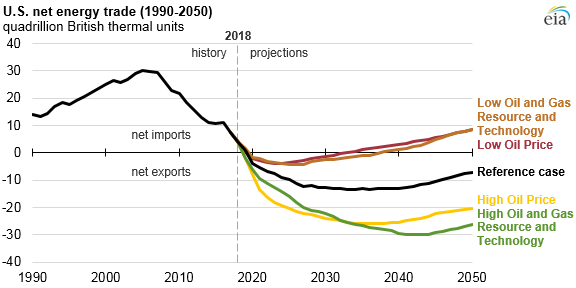
Federal energy analysts project that the United States will export more energy than it imports by 2020, making the nation a net energy exporter for the first time since the 1950s. Fossil fuels represent the largest volumes of this international trade.

Source: U.S. Energy Information Administration
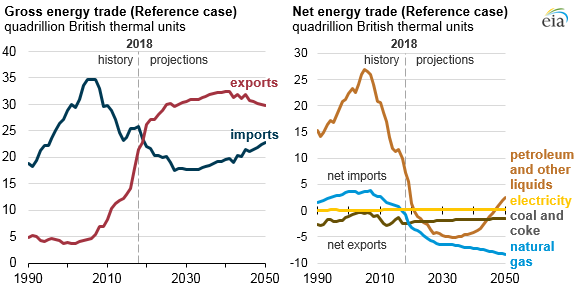
The United States both exports and imports energy in a variety of forms, including natural gas, coal and coke, petroleum and other liquids, and electricity. According to the U.S. Energy Information Administration, the United States has long been a net exporter of coal and coke. In 2017, the nation began exporting more natural gas than it imports, primarily in the form of liquified natural gas or LNG. EIA notes that electricity trades with neighboring Canada and Mexico represent "a relatively small part of U.S. net energy trade flows."

The EIA projects that domestic production of crude oil, natural gas, and natural gas plant liquids will continue to grow at a faster rate than U.S. energy consumption over the next decade, meaning the balance of these fuels will be exported. EIA projects that due to "evolving trade flows of liquid fuels and natural gas," increasing exports of these fuels will tip the trade balance to where the U.S. is a net exporter of energy by 2020. When this shift occurs, it will represent the first time that the United States exports more energy than it imports on an annual basis since 1953.

Exactly how large the nation's net exports might be -- and how long the net-exporter status might last -- depend on a variety of assumptions about matters including oil and gas prices, resource extraction technologies, and possible changes to law. Under EIA's reference case which reflects current laws and regulations, the U.S. begins exporting more energy than it imports on an annual basis in 2020 and maintains that status through 2050. In other cases featuring lower prices or extraction rates for oil and gas, EIA projects that U.S. will return to net-importer status by the mid- to late-2030s.

Source: U.S. Energy Information Administration
Changes to laws and regulations could also affect the trade balance for energy products.

Fate of U.S.-Canada dam license in question

Thursday, April 27, 2017

The holder of the U.S. federal hydropower license for a dam spanning the international border with Canada border has petitioned for approval to surrender that license, citing economic considerations.

At issue is the Forest City Project, located on the East Branch of the St. Croix River which forms the international boundary between the United States and Canada.  The Project operates under conditions set by the International Joint Commission (IJC) in accordance with the Boundary Waters Treaty of 1909, as well as a license issued by the U.S. Federal Energy Regulatory Commission.  The project currently operates under a license issued on November 23, 2015.  That 30-year license expires on October 31, 2045.

Licensed by the Commission as Project No. 2660, the project includes the U.S. portions of a 540-foot-long, 12-foot-high earth dam, an impoundment spanning several lakes, and appurtenant facilities. There are no generating facilities located at the project; rather, the Forest City Project operates as part of a headwater storage system along with two other projects licensed to Woodland Pulp -- West Branch Project No. 2618 and Vanceboro Project No. 2492.  Two hydroelectric generation projects are located downstream on the St. Croix River from these storage facilities, the unlicensed Grand Falls and Woodland hydroelectric projects.

On December 23, 2016, Forest City Project licensee Woodland Pulp LLC applied to the Commission to surrender its license.  A cover letter attached to that application states, "Woodland Pulp has determined that the high cost of operating the Project pursuant to the new FERC license renders the Project uneconomical." In the surrender application itself, the company cited license provisions including new operating restrictions on reservoir pool elevation, a reservation of the Commission’s authority to require additional fishways if so prescribed by the Secretary of the Interior, and a requirement to develop a Historic Properties Management Plan (HPMP), as adding risk or cost.  As noted in the surrender application, "After a comprehensive review of the conditions in the License, the minimal contribution to downstream power generation, and the significant added cost and increased complexity of the License, coupled with the loss of flexibility required to comply with the License, Woodland Pulp has concluded that it is not economic for the company to continue to operate the project.

As described by the Commission in an April 6, 2017 public notice of the surrender application, the licensee proposes to remove the gates on the west side of the spillway.  According to the licensee, removing these gates will return water flow to natural flow conditions, and the Forest City Dam will no longer act as the water control structure for East Grand Lake, nor will it use, obstruct, or divert international boundary waters.

The Commission has docketed the surrender application as P-2660-028, and set deadlines for comments, protests, and interventions in the case.

US, Canada grid security and resilience strategy

Tuesday, December 13, 2016

The governments of the United States and Canada have released a joint strategy for ensuring the security and resilience of their electric grid.  In recognition of the interconnected nature of the North American electric grid, the document, "Joint United States-Canada Electric Grid Security and Resilience Strategy," describes the nations' shared goals and objectives.  An action plan released alongside the strategy presents U.S. steps and milestones toward achieving the strategy's desired outcomes.

The joint strategy centers on a vision of "a secure and resilient electric grid that is able to withstand hazards and recover efficiently from disruptions."  Recognizing that this grid is made up of a variety of interconnected entities -- including federal, territorial, municipal, co-operative, and investor-owned and operated utilities -- the strategy identifies three overarching goals:
  • Protect Today’s Electric Grid and Enhance Preparedness: A secure and resilient electric grid that protects system assets and critical functions and is able to withstand and recover rapidly from disruptions is a priority for the governments of both the United States and Canada.
  • Manage Contingencies and Enhance Response and Recovery Efforts: The Strategy sets out a shared approach for enhancing continuity and response capabilities, supporting mutual aid arrangements such as cyber mutual assistance across a diverse set of stakeholders, understanding interdependencies, and expanding available tools for recovery and rebuilding. 
  • Build a More Secure and Resilient Future Electric Grid: The United States and Canada are working to build a more secure and resilient electric grid that is responsive to a variety of threats, hazards, and vulnerabilities, including increased threats from climate change. To achieve this, the electric grid will need to be more flexible and agile, with an architecture into which new technologies may be readily incorporated.
Beyond the joint strategy, each participating country has also developed its own individual action plan describing steps and milestones toward the strategic goals.  The U.S. National Electric Grid Security and Resilience Action Plan was released concurrently with the Strategy.

The action plan is generally non-binding on the U.S., and it is unclear whether the incoming Trump administration would adopt the plan, as opposed to revising or scrapping it.  Nevertheless the joint U.S.-Canada grid security and resilience strategy and the U.S. action plan may inform future efforts to strengthen the North American electric grid against risk and disturbance.

U.S., China to sign Paris climate agreement

Tuesday, April 5, 2016

The U.S. and China have announced plans to sign the international climate change agreement reached in Paris last December.

The White House.

The Paris Agreement, adopted at the "COP21" U.N. Conference on Climate Change, establishes a framework for reducing global greenhouse gas emissions.  It takes effect once 55 countries accounting for at least 55% of global emissions formally commit to undertaking the low carbon measures it outlines.

According to a March 31 joint presidential statement on climate change, over the past 3 years, "climate change has become a pillar of the U.S.-China bilateral relationship."  The statement notes domestic efforts by the U.S. and China to "build green, low-carbon and climate-resilient economies", as well as the international action culminating in the December 2015 conference decision to adopt the Paris Agreement.

The joint statement declares that U.S. and China "will sign the Paris Agreement on April 22nd and take their respective domestic steps in order to join the Agreement as early as possible this year." April 22 represents the first day that the Paris Agreement will be formally open for signature by adopting nations.

A White House blog post describes this step as a "critical milestone" because it represents a commitment by "the world's two largest polluters" who account for 40% of global emissions.  According to that blog, this commitment places the 55% threshold for implementation "well within reach," "demonstrating to the international community that there is no turning back on the path towards a low carbon future." 

Vanceboro Dam Storage Project relicensed

Tuesday, March 22, 2016

The Federal Energy Regulatory Commission has issued a new license to Woodland Pulp LLC to continue operating and maintaining the Vanceboro Dam Storage Project.  Located on the East Branch of the St. Croix River along the Canadian border in Washington County, Maine, the FERC-licensed project operates as a water storage facility that provides flood storage and flow releases for downstream hydroelectric generation.

The 469-foot-long, 16-foot-high Vanceboro Dam and 178,000 acre-foot project impoundment span the U.S.-Canada border.  The project is subject to the Boundary Waters Treaty of 1909 which established the International Joint Commission (IJC), a bi-national agency with the mission of preventing and resolving disputes between the United States and Canada over boundary waters.

The Vanceboro project is part of the larger St. Croix River headwater storage system.  This system also includes the Forest City Project, located about 24 miles upstream on the East Branch of the St. Croix, as well as the West Branch Project.  Water flows into the Vanceboro project’s impoundment from the Forest City Project. The project operates in a store-and-release mode whereby water is stored during periods of high flow to reduce downstream flooding, and then released during periods of lower flow to increase generation at the downstream hydroelectric projects.   Generation associated with these projects occurs at the unlicensed Grand Falls and Woodland hydroelectric projects located downstream on the St. Croix River.  Collectively, these storage projects provide flood storage and helps to regulate and augment flows, resulting in increased generation at Woodland Pulp’s downstream hydroelectric projects.

The Federal Energy Regulatory Commission issued an original license for the United States portion of the Vanceboro project on April 4, 1966.  The project is docketed as No. 2492.  That original license expired February 29, 2016, so two years earlier the licensee filed an application to the Commission for a new license to continue operating and maintaining the project.  In the interim, Woodland Pulp operated the project under an annual license pending resolution of its FERC relicensing process. 

On March 22, 2016, the FERC released an order issuing a new license for the Vanceboro Project. The new license authorizes no new capacity, and requires what the Commission characterized as "a moderate amount of new environmental mitigation measures."  These include a mandatory prescription issued under section 18 of the Federal Power Act, relating to new upstream fish passage facilities for American eel, river herring, and landlocked Atlantic salmon.

Given the fact that the Vanceboro Project is operated in coordination with the recently-relicensed West Branch Project No. 2618 and Forest City Project No. 2660 which each received 30-year license terms within the past 5 months, the Commission similarly relicensed the Vanceboro project for a 30-year license term to allow coordination of all three projects during any future relicensing.

Based on the large number of FERC-licensed hydropower projects whose licenses will expire in the near future, regulators expect to see an uptick in relicensing activity for hydroelectric projects and dams.

Climate and energy in 2016 State of the Union

Wednesday, January 13, 2016

President Obama delivered his final State of the Union address on January 12, 2016.  The White House has posted his remarks as prepared for delivery to Congress.  Climate change, and related energy and environmental issues, formed a prominent theme in this year's speech.

The White House.

Climate change first surfaced in the 2016 State of the Union as part of one of four "big questions" President Obama posed for the nation.
Second, how do we make technology work for us, and not against us -- especially when it comes to solving urgent challenges like climate change?
After announcing a "moonshot" medical research effort to cure cancer to be led by Vice President Joe Biden, President Obama said, "We need the same level of commitment when it comes to developing clean energy sources."

He then spent several minutes addressing climate change directly.  First, he noted effective consensus that climate change is a topic worth tackling:
Look, if anybody still wants to dispute the science around climate change, have at it. You will be pretty lonely, because you’ll be debating our military, most of America’s business leaders, the majority of the American people, almost the entire scientific community, and 200 nations around the world who agree it’s a problem and intend to solve it.
He then touted the economic and environmental effects of investment in renewable and distributed generation and energy storage:
But even if -- even if the planet wasn’t at stake, even if 2014 wasn’t the warmest year on record -- until 2015 turned out to be even hotter -- why would we want to pass up the chance for American businesses to produce and sell the energy of the future?

Listen, seven years ago, we made the single biggest investment in clean energy in our history. Here are the results. In fields from Iowa to Texas, wind power is now cheaper than dirtier, conventional power. On rooftops from Arizona to New York, solar is saving Americans tens of millions of dollars a year on their energy bills, and employs more Americans than coal -- in jobs that pay better than average. We’re taking steps to give homeowners the freedom to generate and store their own energy -- something, by the way, that environmentalists and Tea Partiers have teamed up to support. And meanwhile, we’ve cut our imports of foreign oil by nearly 60 percent, and cut carbon pollution more than any other country on Earth.
Gas under two bucks a gallon ain’t bad, either.
President Obama then called for changes to transition to clean energy sources:
Now we’ve got to accelerate the transition away from old, dirtier energy sources. Rather than subsidize the past, we should invest in the future -- especially in communities that rely on fossil fuels. We do them no favor when we don't show them where the trends are going. That’s why I’m going to push to change the way we manage our oil and coal resources, so that they better reflect the costs they impose on taxpayers and our planet. And that way, we put money back into those communities, and put tens of thousands of Americans to work building a 21st century transportation system.
Now, none of this is going to happen overnight. And, yes, there are plenty of entrenched interests who want to protect the status quo. But the jobs we’ll create, the money we’ll save, the planet we’ll preserve -- that is the kind of future our kids and our grandkids deserve. And it's within our grasp.
Climate change is just one of many issues where our security is linked to the rest of the world.
His final reference to climate change came while discussing international engagement, and "seeing our foreign assistance as a part of our national security":
When we lead nearly 200 nations to the most ambitious agreement in history to fight climate change, yes, that helps vulnerable countries, but it also protects our kids.
Climate, energy, and environmental issues thus featured prominently in the 2016 State of the Union speech.  Over the coming year, these themes -- domestic and international action on climate change, investment in renewable energy and distributed generation, transition away from oil and coal -- will likely continue to play out at the federal level.

Declining demand for residual fuel oil?

Thursday, October 29, 2015

Global demand for residual fuel oil is expected to decline, according to the U.S. Energy Information Administration.


A Maine State Ferry Service boat near Vinalhaven, Maine.


Residual fuel oil is basically what's left after gasoline and other lighter hydrocarbons are distilled from crude oil.  Industry recognizes several grades of residual fuel oil, including No. 5 (used in steam-powered vessels in government service and inshore powerplants) and No. 6 (used for the production of electric power, space heating, vessel bunkering, and various industrial purposes.) 

Because residual fuel oil is composed of the residue left after distillation, it can contain large amounts of contaminants such as sulfur, nitrogen, or heavy metals.  As environmental regulations limit emissions of pollution, residual fuel oil can become less attractive (or more expensive) as a fuel source for electric power generation or marine transportation.

The EIA notes declining global demand for residual fuel oil since the mid-1980s.  In a brief report, EIA projects that the electric power and heating sectors will likely be responsible for continuedlarge reductions in residual fuel oil demand.

EIA also points to tighter international emissions regulations for the marine transport sector.  Rules under Annex VI of the International Maritime Organization through the International Convention of Pollution from Ships (MARPOL, or Marine Pollution) require global controls on emissions of sulfur and nitrogen oxides.  While residual fuel oil with a sulfur level no more than 3.5% can be used to meet the MARPOL requirements throughout most of the oceans, stricter limits apply to designated emission control areas like the North Sea, the Baltic Sea, and coastal areas in North America and the Caribbean Sea.  These strict limits effectively require 0.1% sulfur content residual fuel oil or lower in the covered emission control areas.  EIA suggests that strategies for MARPOL compliance will likely include low-sulfur fuels (marine gasoil or intermediate fuel oil, or even liquefied natural gas or LNG), or using scrubbers or other technology to remove sulfur post-combustion from the exhaust.

At the same time, EIA notes that some developing countries' power sectors may rely on residual fuel oil as a "transitional fuel" if they are "more sensitive to price and less sensitive to environmental and health implications."

Cross-border infrastructure and presidential permits

Wednesday, August 26, 2015

A recent report casts doubt on whether proposed federal legislation would actually accelerate decisions on the siting of cross-border energy infrastructure.

Cross-border pipelines and electric transmission lines play an important role in the North American energy industry.  Under U.S. law, cross-border energy infrastructure projects require a presidential permit and a finding of consistency with the national interest.  Executive orders give the State Department jurisdiction over cross-border oil pipelines, the Department of Energy jurisdiction over electric transmission lines, and the Federal Energy Regulatory Commission jurisdiction over natural gas pipelines. 

Recent projects like the Keystone XL pipeline have focused attention on the presidential permit process, as that project's presidential permit application has remained pending for years.  Some have raised questions about the scope of agency review and perceived differences in the approaches taken by the State Department, Energy Department, and FERC.

As a result, several members of Congress have proposed legislation designed to accelerate the permitting process.  These bills include:


These bills take various approaches, including limiting agency jurisdiction over cross-border energy infrastructure or the scope of agency review, or setting strict deadlines for agency action following completion of environmental review.

Could federal legislation like this speed up the process for reviewing proposed cross-border pipeline and electric transmission projects?  A recent report by the Congressional Research Service suggests that overall timelines for project review are driven by the scope of the environmental review process, not by delays following that environmental review or agency idiosyncrasies.

In particular, the report found that agency review is "driven largely by the National Environmental Policy Act (NEPA)", which requires federal agencies to consider the environmental impacts before acting.  Moreover, the report notes that the same NEPA requirements apply to all three:
Faced with Presidential Permit applications for energy projects of similar physical scope, the agencies appear to perform NEPA reviews of similar proportion. Very short, smaller projects are generally reviewed more narrowly and quickly, whereas multi-state projects of large capacity are subject to more expansive environmental review and tend to face much greater public scrutiny and comment—regardless of which agency has jurisdiction. 
The report also found that NEPA review is the key driver of overall permitting decision timelines:
As long as agencies apply NEPA to Presidential Permitting decisions, changes to the delineation of, or jurisdiction over, the border-crossing portion of large projects for permitting purposes may not change the scope of project environmental review. The imposition of decision deadlines on the permitting agencies after NEPA review is complete, either for national interest or public interest determination, could provide greater process certainty to stakeholders. However, the overall project review would still be contingent on the completion of NEPA review. Thus, the effects of legislative proposals to change cross-border infrastructure permitting on the review or approval of future border crossing energy infrastructure projects are open to debate. 
It's unclear how the Congressional Research Service report will affect pending legislation.  Likely more influential may be any final action by the State Department on the Keystone XL project's application for a presidential permit.  Nevertheless, interest in cross-border energy trade will likely continue to grow.

US Presidential Permits for cross-border infrastructure

Monday, December 8, 2014

As the U.S.'s international trade in energy grows, so too has interest in the process for securing a federally required approval known as a Presidential Permit.

A marker shows the route of a natural gas pipeline in Utah.

The construction, operation, and maintenance of infrastructure that crosses the U.S.'s border with Mexico or Canada -- think pipelines, transmission lines, and bridges -- generally requires prior authorization by the federal government in the form of a Presidential Permit.  How you obtain a Presidential Permit depends on the type of facilities in question, as permits may be issued by several federal agencies under different legal authorities.

Presidential permits for oil, petroleum products, and other liquids pipelines have been issued by the U.S. State Department since since the promulgation of Executive Order 11423 in 1968.  Executive Order 11423 provided that, except with respect to cross-border permits for electric energy facilities, natural gas facilities, and submarine facilities:
The Secretary of State is hereby designated and empowered to receive all applications for permits for the construction, connection, operation, or maintenance, at the borders of the United States, of: (i) pipelines, conveyor belts, and similar facilities for the exportation or importation of petroleum, petroleum products, coal, minerals, or other products to or from a foreign country; (ii) facilities for the exportation or importation of water or sewage to or from a foreign country; (iii) monorails, aerial cable cars, aerial tramways and similar facilities for the transportation of persons or things, or both, to or from a foreign country; and (iv) bridges, to the extent that congressional authorization is not required.
The State Department's Bureau of Energy Resources Office of Energy Diplomacy receives and processes permit applications for liquid product pipelines, including water and petroleum products.  The standard by which the Secretary of State reviews applications for presidential permits is prescribed by an executive order issued in 2004.  Executive Order 13337 directs the Secretary of State to authorize those border crossing facilities that the Secretary has determined would “serve the national interest."

By contrast, cross-border natural gas pipelines are regulated by the Federal Energy Regulatory Commission, while electric transmission infrastructure is regulated by the Department of Energy.  Section 3 of the Natural Gas Act requires any person desiring to export any natural gas from the United States to a foreign country or to import any natural gas from a foreign country to the United States to obtain an order from the Federal Power Commission authorizing it to do so.   Section 202(e) of the Federal Power Act requires any person desiring to transmit any electric energy from the United States to a foreign country to obtain an order from the Federal Power Commission authorizing it to do so.

Executive Order 10485 designated the FERC's predecessor agency, the Federal Power Commission, to receive applications for natural gas and electricity facilities.  When the Department of Energy Organization Act of 1977 eliminated the Federal Power Commission, it shifted most of the FPC's responsibilities to the FERC, but Section 402(f) of that act specifically reserved import/export permitting functions for the Department of Energy.  For facilities governed by the Department of Energy, the Presidential Permit process is governed by Part 205 of the Department's rules.  In 2006, the Department delegated its authority to issue Presidential Permits for natural gas pipeline border crossings to FERC, via DOE Delegation Order No. 00-004.00A.

Infrastructure projects subject to the Presidential Permit process range widely in type, scope, and controversy, from the proposed Keystone XL oil pipeline from Canada to the proposed Champlain Hudson Express high-voltage direct current electric transmission line.

Presidential permits for cross-border energy facilities

Thursday, November 3, 2011

Presidential permits for the import and export of energy resources across the United States' borders are critical to the development of cross-border energy facilities.

Millions of dollars of energy resources flow across the United States' borders every day.  Trade in energy resources with Canada and Mexico accounts for the bulk of these transactions.  Canada is the single largest foreign supplier of energy to the United States, providing about 20% of U.S. oil imports and 18% of U.S. natural gas imports according to the U.S. State Department.  Canada and the United States share an integrated electricity grid and provide all of each other's electricity imports.  Today and tomorrow, members and guests of the New England - Canada Business Council are meeting in Boston to discuss this close relationship.

Facilities spanning the border -- whether pipelines for oil or natural gas or transmission lines for electricity -- can only be built and operated once a federal approval called a "presidential permit" has been obtained.  Since a 1968 Executive Order, presidential permits have been issued by the State Department.  Presidential permits cover not only the facilities themselves, but also the commodities (oil, gas, electricity) transmitted over those facilities.

For example, the proposed Keystone XL pipeline from Canada to Texas will require a presidential permit.  In today's news, President Obama is reported as saying that he will be the one to make the final decision on whether TransCanada will obtain its permit.