Showing posts with label liquid. Show all posts

U.S. to export more energy by 2020 than it imports, projects EIA

Tuesday, January 29, 2019

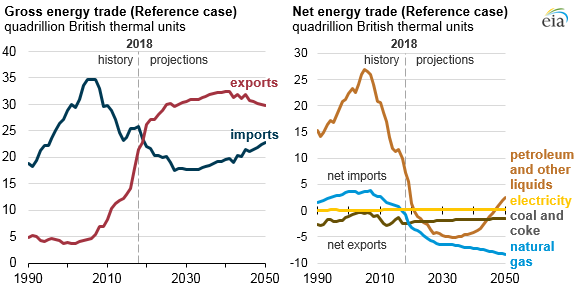
Federal energy analysts project that the United States will export more energy than it imports by 2020, making the nation a net energy exporter for the first time since the 1950s. Fossil fuels represent the largest volumes of this international trade.

Source: U.S. Energy Information Administration
The United States both exports and imports energy in a variety of forms, including natural gas, coal and coke, petroleum and other liquids, and electricity. According to the U.S. Energy Information Administration, the United States has long been a net exporter of coal and coke. In 2017, the nation began exporting more natural gas than it imports, primarily in the form of liquified natural gas or LNG. EIA notes that electricity trades with neighboring Canada and Mexico represent "a relatively small part of U.S. net energy trade flows."

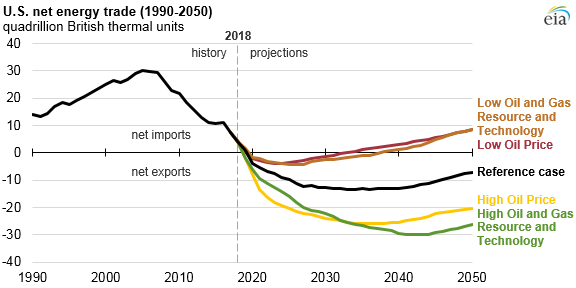
The EIA projects that domestic production of crude oil, natural gas, and natural gas plant liquids will continue to grow at a faster rate than U.S. energy consumption over the next decade, meaning the balance of these fuels will be exported. EIA projects that due to "evolving trade flows of liquid fuels and natural gas," increasing exports of these fuels will tip the trade balance to where the U.S. is a net exporter of energy by 2020. When this shift occurs, it will represent the first time that the United States exports more energy than it imports on an annual basis since 1953.

Exactly how large the nation's net exports might be -- and how long the net-exporter status might last -- depend on a variety of assumptions about matters including oil and gas prices, resource extraction technologies, and possible changes to law. Under EIA's reference case which reflects current laws and regulations, the U.S. begins exporting more energy than it imports on an annual basis in 2020 and maintains that status through 2050. In other cases featuring lower prices or extraction rates for oil and gas, EIA projects that U.S. will return to net-importer status by the mid- to late-2030s.
Source: U.S. Energy Information Administration
Changes to laws and regulations could also affect the trade balance for energy products.

US EPA sets renewable fuel standard for 2019

Monday, December 10, 2018

U.S. environmental regulators have established renewable fuel standards for 2019, calling for a 3% increase in renewable fuel volumes over 2018, but have continued to waive statutory requirements targeting even larger volumes of renewable fuel.

Congress created the Renewable Fuel Standard or RFS program through the Energy Policy Act of 2005, and expanded the program through the Energy Independence and Security Act of 2007. Administered by the U.S. Environmental Protection Agency, the RFS requires a certain volume of renewable fuel to be used in transportation (motor vehicles and jets) and heating. Refiners and importers of gasoline or diesel, along with other market participants like fuel producers and exporters, track and trade renewable fuel credits called Renewable Identification Numbers or RINs.

The RFS includes four categories of renewable fuel: cellulosic biofuel, biomass-based diesel, advanced biofuel, and total renewable fuel. By statute, Congress prescribed specific volumes of these four categories of renewable fuel for each year through 2022, and required the EPA to set RFS volume requirements annually based on these statutory targets. The statute also allows the EPA Administrator to waive these volumetric requirements, based on a determination that implementation of the program is causing severe economic or environmental harm, or based on inadequate domestic supply.

On November 30, 2018, the EPA issued its final rule for the 2019 RFS program. The 2019 final rule sets the total U.S. renewable fuel volume requirements for 2019 at 19.92 billion gallons, including 4.92 billion gallons of advanced biofuel, 2.1 billion gallons of biomass-based diesel, and just 418 million gallons of cellulosic biofuel. The rule also sets a 2020 volume requirement for biomass-based diesel of 2.43 billion gallons.

The EPA noted that "the market has fallen well short of the statutory volumes for cellulosic biofuel, resulting in shortfalls in the advanced biofuel and total renewable fuel volumes." Based on this observation, EPA exercised its waiver authority to finalize the cellulosic biofuel volume requirement at the level EPA projects to be available for 2019. This is consistent with EPA's past practice, through which it has set the cellulosic biofuel requirement lower than the statutory volume for each year since 2010.