Showing posts with label outage. Show all posts

New England Operational Fuel-Security Analysis released

Tuesday, January 23, 2018

The risk that power plants will run out of fuel is the foremost challenge to a reliable power grid in New England, according to the region's grid operator, and the region is vulnerable to the season-long outage of any of several major energy facilities.

While the ability to count on a portfolio of power plants to generate power is considered the cornerstone of reliable electricity supply, ISO New England has noted several factors that make fuel security a growing concern for the region. These factors include the inadequacy of the region’s natural gas infrastructure to meet winter needs for both heating and power, and the retirement of many of the region’s coal, oil, and nuclear power plants due to economic and environmental pressures.

On January 17, 2018, ISO New England released its Operational Fuel-Security Analysis, a 56-page report studying the possible fuel security risks facing region's power plants under a wide range of hypothetical future scenarios. Prepared following about two years of study, the report found that maintaining the electric grid's reliability "is likely to become more challenging, especially if current power system trends continue."

The report considered a 23 possible range of possible future power resource combinations that could materialize for the winter period from December 1, 2024 through February 28, 2025, to examine whether enough fuel would be available to meet demand and to quantify the operational risks. Each scenario assumed no new natural gas pipeline capacity would be added to serve generators, but considered variation in five other key factors for power system reliability: resource retirements, LNG availability, oil tank inventories, imported electricity, and renewable resources.
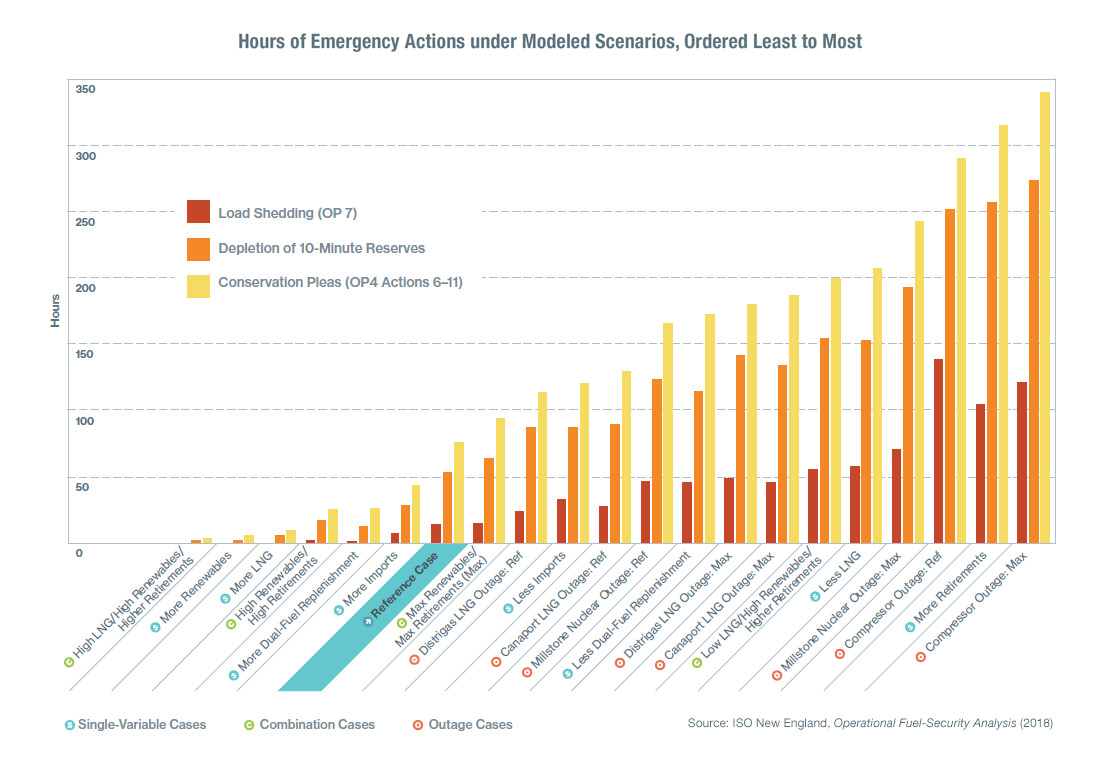
ISO-NE chart of Hours of Emergency Actions under Modeled Scenarios, Ordered Least to Most, Operational Fuel-Security Analysis (2018)

The study identified six major conclusions:
  1. Outages: The region is vulnerable to the season-long outage of any of several major energy facilities.
  2. Stored fuels: Power system reliability is heavily dependent on LNG and electricity imports; more dual-fuel capability is also a key reliability factor, but permitting for construction and emissions is difficult.
  3. Logistics: The timely availability of fuel is critical, highlighting the importance of fuel-delivery logistics.
  4. Risk trends: All but four scenarios result in fuel shortages requiring load shedding, indicating the trends affecting New England’s power system may intensify the region’s fuel-security risk.
  5. Renewables: More renewable resources can help lessen the region’s fuel-security risk but are likely to drive coal- and oil-fired generation retirements, requiring high LNG imports to counteract the loss of stored fuels.
  6. Positive outcomes: Higher levels of LNG, imports, and renewables can minimize system stress and maintain reliability; to attain these higher levels, delivery assurances for LNG and electricity imports, as well as transmission expansion, will be needed.
According to ISO-NE, quantifying the level of risk over a wide range of possible combinations provides information the region can use to consider approaches to ensuring power system reliability. The grid operator has said it plans to engage with stakeholders, regulators, and policymakers through 2018 to discuss the operational fuel-security analysis -- and how much risk the ISO and region would be willing to tolerate.

Maine utility storm damage and response in question

Thursday, November 9, 2017

As Maine recovers from widespread power outages following a storm, what will the event mean for how its public utilities design, operate, and maintain their electric grids?

On October 30, 2017, a storm brought winds and heavy rain to much of New England. In Maine, about 500,000 people lost power, with the state's largest utility Central Maine Power Company reporting the largest number of outages in the company's history and Emera Maine reporting the most widespread outages since 1998.

The utilities had taken some steps to prepare for the storm, describing advance planning to "ensure that adequate resources are in place to restore power outages that might occur as a result of the storm." After the storm passed, line crews from out of state arrived to provide mutual aid. Maine Governor Paul LePage issued an emergency proclamation to allow drivers of electrical line repair vehicles to operate additional hours during storm restoration efforts. By November 5 -- about one week after the storm -- the utility reported that it had restored power to about 99 percent of customers who had lost service, with about 6,000 customers left to go.

A convoy of utility repair trucks after the storm.

Now that the lights are back on in most homes and businesses, most people have cleaned spoiled food from refrigerators and freezers and are back at work. But the storm and outage have thrown a spotlight on the reliability of Maine's electricity grid, and utility preparation and response to storms. Some customers are complaining, pointing to the loss to the state economy caused by the blackouts, on top of personal inconvenience. As with past storms and outages such as the 1998 New England ice storm, preparation, operational response, and communications with customers and policymakers are focal points for complaint.

Some of the present complaints focus on the fact that what has been called the worst power outage in Maine history comes just two years after CMP completed its $1.4 billion Maine Power Reliability Program transmission upgrades. Other complaints focus on the utility's communications with customers -- while CMP's website provided real-time outage information during the storm including estimates on when service will be restored, the Portland Press Herald reported that CMP has acknowledged problems with the web listings, causing customer frustration over inaccurate information.

The Bangor Daily News cites a Maine Public Utilities Commission spokesman as saying that, following further information gathering, the regulatory agency may consider changes to regulation to better hold transmission and distribution utilities accountable for outages and storm restoration efforts. Maine law also allows the Commission to institute a complaint or investigation proceeding into any matter affecting utility service, and requires the Commission to investigate if ten or more aggrieved people file a complaint against a utility.

California grid prepares for solar eclipse

Monday, July 31, 2017

As a total solar eclipse approaches for North America, California electricity regulators have launched a voluntary demand response program designed to reduce power consumption during the eclipse while solar panel output is reduced.

The eclipse will occur on August 21, 2017, and is projected to reduce solar photovoltaic production in the California ISO region by 4,194 megawatts.  Taking gross load increases and estimated wind production into account, CAISO has been told to expect a net load increase of 6,008 MW during the eclipse.

According to the nation's electric reliability organization, NERC, the August 21 eclipse "is not expected to impact the reliability of the bulk power system."  But as NERC also noted, "As the number of photovoltaic generators on the power system increases, the risk created by solar eclipses to reliable system operations will increase as well."

Now, the California Public Utilities Commission has launched a "Do Your Thing for the Sun" or "Cal Eclipse" program.  On its website, the Commission asks, "While our utilities and grid operator have all the tools necessary to manage the grid during the eclipse, what if millions of Californians stepped in to allow our hard working sun to take a break, rather than relying on expensive and inefficient natural gas peaking power plants?"

The website asks consumers to "Take the Pledge", emphasizing the value of "joining a movement of Californians who are taking action during the eclipse to give the sun a break by saving energy and reducing GHG emissions." According to a two-page FAQ posted on the website, consumers can reduce electricity consumption by turning off electronics when leaving, and permanently decrease electricity consumption with energy efficiency measures.  Actions suggested on the pledge website include replacing light bulbs with LEDs, reducing lighting use and electronics charging, unplugging unused appliances, and increasing air conditioning temperature setpoints by 2-5 degrees.

According to the Commission's FAQ, "There is no reason to anticipate any eclipse-related electric service outages because of the reduced solar generation."

Substation security and the Garkane shooting

Tuesday, October 11, 2016

As the U.S. strengthens protections for its electricity grid, much of the discussion focuses on cybersecurity -- but physical security is also important, as shown by an attack on a Utah utility's substation.  On September 25, an unknown gunman fired at least 3 shots into a distribution system substation, damaging a transformer and causing power outages.  The incident may place renewed pressure on utilities to secure their infrastructure against vandalism and terrorism.

As reported by the Deseret News, the damage occurred at a substation owned by Garkane Energy Cooperative.  An assailant reportedly shot the main transformer's oil-cooled radiator system, causing the transformer to overheat and fail.  About 13,000 customers lost power across most of Kane and Garfield counties.  A spokesman for the cooperative said damage to the transformer could reach $1 million; repairs could take 6 to 12 months.  The utility has offered an unusually high reward -- $50,000 -- for information leading to the arrest of the shooter.

This is not the first time someone has used firearms to damage utility infrastructure.  Some incidents, such as the 2012 shotgunning of 167 insulating discs on Vermont's transmission system, may be considered vandalism.  Others, like the 2013 sniper shooting of a PG&E substation in San Jose, California, are considered terrorism.  That attack led the Federal Energy Regulatory Commission to implement new physical security protections for utility infrastructure known as CIP-014, through its Order No. 802.

The Garkane incident remains under investigation.  More broadly, it may strengthen calls for further hardening of the utility system against physical attack.  Meanwhile, efforts continue to strengthen cybersecurity protections for the grid.

FERC considers geomagnetic disturbance standards

Wednesday, January 6, 2016

U.S. energy regulators examining reliability standards for the electric transmission grid relating to geomagnetic disturbances have scheduled a technical conference for March 1, 2016.

Geomagnetic disturbance, or GMD, events occur during solar storms when the sun emits charged particles whose magnetic field interacts with that of the Earth.  GMDs can affect transformers, transmission lines, and other electric grid infrastructure.  As the Federal Energy Regulatory Commission noted in its Order No. 779, "there is a general consensus that GMD events can cause wide-spread blackouts due to voltage instability and subsequent voltage collapse, thus disrupting the reliable operation of the Bulk-Power System."

In 2013, the FERC issued Order No. 779 directing NERC to propose Reliability Standards that address the impact of geomagnetic disturbances (GMD) on the reliable operation of the Bulk - Power System.  In 2015, NERC made its proposal, which the FERC has proposed to largely accept.

But the case before FERC, docketed as RM15-11, remains ongoing.  Grid operators, utilities, trade groups, and others have filed comments or otherwise participated in the case.

The Commission has now scheduled a GMD technical conference on March 1, 2016, as a forum for "a structured dialogue on GMD-related topics."  Items specifically identified for discussion at this stage include what kind of GMD event should be used as the "benchmark" for planning purposes, vulnerability assessments, and monitoring of related parameters.

FERC proposes geomagnetic disturbance reliability standard

Thursday, May 14, 2015

Is the U.S. electric grid ready for solar storms and other geomagnetic disturbances?  Today the Federal Energy Regulatory Commission proposed approving a new reliability standard for the grid to address its vulnerability to these hazards.

A utility substation near Treasureton in southeast Idaho.

Periodic activity on the Sun's surface sends powerful waves of energetic particles toward the Earth.  These solar events can distort the Earth's magnetic field, affecting the flow of electricity on Earth.  While serious geomagnetic disturbances are expected to be infrequent, they can cause blackouts and damage key utility infrastructure.

The Federal Energy Regulatory Commission has jurisdiction over the reliability of the U.S.'s bulk electric power system.  To this end, it has designated the North American Electric Reliability Corporation (NERC) as the nation's electric reliability organization.  In May 2013, FERC directed NERC to develop and submit new standards for protecting the grid against geomagnetic disturbances (Order No. 779)

FERC and NERC have proceeded in a two-stage process.  First, in June 2014 FERC approved a standard on implementation of operating plans, procedures and processes to mitigate effects of geomagnetic disturbances (Order No. 797).

Reserved for the second stage were further requirements that transmission planners and owners assess the vulnerability of their systems to a theoretical benchmark event.  NERC subsequently proposed such a standard, calling for an evaluation of what would happen in a “one-in-100-year” benchmark event.

In a Notice of Proposed Rulemaking issued today, the FERC proposes to largely adopt NERC’s proposed second-stage standard.  The standard would require covered entities to have system models needed to complete vulnerability assessments, to have criteria for acceptable steady state voltage performance during a benchmark event, and to complete a vulnerability assessment once every 60 calendar months. If the assessment indicates that a system does not meet the performance requirements, the entity would have to develop a corrective action plan addressing how the requirements will be met.

The proposed rulemaking would direct NERC to further modify its standard to require that the study and benchmarking of geomagnetic disturbance events is based on a more complete set of data and a reasonable scientific and engineering approach.

Comments on today’s Notice of Proposed Rulemaking are due 60 days after its publication in the Federal Register.

Geomagnetic disturbances, and their impacts to the grid, are a hot topic in energy regulation at the present. States are considering laws regulating utility readiness for and response to geomagnetic disturbances; for example, next week the Maine Legislature’s Joint Standing Committee on Energy, Utilities, and Technology will consider LD 1363, An Act To Secure the Maine Electrical Grid from Long-term Blackouts.

FERC adopts grid physical security reliability standard

Wednesday, November 26, 2014

As expected, federal regulators have approved a new physical security standard for the high-voltage electricity grid.

On November 20, the Federal Energy Regulatory Commission approved Reliability Standard CIP-014-1 (Physical Security).  The standard, proposed by Commission-certified Electric Reliability Organization North American Electric Reliability Corporation (NERC), is designed to enhance physical security measures for the most critical parts of the nation's "bulk-power system," the high-voltage backbone of the nation's electric grid.

In the wake of a 2013 California incident in which a major substation was damaged by gunfire, in March 2014 the FERC directed NERC to prepare a draft standard to protect the physical security of the grid.  In response, NERC proposed a standard requiring owners and operators of transmission facilities toidentify and protect critical transmission stations, substations, and control centers whose damage through physical attack could result in spreading outages or other reliability problems.

On November 20, 2014, the FERC issued its Order No. 802 approving the physical grid reliability standards.  In a press release, the Commission described Order No. 802 as enhancing the physical security for the most-critical Bulk-Power System facilities and reducing the overall vulnerability of the grid to attacks.

As described by the FERC in Order No. 802, Reliability Standard CIP-014-1 has six requirements:
  • Requirement R1 requires applicable transmission owners to perform risk assessments on a periodic basis to identify their transmission stations and substations that, if rendered inoperable or damaged, could result in widespread instability, uncontrolled separation , or cascading within an Interconnection. Requirement R1 also requires transmission owners to identify the primary control center that operationally controls each of the identified transmission stations or substations.
  • Requirement R2 requires that each applicable transmission owner have an unaffiliated third party with appropriate experience verify the risk assessment performed under Requirement R1. Requirement R2 states that the transmission owner must either modify its identification of facilities consistent with the verifier’s recomme ndation or document the technical basis for not doing so. In addition, Requirement R2 requires each transmission o wner to implement procedures for protecting sensitive or confidential info rmation made available to third - party verifier s or developed under the Reliability Standard from public disclosure.
  • Requirement R3 requires the transmission owner to notify a transmission operator that operationally controls a primary control center identified under Requirement R1 of such identification to ensure that the transmission operator has notice of the identification so that it may timely fulfill its obligations under Requirements R4 and R5 to protect the primary control center.
  • Requirement R4 requires each applicable transmission owner and transmission operator to conduct an evaluation of the potential threats and vulnera bilities of a physical attack on each of its respective transmission stations, transmission substations, and primary control centers identified as critical in Requirement R1.
  • Requirement R5 requires each transmission owner and transmission operator to develop and implement documented physical security plans that cover each of their respective transmission stations, transmission substations, and primary control centers identified as critical in Requirement R1.
  • Requirement R6 requires that each transmission owner and transmission operator subject to Requirements R4 and R5 have an unaffiliated third party with appropriate experience review its Requirement R4 evaluation and Requirement R5 security plan. Requirement R6 states that the transmission owner or transmission operator must either modify its evaluation and security plan consistent with the recommendation, if any, of the reviewer or document its reasons for not doing so. Requirement R6 also requires each transmission owner to implement procedures for protecting sensitive or confidential information made available to third-party reviewers or developed under the Reliability Standard from public disclosure

While the Commission adopted the standard, it directed NERC to submit an informational filing within 2 years that addresses whether the physical security reliability standard should be applicable to additional control centers.  It also gave NERC 6 months to propose modifications to clarify the use of the phrase "widespread" instability in Requirement R1.

The FERC's rule will become effective 60 days after its publication in the Federal Register.

FERC settles 3rd Southwest blackout case

Wednesday, October 22, 2014

A California public utility has settled claims by federal electricity regulators related to the September 8, 2011, blackout in the southwestern United States.  Following an investigation by the Federal Energy Regulatory Commission (FERC) and electric reliability organization North American Electric Reliability Corporation (NERC), Southern California Edison Company has agreed to pay a $650,000 civil penalty and undertake additional compliance actions.

According to previous investigative reports, the 2011 blackout started when a 500-kilovolt transmission line owned by Arizona Public Service Company tripped out of service, causing cascading power outages through automatic load shedding as other equipment quickly overloaded.  In the end, the outage affected over 5 million customers, shedding 7,835 megawatts of peak demand and over 30,000 megawatt-hours of energy.

Following the blackouts, both FERC and NERC launched investigations into what had happened.  As a federal agency, FERC has regulatory authority over the reliability of the electric bulk power systemNERC is a not-for-profit international regulatory authority whose mission is to ensure the reliability of the bulk power system in North America, and has been designated by FERC as the nation's electric reliability organization.

In July, FERC announced a $3.25 million settlement with Arizona Public Service.  In August, FERC announced a $12 million settlement with California's Imperial Irrigation District.

Today, FERC announced that it has approved a stipulation and consent agreement between FERC’s Office of Enforcement, NERC, and Southern California Edison Company.  Through a joint investigation, FERC Office of Enforcement staff and NERC determined that the utility violated the Protection and Control group of NERC's Reliability Standards.  In particular, the investigation found that Southern California Edison failed to adequately coordinate its intertie separation scheme at the San Onofre nuclear generating station switchyard with certain other protection systems.  Enforcement staff and NERC found this violation to be a serious deficiency that undermined reliable operation of the Bulk Power System.

Through the settlement, Southern California Edison will pay a civil penalty of $650,000.  Of this penalty, $125,000 will be paid to the U.S. Treasury, $125,000 will be paid to NERC, and $400,000 will be invested in additional reliability enhancement measures.

With Southern California Edison's case resolved, all three of the vertically integrated utilities known to be implicated by FERC's investigation have now settled their alleged violations by agreeing to pay penalties.  Will further penalties be forthcoming?  Will the penalties and ordered reliability measures keep the lights on the next time the grid is stressed?

Polar vortex caused energy price spikes, says FERC staff

Monday, October 20, 2014

Why did energy prices rise during last winter's extremely cold "polar vortex" weather?  A recent report by federal regulators suggests that inadequate infrastructure is largely to blame, while finding no evidence of widespread or sustained market manipulation.

A recent winter in New England: cold ocean, cold snow.  Must high energy prices follow?

The 2013 - 2014 winter season brought prolonged and unusually cold weather events in much of the United States.  While the nation's major electric grids were generally able to maintain reliable operation, prices for natural gas and electricity spiked to unprecedented levels.  Bottlenecks on interstate natural gas pipelines limited the amount of gas flowing into regions like the Northeast, while demand for gas for heating and electric power generation increased beyond the constrained pipelines' capacity.  This imbalance of supply and demand for gas led to extremely high prices for gas as well as for electricity, because the price of natural gas often sets the price for power.  Compounding the problem, some generators could not buy enough gas to operate, while others experienced outages due to equipment failure and frozen coal piles.  In some regions, generators amounting to 30 percent of electric load faced forced outages.

As an immediate response, the Federal Energy Regulatory Commission took actions including changes to rules in the PJM, New York ISO and California ISO electricity markets, the Commission's first use of its emergency powers under the Interstate Commerce Act to direct Enterprise TE Products Pipeline to temporarily provide priority treatment to certain propane shipments, and approving a Winter Reliability Program in the ISO New England region.

According to a recently released report by the staff of the Federal Energy Regulatory Commission, the FERC Office of Enforcement also launched investigations into whether market participant behavior influenced regulated energy prices.  In addition to the Commission's enforcement arm's regular surveillance of natural gas and electric markets for market manipulation and other improper conduct, the past winter's extreme price spikes prompted a closer look by the Office of Enforcement to determine if market manipulation was behind the historically high natural gas and electric prices.

On October 16, FERC’s enforcement staff reported that it found "no evidence of widespread or sustained market manipulation."  Enforcement staff said it reached its conclusions after an extensive review and data analysis related to gas trading behavior, allegations received through the FERC hotline, generator offer behavior and outage behavior.

However, enforcement staff reported that three non-public investigations remain pending.  At stake is whether any market participant was involved with the formation of a single monthly natural gas index to benefit its financial derivative positions, as well as whether certain generators improperly took advantage of constrained conditions in the electric markets by bidding in a way that increased their uplift payments.

Expect these enforcement investigations to continue, either to an informal resolution or a public enforcement process.  With former Office of Enforcement head Norman Bay as the newest FERC Commissioner, FERC's enforcement arm appears to be growing in influence.  Meanwhile, the coming winter may yet again test the nation's electricity and natural gas infrastructure.  What will the 2014 - 2015 winter hold, in terms of energy reliability, pricing, and enforcement actions?

FERC approves second Southwest blackout penalty

Thursday, August 7, 2014

A California irrigation district has agreed to pay a $12 million penalty to settle its role in a 2011 power outage affecting over 5 million people in California, Arizona, and Mexico.

The September 8, 2011 outage started when a 500-kilovolt transmission line owned by Arizona Public Service Company tripped out of service, causing cascading power outages through automatic load shedding as other equipment quickly overloaded.  In the end, the outage deprived customers of 7,835 megawatts of peak demand and over 30,000 megawatt-hours of energy.

Swiftly on the heels of the outage, the Federal Energy Regulatory Commission and electric reliability organization NERC launched an investigation into what had happened -- and whether any laws or regulations had been violated.  That investigation focused on APS and five other entities believed to have been involved: the California Independent System Operator, the Imperial Irrigation District, Southern California Edison, the Western Area Power Administration, and the Western Electricity Coordinating Council Reliability Coordinator.  Last month, the Commission approved a $3.25 million settlement with APS.

Today, the Commission issued an order approving a stipulation and consent agreement resolving  Imperial Irrigation District's role in the blackout.  Imperial Irrigation District is a not-for-profit, publicly owned, vertically integrated utility and political subdivision of the State of California.  The sixth largest utility in California, Imperial Irrigation District Electricity provides electric power to more than 145,000 customers in the Imperial Valley and parts of Riverside and San Diego counties.

Through their investigation, Commission enforcement staff and NERC found Imperial Irrigation District violated 10 requirements of four Reliability Standards on transmission operations and transmission planning, including a failure to coordinate its operations planning with neighboring systems.  The Commission noted that these violations were serious deficiencies that undermined reliable operation of the Bulk Power System.

Through that stipulation, Imperial Irrigation District agreed to pay a civil penalty of $12 million.  Of this amount, at least $1.5 million will go to the U.S. Treasury and another $1.5 million will go to NERC, and at least another $9 million will be invested in reliability enhancement measures that go beyond mitigation of the violations and the requirements of the mandatory Reliability Standards.  These reliability enhancements will include construction of one or more utility-scale battery energy storage facilities within IID’s transmission operations area, with the money spent by December 31, 2016.

Two of the six entities known to be targeted by the Commission's investigation have now settled their alleged violations by agreeing to pay penalties.  Perhaps more significantly, APS and Imperial Irrigation District represent two of the three vertically integrated utilities implicated.  Will the FERC/NERC investigation lead to further settlements soon?  What impact will the Imperial Irrigation District settlement and penalty agreement have?

Arizona utility fined $3.25 million over 2011 blackout

Friday, July 11, 2014

On a hot summer afternoon in 2011, cascading power outages spread across the North American Southwest.  Over 5 million people in Southern California -- including all of San Diego -- Arizona and Mexico were left without power for up to 12 hours.  This week a federal investigation into the outage was partially resolved by a $3.25 million settlement with Arizona Public Service Company.

According to a joint report by the staffs of the Federal Energy Regulatory Commission and the North American Electric Reliability Corporation, the September 8, 2011 outage started when a 500-kilovolt transmission line owned by APS tripped.  The Hassayampa - N. Gila line serves as a major transmission corridor that transports power in an east-west direction, from generators in Arizona into the San Diego area.  The line's failure triggered significant voltage deviations and equipment overloads, causing transformers, transmission lines, and generating units to trip offline through automatic load shedding.  In all, 7,835 megawatts of customer load lost power -- over 30,000 megawatt-hours of energy -- primarily in the San Diego Gas and Electric service territory and in Baja California.

Following the outages, both the Commission's Office of Enforcement and NERC launched an investigation into the incident.  That investigation, which has been ongoing since 2011, focused on APS and five other entities believed to have been involved: the California Independent System Operator, the Imperial Irrigation District, Southern California Edison, the Western Area Power Administration, and the Western Electricity Coordinating Council Reliability Coordinator.


The investigation concluded that APS had violated NERC's mandatory Reliability Standards.  APS's role and liability was ultimately resolved this week when the Commission accepted a stipulation between APS, the Commission's Office of Enforcement and NERC.

Through that stipulation, APS agreed to pay a civil penalty of $3.25 million.  Of this amount, $1 million will go to the U.S. Treasury, $1 million will go to NERC, and $1.25 million will be invested in reliability enhancement measures that go beyond mitigation of the violations and the requirements of the mandatory Reliability Standards.  In finding the settlement to be in the public interest, the Commission cited APS's cooperation in the investigation as well as its voluntary mitigation efforts.

With APS's role in the outage settled, joint FERC/NERC investigations into other entities' roles continue.  While some targets of investigation choose to settle their cases, others insist to exercise their full legal rights.  Will the 2011 Southwest blackouts lead to further stipulations and penalties?

Electricity and Super Bowl XLVIII: Will the lights stay on?

Friday, January 24, 2014

Fans will soon pack MetLife Stadium for Super Bowl XLVII.  The National Football League's 2013-2014 season championship game will be held on February 2 at 6:30 PM (Eastern). Following the power outage during last year's Super Bowl, organizers of this year's event are taking extra precautions to avoid disruptions to the East Rutherford, New Jersey stadium's electricity supply.  At the same time, organizers are promoting the environmental aspects of the power supply for this year's game.

During Super Bowl XLVII at the Mercedes-Benz Superdome in New Orleans, Louisiana, a power outage moments after the beginning of the second half of play caused many of the stadium lights and systems to go dark.  Between restoring power supply, rebooting computer systems, and letting stadium lighting cool and return to full power, it took 34 minutes for play to resume.  Subsequent investigation revealed that the outage occurred when load-monitoring equipment had opened a breaker after detecting an abnormality in the system.

Organizers hope this year's championship is free from such disruption.  MetLife Stadium and the rest of the Meadowlands Sports Complex is served by utility Public Service Electric & Gas Co. or PSE&G.  Two power lines feed into the substation serving the complex, and on-site generators add additional capacity.  PSE&G has been reported as expecting the game to draw as much as 20 megawatts of power, and the utility, NFL, and stadium owner have collaborated on measures and testing to ensure continuity of service during the big game.

Meanwhile, PSE&G's parent PSEG has partnered with the NFL Environmental Program to source renewable energy for the game.  PSEG has agreed to purchase and retire a renewable energy credit, or REC, for every megawatt-hour of electricity used at the stadium, the AFC and NFC team hotels, and Super Bowl in Times Square.  240 solar RECs are slated to come from PSE&G's nearby 3-megawatt Kearny solar farm, as well as 5,700 additional RECs from the 7.5-megawatt Jersey Atlantic Wind Farm near Atlantic City.

Beyond electricity, event organizers have committed that all the waste oil generated from food production during the game will be processed into biodiesel fuel by Tri-State Biodiesel, and that all other food waste will be composted.

Presumably, most fans' attention will be focused on the game.  Will the organizers' measures prevent power outages in an environmentally friendly manner?

Yellowstone park proposes utility upgrades

Friday, November 8, 2013

The U.S. National Park Service manages over 84 million acres of land for both conservation and visitor use.  For wilderness parks, these joint objectives lead to the challenge of providing park facilities with electricity despite their remote location.  The Park Service has launched energy efficiency and sustainability programs, but many visitor and administrative facilities still need electricity for safety and comfort.  How should the Park Service balance conservation and development?

Old Faithful geyser erupts in Yellowstone National Park.

Yellowstone National Park, the nation's first park, highlights the difficulty.  Most facilities in the park receive electricity from transmission and distribution lines owned by utility NorthWestern Energy, but the park's rugged environment, challenging climate, and relatively old electrical infrastrucutre lead to frequent power outages - over 250 in 2012.  Unlike much of the electric grid outside the park, facilities in Yellowstone lack modern communication infrastructure - a Supervisory Control and Data Acquisition or SCADA system - that would let the utility diagnose and correct the cause of power outages from the utility's central offices in Montana.

As a result, Yellowstone and NorthWestern Energy have proposed to update the park's electrical distribution system.  Proposed upgrades include an automated, remote monitoring and control system, the installation of equipment buildings, back-up power generators and propane fuel tanks.  The proposed communication system would require the construction of seven towers for radio equipment within the park, generally located at existing electrical substation sites.

Under the National Environmental Policy Act, the Park Service cannot approve the plan without conducting an environmental assessment of the impacts of the proposed development.  The Park Service has released its Environmental Assessment (10.5 megabyte PDF), which is open for public comment until December 6.

The use of national park lands for energy infrastructure can be controversial due to differing philosophies on the level of development desirable in parks.  At the same time, the Park Service notes that the Yellowstone outages have had negative effects on park operations and visitor experience, creating health and safety concerns and lost revenue for concessioners.  How will this balance play out in Yellowstone?

Super Bowl 2013 power outage

Monday, February 4, 2013

The National Football League held Super Bowl XLVII last night at the Mercedes-Benz Superdome in New Orleans, Louisiana.  The game was interrupted by a power outage just after the second half started, which caused many of the stadium lights and systems to go dark.  Play was delayed for 34 minutes as workers scrambled to resolve the problem.  What happened to the lights at the Super Bowl?

Electric utility Entergy supplies electricity to the Superdome.  According to a statement issued jointly with Superdome manager SMG, load-monitoring equipment sensed "an abnormality in the system".  To protect systems and isolate the issue, that equipment opened a breaker and partially cut the power feed to the facility.  While backup generators kicked in, the backup supply was insufficient to fully power the Superdome's lights and systems.

The Mercedes-Benz Superdome is a significant consumer of electricity.  Statements issued by the Super Bowl New Orleans Host Committee suggest that energy usage for major Super Bowl venues including the Mercedes Superdome, Morial Convention Center, Team and NFL hotels, will consume up to 4,600 megawatts of electricity.  (Note that this statement is improbable - it should likely read 4,600 kilowatts or 4,600 megawatt-hours.  4,600 megawatts would be about 15% of Entergy's 30,000 MW total generating capacity, and represents more power than 4 typical nuclear power plants can produce.  In any event, the Superdome clearly drew a lot of power from the grid.)

The Super Bowl power outage will focus attention on professional sports' approach to energy.  NFL teams and stadium owners have been exploring alternative energy for some time; for example, last year the Philadelphia Eagles considered developing solar panels and wind turbines on their stadium.  Even the Superdome has invested in energy efficiency, developing an efficient exterior LED lighting system in 2011. 

While alternative energy efforts can reduce operating costs and environmental impacts, they are unlikely to completely displace reliance on the utility electric grid.  Stadiums' significant power demands during games far outstrip their electricity consumption at other times.  This means that stadiums would need to install sizable distributed generation to be self-reliant, but would only need to run that generation for a limited number of hours per year -- making the economics of a distributed generation project challenging.

Traditional, utility-supplied power may remain the most cost-effective basis for large stadium electricity supply for now -- but leaves stadiums, players and fans reliant on their public utilities to keep the lights on.  Team and stadium owners eager to avoid the embarrassment and cost of an outage will continue to look for solutions, including more backup generation and more robust grid connections.

Long Island utility exec resigns, hurricane response blamed

Thursday, November 15, 2012

The Long Island Power Authority announced this week that its Chief Operating Officer, Mike Hervey, has resigned from LIPA effective at the end of 2012.

LIPA is a political subdivision of the State of New York.  LIPA was formed in 1985 as a non-profit municipal electric utility to take over the assets of former investor-owned utility Long Island Lighting Company.  Today, LIPA owns the electric grid in most of Long Island.  LIPA does not own electric generation assets on the island but serves 1.1 million customers with electricity generated off-island.  Its electric distribution network was hard hit by Hurricane Sandy, with over 1.1 million customers losing power.  As of earlier this week, 10,000 customers just east of New York City were still without power, while 35,000 more farther onto Long Island suffered significant flood damage and will need repairs before electric service can be restored.  County executives and other leaders are calling for federal involvement, and have criticized LIPA for its management of the restoration process.

In a statement released November 13, LIPA Chairman Howard E. Steinberg stated that he had accepted Hervey's resignation, with regret, on behalf of the Board of Trustees.  The announcement noted that Hervey had worked for LIPA for 12 years, including serving as CEP for two years.

Also on Tuesday, New York Governor Andrew Cuomo formed a commission to investigate utility companies' storm preparedness and management.  Governor Cuomo used his powers under the Moreland Act to form the commission, whose mandate also includes an examination of the regulatory and legal structures for oversight of utility operations.  Citing storms including Hurricane Irene, Tropical Storm Lee, and Hurricane Sandy in the past two years, Governor Cuomo also addressed the adaptation process of adjusting "to the reality of more frequent major weather incidents".

One utility executive has already resigned, and the commission's investigation will soon be under way.  What other changes lie ahead for utility companies in New York and elsewhere as a result of utility responses to hostile weather?

Assessing Hurricane Sandy's energy impacts

Tuesday, October 30, 2012

Yesterday Hurricane Sandy made landfall in New Jersey, but the magnitude of the storm meant that heavy winds, strong rains, and a powerful coastal storm surge affected a broad swath of the mid-Atlantic and northeastern parts of the United States.

One consequence of the storm is widespread power outages.  As of 8:00 AM yesterday, about 36,000 electricity customers had lost power in Connecticut, Delaware, New Jersey, New York, North Carolina, Rhode Island, and Virginia.  By 2:00 PM yesterday, outages were up to over 316,000, in the states listed above as well as in Maryland, Massachusetts, New Hampshire, and Pennsylvania.  At that time, New York had the most outages (105,089 customers, or about 1%), but New Hampshire was the hardest hit in terms of percentage affected (18,190 customers, or about 3%).  These reported outages came six hours before the storm officially made landfall, making outage numbers much higher today -- some reports indicating 8 million customers without power.

[Update: as of 9:00 AM this morning, the Department of Energy reports 8.1 million customers without electricity, including 62% of New Jersey, 31% of Connecticut, and 23% of Rhode Island.]

In addition to these power outages, some electricity generating facilities have shut down.  The U.S. Nuclear Regulatory Commission (NRC) reports three nuclear power units in the Northeastern United States had to shut down and two units reduced as a result of impacts from Hurricane Sandy.  Reasons range from water pump failure to encroaching high water to problems on the external power grid.

Another consequence of the storm is disruption to oil refineries.  By 1:00 PM yesterday, two mid-Atlantic refineries had closed, with four more shutting down part of their production.  In total, 1.1 million barrels per day of refining capacity had been disrupted due to the storm.

Today, as the storm has moved inland, crews are working hard to recover from the storm.  It is still early to assess the total damage from the storm, as well as whether its disruption to energy infrastructure will be temporary or longer-lasting.

Hurricane Sandy's effects on energy

Monday, October 29, 2012

Hurricane Sandy is expected to make landfall near the southern coast of New Jersey this evening.  The storm has already dealt damage to Cuba, Jamaica, and Haiti, and is expected to carry significant storm energy northward into the mid-Atlantic and northeastern United States.  Power outages are already being reported, but many more are expected: according to a Johns Hopkins engineering model, up to 10 million people may lose electricity in the mid-Atlantic over the next week.  Utilities are already staffing up and hiring external contractors to assist in the storm recovery efforts.  State governors are declaring a state of emergency to waive limits on how many hours utility workers can drive and work, to allow workers from other states and Canadian provinces to assist.

Hurricane Sandy's effects on energy are not limited to electric infrastructure.  Petroleum refineries - and by extension oil and gas markets - will also be impacted by the storm. According to a situation report released this morning by the U.S. Department of Energy's Office of Electricity Delivery & Energy Reliability, at least one petroleum refinery has already shut down.  Phillips 66's Linden, NJ refinery has shut down its production; the Linden refinery is capable of producing 238,000 barrels per day.

The report also cites trade press reports indicating reduced production at two other mid-Atlantic oil refineries, Philadelphia Energy Solutions’ Philadelphia, PA refinery (335,000 b/d capacity) and PBF Energy’s Delaware City refinery (182,200 b/d capacity).  Hurricane Sandy's impacts to refineries are not limited to those processing crude oil; the report also cites reduced production rates at Hess Corporation’s Port Reading, NJ facility (70,000 b/d capacity), which processes gas oils to produce petroleum products.

Collectively, these refineries do not account for a significant portion of the nation's refining capacity.  However, the impacted facilities' concentration in the mid-Atlantic may temporarily raise gasoline prices in the mid-Atlantic and northeastern U.S.  A key factor affecting the extent of this price bump will be how quickly the refineries can return to full production.

When tomorrow morning comes, the storm's direct impacts will be well underway, as will restoration efforts.  Last year's October storm, Hurricane Irene, left many electric utility customers without power for over a week.  How will Sandy compare to Irene?

August 18, 2011 - new report assesses Texas, SW blackouts

Thursday, August 18, 2011


Last February’s blackouts in Texas and the Southwest disrupted life for millions of electricity consumers.  When the weather became unusually cold for the region and an ice storm struck, a number of electric generators suffered outages, and natural gas supplies became curtailed.  As a result, real-time wholesale power prices rose to 40 times their previous level, and grid operators were forced to resort to rolling blackouts.  Even as the grid struggled to maintain its integrity, policymakers called for an investigation of what happened – and how to prevent a repeat performance.

This week, after six months of inquiry, the Federal Energy Regulatory Commission (FERC) and North American Electric Reliability Corporation (NERC) have released a report on the incident.  This report – linked here as a 357-page PDF – concludes that most of the electric outages and gas shortages were due to weather-related causes, but noted that proactive steps to protect reliability were lacking.

For example, although many generators did in fact winterize their plants so they could operate in cold conditions, the report concludes that no state, regional or NERC standards required generators to take this step.  The report notes that electric outages were generally caused by weather-related mechanical problems that could have been prevented by proper weatherization – measures to prevent frozen sensing lines, equipment, water lines and valves.

The report similarly concludes that the natural gas shortages and outages were mostly attributable to the lengthy cold weather, the resulting and unprecedented high demand for gas, and simultaneous reductions in supply.

Will this report change the way we protect the reliability of our grid?

February 17, 2011 - Texas blackout aftermath

Thursday, February 17, 2011

When Texas experienced rolling blackouts earlier this month due to severe weather and disruptions to generation and the electric grid, over one million customers lost power intermittently.  Imposing rolling blackouts on customers is an extraordinary measure rarely seen in U.S. power markets.  Typically, utilities and regional transmission organizations will do everything they can to ensure adequate electric supply for all customers.  So what went wrong in Texas?

That question has been on the minds of electricity customers, and is now drawing increased attention by regulatory agencies.  On February 7, less than a week after these outages, the nation’s electric reliability organization North American Electric Reliability Corporation (NERC) announced a joint investigation in coordination with Texas Reliability Entity, Inc. and the Western Electricity Coordinating Council, to understand exactly what happened and what can be done in the future to prevent such electricity curtailment.  In its announcement of its investigation, NERC noted that it will examine whether the recent shift towards greater reliance on natural gas to produce electricity played any role in the outages.

Now, the Federal Energy Regulatory Commission (FERC) has initiated a staff inquiry into the outages and the restrictions of natural gas and electricity service in Texas and other western states.  This inquiry, docketed as Docket No. AD11-9-000, focused on disruption to the bulk of power system in Texas and Arizona as well as disruptions to natural gas delivery in Texas, in Mexico and elsewhere in the southwest.  Notably, FERC’s order opening this investigation states that this will not be an enforcement investigation; rather, this investigation will identify the problems and gather facts, leaving the decision on whether to initiate enforcement proceedings to a later date.  FERC has designated a staff task force to conduct this inquiry.

Meanwhile, Texas’ main electric grid operator, the Electric Reliability Council of Texas (ERCOT) is taking a look at its own internal procedure with an eye to improving its response to situations such as this.  Over the course of the day on February 2, 82 power plants with the combined generating capacity of 11,000 megawatts went offline.  During the peak of the outage, 80,000 megawatts was offline.  Of these, 59% were powered by natural gas, 40% by coal, and 1% by wind.

We shall soon see what these inquiries find.