Showing posts with label shift. Show all posts

Electric utility rate cases on the rise

Monday, July 22, 2019

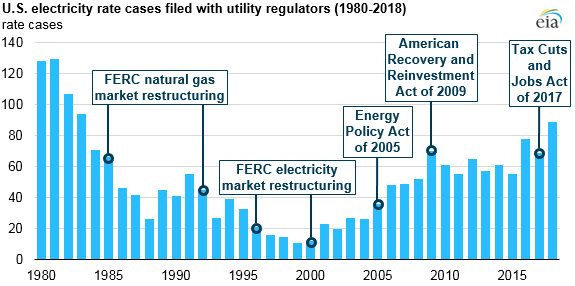
Federal data shows an increase in the number of U.S. electric utility rate cases filed in 2018, to the largest number since 1983. Of the 89 utilities filing rate cases in 2018, 10 proposed to decrease rates, one proposed a rate freeze until next year, and the remaining 78 utilities proposed to increase their rates.

Under typical state law, public electric utility companies must obtain regulatory approvals before changing the rates they charge their customers. According to the U.S. Energy Information Administration, 89 electric utilities sought to change their rates by filing rate cases with state regulatory commissions in 2018. This represents a significant increase relative to two decades ago.
Source: U.S. Energy Information Administration

According to EIA, the frequency or number of electric utility rate cases "typically reflects changes in the costs of generating and delivering electricity." For 2018, EIA pointed to increases in spending for electric transmission and delivery (as opposed to generation) as driving most of the rate increases that were ultimately approved.

EIA notes that the last time electric utility rate case filings were this active was the early 1980s, an era of significant rate increases: electricity rates increased at an average annual rate of 12% in the decade following the 1973 oil embargo. To explain that historic period of numerous rate cases, EIA points to factors including investments in coal and nuclear plants following the oil crisis; the enactment of the federal Public Utility Regulatory Policies Act of 1978 (PURPA), which required utilities to purchase electricity from generation from small, independently-owned renewable facilities, and the 1979 Three Mile Island nuclear plant accident which placed increased focus (and expense) on the safety of nuclear plants. By contrast, during a period of time when the Federal Energy Regulatory Commission was restructuring most electric markets (between 1995 and 2000), fewer than 20 rate cases were filed in most years.

Utilities typically ask for approval of significantly higher rate increases than are ultimately approved by regulators. According to EIA, in 2018, utilities asked for an aggregate rate increase $6.8 billion, but regulators approved a total increase of just $2.8 billion.

New England 2019 Regional Energy Outlook describes shifts, challenges

Thursday, March 21, 2019

New England's electricity system is shifting toward a "hybrid grid," according to the operator of New England's wholesale electricity markets and electric transmission system. A recent report by ISO New England, Inc. describes the electric sector's transition towards generating resources with lower carbon emissions and the resulting implications for the environment and the economy.

ISO New England is the federally-designated regional transmission organization serving New England. The grid operator recently released its 2019 Regional Energy Outlook, a document described as “one of the many ways the ISO keeps stakeholders informed about the current state of the grid, issues affecting its future, and ISO initiatives to ensure a modern, reliable power system for New England.”

In the report, ISO New England emphasizes the region’s decarbonization and shifting resource mix, noting that “carbon emissions from the grid have fallen by roughly a third... the region is on its way from having an electric grid dominated by fossil-fuel and nuclear generation to one that includes large amounts of wind and hydro generation and hundreds of thousands of small solar and storage systems spanning the six states. The states’ next step in their decarbonization journey is to transition the emissions-heavy heating and transportation sectors to low-carbon electricity.”

ISO-NE describes the way these changes are happening as “challenging reliable system operations and competitive wholesale electricity markets.” ISO says that “for the foreseeable future, the region will remain vulnerable to energy shortfalls and wholesale price volatility as more and more resources with limited-energy ‘inventories’ (natural gas generation, wind, solar, battery storage) displace resources with on-site fuel that can sustain operation for extended periods (oil, coal, nuclear, dual-fuel generation).”

ISO New England says its competitive markets weren’t designed to telegraph future energy scarcity conditions, compensate resources for fuel inventory, achieve carbon reduction goals, or specifically lead to renewable development. It notes that state-sponsored resources suppress market prices when in markets, but would lead to overbuild if outside markets. ISO advocates, “Establishing a realistic price on carbon remains a more seamless and simpler way to achieve clean-energy goals through markets without distorting competition, but this is not in the ISO’s jurisdiction. State or federal policymakers could pursue this direction but have not done so to date.” ISO notes, “Nuclear resources will prove critical to meeting both decarbonization and energy-security goals for years to come, but how they can remain financially viable is still unclear.”

ISO-NE says it is focused on 3 elements to support the transition to the “hybrid grid”: supporting the rapid transformation of the region’s electricity supply and demand mix, maintaining a robust transmission system, and ensuring energy security. 

The grid operator also noted limitations on what tools it can use to address these challenges: “Importantly, ISO New England does not have the authority to dictate investments in energy infrastructure that can help ensure that the region’s energy needs can be met in all seasons, under all conditions. Our toolkit is to create financial stimuli through the wholesale electricity markets that will drive action. Opposition or impediments to infrastructure decisions will only exacerbate the region’s energy-security constraints.”

New Mexico legislature passes 100 percent renewable power law

Thursday, March 14, 2019

The New Mexico state legislature has passed a bill that requires public utilities other than rural electric cooperatives and municipalities to supply all retail sales of electricity in New Mexico with zero carbon resources by 2045.

The bill is SB 489, also known as the Energy Transition Act. Much of the Energy Transition Act focuses on procedures allowing utilities to obtain approval to abandon generating facilities which obtaining financing orders from the New Mexico Public Regulation Commission allowing the utilities to recover all of their energy transition costs through securitization -- issuing energy transition bonds whose costs the utilities pay by collecting an "energy transition charge" from their customers. The act creates funds to provide training and economic development in communities within 100 miles of abandoned facilities.

The law also revises New Mexico's renewable portfolio standard. It requires distribution cooperatives to sell at least 40 percent renewable energy by 2025 and at least 50 percent renewable energy by 2030, and sets a "zero carbon resource standard" target for distribution cooperatives by 2050, composed of at least 80 percent renewable energy, if feasible from technical, reliability, and affordability perspectives. For public utilities other than rural electric cooperatives and municipalities, the law requires similarly increasing percentages of renewable power, including 80 percent renewable energy resources by 2040 and 100 percent zero carbon resources by 2045. It allows public utilities to ask the Commission to provide financial or other incentives in excess of these amounts.

The bill passed the state senate with a vote of 32-9, and the state house with a vote of 43-22. It now goes to Governor Michelle Lujan Grisham for her signature. According to a statement Governor Lujan Grisham issued on March 12, "The Energy Transition Act is a promise to future generations of New Mexicans."

Other states are considering changes to their renewable portfolio standards, carbon emission limits, and other legal requirements affecting the electric power sector. If SB 489 is enacted into law, New Mexico will join California and Hawaii in having a future commitment or goal of 100 percent carbon-free electricity.

Coal power plants retiring in 2015

Thursday, May 21, 2015

The U.S. portfolio of electric power plants will continue to shift in 2015, according to a federal assessment projecting that nearly 16 gigawatts (GW) of generating capacity will retire in 2015.  Most of the capacity to be retired this year is coal-fired generation.  This continues a multi-year trend away from coal, and toward natural gas and renewable resources.

According to the U.S. Energy Information Administration, nearly 16 GW of generating capacity is expected to retire in 2015.  Of this, 81% (12.9 GW) is coal-fired generation.  Generator retirements are heavily composed of coal-fired generation, split between bituminous coal (10.2 GW) and subbituminous coal (2.8 GW).  Most of this retiring coal capacity is found in the Appalachian region, with slightly more than 8 GW combined in Ohio, West Virginia, Kentucky, Virginia, and Indiana.

New environmental regulations and struggles to remain cost-competitive explain most of these retirements.  This year, the Environmental Protection Agency's Mercury and Air Toxics Standards (MATS) take effect.  MATS requires existing large coal- and oil-fired electric generators to meet stricter emissions standards by retrofitting the units with new emissions control technologies.  While some units have been granted extensions to operate through April 2016, some power plant operators are choosing to retire units instead of making cost-prohibitive investments in pollution control.

Most of the coal-fired units slated for retirement are smaller and operate at a lower capacity factor than average coal-fired units in the United States.  According to EIA, the to-be-retired units have an average summer nameplate capacity of 158 MW, just 60% as big as the 261 MW average for other coal-fired units.  In 2014, the average capacity factor for all coal units was 61%, but the subset of coal units retiring in 2015 had an average capacity factor of just 36%.  The relatively small size and low capacity factor of these power plants make it harder for them to compete economically against other generation sources.  This competition is especially difficult if sufficient natural gas-fired generating capacity is available, as the cost of natural gas has fallen to levels not seen since 2012.

The coal capacity retiring in 2015 accounted for 1.6% of total U.S. generation during 2014.  At the same time, electric generating companies expect to add more than 20 GW of utility-scale generating capacity to the power grid.  This new capacity is dominated by wind (9.8 GW), natural gas (6.3 GW), and solar (2.2 GW), which together compose 91% of expected new capacity in 2015.