Showing posts with label mix. Show all posts

Electric utility rate cases on the rise

Monday, July 22, 2019

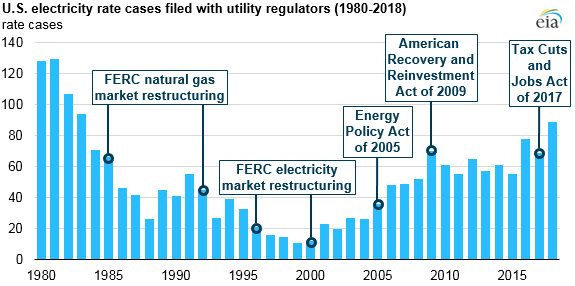
Federal data shows an increase in the number of U.S. electric utility rate cases filed in 2018, to the largest number since 1983. Of the 89 utilities filing rate cases in 2018, 10 proposed to decrease rates, one proposed a rate freeze until next year, and the remaining 78 utilities proposed to increase their rates.

Under typical state law, public electric utility companies must obtain regulatory approvals before changing the rates they charge their customers. According to the U.S. Energy Information Administration, 89 electric utilities sought to change their rates by filing rate cases with state regulatory commissions in 2018. This represents a significant increase relative to two decades ago.
Source: U.S. Energy Information Administration

According to EIA, the frequency or number of electric utility rate cases "typically reflects changes in the costs of generating and delivering electricity." For 2018, EIA pointed to increases in spending for electric transmission and delivery (as opposed to generation) as driving most of the rate increases that were ultimately approved.

EIA notes that the last time electric utility rate case filings were this active was the early 1980s, an era of significant rate increases: electricity rates increased at an average annual rate of 12% in the decade following the 1973 oil embargo. To explain that historic period of numerous rate cases, EIA points to factors including investments in coal and nuclear plants following the oil crisis; the enactment of the federal Public Utility Regulatory Policies Act of 1978 (PURPA), which required utilities to purchase electricity from generation from small, independently-owned renewable facilities, and the 1979 Three Mile Island nuclear plant accident which placed increased focus (and expense) on the safety of nuclear plants. By contrast, during a period of time when the Federal Energy Regulatory Commission was restructuring most electric markets (between 1995 and 2000), fewer than 20 rate cases were filed in most years.

Utilities typically ask for approval of significantly higher rate increases than are ultimately approved by regulators. According to EIA, in 2018, utilities asked for an aggregate rate increase $6.8 billion, but regulators approved a total increase of just $2.8 billion.

Oil, from crude to fuels and chemicals

Monday, April 2, 2012

Petroleum - what we often think of as oil - powers a large sector of the world economy.  Crude oil, a naturally-occurring mix of substances produced by ancient life and transformed by time and geological forces, lies trapped beneath soil, rock, and the sea floor.  When captured and refined, the crude oil can be transformed into gasoline and diesel, but also into a wide variety of other fuels and chemicals.

In the U.S., crude oil is typically quantified in a 42-gallon unit known as the barrel.  While this bears some historic tie to actual barrels of oil, crude oil today is seldom packed in actual 42-gallon barrels, more typically being shipped in large seagoing oil tankers or pipelines.

At a refinery, each of the components of the crude oil mix is separated.  Some are converted from heavy, low-valued chemicals into lighter, higher-valued products like gasoline.  Processes like cracking, coking, and alkylation allow the production of more exotic petroleum derivatives.

From 42 gallons of crude oils, refineries can produce about 45 gallons of refined petroleum products. Typically, these might include:
  • 19 gallons of gasoline
  • 10 gallons of diesel
  • 4 gallons of jet fuel
  • 2 gallons of liquefied petroleum gases (propane, butane, etc.)
  • 1 gallon of other distillates (heating oil)
  • 2 gallons of residual fuel oil
  • 7 gallons of other products

Most of this increase in total product volume comes as different fractions of the petroleum mix are distilled and transformed; the U.S. Energy Information Administration has described the increased volume after refining as "similar to what happens to popcorn, which gets bigger after it's popped".

Because each source of crude oil contains a different mix of hydrocarbons and other chemicals, the refining process yields different mixes of products for each type of crude. The demand for these products drives oil producers' decisions about where to drill and produce oil.

August 2, 2010 - my electricity supply mix; repowering small hydro

Monday, August 2, 2010

Do you know where the energy you consume came from? Electricity consumers in Maine like me get mailings detailing the fuel mix behind our electric generation. Here's the one I received last week:

Standard offer supply mix

This shows that the largest share of my kilowatt-hours (37.9%) comes from hydro-electric generation. Natural gas is next (25.8%), with nuclear from Seabrook close behind (23.1%). For the remaining renewables, I get 0.5% from biomass and 0.6% from municipal solid waste combustion -- totaling a renewable portfolio of 39%. This is well in excess of Maine's basic 30% RPS, suggesting that renewables can be very cost-effective at providing energy, at least in light of the current basket of renewable power incentives like grants, tax credits, and long-term contracts.

The mailings also provide information on air emissions from this generation mix.
Standard offer 2

This supplier's mix averaged 452.95 lbs CO2 per MWh generated, which is stated as 56.7% below the New England average. (Credit our reliance on renewables, as well as natural gas, for this number.) The supplier's mix also emitted 0.4 lbs NOx per MWh, and 0.7 lbs SOx per MWh -- all over 56% below New England's average.


An interesting bit of late-breaking news: Maine Governor Baldacci has nominated David Littell to fill the vacant seat on the Maine Public Utilities Commission. Dave is currently the Commissioner of the Maine Department of Environmental Protection.

After 378 years of continuous ownership and operation, what is believed to be the country's oldest family farm is up for sale.

As we look for renewable energy sources, many people are considering repowering small hydro dams. Many dams formerly had energy development, either mechanical or hydroelectric. Scribner's Mill, in the Maine town of Harrison, once had such a small dam and sawmill. Now, a group of historical enthusiasts called Scribner's Mill Preservation Inc. is proposing to rebuild the dam to power the restored sawmill. The Maine DEP is now reviewing their plans.