Showing posts with label rate. Show all posts

Electric utility rate cases on the rise

Monday, July 22, 2019

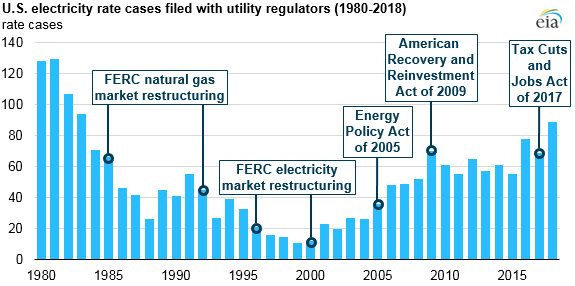
Federal data shows an increase in the number of U.S. electric utility rate cases filed in 2018, to the largest number since 1983. Of the 89 utilities filing rate cases in 2018, 10 proposed to decrease rates, one proposed a rate freeze until next year, and the remaining 78 utilities proposed to increase their rates.

Under typical state law, public electric utility companies must obtain regulatory approvals before changing the rates they charge their customers. According to the U.S. Energy Information Administration, 89 electric utilities sought to change their rates by filing rate cases with state regulatory commissions in 2018. This represents a significant increase relative to two decades ago.

Source: U.S. Energy Information Administration

According to EIA, the frequency or number of electric utility rate cases "typically reflects changes in the costs of generating and delivering electricity." For 2018, EIA pointed to increases in spending for electric transmission and delivery (as opposed to generation) as driving most of the rate increases that were ultimately approved.

EIA notes that the last time electric utility rate case filings were this active was the early 1980s, an era of significant rate increases: electricity rates increased at an average annual rate of 12% in the decade following the 1973 oil embargo. To explain that historic period of numerous rate cases, EIA points to factors including investments in coal and nuclear plants following the oil crisis; the enactment of the federal Public Utility Regulatory Policies Act of 1978 (PURPA), which required utilities to purchase electricity from generation from small, independently-owned renewable facilities, and the 1979 Three Mile Island nuclear plant accident which placed increased focus (and expense) on the safety of nuclear plants. By contrast, during a period of time when the Federal Energy Regulatory Commission was restructuring most electric markets (between 1995 and 2000), fewer than 20 rate cases were filed in most years.

Utilities typically ask for approval of significantly higher rate increases than are ultimately approved by regulators. According to EIA, in 2018, utilities asked for an aggregate rate increase $6.8 billion, but regulators approved a total increase of just $2.8 billion.

Vermont PUC report on electric vehicles

Monday, July 8, 2019

Vermont utility regulators have recommended steps Vermont could take to accelerate the use of electric vehicles (EVs) in the state, including creating state incentives for EV purchases as well as encouraging electric utilities to adopt new rate structures.

Like most other states, Vermont's transportation sector contributes more greenhouse gas emissions than any other sector of the state's economy. Due in large part to emissions from cars and trucks powered by fossil fuels, the transportation sector is responsible for about 47% of Vermont's total greenhouse gas emissions; by contrast, Vermont's electricity generating sector is relatively small but nearly entirely renewable, and has the lowest carbon dioxide emissions of any state according to federal data. Other New England states are similar -- for example, Maine's transportation sector contributed 53% of the state's total greenhouse gas emissions in 2017, while electric power generation in Maine accounted for just 9 percent of the state’s total carbon emissions.

Indeed, the New England electricity grid has experienced significant decarbonized in recent decades, and renewable energy can now be consumed in the transportation sector through the use of EVs. In 2016, Vermont adopted a Comprehensive Energy Plan aiming to power 10% of transportation with renewable energy by 2025, and 80% by 2050, while reducing the sector's emissions by 30% by 2025. Vermont estimates that reaching these goals would require adding about 50,000 to 60,000 EVs to replace vehicles with internal combustion engines by 2025, for a compound annual growth rate of about 54%.

On June 27, 2019, the Vermont Public Utilities Commission released its report to various state legislative committees, "Promoting the Ownership and Use of Electric Vehicles in the State of Vermont." The report recommends that Vermont create incentives for EV purchases or leases, whether in the form of time-of-sale rebates or tax credits. It also recommends that Vermont buy EVs for the state vehicle fleet, and encourage the development of EV charging infrastructure through zoning or building code modifications.

The report also suggests that the Commission encourage electric utilities to take additional actions to promote EV adoption, such as funding EV purchase incentives through Vermont's Renewable Energy Standard program, or developing time-of-use retail rates to encourage car charging at off-peak times. It also noted that utility rate structures which impose demand charges on most commercial accounts but not on residential accounts make public direct-current fast-charging more expensive than at-home charging.

The report also notes that increased education and outreach efforts -- by utilities as well as by car dealers and other third parties -- could encourage consumer adoption of EVs.

West Virginia electric utilities offer discount for new or expanding businesses

Wednesday, February 20, 2019

Two electric utilities serving customers in West Virginia have announced a new discounted "incentive rate" to attract new businesses and grow existing businesses.

Appalachian Power Company and Wheeling Power Company announced on February 14, 2019, that they are are offering discounted rates for electric service to new or expanding businesses meeting defined standards. The discount reduces qualifying customers' incremental billing demand by 40% for a 5-year term. The utilities are offering this new rate to new or existing customers who establish at least 500 kilowatts of new demand for electricity and meet criteria including creating at least 10 jobs or investing at least $2.5 million in an expansion in West Virginia.

The announcement follows a January 29, 2019 decision by the Public Service Commission of West Virginia to approve the companies' "Economic Development Rider" tariff proposed by the utilities in a November 28, 2018 filing. According to the Commission, the discounted rate is "experimental in nature" and is limited in size to an aggregate of 250 megawatts for the companies. As approved by the Commission, the rate will impose no incremental rate burden on any of the companies' West Virginia retail customers, and should result in a net contribution to defray the companies' fixed costs.

According to the Commission's order, the discounted rate will not be available in instances where there is "simply a change in ownership of existing customer operations", where operations are merely relocated within the companies' services territories, or where increases in demand result from the resumption of normal operations following abnormal operating conditions. The rate is also unavailable to "business facilities engaged in the retail sale to the average customer of consumer or final goods" due to concerns that adding new customers engaged in competitive retail sales of consumer goods would increase the "likelihood that the new load will displace an existing load with the net result being zero benefits."

The Commission noted the companies' expectation that the rate "will serve as an inducement for economic development in the West Virginia service territories of the Companies" and that "the resulting economic development will be beneficial to the West Virginia retail ratepayers of the Companies and to the economy of West Virginia."

Appalachian Power and Wheeling Power are subsidiaries of American Electric Power. AEP Appalachian Power has 1 million customers in Virginia, West Virginia and Tennessee.

Report links US nuclear industry to national security

Friday, August 18, 2017

The U.S. nuclear energy enterprise is a key national security enabler, according to a report released this week by a new non-profit.  The Energy Futures Initiative's report describes the domestic nuclear energy industry as playing important roles in both electricity supply and "maintaining a robust supply chain (equipment, services, and skilled personnel) that is necessary for U.S. leadership in global nuclear nonproliferation policy."

According to its website, Energy Futures Initiative, Inc. (EFI) is "a new not-for-profit dedicated to driving innovation in energy technology, policy and business models."  EFI's principals include fomer U.S. Secretary of Energy Dr. Ernest Moniz.

EFI's August 2017 report, "The U.S. Nuclear Energy Enterprise: A Key National Security Enabler," analyzes the domestic nuclear energy sector's role in meeting national security imperatives, including:
  • maintaining U.S. leadership in ensuring nuclear non-proliferation;
  • supporting the U.S. nuclear Navy; and
  • supporting the global strategic stability and deterrence value of nuclear weapons.
It notes that in addition to supplying electricity, nuclear power provides values including climate change risk mitigation, fuel price risk management, and national security -- some of which are not addressed in electricity rate-making policy.  The report notes:
The analysis suggests that the imperatives of global climate change, collective energy security, balance of trade and U.S. national security require a viable domestic commercial nuclear power industry, including a robust supply chain of technology, services and human resources. Recent events and future trends point in the opposite direction: commercial reactors are shutting down, new builds are struggling, the supply chain is at risk, and it is likely that the educational pipeline will negatively respond to these challenges.
To ensure that the federal government addresses the relationship between a robust nuclear energy enterprise and goals including nonproliferation, Navy fleet modernization, and "the global strategic stability and deterrence value of nuclear weapons," the report suggests steps the U.S. could take.  These include making "maximum flexible use of its existing resources and capabilities, including credit support, tax incentives and federal siting and/or purchase power agreements, to bolster support for current new builds and to encourage additional new builds," as well as directing the Federal Energy Regulatory Commission to "place greater emphasis on the national security importance of nuclear power and its associated supply chain."  It also suggests that Congress allocate $2 billion per year for the next five years to fund research and development into new reactor designs.

Maine 2017 solar, energy legislative proposals

Friday, February 3, 2017

The 128th Maine Legislature's first session kicked off last month in Augusta.  Over 2,000 legislative requests or proposed bills were submitted for the 2017 session, most of which will eventually be "printed" or released to the public as bills or "Legislative Documents."  Energy items on this session's docket are expected to include a variety of bills addressing solar energy.  While most of these bills have yet to be printed, energy-related bills that have been printed so far include items related to protecting the grid against geomagnetic disturbances and electromagnetic pulses, consumer protection in the form of limits retail electricity rates, and retooling the Governor's energy office:

  • LD 255, An Act To Implement Electric Grid Reliability Recommendations: as drafted, this concept draft proposes directing the Maine Public Utilities Commission to take certain actions regarding geomagnetic disturbances and electromagnetic pulses on the State’s electric grid, including installation of equipment to enable grid monitoring and protection. 
  • LD 259, An Act To Limit Rates Charged by Competitive Electricity Providers: as drafted, this bill would prohibit competitive electricity providers from charging a residential consumer a rate for generation service that is higher than the applicable standard-offer service rate.
  • LD 260, An Act to Create the Maine Energy Office: as drafted, among other changes this bill would revamp the Governor's Energy Office into a Commissioner-led office, with funding from Efficiency Maine Trust.
Beyond the bills that have been printed so far, a list published by the Legislative Information Office of bill titles organized by subject matter shows 12 legislative requests relating to solar energy:
  • LR 19, An Act To Encourage and Support Solar Energy for Use in the Private and Public Sectors 
  • LR 34, An Act To Grow Maine's Economy through Increased Solar Power Generation
  • LR 179, An Act To Enhance the Commercial Development of Solar Energy
  • LD 394, An Act To Modernize Maine's Solar Power Policy and Encourage Economic Development
  • LR 402, An Act To Promote the Development of Solar Energy in Maine
  • LD 529, An Act To Modernize Maine's Solar Power Policy and Encourage Economic Development
  • LR 1071, An Act To Protect and Expand Access to Solar Power in Maine
  • LR 1367, An Act Regarding Solar Power for Farms and Businesses
  • LR 1424, An Act To Advance Locally Owned Solar Energy Systems
  • LD 1425, An Act To Modernize Community Solar Policy
  • LR 1856, An Act Regarding Large-scale Community Solar Procurement
  • LD 1944, An Act To Address Solar Power in Maine 
The Joint Standing Committee on Energy, Utilities and Technology will hold public hearings on bills referred to it over the course of the session.  

DesertLink transmission project wins rate incentives under Section 219

Tuesday, August 23, 2016

Federal energy regulators have granted a petition by the developer of a proposed electric transmission project in Nevada for certain transmission rate incentives available under federal law.  On August 19, the Federal Energy Regulatory Commission ruled on DesertLink, LLC's petition for declaratory order, with respect to DesertLink's new Harry Allen to Eldorado 500 kV transmission project.  The order grants DesertLink's requests for transmission rate incentives under section 219 of the Federal Power Act, and illustrates how those incentives operate.

DesertLink, a member of the LS Power Group, is the developer of a transmission project to be located in Nevada, but connected to a substation in the grid controlled by the California Independent System Operator Corporation.  CAISO designated the project for competitive bidding under its 2013-2014 transmission plan, and in January 2016 selected DesertLink as the approved project sponsor under its Order No. 1000-based process for eligible transmission developers to submit bids to develop and construct certain transmission projects.  The project is designed to have an in-service date of May 2020.

Rate incentives can be available to promote capital investments in certain transmission infrastructure.  The Federal Power Act authorizes the Federal Energy Regulatory Commission to regulate the transmission and wholesale sales of electricity in interstate commerce.  Through the Energy Policy Act of 2005, Congress added a new section 219 to the Federal Power Act, directing the Commission to create rules establishing incentive-based rate treatments.  The Commission's Order No. 679 sets forth the processes by which a public utility may seek transmission rate incentives under section 219, and the Commission has issued a Transmission Incentives Policy Statement offering guidance on how it evaluates applications for transmission rate incentives.

Section 219 and Order No. 679 require an applicant for rate incentives to show that “the facilities for which it seeks incentives either ensure reliability or reduce the cost of delivered power by reducing transmission congestion.”  Order No. 679 established a rebuttable presumption that this standard is met if:
(1) the transmission project results from a fair and open regional planning process that considers and evaluates the project for reliability and/or congestion and is found to be acceptable to the Commission; or (2) a project has received construction approval from an appropriate state commission or state siting authority.
Order No. 679 also requires an applicant to demonstrate that there is a nexus between the incentive being sought and the investment being made.  The Commission clarified in Order No. 679-A that this "nexus test" is met when an applicant demonstrates, on a project-specific basis, that the total package of incentives requested is “tailored to address the demonstrable risks or challenges faced by the applicant.”

In DesertLink's case, on May 11, 2016, the applicant applied for transmission rate incentives, including (1) deferred recovery of all prudently incurred precommercial costs through the creation of a regulatory asset (regulatory asset incentive); (2) full recovery of 100 percent of prudently-incurred costs, including pre-commercial expenses and construction costs, if the Project is abandoned for reasons beyond DesertLink’s control (abandonment incentive); (3) use of a hypothetical capital structure consisting of 50 percent debt and 50 percent equity until the Project achieves commercial operation (hypothetical capital structure incentive); and (4) a 50-basis point adder to DesertLink’s Return on Equity (ROE) for participating in a Regional Transmission Organization (RTO), namely, CAISO (RTO participation incentive).

Last week, the Commission granted DesertLink's petition.  First, the Commission found that DesertLink is entitled to the rebuttable presumption that the Project will ensure reliability or reduce the cost of delivered power by reducing transmission congestion, because the CAISO transmission planning process found annual production cost benefits of $9.4 million in 2019 to $8.4 million in 2024 and beyond, and annual capacity benefits of $19.7 million in 2020 to $8.8 million in 2025 and beyond.

Next, the Commission found that DesertLink had demonstrated that its total package of requested incentives is tailored to address the demonstrable risks or challenges faced by DesertLink.  The Commission found that the regulatory asset treatment of pre-commercial costs appropriately addresses the risks and challenges of the Project, because it provides DesertLink with added upfront regulatory certainty, reduces interest expenses, and assists in the construction of the Project.  On the abandonment incentive, the Commission found that recovery of abandonment costs was an effective means to encourage transmission development by reducing the risk of non-recovery of costs.  Regarding a hypothetical capital structure, the Commission noted that its use "will aid DesertLink in raising capital during the construction phase of the Project, and will assist DesertLink in maintaining low debt costs while its actual debt-to-equity ratio varies."  The Commission also found DesertLink would qualify for the RTO participation incentive, based on its commitment to become a member of CAISO and to transfer operational control of the project to CAISO after placing it in service.

The Commission's determination takes the form of a declaratory order granting authorization for the rate incentives, but it does not directly authorize DesertLink to include the incentives in its filed rates.  As the Commission noted, "While our determination on DesertLink's Petition establishes whether it qualifies for the requested transmission rate incentives, if DesertLink seeks to put these incentives into effect, it must submit a subsequent filing under section 205 of the FPA."  In such a case, the applicant will need to make a variety of showings before including certain incentives in its rate base, including the justness and reasonableness of costs relating to pre-commercial, formation, and plant abandonment.  Nevertheless, securing the declaratory order gives DesertLink greater certainty about its qualification for these key incentives for electric transmission development.