U.S. energy regulators have denied a petition by a Nevada electric utility that would have rejected a regulatory filing by a local power plant. The ruling preserves the power plant's ability to sell electricity to its host utility.
The case centers on Saguaro Power Company, owner and operator of a 105 megawatt topping-cycle cogeneration facility in Henderson, Nevada. The plant sells electricity to Nevada Power Company under a power purchase agreement. Under that PPA, the energy and capacity rates paid by Nevada Power to Saguaro would be reduced by 20 percent if Saguaro loses its status as a "qualifying facility" or QF under federal law.
Since 1978, qualifying facilities have been entitled to receive certain benefits under the federal law called PURPA, but the process and requirements for becoming a QF have changed over time. Prior to August 8, 2005, in order to be a QF, a cogeneration facility was required to “produce electric energy and forms of useful thermal output (such as heat or steam), used for industrial, commercial, heating, or cooling purposes, through the sequential use of energy” and meet the applicable operating and efficiency standards. Since then, EPAct 2005 and Order No. 671 have provided that any “new” cogeneration facilities, i.e., a cogeneration facility that was either not certified as a QF on or before August 8, 2005 or had not filed a notice of self-certification or Commission application for certification prior to February 2, 2006, must also demonstrate that the “thermal energy output... is used in a productive and beneficial manner.”
In December 2017, Saguaro filed a Form No. 556 recertifying its facility as an existing cogeneration QF. That filing identified new thermal hosts who will receive thermal energy in the form of distilled water from the facility’s low pressure steam output, replacing thermal hosts previously identified in a prior self-recertification filing.
But Nevada Power Company filed a petition for declaratory order with the Federal Energy Regulatory Commission, asserting that Saguaro's self-recertification filing was deficient. Specifically, the utility argued that Saguaro failed to demonstrate its compliance with the operating and efficiency standards -- and also that the facility should be treated as "new" and thus be subject to additional standards under the Energy Policy Act of 2005 and the Commission's Order No. 671, such as whether the facility is being used in a productive and beneficial manner.
The Commission has rejected Nevada Power's petition. In its order denying Nevada Power's petition, the Commission noted that its Order No. 671 establishes a rebuttable presumption that an existing QF does not become a "new cogeneration facility" merely because it files for recertification, and that Saguaro represented having made no changes to its facility. The Commission concluded that filing for recertification to identify new replacement thermal hosts did not make the Saguaro facility "new."

Energy powers society; society's choices shape energy policy. A blog about our energy resources and the choices they present for society.
Showing posts with label Nevada. Show all posts
Showing posts with label Nevada. Show all posts

DesertLink transmission project wins rate incentives under Section 219
Tuesday, August 23, 2016
Federal energy regulators have granted a petition by the developer of a proposed electric transmission project in Nevada for certain transmission rate incentives available under federal law. On August 19, the Federal Energy Regulatory Commission ruled on DesertLink, LLC's petition for declaratory order, with respect to DesertLink's new Harry Allen to Eldorado 500 kV transmission project. The order grants DesertLink's requests for transmission rate incentives under section 219 of the Federal Power Act, and illustrates how those incentives operate.
DesertLink, a member of the LS Power Group, is the developer of a transmission project to be located in Nevada, but connected to a substation in the grid controlled by the California Independent System Operator Corporation. CAISO designated the project for competitive bidding under its 2013-2014 transmission plan, and in January 2016 selected DesertLink as the approved project sponsor under its Order No. 1000-based process for eligible transmission developers to submit bids to develop and construct certain transmission projects. The project is designed to have an in-service date of May 2020.
Rate incentives can be available to promote capital investments in certain transmission infrastructure. The Federal Power Act authorizes the Federal Energy Regulatory Commission to regulate the transmission and wholesale sales of electricity in interstate commerce. Through the Energy Policy Act of 2005, Congress added a new section 219 to the Federal Power Act, directing the Commission to create rules establishing incentive-based rate treatments. The Commission's Order No. 679 sets forth the processes by which a public utility may seek transmission rate incentives under section 219, and the Commission has issued a Transmission Incentives Policy Statement offering guidance on how it evaluates applications for transmission rate incentives.
Section 219 and Order No. 679 require an applicant for rate incentives to show that “the facilities for which it seeks incentives either ensure reliability or reduce the cost of delivered power by reducing transmission congestion.” Order No. 679 established a rebuttable presumption that this standard is met if:
In DesertLink's case, on May 11, 2016, the applicant applied for transmission rate incentives, including (1) deferred recovery of all prudently incurred precommercial costs through the creation of a regulatory asset (regulatory asset incentive); (2) full recovery of 100 percent of prudently-incurred costs, including pre-commercial expenses and construction costs, if the Project is abandoned for reasons beyond DesertLink’s control (abandonment incentive); (3) use of a hypothetical capital structure consisting of 50 percent debt and 50 percent equity until the Project achieves commercial operation (hypothetical capital structure incentive); and (4) a 50-basis point adder to DesertLink’s Return on Equity (ROE) for participating in a Regional Transmission Organization (RTO), namely, CAISO (RTO participation incentive).
Last week, the Commission granted DesertLink's petition. First, the Commission found that DesertLink is entitled to the rebuttable presumption that the Project will ensure reliability or reduce the cost of delivered power by reducing transmission congestion, because the CAISO transmission planning process found annual production cost benefits of $9.4 million in 2019 to $8.4 million in 2024 and beyond, and annual capacity benefits of $19.7 million in 2020 to $8.8 million in 2025 and beyond.
Next, the Commission found that DesertLink had demonstrated that its total package of requested incentives is tailored to address the demonstrable risks or challenges faced by DesertLink. The Commission found that the regulatory asset treatment of pre-commercial costs appropriately addresses the risks and challenges of the Project, because it provides DesertLink with added upfront regulatory certainty, reduces interest expenses, and assists in the construction of the Project. On the abandonment incentive, the Commission found that recovery of abandonment costs was an effective means to encourage transmission development by reducing the risk of non-recovery of costs. Regarding a hypothetical capital structure, the Commission noted that its use "will aid DesertLink in raising capital during the construction phase of the Project, and will assist DesertLink in maintaining low debt costs while its actual debt-to-equity ratio varies." The Commission also found DesertLink would qualify for the RTO participation incentive, based on its commitment to become a member of CAISO and to transfer operational control of the project to CAISO after placing it in service.
The Commission's determination takes the form of a declaratory order granting authorization for the rate incentives, but it does not directly authorize DesertLink to include the incentives in its filed rates. As the Commission noted, "While our determination on DesertLink's Petition establishes whether it qualifies for the requested transmission rate incentives, if DesertLink seeks to put these incentives into effect, it must submit a subsequent filing under section 205 of the FPA." In such a case, the applicant will need to make a variety of showings before including certain incentives in its rate base, including the justness and reasonableness of costs relating to pre-commercial, formation, and plant abandonment. Nevertheless, securing the declaratory order gives DesertLink greater certainty about its qualification for these key incentives for electric transmission development.
DesertLink, a member of the LS Power Group, is the developer of a transmission project to be located in Nevada, but connected to a substation in the grid controlled by the California Independent System Operator Corporation. CAISO designated the project for competitive bidding under its 2013-2014 transmission plan, and in January 2016 selected DesertLink as the approved project sponsor under its Order No. 1000-based process for eligible transmission developers to submit bids to develop and construct certain transmission projects. The project is designed to have an in-service date of May 2020.
Rate incentives can be available to promote capital investments in certain transmission infrastructure. The Federal Power Act authorizes the Federal Energy Regulatory Commission to regulate the transmission and wholesale sales of electricity in interstate commerce. Through the Energy Policy Act of 2005, Congress added a new section 219 to the Federal Power Act, directing the Commission to create rules establishing incentive-based rate treatments. The Commission's Order No. 679 sets forth the processes by which a public utility may seek transmission rate incentives under section 219, and the Commission has issued a Transmission Incentives Policy Statement offering guidance on how it evaluates applications for transmission rate incentives.
Section 219 and Order No. 679 require an applicant for rate incentives to show that “the facilities for which it seeks incentives either ensure reliability or reduce the cost of delivered power by reducing transmission congestion.” Order No. 679 established a rebuttable presumption that this standard is met if:
(1) the transmission project results from a fair and open regional planning process that considers and evaluates the project for reliability and/or congestion and is found to be acceptable to the Commission; or (2) a project has received construction approval from an appropriate state commission or state siting authority.Order No. 679 also requires an applicant to demonstrate that there is a nexus between the incentive being sought and the investment being made. The Commission clarified in Order No. 679-A that this "nexus test" is met when an applicant demonstrates, on a project-specific basis, that the total package of incentives requested is “tailored to address the demonstrable risks or challenges faced by the applicant.”
In DesertLink's case, on May 11, 2016, the applicant applied for transmission rate incentives, including (1) deferred recovery of all prudently incurred precommercial costs through the creation of a regulatory asset (regulatory asset incentive); (2) full recovery of 100 percent of prudently-incurred costs, including pre-commercial expenses and construction costs, if the Project is abandoned for reasons beyond DesertLink’s control (abandonment incentive); (3) use of a hypothetical capital structure consisting of 50 percent debt and 50 percent equity until the Project achieves commercial operation (hypothetical capital structure incentive); and (4) a 50-basis point adder to DesertLink’s Return on Equity (ROE) for participating in a Regional Transmission Organization (RTO), namely, CAISO (RTO participation incentive).
Last week, the Commission granted DesertLink's petition. First, the Commission found that DesertLink is entitled to the rebuttable presumption that the Project will ensure reliability or reduce the cost of delivered power by reducing transmission congestion, because the CAISO transmission planning process found annual production cost benefits of $9.4 million in 2019 to $8.4 million in 2024 and beyond, and annual capacity benefits of $19.7 million in 2020 to $8.8 million in 2025 and beyond.
Next, the Commission found that DesertLink had demonstrated that its total package of requested incentives is tailored to address the demonstrable risks or challenges faced by DesertLink. The Commission found that the regulatory asset treatment of pre-commercial costs appropriately addresses the risks and challenges of the Project, because it provides DesertLink with added upfront regulatory certainty, reduces interest expenses, and assists in the construction of the Project. On the abandonment incentive, the Commission found that recovery of abandonment costs was an effective means to encourage transmission development by reducing the risk of non-recovery of costs. Regarding a hypothetical capital structure, the Commission noted that its use "will aid DesertLink in raising capital during the construction phase of the Project, and will assist DesertLink in maintaining low debt costs while its actual debt-to-equity ratio varies." The Commission also found DesertLink would qualify for the RTO participation incentive, based on its commitment to become a member of CAISO and to transfer operational control of the project to CAISO after placing it in service.
The Commission's determination takes the form of a declaratory order granting authorization for the rate incentives, but it does not directly authorize DesertLink to include the incentives in its filed rates. As the Commission noted, "While our determination on DesertLink's Petition establishes whether it qualifies for the requested transmission rate incentives, if DesertLink seeks to put these incentives into effect, it must submit a subsequent filing under section 205 of the FPA." In such a case, the applicant will need to make a variety of showings before including certain incentives in its rate base, including the justness and reasonableness of costs relating to pre-commercial, formation, and plant abandonment. Nevertheless, securing the declaratory order gives DesertLink greater certainty about its qualification for these key incentives for electric transmission development.
New generation in 2014 mostly gas, solar, wind
Wednesday, September 17, 2014
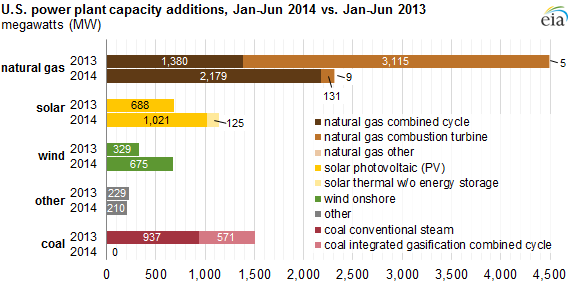
Most new power plants placed in service in the first half of 2014 are powered by natural gas, with new solar and wind capacity coming in second and third, respectively, according to the U.S. Energy Information Administration. Meanwhile, no new coal-fired electric generating capacity was added during that period.
From January through June 2014, EIA data shows the U.S. added 4,350 megawatts of new
utility-scale generating capacity. Combined-cycle natural gas plants contributed 2,179 MW of new capacity. Of this, over half is located at Florida Power & Light's Riviera Beach Next Generation Clean Energy Center in Florida. New combustion turbine plants added another 131 MW. In all, natural gas powers over 53% of new capacity coming online in the first half of 2014. Most of the nation has access to low cost natural gas, which offers significant environmental benefits over other fossil fuels like coal and oil.
Solar projects came in second, with 1,146 MW of new capacity coming online. Solar capacity is growing quickly, with an increase of almost 70% in new capacity added over the same period in 2013. Nearly 75% of this solar capacity is located in California, with most of the rest in Arizona, Nevada, and Massachusetts. Notably, the EIA's data only covers utility-scale projects; it omits most rooftop solar projects and any other solar capacity additions below 1 MW in size.
New wind capacity came in third, with 675 MW added. Most of the new capacity is sited in California, Nebraska, Michigan, and Minnesota.
Coal was notably absent from the ranks of new generating capacity added in the first half of 2014. New coal plants face steep headwinds in the form of environmental regulations and stiff competition against natural gas plants. EIA reports that only two coal plants are planned to come online in 2014.
As regulations and market forces shape the nation's energy mix, where will the new equilibrium be found -- and for how long?
 |
| Source: U.S. Energy Information Administration, Electric Power Monthly, August 2014 edition with June 2014 data Note: Data include facilities with a net summer capacity of 1 MW and above only. |
Solar projects came in second, with 1,146 MW of new capacity coming online. Solar capacity is growing quickly, with an increase of almost 70% in new capacity added over the same period in 2013. Nearly 75% of this solar capacity is located in California, with most of the rest in Arizona, Nevada, and Massachusetts. Notably, the EIA's data only covers utility-scale projects; it omits most rooftop solar projects and any other solar capacity additions below 1 MW in size.
New wind capacity came in third, with 675 MW added. Most of the new capacity is sited in California, Nebraska, Michigan, and Minnesota.
Coal was notably absent from the ranks of new generating capacity added in the first half of 2014. New coal plants face steep headwinds in the form of environmental regulations and stiff competition against natural gas plants. EIA reports that only two coal plants are planned to come online in 2014.
As regulations and market forces shape the nation's energy mix, where will the new equilibrium be found -- and for how long?
Solar, geothermal led new US capacity in January 2014
Friday, March 7, 2014
Solar and geothermal resources led the new utility-scale electric generating capacity installed in the U.S. in January 2014, according to a report by the staff of the Federal Energy Regulatory Commission. In all, the report identified 325 megawatts of new generation placed in service in January, substantially all of which is powered by renewable resources.
Solar power contributed the largest share of new generating capacity installed in January, with 287 megawatts of solar projects placed in service. The largest project, Exelon Corp.'s Antelope Valley Solar Phase II expansion project in Los Angeles County, California, added 130 megawatts of capacity to an existing 230 megawatt project. The power generated is sold to Pacific Gas and Electric under long-term contract. Other large new solar projects include MidAmerican Solar’s 61 MW Topaz Solar Farm Phase III expansion project in San Luis Obispo County, California, and two 20 MW projects (Duke Energy Corp.’s Dogwood Solar Power project in Halifax County, North Carolina, and NextEra Energy Inc.’s Mountain View Solar project in Clark County, Nevada). All of these projects rely on long-term power purchase agreements with utilities.
Geothermal steam power was the second largest category of new electric generating capacity placed in service in January 2014, in the form of Gradient Resources Inc.’s 30 MW Patua Hot Springs Geothermal project in Lyon County, Nevada. As with the solar projects described above, the power generated by the Patua Hot Springs project is sold to a utility -- in this case, Sacramento Municipal Utility District, under a long-term contract.
Rounding out the new capacity installations in January were 3 small biomass units with a combined capacity of 3 megawatts, and one wind project with an installed capacity of 4 megawatts -- Consolidated Edison Inc.’s 4 MW Russell Point Wind Farm project in Logan County, Ohio.
Despite this growth in solar and geothermal power resources, together these resources account for just over 1% of the nation's total installed operating generating capacity. Yet the relative growth in solar and geothermal power over the past years has been striking, and is expected to continue for the near term. Will these resources soon play a larger role in the nation's energy portfolio?
 |
| Old Faithful Geyser erupts in Yellowstone National Park -- a natural geothermal feature. |
Solar power contributed the largest share of new generating capacity installed in January, with 287 megawatts of solar projects placed in service. The largest project, Exelon Corp.'s Antelope Valley Solar Phase II expansion project in Los Angeles County, California, added 130 megawatts of capacity to an existing 230 megawatt project. The power generated is sold to Pacific Gas and Electric under long-term contract. Other large new solar projects include MidAmerican Solar’s 61 MW Topaz Solar Farm Phase III expansion project in San Luis Obispo County, California, and two 20 MW projects (Duke Energy Corp.’s Dogwood Solar Power project in Halifax County, North Carolina, and NextEra Energy Inc.’s Mountain View Solar project in Clark County, Nevada). All of these projects rely on long-term power purchase agreements with utilities.
Geothermal steam power was the second largest category of new electric generating capacity placed in service in January 2014, in the form of Gradient Resources Inc.’s 30 MW Patua Hot Springs Geothermal project in Lyon County, Nevada. As with the solar projects described above, the power generated by the Patua Hot Springs project is sold to a utility -- in this case, Sacramento Municipal Utility District, under a long-term contract.
Rounding out the new capacity installations in January were 3 small biomass units with a combined capacity of 3 megawatts, and one wind project with an installed capacity of 4 megawatts -- Consolidated Edison Inc.’s 4 MW Russell Point Wind Farm project in Logan County, Ohio.
Despite this growth in solar and geothermal power resources, together these resources account for just over 1% of the nation's total installed operating generating capacity. Yet the relative growth in solar and geothermal power over the past years has been striking, and is expected to continue for the near term. Will these resources soon play a larger role in the nation's energy portfolio?
Plan for solar on U.S. public lands advances
Monday, October 15, 2012
The U.S. Department of the Interior has finalized its general assessment of the environmental impacts of developing solar electric generation on public lands in six western states. Last Friday's issuance of a Programmatic Environmental Impact Statement (PEIS) will expedite the permitting of solar energy projects in designated solar energy zones on federal land.
Part of the Obama administration's plan to encourage utility-scale solar energy development on federal lands, the finalization of the record of decision for the PEIS established an initial set of 17 Solar Energy Zones
(SEZs) in Arizona, California, Colorado, Nevada, New Mexico and
Utah. (Refer to DOI's map to see the general location of the zones.)
These initial 17 zones cover about 285,000 acres of public lands, and were designated based on factors including environmental suitability and access to transmission lines. The Interior Department projects that if fully built out, the designated zones could be home to up to 23,700 megawatts of solar energy, an amount sufficient to power about 7 million homes.
The approved solar plan also allows a case-by-case evaluation of solar projects on another 19 million acres in “variance” areas outside the designated zones. At the same time, the plan excludes almost 79 million acres deemed "inappropriate for solar development based on currently available information."
Notably, the PEIS does not pre-approve any specific plan. Each project proposed in the designated zones will still require its own environmental review and other permitting. Nevertheless, the solar plan may facilitate significant development of solar energy projects on public lands in the western United States.
 |
| A view of the back a solar panel on public land in the Utah desert. |
These initial 17 zones cover about 285,000 acres of public lands, and were designated based on factors including environmental suitability and access to transmission lines. The Interior Department projects that if fully built out, the designated zones could be home to up to 23,700 megawatts of solar energy, an amount sufficient to power about 7 million homes.
The approved solar plan also allows a case-by-case evaluation of solar projects on another 19 million acres in “variance” areas outside the designated zones. At the same time, the plan excludes almost 79 million acres deemed "inappropriate for solar development based on currently available information."
Notably, the PEIS does not pre-approve any specific plan. Each project proposed in the designated zones will still require its own environmental review and other permitting. Nevertheless, the solar plan may facilitate significant development of solar energy projects on public lands in the western United States.
Energy projects installed in May 2012
Tuesday, July 3, 2012
A report released this week by federal energy regulators documents the composition of additions to the U.S.'s portfolio of electricity resources. The May 2012 Energy Infrastructure Update released by the Federal Energy Regulatory Commission's Office of Energy Projects provides a summary of newly-built and expanded electric generation facilities. This snapshot of what happened in May 2012 illustrates trends in the electric industry, including a focus on renewable energy and natural gas in project development.
According to the report, 561 megawatts of new or expanded electric generation capacity came online in May 2012. Of this new installed capacity, the largest share -- 228 MW -- came from wind. Most of this new capacity comes from a single project, E.ON Climate & Renewables North America, LLC’s Magic Valley Wind Farm I in Texas. The Magic Valley I project is comprised of 112 Vestas V100 1.8-MW turbines, for a total nameplate capacity of 202 MW.
The second-largest resource class of new generation capacity in May 2012 comes from biomass, with 166 MW of new biomass capacity installed in May. As with wind, Texas hosts the bulk of this new capacity. The largest new biomass project is a 100 MW wood-fired plant built in Nacogdoches County, Texas, by Southern Company, financed in part through a long-term power purchase agreement with Austin Energy to buy the power.
Solar-powered generation provides the third-largest class of capacity newly installed in May 2012. Eleven new projects came online in May, totaling 149 MW of new capacity. The largest of these is Enbridge Inc.’s 50 MW Silver State North Solar Project. This project, located in Clark County, Nevada, is the first utility-scale solar facility built on federal land managed by the Bureau of Land Management. Its output will be sold to NV Energy under a long-term PPA.
Together, these three renewable resources -- wind, biomass, and solar -- represent 543 out of the 561 MW installed in May 2012. Other fuels like coal and natural gas played a relatively minor role in terms of new capacity installed in May. Nevertheless, the year-to-date cumulative data shows that natural gas powers the largest share of projects installed in 2012 -- 2,811 MW out of the 6,225 MW installed so far in 2012.
February 14, 2011 - renewable energy and transmission needs
Monday, February 14, 2011
As more renewable energy projects are built around the nation, the increase in energy produced - as well as shifts in where that energy is produced - may drive the need for new transmission lines to connect green power to customers. For example, in New England, these pressures are behind transmission projects like the Northern Pass and the Champlain-Hudson Power Express. This kind of transmission development raises questions like who should pay for these lines, as well as whether the lines will provide any benefit to the people living in states they cross.
Utah is facing these same questions, thanks to the proposed $3 billion TransWest Express transmission line project. If built, this 725-mile long 600 kilovolt DC transmission line would connect Sinclair, Wyoming to a substation near Boulder City, Nevada. The line is designed to transmit energy from up to 3,000 MW of wind projects east of the Rocky Mountains to customers in southern California, Arizona, and Nevada. Although 429 miles of the transmission line would cross Utah, the project as currently proposed would not include any offramps to connect Utah customers with that renewable power.
Utah does not have a renewable portfolio standard (RPS). RPS programs require utilities to source certain amounts of the electricity they sell to customers from renewable power. Utah does have a statutory renewable goal of 20% of adjusted retail sales by 2025, but utilities are required to pursue renewable energy only to the extent that it is "cost-effective" to do so. California, Arizona, and Nevada - the states that will be served by the TransWest Express transmission line - do have RPS requirements, as do most other states in the nation.
How will Utah respond to the TransWest Express proposal? Is there desire in the state to be able to buy the renewable power that will be winging its way westward through the transmission line? Can the state obtain any benefits in exchange for permitting the line to cross its lands?
January 25, 2011 - Ruby Pipeline
Tuesday, January 25, 2011
 |
| Photo: a recent view of the beach in Seal Harbor, Maine. |
Here's a link to the project's website and a PDF of the route map. I saw a portion of the route across Box Elder and Cache Counties in Utah, where the pipeline runs along the Wasatch Front and climbs up over a pass to Cache Valley. The pipeline itself generally runs underground (buried about 3 feet deep).
If you're really interested, here's a link to the pipeline's tariff (a 236-page PDF).
January 21, 2011 - quick update
Friday, January 21, 2011
A quick update from the road: I've been in Utah, getting a first-hand look at the Ruby Pipeline. This project being developed by El Paso Corporation's subsidiary Ruby Pipeline, L.L.C. represents about $3 billion in investment in natural gas infrastructure. The route travels about 680 miles from the Opal Hub in Wyoming to Malin, Oregon, and has an initial design capacity of up to 1.5 billion cubic feet per day. As I've noted before, Utah already has low electricity prices, and a good supply of natural gas to businesses and households alike. Next week, I'll share some photos of the project, and some observations about its impacts.
Subscribe to:
Posts (Atom)
