U.S. hydropower regulators have proposed revoking a Michigan hydroelectric project's license under the Federal Power Act, following findings of violations of numerous license provisions, agency regulations and orders.
At issue is the Edenville Hydroelectric Project, No. 10808, located on the Tittabawassee and Tobacco Rivers by Wixom Lake in Michigan. The Federal Energy Regulatory Commission initially issued a license for the 4.8-megawatt Edenville project in 1998. That license was eventually transferred to a company named Boyce Hydro Power, LLC.
According to public records in the Commission docket for the license, "Boyce Hydro has a long history of
non-compliance" with license terms and conditions and with related
provisions in the Federal Power Act and Commission regulations and
orders. Orders in the docket recite history including a 2017 Compliance Order finding noncompliance with respect to the adequacy of the project's spillway capacity and other matters. As noted in the docket, "The Commission’s primary
concern has been the licensee’s longstanding failure to address the
project’s inadequate spillway capacity, which currently is designed to
pass only approximately 50 percent of the PMF. Failure of the Edenville
dam could result in the loss of human life and the destruction of
property and infrastructure."
The Commission has tools that it can use to compel compliance with its laws and regulations. For example, on November 20, 2017, Commission staff issued an order requiring the licensee to cease generating at the Edenville Project.
Beyond ordering the project to stop generating power, the Commission can revoke a license. Section 31(b) of the Federal Power Act allows the Commission to issue an
order revoking a license, after providing notice and an opportunity for
an evidentiary hearing, if it finds that a licensee knowingly violated a
final compliance order and was given a reasonable time to comply with
that order before the revocation proceeding was commenced.
On February 15, 2018, the Commission issued an Order Proposing Revocation of License in the Edenville project's docket. In that order, the Commission noted that the licensee "has failed for many years to comply with significant license and safety requirements, notwithstanding having been given opportunities to come into compliance... The licensee failed to meet nearly all the obligations in the compliance order, even after Commission staff granted multiple extensions."
The Commission noted that public safety "would not be affected by revoking the license." It noted that if the Commission were to revoke the license, its jurisdiction would end, and authority over the site will pass to the State of Michigan’s dam regulatory authorities.
The Commission also noted that revocation of the project license "does not mandate removal or any
modification of the dam," citing both its broad authority under the Federal Power Act and its general policy not to condition the effectiveness of a license revocation on a licensee that has shown its unwillingness to comply with other Commission orders.
The Commission set a 30-day deadline within which the licensee may
request an evidentiary hearing before an Administrative Law Judge, after which the Commission will decide the matter.

Energy powers society; society's choices shape energy policy. A blog about our energy resources and the choices they present for society.
Showing posts with label Michigan. Show all posts
Showing posts with label Michigan. Show all posts

New generation in 2014 mostly gas, solar, wind
Wednesday, September 17, 2014
Most new power plants placed in service in the first half of 2014 are powered by natural gas, with new solar and wind capacity coming in second and third, respectively, according to the U.S. Energy Information Administration. Meanwhile, no new coal-fired electric generating capacity was added during that period.
From January through June 2014, EIA data shows the U.S. added 4,350 megawatts of new
utility-scale generating capacity. Combined-cycle natural gas plants contributed 2,179 MW of new capacity. Of this, over half is located at Florida Power & Light's Riviera Beach Next Generation Clean Energy Center in Florida. New combustion turbine plants added another 131 MW. In all, natural gas powers over 53% of new capacity coming online in the first half of 2014. Most of the nation has access to low cost natural gas, which offers significant environmental benefits over other fossil fuels like coal and oil.
Solar projects came in second, with 1,146 MW of new capacity coming online. Solar capacity is growing quickly, with an increase of almost 70% in new capacity added over the same period in 2013. Nearly 75% of this solar capacity is located in California, with most of the rest in Arizona, Nevada, and Massachusetts. Notably, the EIA's data only covers utility-scale projects; it omits most rooftop solar projects and any other solar capacity additions below 1 MW in size.
New wind capacity came in third, with 675 MW added. Most of the new capacity is sited in California, Nebraska, Michigan, and Minnesota.
Coal was notably absent from the ranks of new generating capacity added in the first half of 2014. New coal plants face steep headwinds in the form of environmental regulations and stiff competition against natural gas plants. EIA reports that only two coal plants are planned to come online in 2014.
As regulations and market forces shape the nation's energy mix, where will the new equilibrium be found -- and for how long?
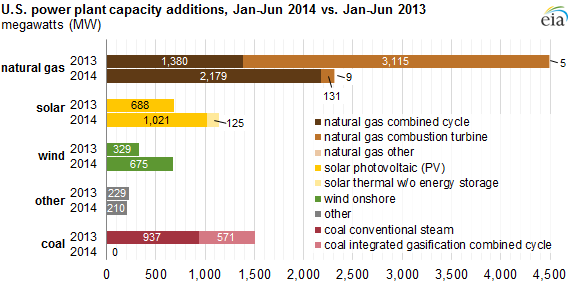 |
| Source: U.S. Energy Information Administration, Electric Power Monthly, August 2014 edition with June 2014 data Note: Data include facilities with a net summer capacity of 1 MW and above only. |
Solar projects came in second, with 1,146 MW of new capacity coming online. Solar capacity is growing quickly, with an increase of almost 70% in new capacity added over the same period in 2013. Nearly 75% of this solar capacity is located in California, with most of the rest in Arizona, Nevada, and Massachusetts. Notably, the EIA's data only covers utility-scale projects; it omits most rooftop solar projects and any other solar capacity additions below 1 MW in size.
New wind capacity came in third, with 675 MW added. Most of the new capacity is sited in California, Nebraska, Michigan, and Minnesota.
Coal was notably absent from the ranks of new generating capacity added in the first half of 2014. New coal plants face steep headwinds in the form of environmental regulations and stiff competition against natural gas plants. EIA reports that only two coal plants are planned to come online in 2014.
As regulations and market forces shape the nation's energy mix, where will the new equilibrium be found -- and for how long?
Election 2012 and energy recap
Wednesday, November 7, 2012
With yesterday's general election behind us, people across the United States are considering its impact on energy policy. From President Obama's retention of the White House to state elections and ballot measures, voters have reshaped the energy landscape. Here are some highlights:
- President Obama wins reelection. Obama's win may mean "more of the same" when it comes to energy policy. President Obama has indicated support for increased domestic production of natural gas and oil, as well as for programs to encourage the development of renewable electric generation. While the U.S. Department of Energy remains under scrutiny for loan guarantees it offered companies like Solyndra, Obama's reelection likely means that the Department of Energy will not face as strong a shakeup as it would have under a President Romney. Still, many observers expect Secretary of Energy Steven Chu to be replaced. The U.S. Environmental Protection Agency will likely continue to develop regulations covering energy-related emissions such as ozone, coal ash, and sulfur from fuels. These regulations have effectively been on hold pending the election. EPA Administrator Lisa Jackson may continue to lead the agency. Likewise, Interior Secretary Ken Salazar has indicated his desire to remain Secretary of the Interior; in Obama's second term, the Department of the Interior is likely to continue its current course in leasing land for oil and gas production as well as for renewable energy production.
- Congress remains divided. At the federal level, Democrats held onto control of the Senate, while Republicans retained control in the House. The chambers' partisan nature may lead to gridlock, or at least to consensus-based, relatively moderate measures as the only kind of legislation likely to meet the approval of both chambers of Congress.
- Michigan rejects constitutional amendment on renewable energy. Michigan voters rejected a proposed amendment to the state constitution that would have increased the amount of renewable energy that utilities must buy to serve their customers. Proposition 3 would have required electric utilities to generate at least 25 percent of their annual retail sales of electricity from renewable energy sources by 2025. Only 36% voted in favor of the measure to increase the renewable portfolio standard, meaning the RPS initiative failed.
How Election 2012 affects energy policy
Tuesday, November 6, 2012
Today voters across the United States cast ballots in the 2012 general election. At stake are a broad range of political offices, ranging from the presidency to local municipal roles. How will the election's outcomes affect energy policy, energy-related businesses, and consumers?
The presidential contest has drawn the greatest attention over the past year. Whether President Obama will retain his office or Governor Romney will take the White House is the largest question. Based on the candidates' past actions and current campaign platforms, voters have some sense of how each would exercise his presidential powers. On energy issues, both candidates appear to favor increased domestic production of natural gas and oil. The candidates differ in their philosophies on the role of governmental incentives and subsidies -- whether for fossil fuel production or for renewable electricity generation -- and on emissions regulations for coal-fired and other power plants. The candidates also disagree on specific energy projects and programs ranging from the Keystone XL pipeline to the Navy's Great Green Fleet biofuels initiative.
Beyond the presidency, federal elections will determine the composition of Congress. While energy policy is more sensitive to presidential changes than to individual congressional elections, the makeup of Congress drives federal energy policy in the aggregate. All seats in the House of Representatives are up for grabs, as are a third of Senate seats. Of the 33 Senate seats, Democrats need to win 21 seats to retain their majority while Republicans need to win 14 seats to take control. The senators elected in 2012 will participate in setting any national energy policy.
State elections will also shape energy policy for the coming years. Voters will select governors in 11 states, and state legislative offices are widely contested. While federal energy policy draws the most attention, the U.S. federalist system leaves significant authority to individual states to set their own policies on energy issues. For example, states may establish electric renewable portfolio standards or otherwise regulate the resource mix used to produce usable energy. The outcomes of state elections will also affect policies on energy efficiency, smart meters and smart grid infrastructure.
Voters in some states will also cast ballots on measures directly affecting energy policy, such as the Michigan citizens' initiative seeking to increase utilities' use of electricity produced by renewable resources.
It may be some time until all the ballots are finally counted, but by tomorrow night we will have a better understanding of the results for most of the races and ballot questions. Those who can translate the election results into an understanding of future policies - and business opportunities - will have a leg up on the competition.
Will Michigan vote for renewable energy as a constitutional amendment?
Thursday, November 1, 2012
Voters will decide a broad slate of issues in the upcoming U.S. elections on November 6, including many that address energy policy. Questions range from who will serve as president to the role of government in managing the mix of energy resources used to power society. In several states, voters will decide whether to increase renewable energy mandates. One example of such a question is Michigan Proposal 3, a citizen-initiated ballot measure that would mandate that 25% of the state's electricity must come from renewable resources by 2025.
Under current law, Michigan's renewable portfolio standard requires electric suppliers to procure at least 10 percent of electricity from renewable sources such as wind, solar, hydro and biomass by 2015. If enacted, Proposal 3 would increase this RPS requirement to 25% by 2025, and limit the impact of the requirement on electric rates to no more than a 1% annual increase.
The official text of Proposal 3 reads:
The effort to place this question on the ballot has been led by a group called Michigan Energy, Michigan Jobs. Supporters project that the amendment would help the local economy by creating over 40,000 jobs and attract $10 billion in new investments, as well as promoting public and environmental health. Opponents, including a group called the Clean Affordable Renewable Energy for Michigan Coalition or (CARE) argue both that the increased renewable mandate would cost too much and that such a measure does not belong in the state constitution.
How will Michigan voters respond to this issue? We will find out within the next week.
Under current law, Michigan's renewable portfolio standard requires electric suppliers to procure at least 10 percent of electricity from renewable sources such as wind, solar, hydro and biomass by 2015. If enacted, Proposal 3 would increase this RPS requirement to 25% by 2025, and limit the impact of the requirement on electric rates to no more than a 1% annual increase.
The official text of Proposal 3 reads:
PROPOSAL 12-3
A PROPOSAL TO AMEND THE STATE CONSTITUTION TO ESTABLISH A STANDARD FOR RENEWABLE ENERGY
This proposal would:
Should this proposal be approved?
- Require electric utilities to provide at least 25% of their annual retail sales of electricity from renewable energy sources, which are wind, solar, biomass, and hydropower, by 2025.
- Limit to not more than 1% per year electric utility rate increases charged to consumers only to achieve compliance with the renewable energy standard.
- Allow annual extensions of the deadline to meet the 25% standard in order to prevent rate increases over the 1% limit.
- Require the legislature to enact additional laws to encourage the use of Michigan made equipment and employment of Michigan residents.
YES __
NO ____
The effort to place this question on the ballot has been led by a group called Michigan Energy, Michigan Jobs. Supporters project that the amendment would help the local economy by creating over 40,000 jobs and attract $10 billion in new investments, as well as promoting public and environmental health. Opponents, including a group called the Clean Affordable Renewable Energy for Michigan Coalition or (CARE) argue both that the increased renewable mandate would cost too much and that such a measure does not belong in the state constitution.
How will Michigan voters respond to this issue? We will find out within the next week.
June 29, 2011 - hydrokinetic energy recap
Wednesday, June 29, 2011
In the past week, I've taken a look at how the Federal Energy Regulatory Commission regulates the development of hydrokinetic energy projects -- powerplants that produce electricity from the movement of water in forms like waves, tides, or undammed rivers.
Here's a quick recap of what we saw:
 |
| A summer day at Preble Cove on Great Cranberry Island, Maine. |
- Intro to hydrokinetics: a description of hydrokinetics, and examples of projects
- Permits and licenses: what kind of federal energy approvals do projects need?
- Issued preliminary permits for inland projects: mostly on the lower Mississippi River, but also Alaska, Arizona, and Michigan
- Issued preliminary permits for marine projects: mostly North Atlantic tidal, some Pacific wave-based
- Pending applications for preliminary permits: almost all for lower Mississippi, but also riverine in NY and NJ, and tidal in NJ and Massachusetts
- Issued licenses for hydrokinetic projects: one riverine project operating, one Pacific wave project surrendered
- Pending applications for licenses: one Pacific wave, one Maine tidal
1/27/2010
Wednesday, January 27, 2010
US federal climate change legislation continues to brew on a back burner, although with last week's change to the Senate balance, the focus should be on enacting realistic measures that will provide a benefit but are politically viable. In addition to Martha Coakley, other losers may include the notion of a cap-and-trade mechanism, which even the lopsided Senate hinted it could not pass. We are more likely to end up with a watered-down bill that offers more carrots for good behavior than sticks raising the cost of "bad" behavior. (Think of increased incentives for efficiency upgrades, but not increased taxes on the rest of us who don't change our wicked ways.) Remember that in the meantime, EPA continues to move forward with its own administrative regulation of carbon emissions, which many consider likely to be more costly than any congressional action.
Following on yesterday's news of lackluster demand for wind turbines, Michigan (with 143 MW of installed wind capacity) and Minnesota (with 1,809 MW of wind) both report declines in the rate of new wind capacity being developed. (Meanwhile, China installed 12,000 MW of wind in 2009, nearly doubling its total wind capacity. The US added 9,000 MW in total.)
Subscribe to:
Posts (Atom)
