This week the U.S. Environmental Protection Agency issued a public notice relating to its Clean Power Plan, the agency's proposed rule to reduce carbon emissions from the nation's existing power plants. The notice reiterates questions raised by commenters about issues including the redispatch from coal- to natural gas-fired generation and near-term carbon reductions through 2029.
The Clean Power Plan imposes a federal carbon emissions rate (stated in pounds of carbon emitted per megawatt-hour of electric energy generated) for each state. The rule is designed to offer states flexibility in developing plans to achieve that level of carbon intensity, and features four proposed "building block" elements that states may choose to include in their program design: increased coal plant efficiency, increased utilization of natural gas plants, increased renewable energy, and increased energy efficiency. Collectively, EPA projects that by 2030 the Clean Power Plan's implementation will reduce power plant carbon emissions 30 percent below 2005 levels.
Since EPA published its proposal on June 18, 2014, the agency has held at least eight days of public hearings in four cities, attended by over 2,700 people, of whom nearly half spoke or otherwise weighed in. The draft Clean Power Plan was originally scheduled for public comment through October 16, but EPA extended the comment period by 45 days (until December 1, 2014) in response to both the volume of comments and numerous requests for additional time.
On October 28, EPA issued a notice of data availability related to the proposed Clean Power Plan. EPA routinely issues such a notice, or NODA, to provide the public with a targeted opportunity to consider and comment on emerging technical issues and data related to an ongoing rulemaking. EPA's Notice of Data Availability Related to the Proposed Clean Power Plan (PDF) provides additional information on several topics raised by
stakeholders and solicits comment on the information
presented. The three topics covered in the notice are the emission reduction
compliance trajectories created by the interim goal for 2020 to
2029, certain aspects of the building block methodology, and the
way state-specific carbon dioxide goals are calculated.
EPA's interim goals govern emission reductions over the 2020-2029 period, as states transition to energy resources with lower carbon intensity. Some stakeholders have expressed concern that, as proposed,
the interim goals do not provide enough flexibility for some
states which may be forced to rely
heavily on re-dispatch from fossil steam generation (e.g., coal-
, oil-, or gas-fired boilers) to natural gas combined cycle
units to achieve the required reductions, and that this effect of the interim goals
severely limits the opportunity to fully take advantage of the
remaining asset value of existing coal-fired generation -- particularly challenging with the threat of a "polar vortex" or other disruptive weather event. EPA requests comment on these interim goals and whether they afford suitable flexibility.
Stakeholders have also raised questions about the building blocks available to states as they design compliance programs. In particular, building block 2 focuses on shifting utilization from coal- and other fossil-fired steam power plants to more carbon-efficient natural gas combined cycle plants. Building block 3 focuses on renewable energy and nuclear power. In response, EPA requests comment on ways
that building block 2 could be expanded to include new natural gas combined cycle
units and natural gas co-firing in existing coal-fired boilers
and ways that state-level renewable energy targets could be set based on
regional potential for renewable energy.
Stakeholders have also noted concerns
with the way the state-specific carbon dioxide goals are calculated. These
include concerns that the numeric formula for calculating each
state's goal is not consistent in its application of the best
system of emission reduction (BSER) for each building block, and concerns with the use
of data for the single year 2012.
EPA's Clean Power Plan is now open for public comment through December 1, 2014.

Energy powers society; society's choices shape energy policy. A blog about our energy resources and the choices they present for society.
Showing posts with label combined cycle. Show all posts
Showing posts with label combined cycle. Show all posts

New generation in 2014 mostly gas, solar, wind
Wednesday, September 17, 2014
Most new power plants placed in service in the first half of 2014 are powered by natural gas, with new solar and wind capacity coming in second and third, respectively, according to the U.S. Energy Information Administration. Meanwhile, no new coal-fired electric generating capacity was added during that period.
From January through June 2014, EIA data shows the U.S. added 4,350 megawatts of new
utility-scale generating capacity. Combined-cycle natural gas plants contributed 2,179 MW of new capacity. Of this, over half is located at Florida Power & Light's Riviera Beach Next Generation Clean Energy Center in Florida. New combustion turbine plants added another 131 MW. In all, natural gas powers over 53% of new capacity coming online in the first half of 2014. Most of the nation has access to low cost natural gas, which offers significant environmental benefits over other fossil fuels like coal and oil.
Solar projects came in second, with 1,146 MW of new capacity coming online. Solar capacity is growing quickly, with an increase of almost 70% in new capacity added over the same period in 2013. Nearly 75% of this solar capacity is located in California, with most of the rest in Arizona, Nevada, and Massachusetts. Notably, the EIA's data only covers utility-scale projects; it omits most rooftop solar projects and any other solar capacity additions below 1 MW in size.
New wind capacity came in third, with 675 MW added. Most of the new capacity is sited in California, Nebraska, Michigan, and Minnesota.
Coal was notably absent from the ranks of new generating capacity added in the first half of 2014. New coal plants face steep headwinds in the form of environmental regulations and stiff competition against natural gas plants. EIA reports that only two coal plants are planned to come online in 2014.
As regulations and market forces shape the nation's energy mix, where will the new equilibrium be found -- and for how long?
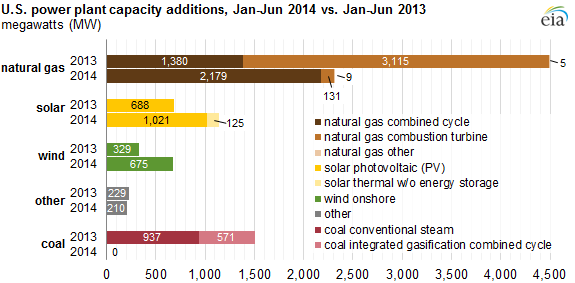 |
| Source: U.S. Energy Information Administration, Electric Power Monthly, August 2014 edition with June 2014 data Note: Data include facilities with a net summer capacity of 1 MW and above only. |
Solar projects came in second, with 1,146 MW of new capacity coming online. Solar capacity is growing quickly, with an increase of almost 70% in new capacity added over the same period in 2013. Nearly 75% of this solar capacity is located in California, with most of the rest in Arizona, Nevada, and Massachusetts. Notably, the EIA's data only covers utility-scale projects; it omits most rooftop solar projects and any other solar capacity additions below 1 MW in size.
New wind capacity came in third, with 675 MW added. Most of the new capacity is sited in California, Nebraska, Michigan, and Minnesota.
Coal was notably absent from the ranks of new generating capacity added in the first half of 2014. New coal plants face steep headwinds in the form of environmental regulations and stiff competition against natural gas plants. EIA reports that only two coal plants are planned to come online in 2014.
As regulations and market forces shape the nation's energy mix, where will the new equilibrium be found -- and for how long?
Gila River Power, FERC enforcement settle for $3.4 million in market manipulation case
Wednesday, November 21, 2012
Federal regulators have amped up their investigations of businesses involved in U.S. energy markets in recent years. This week the Federal Energy Regulatory Commission (FERC) approved a settlement between its Office of Enforcement and Gila River Power LLC over market manipulation claims, requiring Gila River to pay a punitive fine of $2.5 million, and disgorge unjust profits of $911,553 plus interest. Notably, this settlement represents the first time that a market participant accused of manipulating power markets has admitted to unlawful energy trades.
Gila River is a subsidiary of Entegra Power Group LLC. Entegra owns and operates four combined cycle power plants capable of producing about 3,300 MW of power. Two of these plants are located at the 2,200 MW Gila River Power Station in Arizona, while the other four are located at the Union Power Station in Arkansas. Entegra markets energy from these facilities to customers in the southeastern and southwestern U.S.
In the settlement agreement, Gila River admitted to using energy transactions known as "wheeling-through transactions" between July 2009 and October 2010 to manipulate prices in markets operated by the California Independent System Operator. Because congestion on the transmission grid limited both the amount of power Gila River could import into California as well as the price it could get for that power, the company designed its transactions to avoid creating congestion so that it would receive a higher price on a higher quantity of energy imports. This strategy involved claiming that it was simply passing power between two points outside California over transmission facilities located inside California, even though its transactions lacked a resource and a load outside the California markets as required by the CAISO tariff.
Under the FERC's enforcement procedures and penalty guidelines, the FERC assessed a base penalty amount based on its powers under the Federal Power Act, which allows it to levy fines of $1,000,000 per day for each violation. The FERC then considered mitigating factors, including Gila River's cooperation in the enforcement investigation and its acceptance of responsibility for its violations. Based on these factors, and negotiations between Gila River's legal counsel and the FERC's Office of Enforcement, the parties settled on a fine of $2.5 million, and disgorge unjust profits of $911,553 plus interest.
While the Gila River settlement represents the first time an accused company has admitted market manipulation, FERC has used its enforcement powers more extensively in recent years. In fiscal 2012, FERC approved nine settlement agreements entered into by Enforcement for total civil penalty payments of more than $148 million and disgorgement of more than $119 million plus interest.
Gila River is a subsidiary of Entegra Power Group LLC. Entegra owns and operates four combined cycle power plants capable of producing about 3,300 MW of power. Two of these plants are located at the 2,200 MW Gila River Power Station in Arizona, while the other four are located at the Union Power Station in Arkansas. Entegra markets energy from these facilities to customers in the southeastern and southwestern U.S.
In the settlement agreement, Gila River admitted to using energy transactions known as "wheeling-through transactions" between July 2009 and October 2010 to manipulate prices in markets operated by the California Independent System Operator. Because congestion on the transmission grid limited both the amount of power Gila River could import into California as well as the price it could get for that power, the company designed its transactions to avoid creating congestion so that it would receive a higher price on a higher quantity of energy imports. This strategy involved claiming that it was simply passing power between two points outside California over transmission facilities located inside California, even though its transactions lacked a resource and a load outside the California markets as required by the CAISO tariff.
Under the FERC's enforcement procedures and penalty guidelines, the FERC assessed a base penalty amount based on its powers under the Federal Power Act, which allows it to levy fines of $1,000,000 per day for each violation. The FERC then considered mitigating factors, including Gila River's cooperation in the enforcement investigation and its acceptance of responsibility for its violations. Based on these factors, and negotiations between Gila River's legal counsel and the FERC's Office of Enforcement, the parties settled on a fine of $2.5 million, and disgorge unjust profits of $911,553 plus interest.
While the Gila River settlement represents the first time an accused company has admitted market manipulation, FERC has used its enforcement powers more extensively in recent years. In fiscal 2012, FERC approved nine settlement agreements entered into by Enforcement for total civil penalty payments of more than $148 million and disgorgement of more than $119 million plus interest.
Subscribe to:
Posts (Atom)
