Showing posts with label Nebraska. Show all posts

Southwest Power Pool to expand

Wednesday, November 19, 2014

The Federal Energy Regulatory Commission has largely accepted a proposal to expand the geographic footprint of the Southwest Power Pool, a regional power market that will soon include a significant portion of the Upper Great Plains.

Southwest Power Pool, Inc. (SPP) was founded in 1941 by a coalition of regional power companies interested in keeping an Arkansas aluminum factory supplied with power to meet critical defense needs.  Since 2004, SPP has been recognized by the FERC as a Regional Transmission Organization or RTO.  Today, SPP organizes and operates parts of the electric power grid in nine states: Arkansas, Kansas, Louisiana, Mississippi, Missouri, Nebraska, New Mexico, Oklahoma, and Texas. 

On September 11, 2014, pursuant to section 205 of the Federal Power Act (FPA), SPP submitted to the FERC proposed revisions to its governing documents to facilitate the decision of three major transmission owners of the so-called Integrated System in the Upper Great Plains to join SPP.  The three proposed member-owners are:

  • Western Area Power Administration – Upper Great Plains Region: one of four regions of the United States Department of Energy's Western Area Power Administration. Western is a federal power marketing agency that markets federal power and owns and operates transmission facilities through 15 western and central states, encompassing a geographic area of 1.3 million square miles. Western ’s primary mission is to market federal power and transmission resources constructed with Congressional authorization. The federal generation marketed by Western is generated by power plants that were constructed by federal generating agencies, principally the Department of the Interior’s Bureau of Reclamation and the U.S. Army Corps of Engineers. In the Upper Great Plains Region , or Western - UGP, Western owns an extensive system of high - voltage transmission facilities and markets federally generated hydroelectric power in the Pick - Sloan Missouri - Basin Program - Eastern Division of Western.
  • Basin Electric Power Cooperative: serves 2.8 million customers in territories covering approximately 540,000 square miles using nearly 2,100 miles of transmission lines and 70 switch yards
  • Heartland Consumers Power District: a public corporation and political subdivision of the State of South Dakota. It provides wholesale power to 28 municipalities in eastern South Dakota, southwest Minnesota, and northwest Iowa, to six South Dakota state agencies, and to one electric cooperative in South Dakota.
These entities proposed to join SPP as transmission owning members, to place their respective transmission facilities under the functional control of SPP, and to begin taking transmission service under the SPP Tariff.  Their stated motivation was increasing market size and thus opportunities for both consumers and producers of energy.

By order dated November 10, 2014, the FERC accepted SPP's proposal.  Together, these new SPP members provide the backbone of the bulk electric transmission system across seven states in the Upper Great Plains region consisting of approximately 9,500 miles of transmission lines rated 115 kV through 345 kV.  The FERC order directed SPP to take certain interim steps, and SPP has announced plans to integrate the three new utilities by October 2015.

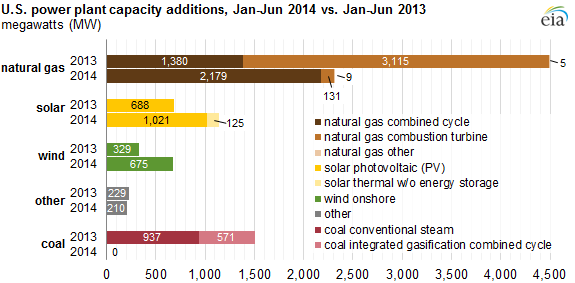
New generation in 2014 mostly gas, solar, wind

Wednesday, September 17, 2014

Most new power plants placed in service in the first half of 2014 are powered by natural gas, with new solar and wind capacity coming in second and third, respectively, according to the U.S. Energy Information Administration.  Meanwhile, no new coal-fired electric generating capacity was added during that period.

Source: U.S. Energy Information Administration, Electric Power Monthly, August 2014 edition with June 2014 data
Note: Data include facilities with a net summer capacity of 1 MW and above only.
From January through June 2014, EIA data shows the U.S. added 4,350 megawatts of new utility-scale generating capacity. Combined-cycle natural gas plants contributed 2,179 MW of new capacity.  Of this, over half is located at Florida Power & Light's Riviera Beach Next Generation Clean Energy Center in Florida.  New combustion turbine plants added another 131 MW.  In all, natural gas powers over 53% of new capacity coming online in the first half of 2014.  Most of the nation has access to low cost natural gas, which offers significant environmental benefits over other fossil fuels like coal and oil.

Solar projects came in second, with 1,146 MW of new capacity coming online.  Solar capacity is growing quickly, with an increase of almost 70% in new capacity added over the same period in 2013.  Nearly 75% of this solar capacity is located in California, with most of the rest in Arizona, Nevada, and Massachusetts.  Notably, the EIA's data only covers utility-scale projects; it omits most rooftop solar projects and any other solar capacity additions below 1 MW in size.

New wind capacity came in third, with 675 MW added.  Most of the new capacity is sited in California, Nebraska, Michigan, and Minnesota.

Coal was notably absent from the ranks of new generating capacity added in the first half of 2014.  New coal plants face steep headwinds in the form of environmental regulations and stiff competition against natural gas plants.  EIA reports that only two coal plants are planned to come online in 2014.

As regulations and market forces shape the nation's energy mix, where will the new equilibrium be found -- and for how long?