An organizational structure called Master Limited Partnerships has the potential to increase private-sector investment in clean energy. Master Limited Partnerships, or MLPs, benefit from a tax structure under which investors are taxed as partners but can trade their ownership stakes on securities exchanges much like corporate stock. Newly proposed federal legislation could extend this treatment to clean energy technologies.
MLPs offer their investors an attractive combination of tax advantages and liquidity. Profit from most publicly traded corporations is taxed twice, at both the corporate level and the shareholder level. By contrast, income from MLPs is taxed only at the shareholder level because it is treated as a partnership for tax purposes. Like Real Estate Investment Trusts or REITs, MLPs thus combine the tax benefits of a limited partnership with the liquidity of publicly traded securities.
Under federal law, MLP treatment is limited to enterprises generating at least 90 percent of their income from qualifying sources. These generally involve the use of natural resources, such as the production, processing or transportation of petroleum, natural gas, coal, timber, and other minerals. Since 1981, the use of the MLP structure has grown; estimates suggest that over 100 MLPs are currently being traded on major exchanges, with a total market valuation of about $445 billion.
Yesterday Congress introduced proposed bipartisan legislation that would extend this tax structure to clean energy technologies. The Master Limited Partnerships Parity Act, formally known as S.795: A bill to amend the Internal Revenue Code of 1986 to extend the publicly traded partnership ownership structure to energy power generation projects and transportation fuels, and for other purposes, is sponsored by Sen. Chris Coons, D-Del., along with co-sponsors Sens. Jerry Moran; R-Kan., Debbie Stabenow, D-Mich.; and Lisa Murkowski, R-Alaska. It has been referred to the Senate Committee on Finance.
The Master Limited Partnerships Parity Act would significantly broaden the scope of projects eligible for MLP treatment to include clean energy resources and infrastructure projects. These projects would include any energy technologies that qualify for the federal production tax credit or investment tax credit, such as wind, closed and open loop biomass, geothermal, solar, municipal solid waste, hydropower, marine and hydrokinetic, fuel cells, and combined heat and power. The bill would also open the MLP structure to advanced transportation fuels such as cellulosic, ethanol, biodiesel, and algae-based fuels, as well as energy-efficient buildings, electricity storage, carbon capture and storage, renewable chemicals, and waste-heat-to-power technologies.
Proponents hope that the act would stimulate investment in clean energy projects much as it has worked for other extractive natural resource infrastructure. At the same time, concern over the federal budget calls for serious consideration of measures that would reduce federal tax revenues. So far, the bill seems to have broad support and little outspoken opposition. If enacted, it could lead to an influx of investment capital into renewable and clean energy technologies.

Energy powers society; society's choices shape energy policy. A blog about our energy resources and the choices they present for society.

Funding to reduce barriers to marine, hydrokinetic energy
Tuesday, April 2, 2013
The U.S. Department of Energy has announced a competitive funding opportunity designed to support the growing marine hydrokinetic energy industry. $1.9 million is available for projects that will improve the collection and analysis of environmental monitoring and experimental data from marine hydrokinetic devices.
Marine hydrokinetic energy technologies capture the energy embodied in moving ocean water such as tides, currents, and waves. While the marine hydrokinetic industry is relatively young, at least one project has been licensed by the Federal Energy Regulatory Commission and built off the Maine coast. Research and development efforts are ongoing regarding a variety of marine hydrokinetic technologies and devices, and their environmental impacts continue to be studied.
The recently-announced federal funding aims to support that environmental evaluation. Working with the National Oceanographic Partnership Program, the Department of Energy's Office of Energy Efficiency and Renewable Energy Wind and Water Power Technologies Office has issued a Funding Opportunity Announcement entitled “Marine and Hydrokinetic (MHK) Environmental Effects Assessment and Monitoring.”
Under that Funding Opportunity Announcement, the Department of Energy offers $1.9 million in funding to be split by up to 11 recipients. Specific project areas include studies of fish behavior and mortality around hydrokinetic turbines, improved environmental monitoring of marine hydrokinetic projects, and predictive modeling of marine hydrokinetic projects' environmental impacts based on surrogate technologies with stressors and receptors similar to those expected from marine hydrokinetic technologies.
Under the competitive solicitation, the Department of Energy requested Letters of Intent to be submitted by 11:59 Eastern Time on April 18, 2013. Full applications, which must include specified documents, must be submitted by 5:00 PM ET on May 16, 2013. For more information, visit the Department of Energy's official Funding Opportunity Announcement website or contact Todd Griset at Preti Flaherty.
 |
| Looking east from Griffith Head, Reid State Park, Maine. Damariscove Island, a proposed offshore wind site, sits on the right horizon. |
Marine hydrokinetic energy technologies capture the energy embodied in moving ocean water such as tides, currents, and waves. While the marine hydrokinetic industry is relatively young, at least one project has been licensed by the Federal Energy Regulatory Commission and built off the Maine coast. Research and development efforts are ongoing regarding a variety of marine hydrokinetic technologies and devices, and their environmental impacts continue to be studied.
The recently-announced federal funding aims to support that environmental evaluation. Working with the National Oceanographic Partnership Program, the Department of Energy's Office of Energy Efficiency and Renewable Energy Wind and Water Power Technologies Office has issued a Funding Opportunity Announcement entitled “Marine and Hydrokinetic (MHK) Environmental Effects Assessment and Monitoring.”
Under that Funding Opportunity Announcement, the Department of Energy offers $1.9 million in funding to be split by up to 11 recipients. Specific project areas include studies of fish behavior and mortality around hydrokinetic turbines, improved environmental monitoring of marine hydrokinetic projects, and predictive modeling of marine hydrokinetic projects' environmental impacts based on surrogate technologies with stressors and receptors similar to those expected from marine hydrokinetic technologies.
Under the competitive solicitation, the Department of Energy requested Letters of Intent to be submitted by 11:59 Eastern Time on April 18, 2013. Full applications, which must include specified documents, must be submitted by 5:00 PM ET on May 16, 2013. For more information, visit the Department of Energy's official Funding Opportunity Announcement website or contact Todd Griset at Preti Flaherty.
USDA announces renewable and energy efficiency funding
Friday, March 29, 2013
The United States Department of Agriculture has announced a new round of funding for assistance to agricultural producers and rural small businesses for energy efficiency and renewable energy projects. USDA's Rural Energy for America Program (REAP) offers eligible farms and businesses incentives to improve their energy efficiency or produce energy from renewable sources.
USDA's mission includes revitalization of rural economies to create opportunities for growth and prosperity, support innovative technologies, identify new markets for agricultural producers, and make better use of natural resources. Authorized by the 2008 farm bill (formally the Food, Conservation, and Energy Act of 2008), the USDA REAP program's goals are to help agricultural producers and rural small businesses reduce energy costs and consumption and help meet the nation's critical energy needs. Through the end of the 2012 fiscal year, REAP has funded over 6,800 renewable energy and energy efficiency projects, feasibility studies, energy audits, and renewable energy development assistance projects.
Today USDA announced that it will accept applications for three REAP program categories:
Application requirements for REAP assistance vary depending on the type of assistance sought. Those interested in applying for assistance can contact their local USDA office for more information, or consult a professional with experience working with the REAP program.
Preti Flaherty helps our clients evaluate whether REAP assistance is a good match for their businesses; I have assisted my clients in securing REAP funding for their energy projects. Please contact us at 207-791-3000 for more information.
USDA's mission includes revitalization of rural economies to create opportunities for growth and prosperity, support innovative technologies, identify new markets for agricultural producers, and make better use of natural resources. Authorized by the 2008 farm bill (formally the Food, Conservation, and Energy Act of 2008), the USDA REAP program's goals are to help agricultural producers and rural small businesses reduce energy costs and consumption and help meet the nation's critical energy needs. Through the end of the 2012 fiscal year, REAP has funded over 6,800 renewable energy and energy efficiency projects, feasibility studies, energy audits, and renewable energy development assistance projects.
Today USDA announced that it will accept applications for three REAP program categories:
- Renewable energy system and energy efficiency improvement grant applications and combination grant and guaranteed loan applications until April 30, 2013
- Renewable energy system and energy efficiency improvement guaranteed loan only applications until July 15, 2013
- Renewable energy system feasibility study grant applications through April 30, 2013
Application requirements for REAP assistance vary depending on the type of assistance sought. Those interested in applying for assistance can contact their local USDA office for more information, or consult a professional with experience working with the REAP program.
Preti Flaherty helps our clients evaluate whether REAP assistance is a good match for their businesses; I have assisted my clients in securing REAP funding for their energy projects. Please contact us at 207-791-3000 for more information.
Linking North American carbon markets
Wednesday, March 27, 2013
As nations, states, and provinces establish carbon markets, there is considerable interest in establishing links between these markets. Two of North America's leading carbon markets - one overseen by the California Air Resources Board (CARB), the other by the Canadian province of Quebec - appear to be on track to link their cap-and-trade systems by January 1, 2014.
A 2006 California law known as AB 32, the Global Warming Solutions Act, established a greenhouse gas cap-and-trade program. The program covers major sources of greenhouse gas emissions in the California, including refineries, power plants, industrial facilities, and transportation fuels. CARB established regulations which set an enforceable greenhouse gas emissions cap. This cap will decline over time. The law requires covered entities to acquire allowances issued by CARB to cover their carbon emissions. These allowances are tradeable permits allowing the holder to emit a given amount of carbon dioxide or its equivalent.
Quebec joined the Western Climate Initiative (WCI) in April 2008, a group of American states and Canadian provinces that have decided to adopt a common approach toward addressing climate change. WCI's goals include the creation of a North American market for trading carbon emission rights. Each WCI member government first creates its own greenhouse gas emissions cap-and-trade system, then links to others through intergovernmental recognition agreements.
California and Quebec's programs are now in the process of linking up. According to a recently-issued CARB document, California and Quebec have been working together to ensure that both systems' operations are compatible and will work together and without disruption to California-covered entities.
According to the notice, linkage between California and Quebec will need to be effective as of January 1, 2014. In the interim, California and Quebec will hold a practice joint auction to test their auction platform, allow market participants to gain familiarity with the future procedures for a linked market, and to allow the jurisdictions to evaluate their readiness for the newly expanded market.
This linkage would not directly affect other North American carbon markets, such as the Regional Greenhouse Gas Initiative or RGGI market. RGGI represents an agreement by nine northeastern states to create a pooled carbon market. Other jurisdictions could join the RGGI market, and it is possible that the RGGI market could one day merge with the CARB and Quebec markets to form a broader North American carbon market. The linkage of the California and Quebec programs may serve as a test of the effectiveness of linking the various North American carbon markets.
Report: northeastern demand drives natural gas pipeline growth
Monday, March 25, 2013
A federal energy agency has highlighted the demand for natural gas in the northeastern United States. The U.S. Energy Information Administration's report shows that over half of U.S. natural gas pipeline projects installed in 2012 were in the Northeast region. Low-cost gas produced from the Marcellus shale formation, combined with increased demand for gas in the Northeast, are driving pipeline expansion - but significant bottlenecks remain, keeping New England's natural gas prices higher and more volatile than those in the rest of the country.
For the past several years, natural gas pipeline capacity in the U.S. has grown. According to EIA, overall investment in domestic natural gas pipeline capacity slowed in 2012, but the northeast United States was home to the majority of growth. Other than facilities for gathering, storing, and distributing natural gas, natural gas pipeline capacity expansions totaled $1.8 billion in capital expenditures in 2012, adding 4.5 billion cubic feet per day of new pipeline capacity and 367 miles of pipe.
Most projects placed in service in 2012 focused on removing constraints that blocked natural gas from the booming Marcellus shale gas from reaching markets in the Northeast. Northeastern pipe additions accounted for two-thirds of all new pipeline mileage placed service in 2012. These additions included large projects such as the Appalachian Gateway Project and the Sunrise Project, both of which are designed to transport natural gas from the Marcellus production zone to markets in the Northeast.
Despite this growth, the New England and New York markets still experience frequent pipeline constraints, meaning that inbound pipeline capacity is insufficient to transport enough gas to meet consumer demand many days per year. This results in not only volatile natural gas pricing in New England, but fundamentally higher prices for consumers. Because the price of natural gas in New England sets the price of electricity most of the time, the result is a double-whammy of high wholesale prices for both electricity and natural gas.
Further pipeline capacity expansions into New England could alleviate these bottlenecks, but it is unclear who will build the capacity or when it will occur. Until it does, New England will remain exposed to high and volatile prices for natural gas and electricity.
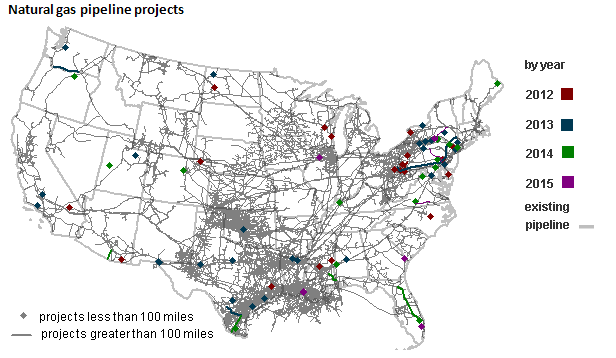 | ||
| Graphic courtesy of the U.S. Energy Information Administration, available at http://www.eia.gov/todayinenergy/detail.cfm?id=10511. |
For the past several years, natural gas pipeline capacity in the U.S. has grown. According to EIA, overall investment in domestic natural gas pipeline capacity slowed in 2012, but the northeast United States was home to the majority of growth. Other than facilities for gathering, storing, and distributing natural gas, natural gas pipeline capacity expansions totaled $1.8 billion in capital expenditures in 2012, adding 4.5 billion cubic feet per day of new pipeline capacity and 367 miles of pipe.
Most projects placed in service in 2012 focused on removing constraints that blocked natural gas from the booming Marcellus shale gas from reaching markets in the Northeast. Northeastern pipe additions accounted for two-thirds of all new pipeline mileage placed service in 2012. These additions included large projects such as the Appalachian Gateway Project and the Sunrise Project, both of which are designed to transport natural gas from the Marcellus production zone to markets in the Northeast.
Despite this growth, the New England and New York markets still experience frequent pipeline constraints, meaning that inbound pipeline capacity is insufficient to transport enough gas to meet consumer demand many days per year. This results in not only volatile natural gas pricing in New England, but fundamentally higher prices for consumers. Because the price of natural gas in New England sets the price of electricity most of the time, the result is a double-whammy of high wholesale prices for both electricity and natural gas.
Further pipeline capacity expansions into New England could alleviate these bottlenecks, but it is unclear who will build the capacity or when it will occur. Until it does, New England will remain exposed to high and volatile prices for natural gas and electricity.
Maine considers renewable feed-in tariff
Wednesday, March 20, 2013
The Maine legislature is set to consider a bill that would create a feed-in tariff for renewable energy. Maine already has a renewable portfolio standard and other incentives for investment in renewable power production. Will Maine add a feed-in tariff to the mix?
A feed-in tariff is a policy tool intended to encourage investment in renewable energy
technologies. Feed-in tariffs typically offer long-term contracts under which utilities purchase power fromrenewable energy producers at predictable prices, often based on the cost of generation of
each technology. Where feed-in tariffs exist, developers of renewable energy projects gain certainty about the revenues their projects will create. This certainty helps developers secure the financing they need to build projects.
A bill proposed by Maine state senator Christopher Johnson would require the state Public Utilities Commission to establish a renewable energy resources feed-in tariff program. An Act To Establish the Renewable Energy Feed-in Tariff, also known as LD 1085, has the stated purpose of encouraging the rapid and sustainable development of renewable energy resources and technology for environmentally healthy generation of electricity. Like feed-in tariffs in other jurisdictions, it would require that utilities purchase renewably produced electricity from all qualified suppliers. It would have the Public Utilities Commission set the rate that electric utilities must pay for such power at a level sufficient to provide revenues to operate and to attract necessary capital and investment for small renewable electric generators.
Qualified suppliers would be limited to certain small renewable electric generators. As defined in the bill, such generators would be limited to systems up to 500 kilowatts in size, that are majority owned by a person or entity that owns less than 500 kilowatts of electricity generating capacity in Maine, and that use solar photovoltaic panels or solar thermal or concentrating solar systems, generators fueled by methane from sewage treatment facilities, landfills or agricultural waste, generators fueled by combustion of biomass, tidal power projects, or wind energy.
Existing Maine law provides incentives for the generation of electricity from renewable resources. Like most states, Maine has a renewable portfolio standard which requires electricity suppliers to source a specified portion of their power from renewable generators. Maine also has a community-based renewable energy pilot program which functions like a feed-in tariff for eligible projects. A feed-in tariff would add another incentive to build relatively small (non-utility-scale) projects.
LD 1085 has not yet been scheduled for a public hearing. It will likely come before the Joint Standing Committee on Energy, Utilities and Technology later this spring.
 |
| The Maine State House, home to a consideration of feed-in tariffs. |
A bill proposed by Maine state senator Christopher Johnson would require the state Public Utilities Commission to establish a renewable energy resources feed-in tariff program. An Act To Establish the Renewable Energy Feed-in Tariff, also known as LD 1085, has the stated purpose of encouraging the rapid and sustainable development of renewable energy resources and technology for environmentally healthy generation of electricity. Like feed-in tariffs in other jurisdictions, it would require that utilities purchase renewably produced electricity from all qualified suppliers. It would have the Public Utilities Commission set the rate that electric utilities must pay for such power at a level sufficient to provide revenues to operate and to attract necessary capital and investment for small renewable electric generators.
Qualified suppliers would be limited to certain small renewable electric generators. As defined in the bill, such generators would be limited to systems up to 500 kilowatts in size, that are majority owned by a person or entity that owns less than 500 kilowatts of electricity generating capacity in Maine, and that use solar photovoltaic panels or solar thermal or concentrating solar systems, generators fueled by methane from sewage treatment facilities, landfills or agricultural waste, generators fueled by combustion of biomass, tidal power projects, or wind energy.
Existing Maine law provides incentives for the generation of electricity from renewable resources. Like most states, Maine has a renewable portfolio standard which requires electricity suppliers to source a specified portion of their power from renewable generators. Maine also has a community-based renewable energy pilot program which functions like a feed-in tariff for eligible projects. A feed-in tariff would add another incentive to build relatively small (non-utility-scale) projects.
LD 1085 has not yet been scheduled for a public hearing. It will likely come before the Joint Standing Committee on Energy, Utilities and Technology later this spring.
UAE opens first 100 MW solar project
Tuesday, March 19, 2013
The United Arab Emirates has recognized the start-up of its largest solar energy project to date.
The Shams 1 solar plant generates of electricity by concentrating solar thermal energy to vaporize a fluid into steam, which in turn spins a turbine. Shams 1 can produce up to 100 megawatts of power, making the project the world's largest concentrating solar power projects.
Concentrating solar power, or CSP projects, use mirrors to heat a working fluid and ultimately to produce steam. Shams 1 uses parabolic trough mirrors to focus the sun's energy on pipes full of a working fluid, while other concentrating solar projects focus mirrors on a central tower containing the working fluid. That working fluid's heat is then exchanged into water, which vaporizes into superheated steam. It is this steam that spins the turbine attached to an electric generator. Concentrating solar thermal projects differ from those using photovoltaic technology, in which the sun's energy is converted into direct current electricity using specialized semiconductors.
Shams 1 was developed by Shams Power Company PJSC, a special purpose vehicle owned 60% by UAE-owned Masdar and 40% by the Total Abengoa Solar Emirates Investment Company, a vehicle in turn jointly owned by Total (50%) and Abengoa (50%). These companies are said to have invested $600 million in building Shams 1.
With its commissioning, Shams 1 becomes the first utility-scale renewable power project in the UAE. Other first and "biggests" include the largest financing transaction for a solar power project (US$600 million) the largest operating single pure concentrating solar plant in the world.
UAE is blessed with energy resources. For years, interest has focused on its oil and gas production. Shams 1 is a small step toward resource diversification. Will UAE continue to invest in alternative and renewable energy?
Subscribe to:
Posts (Atom)
