Showing posts with label Principle Power. Show all posts

Maine offshore wind projects win federal grants

Wednesday, December 12, 2012

The U.S. Department of Energy has announced an award of funding to seven offshore wind Advanced Technology Demonstration projects totaling $168 million over six years.  These projects are designed to achieve large cost reductions over existing offshore wind technologies and develop viable and reliable options for the United States.  Waters off Maine will be home to two of the projects:

  • Statoil North America of Stamford, Connecticut plans to deploy four 3-megawatt wind turbines on floating spar buoy structures in the Gulf of Maine off Boothbay Harbor at a water depth of approximately 460 feet. These spar buoys will be assembled in harbor to reduce installation costs and then towed to the installation site to access the Gulf of Maine's extensive deep water offshore wind resources.

  • The University of Maine, based in Orono, plans to install a pilot floating offshore wind farm off Monhegan Island.  This project will feature two 6-megawatt direct-drive turbines on concrete semi-submersible foundations. These concrete foundations could result in improvements in commercial-scale production and provide offshore wind projects with a cost-effective alternative to traditional steel foundations.
Each project will receive up to $4 million to complete the engineering, site evaluation, and planning phase of their project.  Five other projects were also selected for this first phase:

  • Baryonyx Corporation, based in Austin, Texas, plans to install three 6-megawatt direct-drive wind turbines in state waters near Port Isabel, Texas. The project will demonstrate an advanced jacket foundation design and integrate lessons learned from the oil and gas sector on hurricane-resistant facility design, installation procedures, and personnel safety.

  • Fishermen's Atlantic City Windfarm plans to install up to six direct-drive turbines in state waters three miles off the coast of Atlantic City, New Jersey. The project will result in an advanced bottom-mounted foundation design and innovative installation procedures to mitigate potential environmental impacts. The company expects this project to achieve commercial operation by 2015.

  • Lake Erie Development Corporation, a regional public-private partnership based in Cleveland, Ohio, plans to install nine 3-megawatt direct-drive wind turbines on "ice breaker" monopile foundations designed to reduce ice loading. The project will be installed on Lake Erie, seven miles off the coast of Cleveland.

  • Seattle, Washington-based Principle Power plans to install five semi-submersible floating foundations outfitted with 6-megawatt direct-drive offshore wind turbines. The project will be sited in deep water 10 to 15 miles from Coos Bay, Oregon. Principle Power's semi-submersible foundations will be assembled near the project site in Oregon, helping to reduce installation costs. 

  • Dominion Virginia Power of Richmond plans to design, develop, and install two 6-megawatt direct-drive turbines off the coast of Virginia Beach on innovative "twisted jacket" foundations that offer the strength of traditional jacket or space-frame structures but use substantially less steel.
After the first phase, the DOE Wind Program will select up to three of these projects to advance the follow-on design, fabrication, and deployment phases to achieve commercial operation by 2017. These projects will be eligible for up to $47 million over four years, subject to congressional appropriations.

Floating offshore wind in US waters?

Monday, December 12, 2011

US coastal waters may soon see the development of floating offshore wind electric generating projects. Being able to install offshore wind turbines on floating platforms, as opposed to towers fixed to the seabed, may enable projects to tap into the vast deepwater ocean energy resource. This would represent a major step in history and technology, and could provide real data on the actual feasibility and costs of offshore wind in the United States.
The Cuckolds Light off Boothbay Harbor, Maine, with Seguin Island Light in the distance.

2012 may bring the deployment of North America's first floating offshore wind project. The DeepCWind Consortium and the University of Maine plan to test a floating wind turbine several miles off the Maine island of Monhegan next summer. The Monhegan project is designed as a pilot project, not a commercial effort. Nevertheless, the lessons learned off Monhegan could be used to shape a larger commercial project in 2013.

Historically, this project could be the first operating US offshore wind development. As 2011 closes, US waters still host neither operating commercial offshore wind projects, nor installed pilot projects of significant size. This is not for lack of interest. Universities and businesses are investing in offshore wind research and development, while developers eagerly pursue commercial projects in nearly all US jurisdictions. Commercial proposals range from projects fully permitted projects but unbuilt, to concepts still in the formation phase.

Technologically, a floating offshore wind project would demonstrate potential solutions to the engineering challenges posed by deep water sites. At least two floating turbines have recently been deployed around the world. The first, Statoil’s 2.3 megawatt Hywind unit, was installed off Norway in 2010. In November 2011, Portuguese utility Energias de Portugal (EDP) teamed up with Principle Power, Inc. to deploy a 2 megawatt turbine on a WindFloat platform off Portugal. The semisubmersible WindFloat design allows the unit to be towed in a horizontal position to the site, then erected without the use of a lift vessel. These test projects demonstrate some of the technologies required for deepwater offshore wind projects. A US project would represent a similar demonstration of new technology.

Floating offshore wind projects appear to have some momentum in Europe, and are poised to make a splash in US waters in the next year. Whether these efforts take hold depends on broader questions of economics and policy as much as on technology. What will 2012 bring?

June 25, 2010 - abandoned bridges, and paddling Merrymeeting Bay

Friday, June 25, 2010

Tidal thoughts today, following yesterday's E2Tech forum on ocean energy. E2Tech put on a great event, with speakers Beth Nagusky from state government, Des Fitzgerald of Principle Power, John Ferland of Ocean Renewable Power Company, and Bill Staby of Resolute Marine Energy. Thus all on one panel, we had developers of wind, tidal, and wave energy projects, plus a representative from the government.

Paddling back through time around the site of the former Merrymeeting Bay Bridge.

Gliding over Merrymeeting Bay

The Merrymeeting Bay Bridge was built in 1835 to connect Topsham with East Brunswick. Located near where the Androscoggin River flows into the Bay, the bridge provided a shortcut for commerce. Friends of Merrymeeting Bay have a great history page about the bridge. Bottom line: tolls barely exceeded maintenance costs, and the bridge was repeatedly and badly damaged by floods and ice. In 1896, the bridge was finally wiped out by the spring freshet, and was not rebuilt.

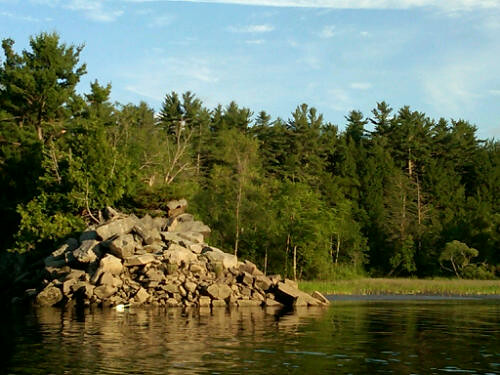
Today, you can still see the granite cribbing that was used to support the 24' wide wooden deck. Here's a shot of the stonework on the south side of Mustard Island:


Bay Bridge remains on the Bath side of Mustard Island

And on the north side:
Bay Bridge remains on the north side of Mustard Island

Right near this point, a very large fish (probably a striper or pike) roiled the water next to my boat, making a 48" diameter boil on the surface. Sturgeon were slapping down all around, and I flushed a great blue heron. There was also a splashy beaver.

Merrymeeting beaver

I'm interested in learning more about how it was decided to build the Bay Bridge back in the 1830s, and what it was like to spend an estimated $1 million in maintenance over 60 years on an asset that just barely broke even in a good year. I'll do some research, but I will be sure to return to the Bay for another firsthand look.

Mustard Island sandbar