BOEM issues Maine a floating offshore wind energy research lease

Monday, August 19, 2024

U.S. federal ocean regulators have announced the execution of a lease with the State of Maine for almost 15,000 acres located on the outer continental shelf offshore Maine. The Bureau of Ocean Energy Management calls the agreement "the nation's first floating offshore wind energy research lease." 

According to BOEM, the lease area includes approximately 14,945 acres, an area of sea sufficient to host up to 12 floating offshore wind turbines collectively capable of generating up to 144 megawatts of renewable energy. BOEM says the research lease will let Maine and stakeholders "conduct in-depth studies and thoroughly evaluate floating offshore wind as a renewable energy source" and "evaluate its compatibility with existing ocean uses and assess its potential effects on the environment, supply chains, and job creation."

BOEM issued the Maine lease through a process that began with the State's October 2021 application for a lease. In 2023, BOEM issued a Determination of No Competitive Interest for the area, enabling BOEM to issue Maine the lease. Maine has described the floating offshore wind research array as "a key priority for the State that will help fulfill the objectives of the Maine Offshore Wind Roadmap by advancing critical research and innovation to develop offshore wind responsibly."

As a research lease, the State of Maine or its designated operator Pine Tree Offshore Wind, LLC will engage in research regarding environmental and engineering aspects of the proposed project, to be made public and for use in informing future commercial-scale floating offshore wind projects in the region. According to BOEM, construction activity on the research array is not likely to occur for several years and will require additional permitting.

Maine PUC inquires into storm costs and grid resilience

Wednesday, August 14, 2024

Citing "increasing storm frequency and severity, and escalating storm restoration costs", Maine utility regulators have opened an inquiry to obtain information about the problem and how it could be addressed.

On July 25, 2024, the Maine Public Utilities Commission (PUC) issued a Notice of Inquiry in docket 2024-00191. According to that notice:

Maine is experiencing increasing storm frequency and severity, and escalating storm restoration costs. While utilities are developing their grid plans and doing the vulnerability assessments and preparing resiliency/mitigation plans, the Commission opens this inquiry to look for some shorter-term efforts to reduce the impact of storm damage to the system and study ways in which Maine’s electric utilities may more proactively address escalating storm costs.

The PUC's notice includes a list of questions and prompts for comment by September 4, 2024. Some questions ask how other states are addressing storm- and resilience-related costs. Others seek information on how Maine utilities might behave differently -- for example, leveraging data systems to prioritize resilience upgrades, shifting away from wood poles, or changing tree trimming protocols and other vegetation management programs. The questions also ask about what "resilience" means and how it can be quantified.

Under PUC practice, an inquiry is a relatively informal proceeding initiated by the PUC to gather information. After the PUC collects information through an inquiry, it can use what it learned to inform a subsequent adjudicatory proceeding (like an investigation) or a rulemaking. 

Outside this inquiry, a recently enacted law requires each of Maine's investor-owned transmission and distribution utilities to develop "a 10-year integrated grid plan designed to improve system reliability and resiliency and enable the cost-effective achievement of the State’s greenhouse gas reduction obligations and climate policies." The utilities must file their proposed grid plans by January 12, 2026.

A separate statute requires each utility to file a 10-year climate change protection plan that includes specific actions for addressing the expected effects of climate change on the utility's assets needed to transmit and distribute electricity to its customers. The first climate change protection plans were due on December 31, 2023, and must be updated every three years.

FERC Order 1920 reforms electric transmission planning

Tuesday, May 14, 2024

US electricity regulators have issued a major order addressing the nation's policy on regional planning of the electric transmission grid. The Federal Energy Regulatory Commission describes its Order No. 1920 as "the first time in more than a decade that FERC has addressed regional transmission policy – and the first time the Commission has ever squarely addressed the need for long-term transmission planning."

FERC adopted Order No. 1920 at its May 13, 2024 Open Meeting, by a vote of 2-1. Captioned "Building for the Future Through Electric Regional Transmission Planning and Cost Allocation", Order No. 1920 spans 1,364 pages

Issued in Docket No. RM21-17-000, the order adopts a final rule revising the Commission's pro forma Open Access Transmission Tariff (OATT) "to remedy deficiencies in the Commission's existing regional and local transmission planning and cost allocation requirements." As described by FERC, the order "finds that sufficiently long-term, forward-looking, and comprehensive regional transmission planning and cost allocation to meet long-term transmission needs is not occurring on a consistent and sufficient basis". According to FERC, this results in "piecemeal transmission expansion that addresses relatively near-term transmission needs" and "transmission providers investing in relatively inefficient or less cost-effective transmission infrastructure", causing customers to incur costs and miss benefits. This, according to the Commission, "in turn renders Commission-jurisdictional regional transmission planning and cost allocation processes unjust and unreasonable."

To remedy this problem, the order prescribes specific requirements that regional grid operators and transmission providers must follow in conducting long-term planning for regional transmission facilities and in allocating their costs. Among other reforms, it requires transmission operators to engage in long-term planning, with a 20-year time horizon, and a process for updates at least once every five years. It requires planners to consider seven specific categories of benefit, to determine whether a regional proposal will efficiently and cost-effectively address long-term transmission needs. These benefits are:

  1. avoided or deferred reliability transmission facilities and aging infrastructure replacement;
  2. either reduced loss of load probability or reduced planning reserve margin;
  3. production cost savings;
  4. reduced transmission energy losses;
  5. reduced congestion due to transmission outages;
  6. mitigation of extreme weather events and unexpected system conditions; and
  7. capacity cost benefits from reduced peak energy losses. 

The order includes provisions designed to "right-size" transmission facilities, by which FERC means considering cost-effective expansion to increase transfer capability, whenever replacement is needed. Incumbent transmission owners will have a right of first refusal to develop these "right-sized" transmission facilities.

Order 1920 also gives states key responsibilities in planning, selecting, and determining the cost allocation for transmission lines, while continuing to require that customers pay only for projects from which they benefit. It also creates a process giving states and interconnection customers the opportunity to fund some or all of the cost of a long-term regional transmission facilities that otherwise would not meet the transmission provider’s selection criteria. 

Commissioner Christie dissented, asserting that the order exceeds FERC's legal authority and fails to protect consumers. The order is set to take effect 60 days after its publication in the Federal Register. Order No. 1920 requires one set of compliance filings within 10 months of its effective date, with another round concerning interregional coordination due within 12 months of the effective date.

New England electric load to grow, grid operator says

Monday, May 6, 2024

Electricity consumption in New England will increase by about 17 percent over the next ten years, according to the regional grid operator, mostly due to the electrification of heating and transportation.

ISO New England tracks and projects power generation as well as consumer demand. Its 2024-2033 Forecast Report of Capacity, Energy, Loads, and Transmission (CELT Report) provides a ten-year look at projected power system characteristics. 

According to the grid operator, 2024 represents an inflection point in New England's electricity use, as the regional trend shifts from declining power consumption, back to significant growth. 


From 1995 to 2005, net annual energy use in New England grew steadily. ISO-NE attributes the growth primarily to "increased economic growth and the use of air conditioning". Since peaking in 2005 at 136,425 gigawatt-hours, net annual energy use in the region has generally decreased. ISO-NE attributes the reduction primarily to "an increase in energy efficiency from advanced cooling and heating technologies, energy-efficient appliances and lighting, and the increased prevalence of BTM solar generation."

Now, ISO-NE projects another reversal of this trend, as it forecasts "steady growth in net annual energy use as state policy goals for carbon emissions reductions drive the increased electrification of heating systems and transportation in the region." The grid operator projects that electric vehicles (EVs) "will account for 15,182 GWh of energy use in 2033, while heating electrification is expected to account for 7,996 GWh that year." After considering growth in behind-the-meter solar and efficiency measures, these projections represent an increase of about 17% in regional net annual energy use; meeting these needs will likely require significant new generating plants and transmission facilities.

ISO-NE also projects that the region will shift from summer-peaking to winter-peaking soon after 2033, due to heating electrification. Specifically, the grid operator expects winter demand to grow faster (3% annually under typical weather conditions) than summer demand (1%). 

ISO-NE notes that behind-the-meter solar power "does not reduce winter peak demand, because the peak typically occurs after sunset."

US proposes Gulf of Maine offshore wind site auction

Wednesday, May 1, 2024

The U.S. Department of the Interior has proposed the first offshore wind energy auction in the Gulf of Maine. The process has potential to advance the development of large-scale offshore wind projects in New England.

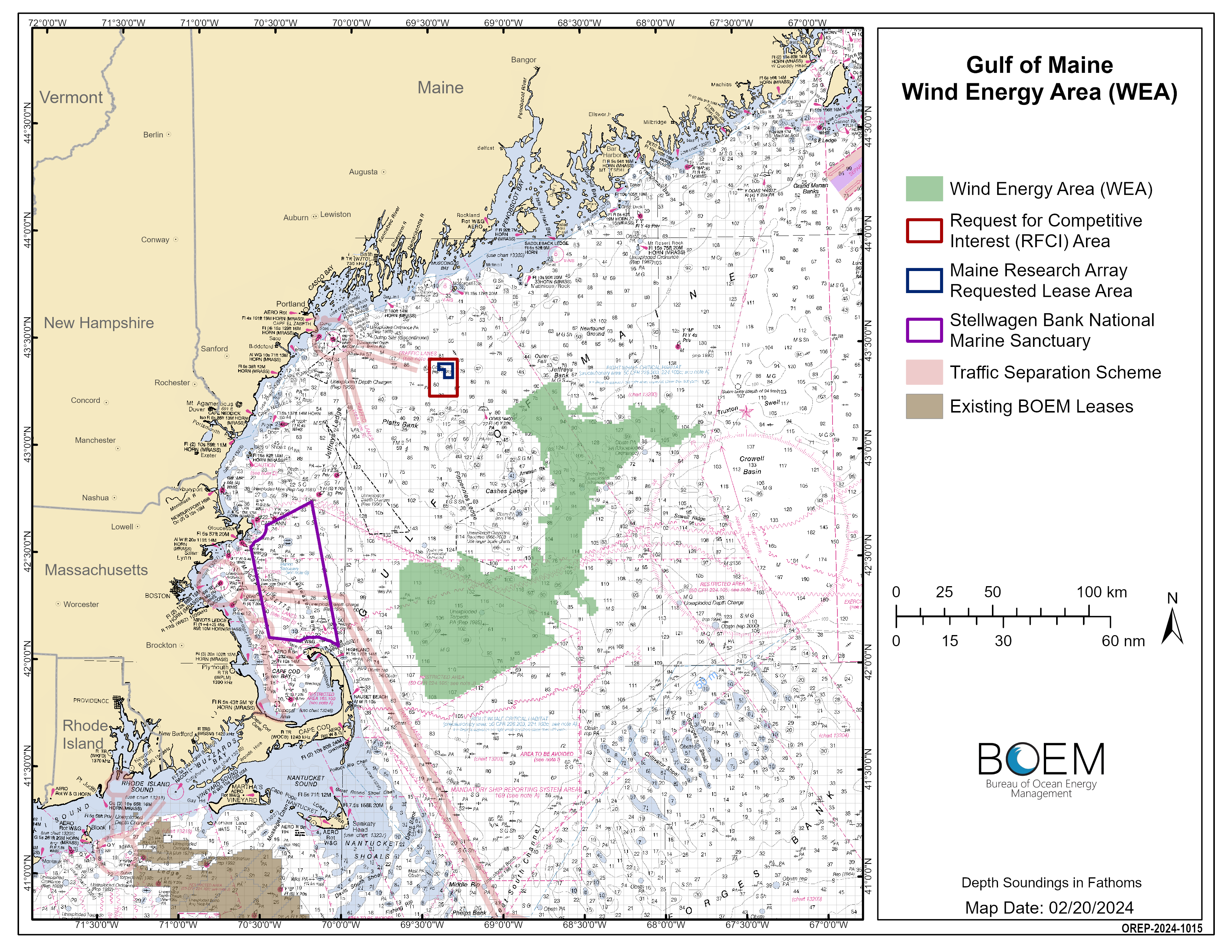
BOEM's Proposed Sale Notice for ATLW-11 appeared in the Federal Register on May 1, 2024. According to the Bureau of Ocean Energy Management, the proposed "Atlantic Wind Lease Sale 11 (ATLW-11)" would cover about one million acres of the Outer Continental Shelf offshore Maine, Massachusetts, and New Hampshire. BOEM plans to divide this zone into eight lease areas, which it says could collectively support about 15 gigawatts of offshore wind generation. 

BOEM selected these areas for leasing through a process that included a 2022 Request for Information (considering public comments and impacts to resources regarding a broader 13.7-million-acre area),  a 2023 Call for Information and Nominations, the 2024 identification of a Wind Energy Area (WEA) in the Gulf of Maine, and environmental reviews. 

BOEM says that in identifying the ATLW-11 areas for leasing, it "prioritized avoidance of offshore fishing grounds and identification of vessel transit routes, while retaining sufficient acreage to support the region’s offshore wind energy goals (13-18 GW based on information from Massachusetts, Maine, and ISO-New England)." For example, in response to requests from members of the fishing community, BOEM created three corridors between leases in the southern region of the Final WEA to facilitate existing and future transit through proposed lease areas.

According to BOEM, it has notified the following entities that their qualification is pending or that they are qualified to participate in any Gulf of Maine auction:

  • Avangrid Renewables, LLC
  • Equinor Wind US LLC
  • US Mainstream Renewable Power Inc
  • Diamond Wind North America, LLC
  • Hexicon USA, LLC
  • TotalEnergies SBE US, LLC
  • Pine Tree Offshore Wind, LLC
  • OW Gulf of Maine LLC
  • Repsol Renewables North America, Inc
  • Maine Offshore Wind Development LLC
  • Corio USA Projectco LLC

Any other entity wishing to participate in any Gulf of Maine auction must submit the required qualification materials to BOEM by July 1, 2024.

US announces offshore wind leasing schedule through 2028, finalizes Gulf of Maine area

Wednesday, April 24, 2024

The U.S. Department of the Interior has announced a schedule for up to 12 potential offshore wind energy lease sales through 2028, in Atlantic, Gulf of Mexico, Pacific, and territorial waters.

According to Interior, the new offshore wind leasing plan features the following schedule:

2024 Central Atlantic, Gulf of Maine, Gulf of Mexico, and Oregon 
2025 Gulf of Mexico 
2026 Central Atlantic 
2027 Gulf of Mexico and New York Bight 
2028 California, a U.S. Territory, Gulf of Maine, and Hawaii 

The Bureau of Ocean Energy Management, within the Interior Department, produced a visual-format schedule showing more detail on the estimated time range for each round of leasing.


To date, BOEM has held 12 offshore wind competitive lease sales resulting in the issuance of at least 26 leases

In support of planned leasing activity, BOEM recently finalized its designation of a Wind Energy Area (WEA) in the Gulf of Maine, capable of supporting 32 gigawatts of generation. The Gulf of Maine WEA covers about two million acres offshore Maine, Massachusetts, and New Hampshire, ranging from approximately 23 to 92 miles off the coast.


BOEM plans to hold a lease auction for sites within the Gulf of Maine WEA later this year.

Bourne tidal hydrokinetic project obtains FERC pilot project license

Tuesday, April 23, 2024

U.S. hydropower regulators have issued a pilot project license to the Marine Renewable Energy Collaborative of New England (MRECo) for its proposed Bourne tidal hydrokinetic energy project to be located on the Cape Cod Canal in Massachusetts.

MRECo describes itself as a nonprofit corporation that educates and involves all stakeholders (Academic, industry, governmental/regulatory, and public interest groups) to promote the sustainable development of renewable energy in New England ocean waters.

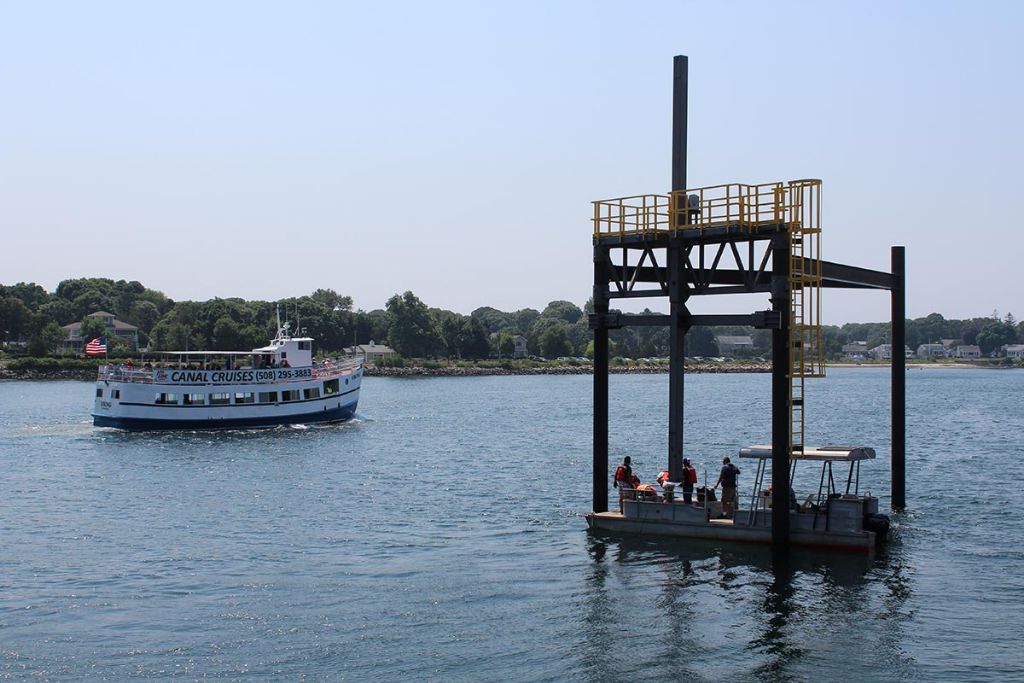
In 2023, MRECo applied to the Federal Energy Regulatory Commision for an 8-year pilot project license for the proposed Bourne Tidal Hydrokinetic Test Site Project. The 50-kilowatt project would include an existing steel platform (installed in 2017), an existing mounting pole, and a new tidal turbine-generator. According to the FERC order, MRECo plans to test various turbine-generator units at the project, including axial, cross flow, oscillating, conveyor, and Archimedes Screw turbine-generator units, but only one turbine-generator unit will be tested at a time. MRECo estimates that testing for any turbine-generator unit will occur for one to two months at a time, with three to four tests per calendar year.  

Photo from MRECo "Current Projects" website

The facilities will be located within the Army Corps-managed canal, less than a mile north of its southern entrance from Buzzards Bay. According to FERC, about 15,000 commercial vessels up to 825 feet in length use the canal each year. 

FERC issued the license under its hydrokinetic pilot project licensing process, a special procedure FERC uses "to meet the needs of entities, such as MRECo, who are interested in testing new hydropower technologies while minimizing the risk of adverse environmental impacts." FERC has described the goal of this process as "to allow developers to test new hydrokinetic technologies, to determine appropriate sites for these technologies, and to confirm the technology’s environmental and other effects without compromising the Commission’s oversight of the projects or limiting agency and stakeholder input."

As outlined in FERC staff’s 2008 white paper presenting the pilot project licensing process, a pilot project should be (1) small, (2) installed for a short term, (3) located in non-sensitive areas based on the Commission’s review of the record, (4) removable and able to be shut down on short notice, (5) removed, with the site restored, before the end of the license term (unless a new license is granted), and (6) initiated by a draft application in a form sufficient to support environmental analysis.

FERC found that these factors applied to the Bourne tidal project, and granted MRECo a pilot license for "an 8-year license term to allow it sufficient time to validate the efficiency of the project prior to applying for a longer-term license for the platform."