To generate electricity, humans rely on a variety of different technologies, ranging from burning coal to make steam, to combined-cycle natural gas turbines, to renewable resources like hydroelectricity and solar photovoltaics. Over time, the portfolio of energy resources upon which we rely may shift to less environmentally harmful assets.
For an example of how certain generation technologies may fall out of the generation mix, take the planned closing of the Salem Harbor Power Station. Located in Salem, Massachusetts (a city that sports solar photovoltaic-powered trash compactors on its sidewalks), this plant is one of several coal-fired power plants closing scheduled for the coming years. Since it started operations in 1951, the Salem Harbor Power Station has expanded and now generates 745 megawatts by burning coal and oil. Although the plant, currently owned by Dominion Resources, Inc. has increased its pollution control systems over the years, it was listed as one of the state’s “filthy five” dirtiest power plants in 2000, a hard reputation to shake. A study by Harvard University researchers at about the same time blamed the plant for 30 premature deaths annually, primarily due to air emissions.
Dominion, which purchased the plant in 2005, took steps to reduce emissions such as switching to lower the sulfur content of the coal burned there. However, the Salem plant has reportedly received $12 million in investments from Dominion since 2005—a marked contrast with the more than $1 billion Dominion invested into its 1,547 megawatt coal plant at Brayton Point in Somerset, Massachusetts.
As it is often the case, declining investments may result in the demise of production operations. Also, I have seen in similar context, the declining investments arise in part from declining economics that are to be seen at that facility. In the case of the Salem Harbor Power Station, the fact that Dominion could not shift the costs of new pollution controls to rate payers made further investment in the plant uneconomic. As a merchant generator in the ISO New England system, Dominion takes a market clearing price for its power, and thus cannot raise its rates over other resources to cover future increases in pollution control expenses.
The Salem Harbor Power Station is also a good example of how an increase in environmental regulation may lead to higher costs for certain kinds of generation units (in this case, coal-fired generation stations). Regulatory requirements to improve pollution control result in higher operational costs; these higher costs may in turn make even a relatively low fuel cost unit (such as coal) comparatively uneconomic. By comparison, once pollution controls are imposed on coal-burning units, the fact that renewable units such as wind or hydro or natural gas-fired units may not require such expensive pollution controls makes them relatively more economic.
Over time, it seems the balance has shifted, the generation mix will shift piece by piece as less economic units such as the Salem plant close, and new more economic units come online. Note that this does not always mean that the price of power goes down; rather, in this case, it is not that wind and hydro got cheaper, nor natural gas, but rather that the cost of coal now includes more expensive pollution control requirements, making it less economic. In 2009, coal fueled 12.8% of the New England portfolio; we shall soon see what 2010 has brought.
One other note on what happens if the Salem Harbor Station goes dark: ISO New England is now studying how to replace the plant, and true to its mission, is considering increasing transmission system upgrades in the region. This is an interesting example of how ISO New England focuses on transmission solutions — perfectly natural given its mandate — to replace a generation asset. While not all generation assets can be effectively replaced by transmission solutions, transmission between a remote generation resource and load may serve to replace at least some generation assets. Whether this will be correct in Salem remains to be seen. Within five years, the Salem station may be closed.

Energy powers society; society's choices shape energy policy. A blog about our energy resources and the choices they present for society.

November 29, 2010 - Cape Wind follow-up
Monday, November 29, 2010
In the wake of the Massachusetts DPU's approval of the Cape Wind contract with National Grid, interest in offshore wind technologies is growing. Under the deal, National Grid will buy half of Cape Wind’s output for a price that starts at 18.7 cents per kilowatt-hour, with a 3.5% annual escalator in each of the 15 contract years.
Today Motley Fool ran a piece noting potential winners from an increased belief that offshore wind is feasible and soon to be here. These winners include turbine manufacturers Vestas and Broadwind, as well as General Electric and Siemens. American Superconductor is pursuing technology to maximize the "power per tower" from offshore wind; its SeaTitan turbines are slated to produce more than 10 MW per turbine.
And don't forget my favorite search engine (though increasingly their business model relies on consumers seeing them as more than that): Google has already made the news for its involvement in energy markets. Now Google is investing in the underwater transmission lines needed to transmit power from offshore wind turbines to the mainland. Specifically, Google is eyeing a 350-mile line from Virginia to New Jersey, and may be interested in further projects to connect offshore generation to the onshore grid.
Today Motley Fool ran a piece noting potential winners from an increased belief that offshore wind is feasible and soon to be here. These winners include turbine manufacturers Vestas and Broadwind, as well as General Electric and Siemens. American Superconductor is pursuing technology to maximize the "power per tower" from offshore wind; its SeaTitan turbines are slated to produce more than 10 MW per turbine.
And don't forget my favorite search engine (though increasingly their business model relies on consumers seeing them as more than that): Google has already made the news for its involvement in energy markets. Now Google is investing in the underwater transmission lines needed to transmit power from offshore wind turbines to the mainland. Specifically, Google is eyeing a 350-mile line from Virginia to New Jersey, and may be interested in further projects to connect offshore generation to the onshore grid.
November 24, 2010 - Cape Wind approval order
Wednesday, November 24, 2010
Yesterday, I looked at the Massachusetts DPU's decision approving a 15-year power purchase agreement between Cape Wind and National Grid. Under the deal, National Grid will buy half of Cape Wind’s output for 18.7 cents per kilowatt-hour, with a 3.5% annual escalator in each of the 15 contract years.
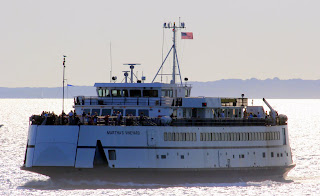 [Photo: the Martha's Vineyard ferry passes through Nantucket Sound, west of the Cape Wind site]
Right in the executive summary, the DPU presents its key finding: "that the Cape Wind contract is both cost-effective and in the public interest." As I read through the DPU's order, I was interested to see how the Department analyzed the facts to reach this finding. While the order resembles those approving contracts between utilities and more traditional generators, it diverged from these precedents in key ways including an analysis of how the contract would support the Commonwealth's renewable power standard and environmental goals.
For example, summarizing its analysis of cost-effectiveness, the DPU stated:
Another interesting section of the order was where the DPU found that this contract was cost-effective by comparison to other offshore wind projects. During the case, the Attorney General and Cape Wind each provided analyses comparing the costs and prices of the Cape Wind facility to a variety of operating and planned offshore wind projects here and abroad. Both the Attorney General and Cape Wind compared the power purchase agreement to that between Delmarva Power & Light Company and Bluewater Wind Delaware LLC for the output of its 200 MW offshore wind facility off Delaware. Analysis was also offered by the AG of the Deepwater Block Island LLC contract (28.8 MW proposed off Rhode Island) and (2) a un-named "domestic offshore wind project" whose information is protected by confidentiality.
After analysis, the DPU stated, "The various analyses performed by the Attorney General and Cape Wind demonstrate that the price terms of PPA-1 are reasonable compared to proposed offshore wind projects in the United States and to existing and proposed offshore wind projects abroad." The Order then compared Cape Wind's levelized price of $230 to the Bluewater levelized price of $230 and the Deepwater Block Island levelized price of $340.
Intuitively, that Deepwater came in with a higher price makes some sense. As the AG pointed out in the Cape Wind case, the nameplate capacity of the 28.8 MW project is just 6% of the capacity of Cape Wind's 468 MW, "presumably providing the Deepwater Block Island facility with fewer economies of scale".
If the Cape Wind order serves as precedent establishing the framework within which future renewable PPAs must fit, we have a lot to learn from the analysis in its 374 pages. Offshore wind developers and others interested in renewable projects who fit their projects into this framework may be better poised for regulatory approval.

Right in the executive summary, the DPU presents its key finding: "that the Cape Wind contract is both cost-effective and in the public interest." As I read through the DPU's order, I was interested to see how the Department analyzed the facts to reach this finding. While the order resembles those approving contracts between utilities and more traditional generators, it diverged from these precedents in key ways including an analysis of how the contract would support the Commonwealth's renewable power standard and environmental goals.
For example, summarizing its analysis of cost-effectiveness, the DPU stated:
As we have said, the price of the Cape Wind contract is $187 per MWh for 15 years, with a 3.5 percent annual escalator and opportunities for both upward and downward price adjustments depending on a variety of contingencies. Contrary to the assertions of some parties in the case, there are no additional transmission costs to customers beyond those that are already included in the contract price, and no costs of any significance to back up the addition to the regional electricity grid of an intermittent resource the size of Cape Wind.
On the other side of the ledger, the benefits associated with the Cape Wind contract include the value associated with the energy, capacity, and renewable energy credits that National Grid will purchase through the contract. In those years when the contract cost exceeds that value, National Grid customers will pay “above-market costs” for the Cape Wind contract. Based on the evidence presented, we believe the most likely range of above-market costs over the 15 years of the contract, including consideration of the price suppression effect, is from $420 million to $695 million.Thus the DPU asserts that over the life of the contract, National Grid's ratepayers will most likely pay $420 million to $695 million in above-market costs.
Another interesting section of the order was where the DPU found that this contract was cost-effective by comparison to other offshore wind projects. During the case, the Attorney General and Cape Wind each provided analyses comparing the costs and prices of the Cape Wind facility to a variety of operating and planned offshore wind projects here and abroad. Both the Attorney General and Cape Wind compared the power purchase agreement to that between Delmarva Power & Light Company and Bluewater Wind Delaware LLC for the output of its 200 MW offshore wind facility off Delaware. Analysis was also offered by the AG of the Deepwater Block Island LLC contract (28.8 MW proposed off Rhode Island) and (2) a un-named "domestic offshore wind project" whose information is protected by confidentiality.
After analysis, the DPU stated, "The various analyses performed by the Attorney General and Cape Wind demonstrate that the price terms of PPA-1 are reasonable compared to proposed offshore wind projects in the United States and to existing and proposed offshore wind projects abroad." The Order then compared Cape Wind's levelized price of $230 to the Bluewater levelized price of $230 and the Deepwater Block Island levelized price of $340.
Intuitively, that Deepwater came in with a higher price makes some sense. As the AG pointed out in the Cape Wind case, the nameplate capacity of the 28.8 MW project is just 6% of the capacity of Cape Wind's 468 MW, "presumably providing the Deepwater Block Island facility with fewer economies of scale".
If the Cape Wind order serves as precedent establishing the framework within which future renewable PPAs must fit, we have a lot to learn from the analysis in its 374 pages. Offshore wind developers and others interested in renewable projects who fit their projects into this framework may be better poised for regulatory approval.
November 23, 2010 - Cape Wind contract approved at 18.7 cents/kWh
Tuesday, November 23, 2010
Throughout 2010, I've been watching the Cape Wind project work its way through the development and regulatory processes. The project has generated controversy over a variety of issues, including siting (should the project be built in Nantucket Sound? if so, where?) and cost (should ratepayers be on the hook for a long-term power purchase agreement for the project's output? if so, at what price?). This latter issue falls under the jurisdiction of the Massachusetts Department of Public Utilities.
This week the DPU issued a decision approving a 15-year power purchase agreement between Cape Wind and National Grid. (The order itself is 374 pages.) Under the deal, National Grid will buy half of Cape Wind’s output for 18.7 cents per kilowatt-hour, with a 3.5% annual escalator in each of the 15 contract years. Some consumer advocates note that this is significantly higher than the most recent average annual wholesale power price in the region: 5.5 cents per kilowatt-hour. Proponents of the project point out that the 18.7 cent price includes the energy itself, capacity value, and renewable energy credits. A closer analysis of this suggests some flaws: the value of capacity plus renewable energy credits generally may not be worth the $132 per MWh price increase. Arguably the difference and that offshore wind has a social or intrinsic value that makes the price worth it.
The DPU acknowledged that the pricing is high:
If 18.7 cents seems high, it is among the lowest of the many of the recent proposed prices for offshore wind. It's worth noting that 18.7 cents per kWh is lower than the price set in previous proposed iterations of this contract. In May 2010, National Grid agreed to a deal at 20.7 cents per kWh (subject to DPU approval, which was withheld). The May proposal in turn was lower than the initial Deepwater Wind proposal off Rhode Island's Block Island, which proposed 24.4 cent per kWh power escalating 3.5% annually for 20 years to a final price of 48.6 cents per kWh. (And even that price was lower than the one Deepwater initially offered National Grid: 30.7 cents per kWh.)
The next step for Cape Wind is to look for a purchaser for the other half of its power. What kind of power purchase agreement will they find? If the DPU's approval of this contract establishes a pricing trend, we may see similar pricing in the second PPA.
This week the DPU issued a decision approving a 15-year power purchase agreement between Cape Wind and National Grid. (The order itself is 374 pages.) Under the deal, National Grid will buy half of Cape Wind’s output for 18.7 cents per kilowatt-hour, with a 3.5% annual escalator in each of the 15 contract years. Some consumer advocates note that this is significantly higher than the most recent average annual wholesale power price in the region: 5.5 cents per kilowatt-hour. Proponents of the project point out that the 18.7 cent price includes the energy itself, capacity value, and renewable energy credits. A closer analysis of this suggests some flaws: the value of capacity plus renewable energy credits generally may not be worth the $132 per MWh price increase. Arguably the difference and that offshore wind has a social or intrinsic value that makes the price worth it.
The DPU acknowledged that the pricing is high:
The power from this contract is expensive in light of today‖s energy prices. It may also be expensive in light of forecasted energy prices—although less so than its critics suggest. There are opportunities to purchase renewable energy less expensively. However, it is abundantly clear that the Cape Wind facility offers significant benefits that are not currently available from any other renewable resource. We find that these benefits outweigh the costs of the project.
One of the many benefits that Cape Wind provides is that it will assist National Grid and Massachusetts in meeting the renewable energy requirements of the Green Communities Act, as well as the greenhouse gas emissions reduction requirements of the Global Warming Solutions Act. Meeting those greenhouse gas emission mandates will require significant investments across all sectors of the economy, and especially from the electricity sector. We conclude that those requirements are unlikely to be met without the Cape Wind contract and the associated emissions reductions from the project.
If 18.7 cents seems high, it is among the lowest of the many of the recent proposed prices for offshore wind. It's worth noting that 18.7 cents per kWh is lower than the price set in previous proposed iterations of this contract. In May 2010, National Grid agreed to a deal at 20.7 cents per kWh (subject to DPU approval, which was withheld). The May proposal in turn was lower than the initial Deepwater Wind proposal off Rhode Island's Block Island, which proposed 24.4 cent per kWh power escalating 3.5% annually for 20 years to a final price of 48.6 cents per kWh. (And even that price was lower than the one Deepwater initially offered National Grid: 30.7 cents per kWh.)
The next step for Cape Wind is to look for a purchaser for the other half of its power. What kind of power purchase agreement will they find? If the DPU's approval of this contract establishes a pricing trend, we may see similar pricing in the second PPA.
November 23, 2010 - Twelve Mile Creek dam removal?
Whether a dam will be removed can depend on what's trapped behind it. Dams can trap a lot of sediment behind them, as solids carried downstream in a flowing river fall out into dams' impoundments as the flow backs up behind the dam. These sediments can add up to a huge volume of material. For example, on the Elwha River in Washington's Olympic Peninsula, where the Glines Canyon and Elwha dams are being removed, nearly 18 million cubic yards of sediment were trapped above the dams. That's a whole lot of sediment. (Picture a large gravel trailer passing you on the highway. Even if the truck can haul the weight, it's likely carrying less than 100 cubic yards, meaning it would take more than 180,000 truck trips to haul the sediment away.)
Sometimes the sediment trapped behind dams comes with an even heavier burden: toxic contaminants washed downriver from upstream sources. South Carolina's Twelve Mile Creek provides a vivid example of this hazard. From from 1955 to 1987, Sangamo Weston, Inc. owned and operated a capacitor manufacturing plant in Pickens, South Carolina. Waste and effluent including 400,000 pounds of polychlorinated biphenyls (PCBs) made its way (in part through direct discharges) to Town Creek and Twelve Mile Creek, a major tributary of the 56,000 acre Lake Hartwell (where Clemson, South Carolina is located). Sangamo Weston ultimately merged with Schlumberger. The area is now a Superfund site.
In 2006, a court ordered Schlumberger to take a variety of remedial actions, including paying $9 million in damages and removing two lower dams -- and possibly a third upstream dam owned by the Easley-Central Water District. It is this dam behind which some of PCB-laden sediments are now trapped. The question is not as much whether, but rather how much. Other sediments have made their way down into Lake Hartley; removal of the three dams is expected to allow cleaner sediments to flow down into Lake Hartwell where they are hoped to be able to cap the PCB-contaminated lake bottom. A study of this dam removal was approved earlier this year, but has yet to commence due to lack of funding.
If and when the dams in question are removed, what will happen to the sediment? Will it have downstream effects? PCB contamination can be serious, as seen in the Champlain Hudson Power Express transmission line's route jog to avoid PCB-contaminated sediments in the Hudson River. Recall that this PCB problem may have been exacerbated by dam removal: the 1970 removal of the Fort Edwards Dam on the Hudson River downstream of PCB-releasing General Electric factories allowed PCB-laden sediment to flow farther and more quickly downstream, resulting in one of the country's largest Superfund sites. By contrast, in Danville, Virginia, where the Brantley Dam is now targeted for removal, studies suggest a small enough volume of sediments (and a low enough toxics load) that dam removal may be feasible without requiring the kind of extensive sediment recovery that may be needed on Twelve Mile Creek.
Sometimes the sediment trapped behind dams comes with an even heavier burden: toxic contaminants washed downriver from upstream sources. South Carolina's Twelve Mile Creek provides a vivid example of this hazard. From from 1955 to 1987, Sangamo Weston, Inc. owned and operated a capacitor manufacturing plant in Pickens, South Carolina. Waste and effluent including 400,000 pounds of polychlorinated biphenyls (PCBs) made its way (in part through direct discharges) to Town Creek and Twelve Mile Creek, a major tributary of the 56,000 acre Lake Hartwell (where Clemson, South Carolina is located). Sangamo Weston ultimately merged with Schlumberger. The area is now a Superfund site.
In 2006, a court ordered Schlumberger to take a variety of remedial actions, including paying $9 million in damages and removing two lower dams -- and possibly a third upstream dam owned by the Easley-Central Water District. It is this dam behind which some of PCB-laden sediments are now trapped. The question is not as much whether, but rather how much. Other sediments have made their way down into Lake Hartley; removal of the three dams is expected to allow cleaner sediments to flow down into Lake Hartwell where they are hoped to be able to cap the PCB-contaminated lake bottom. A study of this dam removal was approved earlier this year, but has yet to commence due to lack of funding.
If and when the dams in question are removed, what will happen to the sediment? Will it have downstream effects? PCB contamination can be serious, as seen in the Champlain Hudson Power Express transmission line's route jog to avoid PCB-contaminated sediments in the Hudson River. Recall that this PCB problem may have been exacerbated by dam removal: the 1970 removal of the Fort Edwards Dam on the Hudson River downstream of PCB-releasing General Electric factories allowed PCB-laden sediment to flow farther and more quickly downstream, resulting in one of the country's largest Superfund sites. By contrast, in Danville, Virginia, where the Brantley Dam is now targeted for removal, studies suggest a small enough volume of sediments (and a low enough toxics load) that dam removal may be feasible without requiring the kind of extensive sediment recovery that may be needed on Twelve Mile Creek.
November 22, 2010 - Champlain Hudson Power Express
Monday, November 22, 2010
A recurring theme this year is that Hydro-Quebec has a large amount of hydroelectricity that it would like to sell us. In order to sell Canadian hydro on the scale HQ envisions, as an engineering fact more transmission lines need to be built. Of these, what is now called the Northern Pass transmission project - effectively a high-voltage DC line capable of carrying 1,200 MW of steady imports into the US - has received a lot of attention. This imported power would be primarily generated by HQ's extensive network of hydroelectric facilities -- with an installed capacity and available supply of over 42,000 MW.
Another similar HQ-inspired transmission project is proposed just west of New England: the Champlain Hudson Power Express, a 300-320 kV DC line, consisting of two 5-inch cables to be buried at a depth of 3 feet. One unique aspect of this HVDC project is that it will be entirely underwater and underground, buried three feet into the substrate.
The proposed route interconnects with a proposed $400 million line project in Quebec. (The Canadian side will be developed by TransÉnergie, which is Hydro-Québec's transmission business.) The route runs from the Richelieu River in Quebec, south through Lake Champlain. Then, to avoid stirring up PCB-contaminated sediment in the Hudson River, the route leaves the water and runs under railroad right of ways. The line will be developed by a private developer (called Transmission Developers, Inc.) supported by the Blackstone Group. Users of the line (primarily utilities using the line to transmit power, or large industrial users who buy their own power) will pay for it. The line developer says its analyses show New York ratepayers will save $8.1 billion on their electricity bills between 2015 and 2024, by providing less expensive Canadian renewable power, which will force older and less economic domestic generating units offline.
Will these lines be built as proposed? What will their effects be on power prices in the U.S.? What effects will the imports have on the development of renewable generation in New England? The answers to these questions remain to be seen. With its large surplus of generation over domestic load, we can be sure that Hydro-Quebec will remain open to selling us power for the foreseeable future -- but the cost of that power, in both cents per kilowatt-hour and in terms of societal impacts, may be hard to calculate.
Another similar HQ-inspired transmission project is proposed just west of New England: the Champlain Hudson Power Express, a 300-320 kV DC line, consisting of two 5-inch cables to be buried at a depth of 3 feet. One unique aspect of this HVDC project is that it will be entirely underwater and underground, buried three feet into the substrate.
The proposed route interconnects with a proposed $400 million line project in Quebec. (The Canadian side will be developed by TransÉnergie, which is Hydro-Québec's transmission business.) The route runs from the Richelieu River in Quebec, south through Lake Champlain. Then, to avoid stirring up PCB-contaminated sediment in the Hudson River, the route leaves the water and runs under railroad right of ways. The line will be developed by a private developer (called Transmission Developers, Inc.) supported by the Blackstone Group. Users of the line (primarily utilities using the line to transmit power, or large industrial users who buy their own power) will pay for it. The line developer says its analyses show New York ratepayers will save $8.1 billion on their electricity bills between 2015 and 2024, by providing less expensive Canadian renewable power, which will force older and less economic domestic generating units offline.
Will these lines be built as proposed? What will their effects be on power prices in the U.S.? What effects will the imports have on the development of renewable generation in New England? The answers to these questions remain to be seen. With its large surplus of generation over domestic load, we can be sure that Hydro-Quebec will remain open to selling us power for the foreseeable future -- but the cost of that power, in both cents per kilowatt-hour and in terms of societal impacts, may be hard to calculate.
November 17, 2010 - Boon Island offshore wind test site
Wednesday, November 17, 2010
In recent entries, I've been looking at potential development of Maine's offshore wind energy resources. For example, this week I've looked at the test wind site off Monhegan Island, to be developed by the DeepCWind Consortium. Back in August, I sailed past Damariscove Island, another of the three offshore wind test sites approved by Maine.
 [Photo: Damariscove Island, one of Maine's offshore wind energy test sites.]
Maine's third offshore wind test site will be the waters off Boon Island near York. (Boon Island is also the site of the shipwreck of the British freighter Empire Knight, whose sunken remains may contain over 8 tons of mercury, and possibly $200 million in copper-platinum wire.)
Boon Island is about 6 miles offshore of York. It's a notorious shipwreck site, and has been home to navigational aids for over 200 years. The current incarnation, Boon Island Light, is the tallest lighthouse in both Maine and New England at 133 feet in height; people on shore, as well as those at sea, can see its white beacon flash every 5 seconds. Boon Island Light and its predecessors have faced some powerful storms over the years, some of which have been damaging.
Back in December 2009, the waters off Boon Island were selected as an offshore wind energy test site. Unlike the Monhegan site, which will be developed by the DeepCWind consortium, the Boon Island offshore wind site is available for a commercial developer to build a test facility. As Maine's development of its offshore energy potential progresses, who will apply for the site license for Boon Island?

Maine's third offshore wind test site will be the waters off Boon Island near York. (Boon Island is also the site of the shipwreck of the British freighter Empire Knight, whose sunken remains may contain over 8 tons of mercury, and possibly $200 million in copper-platinum wire.)
Boon Island is about 6 miles offshore of York. It's a notorious shipwreck site, and has been home to navigational aids for over 200 years. The current incarnation, Boon Island Light, is the tallest lighthouse in both Maine and New England at 133 feet in height; people on shore, as well as those at sea, can see its white beacon flash every 5 seconds. Boon Island Light and its predecessors have faced some powerful storms over the years, some of which have been damaging.
Back in December 2009, the waters off Boon Island were selected as an offshore wind energy test site. Unlike the Monhegan site, which will be developed by the DeepCWind consortium, the Boon Island offshore wind site is available for a commercial developer to build a test facility. As Maine's development of its offshore energy potential progresses, who will apply for the site license for Boon Island?
Subscribe to:
Posts (Atom)
