New England's solar duck curve accelerates, deepens

Thursday, September 18, 2025

Continued installations of consumer-sited solar power have poised New England for a new record number of "duck curve" days, or periods when wholesale demand for grid electricity is lower during the middle of the day than during the night. The shift has consequences for the rest of the grid, including on the portfolio of other generating resources needed to meet demand, related emissions, and power pricing.

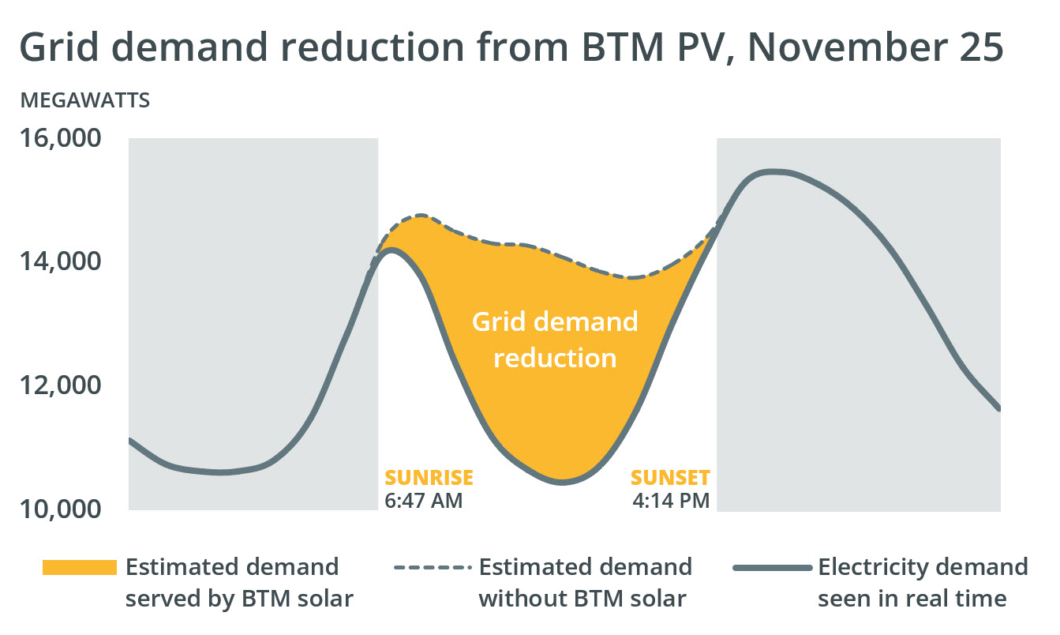
Historically, consumer demand for electricity has been highest during the day and lowest during the night, based on household, business, and other social patterns of energy use. But as behind-the-meter solar generation was added to the system, midday demand for grid power was reduced. On April 21, 2018 -- a mild sunny day on a spring weekend -- conditions combined to cause grid demand to be lower at midday than at night. Based on graphs showing grid demand reduction in yellow, such as the chart below produced by ISO New England, this phenomenon has become known as the "duck curve".


Since 2018, the duck curve phenomenon has become more frequent, as shown in this chart produced by ISO-NE.


In 2024, the region experienced 107 duck curve days -- a new record. So far in 2025, ISO-NE reports 100 duck days, with a projection to exceed last year's record by the end of December.

The "duck curve" is also reaching new depths of midday load. On April 20, 2025, system demand reached an all-time low of 5,318 megawatts -- which the grid operator projects to be less than half the level of load it would have seen without behind-the-meter solar.

With midday behind-the-meter solar producing power, other grid resources need to ramp down their production to keep supply and demand in balance -- and then need to ramp back up as midday sun fades. This requires the grid operator to ensure a sufficient volume of dispatchable generation capable of responding to these shifts, like natural gas-fired power plants (or large volumes of energy storage which have not yet materialized in the region).

Competing tensions around Revolution Wind

Monday, August 25, 2025

Federal regulators have issued a stop-work order to the developer of an offshore wind project under construction off Rhode Island and Connecticut, to allow the agency to address concerns about national security and interference with reasonable uses of the ocean over the U.S. outer continental shelf. The developer says it is "evaluating all options to resolve the matter expeditiously". Meanwhile, the regional electric grid operator says that delaying the wind project's completion "will increase risks to reliability" and could harm New England's economic growth, including potential future data centers.

Revolution Wind, LLC is developing a 704-megawatt offshore wind farm about 15 nautical miles south of Point Judith, Rhode Island, about 12 miles southwest of Martha's Vineyard, and about 32 nautical miles southeast of Connecticut. The project is a 50/50 joint venture between Orsted and an affiliate of Global Infrastructure Partners. According to the developer, the project is fully permitted and started construction last year; project construction is now 80% complete, with all offshore foundations now in place, and 45 wind turbines installed (out of a total of 65). The project has 20-year power purchase agreements in place to deliver 400 MW of electricity to Rhode Island and 304 MW to Connecticut.

On August 22, 2025, BOEM's Acting Director Matthew Giacona issued a Director's Order to Revolution Wind, ordering it to halt all ongoing activities on the outer continental shelf related to the project. The order cites the January 20, 2025 Presidential Memorandum withdrawing all lands on the outer continental shelf from wind leasing, saying the agency needs time to address concerns during its review. Specifically, the order says "BOEM is seeking to address concerns related to the protection of national security interests of the United States and prevention of interference with reasonable uses of the exclusive economic zone, the high seas, and the territorial seas, as described in that subsection of OCSLA."

In a press release, Orsted said that it is evaluating all options to resolve the matter expeditiously. This includes engagement with relevant permitting agencies for any necessary clarification or resolution as well as through potential legal proceedings, with the aim being to proceed with continued project construction towards COD in the second half of 2026.

Regional electricity grid operator ISO New England issued a statement on August 25, expressing concerns that grid planning relies on the assumption that Revolution Wind will be online and producing power in 2026. According to ISO-NE, "Delaying the project will increase risks to reliability." 

The remainder of the grid operator's statement is voiced generally, as opposed to project-specific. Citing rising demand for power and the need to maintain adequate generating capacity to meet demand, the grid operator noted that "delays in the availability of new resources will adversely affect New England’s economy and industrial growth, including potential future data centers." Moreover ISO-NE warned, "Unpredictable risks and threats to resources—regardless of technology—that have made significant capital investments, secured necessary permits, and are close to completion will stifle future investments, increase costs to consumers, and undermine the power grid’s reliability and the region’s economy now and in the future."

TVA, Google and Kairos Power to collaborate through nuclear PPA

Tuesday, August 19, 2025

The Tennessee Valley Authority, Google, and nuclear reactor developer Kairos Power have announced agreements to collaborate on the development of a new small modular nuclear power plant in Tennessee, designed to provide power to the TVA grid to support Google data centers in Tennessee and Alabama.

Congress created the TVA in 1933 as a public power provider assigned to improve living standards. TVA cites energy, environmental stewardship, and economic development as three essential components of how it achieves its mission.

Kairos Power is a nuclear technology, engineering and manufacturing company focused on commercializing a fluoride salt-cooled high-temperature reactor. Its Hermes demonstration small modular nuclear reactor is the first non-water-cooled reactor to be approved for construction in the U.S. in over 50 years. Construction on the Hermes project commenced last year.

Technology companies, data center operators, and businesses involved with artificial intelligence (AI) are investing heavily to secure energy supplies for their operations. New demands for electricity are driving existing powerplants to stay in operation, or even restart after being mothballed like the Three Mile Island nuclear plant whose owner proposes to resume fission to power a Microsoft data center. 

These same trends are also driving proposals to site new power plants, including small modular reactors (SMR). In October 2024, Google announced a collaboration with Kairos Power to deploy up to 500 MW of new nuclear power from SMRs to support Google's tech operations.

Interest in using SMRs to power data centers continues. On August 18, Google, Kairos Power, and TVA announced a new power purchase agreement between Kairos and TVA, under which Kairos will increase the output of its Hermes 2 plant from 28 to 50 MW. Google will receive the clean energy attributes from the plant. According to TVA, it is the "the first U.S. utility to sign a PPA to buy electricity from an advanced, GEN IV reactor".

Pumped storage hydro in Maine

Wednesday, August 13, 2025

Could a large pumped storage hydroelectric facility be developed in Maine? A company named Western Maine Energy Storage, LLC has applied to federal hydropower regulators for a preliminary permit to evaluate the potential development of a 500 megawatt pumped storage facility above the Androscoggin River in the Dixfield area.

Historically electricity has been easier to generate than to store. Hydropower typically harvests energy from water flowing or falling downhill under gravity's influence. If water in a hydroelectric system can be pumped back uphill, it can be stored in an upper reservoir and then reused to generate additional electricity. This technology was first used in Europe in the late nineteenth century, and remains the dominant form of electric energy storage today. Pumped storage hydropower facilities presently account for nearly all of the utility-scale energy storage capacity in the U.S.: about 96% as recently as 2023.

Modern pumped storage hydropower plants typically move water between an upper reservoir and a lower reservoir, using lower-cost electricity for the uphill pumping phase of the cycle. Pumping water uphill to recharge an upper reservoir takes energy, but most of this energy can be recovered on demand by allowing the water to flow back downhill through the generators. According to the Federal Energy Regulatory Commission, several dozen pumped storage projects are constructed and in operation in the U.S., with a total installed capacity of over 16,500 megawatts.

As part of the ongoing energy transition, many policymakers and investors are focused on technologies like battery energy storage, but pumped storage hydropower has a long track record of success -- and significant potential for growth. Most pumped storage generators in the U.S. were built during the 1970s, but a 2016 report by the U.S. Department of Energy found that the US could add 36 gigawatts of pumped storage by 2050.

Western Maine Energy Storage's application to the Federal Energy Regulatory Commission describes a proposed project located primarily in Dixfield, Maine (with a portion in the adjacent town of Canton). The upper reservoir would be located just below the crest of Colonel Holman Mountain; the lower reservoir would be in the adjacent Ludden Brook watershed. The project would draw its initial fill water from the Androscoggin River at a site near the Dixfield-Canton boundary (delivered via a temporary 2-mile pipe), but would then shift to closed-loop operation (using groundwater wells for reservoir level maintenance). The project would have about 500 MW of generating capacity (two units of about 200-250 MW each). The applicant says it expects to spend about $6 million studying the project’s feasibility if FERC grants it a 48-month preliminary permit. 

Maine is not presently home to any pumped storage hydropower projects, but about 90 years ago the Passamaquoddy Tidal Power Project was proposed with features including pumped storage reservoirs and generators. The Quoddy project would have used tidal energy and pumping to transfer water uphill, to produce sustainable renewable energy. The project received significant support from President Franklin D. Roosevelt along with millions of dollars in funding from Congress, but was never completed. To learn more about the historic Passamaquoddy Tidal Power Project, read the book Moondoggle: Franklin Roosevelt and the Fight for Tidal-Electric Power at Passamaquoddy Bay by Mark C. Borton.

US tariffs on Canadian energy imports

Monday, February 3, 2025

President Trump has issued a series of executive orders, including orders imposing tariffs or duties on articles imported from Canada, and declaring a national energy emergency.

Under Section 2 of the Imposing Duties executive order, most imports from Canada are subject to a general 25% tariff . However, Section 2(b) applies a lesser 10% tariff to “energy or energy resources" as defined in section 8 of Executive Order 14156 of January 20, 2025 (Declaring a National Energy Emergency), and related Federal Register notices.

In turn, section 8 of the Declaring a National Energy Emergency executive order defines “energy” or “energy resources” to include:

  • crude oil
  • natural gas
  • lease condensates
  • natural gas liquids
  • refined petroleum products
  • uranium
  • coal
  • biofuels
  • geothermal heat
  • the kinetic movement of flowing water
  • critical minerals, as defined by 30 U.S.C. 1606 (a)(3).
These articles are subject to a 10 percent tariff pursuant to the Imposing Duties order. 

New England's regional energy market operator, ISO New England, issued a statement shortly after the tariffs took effect. According to the statement, ISO-NE is seeking guidance from the administration on what role it will have in implementing these tariffs, but "cannot speculate on what, if any, impact these actions will have on wholesale electricity prices or the level of imports into the region." 

ISO-NE also noted that in 2024, Canadian imports powered about 9 percent of New England's grid-served net energy for load.

NESCOE requests first ISO-NE LTTP RFP

Friday, December 20, 2024

In a move that could unlock significant new energy supplies for New England, a committee representing the six states has asked the region's electric grid operator to use a new process to solicit transmission capable of accommodating large amounts of new generation plants interconnected to the Maine grid.

The New England States Committee on Electricity (NESCOE) is a not-for-profit entity recognized by the Federal Energy Regulatory Commission (FERC) as a regional state committee. NESCOE represents the collective perspective of the six New England states in regional electricity matters. The organization typically focuses on two areas: resource adequacy and system planning and expansion.

For several years, NESCOE has been engaged with regional grid operator ISO New England to reform the region's longer-term transmission planning (LTTP) process. In an initial phase, in 2022 FERC approved a new process through which NESCOE may ask ISO-NE to perform system planning analyses that may extend beyond its usual 10-year planning horizon and that identify, at a high-level, transmission infrastructure necessary to meet a New England state’s energy policy, mandate, or legal requirement.

Meanwhile ISO and stakeholders continued to develop a second phase of reforms, which FERC accepted in July 2024. The second phase's reforms included a new "scenario-based" LTTP process. The second phase of LTTP reforms also creates a process to advance identified transmission upgrades into developable projects. It also includes a cost-allocation mechanism for those transmission improvements

On December 13, 2024, NESCOE submitted a request to ISO-NE, asking the grid operator to issue its first regional solution under this new LTTP process. NESCOE identified the following minimum scope for the first LTTP RFP:

 (1) a requirement to increase the Maine-New Hampshire interface capacity to at least 3,000 MW by 2035 and increase the Surowiec-South interface capacity to at least 3,200 MW by 2035; and

(2) a requirement to develop new infrastructure (e.g., substation) at Pittsfield, Maine that can accommodate the interconnection of at least 1,200 MW (nameplate) of onshore wind. Pittsfield should be used as the presumed location based on previous analysis, however, bidders may propose alternate locations which, based on their own expertise, bidders conclude would be more efficient and cost-effective.

(3) The required in-service date for both scope components is by 2035 unless a bidder can demonstrate supply chain issues that warrant a later in-service date. A strong preference should be given to bids with an in-service date by 2035, or as close as possible thereto recognizing supply chain constraint information bidders provide.

According to NESCOE, this scope includes "two equally important requirements that, when taken together, should result in improvements to the transmission system that will benefit consumers." 

Record-low inflation-adjusted natural gas prices, says EIA

Thursday, December 12, 2024

For the tenth time this year, natural gas at the U.S. benchmark "Henry Hub" pricing point has reached an all-time low in inflation-adjusted dollars, according to the federal Energy Information Administration.

Image source: U.S. Energy Information Administration

According to U.S. EIA, natural gas at the Henry Hub has recently reached all-time low pricing on an inflation-adjusted basis. EIA says gas at Henry Hub was priced at $1.21 per million British thermal units (MMBtu) twice last month, on November 8 and November 11, 2024. EIA called this pricing "an all-time low in inflation-adjusted dollars." 

These record low prices were just the latest in a series, as two earlier days in November had already seen record low inflation-adjusted prices for gas at the Henry Hub. Six more record-low inflation-adjusted prices occurred earlier in 2024, according to the energy agency.

EIA attributes the record-low prices to factors including robust supply and constraints on demand. EIA also notes that natural gas prices can be volatile, as "Henry Hub spot prices spiked to over $13/MMBtu in January due to well-below-normal temperatures across most of the United States."

Corporate nuclear power offers solicited

Wednesday, December 4, 2024

Tech company Meta Platforms Inc. has issued a request for proposals "to identify nuclear energy developers to help us meet our AI innovation and sustainability objectives — targeting 1-4 gigawatts (GW) of new nuclear generation capacity in the U.S."

In a statement on its sustainability blog, Meta expressed its views that nuclear power would help the company meet its objectives relating to both artificial intelligence and sustainability:

... we believe that nuclear energy can help provide firm, baseload power to support the growth needs of the electric grids that power both our data centers (the physical infrastructure on which Meta’s platforms operate) as well as the communities around them. ... At Meta, we believe nuclear energy will play a pivotal role in the transition to a cleaner, more reliable, and diversified electric grid.

Citing its experience helping the renewable energy industry develop, Meta says it is taking a similar approach to nuclear power: 

When we began engaging with the renewable energy industry more than a decade ago, the industry was scaling. Our early engagement with developers of renewable energy allowed Meta to design contracts that enable both Meta and our developer partners to achieve our respective goals. We want to work creatively with developers to structure an agreement that will similarly enable development of nuclear technology.

At the same time, Meta notes that nuclear power's needs are somewhat different from those of renewable projects, due to key technological, economic, and regulatory differences: 

Compared to renewable energy projects that we continue to invest in, such as solar and wind, nuclear energy projects are more capital intensive, take longer to develop, are subject to more regulatory requirements, and have a longer expected operational life. These differences mean we need to engage nuclear energy projects earlier in their development lifecycle and consider their operational requirements when designing a contract. And, as scaling deployments of nuclear technology offers the best chance of rapidly reducing cost, engaging with a partner across projects and locations will allow us to ensure that we can deploy strategically. An RFP process will allow us to approach these projects thoroughly and thoughtfully with these considerations in mind.

Meta's RFP is not directly available to the public. Instead, Meta's blog directs interested parties to complete a qualification intake form by January 3, 2025, with initial RFP proposals due on February 7. Meta says it will screen interested parties for their qualifications, including "developers with strong community engagement, development, and permitting, and execution expertise that have development opportunities for new nuclear energy resources – either Small Modular Reactors (SMR) or larger nuclear reactors." Meta says it will also require interested parties to execute a non-disclosure agreement before receiving Meta's Nuclear RFP.

Other tech companies are similarly pursuing nuclear energy projects to power datacenters, as are some utilities. Nuclear power is drawing renewed interest from other sectors too, like the military and even industrial manufacturers.

New England passes its 100th duck curve day of 2024

Tuesday, December 3, 2024

For the 100th time this year, demand for electricity from New England's power grid was lower at midday than overnight, a sign of significant growth in behind-the-meter solar photovoltaic power in recent years. Until 2018, this phenomenon -- called the "duck curve" due to the shape of graphs of demand -- had never occurred. But according to the region's grid operator, duck curve days will likely continue to recur.

ISO New England says that April 21, 2018 was the first day when "New Englanders used less grid electricity midday than while they were sleeping". Nearly two years later, by the spring of 2020, the duck curve phenomenon had appeared on seven days. By the end of 2021, it had occurred a total of 35 times.

The duck curve phenomenon has since gone from rare to common. The grid operator says there were "45 times in 2022 when demand for grid electricity was lowest during the day instead of at night." In 2023, New England experienced 73 duck curve days. Last year the region also set a new low for midday demand, thanks to mild temperatures, a holiday, and continued growth of behind-the-meter solar.

The duck curve trend has continued to spread. According to ISO-NE, "the region recorded its 100th 'duck curve' day of 2024 on Monday, November 25."

Graph from ISO-NE. Available at 100th ‘duck curve’ day marks New England solar power milestone - ISO Newswire

So far this year, the New England grid has also set a new record low for midday demand. 

The grid operator notes:

Duck curve days are becoming more frequent as more New England homeowners and businesses install solar power systems. But duck curves are not disruptive from a grid operations perspective. Staff in the ISO’s control room keep the entire system in balance by instructing the region’s other energy resources to decrease production when BTM PV output is high, and to increase production when BTM PV output is low. 

At the same time, this level of solar penetration requires flexibility from "the region's other energy resources", which must be technically capable of ramping up and down to follow load, as well as economically capable of sustaining commercial operations.

Small modular reactors and Maine's nuclear referendum law

Tuesday, November 12, 2024

Tech companies, datacenters, and industrial consumers are pursuing the development of small modular nuclear reactors (SMR), capable of producing stable amounts of carbon-free power at a distributed scale. 

Much smaller than a typical commercial or utility-scale nuclear power plant, SMRs are typically envisioned as varying in size from tens of megawatts up to hundreds of megawatts, with potential uses including power generation, process heat, desalination, or other industrial uses.

Utilities, tech companies and some other corporate energy consumers have signed deals or announced plans to pursue SMR development. In 2023, GE Hitachi Nuclear Energy announced that it had signed a contract with Ontario Power Generation and others to deploy a BWRX-300 SMR at the Darlington New Nuclear Project site. GE's press release called the Darlington deal "the first commercial contract for a grid-scale SMR in North America." 

That same year, materials science manufacturer Dow announced a joint development agreement with X-Energy Reactor Company, LLC "to demonstrate the first grid-scale advanced nuclear reactor for an industrial site in North America." The Dow project involves the installation of an Xe-100 SMR at one of Dow’s U.S. Gulf Coast sites, using funding from sources including the Department of Energy's Advanced Reactor Demonstration Program. 

Federal support for SMR development is both longstanding and bipartisan. The Department of Energy cites an unbroken heritage of support for SMRs since the late 1990s. Both President Obama and President Trump issued executive orders promoting the design and development of small modular nuclear reactors. Under the Biden administration, the U.S. Department of Energy has described advanced SMRs as "a key part of the Department’s goal to develop safe, clean, and affordable nuclear power options." Last month, the Energy Department offered up to $900 million in funding to support the initial domestic deployment of Generation III+ (Gen III+) SMR technologies.

Corporate interest in SMRs has continued, and maybe even grown. In October 2024, Dominion Energy Virginia announced that it had entered into a memorandum of understanding with Amazon "to explore innovative new development structures that would help advance potential Small Modular Reactor (SMR) nuclear development in Virginia." With federal energy regulators recently rejecting a separate plan to co-locate an Amazon data center behind-the-meter at the utility-scale Susquehanna nuclear plant, corporate buyer pressure may soon place an increased emphasis on developing new SMRs at datacenter sites, rather than siting datacenters at existing nuclear plants.

Might small modular reactors come to Maine? Maine's history with nuclear energy involves the now-decommissioned Maine Yankee plant, the continued storage of its spent nuclear fuel and radioactive reactor components, and public perceptions of nuclear power. As a result of this history, any Maine SMR project faces challenges including a law which requires approval by the state's voters through a statewide referendum before any nuclear reactor may be constructed. 

A law enacted in 1987 provides for "citizen participation in any decision to construct a nuclear power plant within the State." Now codified as Chapter 43 of Title 35-A of the Maine Revised Statutes, this law requires a statewide referendum asking voters to accept or reject construction of any proposed plant, through balloting on the following question: "Do you approve construction of the nuclear power plant proposed for (insert locations)?"

As interest in SMRs continues to grow, expect Maine to consider its 1987 nuclear referendum law, and whether change is appropriate to enable small modular nuclear reactor development in Maine.

New England natural gas market dynamics affected by constraints and changing supply mix

Thursday, October 31, 2024

Natural gas market dynamics vary across the U.S., according to the U.S. Energy Information Administration, with a key pricing hub in the Northeast showing both high prices and high price volatility due to constrained infrastructure and a changing supply mix.

According to EIA, natural gas is traded at about 200 pricing hubs across North America, with prices varying widely based on factors including location, weather conditions, proximity to supply, pipeline constraints and bottlenecks.

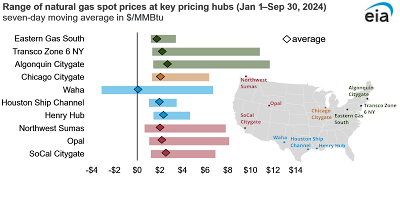
EIA produced the graphic below, showing the range of natural gas spot prices at seven key pricing hubs for the first nine months of 2024. It shows that the Algonquin Citygate pricing hub experienced the highest average price over this time period, as well as the highest spot price and the largest price volatility (or range of prices).

Chart source: U.S. Energy Information Administration

According to EIA: 
Algonquin Citygate is an important pricing hub in the northeastern United States, and prices at this hub reflect natural gas market dynamics in Boston, Massachusetts, and elsewhere in New England. New England relies heavily on natural gas for heating in the winter months, but supplies are constrained by the region’s limited natural gas pipeline capacity and changing fuel mix. Price volatility at Algonquin Citygate is typically related to these periods of peak demand.
As EIA notes, natural gas pipeline constraints contribute to high prices and price volatility in New England, particularly during the winter heating season.

Maine PUC awards biomass power contract

Tuesday, October 29, 2024

Maine utility regulators have voted to award a long-term contract to a biomass-fueled power plant proposed for development in northern Maine.

In 2022, the Maine legislature enacted a law directing the Public Utilities Commission to establish a wood-fired combined heat and power program. The law creates an opportunity for qualifying projects to compete for long-term contracts to sell electricity or renewable energy certificates to Maine's investor-owned transmission and distribution utilities. In 2023, the PUC solicited proposals, but the PUC ultimately found that none of the proposals submitted were eligible for contracting under the 2022 law.

In 2023, the legislature amended the procurement law to broaden program eligibility including with respect to size, net generating capacity, and location. The PUC issued a revised request for proposals under the amended law. 

Now, the PUC has selected a proposal by Ashland CHP LLC to sell the electricity generated by a new biomass-fueled facility to the local utility. According to the PUC, the facility would include about 17.75 megawatts of biomass power, with 15 megawatts of electricity offered into the program, and the remaining power used for heating.

In deliberations, Maine PUC commissioners encouraged the purchasing utility to "secure offtake for the project" and to "maximize the value of the energy from this project". Maine restructured its investor-owned utilities 25 years ago, to separate wires-owning utilities from deregulated generation and competitive retail supply. The restructured utility environment means that the utility has no natural need for power, so the utility typically resells its entitlements under power purchase agreements to other buyers. 

Gulf of Maine offshore wind lease auction scheduled

Monday, September 16, 2024

U.S. ocean energy managers will soon auction the right to lease about 850,000 acres offshore Maine, New Hampshire, and Massachusetts, according to a recent federal announcement. 

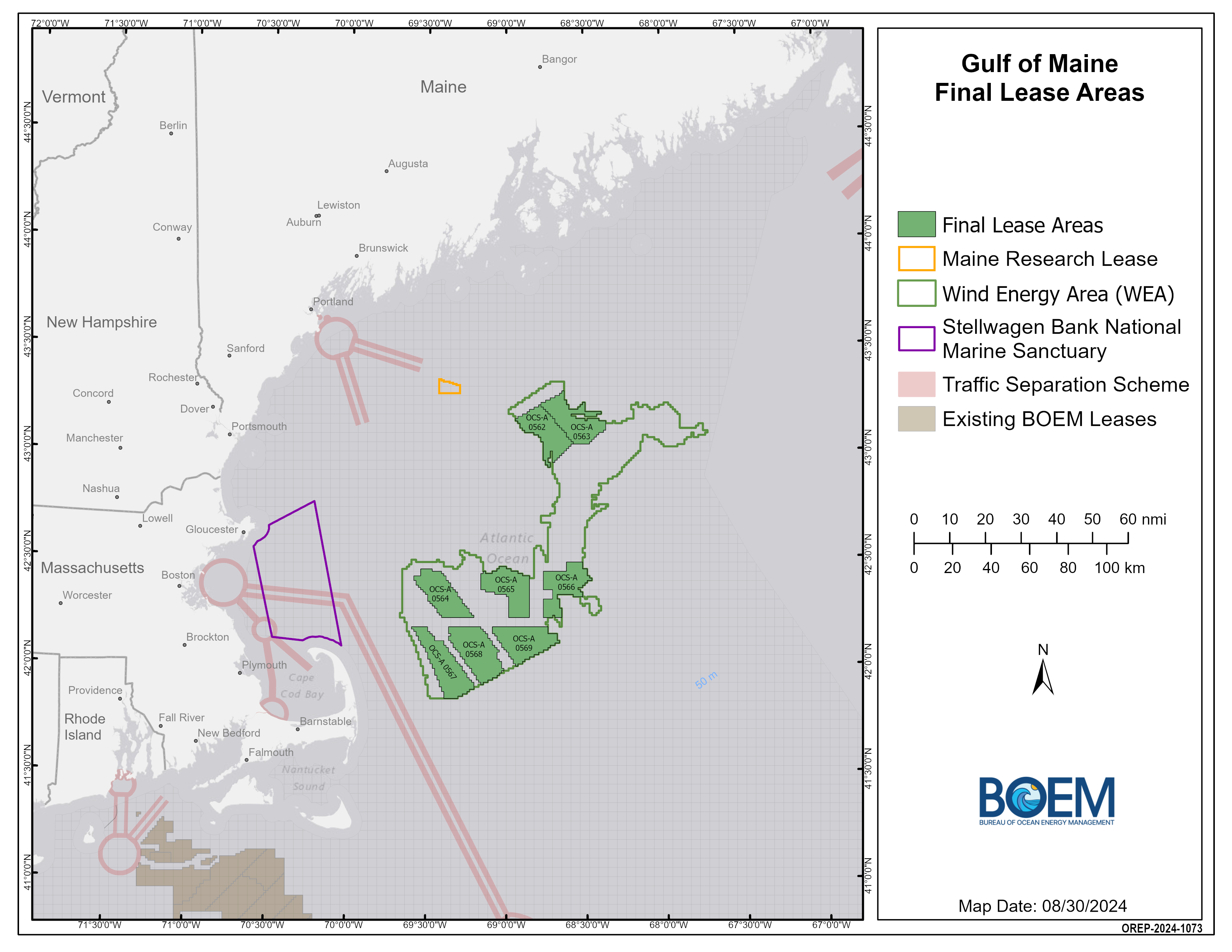
On September 16, 2024, the Department of the Interior announced an offshore wind energy lease sale to be held on October 29, 2024. Through an auction process, the Bureau of Ocean Energy Management will sell leasehold interests in eight designated areas in the Gulf of Maine.

According to BOEM's Final Sale Notice for offshore wind leasing on the Outer Continental Shelf (OCS) in the U.S. Gulf of Maine, the government will auction rights to eight separate lease areas within the Gulf of Maine. Each lease area varies in total acreage as well as "developable acres", with the average size being just over 100,000 acres per area. 

If fully developed, BOEM says these "these areas have a potential capacity of approximately 13 gigawatts of clean offshore wind energy, which could power more than 4.5 million homes."

BOEM notes that these lease areas exclude about 120,000 acres that BOEM had initially proposed for leasing; these areas were removed following public comment, engagement meetings, and concern over impacts to fishing grounds, navigation, and habitats. The Final Sale Notice also follows BOEM's recent issuance of its final Environmental Assessment of leasing in the Gulf of Maine Wind Energy Area (WEA).

Separate from this commercial leasing process, earlier this year BOEM entered into the nation’s first floating offshore wind energy research lease, covering about 15,000 acres elsewhere in the Gulf of Maine.

BOEM releases Gulf of Maine offshore wind environmental assessment

Monday, September 9, 2024

U.S. federal ocean energy managers have issued a final assessment of the environmental impacts of issuing leases for offshore wind development in the Gulf of Maine. The Bureau of Ocean Energy Management's final Environmental Assessment (EA) of the Gulf of Maine Wind Energy Area (WEA) sets the stage for future leasing.

Earlier this year, the U.S. Department of Energy designated the Gulf of Maine WEA and announced that BOEM would prepare an EA on potential impacts from offshore wind energy leasing in the Gulf of Maine. BOEM also proposed an offshore wind energy lease sale in the Gulf of Maine featuring eight potential leasing areas offshore Maine, Massachusetts, and New Hampshire.

Furthering these processes, on September 6, 2024, BOEM announced the availability of its final EA for offshore wind site leasing in the Gulf of Maine. The final EA evaluated the potential issuance of commercial wind energy leases off the coasts of Maine, New Hampshire, and Massachusetts. 

BOEM's September 2024 environmental review considered potential environmental impacts from pre-development activities like conducting surveys and installing meteorological buoys. BOEM found that leasing and these site assessment and characterization activities will not have a significant impact on the environment.  

Notably, this EA did not cover the installation of offshore turbines in the Gulf of Maine. Any specific project development of that nature would need to be assessed in a separate environmental review, following lease issuance and a project proposal by a leaseholder.

Separately, in August 2024, the Department of Interior issued a research lease for a floating offshore wind project in the Gulf of Maine. BOEM has called that agreement "the nation's first floating offshore wind energy research lease." 

ISO-NE EPCET report projects future power supply and demand

Thursday, September 5, 2024

New England's electric grid must overcome operational, engineering, and economic challenges to support state decarbonization commitments, according to a recently released draft report by grid operator ISO New England. ISO-NE's Economic Planning for the Clean Energy Transition (EPCET) study report concludes that a "vast renewable build-out may be required" to support wide swings in demand for electricity across days and seasons.

Today, peak demand for electricity occurs during the summer for reasons including air conditioning demand. But ISO-NE projects that peak demand for electricity will shift from summer to winter by the mid-2030s, as heat pumps are increasingly used to decarbonize building heating. 

As this new form of heating load becomes dominant, the weather will increasingly affect the level of peak demand, with a severe winter calling for up to 20 gigawatts more power than a mild winter. Increased variability in power system demand will require "vastly different supply levels from year to year", according to ISO-NE. The grid operator expects that this variability will mean that some dispatchable capacity is needed for reliability but might operate infrequently: "Some resources needed to maintain reliability during the harshest conditions may only run for a few days once every few years."

Another consequence of this variability is that emissions reductions will vary seasonally. Relatively high power production by wind and solar resources in spring and fall could combine with relatively lower levels of electricity demand in those seasons to yield substantial decarbonization in spring and fall, many years before summer or winter achieve that level of decarbonization. "Modeling shows spring will be mostly decarbonized by 2040, but a small portion of winter days will still produce significant emissions in 2050."

To meet these projected levels of demand solely with renewable resources, ISO-NE projects that the scale of development needed is vast. "If the future resource build-out is almost entirely wind, solar, and batteries, the region will need to add roughly 18 times its current combined capacity of these resources to achieve state emissions goals and maintain reliability." Revenue structures for generators might also need to change, to accommodate expected surplus generation from wind and solar resources in spring and fall. 

ISO-NE thinks that long-duration storage can help during shorter cold snaps but not over more extended periods of severe winter weather. To ensure reliability during prolonged severe winter conditions, ISO-NE suggests firm, dispatchable, zero-carbon generation, such as the use of synthetic natural gas (SNG) and small modular nuclear reactors (SMRs) as possible resources. The EPCET report concludes that SNG and SMRs may reduce overall system costs, by reducing the need for new renewable capacity.

BOEM issues Maine a floating offshore wind energy research lease

Monday, August 19, 2024

U.S. federal ocean regulators have announced the execution of a lease with the State of Maine for almost 15,000 acres located on the outer continental shelf offshore Maine. The Bureau of Ocean Energy Management calls the agreement "the nation's first floating offshore wind energy research lease." 

According to BOEM, the lease area includes approximately 14,945 acres, an area of sea sufficient to host up to 12 floating offshore wind turbines collectively capable of generating up to 144 megawatts of renewable energy. BOEM says the research lease will let Maine and stakeholders "conduct in-depth studies and thoroughly evaluate floating offshore wind as a renewable energy source" and "evaluate its compatibility with existing ocean uses and assess its potential effects on the environment, supply chains, and job creation."

BOEM issued the Maine lease through a process that began with the State's October 2021 application for a lease. In 2023, BOEM issued a Determination of No Competitive Interest for the area, enabling BOEM to issue Maine the lease. Maine has described the floating offshore wind research array as "a key priority for the State that will help fulfill the objectives of the Maine Offshore Wind Roadmap by advancing critical research and innovation to develop offshore wind responsibly."

As a research lease, the State of Maine or its designated operator Pine Tree Offshore Wind, LLC will engage in research regarding environmental and engineering aspects of the proposed project, to be made public and for use in informing future commercial-scale floating offshore wind projects in the region. According to BOEM, construction activity on the research array is not likely to occur for several years and will require additional permitting.

Maine PUC inquires into storm costs and grid resilience

Wednesday, August 14, 2024

Citing "increasing storm frequency and severity, and escalating storm restoration costs", Maine utility regulators have opened an inquiry to obtain information about the problem and how it could be addressed.

On July 25, 2024, the Maine Public Utilities Commission (PUC) issued a Notice of Inquiry in docket 2024-00191. According to that notice:

Maine is experiencing increasing storm frequency and severity, and escalating storm restoration costs. While utilities are developing their grid plans and doing the vulnerability assessments and preparing resiliency/mitigation plans, the Commission opens this inquiry to look for some shorter-term efforts to reduce the impact of storm damage to the system and study ways in which Maine’s electric utilities may more proactively address escalating storm costs.

The PUC's notice includes a list of questions and prompts for comment by September 4, 2024. Some questions ask how other states are addressing storm- and resilience-related costs. Others seek information on how Maine utilities might behave differently -- for example, leveraging data systems to prioritize resilience upgrades, shifting away from wood poles, or changing tree trimming protocols and other vegetation management programs. The questions also ask about what "resilience" means and how it can be quantified.

Under PUC practice, an inquiry is a relatively informal proceeding initiated by the PUC to gather information. After the PUC collects information through an inquiry, it can use what it learned to inform a subsequent adjudicatory proceeding (like an investigation) or a rulemaking. 

Outside this inquiry, a recently enacted law requires each of Maine's investor-owned transmission and distribution utilities to develop "a 10-year integrated grid plan designed to improve system reliability and resiliency and enable the cost-effective achievement of the State’s greenhouse gas reduction obligations and climate policies." The utilities must file their proposed grid plans by January 12, 2026.

A separate statute requires each utility to file a 10-year climate change protection plan that includes specific actions for addressing the expected effects of climate change on the utility's assets needed to transmit and distribute electricity to its customers. The first climate change protection plans were due on December 31, 2023, and must be updated every three years.

FERC Order 1920 reforms electric transmission planning

Tuesday, May 14, 2024

US electricity regulators have issued a major order addressing the nation's policy on regional planning of the electric transmission grid. The Federal Energy Regulatory Commission describes its Order No. 1920 as "the first time in more than a decade that FERC has addressed regional transmission policy – and the first time the Commission has ever squarely addressed the need for long-term transmission planning."

FERC adopted Order No. 1920 at its May 13, 2024 Open Meeting, by a vote of 2-1. Captioned "Building for the Future Through Electric Regional Transmission Planning and Cost Allocation", Order No. 1920 spans 1,364 pages. 

Issued in Docket No. RM21-17-000, the order adopts a final rule revising the Commission's pro forma Open Access Transmission Tariff (OATT) "to remedy deficiencies in the Commission's existing regional and local transmission planning and cost allocation requirements." As described by FERC, the order "finds that sufficiently long-term, forward-looking, and comprehensive regional transmission planning and cost allocation to meet long-term transmission needs is not occurring on a consistent and sufficient basis". According to FERC, this results in "piecemeal transmission expansion that addresses relatively near-term transmission needs" and "transmission providers investing in relatively inefficient or less cost-effective transmission infrastructure", causing customers to incur costs and miss benefits. This, according to the Commission, "in turn renders Commission-jurisdictional regional transmission planning and cost allocation processes unjust and unreasonable."

To remedy this problem, the order prescribes specific requirements that regional grid operators and transmission providers must follow in conducting long-term planning for regional transmission facilities and in allocating their costs. Among other reforms, it requires transmission operators to engage in long-term planning, with a 20-year time horizon, and a process for updates at least once every five years. It requires planners to consider seven specific categories of benefit, to determine whether a regional proposal will efficiently and cost-effectively address long-term transmission needs. These benefits are:

  1. avoided or deferred reliability transmission facilities and aging infrastructure replacement;
  2. either reduced loss of load probability or reduced planning reserve margin;
  3. production cost savings;
  4. reduced transmission energy losses;
  5. reduced congestion due to transmission outages;
  6. mitigation of extreme weather events and unexpected system conditions; and
  7. capacity cost benefits from reduced peak energy losses. 

The order includes provisions designed to "right-size" transmission facilities, by which FERC means considering cost-effective expansion to increase transfer capability, whenever replacement is needed. Incumbent transmission owners will have a right of first refusal to develop these "right-sized" transmission facilities.

Order 1920 also gives states key responsibilities in planning, selecting, and determining the cost allocation for transmission lines, while continuing to require that customers pay only for projects from which they benefit. It also creates a process giving states and interconnection customers the opportunity to fund some or all of the cost of a long-term regional transmission facilities that otherwise would not meet the transmission provider’s selection criteria. 

Commissioner Christie dissented, asserting that the order exceeds FERC's legal authority and fails to protect consumers. The order is set to take effect 60 days after its publication in the Federal Register. Order No. 1920 requires one set of compliance filings within 10 months of its effective date, with another round concerning interregional coordination due within 12 months of the effective date.

New England electric load to grow, grid operator says

Monday, May 6, 2024

Electricity consumption in New England will increase by about 17 percent over the next ten years, according to the regional grid operator, mostly due to the electrification of heating and transportation.

ISO New England tracks and projects power generation as well as consumer demand. Its 2024-2033 Forecast Report of Capacity, Energy, Loads, and Transmission (CELT Report) provides a ten-year look at projected power system characteristics. 

According to the grid operator, 2024 represents an inflection point in New England's electricity use, as the regional trend shifts from declining power consumption, back to significant growth. 


From 1995 to 2005, net annual energy use in New England grew steadily. ISO-NE attributes the growth primarily to "increased economic growth and the use of air conditioning". Since peaking in 2005 at 136,425 gigawatt-hours, net annual energy use in the region has generally decreased. ISO-NE attributes the reduction primarily to "an increase in energy efficiency from advanced cooling and heating technologies, energy-efficient appliances and lighting, and the increased prevalence of BTM solar generation."

Now, ISO-NE projects another reversal of this trend, as it forecasts "steady growth in net annual energy use as state policy goals for carbon emissions reductions drive the increased electrification of heating systems and transportation in the region." The grid operator projects that electric vehicles (EVs) "will account for 15,182 GWh of energy use in 2033, while heating electrification is expected to account for 7,996 GWh that year." After considering growth in behind-the-meter solar and efficiency measures, these projections represent an increase of about 17% in regional net annual energy use; meeting these needs will likely require significant new generating plants and transmission facilities.

ISO-NE also projects that the region will shift from summer-peaking to winter-peaking soon after 2033, due to heating electrification. Specifically, the grid operator expects winter demand to grow faster (3% annually under typical weather conditions) than summer demand (1%). 

ISO-NE notes that behind-the-meter solar power "does not reduce winter peak demand, because the peak typically occurs after sunset."

US proposes Gulf of Maine offshore wind site auction

Wednesday, May 1, 2024

The U.S. Department of the Interior has proposed the first offshore wind energy auction in the Gulf of Maine. The process has potential to advance the development of large-scale offshore wind projects in New England.

BOEM's Proposed Sale Notice for ATLW-11 appeared in the Federal Register on May 1, 2024. According to the Bureau of Ocean Energy Management, the proposed "Atlantic Wind Lease Sale 11 (ATLW-11)" would cover about one million acres of the Outer Continental Shelf offshore Maine, Massachusetts, and New Hampshire. BOEM plans to divide this zone into eight lease areas, which it says could collectively support about 15 gigawatts of offshore wind generation. 

BOEM selected these areas for leasing through a process that included a 2022 Request for Information (considering public comments and impacts to resources regarding a broader 13.7-million-acre area),  a 2023 Call for Information and Nominations, the 2024 identification of a Wind Energy Area (WEA) in the Gulf of Maine, and environmental reviews. 

BOEM says that in identifying the ATLW-11 areas for leasing, it "prioritized avoidance of offshore fishing grounds and identification of vessel transit routes, while retaining sufficient acreage to support the region’s offshore wind energy goals (13-18 GW based on information from Massachusetts, Maine, and ISO-New England)." For example, in response to requests from members of the fishing community, BOEM created three corridors between leases in the southern region of the Final WEA to facilitate existing and future transit through proposed lease areas.

According to BOEM, it has notified the following entities that their qualification is pending or that they are qualified to participate in any Gulf of Maine auction:

  • Avangrid Renewables, LLC
  • Equinor Wind US LLC
  • US Mainstream Renewable Power Inc
  • Diamond Wind North America, LLC
  • Hexicon USA, LLC
  • TotalEnergies SBE US, LLC
  • Pine Tree Offshore Wind, LLC
  • OW Gulf of Maine LLC
  • Repsol Renewables North America, Inc
  • Maine Offshore Wind Development LLC
  • Corio USA Projectco LLC

Any other entity wishing to participate in any Gulf of Maine auction must submit the required qualification materials to BOEM by July 1, 2024.