Newly enacted Maine legislation establishes the Maine Climate Council to advise the Governor and state Legislature on ways to mitigate the causes of, prepare for and adapt to the consequences of climate change, and calls for significant reductions in the state's overall greenhouse gas emissions.
On June 26, 2019, Maine Governor Janet Mills signed into law An Act to Promote Clean Energy Jobs and To Establish the Maine Climate Council. One set of provisions in the new law establishes a requirement that Maine reduce gross annual greenhouse gas emissions -- to at least 45% below the 1990 gross annual greenhouse gas emissions level by 2030, at least 80% below the 1990 gross annual greenhouse gas emissions level by 2050, and on track to meet the 2050 target by 2040. The law requires the Department of Environmental Protection to adopt rules to ensure compliance with these levels, and authorizes the Department of Transportation to adopt similar rules.
Crucially, the rules must prioritize greenhouse gas emissions reductions by sectors
that are the most significant sources of greenhouse gas emissions, as
identified by the United States Energy Information Administration and in
the department's biennial reports, taking
into account gross greenhouse gas emissions reductions achieved by each
sector since 1990 and the cost-effectiveness of future
gross greenhouse gas emissions reductions by each sector. While the electricity sector has largely been decarbonized, transportation and heating lag significantly. Maine's transportation sector was responsible for 53 percent of the state's greenhouse gas emissions in 2017, with heating taking the next greatest share. Meanwhile, electricity generation in Maine accounted for just 9 percent of the state's greenhouse gas emissions.
The law also creates a 39-member Maine Climate Council, with a subcommittee for scientific and technical matters and various working groups. The Council must meet at least every three months, report annually to a legislative committee, and prepare an updated climate action plan by December 1, 2020 and every four years thereafter. The climate action plan must include a clean energy economy transition plan.

Energy powers society; society's choices shape energy policy. A blog about our energy resources and the choices they present for society.

ISO-NE expects competitive Boston transmission solicitation
Thursday, July 11, 2019
The operator of New England's electricity system has announced an upcoming competitive solicitation for transmission proposals to address the expected retirement of a large power plant outside Boston. The solicitation would be significant, as the region's first competitive transmission procurement since a 2011 order by federal regulators created a competitive selection process for certain transmission upgrades.
In 2011, the Federal Energy Regulatory Commission issued its landmark Order No. 1000, reforming how public utilities plan and pay for transmission upgrades. In issuing the order, the Commission noted that changes in the generation mix were driving significant expansions of the transmission system -- but that "the narrow focus of current planning requirements and shortcomings of current cost allocation practices create an environment that fails to promote the more efficient and cost-effective development of new transmission facilities." Order No. 1000 aimed to address these problems by providing a framework for fair and open evaluation of regional transmission needs, and for fair allocation of the costs of transmission solutions to their beneficiaries.
Each regional transmission organization revised its tariff to conform to Order No. 1000. Since the order took effect, several other regional transmission organizations have engaged in competitive solicitations for transmission solutions. But to date, ISO New England Inc. has not. That may soon change, as according to ISO-NE, the grid operator expects to issue a request for proposals in the coming months. In a statement, ISO-NE notes that Exelon has sought to retire the Mystic Generating Station outside Boston -- one of the largest power plants in New England, located adjacent to the region's most concentrated demand -- in June 2022. While ISO-NE chose to retain two of the Mystic units until June 1 2024 for fuel-security reasons, a Boston 2028 Needs Assessment and other studies by the grid operator led it to announce plans to issue its first request for proposals for a competitively-selected regulated transmission solution, pursuant to Oder No. 1000.
ISO-NE has released the draft RFP templates that will be used in competitive transmission solicitations. The grid operator says it expects to issue a final request for proposals in late 2019 or early 2020.
In 2011, the Federal Energy Regulatory Commission issued its landmark Order No. 1000, reforming how public utilities plan and pay for transmission upgrades. In issuing the order, the Commission noted that changes in the generation mix were driving significant expansions of the transmission system -- but that "the narrow focus of current planning requirements and shortcomings of current cost allocation practices create an environment that fails to promote the more efficient and cost-effective development of new transmission facilities." Order No. 1000 aimed to address these problems by providing a framework for fair and open evaluation of regional transmission needs, and for fair allocation of the costs of transmission solutions to their beneficiaries.
Each regional transmission organization revised its tariff to conform to Order No. 1000. Since the order took effect, several other regional transmission organizations have engaged in competitive solicitations for transmission solutions. But to date, ISO New England Inc. has not. That may soon change, as according to ISO-NE, the grid operator expects to issue a request for proposals in the coming months. In a statement, ISO-NE notes that Exelon has sought to retire the Mystic Generating Station outside Boston -- one of the largest power plants in New England, located adjacent to the region's most concentrated demand -- in June 2022. While ISO-NE chose to retain two of the Mystic units until June 1 2024 for fuel-security reasons, a Boston 2028 Needs Assessment and other studies by the grid operator led it to announce plans to issue its first request for proposals for a competitively-selected regulated transmission solution, pursuant to Oder No. 1000.
ISO-NE has released the draft RFP templates that will be used in competitive transmission solicitations. The grid operator says it expects to issue a final request for proposals in late 2019 or early 2020.
Vermont PUC report on electric vehicles
Monday, July 8, 2019
Vermont utility regulators have recommended steps Vermont could take to accelerate the use of electric vehicles (EVs) in the state, including creating state incentives for EV purchases as well as encouraging electric utilities to adopt new rate structures.
Like most other states, Vermont's transportation sector contributes more greenhouse gas emissions than any other sector of the state's economy. Due in large part to emissions from cars and trucks powered by fossil fuels, the transportation sector is responsible for about 47% of Vermont's total greenhouse gas emissions; by contrast, Vermont's electricity generating sector is relatively small but nearly entirely renewable, and has the lowest carbon dioxide emissions of any state according to federal data. Other New England states are similar -- for example, Maine's transportation sector contributed 53% of the state's total greenhouse gas emissions in 2017, while electric power generation in Maine accounted for just 9 percent of the state’s total carbon emissions.
Indeed, the New England electricity grid has experienced significant decarbonized in recent decades, and renewable energy can now be consumed in the transportation sector through the use of EVs. In 2016, Vermont adopted a Comprehensive Energy Plan aiming to power 10% of transportation with renewable energy by 2025, and 80% by 2050, while reducing the sector's emissions by 30% by 2025. Vermont estimates that reaching these goals would require adding about 50,000 to 60,000 EVs to replace vehicles with internal combustion engines by 2025, for a compound annual growth rate of about 54%.
On June 27, 2019, the Vermont Public Utilities Commission released its report to various state legislative committees, "Promoting the Ownership and Use of Electric Vehicles in the State of Vermont." The report recommends that Vermont create incentives for EV purchases or leases, whether in the form of time-of-sale rebates or tax credits. It also recommends that Vermont buy EVs for the state vehicle fleet, and encourage the development of EV charging infrastructure through zoning or building code modifications.
The report also suggests that the Commission encourage electric utilities to take additional actions to promote EV adoption, such as funding EV purchase incentives through Vermont's Renewable Energy Standard program, or developing time-of-use retail rates to encourage car charging at off-peak times. It also noted that utility rate structures which impose demand charges on most commercial accounts but not on residential accounts make public direct-current fast-charging more expensive than at-home charging.
The report also notes that increased education and outreach efforts -- by utilities as well as by car dealers and other third parties -- could encourage consumer adoption of EVs.
Like most other states, Vermont's transportation sector contributes more greenhouse gas emissions than any other sector of the state's economy. Due in large part to emissions from cars and trucks powered by fossil fuels, the transportation sector is responsible for about 47% of Vermont's total greenhouse gas emissions; by contrast, Vermont's electricity generating sector is relatively small but nearly entirely renewable, and has the lowest carbon dioxide emissions of any state according to federal data. Other New England states are similar -- for example, Maine's transportation sector contributed 53% of the state's total greenhouse gas emissions in 2017, while electric power generation in Maine accounted for just 9 percent of the state’s total carbon emissions.
Indeed, the New England electricity grid has experienced significant decarbonized in recent decades, and renewable energy can now be consumed in the transportation sector through the use of EVs. In 2016, Vermont adopted a Comprehensive Energy Plan aiming to power 10% of transportation with renewable energy by 2025, and 80% by 2050, while reducing the sector's emissions by 30% by 2025. Vermont estimates that reaching these goals would require adding about 50,000 to 60,000 EVs to replace vehicles with internal combustion engines by 2025, for a compound annual growth rate of about 54%.
On June 27, 2019, the Vermont Public Utilities Commission released its report to various state legislative committees, "Promoting the Ownership and Use of Electric Vehicles in the State of Vermont." The report recommends that Vermont create incentives for EV purchases or leases, whether in the form of time-of-sale rebates or tax credits. It also recommends that Vermont buy EVs for the state vehicle fleet, and encourage the development of EV charging infrastructure through zoning or building code modifications.
The report also suggests that the Commission encourage electric utilities to take additional actions to promote EV adoption, such as funding EV purchase incentives through Vermont's Renewable Energy Standard program, or developing time-of-use retail rates to encourage car charging at off-peak times. It also noted that utility rate structures which impose demand charges on most commercial accounts but not on residential accounts make public direct-current fast-charging more expensive than at-home charging.
The report also notes that increased education and outreach efforts -- by utilities as well as by car dealers and other third parties -- could encourage consumer adoption of EVs.
US ocean energy regulators consider NY-NJ offshore transmission line
Wednesday, July 3, 2019
After receiving a request from a developer of offshore electricity transmission lines for a right-of-way in ocean waters offshore New York and New Jersey, U.S. ocean energy regulators have asked whether any other developers are interested in the same area.
On April 30, 2018, Anbaric Development Partners, LLC (ADP) applied to the federal Bureau of Ocean Energy Management (BOEM) for a right-of-way grant for a proposed project called the New York/New Jersey Ocean Grid. As envisioned by ADP, the project would include a submarine system approximately 185 nautical miles in length. It would also include up to 9 offshore collector platforms which would collect and distribute power generated from existing offshore wind leases, each capable of handling 800 to 1,200 megawatts of offshore wind energy, as well as up to 6 onshore landings at locations from Long Island, New York to Cardiff, New Jersey. On June 22, 2018, BOEM approved ADP's legal, technical, and financial qualifications to acquire and hold a Right of Way Grant on the Outer Continental Shelf.
Under BOEM's regulations, different procedures apply depending on whether the agency is following a competitive lease process or a noncompetitive lease award process. ADP's application was "unsolicited," meaning it was not submitted in response to a BOEM solicitation, Request for Interest, or Call for Information and Nominations. Under BOEM's case-by-case process for considering unsolicited requests, the agency will issue a public notice and solicit comments to determine whether competitive interest exists, before considering the application itself. If BOEM determines that competitive interest exists in the requested lease area, BOEM will proceed with its competitive process; otherwise, BOEM will publish a notice of Determination of No Competitive Interest, and may proceed to review the unsolicited lease request.
On June 17, 2019, BOEM announced that it would publish a Request for Competitive Interest for project; the Notice of Proposed Grant Area and Request for Competitive Interest was published in the Federal Register on June 19, 2019. Indications of interest in acquiring a right-of-way grant for the area ADP requested must be sent by mail, postmarked no later than July 19, 2019, to be considered. Comments or other information may be sent by mail, postmarked by the same date, or may be submitted through the Federal Rulemaking Portal at http://www.regulations.gov.
If BOEM receives indications of competitive interest from qualified entities, the bureau may decide to move forward with the right-of-way grant issuance process using competitive procedures. BOEM will continue to consult with the state task force and partners regarding the proposed transmission project.
As an increasing number of states and utilities are procuring offshore wind, functions that must be provided include collecting the power produced, transmitting it to shore, and integrating it into the onshore grid. Depending on their design and configuration, offshore transmission grids could play these roles, and could also help wheel power along the coastline from one region to another. Questions of cost recovery -- who pays for these systems -- will continue to arise, at the intersection between state policies calling for offshore wind and regional markets rooted in economics.
On April 30, 2018, Anbaric Development Partners, LLC (ADP) applied to the federal Bureau of Ocean Energy Management (BOEM) for a right-of-way grant for a proposed project called the New York/New Jersey Ocean Grid. As envisioned by ADP, the project would include a submarine system approximately 185 nautical miles in length. It would also include up to 9 offshore collector platforms which would collect and distribute power generated from existing offshore wind leases, each capable of handling 800 to 1,200 megawatts of offshore wind energy, as well as up to 6 onshore landings at locations from Long Island, New York to Cardiff, New Jersey. On June 22, 2018, BOEM approved ADP's legal, technical, and financial qualifications to acquire and hold a Right of Way Grant on the Outer Continental Shelf.

Under BOEM's regulations, different procedures apply depending on whether the agency is following a competitive lease process or a noncompetitive lease award process. ADP's application was "unsolicited," meaning it was not submitted in response to a BOEM solicitation, Request for Interest, or Call for Information and Nominations. Under BOEM's case-by-case process for considering unsolicited requests, the agency will issue a public notice and solicit comments to determine whether competitive interest exists, before considering the application itself. If BOEM determines that competitive interest exists in the requested lease area, BOEM will proceed with its competitive process; otherwise, BOEM will publish a notice of Determination of No Competitive Interest, and may proceed to review the unsolicited lease request.
On June 17, 2019, BOEM announced that it would publish a Request for Competitive Interest for project; the Notice of Proposed Grant Area and Request for Competitive Interest was published in the Federal Register on June 19, 2019. Indications of interest in acquiring a right-of-way grant for the area ADP requested must be sent by mail, postmarked no later than July 19, 2019, to be considered. Comments or other information may be sent by mail, postmarked by the same date, or may be submitted through the Federal Rulemaking Portal at http://www.regulations.gov.
If BOEM receives indications of competitive interest from qualified entities, the bureau may decide to move forward with the right-of-way grant issuance process using competitive procedures. BOEM will continue to consult with the state task force and partners regarding the proposed transmission project.
As an increasing number of states and utilities are procuring offshore wind, functions that must be provided include collecting the power produced, transmitting it to shore, and integrating it into the onshore grid. Depending on their design and configuration, offshore transmission grids could play these roles, and could also help wheel power along the coastline from one region to another. Questions of cost recovery -- who pays for these systems -- will continue to arise, at the intersection between state policies calling for offshore wind and regional markets rooted in economics.
U.S. consumes more petroleum than any other energy source
Monday, July 1, 2019
Petroleum was the largest source of energy consumed in the United States in 2018, as it has been every year since it surpassed coal in 1950.
According to data maintained by the U.S. Energy Information Administration, in 2018 the U.S. used 101 quadrillion British thermal units (Btu) of overall energy -- for transportation, heating, electric power generation, and all other uses. This was a record high level of overall energy consumption.
Of this amount, about 81 quadrillion Btu (about 80% of the total) came from fossil fuels -- petroleum, natural gas, and coal. This is fossil fuels' second-lowest share of the total since 1902, after setting a record low share in 2017.
Petroleum provides the largest share of energy consumed in the U.S., at about one-third of the total. Petroleum consumption increased year-over-year, to about 37 quadrillion Btu in 2018. At the same time, U.S. petroleum consumption remains lower than its peak level (about 40 quadrillion Btu), which occurred in 2005.
Natural gas consumption also increased in 2018, reaching a new record level of 82.1 billion cubic feet per day (or about 31 quadrillion Btu for the year).
Meanwhile, coal consumption fell by 4.3% in 2018. U.S. coal consumption peaked in 2005, and has declined about 42% since then, to the lowest level of coal consumption since the 1970s.
At the same time, renewable energy has continued to grow. In 2018, hydroelectricity, biomass, wind, solar, and other renewables provided about 11.4% of the total energy consumed in the U.S., with significant growth in solar and wind energy generation. In the electric power sector, renewable resources generated more electricity than coal did in the U.S. in April 2019 for the first month.
However, despite the substantial decarbonization of the power grid in New England and other regions, for now transportation and heating remain dominated by petroleum, with associated economic, environmental, and climate implications. Efforts to reduce the carbon intensity of these sectors, such as through electric vehicles and electricity-powered heat pumps, could do much to reduce the associated greenhouse gas emissions.
According to data maintained by the U.S. Energy Information Administration, in 2018 the U.S. used 101 quadrillion British thermal units (Btu) of overall energy -- for transportation, heating, electric power generation, and all other uses. This was a record high level of overall energy consumption.
Of this amount, about 81 quadrillion Btu (about 80% of the total) came from fossil fuels -- petroleum, natural gas, and coal. This is fossil fuels' second-lowest share of the total since 1902, after setting a record low share in 2017.
Petroleum provides the largest share of energy consumed in the U.S., at about one-third of the total. Petroleum consumption increased year-over-year, to about 37 quadrillion Btu in 2018. At the same time, U.S. petroleum consumption remains lower than its peak level (about 40 quadrillion Btu), which occurred in 2005.
Natural gas consumption also increased in 2018, reaching a new record level of 82.1 billion cubic feet per day (or about 31 quadrillion Btu for the year).
Meanwhile, coal consumption fell by 4.3% in 2018. U.S. coal consumption peaked in 2005, and has declined about 42% since then, to the lowest level of coal consumption since the 1970s.
At the same time, renewable energy has continued to grow. In 2018, hydroelectricity, biomass, wind, solar, and other renewables provided about 11.4% of the total energy consumed in the U.S., with significant growth in solar and wind energy generation. In the electric power sector, renewable resources generated more electricity than coal did in the U.S. in April 2019 for the first month.
However, despite the substantial decarbonization of the power grid in New England and other regions, for now transportation and heating remain dominated by petroleum, with associated economic, environmental, and climate implications. Efforts to reduce the carbon intensity of these sectors, such as through electric vehicles and electricity-powered heat pumps, could do much to reduce the associated greenhouse gas emissions.
US renewables outproduced coal in April 2019
Wednesday, June 26, 2019
Renewable resources generated more electricity than coal did in the United States in April 2019, for the first time in history, according on federal data.
The U.S. Energy Information Administration reports that in April 2019, renewable sources including utility-scale hydropower, wind, solar, geothermal, and biomass provided 23% of total domestic electricity generation. By comparison, coal provided 20%. This represents a reversal of over 100 years of history during which more U.S. electricity generation came from coal than from renewable resources.
EIA attributes this outcome to a combination of seasonal factors and long-term trends. Seasonal factors include expected low demand for power in springtime, and a corresponding decline in electricity generation from fuels such as natural gas, coal, and nuclear is often at its lowest point during these months as some generators undergo maintenance.
Meanwhile, increasing amounts of renewable generation are joining the grid. EIA reports that in 2018, about 15 gigawatts of utility-scale wind and solar generating capacity came online, with additional capacity coming from smaller and behind-the-meter solar projects. 2018 brought record levels of renewable energy generation.
At the same time, U.S. coal generation is in decline. About 47 gigawatts of U.S. coal-fired capacity have retired since 2015, and EIA expects another 4.1 gigawatts of coal capacity will retire in 2019, accounting for the majority of power plant retirements expected this year.
One effect of these forces has been reductions in the carbon intensity of electricity generation in New England and other markets.
The U.S. Energy Information Administration reports that in April 2019, renewable sources including utility-scale hydropower, wind, solar, geothermal, and biomass provided 23% of total domestic electricity generation. By comparison, coal provided 20%. This represents a reversal of over 100 years of history during which more U.S. electricity generation came from coal than from renewable resources.
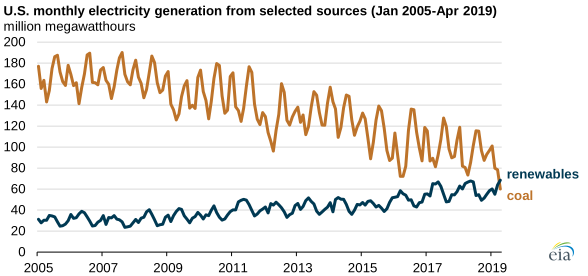 |
| Source: U.S. Energy Information Administration |
EIA attributes this outcome to a combination of seasonal factors and long-term trends. Seasonal factors include expected low demand for power in springtime, and a corresponding decline in electricity generation from fuels such as natural gas, coal, and nuclear is often at its lowest point during these months as some generators undergo maintenance.
Meanwhile, increasing amounts of renewable generation are joining the grid. EIA reports that in 2018, about 15 gigawatts of utility-scale wind and solar generating capacity came online, with additional capacity coming from smaller and behind-the-meter solar projects. 2018 brought record levels of renewable energy generation.
At the same time, U.S. coal generation is in decline. About 47 gigawatts of U.S. coal-fired capacity have retired since 2015, and EIA expects another 4.1 gigawatts of coal capacity will retire in 2019, accounting for the majority of power plant retirements expected this year.
One effect of these forces has been reductions in the carbon intensity of electricity generation in New England and other markets.
US EPA adopts ACE carbon rule
Friday, June 21, 2019
On June 19, 2019, the U.S. Environmental Protection Agency finalized its Affordable Clean Energy rule, designed as a replacement for the Obama administration's Clean Power Plan.
The rule, also known as the ACE rule, gives states 3 years to submit plans to limit carbon dioxide emissions from their coal-fired power plants, and sets guidelines for states to use when developing these plans. It identifies heat rate improvements at individual facilities as the best system of emission reduction (BSER) for reducing carbon emissions from coal-fired power plants. States will establish unit-specific “standards of performance” that reflect the emission limitation achievable through application of the BSER technologies.
EPA initially proposed a draft ACE rule in August 2018, and developed the final rule following public comment. It followed the Clean Power Plan, finalized in 2015 but stayed by the U.S. Supreme Court in 2016. Separately, but through the same public notice as the final ACE rule, EPA has formally repealed the Clean Power Plan.
According to EPA, the final ACE rule will reduce CO2 emissions by 11 million short tons in 2030, and will result in annual net benefits of $120 million to $730 million, including costs, domestic climate benefits, and health co-benefits. EPA says that with the ACE rule, along with additional expected emissions reductions based on long-term industry trends, it expects to see CO2 emissions from the electric sector fall by as much as 35% below 2005 levels in 2030.
The rule, also known as the ACE rule, gives states 3 years to submit plans to limit carbon dioxide emissions from their coal-fired power plants, and sets guidelines for states to use when developing these plans. It identifies heat rate improvements at individual facilities as the best system of emission reduction (BSER) for reducing carbon emissions from coal-fired power plants. States will establish unit-specific “standards of performance” that reflect the emission limitation achievable through application of the BSER technologies.
EPA initially proposed a draft ACE rule in August 2018, and developed the final rule following public comment. It followed the Clean Power Plan, finalized in 2015 but stayed by the U.S. Supreme Court in 2016. Separately, but through the same public notice as the final ACE rule, EPA has formally repealed the Clean Power Plan.
According to EPA, the final ACE rule will reduce CO2 emissions by 11 million short tons in 2030, and will result in annual net benefits of $120 million to $730 million, including costs, domestic climate benefits, and health co-benefits. EPA says that with the ACE rule, along with additional expected emissions reductions based on long-term industry trends, it expects to see CO2 emissions from the electric sector fall by as much as 35% below 2005 levels in 2030.
Subscribe to:
Posts (Atom)
