Energy policy in the 2018 State of the Union

Wednesday, January 31, 2018

U.S. President Donald Trump delivered the 2018 edition of the State of the Union speech on January 30, 2018. Unlike many previous such addresses, this one barely covered energy policy, focusing instead on a variety of other matters. But the speech offers insight into the Trump administration's view of the national situation, as well as into its priorities.

Energy policy and resources have often featured prominently in previous State of the Union addresses, and in remarks in 2017 President Trump advocated for a national strategy of "energy dominance." By contrast, President Trump's 2018 State of the Union speech mentioned U.S. regulation, production, and trade in energy only briefly, emphasizing his deregulatory agenda and pro-export philosophy.

The Trump administration posted an online version of his 2018 remarks as prepared for delivery. In that version, only two sentences use the word "energy":
We have ended the war on American Energy — and we have ended the war on clean coal.  We are now an exporter of energy to the world.
A transcript released by the U.K. media source The Independent suggests President Trump stuck close to his script on this (and other points):
We have ended the war on American energy, and we have ended the war on beautiful clean coal. We are now very proudly an exporter of energy to the world. 
These statements appear to relate to announcements made over the last year. Back in March 2017, President Trump signed an executive order which he described as "putting an end to the war on coal. We’re going to have clean coal — really clean coal." The U.S. does export a significant amount of energy -- and last year the Energy Information Administration projected that the U.S. would likely become a net exporter of energy within several years "as petroleum liquid imports fall and natural gas exports rise." Subsequent developments over the last year have lent preliminary support to this prediction.

President Trump's 2018 State of the Union speech did not otherwise directly address energy policy. That said, he did emphasize policy goals and achievements with respect to economic factors, such as tax cuts, job creation in manufacturing and other sectors, and improved small business confidence, as well as matters like national defense and immigration.

It can be tempting to infer administrative priorities from what is or isn't covered in a speech like this. At the same time, any leader has limited time to cover a host of important topics. With respect to energy matters, the speech emphasizes the Trump administration's focus on reducing regulations and increasing exports of America-produced energy resources.

Nova Scotia tidal energy demonstration projects

Tuesday, January 30, 2018

The Canadian province of Nova Scotia is seeking applications from tidal energy project developers for permits for tidal energy demonstration projects.

Nova Scotia is home to significant tidal energy potential. According to the provincial Department of Energy, the Bay of Fundy tides offer "an estimated potential of up to 60,000 megawatts (MW) of energy, of which up to 2,500 MW may be extracted without significant impact on our marine environment." The province adopted a Marine Renewable Energy Strategy in 2012, and a legislative framework for marine renewable energy in 2015. It is home to the 20 megawatt barrage-based Annapolis Royal Tidal Power Plant, and has taken steps to encourage research and development into tidal energy technologies.

Opportunities for Nova Scotia tidal energy demonstration projects have just expanded again. On January 24, 2018, the province announced that applications are now available for tidal energy demonstration permits under a recent amendment to the provincial Marine Renewable-Energy Act. Under the amended Nova Scotia tidal energy demonstration program, a demonstration permit allows for the development of a project consisting of up to 5 megawatts of aggregate capacity. No more than 10 megawatts of total power can be authorized under the program, which targets two specific "areas of priority for marine renewable energy developments": Bay of Fundy and the Bras d’Or Lake inland-sea.

The Nova Scotia demonstration permit program is designed to create "another way for developers to test and prove their ideas for innovative new devices," while allowing regulatory oversight of environmental and other concerns. For example, developers still must obtain all applicable permits and approvals. For tidal projects that could generate two megawatts or more, the process includes an environmental assessment approval. At the same time, the amended program significantly expands the area of waters where tidal demonstration projects may be permitted, and gives permittees the opportunity to sell the electricity they generate.

Massachusetts picks Northern Pass bid

Thursday, January 25, 2018

According to a website associated with a clean energy solicitation for Massachusetts electric utilities, the bid committee has selected a proposal called "Northern Pass Transmission, Hydro" as the winning bid. While further steps lay ahead, the agreement that could result would represent a long-term commitment to purchase of about 9,450,000 megawatt-hours of clean energy annually for Massachusetts electric customers -- and lead to the development of a major new electric transmission line from Canada into New England.

The so-called Massachusetts Section 83D process is one of several ongoing renewable energy procurements in New England. Legislation enacted in Massachusetts in 2016 amended the existing Green Communities Act to add a new Section 83D calling for joint utility procurement of significant amounts of "clean" energy, defined to include firm service hydroelectric generation. The Massachusetts electric distribution companies issued their Request for Proposals for Long-term Contracts for Clean Energy Projects pursuant to Section 83D on March 31, 2017, in coordination with the Massachusetts Department of Energy Resources.

The 83D solicitation called for bids by July 27, 2017. Public copies of the bids received, including a proposal labeled NPT Hydro, are posted on the program's website. The transmittal letter for the NPT Hydro project describes a joint proposal by Hydro-Quebec affiliate Hydro Renewable Energy Inc. and Northern Pass Transmission LLC. As described by Northern Pass in its bid and other documents, the project includes a new 192-mile transmission line importing 1,090 megawatts of firm clean energy from Quebec into New Hampshire. The proposal describes the project as shovel-ready, with a targeted in-service date of 2020.

According to the website, final acceptance of the bid and the award of a contract is conditional upon additional steps. These include the successful negotiation of the contract and required regulatory approval at the Massachusetts Department of Public Utilities. The notice also states that if this bid selected to advance to contract negotiation does not result in actual contracts, other bids may be selected for contract negotiations.

The siting of the project has been controversial for its impacts on the White Mountain National Forest and nearby northern New Hampshire forestlands, prompting a redesigned route with more cable mileage installed underground to address scenic impacts. The New Hampshire Site Evaluation Committee recently concluded hearings on applications for the Northern Pass Transmission project's development, with a decision by the Committee expected this year.

NYC tidal project asks for more time

The holder of a pilot license for a hydrokinetic energy project under development off New York City has asked federal regulators for a 5-year extension of the license term, and has signaled its intent to relicense the project.

At issue is Verdant Power's Roosevelt Island Tidal Energy (RITE) Project, located in the tidal East Channel of the East River between Manhattan and Long Island. The Federal Energy Regulatory Commission issued Verdant Power a 10-year pilot project license on January 23, 2012. The license describes a phased project, starting with deployment of three 35-kW hydrokinetic turbine-generator systems, and ultimately capable of scaling up to a total of 30 turbines, for a total nameplate capacity of 1,050 kilowatts. Hydrokinetic projects generate electricity from waves or directly from the flow of water in ocean currents, tides, or inland waterways, generally without creating new dams or impoundments.

The RITE Project's pilot license was the first to be issued by the Commission through a special hydrokinetic pilot project licensing process which it designed to let developers test technologies and sites without compromising the Commission’s oversight of the projects or limiting agency and stakeholder input. As defined by the Commission, a pilot project license authorizes the construction, operation, and maintenance of an original (i.e., unconstructed) hydrokinetic project that is:
  1. small (5 megawatts or less);
  2. easily removed or shut down quickly;
  3. located in a non-sensitive area; and
  4. has the primary purpose of testing new technologies or locating suitable generation sites.
Since the RITE Project's pilot license issued, Verdant says it has taken steps including maintaining a control room and ancillary equipment, conducting an in-water test of turbine rotor components, beta-tested environmental equipment, and beginning environmental monitoring as required by its license.

But the licensee would like more time. According to a letter filed with the Commission on December 29, 2017, "Verdant Power is poised to install the first phase of the licensed Pilot Project (Install B-1) in the 2019-20 timeframe. This installation will represent a significant milestone in the advancement of hydrokinetic energy in the US." In that letter, Verdant requested a 5-year extension of its pilot license. Also on December 29, Verdant Power submitted a document it described as its notice of intent to apply for a new license for the RITE project.

The docket remains open before the Commission.

New England Operational Fuel-Security Analysis released

Tuesday, January 23, 2018

The risk that power plants will run out of fuel is the foremost challenge to a reliable power grid in New England, according to the region's grid operator, and the region is vulnerable to the season-long outage of any of several major energy facilities.

While the ability to count on a portfolio of power plants to generate power is considered the cornerstone of reliable electricity supply, ISO New England has noted several factors that make fuel security a growing concern for the region. These factors include the inadequacy of the region’s natural gas infrastructure to meet winter needs for both heating and power, and the retirement of many of the region’s coal, oil, and nuclear power plants due to economic and environmental pressures.

On January 17, 2018, ISO New England released its Operational Fuel-Security Analysis, a 56-page report studying the possible fuel security risks facing region's power plants under a wide range of hypothetical future scenarios. Prepared following about two years of study, the report found that maintaining the electric grid's reliability "is likely to become more challenging, especially if current power system trends continue."

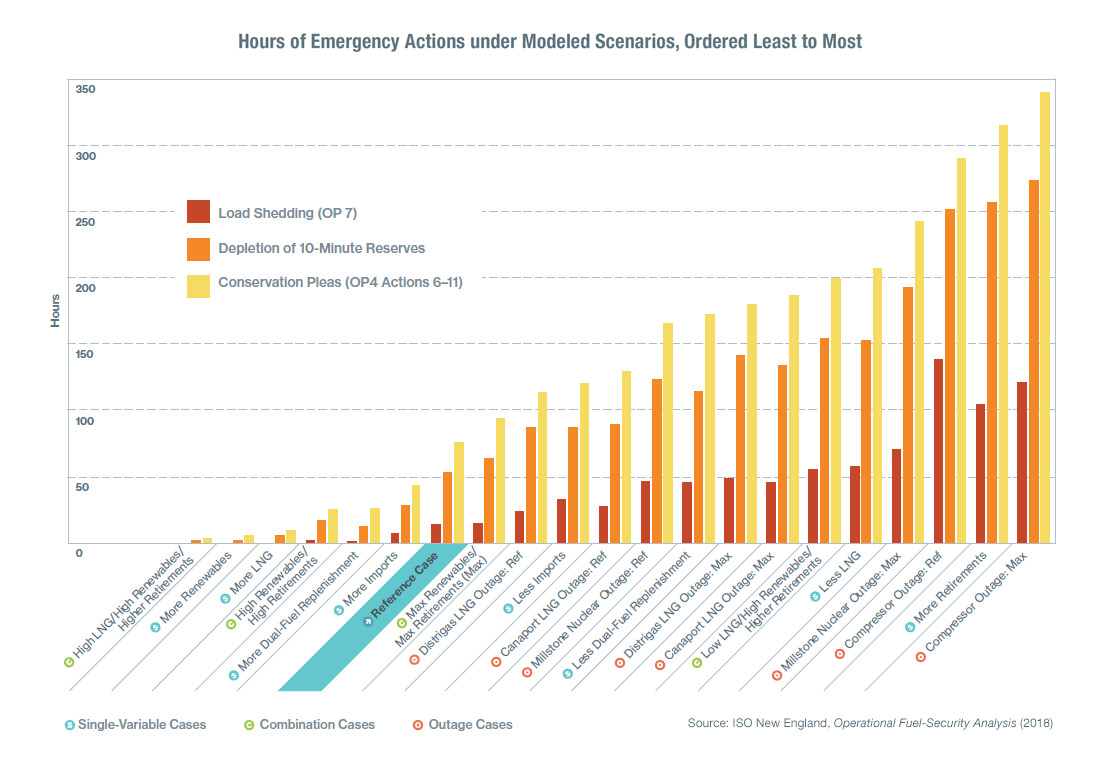
The report considered a 23 possible range of possible future power resource combinations that could materialize for the winter period from December 1, 2024 through February 28, 2025, to examine whether enough fuel would be available to meet demand and to quantify the operational risks. Each scenario assumed no new natural gas pipeline capacity would be added to serve generators, but considered variation in five other key factors for power system reliability: resource retirements, LNG availability, oil tank inventories, imported electricity, and renewable resources.

ISO-NE chart of Hours of Emergency Actions under Modeled Scenarios, Ordered Least to Most, Operational Fuel-Security Analysis (2018)

The study identified six major conclusions:
  1. Outages: The region is vulnerable to the season-long outage of any of several major energy facilities.
  2. Stored fuels: Power system reliability is heavily dependent on LNG and electricity imports; more dual-fuel capability is also a key reliability factor, but permitting for construction and emissions is difficult.
  3. Logistics: The timely availability of fuel is critical, highlighting the importance of fuel-delivery logistics.
  4. Risk trends: All but four scenarios result in fuel shortages requiring load shedding, indicating the trends affecting New England’s power system may intensify the region’s fuel-security risk.
  5. Renewables: More renewable resources can help lessen the region’s fuel-security risk but are likely to drive coal- and oil-fired generation retirements, requiring high LNG imports to counteract the loss of stored fuels.
  6. Positive outcomes: Higher levels of LNG, imports, and renewables can minimize system stress and maintain reliability; to attain these higher levels, delivery assurances for LNG and electricity imports, as well as transmission expansion, will be needed.
According to ISO-NE, quantifying the level of risk over a wide range of possible combinations provides information the region can use to consider approaches to ensuring power system reliability. The grid operator has said it plans to engage with stakeholders, regulators, and policymakers through 2018 to discuss the operational fuel-security analysis -- and how much risk the ISO and region would be willing to tolerate.

Energy dept adopts grid emergency order rule

Wednesday, January 17, 2018

U.S. energy regulators have issued a final rule governing the procedures through which the Secretary of Energy may issue an emergency order under the Federal Power Act to respond to an electric grid security emergency.

Under the Fixing America's Surface Transportation Act of 2015, Congress authorized the Secretary of Energy to order emergency measures after the President declares a grid security emergency. Such an emergency could occur as the result of a physical attack, a cyber-attack using electronic communication, an electromagnetic pulse (EMP), or a geomagnetic storm event. The FAST Act added these powers to the Federal Power Act, which contained additional language authorizing the Secretary to order temporary emergency measures as needed to serve the public interest.

On January 10, the U.S. Department of Energy published its final rule governing grid security emergency orders.  According to the Department, the procedures established by this final rule "will ensure the expeditious issuance of emergency orders under the Federal Power Act." It says the final rule establishes a "consistent yet flexible set of procedures" for regulatory engagement with impacted parties as the Department issues emergency orders. The Department says it "expects that these emergency orders would be issued rarely," but emphasized its need for flexibility in tailoring a response to the particular circumstances of any grid disruption.

The new final rule is codified in 18 C.F.R. section 205.380 et seq.

FERC license surrender with facilities in place

Friday, January 12, 2018

When a federally licensed hydropower project is decommissioned, U.S. regulators have authority to accept or prescribe plans for the disposition of the project's dams, reservoirs, and other facilities -- and depending on the case, decommissioning plans could range from removing facilities and restoring the site, to leaving some facilities in place.

Under federal law, most U.S. hydropower projects are licensed by the Federal Energy Regulatory Commission – and a license cannot be surrendered without the Commission’s agreement. By regulation, a licensee applying to surrender its license must identify all project features – dams, reservoirs, power plants, transmission lines, etc. – and how they will be disposed.

According to Commission guidance on hydropower license surrender, surrender applications for constructed projects should include a plan for decommissioning the project. The Commission requires decommissioning plans to address any dam safety or environmental concerns that could remain after the license is surrendered. But the nature and scope of decommissioning activities can vary, from leaving project features in-place for other uses, to removing project features restoring the site. The Commission encourages licensees considering a surrender application to consult with other regulatory agencies and stakeholders, in part to inform the development of a decommissioning plan.

An order issued in 2016 provides an example of a license surrender where facilities were allowed to be left in place. On May 3, 2016, the Commission issued an order accepting the surrender of the license for the 23-kilowatt Burnham Creek Hydroelectric Project in Washington. Originally licensed in 1987 for a 50-year term, the project facilities include a 20-foot-high earthen dam, a 5-acre reservoir, intake, penstock, powerhouse, generating unit, and transmission line. But the Burnham Creek project has not generated electricity since its power line was damaged by a windstorm in 2007.

In 2012, after consulting with various agencies and stakeholder entities, the project licensee filed an application to surrender her license, stating that the cost to repair the power line was too great when weighed against the benefits of the project. In her surrender application, the licensee proposed to leave the project "in place", in its current condition, with no ground-disturbing work, and without removing the dam, powerhouse, generating unit, or transmission line. No entity filed an objection to the proposed surrender.

The Commission issued its order accepting surrender about three years later. Because the licensee did not propose any ground-disturbing activities and would leave all project facilities in place, the Commission concluded that “the proposed surrender would have no effects to geology and soils, water quality, terrestrial resources, or land use.” For similar reasons, the Commission concluded that “surrendering the project would not constitute a major federal action significantly affecting the quality of the human environment,” reducing the environmental analysis required under federal law.

With respect to dam safety, the Commission noted several potential safety issues (including de-pressurizing the penstock, removing turbine or transformer oil from the powerhouse, and removing or securing the downed portion of transmission line), and made the surrender contingent upon the licensee showing that it had taken certain steps to address those concerns. The Commission also noted that the state of Washington would have jurisdiction over the facilities when, and if, the surrender is finalized.

In some cases, a FERC license surrender and decommissioning plan can entail dam removal. But surrender orders like that issued in the Burnham Creek case, or a similar order accepting surrender for the Columbia Dam project in New Jersey, illustrate the potential for surrendering a hydropower license while leaving most of a project’s facilities in place.