New Hampshire utility regulators have reopened a program offering a rebate to commercial and industrial electric customers who undertake qualifying solar energy projects, while reducing the size of the incentive and changing other program terms.
To encourage commercial and industrial (C&I) customers to participate in solar photovoltaic and solar thermal energy projects, the New Hampshire Public Utilities Commission first approved a solar rebate program in 2010. That program disburses funds from the state's Renewable Energy Fund to customers in exchange for customers' development of qualifying solar projects.
Terms and conditions for New Hampshire's C&I solar rebate program have varied since 2010, and the amounts of rebates available under the program have generally decreased over time. In 2015, the Commission created two separate categories of eligible projects with different rebate rates: Category 1, consisting of solar electric and
thermal systems rated
less than or equal to
100 kilowatts (AC) or thermal equivalent, and Category 2 consisting of solar electric
systems greater than 100 kilowatts (AC) but less than or equal to 500 kilowatts (AC).
A 2016 Commission order set program rebate levels at $0.65 per watt (AC) for
Category 1 new electric
projects, and $0.55 per watt (AC), but not in excess of $175,000, for Category 2 new electric
projects, in each case subject to a limit of 25
percent
of the total project cost if less than the
incentive payment otherwise calculated.
But the program closed to new applications as of July 14, 2017, due to "record demand" and a lack of funds. Even the allocation of additional funds only reopened the program for waitlisted applications, while keeping it closed to new applicants.
On February 13, 2018, Commission staff recommended reopening the program, while modifying it to further reduce the applicable incentive levels
and to consolidate Category 1 and 2 projects into a single program that would allow applications
for projects with capacities up to and including 500 kW
AC.
On March 8, 2018, the Commission issued its Order No. 26,111, modifying the solar rebate program's terms and reopening the program. The changes
include reduction in the amount of the rebate to $0.40 per watt
up to
a maximum of $50,000, or 25 percent
of total project cost, whichever is less; and consolidation
of Category 1 and 2 photovoltaic projects into a single program that would allow
applications for projects with capacities
up to and including 500 kilowatts AC.
No change was
made to the program terms and conditions applicable to solar thermal projects.
Under the order, the modified program terms and conditions became effective on March 19, 2018, and the program was reopened as of that date. The Commission noted that in anticipation of "robust demand for and potential oversubscription of the reopened program," it will conduct a public lottery in April to allocate initial queue positions for applications.

Energy powers society; society's choices shape energy policy. A blog about our energy resources and the choices they present for society.
Showing posts with label thermal. Show all posts
Showing posts with label thermal. Show all posts

DONG Energy proposes Massachusetts offshore wind farm
Thursday, November 12, 2015
A subsidiary of Danish energy company DONG Energy has proposed an offshore wind development to be located in federal waters off the Massachusetts coast. The "Bay State Wind" project would be a utility scale offshore wind
farm, located 15 miles south of Martha's Vineyard.
Largely owned by the Danish government, DONG is the world’s largest developer of offshore wind projects, reportedly having built over 3,000 megawatts or about a third of all installed offshore wind capacity in the world. Other branches of the company engage in serving Danish customers, oil and natural gas exploration and production, and thermal power generation.
Because the Bay State Wind project's site is over the outer continental shelf, it falls under federal jurisdiction for site leasing purposes under subsection 8(p) of the Outer Continental Shelf Lands Act. The wind energy area in question was originally auctioned by the U.S. Bureau of Ocean Energy Management in January 2015. In that January auction, RES America Developments, Inc. provisionally won the rights to Lease OCS-A 0500 (187,523 acres) with a winning bid of $281,285. BOEM signed the commercial wind energy lease for the site on March 23, 2015, and the lease went into effect on April 1, 2015.
In April 2015, RES agreed to transfer the lease to DONG. In accordance with BOEM's process for assigning a site lease, BOEM agreed to assign the lease to DONG Energy Massachusetts (U.S.) LLC on June 12.
According to DONG, full development of the Bay State Wind project might entail 1,000 megawatts of generating capacity. Its lease area is adjacent to the wind energy area offshore Rhode Island and Massachusetts won by Deepwater Wind in 2013 in BOEM's first competitive lease sale for offshore wind sites.
Largely owned by the Danish government, DONG is the world’s largest developer of offshore wind projects, reportedly having built over 3,000 megawatts or about a third of all installed offshore wind capacity in the world. Other branches of the company engage in serving Danish customers, oil and natural gas exploration and production, and thermal power generation.
Because the Bay State Wind project's site is over the outer continental shelf, it falls under federal jurisdiction for site leasing purposes under subsection 8(p) of the Outer Continental Shelf Lands Act. The wind energy area in question was originally auctioned by the U.S. Bureau of Ocean Energy Management in January 2015. In that January auction, RES America Developments, Inc. provisionally won the rights to Lease OCS-A 0500 (187,523 acres) with a winning bid of $281,285. BOEM signed the commercial wind energy lease for the site on March 23, 2015, and the lease went into effect on April 1, 2015.
In April 2015, RES agreed to transfer the lease to DONG. In accordance with BOEM's process for assigning a site lease, BOEM agreed to assign the lease to DONG Energy Massachusetts (U.S.) LLC on June 12.
According to DONG, full development of the Bay State Wind project might entail 1,000 megawatts of generating capacity. Its lease area is adjacent to the wind energy area offshore Rhode Island and Massachusetts won by Deepwater Wind in 2013 in BOEM's first competitive lease sale for offshore wind sites.
U.S. renewable energy share highest since 1930s
Tuesday, July 21, 2015
In 2014, about 9.8% of the total energy consumed in the U.S. came from renewable energy sources, according to the U.S. Energy Information Administration. This represents the highest share of total domestic energy supply coming from renewable resources since the 1930s.
Prior to the growth of production and distribution networks for petroleum and other fossil fuels in the early 20th century, many homes used wood for heating as did industry. This reliance on renewable biomass historically satisfied a significant portion of the total domestic energy demand. But technological advances and the birth of the electric power industry led to greater use of other fuels. As a result, the EIA reports that renewable resources' share of total domestic energy supply peaked in the 1930s, then declined.
But recent growth in U.S. renewable energy use has brought the country's energy mix back to nearly 10% renewable. Indeed, from 2001 to 2014, renewable energy use grew an average of 5% per year, largely through increased use of wind, solar, and biofuels:
Prior to the growth of production and distribution networks for petroleum and other fossil fuels in the early 20th century, many homes used wood for heating as did industry. This reliance on renewable biomass historically satisfied a significant portion of the total domestic energy demand. But technological advances and the birth of the electric power industry led to greater use of other fuels. As a result, the EIA reports that renewable resources' share of total domestic energy supply peaked in the 1930s, then declined.
But recent growth in U.S. renewable energy use has brought the country's energy mix back to nearly 10% renewable. Indeed, from 2001 to 2014, renewable energy use grew an average of 5% per year, largely through increased use of wind, solar, and biofuels:
- Wind energy grew from 70 trillion Btu in 2001 to more than 1,700 trillion Btu in 2014.
- Solar energy (solar thermal and photovoltaic) grew from 64 trillion Btu to 427 trillion Btu.
- The use of biomass for the production of biofuels grew from 253 trillion Btu to 2,068 trillion Btu.
Vermont resets renewable energy program
Tuesday, May 26, 2015
The Vermont legislature has voted to create the state's first renewable energy standards for electric utilities. The bill, H.40, changes the way Vermont encourages the generation and use of renewably derived electricity.
Like most states, Vermont law has encouraged renewable energy development for over a decade. In 2005 the state legislature created the Sustainably Priced Energy Enterprise Development, or SPEED, program to promote renewable energy development. Under SPEED, the state encouraged its 18 utilities to enter into long-term contracts for power from renewable energy sources, with a goal that utilities source 20% of their supply from qualifying SPEED resources by 2017. The SPEED program's goal has been to promote the development of in-state energy sources which use renewable fuels to ensure that to the greatest extent possible the economic benefits of these new energy sources flow to the Vermont economy in general and to the rate paying citizens of the state in particular.
But between recent controversy over possible "double counting" of renewable energy attributes produced and sold by Vermont utilities, and perennial interest in refining state energy policy, this year the Vermont legislature pursued H.40 as an attempt to fix Vermont's renewable energy programs. H.40 will replace the SPEED goals with a Renewable Energy Standard and Energy Transformation, or RESET, program. The RESET program includes a renewable portfolio standard requiring that 55 percent of a utility’s electricity come from renewables, including large-scale hydro power, by 2017, increasing 4 percentage points every three years until reaching 75% by 2032.
The bill also gives utilities an entrance into financing thermal efficiency for heating and cooling. It will require utilities to offer incentives and on-bill financing for projects like weatherization and heat pumps. To monitor and protect against impacts to customer rates, H.40 requires annual reports starting in 2018 on the RESET program's impact on electric rates, including 10-year forward projections. It also allows utilities to seek waivers if they can show that compliance would increase electric rates.
Previous efforts to institute a mandatory renewable energy standard in Vermont were not successful, but this year versions of H.40 have now been approved by both chambers of the state legislature. The Vermont House of Representatives passed H.40 on March 10, and the Senate approved an amended version on May 15.
Like most states, Vermont law has encouraged renewable energy development for over a decade. In 2005 the state legislature created the Sustainably Priced Energy Enterprise Development, or SPEED, program to promote renewable energy development. Under SPEED, the state encouraged its 18 utilities to enter into long-term contracts for power from renewable energy sources, with a goal that utilities source 20% of their supply from qualifying SPEED resources by 2017. The SPEED program's goal has been to promote the development of in-state energy sources which use renewable fuels to ensure that to the greatest extent possible the economic benefits of these new energy sources flow to the Vermont economy in general and to the rate paying citizens of the state in particular.
But between recent controversy over possible "double counting" of renewable energy attributes produced and sold by Vermont utilities, and perennial interest in refining state energy policy, this year the Vermont legislature pursued H.40 as an attempt to fix Vermont's renewable energy programs. H.40 will replace the SPEED goals with a Renewable Energy Standard and Energy Transformation, or RESET, program. The RESET program includes a renewable portfolio standard requiring that 55 percent of a utility’s electricity come from renewables, including large-scale hydro power, by 2017, increasing 4 percentage points every three years until reaching 75% by 2032.
The bill also gives utilities an entrance into financing thermal efficiency for heating and cooling. It will require utilities to offer incentives and on-bill financing for projects like weatherization and heat pumps. To monitor and protect against impacts to customer rates, H.40 requires annual reports starting in 2018 on the RESET program's impact on electric rates, including 10-year forward projections. It also allows utilities to seek waivers if they can show that compliance would increase electric rates.
Previous efforts to institute a mandatory renewable energy standard in Vermont were not successful, but this year versions of H.40 have now been approved by both chambers of the state legislature. The Vermont House of Representatives passed H.40 on March 10, and the Senate approved an amended version on May 15.
Predictions for renewable energy in 2013
Tuesday, October 8, 2013
With under three months left in 2013, we will soon learn whether this year's projections for the energy industry prove accurate. The U.S. Energy Information Administration publishes a series of short-term energy outlook reports covering crude oil and liquid fuels, natural gas, coal, and electricity. What has EIA forecast for the year in renewable energy?
EIA projects a continued increase in the consumption of renewable energy in the forms of electricity and heat generation. Overall, in 2013 EIA expects 4.5% growth over 2012's renewable energy consumption, with further growth of 2.3% in 2014.
EIA also predicts shifts in the resource mix providing this renewable energy. In 2013, EIA expects a 1.5% decline in hydropower production, offset by 8.3% average growth of nonhydropower renewables used for electricity and heat generation. In particular, EIA expects 2.5% growth in wind capacity this year, reaching a total installed capacity of about 61 gigawatts from wind. This capacity is predicted to enable generation from wind to increase 19% in 2013 and another 2.4% in 2014, at which point it is expected to reach over 4% of all electricity generated in the U.S.
Solar energy is expected to grow more sharply, but will remain a relatively small segment of the nation's overall energy portfolio. EIA expects solar generation by the electric power sector to increase a staggering 79% in 2013 and 80% in 2014. In recent years, customer-sited distributed generation projects have led the charge in new capacity additions, but EIA expects utility-scale projects to more than double in total installed capacity between 2012 and 2014. Most of this new utility-scale solar capacity will continue to come from photovoltaics, but several large solar thermal generation projects may come online the next two years. Despite this relative growth, the small absolute size of the U.S. solar market means that solar energy will only account for about 0.3% of energy consumed in 2014.
When 2013 has ended, will EIA's predictions come true? We will learn in several months.
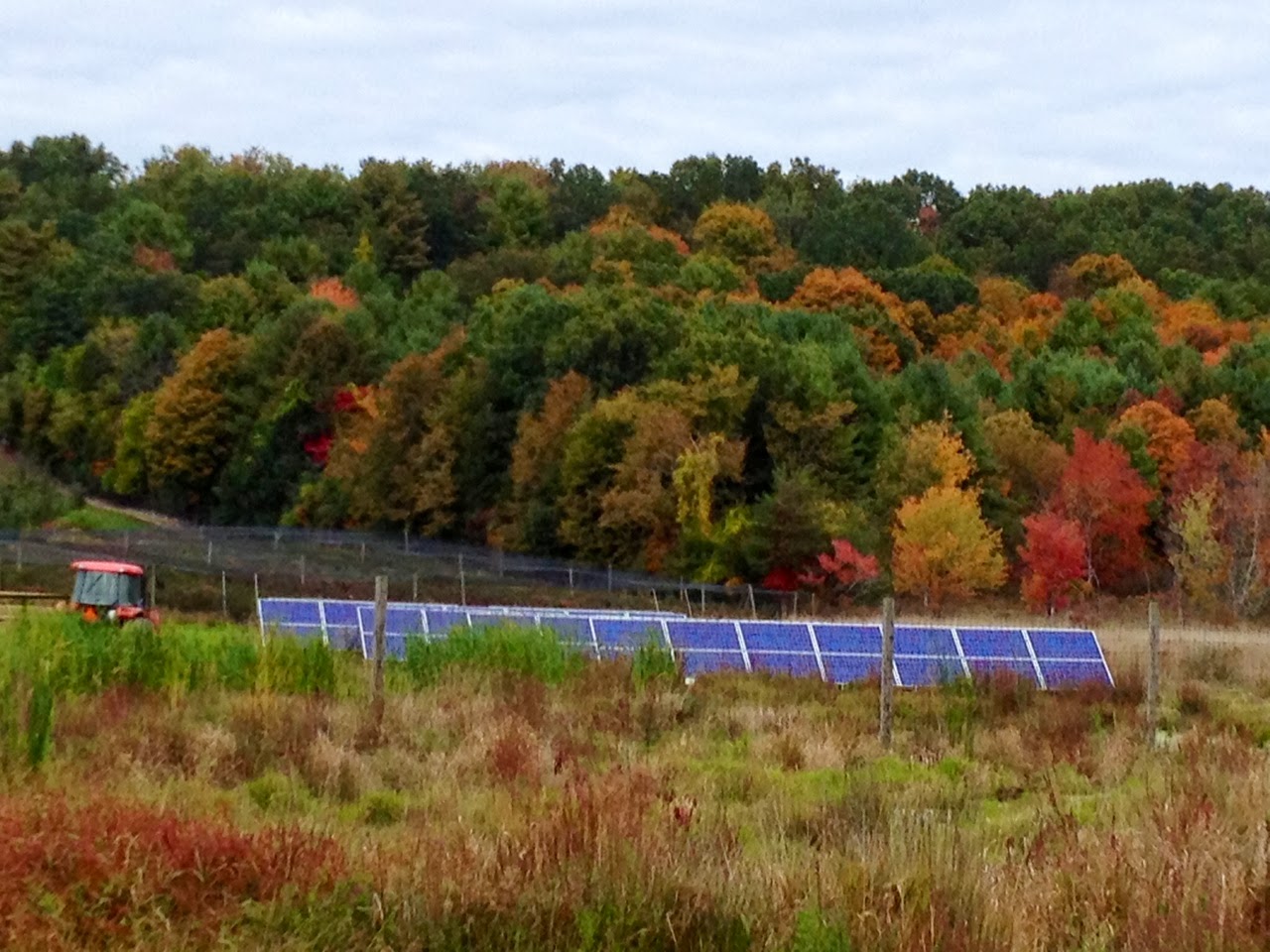 |
| Fall foliage and solar photovoltaic panels at Cider Hill Farm in Amesbury, Massachusetts. |
EIA projects a continued increase in the consumption of renewable energy in the forms of electricity and heat generation. Overall, in 2013 EIA expects 4.5% growth over 2012's renewable energy consumption, with further growth of 2.3% in 2014.
EIA also predicts shifts in the resource mix providing this renewable energy. In 2013, EIA expects a 1.5% decline in hydropower production, offset by 8.3% average growth of nonhydropower renewables used for electricity and heat generation. In particular, EIA expects 2.5% growth in wind capacity this year, reaching a total installed capacity of about 61 gigawatts from wind. This capacity is predicted to enable generation from wind to increase 19% in 2013 and another 2.4% in 2014, at which point it is expected to reach over 4% of all electricity generated in the U.S.
Solar energy is expected to grow more sharply, but will remain a relatively small segment of the nation's overall energy portfolio. EIA expects solar generation by the electric power sector to increase a staggering 79% in 2013 and 80% in 2014. In recent years, customer-sited distributed generation projects have led the charge in new capacity additions, but EIA expects utility-scale projects to more than double in total installed capacity between 2012 and 2014. Most of this new utility-scale solar capacity will continue to come from photovoltaics, but several large solar thermal generation projects may come online the next two years. Despite this relative growth, the small absolute size of the U.S. solar market means that solar energy will only account for about 0.3% of energy consumed in 2014.
When 2013 has ended, will EIA's predictions come true? We will learn in several months.
NH renewable thermal energy standard
Tuesday, June 26, 2012
New Hampshire Governor John Lynch has signed a new law expanding the Granite State's renewable portfolio standard to cover thermal energy.
Since 2007, New Hampshire has required most electricity providers to source 23.8% of their electricity from renewable resources by 2025. The state legislature recognized four classes of renewable resources, and prescribed gradual increases in each class's share of the total electricity served in the state. Class I resources cover most new renewable electricity generating facilities installed after January 1, 2006. Class II covers solar-generated electricity from facilities that began operation in 2006 or later. Class III covers existing biomass systems up to 25 megawatts, and methane gas, predating 2006. Class IV covers power produced by existing small hydroelectric facilities up to 5 MW that meet environmental protection standards.
Some of these electricity generating technologies, such as the combustion of biomass to power steam turbines, also produce significant amounts of heat. Other technologies like solar hot water, wood pellet boilers, or geothermal heat pumps may not generate electricity, but can displace the use of fossil fuels that would otherwise be used for heating. This useful thermal energy has not previously been covered by New Hampshire's renewable portfolio standard. This means that people and businesses have not been able to create renewable energy certificates (RECs) by putting this thermal energy to productive use. As a result, the efficient use of this thermal energy has not been incentivized as has the production of electricity from renewable resources.
Enacted by the New Hampshire Senate and House earlier this month, and signed by the governor yesterday, Senate Bill 218 (text available via the New Hampshire General Court website) expands New Hampshire's renewable portfolio standard to cover heat or thermal energy. As of January 1, 2013, the useful heat produced by renewable power technologies can qualify to produce RECs which can be used to satisfy the renewables requirement. While Class I thermal energy RECs have a lower price cap than Class I electrical RECs - $25 instead of $55 - the ability to produce and sell thermal RECs will enhance business opportunities to use steam or heat produced from renewable resources.
 |
| Avalanche Falls in the Flume Gorge, New Hampshire. |
Since 2007, New Hampshire has required most electricity providers to source 23.8% of their electricity from renewable resources by 2025. The state legislature recognized four classes of renewable resources, and prescribed gradual increases in each class's share of the total electricity served in the state. Class I resources cover most new renewable electricity generating facilities installed after January 1, 2006. Class II covers solar-generated electricity from facilities that began operation in 2006 or later. Class III covers existing biomass systems up to 25 megawatts, and methane gas, predating 2006. Class IV covers power produced by existing small hydroelectric facilities up to 5 MW that meet environmental protection standards.
Some of these electricity generating technologies, such as the combustion of biomass to power steam turbines, also produce significant amounts of heat. Other technologies like solar hot water, wood pellet boilers, or geothermal heat pumps may not generate electricity, but can displace the use of fossil fuels that would otherwise be used for heating. This useful thermal energy has not previously been covered by New Hampshire's renewable portfolio standard. This means that people and businesses have not been able to create renewable energy certificates (RECs) by putting this thermal energy to productive use. As a result, the efficient use of this thermal energy has not been incentivized as has the production of electricity from renewable resources.
Enacted by the New Hampshire Senate and House earlier this month, and signed by the governor yesterday, Senate Bill 218 (text available via the New Hampshire General Court website) expands New Hampshire's renewable portfolio standard to cover heat or thermal energy. As of January 1, 2013, the useful heat produced by renewable power technologies can qualify to produce RECs which can be used to satisfy the renewables requirement. While Class I thermal energy RECs have a lower price cap than Class I electrical RECs - $25 instead of $55 - the ability to produce and sell thermal RECs will enhance business opportunities to use steam or heat produced from renewable resources.
Subscribe to:
Posts (Atom)
